Introduction
Substance use and substance use disorders (SUD) are leading preventable causes of morbidity and mortality (GBD Alcohol Drug Use Collaborators, 2018; Glei & Preston, Reference Glei and Preston2020; Grant, Shmulewitz, & Compton, Reference Grant, Shmulewitz and Compton2020; Rehm & Shield, Reference Rehm and Shield2019; U. S. Burden of Disease Collaborators, 2018). SUD are associated with poorer physical, mental, social, and economic functioning (Chou et al., Reference Chou, Goldstein, Smith, Huang, Ruan, Zhang and Grant2016; Grant et al., Reference Grant, Goldstein, Saha, Chou, Jung, Zhang and Hasin2015, Reference Grant, Saha, Ruan, Goldstein, Chou, Jung and Hasin2016; O'Brien et al., Reference O'Brien, Charney, Lewis, Cornish, Post, Woody and Weisner2004), and are increasing in prevalence (Grant et al., Reference Grant, Chou, Saha, Pickering, Kerridge, Ruan and Hasin2017, Reference Grant, Shmulewitz and Compton2020; Hasin, Shmulewitz, & Sarvet, Reference Hasin, Shmulewitz and Sarvet2019; John & Wu, Reference John and Wu2017; Kerridge et al., Reference Kerridge, Chou, Pickering, Ruan, Huang, Jung and Hasin2019; Martins et al., Reference Martins, Sarvet, Santaella-Tenorio, Saha, Grant and Hasin2017; Saha et al., Reference Saha, Kerridge, Goldstein, Chou, Zhang, Jung and Grant2016). A better understanding of the elements of SUD is important to facilitate the identification of risk factors, and to develop and implement effective prevention and intervention strategies.
Substance craving, i.e. a compulsion or strong desire to use a substance, is considered by many as key to substance use and SUD development and persistence (Auriacombe, Serre, Denis, & Fatseas, Reference Auriacombe, Serre, Denis, Fatseas, Pickard and Ahmed2018; Sayette, Reference Sayette2016; Tiffany & Wray, Reference Tiffany and Wray2012). Craving is related to the likelihood of use (Serre, Fatseas, Swendsen, & Auriacombe, Reference Serre, Fatseas, Swendsen and Auriacombe2015) and may lead to impaired control over use (Sayette, Reference Sayette2016; Tiffany & Wray, Reference Tiffany and Wray2012) and recurrent SUD (American Psychiatric Association, 2013). Thus, the Diagnostic and Statistical Manual of Mental Disorders, DSM-5 (American Psychiatric Association, 2013) added a craving criterion to the SUD diagnostic criteria (Hasin et al., Reference Hasin, O'Brien, Auriacombe, Borges, Bucholz, Budney and Grant2013). Indirect support for the inclusion of the craving criterion came from neurobiological, pharmacological, genetic, and behavioral studies suggesting the centrality of craving to SUD (Hasin et al., Reference Hasin, O'Brien, Auriacombe, Borges, Bucholz, Budney and Grant2013), while direct support came from item response theory (IRT) studies showing that across substances, craving fit well with the other DSM-5 SUD criteria (Casey, Adamson, Shevlin, & McKinney, Reference Casey, Adamson, Shevlin and McKinney2012; Castaldelli-Maia et al., Reference Castaldelli-Maia, Wang, Borges, Silveira, Siu, Viana and Andrade2015; Cherpitel et al., Reference Cherpitel, Borges, Ye, Bond, Cremonte, Moskalewicz and Swiatkiewicz2010; Chung, Martin, Maisto, Cornelius, & Clark, Reference Chung, Martin, Maisto, Cornelius and Clark2012; Gilder, Gizer, Lau, & Ehlers, Reference Gilder, Gizer, Lau and Ehlers2014; Hasin, Fenton, Beseler, Park, & Wall, Reference Hasin, Fenton, Beseler, Park and Wall2012, Reference Hasin, O'Brien, Auriacombe, Borges, Bucholz, Budney and Grant2013; Kervran et al., Reference Kervran, Shmulewitz, Serre, Stohl, Denis, Hasin and Auriacombe2020; Keyes, Krueger, Grant, & Hasin, Reference Keyes, Krueger, Grant and Hasin2011; Mewton, Slade, McBride, Grove, & Teesson, Reference Mewton, Slade, McBride, Grove and Teesson2011; Saha, Chou, & Grant, Reference Saha, Chou and Grant2020; Serier, Venner, & Sarafin, Reference Serier, Venner and Sarafin2019; Shmulewitz et al., Reference Shmulewitz, Keyes, Wall, Aharonovich, Aivadyan, Greenstein and Hasin2011; Yang, Chen, Liu, & Xin, Reference Yang, Chen, Liu and Xin2019). However, evidence on the reliability and validity of the DSM-5 craving criterion as an independent construct, and whether its addition improves the SUD diagnosis overall, is also important. The DSM-5 craving criterion is highly reliable across substances (Hasin et al., Reference Hasin, Shmulewitz, Stohl, Greenstein, Roncone, Aharonovich and Wall2020), but information directly addressing the construct validity of the DSM-5 craving criterion across substances is lacking.
A standard approach to assessing validity is to determine if the DSM-5 craving criterion is associated with substance-related variables in predicted ways (Kendler, Reference Kendler1990), similar to previous validation studies of criteria for nicotine use disorder (Shmulewitz et al., Reference Shmulewitz, Wall, Aharonovich, Spivak, Weizman, Frisch and Hasin2013), alcohol use disorder (Chung & Martin, Reference Chung and Martin2002; de Bruijn, van den Brink, de Graaf, & Vollebergh, Reference de Bruijn, van den Brink, de Graaf and Vollebergh2005; Verges et al., Reference Verges, Lee, Martin, Trull, Martens, Wood and Sher2021), and cannabis withdrawal (Budney, Hughes, Moore, & Vandrey, Reference Budney, Hughes, Moore and Vandrey2004). Additionally, as an indicator of SUD, craving should be related to correlates of SUD (Keyes et al., Reference Keyes, Krueger, Grant and Hasin2011). Across substances, other assessments of craving (e.g. laboratory measures, multi-item scales) showed association with prospective and concurrent substance use and measures of problematic substance use and severity (Bohn, Krahn, & Staehler, Reference Bohn, Krahn and Staehler1995; Chakravorty et al., Reference Chakravorty, Kuna, Zaharakis, O'Brien, Kampman and Oslin2010; Fatseas, Serre, Swendsen, & Auriacombe, Reference Fatseas, Serre, Swendsen and Auriacombe2018; Heishman, Singleton, & Liguori, Reference Heishman, Singleton and Liguori2001; Murphy, Stojek, Few, Rothbaum, & Mackillop, Reference Murphy, Stojek, Few, Rothbaum and Mackillop2014; Serre et al., Reference Serre, Fatseas, Swendsen and Auriacombe2015; Sussner et al., Reference Sussner, Smelson, Rodrigues, Kline, Losonczy and Ziedonis2006), and with mental health indicators related to mood, personality, and stress disorders (Driessen et al., Reference Driessen, Schulte, Luedecke, Schaefer, Sutmann, Ohlmeier and Group2008; Fatseas et al., Reference Fatseas, Serre, Swendsen and Auriacombe2018; Franken, Reference Franken2002; Joos et al., Reference Joos, Goudriaan, Schmaal, De Witte, Van den Brink, Sabbe and Dom2013; Sussner et al., Reference Sussner, Smelson, Rodrigues, Kline, Losonczy and Ziedonis2006; Wolitzky-Taylor & Schiffman, Reference Wolitzky-Taylor and Schiffman2019), which are also related to SUD (Chou et al., Reference Chou, Goldstein, Smith, Huang, Ruan, Zhang and Grant2016; Grant et al., Reference Grant, Goldstein, Saha, Chou, Jung, Zhang and Hasin2015, Reference Grant, Saha, Ruan, Goldstein, Chou, Jung and Hasin2016). However, these studies did not operationalize craving as a binary criterion as in the DSM-5; thus, studies on association of the DSM-5 craving criterion with measures of substance use/disorder and mental health (validators) across substances are lacking. Evidence for such associations would support the validity of the craving criterion.
Additionally, the DSM-5 text defines craving as “an intense desire or urge” for the substance, which could be assessed “by … such strong urges to take the drug that they could not think of anything else” (American Psychiatric Association, 2013). While this operationalization indicates severe craving (Keyes et al., Reference Keyes, Krueger, Grant and Hasin2011), more moderate craving, indicated by a strong desire or urge to use, may also be diagnostically important (Chung et al., Reference Chung, Martin, Maisto, Cornelius and Clark2012; Hasin et al., Reference Hasin, Fenton, Beseler, Park and Wall2012). Alternatively, moderate craving may be an overly inclusive construct without a clear relationship to SUD. DSM-5 studies have assessed the craving criterion inconsistently (e.g. Casey et al., Reference Casey, Adamson, Shevlin and McKinney2012; Cherpitel et al., Reference Cherpitel, Borges, Ye, Bond, Cremonte, Moskalewicz and Swiatkiewicz2010; Chung et al., Reference Chung, Martin, Maisto, Cornelius and Clark2012; Gilder et al., Reference Gilder, Gizer, Lau and Ehlers2014; Hasin et al., Reference Hasin, Fenton, Beseler, Park and Wall2012; Keyes et al., Reference Keyes, Krueger, Grant and Hasin2011; Mewton et al., Reference Mewton, Slade, McBride, Grove and Teesson2011; Saha et al., Reference Saha, Chou and Grant2020; Shmulewitz et al., Reference Shmulewitz, Keyes, Wall, Aharonovich, Aivadyan, Greenstein and Hasin2011), indicating lack of consensus on the operationalization of craving. Validity information on the different constructs (severe, moderate) is lacking. Providing such information may impact future versions of the DSM-5 text and diagnostic studies.
Furthermore, no studies show that adding craving as a criterion improves the overall validity of the DSM-5 SUD diagnosis (Hasin et al., Reference Hasin, Shmulewitz, Stohl, Greenstein, Roncone, Aharonovich and Wall2020), as advocated by the DSM-5 Scientific Review Committee to justify adding a new criterion (Kendler, Reference Kendler2013). Whether the validators show greater association with DSM-5 SUD diagnosed with the craving criterion than without it remains untested.
Given this lack of information, we used data from patients in substance use treatment and community participants with problematic substance use (Gorfinkel et al., Reference Gorfinkel, Stohl, Greenstein, Aharonovich, Olfson and Hasin2021; Hasin et al., Reference Hasin, Shmulewitz, Stohl, Greenstein, Roncone, Aharonovich and Wall2020; Livne, Stohl, Shmulewitz, Mannes, & Hasin, Reference Livne, Stohl, Shmulewitz, Mannes and Hasin2020) to investigate the validity of DSM-5 craving, and whether the validity of DSM-5 SUD diagnosis increased with the addition of craving across substances: alcohol, tobacco, non-medical cannabis, cocaine, heroin, and non-prescription use of prescription opioids. We addressed the following questions. Is each substance-specific craving criterion associated with a set of concurrent validators related to substance use and mental health? Is association with concurrent validators stronger for the severe craving construct than the moderate construct? Is each craving criterion/construct associated with prospective substance use, and does the association differ by construct? Finally, for each substance, does the association of the validators and SUD diagnosis with or without the craving criterion differ? The last evaluated whether adding craving improved the validity of the overall DSM-5 SUD diagnosis.
Methods
Participants and procedures
As described elsewhere (Gorfinkel et al., Reference Gorfinkel, Stohl, Greenstein, Aharonovich, Olfson and Hasin2021; Hasin et al., Reference Hasin, Shmulewitz, Stohl, Greenstein, Roncone, Aharonovich and Wall2020; Livne et al., Reference Livne, Stohl, Shmulewitz, Mannes and Hasin2020), study participants constituted a convenience sample of adults (⩾18 years old; N = 588) recruited from two settings: a clinical research setting in an urban medical center (n = 438) and a suburban inpatient addiction treatment program (n = 150). Potential participants were informed about the study through advertisements (medical center) or hospital staff (inpatient addiction treatment). To be eligible for study participation, all participants were required to screen positive for potentially problematic substance use: binge drinking or illicit drug use (e.g. non-medical use of cannabis, cocaine, heroin, prescription opioids) in the prior 30 days or 30 days prior to inpatient admission, and endorsement of at least 1 DSM-5 SUD criterion. Exclusion criteria included: non-English speaking; currently homicidal, suicidal, or psychotic; plans to leave the area (since the study included 3- and 6-month follow-up interviews); and significant cognitive, hearing, or visual impairment precluding ability to participate. Participants gave written informed consent after study procedures were explained by study coordinators. Procedures were approved by the Institutional Review Boards of South Oaks Hospital and the New York State Psychiatric Institute. At baseline, trained interviewers administered the Psychiatric Research Interview for Substance and Mental Disorders, DSM-5 version (Hasin et al., Reference Hasin, Shmulewitz, Stohl, Greenstein, Roncone, Aharonovich and Wall2020) (PRISM-5), participants completed a computerized self-administered questionnaire (SAQ), and were compensated $50 for their time. As described in detail elsewhere (Hasin et al., Reference Hasin, Shmulewitz, Stohl, Greenstein, Roncone, Aharonovich and Wall2020), interviewers had graduate degrees and clinical experience, and underwent rigorous PRISM-5 training, including workshops, practice interviewing, role-playing, certification, and supervision. Supervisors maintained quality assurance by listening to recordings of 10% of the interviews to ensure that standardized interviewing practices were maintained and to identify any interviewing problems, meeting with interviewers to discuss issues that arose. For 90 days after the baseline interview, participants were asked to call or text into a daily electronic data assessment (EDA) of substance use and were compensated $1 for each day of EDA participation, with bonuses for full completion of up to $50 (Gorfinkel et al., Reference Gorfinkel, Stohl, Greenstein, Aharonovich, Olfson and Hasin2021).
Measures
PRISM-5 interview
The PRISM-5 is a semi-structured, computer-assisted interview designed for clinician interviewers, which assesses sociodemographic background information and DSM-5 symptoms and criteria of substance use and other psychiatric disorders (Hasin et al., Reference Hasin, Shmulewitz, Stohl, Greenstein, Roncone, Aharonovich and Wall2020). The PRISM-5 and previous versions show good reliability and validity in assessing psychiatric disorders among adults reporting substance use (Hasin et al., Reference Hasin, Samet, Nunes, Meydan, Matseoane and Waxman2006, Reference Hasin, Shmulewitz, Stohl, Greenstein, Roncone, Aharonovich and Wall2020, Reference Hasin, Trautman and Endicott1998, Reference Hasin, Trautman, Miele, Samet, Smith and Endicott1996; Torrens, Serrano, Astals, Perez-Dominguez, & Martin-Santos, Reference Torrens, Serrano, Astals, Perez-Dominguez and Martin-Santos2004) and the general population studies (Hasin et al., Reference Hasin, Greenstein, Aivadyan, Stohl, Aharonovich, Saha and Grant2015a, Reference Hasin, Shmulewitz, Stohl, Greenstein, Aivadyan, Morita and Grant2015b).
DSM-5 substance-related variables
Substances included in this study were alcohol, tobacco, cocaine, heroin, non-medical cannabis and non-medical opioid painkillers (opioids). These were selected due to their high prevalence of use in the US general population (Substance Abuse and Mental Health Services Administration, 2019). The substance disorder section starts with questions about non-medical use (without a prescription or other than prescribed) of each substance. For any substance used non-medically at least six times within a 12-month period, SUD criteria were assessed, and the following measures were created: The craving criterion was considered positive for participants who “wanted to use so badly they couldn't think of anything else” (severe craving) or “felt a very strong desire or urge to use” (moderate craving) during the past 12 months, similar to measures used in previous studies (Hasin et al., Reference Hasin, Fenton, Beseler, Park and Wall2012; Keyes et al., Reference Keyes, Krueger, Grant and Hasin2011; Muthen, Hasin, & Wisnicki, Reference Muthen, Hasin and Wisnicki1993; Saha et al., Reference Saha, Chou and Grant2020). The craving criterion and constructs (severe, moderate) were outcomes for concurrent (baseline) validation and predictors for prospective validation using EDA data. Current DSM-5 SUD was positive if participants endorsed ⩾2 of 11 criteria in the past 12 months, while modified SUD (excluding craving) was positive with ⩾2 of 10 criteria. Modified SUD severity was based on a number of criteria endorsed: 0 = no disorder (0–1 criteria); 1 = mild (2–3 criteria); 2 = moderate (4–5 criteria); and 3 = severe (6–10 criteria). A modified dimensional variable indicated the number of criteria endorsed, not counting craving, and ranged from 0 to 10. These modified SUD variables were used as concurrent validators (predictors) of the craving criterion and constructs. Additionally, DSM-5 SUD and modified SUD were used in differential association analysis as outcomes for concurrent validators and predictors for prospective validation. In sensitivity analysis, past-year substance use for the six substances included and sedatives, stimulants, hallucinogens, and other illicit drugs were used as control variables.
DSM-5 mental health concurrent validators
In separate modules, four DSM-5 psychiatric disorders were assessed for their occurrence in the past 12 months, as described elsewhere (Mannes, Shmulewitz, Livne, Stohl, & Hasin, Reference Mannes, Shmulewitz, Livne, Stohl and Hasin2020)): major depressive disorder (MDD), post-traumatic stress disorder (PTSD), borderline personality disorder (BPD), and antisocial personality disorder (ASPD).
Self-administered questionnaire (SAQ)
Participants responded to the SAQ in computerized form, either on-site using a tablet or accessed online via a web link. The SAQ included widely used, reliable, and valid self-report measures related to substance use, mental health, and functioning. Modules and measures relevant to this study are listed below.
Substance use severity (concurrent validators)
The Addiction Severity Index (ASI) is a standardized instrument used to assess substance-related problems (Butler et al., Reference Butler, Budman, Goldman, Newman, Beckley, Trottier and Cacciola2001; McLellan et al., Reference McLellan, Kushner, Metzger, Peters, Smith, Grissom and Argeriou1992b; Rosen, Henson, Finney, & Moos, Reference Rosen, Henson, Finney and Moos2000). For alcohol, cannabis, cocaine, heroin, and opioids, severity was indicated with two ASI variables: (1) a count variable indicating the number of days used substance in the past month, and a binary variable indicating whether participants had ever considered use a major problem. For tobacco, the National Cancer Institute Tobacco Use Supplement to the Current Population Survey was used to assess the number of days used tobacco in the past month (Chahine, Subramanian, & Levy, Reference Chahine, Subramanian and Levy2011; Soulakova, Hartman, Liu, Willis, & Augustine, Reference Soulakova, Hartman, Liu, Willis and Augustine2012; Trinidad, Perez-Stable, White, Emery, & Messer, Reference Trinidad, Perez-Stable, White, Emery and Messer2011).
Additional craving measures (concurrent validators)
From the NIH PhenX Toolkit (Hamilton et al., Reference Hamilton, Strader, Pratt, Maiese, Hendershot, Kwok and Haines2011; PhenX, 2013), which includes measures recommended by expert panels, we used a high-quality, multi-item scale of craving for each substance. In these scales, the craving was assessed using a series of statements about the participant's current thoughts and feelings on using the substance, with responses forming a seven-item Likert scale ranging from “strongly disagree” to “strongly agree”. Alcohol craving was assessed with the Alcohol Urge Questionnaire; scale scores were derived as the mean response to eight statements and ranged from 1 to 7 (Bohn et al., Reference Bohn, Krahn and Staehler1995). The alcohol craving scale was assessed among those who either used alcohol in the past month or used alcohol regularly (three or more times a week) for at least a year; thus, 31 individuals without such use were excluded from this analysis (N = 557). Cigarette craving was assessed with the Brief Questionnaire of Smoking Urges; scale scores were derived as the sum of responses to 10 statements and ranged from 10 to 70 (Cox, Tiffany, & Christen, Reference Cox, Tiffany and Christen2001; Tiffany & Drobes, Reference Tiffany and Drobes1991). Cannabis craving was assessed with the Marijuana Craving Questionnaire – Short Form, which includes 12 statements that formed four sub-scales, each scored as the mean response from three statements. Total scale scores consisted of the sum of the four sub-scale scores and ranged from 4 to 28 (Heishman et al., Reference Heishman, Evans, Singleton, Levin, Copersino and Gorelick2009, Reference Heishman, Singleton and Liguori2001). Cocaine craving was assessed with the Cocaine Craving Questionnaire-Brief; scale scores were derived as the mean response to 10 statements and ranged from 1 to 7 (Sussner et al., Reference Sussner, Smelson, Rodrigues, Kline, Losonczy and Ziedonis2006; Tiffany, Singleton, Haertzen, & Henningfield, Reference Tiffany, Singleton, Haertzen and Henningfield1993). Heroin craving was assessed with the Heroin Craving Questionnaire – Short Form; scale scores were derived as the mean response to 14 statements and ranged from 1 to 7 (Heinz et al., Reference Heinz, Epstein, Schroeder, Singleton, Heishman and Preston2006). For all substances, higher scores indicated greater craving. Those who never used the substance (alcohol, n = 13; tobacco, n = 135; cannabis, n = 68; cocaine, n = 133; heroin, n = 357) were coded as the lowest value.
Alternate measures of problematic substance use (concurrent validators)
Alcohol. The Alcohol Use Disorders Identification Test (AUDIT) (Allen, Litten, Fertig, & Babor, Reference Allen, Litten, Fertig and Babor1997; Daeppen, Yersin, Landry, Pecoud, & Decrey, Reference Daeppen, Yersin, Landry, Pecoud and Decrey2000; de Meneses-Gaya, Zuardi, Loureiro, & Crippa, Reference de Meneses-Gaya, Zuardi, Loureiro and Crippa2009; Higgins-Biddle & Babor, Reference Higgins-Biddle and Babor2018; Saunders, Aasland, Babor, de la Fuente, & Grant, Reference Saunders, Aasland, Babor, de la Fuente and Grant1993) is a 10-item screening tool that assesses drinking over the past year: the usual number of drinks, frequency of seven indications of harmful drinking (never; less than monthly; monthly; weekly; and daily/almost daily), alcohol-associated injuries, and familial/peer concern related to alcohol use (Babor, Higgins-Biddle, Saunders, & Monteiro, Reference Babor, Higgins-Biddle, Saunders and Monteiro2001). Items were summed to yield a total score of 0–40, with scores 8 or above indicating harmful alcohol use.
Tobacco. The Fagerström Test for Nicotine Dependence (FTND) (Heatherton, Kozlowski, Frecker, & Fagerstrom, Reference Heatherton, Kozlowski, Frecker and Fagerström1991) assessed past month cigarette dependence, based on a number of cigarettes smoked and five items related to wanting to use (NIDA CTN Common Data Elements, 2014b). The items were summed to yield a total score of 0–10, with standard categorization [1 = very low dependence (score: 0–2); 2 = low dependence (score: 3, 4); 3 = medium dependence (score: 5); 4 = high dependence (score: 6, 7); 5 = very high dependence (score: 8–10)].
Drugs. The Drug Abuse Screening Test – version 10 (DAST-10) (Skinner, Reference Skinner1982; Yudko, Lozhkina, & Fouts, Reference Yudko, Lozhkina and Fouts2007) assesses the degree of consequences related to any drug abuse during the past 12 months with 10 items, summed to yield a score of 0–10, with standard categorization [0 = no problems (score: 0); 1 = low problems (score: 1, 2); 2 = moderate problems (score: 3–5); 3 = substantial problems (score: 6–8); 4 = severe problems (score: 9, 10)] (NIDA CTN Common Data Elements, 2014a). The DAST-10 was used as a validator for cannabis, cocaine, heroin, and opioid craving.
Alternate measure of depression (concurrent validator)
The Patient Health Questionnaire (PHQ-9) (Delgadillo et al., Reference Delgadillo, Payne, Gilbody, Godfrey, Gore, Jessop and Dale2011; Kroenke, Spitzer, & Williams, Reference Kroenke, Spitzer and Williams2001; Lowe, Kroenke, Herzog, & Grafe, Reference Lowe, Kroenke, Herzog and Grafe2004) assessed self-reported depressive symptoms over the prior 2 weeks using nine items, with responses ranging from 0 “not at all” to 3 “nearly every day”. Items were summed to yield a total score of 0–27, with standard categorization [1 = Minimal or no problems (score: 0–4); 2 = Mild problems (score: 5–9); 3 = Moderate problems (score: 10–14); 4 = Moderately Severe problems (score: 15–19); 5 = Severe problems (score: 20–27)] (Kroenke et al., Reference Kroenke, Spitzer and Williams2001).
Electronic data assessment (EDA)
In all, 586 participants responded to a brief daily self-administered survey by telephone interactive voice response or text messaging, with binary questions assessing daily substance use, e.g. did you [drink alcohol/use a specific substance] yesterday. Daily assessments were used to avoid recall problems with retrospective follow-up assessments. Similar methods were validated and used in prior research (Aharonovich, Stohl, Cannizzaro, & Hasin, Reference Aharonovich, Stohl, Cannizzaro and Hasin2017; Corkrey & Parkinson, Reference Corkrey and Parkinson2002; Perrine, Mundt, Searles, & Lester, Reference Perrine, Mundt, Searles and Lester1995). The repeated measures of substance use each day for the 90 days after the baseline interview were outcomes for prospective validity. For descriptive purposes, a variable measuring the percent of days used the substance over the 90-day period was constructed as 100*([number of days used]/[total number of days responded]).
Sociodemographic and clinical covariates
Sociodemographic control variables included age, sex (male; female), education (no college; at least some college), race/ethnicity (Hispanic; non-Hispanic White; Black; Other), participant type (inpatient; community sample), and baseline treatment for alcohol/drug use (yes; no) as queried in the SAQ using questions from the Treatment Services Review (McLellan, Alterman, Cacciola, Metzger, & O'Brien, Reference McLellan, Alterman, Cacciola, Metzger and O'Brien1992a).
Statistical analysis
Analyses were carried out using SAS 9.4 software (SAS Institute Inc, 2014). Descriptive statistics were calculated for covariates, craving constructs and criteria, and validators.
Concurrent validity
For each substance, logistic regression was used to estimate the association of each concurrent validator (predictor) with the craving criterion (outcome), adjusting for sociodemographic characteristics (age, sex, education, race/ethnicity) and participant type (patient/community). Association was reported as adjusted odds ratios (OR), as is appropriate in this non-representative sample that was enriched for the outcome (DSM-5 SUD) (Bovbjerg, Reference Bovbjerg2020). For each substance and each validator, to determine if either of the craving constructs showed greater validity, i.e. stronger association with the validators, bivariate correlated-outcome logistic regressions modeled the two constructs (outcomes) simultaneously, adjusting for sociodemographics, using generalized estimating equations to account for within-participant correlation (Fitzmaurice, Laird, Zahner, & Daskalakis, Reference Fitzmaurice, Laird, Zahner and Daskalakis1995). Modeling both constructs together allows direct comparison of the strength of their associations with the predictors. Similar models were used to determine if SUD diagnosed with or without craving showed greater validity, modeling the two alternate SUD diagnoses as the correlated outcomes.
Prospective validity
For each substance, logistic regression, using generalized linear mixed models (GLMM) with random slopes and intercepts to model within-subject correlations and correlations over time, was used to estimate the association of the baseline craving criterion/constructs (predictors) with the repeated measure of substance use on each of the 90 days after the baseline interview. Models were adjusted for sociodemographic characteristics, participant type, and baseline treatment. The results were reported as OR from the fixed effect of baseline craving, and represent the odds of use on any given day among those with v. without craving, holding the random effects constant. To determine if either of the craving constructs showed a greater association with the outcome (i.e. greater validity), for each substance, 100 bootstrapped samples (DiCiccio & Efron, Reference DiCiccio and Efron1996; Efron & Tibshirani, Reference Efron and Tibshirani1986) were generated. Within each bootstrapped sample, the regression model was run separately for each predictor (e.g. severe then moderate) and the difference in the regression coefficients for the predictors was calculated. Across all samples, the mean difference and 95% empirical confidence intervals (CI) were calculated. Validity was considered significantly different if the 95% CI was above 0.0. To determine if SUD diagnosed with or without craving showed greater validity, similar analyses were conducted, modeling the two SUD diagnoses as the predictors.
Sensitivity analysis
First, for concurrent validators that were not substance-specific, to determine that the association with a specific substance craving criterion was not driven by the use of a different substance, association models were re-run adjusting for other past-year substance use. Second, for prospective analyses, since participants were less likely to use substances while they were inpatients, analyses were re-run excluding all inpatient days.
Results
Sample descriptives
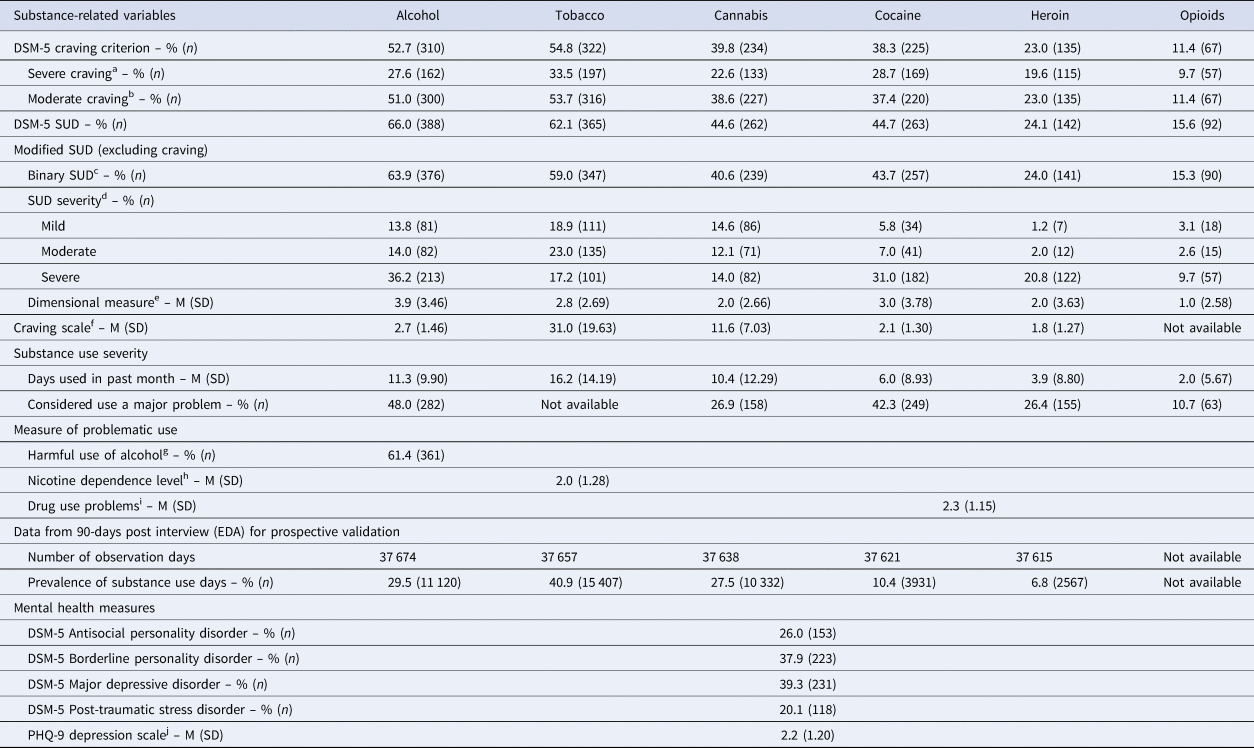
Participants' sociodemographic characteristics are reported in detail elsewhere (Livne et al., Reference Livne, Stohl, Shmulewitz, Mannes and Hasin2020) and summarized here: 69.7% male; 47.8% Black, 19.1% Hispanic, and 27.6% White; 54.8% less than college education; 75.5% community sample; 46.4% with any alcohol/drug use treatment; and mean age was 43.7 years. Prevalence of the craving criteria, constructs, and validators are shown in Table 1. Prevalence of craving for each substance: alcohol, 52.7%; tobacco, 54.8%; cannabis, 39.8%; cocaine, 38.3%; heroin, 23.0%; and prescription opioids, 11.4%. Greater prevalence was observed for moderate craving than severe. The prevalence of DSM-5 SUD ranged from 66.0% (alcohol) to 15.6% (opioids), with slightly lower prevalence for modified SUD [without craving; range: 63.9 (alcohol) to 15.3% (opioids)], and the prevalence of psychiatric disorders ranged from 20.1% (PTSD) to 39.3% (MDD). In the EDA data, the mean completion rate (number of days responded out of the total possible 90 days) was 71% (s.d. = 31.6%), and the median completion rate was 86% (interquartile range = 47.8%).
Prevalence and means of DSM-5 SUD, substance-related and mental health validators, and craving (N = 588)

M, mean; SD, standard deviation; EDA, electronic data assessment; PHQ-9, Patient Health Questionnaire version 9.
a Based on ‘Have you ever wanted [a drink/to use substance] so badly that you couldn't think of anything else?’.
b Based on ‘Have you ever felt a very strong desire or urge to [drink/use]?’.
c 2 + (of 10) criteria endorsed.
d Mild = 2 or 3 criteria; moderate = 4 or 5 criteria; severe = 6-10 criteria.
e Count variable indicating a total number of criteria endorsed (range 0–10).
f Ccount variable with higher values indicating greater current craving. Only lifetime users screened into the craving section; non-users were assigned the lowest values for the craving scale. For alcohol, respondents also needed past month use or regular use over the past year to screen in; those without such use (n = 31) were excluded from the analysis.
g Based on a score of 8 or more on the Alcohol Use Disorders Identification Test.
h Based on the Fagerstrom Test of Nicotine Dependence; count variable, 1 = very low dependence to 5 = very high dependence.
i Based on the Drug Abuse Screening Test; the count variable, 0 = no problems to 4 = severe problems.
j Count variable, 1 = no problems to 5 = severe problems.
Concurrent validity of craving
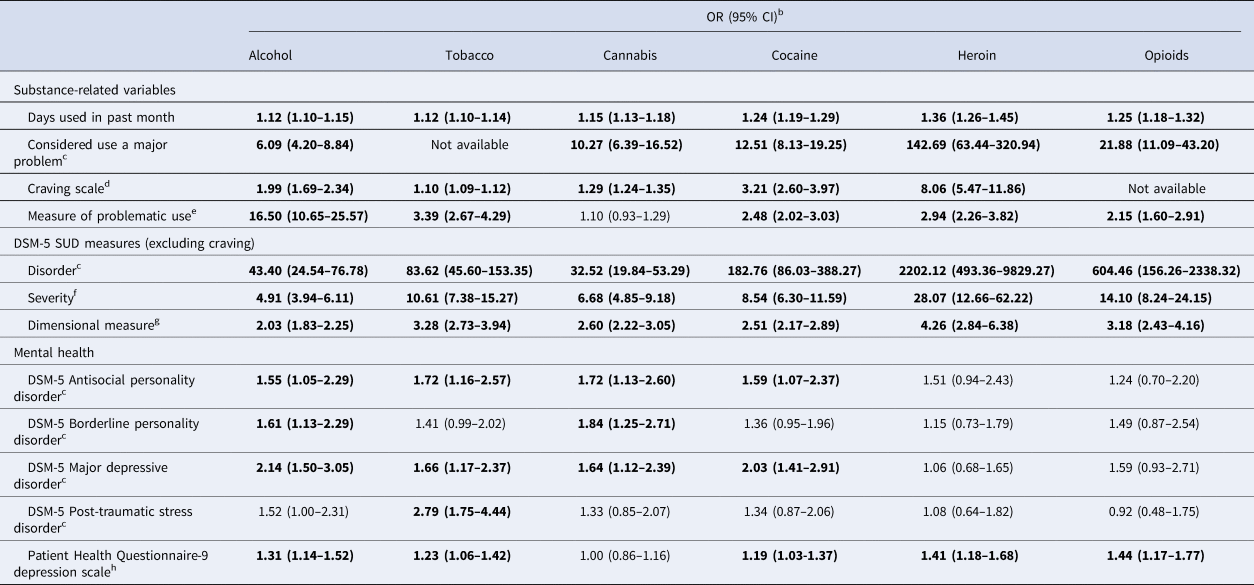
For each substance, the craving criterion was significantly associated with all substance-related validators: [days used in last month (ORs 1.1–1.4); considered use a major problem (ORs 6.1–142.7); craving scale (ORs 1.1–8.1); an alternate measure of problematic use (ORs 2.2–16.5) and modified DSM-5 SUD measures], except that cannabis craving was not significantly associated with the DAST-10 (Table 2), which is not substance-specific. Most mental health variables were significantly associated with craving for alcohol, tobacco, cannabis, and cocaine, and PHQ-9 depression was significantly associated with craving for heroin and opioids (Table 2). In sensitivity analysis, after adjusting for past-year use of other substances, some associations with mental health variables lost significance, e.g. an association of ASPD with a craving for alcohol, cannabis, and cocaine (Supplementary Table S1), suggesting that these relationships were driven in part by poly-substance use.
Association of concurrent (baseline) validators with DSM-5 craving criteriona (N = 588)

Bold indicates significance at the p < 0.05 level.
a Based on endorsing ‘Have you ever wanted [a drink/to use substance] so badly that you couldn't think of anything else?’ or ‘Have you ever felt a very strong desire or urge to [drink/use substance]?’.
b Estimated from logistic regression analysis of validator predicting craving criterion, adjusted for gender, age, race/ethnicity, education level, and participant type.
c Reference group is No.
d Count scale with higher values indicating greater current craving. Only lifetime users screened into the craving section; non-users were assigned the lowest values for the craving scale. For alcohol, respondents also needed past month use or regular use over the past year to screen in; those without such use (n = 31) were excluded from the analysis.
e Alcohol Use Disorders Identification Test (binary) for alcohol; Fagerstrom Test of Nicotine Dependence (count variable, 1 = very low dependence to 5 = very high dependence) for tobacco; and Drug Abuse Screening Test-10 (count variable, 0 = no problems to 4 = severe problems) for cannabis, cocaine, heroin, and opioids.
f Count variable: 0 = no disorder (0, 1 criteria); 1 = mild (2, 3 criteria); 2 = moderate (4, 5 criteria); 3 = severe (6−10 criteria).
g Count variable indicating total number of DSM-5 criteria endorsed (range 0-10).
h Count variable, 1 = no problems to 5 = severe problems.
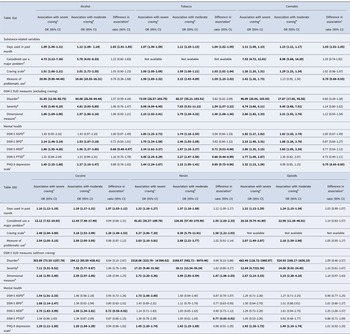
For each substance, both craving constructs (severe, moderate) showed patterns of association similar to those observed for the craving criterion, with significant associations with all substance-related validators and some mental health validators (Table 3). Although neither construct consistently showed greater association across all substances for all validators, some differential association was observed for most substances: a number of days used in the past month showed a greater association with moderate craving, while depression showed a greater association with severe craving (Table 3).
Differential association of concurrent validators with DSM-5 craving constructs (N = 588)

OR, odds ratio; CI, confidence interval; ASPD, Antisocial personality disorder; BPD, Borderline personality disorder; MDD, Major depressive disorder; PTSD, Post-traumatic stress disorder; PHQ-9, Patient Health Questionnaire version 9.
All logistic regression models are adjusted for gender, age, race/ethnicity, education level, and participant type. Bold indicates significance at the p < 0.05 level.
a Based on ‘Have you ever wanted [a drink/to use substance] so badly that you couldn't think of anything else?’.
b Based on ‘Have you ever felt a very strong desire or urge to [drink/use substance]?’.
c Difference in an association is indicated by the ratio of OR (exponentiated coefficient for the interaction term): OR for strong desire /OR for compulsion.
d Reference group is No.
e Count scale with higher values indicating greater current craving. Only lifetime users screened into the craving section; non-users were assigned the lowest values for the craving scale. For alcohol, respondents also needed past month use or regular use over the past year to screen in; those without such use (n = 31) were excluded from the analysis.
f Alcohol Use Disorders Identification Test (binary) for alcohol; Fagerstrom Test of Nicotine Dependence (count variable, 1 = very low dependence to 5 = very high dependence) for tobacco; and Drug Abuse Screening Test-10 (count variable, 0 = no problems to 4 = severe problems) for cannabis, cocaine, heroin, and opioids.
g Count variable: 0 = no disorder (0, 1 criteria); 1 = mild (2, 3 criteria); 2 = moderate (4, 5 criteria); 3 = severe (6-10 criteria).
h Count variable indicating a total number of DSM-5 criteria endorsed (range 0-10).
i Count variable, 1 = no problems to 5 = severe problems.
Prospective validity of craving
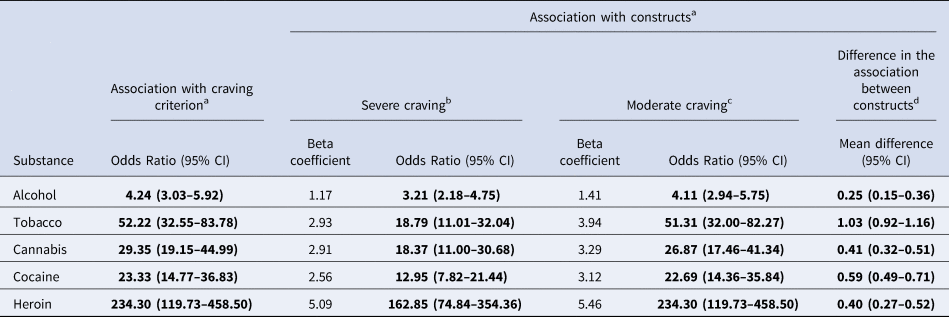
Descriptively, on average, for each substance, those with the baseline craving criterion for that substance had a higher percent of days used over the 90-days than those without baseline craving (Supplementary Table S2). Additionally, the baseline craving criterion significantly predicted the odds of substance use on any given day over the next 90 days (Table 4; ORs 4.2–234.3). Similarly, substance use was significantly predicted by each construct [severe (ORs 3.2–162.9); moderate (ORs 4.1–234.3)], with a significantly stronger association with moderate craving (p's<0.05). In sensitivity analysis, excluding inpatient days, slight variations in numbers from the models did not affect overall results (Supplementary Table S3).
Baseline DSM-5 craving predicting use on any given day of the 90 day post-interview period (N = 586)

All GLMM include random slope and intercept. Bold indicates significance at the p < 0.05 level. CI = confidence interval.
a Model adjusted for gender, age, race/ethnicity, education level, site, and treatment at baseline.
b Based on ‘Have you ever wanted [a drink/to use substance] so badly that you couldn't think of anything else?’.
c Based on ‘Have you ever felt a very strong desire or urge to [drink/use substance]?’.
d Difference is calculated by estimating the regression coefficient (Beta) for association with each construct in each of 100 bootstrapped samples, subtracting beta for a compulsion to use from strong desire, and generating empirical 95% confidence intervals for the difference. Differences with 95% CI that are above 0 are considered significant at the p < 0.05 level.
Differential validity of the overall SUD diagnosis with and without craving
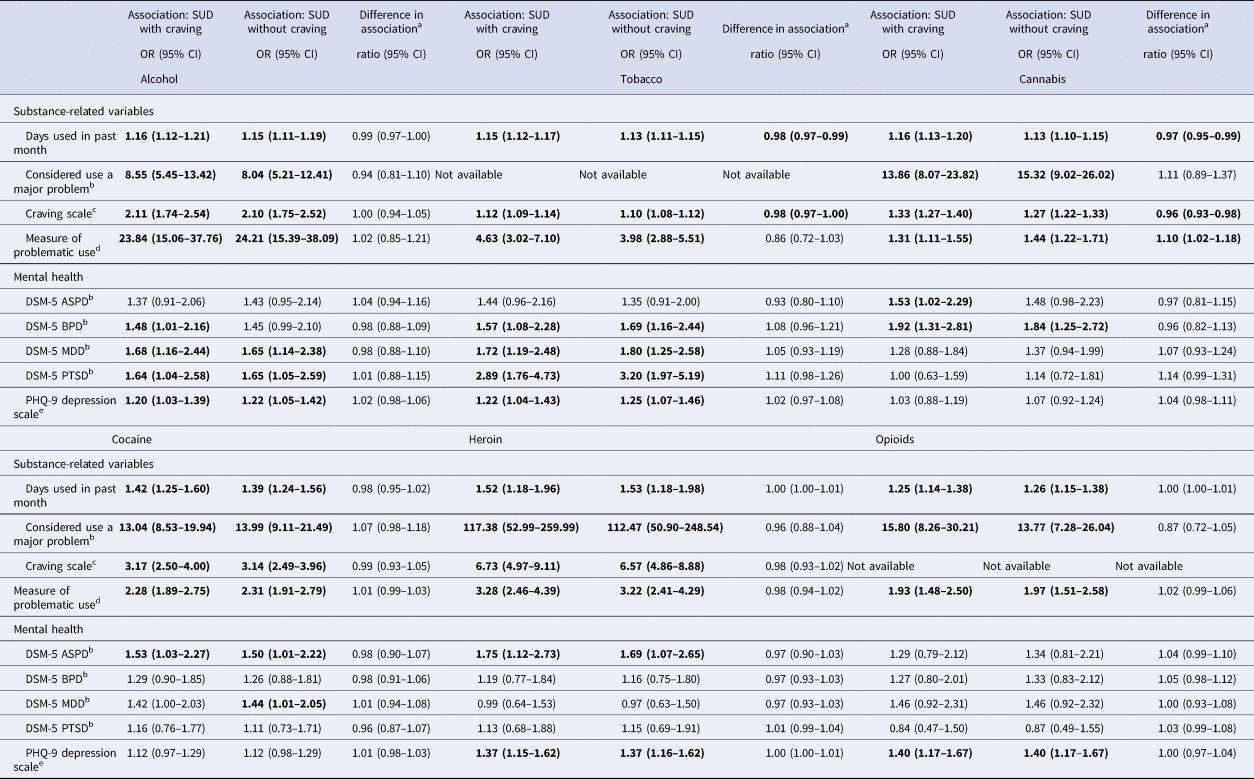
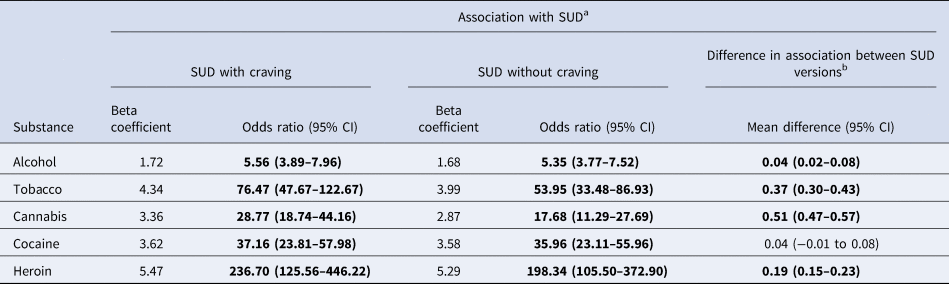
For each substance, both versions of SUD were generally associated with the same concurrent validators, with few significant differences in association strength (Table 5). In prospective data, while both SUD versions significantly predicted substance use, associations were significantly stronger for SUD with than without craving for alcohol, tobacco, cannabis, and heroin (Table 6). Results were virtually the same when inpatient days were excluded (Supplementary Table S4).
Differential association of validators with DSM-5 SUD, with and without craving

OR, odds ratio; CI, confidence interval; ASPD, Antisocial personality disorder; BPD, Borderline personality disorder; MDD, Major depressive disorder; PTSD, Post-traumatic stress disorder; PHQ-9, Patient Health Questionnaire version 9.
All logistic regression models are adjusted for gender, age, race/ethnicity, education level, and participant type. Bold indicates significance at the p < 0.05 level.
a Difference in association is indicated by the ratio of OR (exponentiated coefficient for the interaction term): OR for SUD with craving /OR for SUD without craving.
b Reference group is No.
c Count scale with higher values indicating greater current craving. Only lifetime users screened into the craving section; non-users were assigned the lowest values for the craving scale. For alcohol, respondents also needed past month use or regular use over the past year to screen in; those without such use (n = 31) were excluded from the analysis.
d Alcohol Use Disorders Identification Test (binary) for alcohol; Fagerstrom Test of Nicotine Dependence (count variable, 1 = very low dependence to 5 = very high dependence) for tobacco; and Drug Abuse Screening Test-10 (count variable, 0 = no problems to 4 = severe problems) for cannabis, cocaine, heroin, and opioids.
e Count variable, 1 = no problems to 5 = severe problems.
Baseline DSM-5 SUD predicting use on any given day of the 90 day post-interview period (N = 586)

All GLMM include random slope and intercept. Bold indicates significance at the p < 0.05 level. CI = confidence interval.
a Model adjusted for gender, age, race/ethnicity, education level, site, and treatment at baseline.
b Difference is calculated by estimating the regression coefficient (Beta) for association with each version of SUD in each of 100 bootstrapped samples, subtracting beta for SUD without craving from SUD with craving, and generating empirical 95% CIs for the difference. Differences with 95% CI that are above 0 are considered significant at the p < 0.05 level.
Discussion
In 588 adults with problematic substance use evaluated at baseline and followed with daily substance use assessments for 90 days, the validity of the DSM-5 craving criterion and DSM-5 SUD diagnoses with and without the craving criterion was examined. Craving for alcohol, tobacco, cannabis, cocaine, heroin, and opioids showed concurrent and prospective validity across an array of substance-related and mental health validators through significant associations with the validators. Both the severe and moderate craving constructs showed validity, with no consistent pattern favoring either one across the baseline concurrent validators. However, prospective validity was stronger for moderate than severe craving. While SUD diagnoses with or without craving in the criterion set were associated with the validators, prospective validity was generally stronger for SUD diagnoses when the SUD diagnosis included the craving criterion. Thus, evidence supports the inclusion of the craving criterion in the DSM-5 SUD diagnostic set.
The substance-related validators (number of days used, alternate craving measure, problematic use, modified SUD measures) were associated with the craving criterion, confirming many prior studies showing relationships between substance use/problematic use and other measures of craving (Auriacombe et al., Reference Auriacombe, Serre, Denis, Fatseas, Pickard and Ahmed2018; Bohn et al., Reference Bohn, Krahn and Staehler1995; Chakravorty et al., Reference Chakravorty, Kuna, Zaharakis, O'Brien, Kampman and Oslin2010; Fatseas et al., Reference Fatseas, Serre, Swendsen and Auriacombe2018; Hasin et al., Reference Hasin, O'Brien, Auriacombe, Borges, Bucholz, Budney and Grant2013; Heishman et al., Reference Heishman, Singleton and Liguori2001; Keyes et al., Reference Keyes, Krueger, Grant and Hasin2011; Murphy et al., Reference Murphy, Stojek, Few, Rothbaum and Mackillop2014; Serre et al., Reference Serre, Fatseas, Swendsen and Auriacombe2015; Sussner et al., Reference Sussner, Smelson, Rodrigues, Kline, Losonczy and Ziedonis2006). However, concurrent validators do not indicate directionality. Although the concurrent validators were modeled as predictors, the relationship is likely bi-directional, i.e. substance use/disorder leads to craving and craving leads to substance use/disorder. In contrast, prospective data showing that each baseline substance-specific craving criterion predicted subsequent use of that substance made the direction clearer. Additional longitudinal studies should investigate the complex interplay of craving and substance use/disorder, particularly since craving is considered a target for SUD treatment (Auriacombe et al., Reference Auriacombe, Serre, Denis, Fatseas, Pickard and Ahmed2018; Sayette, Reference Sayette2016; Tiffany & Wray, Reference Tiffany and Wray2012).
The craving criteria were associated with some of the mental health validators, with similarities observed across substances. For all substances, the craving criterion showed greater odds of endorsement among those with MDD or higher levels of the depression scale. These results are similar to others showing an association between craving and depression/negative affect (Fatseas et al., Reference Fatseas, Serre, Swendsen and Auriacombe2018; Sussner et al., Reference Sussner, Smelson, Rodrigues, Kline, Losonczy and Ziedonis2006; Wolitzky-Taylor & Schiffman, Reference Wolitzky-Taylor and Schiffman2019; Yoon et al., Reference Yoon, Thompson, Hakes, Westermeyer, Petrakis and Kim2021), which might partially explain the high comorbidity of MDD and SUD, based on negative affect leading to craving leading to substance use/disorder. Clinical studies showed that treating (and reducing) craving in response to depression/negative affect reduced the risk of heavy drinking after treatment for alcohol dependence, supporting this hypothesized pathway (Witkiewitz & Bowen, Reference Witkiewitz and Bowen2010; Witkiewitz, Bowen, & Donovan, Reference Witkiewitz, Bowen and Donovan2011). Studies should assess similar effects for other substances. Furthermore, craving may lead to depressed mood (Wolitzky-Taylor & Schiffman, Reference Wolitzky-Taylor and Schiffman2019), so patients being treated for depression should be screened and treated for craving; reducing craving might both improve their mood and reduce the risk of substance use (Yoon et al., Reference Yoon, Thompson, Hakes, Westermeyer, Petrakis and Kim2021).
Craving was not associated with all tested psychiatric disorders across all substances. Although SUD are associated with many other psychiatric disorders (Chou et al., Reference Chou, Goldstein, Smith, Huang, Ruan, Zhang and Grant2016; Grant et al., Reference Grant, Goldstein, Saha, Chou, Jung, Zhang and Hasin2015, Reference Grant, Saha, Ruan, Goldstein, Chou, Jung and Hasin2016), craving indicates one aspect of SUD, which may show a weaker relationship with some disorders than others. Few studies have examined associations of craving with a range of psychiatric disorders. One study showed an association of alcohol craving with MDD, BPD, and ASPD, but not PTSD (Yoon et al., Reference Yoon, Thompson, Hakes, Westermeyer, Petrakis and Kim2021), similar to our results. Furthermore, craving may be associated with specific traits, e.g. impulsivity and stress reactivity, rather than particular disorders (e.g. personality disorders and PTSD), and the associated symptoms may differ across substances (Joos et al., Reference Joos, Goudriaan, Schmaal, De Witte, Van den Brink, Sabbe and Dom2013; Simpson, Stappenbeck, Varra, Moore, & Kaysen, Reference Simpson, Stappenbeck, Varra, Moore and Kaysen2012; Somohano, Rehder, Dingle, Shank, & Bowen, Reference Somohano, Rehder, Dingle, Shank and Bowen2019; Yoon et al., Reference Yoon, Thompson, Hakes, Westermeyer, Petrakis and Kim2021). Additional studies should explore the relationship of craving to psychiatric disorders and symptoms and the directionality of these relationships.
Both craving constructs (moderate, severe) showed validity, and neither showed consistently greater concurrent associations across all substances and validators. However, some patterns of differential association were observed. First, moderate craving showed stronger associations with concurrent and prospective substance use. This suggests that even moderate craving may be enough to trigger substance use, with potential impaired control over use, and thus may be a clinically important indicator of SUD. Second, depression showed a stronger association with severe craving. Patients with depressed moods might generally perceive their life experiences more negatively, and thus may report severe cravings. While almost all of those who endorsed “couldn't think of anything else” (severe) also endorsed “very strong desire or urge” (moderate), using both to assess craving is valid, consistent with the text of the DSM-5 (American Psychiatric Association, 2013), and provides information on both the physiological and cognitive aspects of craving (Yoon et al., Reference Yoon, Thompson, Hakes, Westermeyer, Petrakis and Kim2021). Third, in contrast to other substances, tobacco craving constructs showed differential association with many validators; additional studies should investigate why tobacco craving may behave somewhat differently.
Including craving in the set of diagnostic criteria increased SUD validity for prospective substance use but not for concurrent validators, perhaps due to redundancy between craving and other criteria, one reason that adding craving to the diagnostic set did not increase overall diagnostic information in IRT studies (Hasin et al., Reference Hasin, Fenton, Beseler, Park and Wall2012, Reference Hasin, O'Brien, Auriacombe, Borges, Bucholz, Budney and Grant2013; Kervran et al., Reference Kervran, Shmulewitz, Serre, Stohl, Denis, Hasin and Auriacombe2020; Shmulewitz et al., Reference Shmulewitz, Keyes, Wall, Aharonovich, Aivadyan, Greenstein and Hasin2011). If refinements of the criteria set are of interest, retaining craving and dropping other redundant criteria could be considered for several reasons. First, across substances, in IRT studies, the craving criterion showed high discrimination, i.e. information about SUD status (Chung et al., Reference Chung, Martin, Maisto, Cornelius and Clark2012; Gilder et al., Reference Gilder, Gizer, Lau and Ehlers2014; Hasin et al., Reference Hasin, Fenton, Beseler, Park and Wall2012; Kervran et al., Reference Kervran, Shmulewitz, Serre, Stohl, Denis, Hasin and Auriacombe2020; Serier et al., Reference Serier, Venner and Sarafin2019; Shmulewitz et al., Reference Shmulewitz, Keyes, Wall, Aharonovich, Aivadyan, Greenstein and Hasin2011). Second, some consider craving to be central to SUD, given its relationship to use and potential relapse. Third, craving is an important treatment endpoint, since reducing craving may improve treatment outcomes (Sayette, Reference Sayette2016; Tiffany & Wray, Reference Tiffany and Wray2012). Additionally, in a set optimization study of SUD diagnostics for alcohol, cannabis, and opioids, the subscales with the greatest validity (correlation with validators) were those that included craving (Raffo, Reference Raffo2018; Raffo, Hasin, Appelbaum, & Wall, Reference Raffo, Hasin, Appelbaum and Wall2019). Further studies in different datasets should investigate how the criteria set could be shortened to reduce redundancy and increase efficiency without loss of information.
Limitations
Study limitations are noted. Participants may have under-reported substance use and disorder symptoms, but the SAQ and EDA were self-administered, reducing potential bias. Further, potential recall problems were minimized through the use of EDA data, which was collected daily. Forms of tobacco other than cigarettes (e.g. cigars) were not assessed. Prospective validation was not conducted for opioids because respondents were asked about non-prescription use of any prescription drugs, not specifically about opioids. While one strength of this study was using a convenience sample of adults with substance problems at baseline, which provided a sample enriched for SUD and an efficient way to study craving across a broad range of substances, the generalizability of results to other samples (e.g. with lower prevalence of problematic substance use or SUD) should be investigated, e.g. the general population, patients in other types of settings (psychiatric care, primary care), and adolescents. Also, studies for lower-prevalence drugs (e.g. stimulants, sedatives, hallucinogens, inhalants) should be conducted in appropriate datasets. While it is beyond the scope of this study, this approach can be used to explore the validity of all DSM-5 criteria across substances.
Conclusion
This study shows that in a sample of adults with problematic substance use, the DSM-5 SUD craving criterion, as operationalized in the PRISM-5, is valid across substances, as is DSM-5 SUD diagnosed with craving in the diagnostic set, supporting the inclusion of craving among the 11 DSM-5 SUD criteria. Moderate craving, as indicated by a strong urge to use, might capture the mild end of the severity spectrum and thus be a good early indicator of SUD (Chung et al., Reference Chung, Martin, Maisto, Cornelius and Clark2012; Hasin et al., Reference Hasin, Fenton, Beseler, Park and Wall2012; Kervran et al., Reference Kervran, Shmulewitz, Serre, Stohl, Denis, Hasin and Auriacombe2020) or relapse. Additionally, many consider craving to be an important clinical indicator of SUD, since craving can lead to uncontrollable substance use and other subsequent symptoms of problematic use. Furthermore, craving is a target for SUD treatment, since reducing craving may improve the ability to refrain from use, reducing relapse risk. Thus, including craving in the DSM-5 provides more valid and clinically relevant SUD diagnoses, which may help with the identification of risk factors for SUD and the development of better treatment strategies, with the ultimate goal of decreasing the personal and societal toll of SUD.
Supplementary material
The supplementary material for this article can be found at https://doi.org/10.1017/S0033291721003652.
Conflicts of interest
Dr Shmulewitz, Ms. Stohl, Ms. Greenstein, Ms. Roncone, Ms. Walsh, Dr Aharonovich, and Dr Wall report no conflicts of interest. Dr Hasin reports funding for a separate project from Syneos Health.
Financial support
This work was supported by the National Institutes of Health (DSH, grant numbers R01DA018652 and 1R01AA025309) and the New York State Psychiatric Institute.