This article explores judicial politics in three regimes that have a serious claim to be considered “constitutional” in a meaningful sense: the European Convention on Human Rights (ECHR; Greer 2006; Stone Sweet 2009b), the European Union (EU; Stein 1981; Weiler 1991), and the World Trade Organization (WTO; Cass 2005; Trachtman 2006). In each, trustee courts govern through the production of what is, in effect, a precedent-based jurisprudence. They perform an oracular function, giving meaning to incomplete treaty provisions and making law in other ways. They routinely resolve disputes in which core treaty values are in conflict, deploying balancing techniques similar to those used by powerful national constitutional courts. And they constitute a crucial mechanism for coordinating the regime’s law with national legal orders.
While the appropriateness of the constitutional label remains in dispute, it is undeniable that each of these regimes has been heavily judicialized. The judicialization of an international regime refers to the process through which its court accretes influence over the treaty system’s institutional evolution. In the basic theory, judicialization is explained as a product of logics of delegation and the dynamics of judicial-political interaction, in particular, the feedback effects of judicial lawmaking on the decision making of state officials (Stone Sweet 1999). In the three regimes under consideration, states have delegated significant “political property rights” to courts, not least in order to enhance compliance with the regime’s law (Majone 2001).
The article proceeds as follows. In Section I, we focus on logics of delegation, elaborating a theory of trusteeship from within the standard principal-agent framework. The European Court of Human Rights (ECTHR), the European Court of Justice (ECJ), and the WTO Appellate Body (WTO-AB) are not simple agents of contracting states but are trustees of their respective regimes. In the international context, a trustee court can be identified on the basis of three criteria:Footnote 1 (1) the court is recognized as the authoritative interpreter of the regime’s law, which it applies to resolve disputes concerning state compliance; (2) the court’s jurisdiction, with regard to state compliance, is compulsory; and (3) it is virtually impossible, in practice, for contracting states to reverse the court’s important rulings on treaty law. A trustee court is a kind of “super agent,” empowered to enforce the law against states themselves. States, as principals, delegated to courts in order to help them overcome the acute commitment problems associated with market and political integration (EU), the protection of fundamental rights (ECHR), and the liberalization of trade (WTO). In this account, courts are trustees of the values that inhere in the treaties that constituted them, discharging various “fiduciary” duties in the service of the overarching objectives of the regime.
Two points concerning the notion of trusteeship deserve emphasis in advance. First, the concept denotes a specific institutional configuration. By definition, an international trustee court occupies a position of structural supremacy in relation to states; how judges actually use their authority is an empirical, not a conceptual, question. Any well-specified theory of judicial politics must include an account of the institutional foundations of judicial power, which trusteeship provides in the case of these regimes. To develop explanatory theory, however, the concept must be supplemented with other ideas and variables. One major claim of the article is that, under certain conditions, trustee courts are able to dominate the institutional evolution of their respective regimes. To the extent that (1) important disputes alleging noncompliance with treaty law are routinely brought to the court, (2) the judges produce defensible rulings, and (3) states treat the reasons the court gives to justify rulings as having precedential effect, then the steady judicialization of the regime is all but inevitable. In the systems under consideration, these conditions are met, and judicialization has steadily proceeded.
Second, judicial supremacy raises well-known legitimacy concerns, the source of which is the capacity of a trustee court to generate policy outcomes that elected officials would not have produced on their own but are virtually impossible to reverse except through subsequent rounds of litigation. In the United States, under the trusteeship of the Supreme Court, the effort to counter the so-called counter-majoritarian difficulty has dominated constitutional theory over many decades (Bickel 1962; Ely 1980; Kramer 2004). In the international realm, it is commonplace to assert that courts face more acute legitimacy dilemmas than do national courts when they exercise judicial review of state measures (Walker 2008). The ECTHR, the ECJ, and the WTO-AB, after all, are regularly asked to pass judgment on the decisions of elected national officials. In the law of trusts, trustees are required to fulfill specific fiduciary duties, not least to allow them to elicit and respond to the preferences of beneficiaries. By fulfilling similar obligations, these courts have constructed deliberative practices that have served to bolster their own political legitimacy.
Section II of the article examines how the ECTHR, the ECJ, and the WTO-AB have resolved disputes involving derogation clauses that permit a defendant state to claim an exemption from treaty obligations for measures that are “necessary” to achieve important public interests. We do so in order to provide a comparable test of our claims across the three regimes. The test is relatively robust. Derogation clauses generate the most politically sensitive class of cases these courts confront, not least because the treaties themselves permit states to invoke them in order to shield measures under review from judicial censure. Adopting a deferential posture would have stunted the development of the legal system in that states, not the court, would determine whether treaty obligations trumped national policy preferences.Footnote 2 Instead, judges opted for an intrusive standard of judicial review, fully exposing themselves as significant lawmakers.
The case studies focus on how each of these courts determines whether the state acts under review infringe more on treaty rights or entitlements than is “necessary” for the defendant state to achieve its declared goal. We show that, within “necessity analysis,” judges have developed techniques of assessing aggregate state practice in order to arrive at some measure of the extent of regime consensus on a relevant policy issue; the degree of policy consensus is then treated as an important fact bearing on the case at hand. This practice enables judges to pursue a strategy of majoritarian activism,Footnote 3 although the WTO-AB does so less intensively than its ECJ and ECTHR counterparts. Majoritarian activism refers to the disposition of judges to produce rulings that reflect outcomes that states might adopt under majoritarian, but not unanimity, decision rules. The strategy helps these courts manage judicialization, mitigate the legitimacy problems associated with judicial lawmaking under supremacy, and render efforts at curbing the growth of their authority improbable or ineffective.
I. Trusteeship and Fiduciary Duties
Over the past three decades, the principal-agent construct has emerged as a standard approach to research on the firm (Milgrom and Roberts 1992; Laffont and Martimort 2001), state organs (Strom, Müller, and Bergman 2006), and international regimes (Pollack 2003), not least because it offers ready-made, appropriate concepts that the analyst can tailor to empirical research on virtually any governance situation. The approach dramatizes the relationship between “principals” and “agents” against the background of a specified set of governance problems.Footnote 4 In this section, we reference the framework to distinguish trustee courts from simple courts-as-agents and to draw out the consequences of trusteeship for the judicialization of international regimes.
The principals are those actors who create agents, whereupon the former confer on the latter discretionary authority to make binding decisions. The agent governs to the extent that her decisions influence the distribution of values and resources in the domain of her competence. By assumption, the principals are initially in control in that they possess the authority and resources to constitute (or not to constitute) the agent. Since the principals are willing to pay the costs of delegation, it is assumed that they expect benefits to outweigh costs over time. The analyst typically “explains” the origin and persistence of an organization, or governance situation, in light of the specific functional demands of those who delegate (Thatcher and Stone Sweet 2002). Among other reasons, principals constitute agents in order to help them resolve commitment problems, to harness epistemic expertise in the regulation of technical policy areas, and to avoid taking blame for pursuing outcomes that will be unpopular with important actors and groups.
The capacity of principals to control agents is a central preoccupation of the approach. Whereas the legitimacy of delegated governance flows from the goals of the principals, the potential for the agent to develop her own interests—and thereby produce unforeseen and unwanted policy that is costly to eradicate—is assumed to be an omnipresent problem. Because such “agency costs” inhere in delegation, would-be principals face a design dilemma. In order for them to achieve their goals, they have to grant meaningful discretionary authority to an agent, although these powers may be used in ways that undermine the rationale for delegating in the first place. If principals share this anxiety, they will seek to incentivize the agent so as to limit agency costs, most notably, through procedures that allow for oversight and override. Legislatures typically retain the capacity to control policies produced by “independent” agencies, for example. In contrast, the more intensive the commitment problem faced by principals, the more likely they are to create a trusteeship situation, that is, the more discretionary authority they will delegate to agents, ex ante, while limiting their own capacity to overturn the agent’s decisions, ex post.
When courts are enlisted to enforce statutes or to monitor the activities of independent agencies, judges can be scripted as agents of their principal: the legislature. Consider a legal system based on the rule of parliamentary sovereignty.Footnote 5 In such a regime, the judges’ task is to enforce legislation, and judicial review of statutes is necessarily prohibited. Nonetheless, in order to enforce parliament’s law, judges need discretion to interpret and apply it to legal disputes. Because interpretation and application are themselves forms of lawmaking, the question of agency costs inevitably arises: the more the law is used and litigated, the more courts will determine what the law means, as a matter of practice. Yet, even in the face of extensive judicial lawmaking, the principal remains in charge. Through a majority vote in parliament, lawmakers can overturn unwanted judicial decisions by amending the statute. Thus, insofar as the principals can identify agency “errors,” they can correct them, since the decision rule governing override—a majority vote of the parliament—facilitates the principal’s control.Footnote 6
In the principal-agent construct, the decision rules governing override are crucial. Courts in a legislative sovereignty system are relatively simple agents of parliament because parliamentarians directly control the legal instrument—statute—that binds the courts. In contrast, the US Supreme Court and many constitutional courts around the world are trustees of their respective constitutions, empowered to enforce the constitutional law against any contrary public act, including acts of the legislature. They do so in the name of a fictitious (if symbolically powerful) principal: the sovereign people. Legislators may seek to overturn constitutional decisions they do not like or to curb a trustee court’s powers. But to do so they must amend the constitution, the procedures for which are far more restrictive than those governing the revision of legislation. In many countries, amendment is a practical impossibility.
Put in strategic terms, a trustee court operates in an unusually permissive zone of discretion. The zone of discretion is determined by the sum of competences explicitly delegated to a court and possessed as a result of its own lawmaking, minus the sum of control instruments available for use by the principals to override the court or to curb it in other ways (Stone Sweet 2002). The courts of the ECHR, the EU, and the WTO exercise compulsory jurisdiction over questions concerning state noncompliance; states are under a legal obligation to comply with their rulings; and the decision rule governing override—unanimity—reduces the probability of reversal virtually to nil. These facts are crucial to the claims of those who view these organs in constitutional terms (Alter 2008b; Stone Sweet 2009a).
Mapping a court’s zone of discretion will not tell us how judges will deploy their powers. Nonetheless, we can predict that a trustee court, rather than the contracting states, will dominate the institutional evolution of the regime insofar as three conditions are met. First, the court must have a steady caseload. If potential litigants refuse to activate the court, judges will accrete no influence over the evolution of the regime. Second, the court must give reasons to justify its rulings. If it does, one output of judging will be the production of a jurisprudence: a case law recording how the law has been interpreted and applied. The third condition is that a minimally robust conception of precedent must develop within the system. States must accept that legal meanings are (at least partly) constructed through adjudication and use or refer to relevant jurisprudence in future litigation and policy making. To the extent that these three conditions are met, the judicialization of the regime will proceed.
From the standpoint of agency control, several implications of trusteeship deserve emphasis. First, the principal in international regimes is a composite, not a unified, entity. The situation weakens the threat of override. A composite principal, one comprising multiple states whose leadership will change periodically (through elections, e.g.), may not possess stable policy preferences over time. Further, as in the WTO, states may be competing for resources on the basis of differing preferences, thus hindering their capacity to act in a united way. Second, a trustee court possesses the de facto power to determine the scope of its own competences and, therefore, to expand or contract the zone of discretion. The ECJ, for example, wrote into the Treaty of Rome the doctrines of direct effect, supremacy, and state liability, strengthening the legal system’s capacities to deal with state noncompliance (discussed below). A third point follows: under trusteeship, the judicial process is likely to evolve into a substitute for the regime’s legislative and treaty-revision processes in domains in which the court possesses jurisdiction but states have proved unable to overcome bargaining impasses. In the EU (Stone Sweet 2010) and the WTO (Goldstein and Steinberg 2009), adjudication regularly replaces interstate bargaining as a primary mechanism for rule innovation. For its part, the ECTHR treats the convention as a “living instrument” whose contents are to be interpreted dynamically, as European society evolves (Loizidou v. Turkey, no. 15318/89, judgment of March 23, 1995). Trusteeship—structural judicial supremacy—means that judicial lawmaking will be “sticky” and path dependent: outcomes produced will be relatively resistant to change except through subsequent rounds of adjudication (Stone Sweet 2004, 32–41).
No important ruling on treaty interpretation by these courts has ever been overridden by states through treaty revision. To the extent that override is, in practice, off the table, indirect controls will be ineffective.Footnote 7 The usual assumption in delegation theory is that indirect controls operate according to logics of deterrence and anticipatory reaction: the more credible the threat of punishment, the more the agent will act as if the principal’s policy interests were its own. Other things equal, threats and decisions “not to comply” with a ruling are assumed (or hypothesized to be) far less effective under trusteeship than in a simple agency relationship. We do not want to be misunderstood on this point. Courts have a powerful interest in eliciting compliance with their decisions, because compliance is intimately connected to building judicial authority and the rule of law, but not necessarily because judges fear override. Any informed observer of even the most powerful court can point to specific rulings in which compliance considerations weighed heavily on the outcome. Nonetheless, to make the case that noncompliance has constrained trustee courts, in a systematic sense, one would have to demonstrate that the legal system’s overall capacity to deal with state noncompliance has decreased, over time, as a result of state noncompliance with court rulings. As the case studies show, it would be impossible to do so with respect to the ECJ, the ECTHR, or the WTO-AB.
It is important to note that the first trustee court in global history—the ECJ—dates only from the 1950s. As Alter (2008a, 2012) has documented, compulsory jurisdiction enabling the judicial review of state measures by international courts has since become widespread. But there are no important examples of the steady judicialization of an international regime in the absence of a court that enjoys trusteeship status. Instead, even nontrustee courts of crucial significance to international lawyers, such as the International Court of Justice, have seen their activity and influence decline in recent decades (Posner 2006).
Fiduciary Duties
Contemporary delegation theory, with its emphasis on principal, agents, and dilemmas of agency control, is an adaptation of concepts of contract law to the political world. Trusts and trustees are creatures of contract and thus belong to a related cluster of concepts. By their nature, trustees possess wide discretion to manage the resources and interests placed in trust for the good of beneficiaries. Because beneficiaries have virtually no direct means of controlling the trustee’s decisions, the trustee is understood to be bound by a set of robust obligations. The most important fiduciary duties—“loyalty,” “accountability,” and “deliberative engagement”—apply to trustee courts.Footnote 8
In international regimes, fiduciary duties are articulated through codified rules governing the court’s procedures, as well as in practices that the courts themselves have developed in the course of performing their tasks.Footnote 9 For present purposes, loyalty refers to the court’s obligation to pursue the interests and values placed in trust by the principals while maintaining “judicial impartiality” with respect to states (Leib et al. 2013). The linked duties of accountability require judges to give reasons for their decisions in the service of the rule of law. Judges ground their rulings in treaty provisions and precedent, and they seek jurisprudential coherence by reasoning through analogy (treating like cases similarly). The obligation of deliberative engagement, as Leib et al. stress, comprises “an affirmative duty to engage in dialogue with those whose interests the … fiduciary holds in trust” (emphasis in original), which entails “an authentic effort to uncover preferences rather than a mere hypothetical projection of what beneficiaries might want.” International trustee courts use dialogic materials and procedures, including written briefs, oral arguments, and expert testimony, to gauge state preferences and the probable effects of potential rulings.
Principals delegate to agents in order to govern more effectively; harnessing an agent’s expertise to help them enforce law and make policy is one way to do so. When states delegate to courts, they enlist legal expertise, which is heavily conditioned—at least in the three regimes under consideration here—by the epistemic commitments of lawyers concerning the appropriate exercise of discretion. Fiduciary obligations formalize these commitments. Whether and how a court meets these obligations is, of course, an empirical question.Footnote 10 Nonetheless, a court that strives to fulfill its fiduciary duties will be better able to access the legitimizing resources of a powerful elite community; a court that fails to perform them will find the struggle for legitimacy that much harder.
Incomplete Contracting and Proportionality
The treaty instruments that govern the ECHR, the EU, and the WTO are incomplete contracts to the extent that rights and obligations are laid down without being fully specified.Footnote 11 Incomplete contracting facilitated interstate agreement at the bargaining stage, and it enshrined the adjudication of noncompliance cases as the basic mechanism for completing contracts over time. The case studies in Section II analyze how the courts have approached what are, arguably, the most important and incomplete of provisions: the derogation clauses that permit a state to claim an exemption from treaty obligations for measures “necessary” to achieve certain specified public interests. Each of the courts under consideration adapted a version of proportionality analysis (PA) to deal with such claims.Footnote 12
PA is a multistage, analytical procedure that courts use to evaluate the justifications proffered by a state when it claims an exemption from treaty obligations under a derogation clause. Our focus is on the so-called necessity stage, in which the court determines whether the state measure under review infringes more on treaty rights or entitlements than is necessary for the defendant state to achieve its declared goal. Necessity analysis typically entails a “least restrictive means” test (a “narrow tailoring” requirement in American terms) in the context of balancing regime values against the interest being pleaded by the defendant state. A state measure that fails to meet necessity requirements is, under the regime’s law, a “disproportionate” exercise of discretion under the treaty, and the defendant state loses.
The turn toward PA is important to our concerns for two linked reasons. First, PA provides a host of strategic advantages to judges in highly politicized settings (Stone Sweet and Mathews 2008). If adjudicating derogation clauses is largely outcome indeterminate—cases vary on the facts, not on the law—PA provides a measure of procedural determinacy, guiding how balancing, argumentation, and justification proceed. As important, PA gives judges flexibility to tailor outcomes to the more general governance problems arising under the regime: PA does not tell judges what weight to give factors when they balance. Second, a court that deploys PA consistently and in good faith will meet its fiduciary duties. Unlike stand-alone deference doctrines, PA is a principled decision-making framework that serves the goal of loyalty in that it enables judges to take into account all relevant considerations when it comes to resolving conflicts between regime priorities and national regulatory difference. Necessity analysis also embeds the reason-giving and deliberative engagement requirements in a transparent procedure, the basics of which are easy to master by litigants.
II. Noncompliance and Majoritarian Activism
In the EU, the ECHR, and the WTO, litigating state noncompliance has generated a steady caseload, opportunities that judges have taken to enhance the effectiveness of adjudication as a basic mode of lawmaking and governance. In this section, we focus on how the courts have adjudicated noncompliance disputes in which defendant states plead exemptions provided by the treaty as a defense. We give relatively more attention to the EU case in order to address evidence provided for the opposing view, that state noncompliance and the threat of override have constrained a trustee court.
European Union
A striking feature of European governance over the past 50 years has been the central role played by the ECJ, whose rulings have helped to determine the course of market and political integration at crucial moments in the regime’s evolution.Footnote 13 The court’s impact is rooted in the “transformation” (Weiler 1991) of the treaty system through judicial rulings, which Stein (1981) famously characterized as the “constitutionalization” of the regime. This transformation proceeded with the consolidation of the “constitutional” doctrines of direct effect and supremacy, first announced by the ECJ in the 1960s (discussed below). As lawyers, national judges, the EU’s legislative organs, and national officials worked out the implications of these and related doctrines, an expansionary, quasi-federal legal system emerged (Burley and Mattli 1993; Stone Sweet 2004; Kelemen 2010).
The notion of trusteeship embodies three elements that have been crucial to the constitutionalization process. First, the ECJ’s major treaty rulings are effectively insulated from override, and no such ruling has ever been reversed. Second, member state governments (MSGs) are not able to block noncompliance litigation. Under article 258 of the Treaty on the Functioning of the European Union (TFEU), the commission—the EU’s central agency—has complete discretion to bring infringement proceedings, also called enforcement actions, against states, which it almost always wins. Under article 267 TFEU, national judges may seek guidance from the ECJ in litigation initiated by private parties alleging state noncompliance. National judges do so routinely, and they routinely comply with the ECJ’s rulings.Footnote 14 Third, the ECJ has exploited trusteeship to upgrade the legal system’s capacity to deal with state noncompliance (discussed below). The ECJ has been a powerful “engine of integration” for nearly five decades, and the machine is fueled, not stalled, by noncompliance (Tallberg 2002; Pollack 2003).
To date, the EU is the only international regime on which scholars have designed systematic research to assess whether judicial outcomes are constrained by the threats of noncompliance and override. The standard method involves exploring relationships between (1) the noncompliance issues raised by national courts and the commission, (2) the legal arguments contained in amici briefs to the ECJ, and (3) the substance of the court’s decisions. MSGs (and the commission in the context of preliminary references from the national courts) may file briefs advising the ECJ on how it should rule on the legal questions constituting any given case; the briefs thus reveal state preferences in a highly formalized sense. Stein (1981) developed the approach in order to assess the influence of the ECJ’s interlocutors on 11 foundational, “constitutional” rulings. These rulings unambiguously expanded the judiciary’s zone of discretion in Europe, creating a decentralized system for enforcing state compliance, in effect, rewriting the Treaty of Rome. Stein found that, in their briefs to the ECJ, no state supported the ECJ’s moves, while each state had strongly opposed at least one of them. In contrast, the ECJ found a dependable ally in the commission.
Consider Van Gend en Loos (case 26/62, 1963 ECR 1), the single most important ruling issued by the ECJ. The briefing parties battled over “direct effect”: could a private party rely on a treaty provision in a national court against a state measure? Belgium, the Netherlands, and Luxembourg had collectively raised customs duties in apparent violation of the treaty, thus harming an importer, who sued in Dutch courts. In their briefs, Belgium, Germany, and the Netherlands (the EU had only six members at the time) insisted that the treaty creates rights and obligation only for states, not for private parties. In fact, they stressed, the founding states had expressly rejected giving the treaty direct effect in national orders. Prompted by the Dutch judge of reference and urged on by the commission, the court declared that the treaty provision in question was directly effective, that it could be pleaded before and enforced by a Dutch judge. The plaintiff won, and the foundations of a new legal system were recast. Neither the fact of noncompliance nor an implicit threat of override constrained the ECJ. The court subsequently extended the scope of direct effect to cover a major class of EU statutes—directives; and the ECJ announced and developed its doctrine of “supremacy,” the rule (also not provided for in the Treaty of Rome) that in any conflict between an EU legal norm and a national law or practice arising in a case before a national judge, the EU norm must prevail.Footnote 15 These decisions ensured a steadily increasing docket of noncompliance cases from the national courts.
Beginning in the mid-1990s, political scientists refined Stein’s method and then applied it systematically to evaluate the extent to which MSGs, through threats and other mechanisms, constrained judicial outcomes (McCown 2003; Nyikos 2003; Stone Sweet 2004; Cichowski 2007). Findings were remarkably consistent across the two categories of noncompliance cases. The ECJ sided with the commission in more than 90% of infringement proceedings across all policy domains.Footnote 16 With regard to cases sent to the ECJ by national judges, the ECJ proved to be far more responsive to the preferences of national judges and the commission than it was to MSGs, even the most powerful; and the system routinely generated important outcomes that MSGs had blocked or failed to produce themselves.
In a recent paper, Carrubba, Gabel, and Hankla (2008) purport to demonstrate that the rulings of the ECJ are constrained, “substantively” and “systematically,” by two threats: of noncompliance on the part of any single state and of override by states acting collectively. We address this research here for two reasons. First, Carrubba et al. argue that their results “have general implications for the study of judicial politics” in international regimes (449). Second, their paper is the only published piece of empirical research that claims to show—rather than simply assert—that the case law of any international trustee court has been constrained by noncompliance and the threat of override.
Carrubba et al. (2008) analyzed a data set containing coded information on every ECJ ruling rendered during the 1986–97 period (n = 2,246), which addressed 3,176 legal questions.Footnote 17 The authors added a feature to the standard method, “weighing” the briefed positions of MSGs in proportion to the number of votes assigned to each in the Council of Ministers (the EU’s legislative organ comprising MSGs) under qualified majority voting rules.Footnote 18 They could then derive a “net weighted position,” either positive (briefs sum up to support the plaintiff), negative (the MSGs oppose the plaintiff), or zero (no MSG filed a brief or the briefs cancel one another out). The design is well suited to measuring the extent to which ECJ’s rulings align with, or depart from, the preferences of the briefing parties.
Carrubba et al. (2008) cast the ECJ as a simple agent of MSGs whose rulings will follow from MSG preferences, as briefed. The ECJ will be loath to punish a state for noncompliance unless MSGs side against the defendant state. “If governments have the ability to ignore adverse rulings,” they declare, “the court can only expect compliance with its rulings when nonlitigating governments are willing to punish the defecting government for noncompliance” (439). Moreover, the threat of override is posed whenever the ECJ decides a question contrary to a net weighted position taken by the MSGs. Carrubba et al.’s major claims are based on one statistically significant result: when the MSGs registered a net weighted position on a legal question, the ECJ was likely to rule in congruence with that weighting.
However, Carrubba et al. do not demonstrate that the threats of noncompliance and override produced the result. Indeed, they chose not to report the basic statistics that would enable assessment of their claims. We therefore collected and analyzed this information from the cases listed in their data set and summarize our three most important findings here.Footnote 19
First, our analysis of the same rulings provides no evidence that noncompliance constrains outcomes. During the period in question, noncompliance cases exploded.Footnote 20 The data base contains 444 rulings pursuant to article 258 enforcement proceedings, suits brought by the commission against states for noncompliance. Despite the fact that MSGs registered a net weighted position in favor of the commission in only 14 cases (3.2%), the ECJ ruled against defendant states in over 90% of its rulings. Twelve rulings in the data set involve suits brought for failure of a state to comply with a prior article 258 ruling, the defendant state losing each. State noncompliance activates, rather than paralyzes, the ECJ. Contrary to Carrubba et al.’s assertions, the ECJ does not need prior authorization from MSGs to punish states for noncompliance.
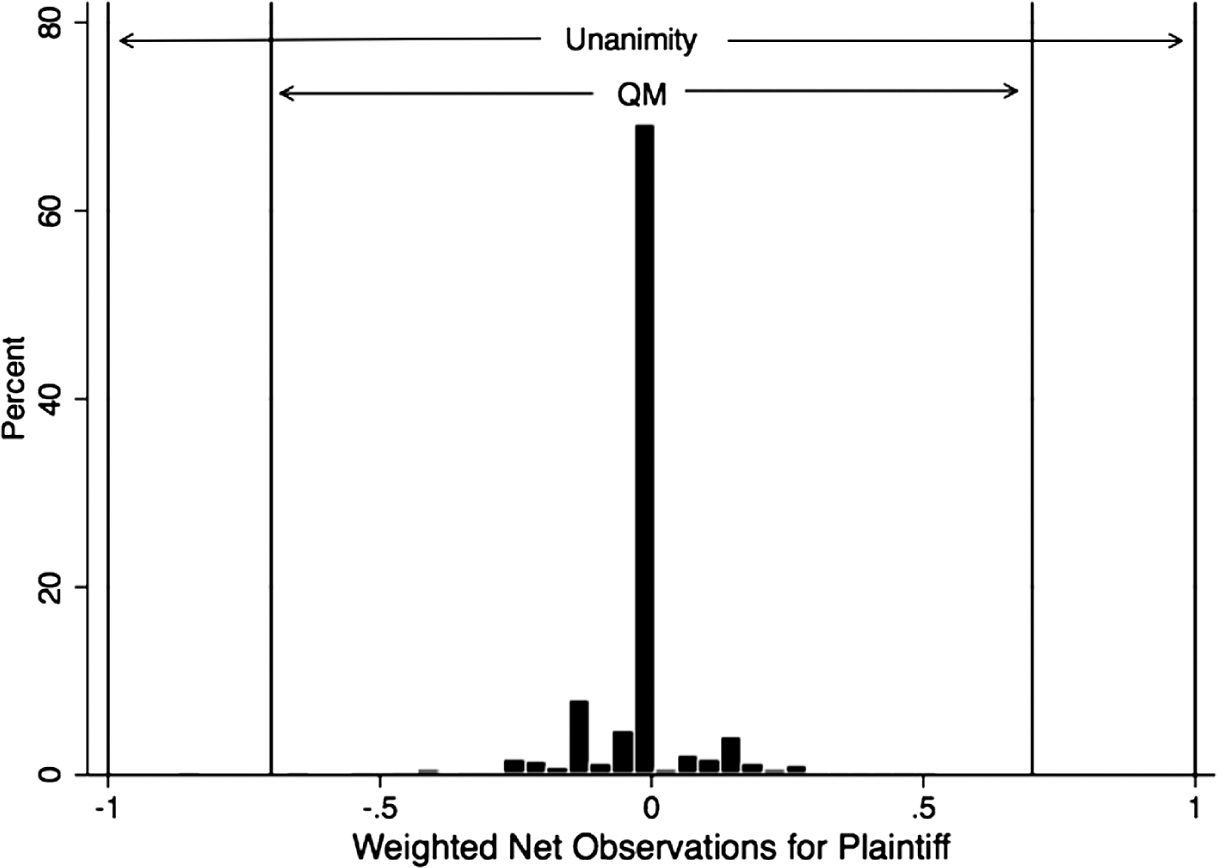
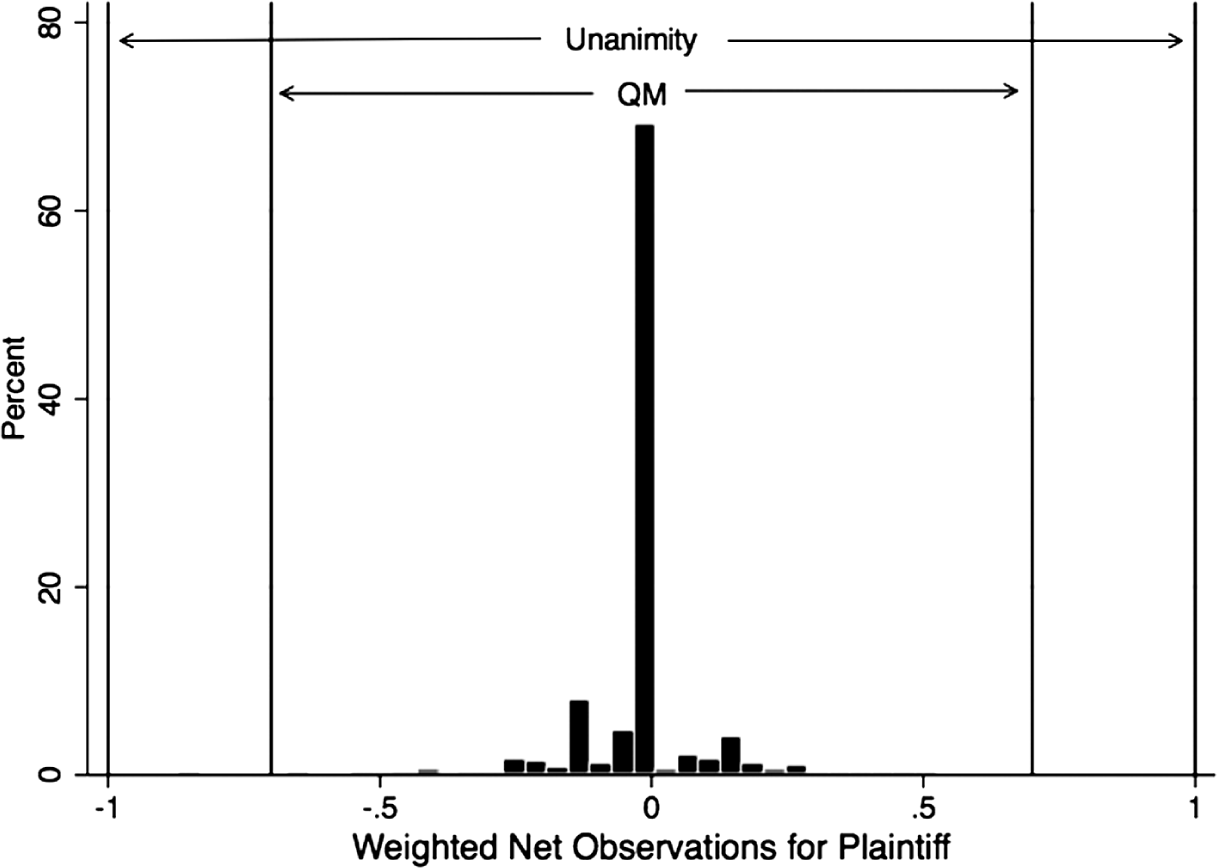
Second, the threat of override cannot constrain the ECJ because it is not a credible threat. In our analysis, we found that the override rule was unanimity in more than 90% of the cases in the data base (whereas Carrubba et al. [2008, 448] proceeded on the assumption that the override rule was a qualified majority vote for all cases). Figure 1 depicts the distribution of values on the independent variable for Carrubba et al.’s data set as a whole, information that they did not report. On more than two-thirds of the issues coded, MSGs took no position. On 11.8% of the questions (375/3,176), the authors code the member states as having registered a position in favor of the plaintiff, the mean score of which is 14.4%, slightly more than the vote of a single large state (e.g., France or Germany, which are coded with a 14% weight). On 20% of the questions in the data set, MSGs registered a position opposing the plaintiff (favoring the defendant state), the mean score of which is 15.1%, far short of the combined votes of any two important states. As figure 1 shows, states do not come close to reaching a qualified majority (about 70% of total weighted votes) let alone unanimity in any systematic way. Carrubba et al.’s claim that the threat of override has somehow constrained the ECJ—systematically—is thus inexplicable.
Distribution of net weighted positions taken by the member states on legal questions in the Carrubba et al. data set. The graph depicts the distribution of the major independent variable in their study: the normalized net weighted positions taken by the member states in briefs to the ECJ on legal questions in the data set. Source of the data: Carrubba et al. (2008).
Third, the evidence refutes Carrubba et al.’s assertion that the ECJ takes its cues from MSG briefs but sides with the commission only “on the margin” (2008, 432). We have already seen that the commission wins more than 90% of the noncompliance suits brought against states under article 258. What about rulings pursuant to article 267 references sent by national courts? Of the 2,048 questions raised in these references, the commission filed observations in 77.7% (n = 1,588), whereas MSGs produced a weighted position in 45.2% (n = 926). When the commission takes the plaintiff’s side (n = 841), the ECJ rules in favor of the plaintiff 79.9% of the time, compared to the MSGs’ lower 70.8% success rate in far fewer cases (n = 342). When the commission files observations against the plaintiff (n = 747)—in favor of the defendant state—the ECJ rules in favor of the defendant state 77.7% of the time, compared to the MSGs’ far lower 57.2% success rate (n = 584). Note that the MSGs’ success rate is higher when they encourage the ECJ (to punish noncompliance) than when they attempt to constrain the court (from finding against a defendant state), though MSGs participate in the latter activity more than in the former, a result that casts further doubt on Carrubba et al.’s claims. The commission’s success rate, in contrast, varies hardly at all, regardless of which side it supports.
The crucial test is the following: what happens when the commission opposes the net weighted positions taken by the MSGs? If Carrubba et al. are right, then the commission will be relatively ineffectual when it opposes MSGs. There are 96 legal questions in the data set on which the commission supported the defendant and MSGs took a weighted position supporting the plaintiff; in these, the ECJ favored the MSGs’ position in only 36.5% (n = 35) of these cases. There are 234 legal questions in which the commission filed an observation in favor of the plaintiff and MSGs took a net weighted position supporting the defendant. On 70.1% of these issues (n = 164), the court agreed with the commission, finding for the plaintiff. Thus, when MSGs oppose the commission (n = 330), the commission prevails more than two-thirds of the time. If the commission’s position represents a majoritarian position, then the ECJ’s posture is majoritarian.
Our findings fit comfortably the notion of trusteeship developed here but are in tension with a model of the system that scripts the ECJ as a simple agent. The ECJ is a trustee of the interests placed in trust by states for the benefit not just of governments but also of every subject of EU law.
We now turn to the politics of majoritarian activism in two policy domains: free movement of goods and sex equality. The first involves the adjudication of article 34 TFEU. No other treaty provision has been more important to market integration and to defining the relationship between the scope of EU authority and national regulatory autonomy. Article 34 prohibits non–tariff barriers,Footnote 21 although it is famously tempered by an escape hatch—article 36—which permits states to derogate from article 34 on diverse grounds.Footnote 22 The treaty also obligated states to eliminate barriers to intra-EU trade by the end of 1969 and to legislate EU market regulations in a timely fashion. The states missed the deadline. In the 1970s, with two seminal decisions, the ECJ gave extensive reach to article 34, encompassing virtually all national market regulations, while developing PA as a method of assessing state claims to derogations.Footnote 23 Activated by traders, the legal system steadily dismantled non–tariff barriers, helped to revitalize the commission’s harmonization efforts, and provoked a process that culminated in the Single European Act of 1986 (Stone Sweet 2004, chap. 3).
Maduro (1998, 72–78) examined every ruling in which the ECJ assessed the proportionality of derogations of noncompliance claims under the framework of articles 34 and 36. Judges, he found, engaged systematically in majoritarian activism within the necessity stage. Once the ECJ had determined that the national measure in question was more unlike than akin to equivalent measures in place in a majority of states, the ECJ would strike it down as a violation of article 34. (On its own initiative, the ECJ had begun, in the early 1980s, to ask the commission to provide such information.) Strikingly, he found no exception to this rule. In contrast, the court tended to uphold national measures in areas where no dominant type of regulation existed.
A second form of majoritarian activism concerns the role the ECJ has played in EU legislative processes. In several policy domains, the court has enacted, through judicial decision, legislation supported by a majority of MSGs in the Council of Ministers, but blocked by a minority of MSGs, under unanimity procedures. A well-documented example involves the effort to combat sex discrimination in the workplace. In a series of controversial rulings—all of which are contained in the Carrubba et al. data set—the ECJ aggressively enacted core provisions of EU legislation that had been vetoed by France and the United Kingdom, after having been proposed by the commission (Stone Sweet 2004, chap. 4). During the 1986–93 period, the court extended article 157 TFEU, guaranteeing equal pay for equal work among men and women, to workplace policies and benefits that, although gender neutral on their face, disproportionately affected women compared to men. The rulings broke the impasse, and the MSG codified the main elements of this jurisprudence in a 1997 statute (directive on indirect discrimination and burden of proof).Footnote 24 In 1990, the ECJ extended the equal treatment principle to employer-provided occupational pension schemes, case law that was ratified in the 1997 directive on occupation social security. Similarly, the court’s 1990 moves to prohibit pregnancy discrimination and to require states to provide maternity leave provided the template for a 1992 statute. In these sensitive areas, and many others, the ECJ extended the rights of individuals, under EU law, to policy domains that states had previously assumed fell within fields of national competence. Pervasive judicialization of EU policy making has been the result (Kelemen 2010; Stone Sweet 2010).
The Carrubba et al. data set also contains a set of landmark constitutional rulings ranking in significance with those analyzed by Stein (1981) in that they significantly expanded the courts’ competences. In 1991, the ECJ announced the doctrine of state liability, holding that national courts were under a duty to order a state to pay compensation to private parties harmed by the state’s compliance failures (Francovich, case C-6 and 9/90, 1991 ECR I-5357). Italy, Netherlands, and the United Kingdom filed briefs, supported by Germany in oral argument, arguing that, since the treaty was silent on these issues, state liability should be provided for only through EU legislation. Siding with the commission, the ECJ rejected these arguments, bluntly stating that the doctrine of state liability would further enhance the effectiveness of EU law within national legal orders. As subsequently extended in 1996, individuals and firms are entitled to reparation when noncompliance involves EU law that is “intended to confer rights upon [individuals], the breach is sufficiently serious, and there is a direct causal link between the breach and the damage sustained” (Brasserie du Pecheur, case C-46/93 and C-48/93, 1996 ECR I-1029). In this case, the ECJ responded to France, Germany, Ireland, and the United Kingdom, which argued that the treaty could not provide a remedy that is nonexistent in national law. The ECJ dismissed the objection in terms that echo our discussion of trusteeship: “The German Government … submits that [for state liability] to be recognized by judicial decision would be incompatible with the allocation of powers as between the [ECJ] and the Member States. … It must, however, be stressed that the existence and extent of state liability … are questions of Treaty interpretation which fall within the jurisdiction of the Court. Since the Treaty contains no provision expressly and specifically governing the consequences of breaches of [EU Law] by Member States, it is for the Court … to rule … in accordance with generally accepted methods of interpretation.” As the episode makes clear, even the most powerful states have failed to constrain judges from building the capacity of the legal system to punish states for compliance failures.
The European Convention on Human Rights
The ECHR, the centerpiece of the Council of Europe, is a pan-European regime that today covers 47 states with a population exceeding 800 million people. The legal system was transformed by Protocol no. 11, which entered into force on November 1, 1998. Protocol no. 11 conferred upon the court compulsory jurisdiction over individual “applications” claiming a violation of convention rights, once national remedies have been exhausted. In the 1980s, when states could still opt out of compulsory jurisdiction, the regime received 455 petitions; and the court, in its first four decades (1959–98), had rendered a total of 837 judgments. Under Protocol no. 11, activity exploded. In 1999, the court received 8,400 complaints, a figure increasing to 61,300 in 2010. In 1999, the ECTHR rendered 250 judgments, 1,200 in 2005, and 1,607 in 2010.Footnote 25 Today, the ECTHR is the most active and important rights-protecting court in the world.
Why did states enhance the court’s authority? Two factors are crucial. First, after World War II, Western Europe emerged as the epicenter of a “new constitutionalism” that, with successive waves of democratization, spread across the continent. Legislative sovereignty was overthrown and replaced by a model of constitutionalism with judicial mechanisms for rights protection at its core. The ECHR helped to ground the diffusion of this model while providing a transnational layer to rights constitutionalism. Second, the Soviet bloc collapsed. In the 1990s, a decade of massive constitutional reconstruction, the EU and the Council of Europe offered membership to post-Communist states on conditions that included a commitment to rights protection. Placing them under the supervision of the ECTHR was a means of securing that commitment. The convention has in fact played a crucial role in democratic transitions in post-Communist Europe: most of these states modeled their new bills of rights on the ECHR, and many even signed it prior to ratifying new constitutions.Footnote 26 From the perspective of Western states, Protocol no. 11 remade the regime into an efficient mechanism for monitoring domestic politics in regions that could pose serious threats to peace and stability on the continent. The cost to Western states was stronger supervision of their own systems of rights protection.
The ECTHR performs three governance functions. It renders justice to individual applicants beyond the state (a justice function); it supervises the rights-regarding activities of all national officials, including judges (a monitoring function); and it determines the content of convention rights (a lawmaking function). Protocol no. 11 fully exposed all state organs to the supervisory machinery of the ECHR, but it did not transfer sovereignty to the court. On paper, the ECTHR’s powers remain tailored to rendering justice to individual claimants. If the court finds that a state has violated an individual’s convention rights, it may award that victim monetary damages. Unlike a national constitutional court, the court has no authority to invalidate national law that conflicts with the ECHR. Nonetheless, the ECTHR confronts cases that would be classified, in the national context, as inherently “constitutional.” It resolves tensions between rights and state interests through balancing, using PA; it has steadily raised standards with regard to every convention right; it has long held that its precedents bind all judges in the system;Footnote 27 and it routinely indicates how a state must reform its law in order to avoid future violations. For these reasons, the ECTHR can be considered a specialized, transnational, constitutional court (Sadursky 2009).
In the ECHR (as in all national constitutions adopted in Europe since the end of World War II), important fundamental rights are “qualified” by limitation clauses. States may limit the enjoyment of rights associated with privacy and family life (art. 8), conscience and religion (art. 9), expression (art. 10), and assembly and association (art. 11) when “necessary” to achieve certain purposes. In the standard formula, states may “interfere with” or “restrict” the “exercise” of a convention right, but only when such interferences are “prescribed by law” and “are necessary in a democratic society in the interests of national security or public safety for the prevention of disorder or crime, for the protection of health or morals, or for the protection of the rights and freedoms of others.” As in the EU and the WTO, the ECTHR deploys PA to test “necessity.”
The ECTHR typically uses necessity analysis to determine how much discretion—the size of the “margin of appreciation”—states possess when they act under limitation clauses. If the court finds that a state measure under review is “necessary” to achieve its goals under one of the headings, the state will maintain its regulatory autonomy. If the court finds that a national law or other general measure is the source of a violation, then the state will be subject to repetitive petitions and findings of violation until it changes its law. A strategy of majoritarian activism animates the politics of necessity analysis. The court raises the standard of protection in a given domain when a sufficient number of states have withdrawn public interest justifications for restricting the right. Put differently, the margin of appreciation shrinks as consensus on higher standards emerges. The move will always put some states out of compliance. Yet the court and its supporters can claim that majoritarian activism constitutes an external, “objective” means of determining the weights to be given to the legal interests in tension, leaving the losing state to defend a lower standard of rights protection on seemingly idiosyncratic grounds. Although states may balk when it comes to implementing controversial judgments, they eventually comply in the vast majority of cases.
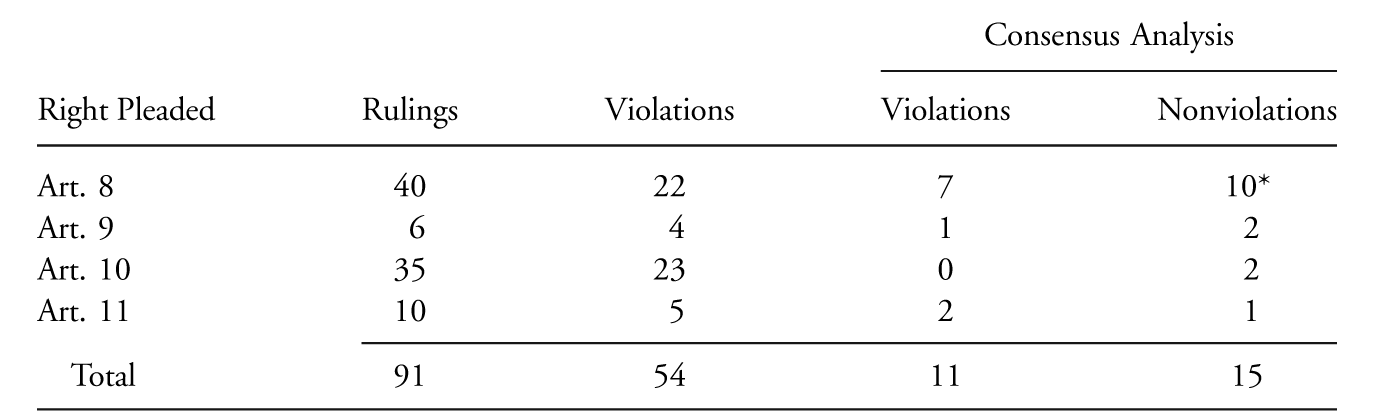
In order to assess how the court determines if a new consensus among states has emerged, we examined rulings rendered between January 1, 1999, and January 28, 2010, focusing on individual petitions pleading a right contained in articles 8–11 (see table 1). Cases are decided at first instance by a seven-member section, whose rulings can be appealed by a defendant state to a 17-member “Grand Chamber”; a section may also refer the case directly to the Grand Chamber without ruling on the merits. The activities of Grand Chambers deserve particular attention since their judgments are both final and capable of authoritatively establishing and overruling precedent. Since the entry into force of Protocol no. 11, Grand Chambers have issued 246 rulings on the merits, finding violations in 179 cases (73%). Individuals pleaded one or more rights contained in articles 8–11 in 91 of these rulings, 54 (59%) of which found violations.
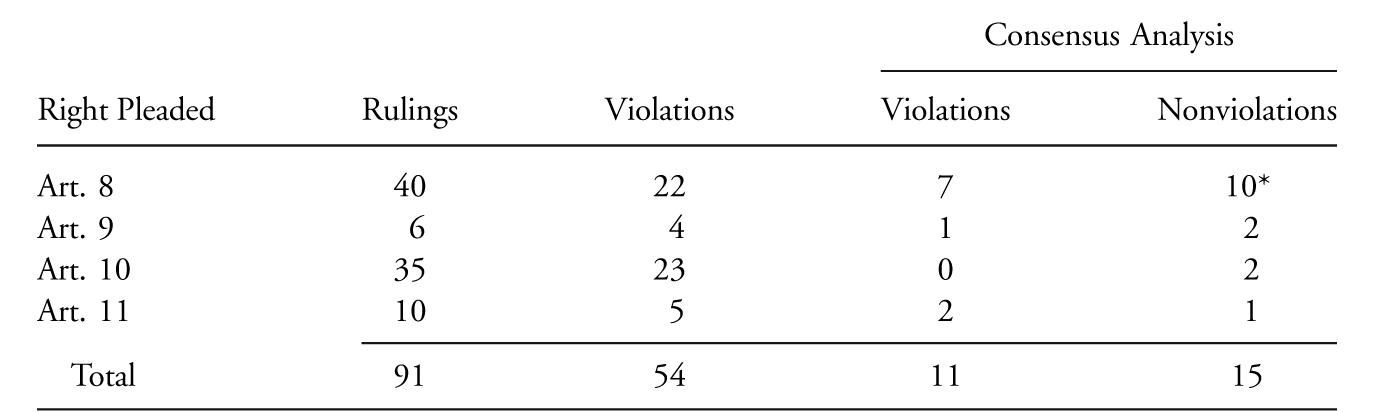
Note The data set includes every Grand Chamber ruling issued between January 1, 1999, and February 5, 2012 (n = 271). The Grand Chamber has rendered final rulings on the merits in 246 cases, in 179 of which the Grand Chamber found violations of at least one right pleaded by an individual. Table 2 provides information on Grand Chamber rulings in cases in which arts. 8–11 were pleaded by the applicant. “Violations” is the number of judgments in which the Grand Chamber found a violation of in all cases and in cases in which consensus analysis was used.
* Includes six cases on similar facts decided by the court on the basis of the same reasons given.
In 26 (29%) of the 91 cases involving articles 8–11, Grand Chambers used one or more techniques of gauging state consensus within necessity analysis. In these cases, the crucial moment occurs when the court assesses the level of state consensus. Cases are won or lost, and precedents are reassessed, at this point in the ruling. As a result, petitioners, the defendant state, and third parties (nongovernmental organizations and states filing as amici) collect and report evidence of state practice to the court, and the court often undertakes its own investigations. This evidence can take the form of (1) a count of states that restrict (or no longer limit) a right in a particular way, through a survey of relevant national legislation, case law, and administrative practice; (2) EU law and Council of Europe positions, as evidence of European consensus; and (3) international conventions to which states are parties. The ECTHR may also treat as pertinent to the analysis the rulings outside the regime, such as Canada and South Africa, and the Inter-American Court of Human Rights. The court often blends evidence from these various sources to arrive at a conclusion. It is important to stress that sections process the vast bulk of these cases, and they too routinely engage in “consensus analysis” when evaluating the “necessity” of state measures.
To illustrate, consider the response to discrimination against homosexuals. In the 1980s, the court found that laws criminalizing homosexual acts violated article 8 (privacy; Norris v. Ireland, no. 10581/83, judgment of October 26, 1988), decisions that opened the door to the review of all national law that denied homosexuals equal rights. The court has taken a majoritarian stance, steadily raising protection in this field, as social mores have evolved. In 1999, a section held that the United Kingdom’s prohibition against gays and lesbians serving in the military violated article 8 (Smith and Grady v. the UK, no. 33985/96 and no. 33986/96, judgment of September 27, 1999); the judges rejected the claim that the ban was necessary to preserve morale in the armed forces, stressing that the United Kingdom’s position was a distinctly minoritarian one. The United Kingdom, after further inquiry, rescinded the ban. In 2010, a section found a violation of articles 11 (assembly), 13 (access to justice), and 14 (nondiscrimination) in three cases involving the recurrent refusal of Russian authorities to permit “gay pride” parades (Alekseyez v. Russia, no. 4916/07, no. 25924/08, and no. 14599/09; judgment of October 21, 2010). Russia claimed a wide “margin of appreciation” when “homosexual behavior” spilled from the private into the public domain, which the section rejected on the grounds of solid state consensus to the contrary. In 2008, a Grand Chamber held that France could not withhold authorization from a lesbian woman attempting to adopt a child, although the judges could count only 10 states permitting the practice.Footnote 28 Since the Grand Chamber stressed that the French Council of State had partly based its decision on the fact of the woman’s homosexuality, the ruling could be considered to be an application of existing consensus and settled case law. In any event, the oracular nature of the ruling was obvious, and France soon changed its law.
Majoritarian activism also applies to negative cases. If the court finds that state consensus on extending the scope of rights protection has not emerged or has not yet been consolidated, it will balk at extending the scope of a right. In a 2010 case, for example, a Grand Chamber decided an article 8 case involving same-sex marriage in these terms: “The Court [finds] that there is an emerging European consensus towards legal recognition of same-sex couples. Moreover, this tendency has developed rapidly over the past decade. Nevertheless, there is not yet a majority of States providing for legal recognition of same-sex couples. The area in question must therefore still be regarded as one of evolving rights with no established consensus. [Thus] States … enjoy a margin of appreciation in the timing of the introduction of legislative changes” (Schalk and Kopf v. Austria, no. 30141/04, judgment of June 24, 2010). The finding of nonviolation indicates that laggard states will not be able to maintain the status quo. In 2011, the court rejected a challenge to Austria’s ban on in vitro fertilization using donated genetic material. A section declared that “there is now a clear trend in the legislation of the Contracting States towards allowing gamete donation for the purpose of in vitro fertilisation, which reflects an emerging, but not yet consolidated, ‘consensus’” (S.H. and Others v. Austria, 57813/00, judgment of November 3, 2011). In these and many other rulings, states may have survived a challenge, but they have been put on notice that change is coming.
In sum, majoritarian activism, staged within necessity analysis, often determines how convention rights will evolve. The court treats rights as substantively and temporally incomplete norms to be constructed dynamically as social mores evolve. Although the court regularly overturns precedent to raise standards of rights protection under the convention, the court has never reversed a precedent in order to reduce the level of protection. Once national regulatory autonomy has been lost in a given field, states have never regained it.Footnote 29 To date, no ECTHR ruling has ever been overridden.
The World Trade Organization
The WTO, created by the Uruguay round agreements that entered into force on January 1, 1995, absorbed or replaced features of a dispute resolution system that had evolved under the 1947 General Agreement on Tariffs and Trade (GATT). The regime’s purpose is to facilitate the expansion of international commerce through legislating and enforcing multilateral trade law. Although the original GATT did not provide for a court, third-party dispute resolution nonetheless emerged in the form of the panel system. The panels acquired their authority through the ad hoc consent of two disputing states. In the 1970s and 1980s, the system underwent a process of judicialization (Stone Sweet 1997), which helped to generate the conditions necessary for the establishment of a system of adjudication on the basis of compulsory jurisdiction. The panel system was, in part, retained, but its work is supervised by a high appellate organ, the AB.
The AB is a trustee court. The treaty instruments constituting the regime’s law can be revised only by unanimous vote of its present 153 members. The “negative consensus” rule governs override: a move to block a ruling of the AB can succeed only if it is unopposed by any member; that is, the winning party to a dispute can block override. The AB largely determines its own lawmaking capacities, and no AB ruling has ever been overturned. As Steinberg (2004, 249) puts it, given “weak constitutional constraints,” the AB has inherent capacity “to engage in expansive lawmaking.” The AB authoritatively interprets WTO agreements and ensures that panels apply its jurisprudence in a consistent manner, a task it performs through de facto adherence to precedent.
WTO agreements are incomplete contracts that, in practice, are completed through adjudicating state disagreements over treaty interpretation (Goldstein and Steinberg 2009; Shaffer and Trachtman 2011). Owing to the decision rule (consensus) governing treaty making, WTO law tends to be both incomplete and rigid. States left key provisions of agreements vague, not least to secure consensus, but such law is virtually immune to change except through litigation (Shaffer and Trachtman 2011, 19). As a result, “judicial action” routinely becomes “a substitute for legislative action” (Goldstein and Steinberg 2009, 274; Shaffer and Trachtman 2011, 25). Like the ECJ and the ECTHR, the AB has not adopted a formal posture of deference when it comes to positions taken by defendant states. Instead, the AB has pursued trade liberalization—the values enshrined in treaty instruments—while clarifying and progressively constructing the regime’s law. To date, the AB has produced 106 reports. In 94 rulings (88.7%), the AB held that the defendant state had failed to meet its obligations under WTO agreements.Footnote 30
Decision rules based on consensus (unanimity) are also implicated in the WTO’s failure to produce common market regulations. By default, litigating article XX (GATT) was long the principal means of testing the limits of state competences to deal with negative externalities of trade, and other policy problems, unilaterally.Footnote 31 Article XX contains a list of “General Exceptions” to the GATT (the equivalent provision in the General Agreement on Trade in Services [GATS] is art. XV). Measures that come under one of the headings listed in article XX and meet the conditions that have been developed by panels and the AB are permitted. Permissible exceptions include measures “necessary” to protect public morals, intellectual property, and the life and health of humans, animals, and plants; to secure compliance with customs rules; to prevent “deceptive practices” in the marketplace; and to conserve “exhaustible natural resources.” Article XX is a paradigmatic example of an incomplete norm of crucial significance. Its “open language” constitutes an “implicit delegation” of authority to judges (Shaffer and Trachtman 2011, 11), made explicit by ongoing litigation.
PA, which first emerged in a pre-WTO dispute, was immediately adopted and refined by WTO judges.Footnote 32 The leading AB ruling is Korea—Beef, which laid down general guidelines for necessity analysis (WTO-AB report, Korea—Beef, WT/DS161/AB/R [2001]). The AB stressed that determining necessity proceeds on a case-by-case basis through a “process of weighing and balancing a series of factors,” including “the extent to which the measure contributes to the realization of the end pursued”; “the importance of the common interests or values protected” by the measure; and the impact of the measure on trade (para. 164). Further, the defendant state is likely to lose if a less trade restrictive, or more GATT consistent, measure exists. As in the EU, the evaluation of less restrictive alternatives is conditioned by a constraint, which has gradually congealed as an unwritten fiduciary duty. To reject an article XX defense, judges must identify specific policy alternatives that were “reasonably available” to the defendant state, and litigating states are thus led to identify alternatives as well.Footnote 33
Do WTO judges engage in majoritarian activism when they undertake necessity analysis? To address the question, we examined every panel and AB report issued in litigation in which the defendant state pleaded article XX GATT (n = 21) or article XV of the GATS (n = 1). In all but two of these cases, the defendant state’s derogation claim was rejected (WTO-AB, U.S.—Shrimp [I], WT/DS58/AB/R [1998]; EC—Asbestos, WT/DS135/AB/R [2001]). Unlike the ECJ and the ECTHR, WTO judges do not routinely count states. They do seek to identify consensus on relevant law and practice, which they then treat as facts that bear on necessity analysis. In most cases, this evidence helps to determine the outcome.
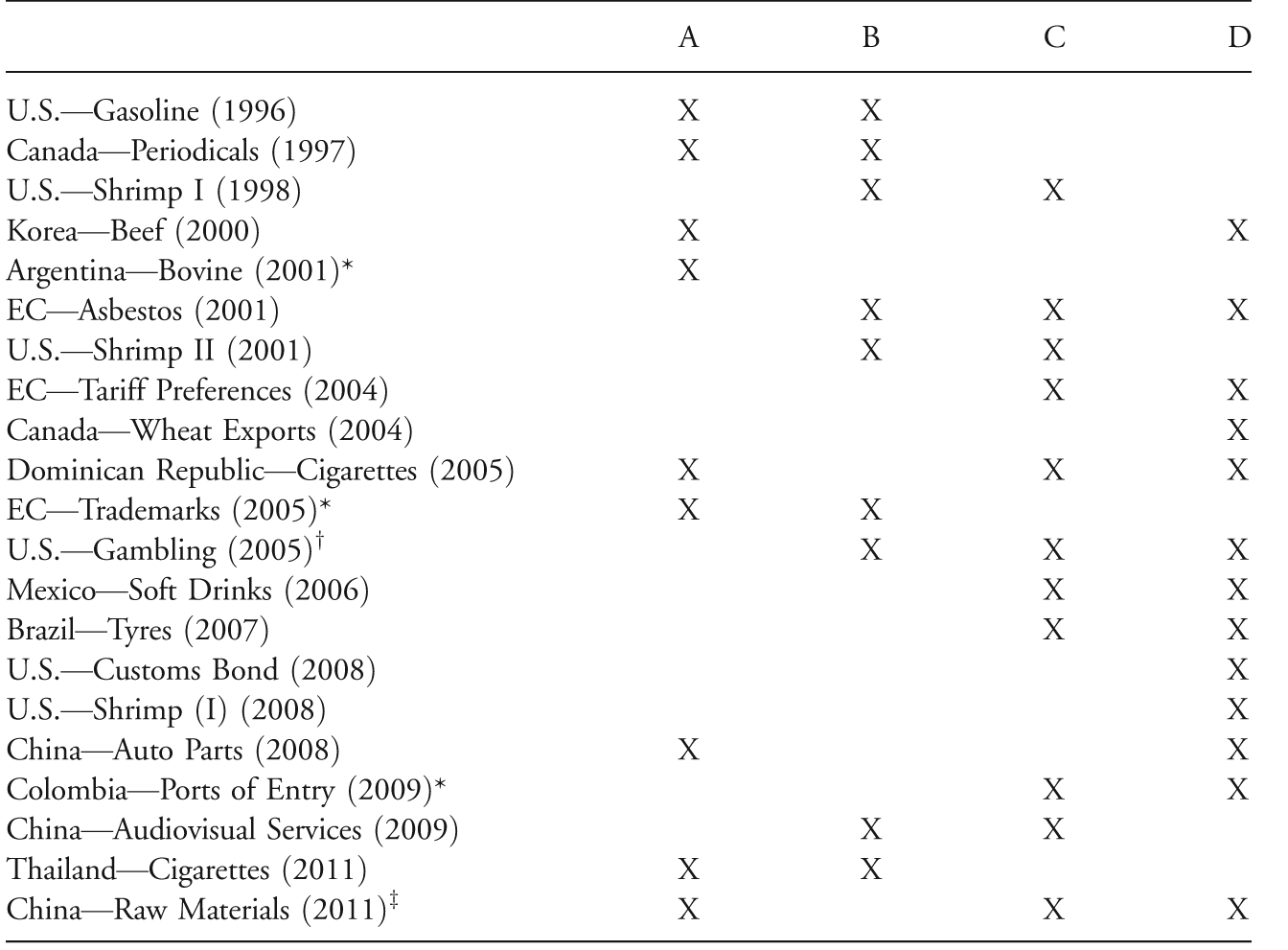
Table 2 summarizes our findings. First, WTO courts may reference established industry standards and state practices that point to available measures that are less trade restrictive than the measure under review. If a “usual,” “normal,” or “commonly used” technique or practice would entail measures that are more GATT consistent, then the defendant state loses.Footnote 34 Plaintiff states help the judges identify such practices. In EC—Trademarks, for example, the United States proposed a less onerous alternative to an administrative procedure under review, noting that “many other WTO Members employ [the alternative] procedure,” and “it is not disputed that [the alternative] would be WTO-consistent” (panel report, EC—Trademarks, WT/DS174/R [2005], para. 7.301). Similarly, judges may refer to relevant measures of specific third-party states to help them determine if a particular measure is in fact “necessary” to achieve a particular purpose. A defendant states may also bring a count of states to the judges’ attention. In EC—Asbestos, the EC defended its ban on imports of asbestos-based building materials, showing that “many other Members of the WTO” had taken similar measures, and referencing the positions taken by the World Health Organization and the International Labor Organization. The panel found these facts to be sufficient to accept the EC’s article XX plea (panel report, WT/DS/135/R, EC—Asbestos [2000], paras. 3.505, 3.517, and 8.231).
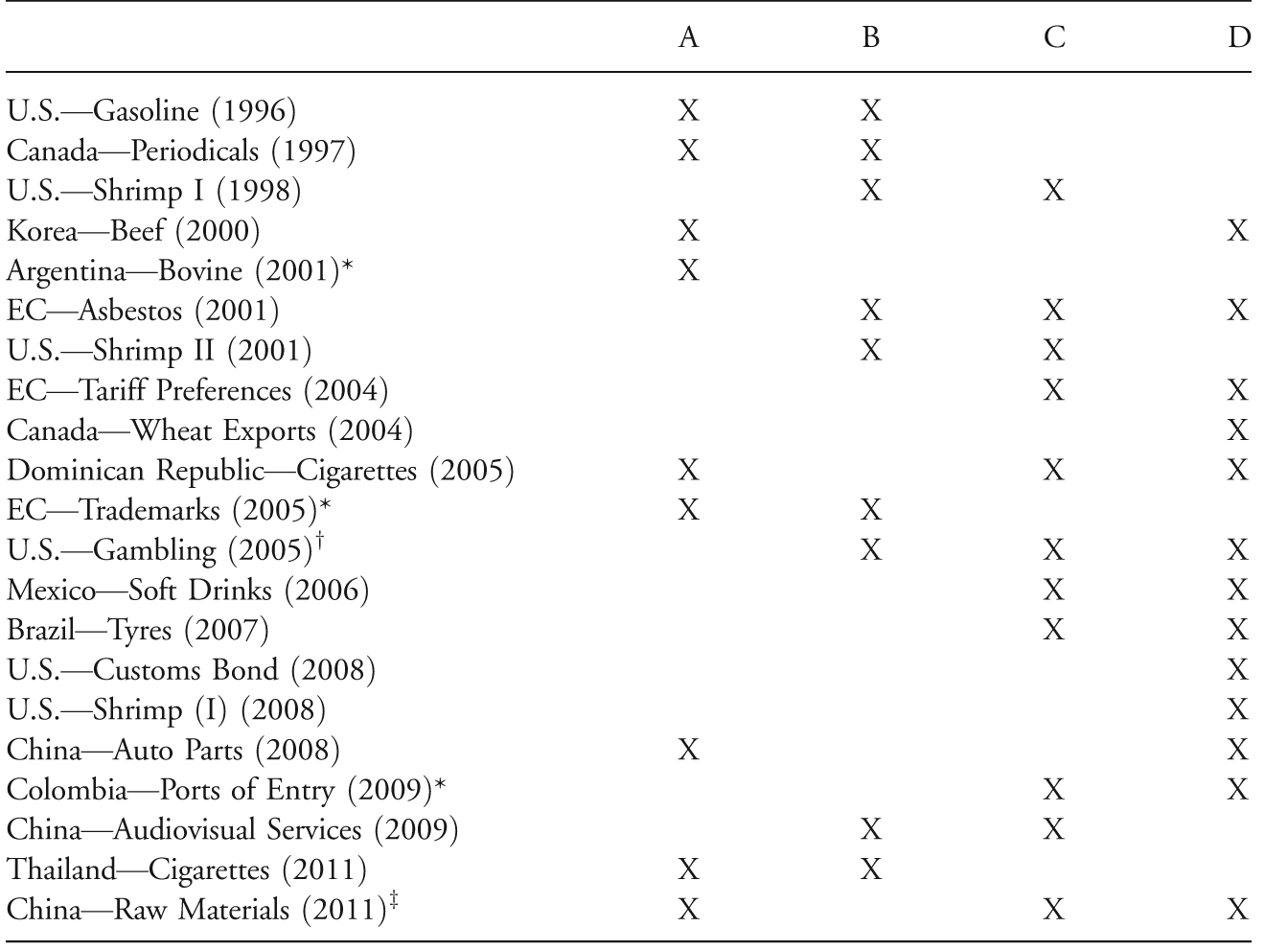
Source Data compiled by Alec Stone Sweet and William Moon from panel and AB reports.
Note Date indicates the year of the last ruling on the dispute. Key: As a fact bearing on necessity analysis, a panel, and/or AB references, A refers to “established” practices in an industry or state measures that are less trade restrictive than the measure under review; B refers to relevant measures of specific third-party states; C refers to provisions of a multilateral treaty or the positions taken by an international organization; D refers to the dicta in Korea—Beef on the importance of state measures that pursue “common interests or values.”
* Panel ruling was not appealed to the AB.
† Litigation of the GATS.
‡ Panel ruling pending appeal as of January 30, 2012.
As in EC—Asbestos, multilateral treaties and the positions taken by international organizations can serve as indicators of wider state consensus, as well as sources of law binding the defendant state.Footnote 35 In U.S.—Shrimp I (1998), the AB analyzed relevant multilateral treaties at length, in particular, the Convention on Trade in Endangered Species. Protecting sea turtles, the AB noted, is a legal objective “shared by all participants and third participants in this appeal, indeed, by the vast majority of the nations of the world.” The AB held that the United States could require shrimp harvesters to employ turtle-excluding devices in nets in the service of protecting animal life under article XX, while faulting the United States for failing to properly consult with trading partners before enforcing the rule.
Finally, we note that the dicta in Korea—Beef—stating that the more state measures are designed to pursue “common interests or values” (rather than narrow national interests), the more likely they will be accepted by the AB as necessary to achieve state objectives under article XX—are now routinely cited and its terms debated throughout the proceedings.
The techniques the AB uses in necessity analysis enable it to pursue multilateral solutions to what are, formally, dyadic conflicts. More generally, WTO judges engage in fact finding and analysis that help it to develop trade law in line with its mission (to help WTO members reduce protectionism) and with the interests of the vast majority of its members (to achieve the benefits of trade in the face of domestic interests opposed to liberalization). As Goldstein and Steinberg (2009, 280–81) have it, “As long as the Appellate Body does not deviate too far from underlying interests in member countries, they can rule, countries will comply, and liberalization moves forward—albeit with a Greek chorus of politicians and the public complaining about judicial activism and a loss of sovereignty.”
Comparatively, the WTO-AB engages in majoritarian activism less systematically than do the ECJ and the ECTHR. As they have evolved, the ECJ and the ECHR have made it clear that gauging consensus serves the goal of helping Europeans construct a transnational identity. The fact that members of the WTO-AB recognize no such mandate, which would be highly controversial among WTO members, may have the effect of reducing the intensity in which they pursue majoritarian activism. That said, the WTO-AB could encourage the secretariat and litigating states to provide evidence of state consensus on practices that are both GATT compliant and relevant to litigation at hand, without violating its mission.
III. Conclusion
In adjudicating a steady stream of litigation on state noncompliance cases, the ECJ, the ECTHR, and the WTO-AB have used their lawmaking powers to complete crucial but incomplete treaty norms and to enhance the effectiveness of the regime’s law in other ways. At the same time, they have tempered judicial supremacy and sought to bolster the legitimacy of judicialized governance by pursuing a strategy of majoritarian activism.
The various techniques associated with majoritarian activism also help them fulfill their fiduciary duties. Trustee courts have an obligation to pursue the values placed in trust by states on the establishment of the regime (the duty of loyalty). The ECJ, ECTHR, and the AB developed necessity analysis to deal with their most politically controversial cases, those involving derogation or limitation clauses that defendant states invoke to defend measures that would otherwise be illegal. Majoritarian activism builds into the reason-giving requirement (the duty of accountability) a concern for multilateral solutions enabling judges to make use of dyadic disputes to develop the law for the regime as a whole. If their decisions are to be based, at least in part, on an assessment of state preferences and relevant social beliefs and practices as they evolve, then courts must build capacity to engage in dialogue with the regime’s beneficiaries (the duty of deliberative engagement), which is precisely what has happened.
We conclude with two general points. First, in the EU, the ECHR, and the WTO, state noncompliance has been the fuel of judicialization. Noncompliance with rulings on the part of any single state, even a powerful one, will not threaten the system as long as the three conditions for judicialization (Sec. I) continue to be met. It follows that the notion of state “noncompliance” must cover politics beyond the narrow question of whether a state chooses to comply with the regime’s law or a judicial ruling. States adapt to the court’s jurisprudence in myriad ways, including how they tailor litigation strategies. The courts of these three regimes have been remarkably successful at propagating argumentation frameworks that govern how noncompliance is to be judged. When states defend positions on the basis of necessity, they legitimize necessity analysis in a powerful way—through use.
Second, theoretical approaches to the evolution of international organizations that were dominant two decades ago are incapable of explaining judicialization under conditions of trusteeship.Footnote 36 Override is, for all practical purposes, off the table, and noncompliance activates rather than paralyzes the legal system. Under trusteeship conditions, a regime’s legal system can be expected to evolve in ways that cannot be predicted from the ex ante preferences of states-as-principals or from the preference of states-as-litigants when they use the system. States, their preferences, and patterns of compliance are all crucial factors in the judicial politics of these regimes. Indeed, majoritarian activism is itself constrained by state preferences, but not by noncompliance and the threat of override.