Introduction
Grape (Vitis vinifera L.) that belong to the family Vitaceae comprise 12 genera and 60 species and are one of the most commercially important fruit crops in the world (Melyan et al., Reference Melyan, Sahakyan and Harutyunyan2015). Grape is a medicinally important fruit because studies have reported the presence of several compounds with antiaging, anti-infection, anticarcinogenic, antidiabetes, immune-modulatory, antiobesity, antiatherogenic and neuroprotective properties in grapes (Yadav et al., Reference Yadav, Jain, Bhardwaj, Nagpal, Puniya, Tomar and Yadav2009; Yang and Xiao, Reference Yang and Xiao2013; Doulati-Baneh et al., Reference Doulati-Baneh, Mohammadi, Labra, De Mattia, Bruni, Mezzasalma and Abdollahi2015). Globally, a total of 69,31,353 million hectares of tropical and subtropical area are under grape cultivation, with the overall grape production being 71,781,883 metric tons. In terms of grape production, China stands first, followed by Italy and USA, producing 16.8% (11,868,697), 10.9% (6,504,283) and 9.6% (6,059,278) metric tons of grapes, respectively (FAOSTAT, 2018). India ranks seventh with a total production of 2,650,793 metric tons (FAOSTAT, 2018). Based on their utilization, grapes are classified into two major groups: (1) table grapes, which are used for eating, and (2) wine grapes, which are used for preparing wine. Grapes are rich sources of mineral nutrients, vitamins and antioxidative dietary fibre and have anticancer property (Llobera and Cañellas, Reference Llobera and Cañellas2007; Deng et al., Reference Deng, Penner and Zhao2011). In-vitro regenerated plants may show genetic variations because of different media and hormones used during tissue culture (Jiao et al., Reference Jiao, Li, Xu, Guo, Zhang, Li, Jiang, Liu and Xu2018). Currently, European grapes (V. vinifera L.) are the leading cultivars that contribute to a major share in the global market. However, the disease susceptibility and cracking nature of the fruits create hurdles in their cultivation in South and East Asia (Morinaga, Reference Morinaga, Papademetrious and Dent2001; Ergül et al., Reference Ergül, Perez-Rivera, Söylemezoglu, Kazan and Arroyo-Garcia2011). Therefore, breeders develop hybrids of V. labrusca and V. vinifera to improve disease and cracking tolerance (Ban et al., Reference Ban, Mitani, Sato, Kono and Hayashi2016). Over 1500 years, V. labruscana-derived Bailey cultivars have been developed and introduced in East and South Asia and have become the leading cultivars (Ban et al., Reference Ban, Mitani, Sato, Kono and Hayashi2016). Thus, interspecific hybrids of grapes are routinely developed for high-quality berries. The essential criteria for quality are large berry size, firm flesh, low acidity, crackless nature, striking appearance, disease resistance and high concentration of soluble solids. Furthermore, hybrid grape exhibit a lack of seed propagation because of the lower quality of seedlings than those of parent vine; however, the seeds are important for breeding and development of new varieties. Seeds from fresh grapes remain dormant and thus are tough to germinate (Selim et al., Reference Selim, Ibrahim, Fayek, El-Deen and Gamal2016; Uzun et al., Reference Uzun, Nuray, Akkurt, Cengiz, Aydin and Akturk2019). Many approaches have been used to break the dormancy of seeds, including long-term storage of seeds at low temperature under a moist condition or in the presence of chemicals such as acetic acid, hydrogen peroxide, lactic acid, hydrogen cyanamide and plant growth regulators (PGRs), such as benzyl amino purine (BA), indoleacetic acid, indole butyric acid (IBA), gibberellic acid (GA), thiourea, kinetin and ethephon (Ledbetter and Shonnard, Reference Ledbetter and Shonnard1990; Ergenoglu et al., Reference Ergenoglu, Tangolar and Gök1996; Celik, Reference Celik2001; Akkurt et al., Reference Akkurt, Keskin, Shidfar, Shidfar and Çakir2013; Uzun et al., Reference Uzun, Nuray, Akkurt, Cengiz, Aydin and Akturk2019). All these approaches are time-consuming and have less potential, and hence they cause a great loss of shy seeds (Akkurt et al., Reference Akkurt, Keskin, Shidfar, Shidfar and Çakir2013). To overcome this issue and improve the breeding efficiency, breeders generally use the embryo rescue or immature embryo culture technique (Li et al., Reference Li, Li, Zhao, Zhao, Luo and Wang2020) as this technique can be performed rapidly and results in a high germination rate. Embryo rescue is a technical practice for facilitating embryos recovery from abortion and speeding up the breeding programme by breeders for crop improvement. The success of embryos rescue depends on several factors such as the genotype of parents, composition of the culture medium, sampling time and age of the embryos (Tian and Wang, Reference Tian and Wang2008; Li et al., Reference Li, Li, Zhao, Zhao, Luo and Wang2020). At an early developmental stage, embryos are not suitable to rescue because of their partial development; however, embryos at the 40–60 days after flowering (DAF) stage are suitable for embryo rescue (Li et al., Reference Li, Li, Zhao, Zhao, Luo and Wang2020). The efficiency and germination percentage of embryos can be improved by changing the medium composition and exogenous application of PGRs (Tian et al., Reference Tian, Wang, Niu and Tang2008). In India, downy mildew causes approximately 30–40% of grape loss. This problem triggers the need for developing a disease-resistant grape cultivar by using interspecific hybridization. Thus, standardization of the in-vitro seed germination protocol is a prerequisite for hybrid development. In the present study, three media (ER: Emershad and Ramming, Reference Emershad and Ramming1984; MS: Murashige and Skoog, Reference Murashige and Skoog1962; NN: Nitsch and Nitsch, Reference Nitsch and Nitsch1969) with a combination of different PGRs and amino acids (AAs) were screened for in-vitro embryos germination. The present study provides a suitable and efficient medium combination for in-vitro embryos germination of grape and will help accelerate the breeding programme for grape improvement.
Materials and methods
Plant material
The berries were collected from the orchard of the Indian Council of Agriculture Research-National Research Centre for Grape, Pune, Maharashtra, India. For sample collection, the dates of anthesis for the Red Globe grape variety were recorded and the berries were collected after 50, 60 and 70 days of anthesis. The berries were washed under running tap water and treated with 0.5% bavistin (TATA, Mumbai, India) and then stored at 4°C with proper tagging for embryos rescue.
Media preparation and sterilization
Three media, namely, ER, NN and MS (Ducefa Biochemie, Haarlem, the Netherlands), supplemented with 3% (w/v) sucrose and 0.8% (w/v) agar (Hi-Media, Mumbai, India) were used as the base culture media. The pH of the media was set to 5.8 ± 0.2 by using 1 N NaOH. Agar was added into the media after adjusting the pH and autoclaving the media for 15 min at 121°C. PGRs such as BA (0.5, 0.7 and 0.9 mg/l), IBA (1.0, 1.5 and 2.0 mg/l) and GA (0.1, 0.3 and 0.9 mg/l) and three AAs, namely cysteine, glutamine and proline (2.0 μmol/l each), were added as per their specification either before or after autoclaving. Cultures were grown at 25 ± 2°C under 16 h photoperiod and white fluorescent tube lights (40 W, Philips, India) emitting the light intensity of 50 μmol/m2/s, with 60–70% relative humidity.
Sterilization of berries, embryo rescue and germination
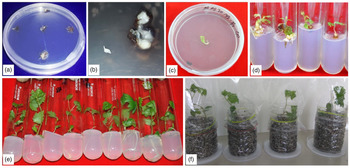
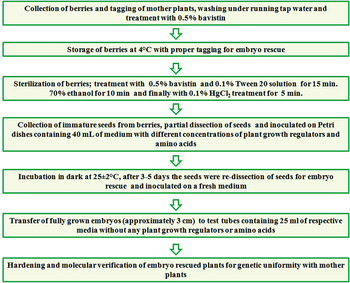
The berries were washed thoroughly under running tap water for 30 min and then treated with 0.5% bavistin (TATA) and 0.1% Tween 20 (Hi-Media) solution for 15 min with continuous shaking, followed by washing with 70% ethanol for 10 min and washing twice with sterile distilled water. The berries were further treated with 0.1% mercuric chloride (Hi-Media) for 5 min, followed by washing with sterile distilled water four times. For embryo germination, 36 medium combinations were prepared with three different PGRs (BA, IBA and GA3) and three AAs (cysteine, glutamine and proline) (Table 1). Immature seeds were collected from the sterilized berries; their seed coats were partially removed and were plated into Petri dishes (Tarsons, Kolkata, India) containing 40 ml of medium with different concentrations of PGRs. The cut sides were kept facing the media (Fig. 1(a)) and incubated at 25 ± 2°C in the dark. After 3–5 days, the seeds were redissected and embryos were rescued (Fig. 1(b)) and inoculated on a fresh medium. After 1-week germination, the embryos were subcultured on the respective medium. Fully grown embryos (approximately 3 cm) (Fig. 1(c)) were transferred to test tubes containing 25 ml of the respective medium without any PGRs or AAs (Fig. 1(d)). For further growth, development and maintenance, the plants were cultured on basal MS medium (Fig. 1(e)).
Developmental stages of rescued embryo; (a) inoculation of partially dissected seeds on the medium; (b) dissection of developed embryos; (c) sub-culturing of fully germinated embryo; (d) transfer of grown embryo in respective medium; (e) maintenance of plantlets in MS medium; hardening of the plantlets.

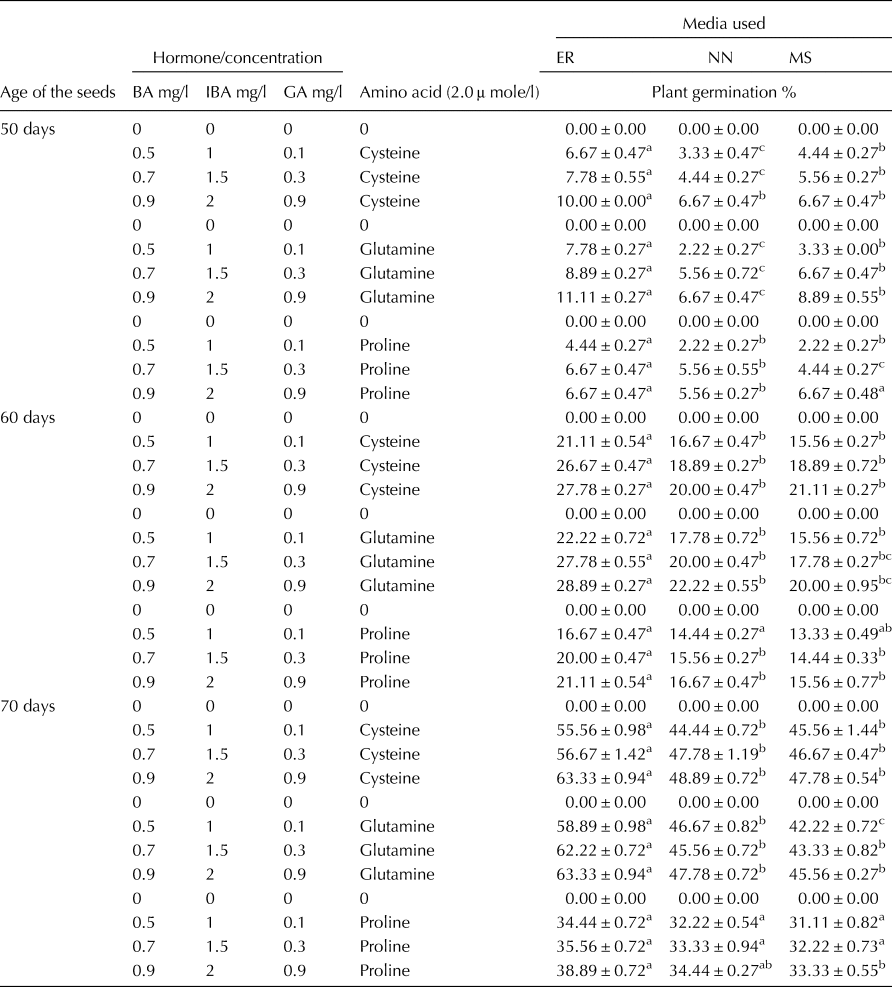
The response of grape embryo germination under different media composition

BA, benzylaminopurine; IBA, indole butyric acid; GA, gibberellic acid; ER, Emershad and Ramming; NN, Nitsch and Nitsch; MS, Murashige and Skoog.
The figure followed by the same letters within the rows is not significantly different according to Duncan's multiple range test at P < 0.01.
Hardening of plantlets
Plantlets that grew well were taken out from the test tubes, and plant roots were washed with sterile distilled water and transplanted into bottom holed plastic cups containing autoclaved soil, cocopeat, borokit and perlite in a 1:1:1:1 ratio. The plants treated with 0.5% (w/v) bavistin were covered with transparent plastic bags for tissue culture initially for 3 days (Fig. 1(f)). Then, the plants were shifted to the natural environment for hardening. The plants were regularly irrigated on a requirement basis. Then, the bags were removed, and the plants were transplanted in the field after 2 weeks.
Assessment of genetic fidelity
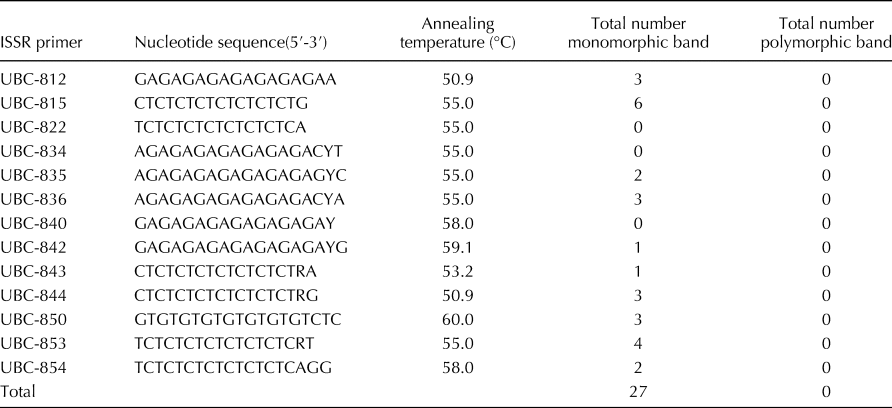
The molecular analysis of regenerated plants was performed using the inter simple sequence repeat (ISSR) analysis. DNA was isolated from 5 g of young leaves of the mother plant and seven randomly selected embryo-rescued plants according to the method described by Doyle and Doyle (Reference Doyle and Doyle1987). Leaf tissues were crushed in liquid nitrogen, and fine powder was used for DNA isolation. A total of 13 ISSR primers (Table 2) were assessed for the study by using polymerase chain reaction (PCR). PCR amplification was performed in a 15 μl volume of reaction mixture containing 1 μl of template DNA, 1.5 μl of 10 × PCR buffer, 0.35 μl of dNTPs (25 mM), 0.3 μl of MgCl2 (1.5 mM), 1.2 μl of random primer (10 pM), 0.25 μl of Taq-DNA polymerase and 10.4 μl of sterile Milli-Q water. PCR was performed using the ProFlex™ PCR System (Thermo Fisher Scientific, Mumbai, India). The temperature cycle was set as follows: initial denaturation at 94°C for 4 min and 1 min for cyclic denaturation for 36 cycles; annealing at 55°C for 1 min; and extension at 72°C for 1 min (with a final extension for 10 min at 72°C). PCR amplicons were analysed using agarose (1.5%) gel electrophoresis. One kilobase of DNA ladder (Fermentas, Mumbai, India) was used to determine the size of amplicons. The amplified products were visualized using a gel documentation system (AlphaImager™ 3400, USA). The amplification was repeated thrice with each primer to verify the reproducibility of results.
ISSR details screened for the genetic stability analysis

Statistical analysis
The experiment was set up in a completely randomized block design with three replications per treatment, and each replicate consisted of 30 explants. Data are represented as mean ± standard deviation. Analysis of variance was performed using SPSS 11.0, and differences between the means were compared by performing the Tukey's range test at a probability level of 5%.
Results
Effect of media containing different combinations of PGRs and AAs on embryo germination
The germination efficiency of embryos under different medium combinations was found to vary (Table 1). The seeds of 50, 60 and 70 days of age were grown in three different media, viz. ER, NN and MS under 36 different concentrations of BA, IBA and GA along with cysteine, glutamine and proline. The germination percentage of 50-day seeds was lesser than that of 70-day seeds. The germination percentage of 50-day seeds grown in ER, NN and MS media supplemented with 0.5, 1 and 0.1 mg/l of BA, IBA and GA, respectively, and cysteine, glutamine and proline was 6.67, 3.33, 4.44; 7.78, 2.22, 3.33; and 4.44, 2.22, 2.22, respectively. Similarly, the germination percentage of 50-day seeds grown in ER, NN and MS media supplemented with 0.7, 1.5 and 0.3 mg/l of BA, IBA and GA, respectively, and cysteine, glutamine and proline was 7.78, 4.44, 5.56; 8.89, 5.56, 6.67; and 6.67, 5.56, 4.44, respectively. The germination percentage of 50-day seeds grown in ER, NN and MS media supplemented with 0.9, 2 and 0.9 mg/l of BA, IBA and GA, respectively, and cysteine, glutamine and proline was 10, 6.67, 6.67; 11.11, 6.7, 8.89; and 6.67, 5.56, 6.67, respectively. However, without PGRs and AAs, no germination was recorded in all the three media.
The germination percentage of 60-day seeds grown in ER, NN and MS media supplemented with 0.5, 1 and 0.1 mg/l of BA, IBA and GA, respectively, and cysteine, glutamine and proline, was 21.11, 16.67, 15.56; 22.22, 17.78, 15.56; and 16.67, 14.44, 13.33, respectively. Similarly, the germination percentage of 60-day seeds grown in ER, NN and MS media supplemented with 0.7, 1.5 and 0.3 mg/l of BA, IBA and GA, respectively, and cysteine, glutamine and proline was 26.67, 18.89, 18.89; 27.78, 20, 17.78; and 20, 15.56, 14.55, respectively. The germination percentage of 60-day seeds grown in ER, NN and MS media supplemented with 0.9, 2 and 0.9 mg/l of BA, IBA and GA, respectively, and cysteine, glutamine and proline was 27.78, 20, 21.11; 28.89, 22.22, 20; and 21.11, 16.67, 15.56, respectively. However, without PGRs and AAs, no germination was recorded in all the three media.
The germination percentage of 70-day seeds grown in ER, NN and MS media supplemented with 0.5, 1 and 0.1 mg/l of BA, IBA and GA, respectively, and cysteine, glutamine and proline was 55.56, 44.44, 45.56; 58.89, 46.67, 42.22; and 34.44, 32.22, 31.11, respectively. Similarly, the germination percentage of 70-day seeds grown in ER, NN and MS media supplemented with 0.7, 1.5 and 0.3 mg/l of BA, IBA and GA, respectively, and cysteine, glutamine and proline was 56.67, 47.78, 46.67; 62.22, 45.56, 43.33; and 35.56, 33.33, 32.22, respectively. The germination percentage of 70-day seeds grown in ER, NN and MS media supplemented with 0.9, 2 and 0.9 mg/l of BA, IBA and GA, respectively, and cysteine, glutamine and proline was 63.33, 48.89, 47.78; 63.33, 47.78, 45.56; and 38.89, 34.44, 33.33, respectively. However, without PGRs and AAs, no germination was recorded in all the three media (Table 1).
The maximum germination efficiency recorded was 11.1% with ER media supplemented with 0.9 mg/l BA, 2 mg/l IBA, 0.9 mg/l GA and 2 μmol/ L-glutamine. No germination was recorded in any of the three media not supplemented with PGRs and AAs at any stage of the seed development. The germination percentage of 60-day seeds was in between the germination percentage of 50- and 70-day seeds. The maximum embryo germination percentage was 28.9 and 22.2% with ER and NN media supplemented with 0.9 mg/l BA, 2 mg/l IBA, 0.9 mg/l GA and 2 μmol/l glutamine as well as in MS media supplemented with 0.9 mg/l BA, 2 mg/l IBA, 0.9 mg/l GA and 2 μmol/l cysteine. However, the maximum germination percentage was observed for 70-day seeds in all the three media supplemented with different combinations of PGRs and AAs. The maximum germination percentage of 63.3, 48.9 and 47.8% was observed in ER, NN and MS media, respectively, supplemented with 0.9 mg/l BA, 2 mg/l IBA, 0.9 mg/l GA and 2 μmol/l cysteine (Table 1).
Assessment of genetic uniformity
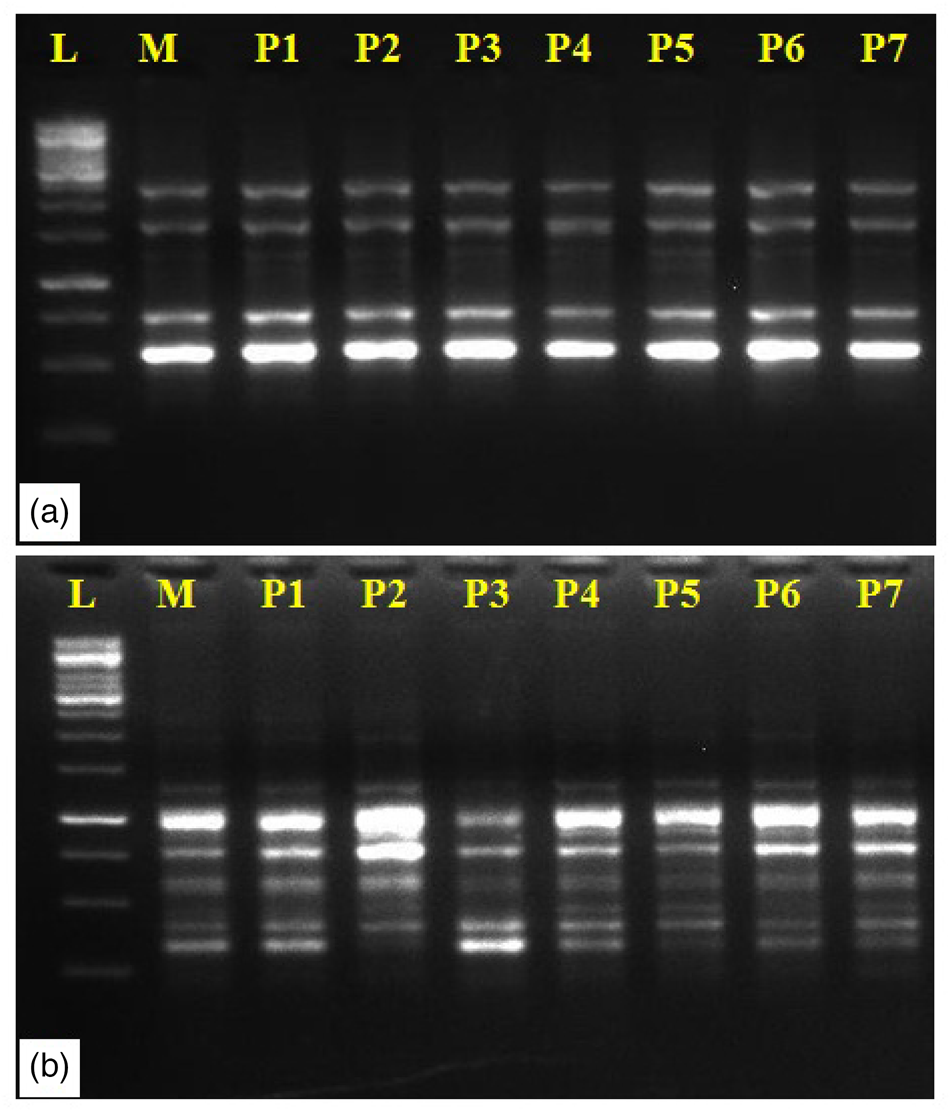
To assess genetic uniformity, randomly selected regenerated plants and the mother plant were analysed using the ISSR analysis under optimized PCR conditions. ISSR markers were used for a broad analysis of the genetic stability and variations in plants. The gel profile produced resolvable, clear and reproducible amplification products during the analysis; a unique set of amplified product was obtained from each primer. Among the 13 ISSR primers used in this analysis, 10 primers produced distinct and scorable bands ranging from 300 to 2500 base pairs, which varied from one to six in number (Table 2; Fig. 2(a) and (b)). No ISSR polymorphism was observed between the regenerated plants and the mother plant.
ISSR amplification of regenerated plantlets and mother plant; L, ladder 1 kb GeneRular; M, mother plant; P1 to P7 embryo rescued plants. (a) PCR amplification pattern of UBC-853 and (b) UBC-815.

Discussion
Embryo rescue is the most widely used technique to remove pre and post-transcriptional barriers, which hinder the proper development of embryos in intervarietal or interspecific crosses or distant breeding programmes. In case of grapes, seedlessness is the most common phenomenon important for table grapes and raisin preparation. In advanced breeding techniques, potential breeding varieties act as a crucial parenting material to target the issues related to biotic and abiotic stress. In grape breeding, to rescue inherently weak embryos, embryo rescue is performed for cultivars with seedless fruits/seeds with low germination capacity because of physiological and/or nutritional scarcity. This technique helps in developing such embryos into a normal plant, and it involves excising seeds/ovules and culturing on various compositions of the culture medium. The successful development of an embryo into a plant depends on various factors such as the genotype and developmental age of berries, season of berry collection, culture medium and PGRs, and additional supplements including AAs (Ji et al., Reference Ji, Li, Zhou, Yao and Wang2013). The developmental stage of embryos is a crucial factor; in the early developmental stage, a few embryos develop into mature embryos and then into plants (Li et al., Reference Li, Wang and Wang2013; Wang et al., Reference Wang, Hu, Jiao, Li, Fei, Yan and Wang2016). In the present study, a large number of embryos were obtained from the grape berries at the 70-DAF stage. The lowest embryo survival rate was found in the grape berries at 50 DAF (Table 1), and these results are in accordance with those of a study by Guo et al. (Reference Guo, Zhao, Li, Liu, Lin, Guo and Li2011), who reported embryo germination rates of 39–73% in grape berries from 55 to 80 DAF, which was the most suitable stage. In the early stage, embryos remain globular, which has the lowest germinating capacity, whereas during the late germination stage, embryos remain in the torpedo stage, which has the highest germination power (Li et al., Reference Li, Li, Wang and Xu2015).
Growth medium and its composition are the most important factors that determine the proper growth and development of embryos. In the present study, different medium combinations were screened for successful embryos rescue (Li et al., Reference Li, Li, Wang and Xu2015). Among all the tested combinations, ER medium supplemented with 0.9 mg/l BA, 2.0 mg/l IBA, 0.9 mg/l GA and 2.0 μmol glutamine showed the highest embryos germination capacity. The ER medium with the same PGRs and 2.0 μmol cysteine showed similar embryos germination capacity. Similar results were reported in a study by Guo et al. (Reference Guo, Gao, Zhao and Guo2004), wherein the embryos germination capacity of seedless grape was found to be higher in ER medium supplemented with 0.5 mg/l BA, 2 mg/l IBA and 0.5 mg/l GA3 than in NN and MS media; the same media with a higher concentration of PGRs showed higher embryos germination capacity. Furthermore, MS medium among all the tested media showed the highest callus formation and successful growth of embryos. Similarly, callus formation and durable embryos survival efficiency of MS medium compared with those of ER and NN media were reported by Singh and Brar (Reference Singh and Brar1992) and Singh et al. (Reference Singh, Singh and Singh2011).
Addition of specific AAs such as L-cysteine, L-glutamine and proline into the culture media improves embryo germination by supporting the maturation of developing embryos. In the present study, the addition of AAs significantly improved embryos germination, which may be because of the growth-supporting property of AAs; L-glutamine showed the highest effect on embryo germination among all the three AAs (Table 1, Fig. 3). Similar results were reported by Emershad et al. (Reference Emershad, Ramming and Serpe1989) and Tian and Wang (Reference Tian and Wang2008), who cultured the ovules of Thompson Seedless on Cain's basal medium fortified with L-asparagine, L-cysteine, L-glutamine and L-serine.
Flow chart showing embryo germination protocol step by step.

Genetic stability is the most desired characteristic during in-vitro plant development as different PGRs induce genetic changes. In this study, we also assessed the genetic stability of embryos by using ISSR markers. ISSR markers are frequently used to assess the genetic stability and diversity of plants and microbes (Srivastava et al., Reference Srivastava, Krishna, Sinha and Singh2017; Verma et al., Reference Verma, Jaiswal, Krishna, Prakash, Yadav and Singh2018). The ISSR analysis showed no noticeable variations among the embryo-rescued germinated plantlets and the mother plant from which the berries were collected. Similar to our results, unique and monomorphic banding patterns were reported by Srivastava et al. (Reference Srivastava, Krishna, Sinha and Singh2017). The genetic stability analysis confirmed the genetic uniformity and true-to-type nature of the in-vitro regenerated plants.
Conclusion
The present study provides a potent embryo-rescue protocol for the cultivation of grape cultivars having low seed-germination capacity. The screening of the three most commonly used media, ER, NN and MS, revealed that ER medium supplemented with 0.9 mg/l BA, 2.0 mg/l IBA and 0.9 mg/l GA is potent for rescuing embryos of the Red Globe grape cultivars. This study also showed that the grape berries at the 70-DAF stage are most suitable for rescuing embryos from the immature seed. Furthermore, L-glutamine was found to be the most potent supplement for embryo-rescue germination. This study provides an efficient medium recipe consisting of PGRs and AAs for embryo-rescue germination without affecting the genetic stability of plants, and the medium composition can also be efficient for the germination of other grape cultivars.
Acknowledgements
The authors are thankful to the Director, ICAR-Directorate of Onion and Garlic Research, Rajgurunagar, Pune, and ICAR-National Research Centre for Grape, Pune, Maharashtra, India for generously providing laboratory facilities.