Introduction
Understanding the fine-grain distribution of species improves our knowledge of their ecology and behaviour and allows for further testing of hypotheses relating to their distribution (Block & Brennan Reference Block, Brennan and Dennis1993). In the extensive Neotropical forests, the occurrence of some bird species is related to highly specialised micro-habitat use, including treefall gaps, along watercourses, and in patches of bamboo or Heliconia spp. (Kratter Reference Kratter1997, Marra & Remsen Reference Marra and Remsen1997, Thiollay Reference Thiollay1994). There are also unexplained cases of territory grouping with interspersed vacant areas within apparently high-quality habitat (Robinson et al. Reference Robinson, Brawn and Robinson2000, Robinson & Terborgh Reference Robinson and Terborg1995, Thiollay Reference Thiollay1994). In highly fragmented landscapes, these microhabitats can be lost or disconnected. This often results in forest fragments having fewer species of birds when compared with continuous forests. Lack of habitat, small habitat size, and poor connectivity to primary forests can also result in fewer species. In addition, a hostile matrix, edge effects, and mesopredator release can negatively affect bird species (Laurance & Bierregaard Jr Reference Laurance and Bierregaard1997, Mayhew et al. Reference Mayhew, Tobias, Bunnefeld and Dent2019, Willis Reference Willis1979, Wilson & Willis Reference Wilson, Willis, Cody and Diamond1982). Less-researched variables including larger territories and ranges, topography, and climate change could aid in the understanding of local species distribution in the tropics (Davies et al. Reference Davies, Orme, Storch, Olson, Thomas, Ross, Ding, Rasmussen, Bennett, Owens, Blackburn and Gaston2007, Robinson et al. Reference Robinson, Leonard, Bennett and Clarke2016, Sheldon Reference Sheldon2019, Virkala et al. Reference Virkala, Aalto, Heikkinen, Rajasärkkä, Kuusela, Leikola and Luoto2020, Willig et al. Reference Willig, Presley, Bloch, Castro-Arellano, Cisneros, Higgins and Klingbeil2011).
Topography is an understudied variable that has important implications for the structure and dynamics of tropical forest communities (Remes & Harmáčková Reference Remeš and Harmáčková2018, Sawada et al. Reference Sawada, Aiba, Takyu, Repin, Nais and Kitayama2015, Stratford & Stouffer Reference Stratford and Stouffer2013). Relief diversity and orographic rains are important determinants of bird species richness across several vegetation types in the Neotropical region (Rahbek & Graves Reference Rahbek and Graves2001) and forest structure can be strongly related to soil and humidity characteristics (Cintra & Naka Reference Cintra and Naka2012, Oliveira Filho et al. Reference Oliveira-Filho, Vilela, Carvalho and Gavilanes1994). In the Andes, the mid-level altitudinal strip at 800–1200 m asl holds the highest bird species richness when compared to strips above and below it. This pattern is attributed to having a more local complex mosaic of micro-habitats (patchiness) due to a more complex topography than at other elevations (Terborgh Reference Terborgh1977). Additionally, the location of some manakin (Pipridae) leks can be dictated by the local topography of the forest (Loiselle et al. Reference Loiselle, Blake, Durães, Ryder and Tori2007). However, the effect of topography on the spatial distribution of Neotropical bird species remains poorly understood (Ribon Reference Ribon2003, Robinson et al. Reference Robinson, Brawn and Robinson2000, Stratford & Stouffer Reference Stratford and Stouffer2013).
The above patterns have been found in pristine or well-conserved forests, but not in secondary growth (Brown & Lugo Reference Brown and Lugo1990). Within secondary forests, vegetation is much more homogeneous in terms of plant diversity and micro-habitat complexity. In addition, birds appear to show a more homogeneous distribution within the same vegetation type (Loiselle & Blake Reference Loiselle and Blake1994, Ribon & Marini Reference Ribon and Marini2016, Stratford & Stouffer Reference Stratford and Stouffer2013). If all that remains in a region are fragments composed of secondary growth, or highly disturbed old-growth vegetation, many bird extinctions can occur (Ribon et al. Reference Ribon, Simon and Mattos2003, Willis Reference Willis1979, Willrich et al. Reference Willrich, Calsavara, Lima, De Oliveira, Bochio, Rosa, Muzi and Dos Anjos2016). Thus, unveiling patterns of bird occupancy at secondary forests is of special interest given that most pristine forests in the world tend to be restricted to reserves and secondary forests are increasingly replacing primary forests (Brown & Lugo Reference Brown and Lugo1990).
The Atlantic Forest is a world biodiversity hotspot (Myers et al. Reference Myers, Mittermeier, Mittermeier, Fonseca and Kent2000) now mostly composed of secondary-forest patches (Ribeiro et al. Reference Ribeiro, Metzger, Martensen, Ponzoni and Hirota2009). It has ˜76% of Brazil’s endemic-threated species (Marini & Garcia Reference Marini and Garcia2005) and three of its bird species are now officially considered extinct (MMA 2014). Updated data from high-resolution satellite images have shown that 26% of the original biome is covered by forest in various successional stages (Rezende et al. Reference Rezende, Scarano, Assad, Joly, Metzger, Strassburg, Tabarelli, Fonseca and Mittermeier2018) and knowledge of how birds use remnant forest patches is needed if we want to increase our chances of preventing further bird extinctions in the biome.
In this paper, we investigate the distribution pattern of birds across secondary-forest fragments to test the hypotheses that bird’s occupancies are affected both by fragment size and relief types. We expected that fewer species would occupy smaller fragments and that species would occupy selective relief types (topography). We estimated bird species’ abundance in Atlantic forest secondary fragments and investigated their relationship with fragment size and topographic measurements with occupancy models.
Methods
Study site
The study area is found within a 100-km2 region in Viçosa, Paula Cândido, and Cajuri counties, in south eastern State of Minas Gerais, Brazil (20o42′30″-20o50′00″S; 42o48′45″-42o56′15″ W) (a map of the study area and a brief history of the forest fragmentation process and bird surveys in the region can be found in Ribon et al. Reference Ribon, Simon and Mattos2003). The region is located in the Atlantic Forest domain and was originally covered by submontane semideciduous forest (Brant Reference Brant2004, Oliveira-Filho & Fontes Reference Oliveira-Filho and Fontes2000), with altitudes ranging from 600 to 800 m asl. Currently, the forest is fragmented and comprises remnants of second-growth or highly disturbed old-growth forest immersed in a matrix of pastures, coffee, annual crops, and Eucalyptus plantations. The few old-growth forest patches remaining have suffered moderate to strong selective logging throughout the years. Most remnants are located on hillsides or hilltops, have very few lowlands or ravines, and none of the fragments contains significant streams (Pereira Reference Pereira1999).
Fragment selection and measurements
In 1996, the 243 native forest fragments of the area had their size measured from 1:10,000 scale orthophotos taken from 1986 to 1987. The orthophotos were produced by the Companhia Energética de Minas Gerais (CEMIG) (Appendix 1 - Supplementary Material), and their resolution was much better than the available satellite images at the time. This even allowed the visualisation of very small forest fragments and dirt roads. After measuring, 41 forest fragments ranging from 1.0 to 384.5 ha (mean = 192.8 ha) were randomly selected to be sampled (Appendices 1 and 2 - Supplementary Material).
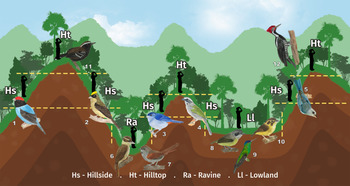
The different relief types of each fragment were classified after Espartel (Reference Espartel1977) as lowland, hillside, hilltop, or ravine. Lowlands were flatter, more humid areas covered by forest. The lower half of a forested hillside was considered one of the sides of a ravine if its bottom ended in the bottom of another immediately closer hillside, forming a v-shape bottom. Thus, ravine was defined as the part of the terrain between the lower halves of two adjacent hillsides. If the immediate neighbour of the lower part of a hillside was a flatter area, then the place was considered as hillside as opposed to ravine. Hilltop was the upper half of any hillside covered by forest vegetation.
Bird sampling
At each of the 41 forest fragments, one to 15 census points were established according to fragment size (Appendix 2 - Supplementary Material). Birds were identified by their songs, calls, mechanical sounds, and visually. They were sampled by unlimited radius point counts (Ralph et al. Reference Ralph, Droege, Sauer, Ralph, Droege and Sauer1995) with points located at least 150 m apart and 50 m from forest edges. Points were distributed across fragments covering the four topographic types: lowland (n = 10), ravine (n = 34), hillside (n = 103), and hilltop (n = 89). The number of survey points at each topographic type was determined at random as these points where located in order to cover as much of each forest fragment as allowed by its size and shape (up to a limit of 15 points in larger fragments). Thus, a total of 236 points were sampled six times each (n = 1416 samples), between April 1996 and April 1997 (four counts), and twice in 1999. Sampling lasted 10 min, starting near dawn to 10h00 and from 16h00 to shortly before sunset.
Species were classified in three habitat groups according to their dependence on forest habitat at the local level (pers. obs., Ribon et al. Reference Ribon, Simon and Mattos2003), although some species were assigned to other categories and geographic ranges (Stotz et al. Reference Stotz, Fitzpatrick, Parker and Moscovits1996). These categories included: Open-country: species that feed and breed in grasslands and scrublands but are occasionally found in forest patches, almost always at their edges. Habitat-generalist: species regularly found in grassland and scrubland, gardens, and orchards. They also occur in forest patches, where they often inhabit both the edges and the interior. Some species breed only in the forest edges, while others were observed with nests near or in buildings, or within scattered trees or clusters of trees isolated in pasturelands. Forest-dependent: species only exceptionally observed outside forest fragments, occurring at forest edges but breeding mainly in the forested habitat. Birds were classified into foraging guilds after Ribon et al. (Reference Ribon, Simon and Mattos2003). Bird nomenclature and systematic order follow Piacentini et al. (Reference Piacentini, Aleixo, Agne, Maurício, Pacheco, Bravo, Brito, Naka, Olmos, Posso, Silveira, Betini, Carrano, Franz, Lees, Lima, Pioli, Schunck, Amaral, Bencke, Cohn-Haft, Figueiredo, Straube and Cesari2015).
Data analysis
Species occurring in <30 sampling points were excluded from the analysis because we were not able to perform the analysis with species that have relatively small sample size. Moreover, for some species, modelling did not estimate all parameters properly (parameters on their boundary did not have proper estimates of their standard errors.). In these cases, we excluded the species from the analysis.
We estimated occupancy probability of each bird species (ψ) using multi-season occupancy modelling (Mackenzie et al. Reference Mackenzie, Nichols, Hines, Knutson and Franklin2003). Dynamic occupancy models estimate initial occupancy (ψ), local colonisation (γ), and extinction (ϵ) probabilities, while accounting for imperfect detection (p). Occupancy is defined as the probability that a species is present at site I, and detection is the conditional probability that given the presence, a species is detected at site i at time t (Bailey et al. Reference Bailey, Simons and Pollock2004). The detection probability incorporated into the models accounts for imperfect detection, which reduces bias in parameters estimation (MacKenzie et al. Reference Mackenzie, Nichols, Royle, Pollock, Bailey and Hines2006). Colonisation and extinction parameters are probabilities that a site become occupied or unoccupied between consecutive seasons, representing dynamic processes through time (MacKenzie et al. Reference Mackenzie, Nichols, Royle, Pollock, Bailey and Hines2006). Here, we considered each year as a distinct season. To evaluate the relationship among relief types and fragment size with probability of occupancy of each bird species, we built models with initial occupancy, detection probability, and colonisation and extinction probability between years.
We split data among three years (1996, 1997, and 1999) combining detections into periods of 3 d (occasions) in 1996, 2 d in 1997 and 1999, to build detection histories for each site. The repeated sampling survey allowed us to estimate detection probability incorporated into the models. We computed data as presence (1) or absence (0) for each species per site, during each occasion.
We first fitted four models with local colonisation and extinction parameters fixed to zero (static occupancy state between years) or estimated (non-zero) and detection varying or not between years. This approach allowed us to test for the closure assumption. We selected the best supported model based on Akaike’s Information Criterion adjusted for small sample size (AICc value) (Burnham & Anderson Reference Burnham and Anderson2002). When the model with static occupancy and constant detection probability was best supported, we did not model seasonality effects on species detection and instead performed a single-season occupancy modelling with six occasions (three years). We performed these models for southern antpipit Corythopis delalandi, plain antvireo Dysithamnus mentalis, lesser woodcreeper Xiphorhynchus fuscus, violet-capped woodnymph Thalurania glaucopis, olivaceous woodcreeper Sittasomus griseicapillus, chestnut-vented conebill Conirostrum speciosum, lineated woodpecker Dryocopus lineatus, serra antwren Formicivora serrana, white-eyed foliage-gleaner Automolus leucophthalmus, black-billed scythebill Campylorhamphus falcularius, tataupa tinamou Crypturellus tataupa, tufted antshrike Mackenziaena severa, short-crested flycatcher Myiarchus ferox, social flycatcher Myiozetetes similis, dusky-throated hermit Phaethornis squalidus, squirrel cuckoo Piaya cayana, gilt-edged tanager Tangara cyanoventris, and surucua trogon surrucura. Otherwise, we performed multi-season occupancy modelling. Next, we built a set of all possible additive combination models allowing detection probability to vary with year and relief type, while keeping the other parameters constant. Finally, we modelled occupancy probability as a function of relief type and forest fragment size. Here, we used the detection probability of the top-ranked model from the previous step and built models with all possible additive covariate combinations for occupancy. We were not able to perform interactions between variables as the amount of data was not sufficient to run more complex models. The models we used to estimate colonisation and extinction parameters were by default, and it was not our aim to estimate them. Thus, we held these parameters constant in all models (gamma(.) eps(.)). When we were not able to estimate occupancy and/or detection parameters, we performed single-season occupancy models with data collected in 1996, the first year of the study. We performed these models for grey-bellied spinetail Synallaxis cinerascens, rufous-capped spinetail Synallaxis ruficapilla, pale-breasted thrush Turdus leucomelas, roadside hawk Rupornis magnirostris, and reddish hermit Phaethornis ruber. After that, if we were not able to estimate occupancy and/or detection parameters, we excluded the species from analysis (Appendix 3 - Supplementary Material).
Occupancy analysis was conducted in Program MARK 9.x (White & Burnham Reference White and Burnham1999). We built models with all possible additive combinations of relief type and fragment area variables for occupancy and detection probabilities, resulting in a balanced set of models (i.e., a set where each variable occurs the same number of times) (Doherty et al. Reference Doherty, White and Burnham2012). Since our aim was to assess the relationship among covariates and occupancy probability of bird species, we built a balanced model set based on all combinations of our a priori biological hypotheses. We used Akaike’s Information Criterion with small sample size correction (AICc) to rank competing models and selected top models based on ΔAICc values and the relative weight of support (w i) of each model. We then model-averaged occupancy across the final set of models to make inferences (Burnham & Anderson Reference Burnham and Anderson2002). Finally, we calculated relative importance of variables (the cumulative AICc weights of variables) to select the most important variables to explain the variation on the occupancy probabilities. We considered important variables with AICw values above 0.5 (Barbieri & Berger Reference Barbieri and Berger2004).
Results
We recorded 21,464 birds of 169 species in the 41 forest fragments. The maximum number of points for a given species was 235 for golden-crowned warbler (Basileuterus culicivorus).
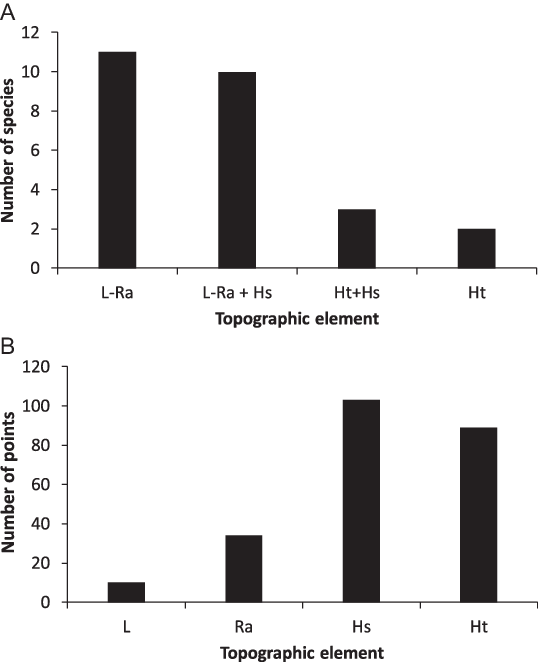
We were able to estimate occupancy probability of 67 species and found that relief type was an important variable for 26 species (38.8%) (relative importance of variable ranging from 0.53 to 0.99, Appendix 3 - Supplementary Material, Figure 1) and fragment size was important for 46 species (relative importance of variable ranging from (0.56 to 1, Appendix 4 - Supplementary Material). Regarding relief type, 11 species had a higher probability of occupying lowlands and ravines (ψlowlands/ravines = 0.37–0.99); another 10 species had a higher occupancy probability in lowlands/ravines and hillsides (ψlowlands/hillsides = 0.51–0.94); three species had a higher probability of occupy hilltops and hillsides (ψhilltops/hillsides = 0.67–0.99), and two species had a higher occupancy probability in hilltops (ψhilltops = 0.49–0.80). For the remaining 41 species, we found weak evidence that occupancy probability varies with type of relief, indicating no relief-type preference. For most species, occupancy probability did not vary with fragment size (Appendices 3, 4, and 5 - Supplementary Material). Even species for which this variable was important, the beta coefficient showed confidence intervals that included zero or were very close to zero. This indicates that fragment size was important but had a weak relationship with the occupancy probability.
Schematic representation of the four relief types in 41 fragments of semidecidual Atlantic Forest, and groups of bird species associated with each type covered by the forest. Given the small number of lowlands, and sampling points on them, and due to the vegetation and microclimate similarities among lowlands and ravines, birds associated with them were grouped into the category lowland-ravines. Hillsides and hilltops had a much larger number of points to keep them separated in the analysis. Human silhouettes indicate hypothetical sampling points. Dashed lines represent approximated limits of each relief type. The bird species illustrated represents some of the species in each group – Species associated with lowlands/ravines and hillsides: 1) Chiroxiphia caudata, 2) Trichothraupis melanops, 3) Conisrostrum speciosum, 4) Saltator similis, and 5) Thraupis sayaca; species associated with lowlands and ravines: 6) Anabazenops fuscus, 7) Synallaxis cinerascens, 8) Dysithamnus mentalis, 9) Thalurania glaucopis, and 10) Platyrinchus mystaceus; species associated with hilltops: 11) Formicivora serrana and 12) Dryocopus lineatus.

Ninety-two species occurred in up to 30 points and were excluded from the analysis, including 54 forest-dependent species, 30 habitat-generalist species, and 17 open-country species. Nine species were found in more than 30 points, but the modelling procedures did not properly estimate all parameters, thus totalling 101 species for which the verification of their association to topography was not possible (Appendix 4 - Supplementary Material).
The majority of species that showed an association to some type of relief had an association with lowlands and ravines and some kind of combination of these and hillsides and hilltops (Figure 2). Twenty of 26 species with some association with a relief type were forest species, and the other six were habitat generalist species. Although forest species were most associated with some type of relief, six habitat generalist and common species presented higher occupancy probability in other parts of the forest. Great kiskadee Pitangus sulphuratus, sayaca tanager Thraupis sayaca, and bananaquit Coereba flaveola were associated with lowland/ravines and hillsides, while picazuro pigeon Patagioneas picazuro and T. leucomelas were associated with hillsides and hilltops, and Dryocopus lineatus was associated with hilltops.
Distribution of the number of birds that prefer different topographic elements (A) and distribution of sampled points in each topographic element (B) in 41 Atlantic Forest fragments in the Viçosa region, south eastern Brazil. L = lowland, Ra = ravine, Hs = hillside, Ht = hilltop.

Discussion
Our analyses demonstrated that topography can be an important variable affecting the spatial distribution of birds in secondary tropical forest fragments, a finding in line with other botanical studies (Burnett et al. Reference Burnett, August, Brown and Killingbeck1998, Clark et al. Reference Clark, Palmer and Clark1999). The differential use of relief by some species of birds has already been reported elsewhere for old-growth forests (Cintra & Naka Reference Cintra and Naka2012, Robinson et al. Reference Robinson, Brawn and Robinson2000, Stratford & Stouffer Reference Stratford and Stouffer2013, Terborgh Reference Terborgh1977). However, our study seems to be the first to analyse the spatial distribution of a tropical forest bird community under the context of topographic association in secondary-forest fragments. Our data have shown that the distribution of one-third of the bird species in the forest Atlantic Forest fragments studied is significantly affected by topography. Furthermore, each of these species has specific preferences with respect to relief. A variety of microhabitats and differences in vegetation structure and composition are also important determinants of bird distribution within a given forest type (Marra & Remsen Reference Marra and Remsen1997, Robinson & Terborgh Reference Robinson and Terborg1995, Stratford & Stouffer Reference Stratford and Stouffer2013). In addition to our research, other studies conducted in Central America and the Amazon (Cintra & Naka Reference Cintra and Naka2012, Loiselle et al. Reference Loiselle, Blake, Durães, Ryder and Tori2007, Stratford & Stouffer Reference Stratford and Stouffer2013) have also highlighted the importance of studying topography when trying to explain bird distribution at small spatial scales in both secondary and old-growth forests. The fact that topography is important even at degraded fragments and vegetation suggests that topography-related variables could be deeply linked to species life histories and niche breadth.
Among the species with preference for some relief-type X. fuscus, D. mentalis, white-collared foliage-gleaner Anabazenops fuscus and black-goggled tanager Trichothraupis melanops are intensely associated with mixed-species flocks, an association among insectivorous birds which is strongly affected by seasonality and fragment size in the study area (Maldonado-Coelho & Marini Reference Maldonado-Coelho and Marini2003, Reference Maldonado-Coelho and Marini2004). The red-crowned ant-tanager (Habia rubica) is a key leader species of understorey flocks in the Viçosa forest fragments. Although we were unable to run the models for this species, a separate method with similar results to those presented here has shown a strong relationship between this species and lowlands and ravines (Ribon Reference Ribon2003). When the red-crowned ant-tanager is not present in a forest fragment, the other understorey species that regularly gather with it in mixed species flocks either maintains themselves together as a flock just for a few minutes, or do not group as a flock at all (Maldonado-Coelho & Marini Reference Maldonado-Coelho and Marini2003). Thus, the maintenance of understorey mixed-species flocks in our study area is probably strongly dependent on the maintenance of forested lowlands and ravines with dense understorey, as, otherwise, the red-crowned ant-tanager would locally disappear. Also, the lek-making swallow-tailed manakin Chiroxiphia caudata prefers lowlands-ravines and hillsides, similarly to the blue-backed manakin Chiroxiphia pareola leks in Ecuadorian pristine forests (Loiselle et al. Reference Loiselle, Blake, Durães, Ryder and Tori2007). The forest species above are more specialised in terms of diet and habitat and, because of this, some degree of topographic specialisation could also be expected. However, it was unexpected that such generalist species as great kiskadee and sayaca tanager have shown some association with topography as they have shown in our study. What variables and mechanisms drive these species and the others that showed association with some relief type are however still to be revealed.
Our study demonstrated that topography affects the bird community at a considerably larger spatial scale, since we investigated forest fragments of several sizes, history, and disturbance levels within a 100-km2 landscape. This stresses the importance of topography and spatial scale for the study of species richness. Most studies at small and medium scales traditionally evaluate species niche (Ricklefs & Miller Reference Ricklefs and Miller2000) mostly under the vegetation structure scope, including leaf litter (Stratford & Stouffer Reference Stratford and Stouffer2013). However, tropical birds are known to use highly specific microhabitats (patches of bamboo or Heliconia spp.), different heights, foraging substrates, and food items (Marini & Cavalcanti Reference Marini and Cavalcanti1993, Marra & Remsen Reference Marra and Remsen1997) that help increase richness of tropical forests. This differential use of parts of the topography show another dimension within a forest allowing several species to expand or decrease their niches, increase specialisation, decrease niche overlap, and potentially increase local species richness (Schoener Reference Schoener, Diamond and Case1986).
An uneven qualitative and quantitative distribution of food items (fruits and insects) across different reliefs might be one of the factors determining bird distribution. Many plants are distributed differentially with respect to topography (Clark et al. Reference Clark, Palmer and Clark1999, Whittaker Reference Whittaker1967) which may also affect the distribution of their associated insects (Bernays & Chapman Reference Bernays and Chapman1994). In addition, nest-site selection could also explain part of the preference for some relief types since nest microclimate might affect egg/nestling development (Rahn Reference Rahn and Seymour1984, Walsberg Reference Walsberg1980) and that topography has been demonstrated to affect both nest-site selection and breeding success (Newell & Rodewald Reference Newell and Rodewald2011). Overall, birds vary strongly in the location and selection of nest sites (Mainwaring et al. Reference Mainwaring, Reynolds, Weidinger, Deeming and Reynolds2015), including those from Neotropical forests in south eastern Brazil (Marini et al. Reference Marini, Aguilar, Andrade, Leite, Anciães, Carvalho, Duca, Maldonado-Coelho, Sebaio and Gonçalves2007).
We must stress that most forest fragments of the region cover mainly hillsides and hilltops and those at ravines and lowlands are rare (Pereira Reference Pereira1999, Valverde Reference Valverde1954). Thus, the lack of ravines and lowlands is probably an important factor affecting the occurrence and distribution of many species in the region. For example, some of the species that showed a preference for ravines and lowlands were recorded in <10% of the sampling points (grey-hooded attila, cliff flycatcher, rufous-capped motmot, ferruginous antbird Drymophila ferruginea, rufous-winged antwren Herpsilochmus rufimarginatus, red-crowned ant-tanager, rufous-headed tanager Hemithraupis ruficapilla, and grey elaenia Myiopagis caniceps), and some of them are already locally threatened by extinction (Ribon et al. Reference Ribon, Simon and Mattos2003). Areas with more heterogeneous topography might also promote long-term stability of ecological systems under climatic change (Hindle et al. Reference Hindle, Kerr, Richards and Willis2015). Changes in traditional monoculture systems and pasturelands into more complex systems, such as agroforestry (Goulart et al. Reference Goulart, Salles, Saito and Machado2013) should also be stimulated in the region both in ravines and lowlands as well as in hilltops and hillsides in already deforested spots. Thus, conservation and management programmes, as well as the selection of reserves, in areas with heterogeneous terrain will probably sustain a higher diversity of species at the landscape level. Many bird species of humid tropical forests avoid secondary forests, and this avoidance can be related to both simple vegetation structure and harsh microclimate (Stratford & Stouffer Reference Stratford and Stouffer2013). Thus, restoration projects aiming to recover native vegetation (ITTO 2002) should prioritise lowlands and ravines not just because of their importance to environmental services such as water production, but also as places where microclimate harshness can be alleviated. Although still poorly explored by ecologists, the relationship of tropical forest birds (and other taxa) to forest relief can bring important insights to the understanding of habitat selection, population dynamics and community structure not only in large and continuous pristine forests but also in fragmented and human-disturbed landscapes.
Acknowledgements
Coordenação de Aperfeiçoamento de Pessoal de Nível Superior (CAPES), Conselho Nacional de Desenvolvimento Científico e Tecnológico (CNPq), Graduate Program in Wildlife Ecology, Conservation and Management of the Universidade Federal de Minas Gerais, Programa Nacional de Biodiversidade/Ministério do Meio Ambiente/ (PROBIO/MMA/BIRD/GEF), “Programa Natureza e Sociedade” of the World Wildlife Fund/United States Agency for International Development (WWF/USAID project CSR 142-00), American Bird Conservancy (PMAY00396), and the U.S. Fish and Wildlife Service funded Master and-or Doctorate fellowships or grants to RR from which this manuscript result. PDM Jr. and MÂM received researcher fellowships from CNPq. LRS received a post-doc fellowship from Fundação de Apoio à Pesquisa do Distrito Federal (FAP-DF). We thank, G. A. B. Fonseca, J. E. Figueira, R. B. Cavalcanti, M. Cohn-Haft, and S. K. Robinson for suggestions and improvements of earlier drafts. J. F. Pacheco helped in the identification of some bird vocalisations. J. Stratford, I. Turner, and an anonymous reviewer greatly improved the manuscript. These reviewers and BJ Byers greatly improved the English. In memory of José Eduardo Simon, who gave to RR the first hints on the association of some birds to the ravines. Liara A. Cassiano greatly improved a first version of Fig. 1 with her bird drawings.
Competing interests
The authors declare none.
Supplementary material
To view supplementary material for this article, please visit https://doi.org/10.1017/S0266467421000328