Introduction
WHAT are the effects of foreign aid on the perceived legitimacy of recipient states? According to prominent accounts of state legitimacy in political science, the more citizens credit the state with providing services equitably and effectively, the more legitimate they will perceive the state to be. Legitimacy reflects the belief that the state has a “right to rule,” and thus to impose restrictions and extractions on citizens.Footnote 1 The more legitimate citizens perceive the state to be, the more willing they will be to obey state laws and to pay state taxes, thus increasing the state’s capacity to provide services. The result is a virtuous circle in which service provision increases state legitimacy, and state legitimacy increases service provision.Footnote 2
Scholars have long argued that aid and other forms of third-party service provision rupture this virtuous circle.Footnote 3 A large and established cross-national literature finds that aid has adverse effects on the behavior of government officials and the performance of government institutions, exacerbating corruption and diminishing the strength of the bureaucracy at the macrolevel.Footnote 4 This may decrease state legitimacy if citizens conclude that the state is too weak or corrupt to provide services equitably and effectively. But subnationally, recent research finds little evidence of similarly deleterious effects on state legitimacy as perceived by the citizens who experience aid most directly, such as by using or otherwise learning about donor-provided services.Footnote 5 At the microlevel, the effects of aid on state legitimacy in the eyes of citizens appear to be benign.
We hypothesize that one possible explanation for these null results lies in the particular types of donors that previous scholars have studied at the microlevel. Different donors adhere to different rules, principles, and operating procedures. We refer to these rules, principles, and procedures as aid regimes. Donors within the Organization for Economic Cooperation and Development, for example, typically follow guidelines issued by the oecd’s Development Assistance Committee (dac), of which the United States, the European Union, and twenty-eight other countries are members. These guidelines influence the types of projects funded by oecd donors; the regulations, restrictions, and good governance conditionalities that oecd donors impose on recipient states; and the transparency with which aid from oecd donors is disbursed. Although compliance with these guidelines is imperfect, their existence nonetheless ensures a degree of homogeneity across oecd aid regimes.
To our knowledge, all existing studies of aid and state legitimacy at the microlevel focus on oecd donors.Footnote 6 But in recent years, the oecd has faced increasingly fierce competition from “nontraditional” donors like Qatar, Saudi Arabia, and, most important, China. Over the past two decades, China has dramatically increased the amount of aid it provides to developing countries, especially in Africa.Footnote 7 China’s rise as a donor and investor has proven highly controversial. Critics argue that China is underwriting “a world that is more corrupt, chaotic, and authoritarian.”Footnote 8 This perspective is shared by officials at the highest levels of the US government, who accuse China of undermining democracy and human rights in recipient countries.Footnote 9 In contrast, advocates—including some African heads of state—praise China for delivering aid more quickly, at lower cost, and with fewer strings attached than its oecd rivals do.Footnote 10
The Chinese aid regime differs dramatically from that of most oecd donors. oecd donors tend to impose antibribery and anticorruption regulations on recipient countries, but China typically does not. Many oecd donors condition aid on the adoption of political or economic reforms; again, China typically does not. And although most oecd donors participate in international aid transparency initiatives, China usually doesn’t. We argue that these features of the Chinese aid regime may have important implications for the legitimacy of recipient states, especially those in Africa. But these implications remain understudied and poorly understood, even as Chinese aid to Africa continues to grow and as research on the nature and effects of that aid is expanding.Footnote 11
In a preanalysis plan (pap),Footnote 12 we predicted that Chinese aid would diminish the legitimacy of recipient states, both in absolute terms and relative to aid from oecd donors. We theorized that the effects of aid on state legitimacy would depend on whether citizens give credit to donors or to recipient states for the services donors provide (attribution), whether they believe donor-provided services are distributed fairly and transparently (procedural legitimacy), and whether they perceive donor-provided services to be of high quality (outcome-based legitimacy). We hypothesized that Chinese aid would have adverse effects on state legitimacy because citizens would be less likely to credit recipient states with the services provided by China, less likely to believe Chinese-provided services are distributed fairly and transparently, and less likely to perceive Chinese-provided services as high quality. Drawing on theories of retrospective voting,Footnote 13 we predicted that Chinese-provided services would generate disaffection not only with China, but also with the local government officials and institutions responsible for regulating China’s actions—even when those actions are largely or entirely out of the government’s control. We motivate these predictions in further detail below.
We test our hypotheses by combining multiple data sources and multiple measurement and identification strategies at multiple levels of analysis. We integrate cross-country analysis of data from Afroba-rometer, AidData, and the Aid Information Management Systems of African finance and planning ministries with within-country analysis of original surveys, survey experiments, and behavioral games in Liberia, one of the world’s most aid-dependent states. Each of these approaches complements and compensates for the limitations of the others. We triangulate between them. Although we test the effects of aid on multiple indicators of state legitimacy, we focus in particular on tax compliance—the extent to which citizens actually pay taxes—and tax morale—the extent to which citizens believe they have a duty to pay taxes.Footnote 14
Tax morale captures the “value-based” component of legitimacy, defined as citizens’ “sense of obligation or willingness to obey authorities.” Tax compliance captures the behavioral component, defined as “actual compliance with governmental regulations and laws.”Footnote 15 We focus on taxation because it’s central to the virtuous circle of service provision and state legitimacy described above, and is also central to the more general challenge of “building and sustaining the power of states, and shaping their ties to society.”Footnote 16 Not coincidentally, tax compliance and morale are among the most prominent and widely used proxies for state legitimacy in the social sciences.Footnote 17 Indeed, in many respects the “general problem of legitimacy” is best understood as a problem “exhibited in the authority of the tax collector.”Footnote 18 To explore the robustness of our results, we also test the effects of aid on several additional proxies for state legitimacy.
Contrary to our expectations, we find little evidence that Chinese aid has diminished the legitimacy of recipient states in Africa, either in absolute terms or relative to aid from the US, China’s most important oecd rival. In Liberia, we find that randomly assigned vignettes about donor-provided services have either null or, in the case of US aid, positive effects on tax compliance and morale as measured through surveys and behavioral games. Similarly, we find that Liberians who are most affected by US aid typically have more favorable rather than less favorable perceptions of the Liberian government. Exposure to Chinese aid is not associated with perceptions of the Liberian government one way or the other. Across other African countries as well, we use a spatial difference-in-differences estimator to show that both Chinese and US aid generally have null or even positive effects on perceptions of government after correcting for potential selection biases. These results are consistent across measurement and identification strategies, and, as we discuss below, are unlikely to be artifacts of measurement error, selection bias, or statistical power. We conclude by considering the implications of our results for the study and practice of providing aid in the future.
Theoretical Framework
Foreign Aid and State Legitimacy
The most prominent accounts of state legitimacy posit that states gain legitimacy when citizens credit them with providing services, and with doing so equitably and effectively. Citizens who credit the state for the services it provides will view the state as legitimate, and will respond by taking actions that facilitate further service provision—most importantly, by paying taxes.Footnote 19 The result is a virtuous circle by which service provision increases state legitimacy and state legitimacy increases service provision.Footnote 20 This model, sometimes described as the “fiscal contract,”Footnote 21 is central to most studies of citizen/state relations in political science.
Two key features of the model are the quality of state-funded services and the fairness and transparency with which those services are allocated.Footnote 22 Legitimacy is thus a function of both outcomes and procedures.Footnote 23 It’s not enough that citizens merely attribute services to the government (attribution). They must also perceive government service provision to be of high quality (outcome-based legitimacy) and fair and transparent (procedural legitimacy). Indeed, attribution can have de-legitimizing effects if services are delivered in a way that suggests government incompetence or inequity.Footnote 24 For example, if citizens perceive a government-built road as low quality, or the administrators at a government-run school as discriminatory and corrupt, then service provision may have the paradoxically adverse effect of decreasing state legitimacy.Footnote 25
Scholars have long worried that foreign donors and other third parties might rupture the fiscal contract between citizens and the state, and thus break the virtuous circle of service provision and state legitimacy.Footnote 26 Underlying this concern is the intuition that if citizens see third parties supplying services, they’ll conclude that government officials and institutions aren’t fulfilling their end of the fiscal contract. This is a problem of attribution. By this logic, the dilemma for recipient countries isn’t aid per se, but rather the risk that aid will cause citizens to attribute services to third parties. If governments could claim credit for donor-provided services—or if citizens (erroneously) gave governments credit for providing those services—then aid might bolster state legitimacy rather than erode it. This focus on attribution is common to almost all studies of aid and state legitimacy over the past decade, especially at the microlevel.Footnote 27
Contrary to the concerns of skeptics, these studies have almost uniformly found that aid does not have de-legitimizing effects. As is appropriate for studies focused on the attribution problem, most researchers explain this null (or in some cases even positive) effect of aid on state legitimacy as a byproduct of undeserved credit claiming. By these accounts, citizens credit governments not only for government-provided services, but for donor-provided services as well. This occurs either because citizens don’t have enough information to assign credit accurately, or because they interpret donor-provided services as a “signal of [politicians’] ability to extract resources from donors for the benefit of their communities.”Footnote 28 Either way, the more aid the state receives, the more legitimate citizens perceive it to be.
But because existing studies focus on the attribution problem, they capture only part of the dynamic that’s at work when donors provide services. We follow the influential model of state legitimacy described above and argue that aid will have (de-)legitimizing effects depending not only on (1) whether citizens credit their own government with the services provided by donors (attribution), but also on (2) the quality of the services (outcome-based legitimacy) and (3) the fairness and transparency with which they’re provided (procedural legitimacy). Previous studies address this first source of (il)legitimacy (attribution), but implicitly assume away the second two (effectiveness and equity). Cesi Cruz and Christina Schneider make this assumption explicit when they write, “people in communities which obtain foreign aid projects tend to be favorably disposed to them,” an assumption they describe as “straightforward and uncontroversial.”Footnote 29 Our theory begins with the proposition that citizens’ attitudes toward donor-provided services aren’t always as straightforward and uncontroversial as they may seem.
Just as citizens may credit their own governments (perhaps undeservedly) for benefits provided by donors, so may they blame their own governments (perhaps undeservedly) for any damage caused by donors. Undeserved blame attribution is the inverse of undeserved credit claiming, and it’s a phenomenon that extends well beyond the politics of aid. For example, scholars of retrospective voting have shown that voters will punish incumbents for events that are largely or entirely outside the control of elected officials, such as shark attacks,Footnote 30 floods,Footnote 31 and even the outcomes of college football gamesFootnote 32—although voters’ reactions to these events also depend in part on the competence of the government’s response to them.Footnote 33
In the context of aid, although governments can’t control donors’ actions, they can negotiate agreements with donors that maximize the benefits to citizens and minimize risks. They can also enforce regulations to ensure that aid is delivered fairly, transparently, and effectively. Citizens may punish recipient governments for allowing donors to operate in ways that are detrimental to their communities, even when recipient governments aren’t directly responsible for the harm inflicted by donors. In this way, dissatisfaction with donor-provided services may result in disapproval not only of the donor itself, but also of the government officials and institutions tasked with negotiating and regulating the donor’s operations. This effect may be especially stark among urban populations, in which residents tend to be better informed and less supportive of incumbent governments,Footnote 34 and thus potentially more sensitive to the government’s perceived failures in overseeing donor activities.
Aid Regimes
As noted above, we use the term aid regimes to refer to the different rules, principles, and operating procedures followed by different donors. Aid regimes vary along multiple dimensions, including project type (whether donors specialize in projects of a certain size, scope, or sector); standards (whether donors use benchmarks of project success); conditionalities (whether donors make aid conditional on political or economic reforms); regulations (whether donors impose restrictions on labor, corruption, or the environment); procurement (whether aid is tied to the procurement of goods or services from the donor country); and transparency (whether donors publicly disclose the terms of aid agreements). We argue that variation along these dimensions may help to explain differences in the quality, fairness, and transparency of donor-provided services. Such differences, in turn, may help to explain variation in the (de-)legitimizing effects of aid across donors.
Although we conceptualize aid regimes as a country-level phenomenon, groups of countries often follow very similar aid regimes. Consider, for example, the guidelines published by the oecd’s Development Assistance Committee. The dac explicitly encourages oecd donors to invest in political parties and other “accountability actors and institutions.”Footnote 35 This guidance is intended to ensure that oecd donors coordinate around certain project types. The dac also publishes criteria to help oecd donors set “standards of success” related to project relevance, coherence, effectiveness, efficiency, impact, and sustainability.Footnote 36 These standards are designed to ensure the quality of oecd -provided projects. The dac also maintains a set of antibribery and anticorruption safeguards that oecd donors are expected to impose on the funds they disburse.Footnote 37 These regulations are meant to ensure fairness and transparency in the way oecd -provided projects are allocated and administered. In addition, the dac regulates procurement for oecd -provided projects by urging oecd donors to “untie” the aid they give, so that recipient governments can procure goods and services from the lowest bidders.Footnote 38
Inevitably, compliance with these guidelines isn’t perfect, but their existence does ensure a degree of homogeneity across the aid regimes of oecd donors. We argue that the shared features of these aid regimes may have significant implications for the effects of oecd -provided projects on the legitimacy of recipient states. Importantly, we don’t argue that citizens necessarily care or even know about the general macrolevel attributes of aid regimes. Rather, we argue that these attributes shape the specific microlevel characteristics of donor-provided projects—which, in turn, shape citizens’ attitudes toward those projects and, more important, toward the government officials and institutions responsible for negotiating and regulating them.
For example, aid to “accountability actors and institutions” is likely to be invisible to most citizens in recipient countries, which creates opportunities for government officials to claim credit for any subsequent improvements in government performance. The use of evaluation criteria may increase the likelihood that oecd -provided projects are high quality, while the imposition of antibribery and anticorruption safeguards may increase the likelihood that the distribution of oecd funds is fair and transparent. These attributes of the oecd aid regime make undeserved credit claiming more probable, and undeserved blame attribution less probable. Citizens may credit the government (perhaps undeservedly) for services provided by oecd donors. But even if they don’t, they may nonetheless credit the government (perhaps undeservedly) for ensuring that oecd -provided services are high quality and that oecd service provision is fair and transparent.
Although existing studies have taught us much about the relationship between aid and state legitimacy, they’re almost uniformly designed in ways that preclude comparisons across aid regimes—comparisons that might further illuminate the (de-)legitimizing effects of aid on recipient states. Most studies of aid and state legitimacy test the impact of aid from a single donor, such as Japan,Footnote 39 the US,Footnote 40 or the World Bank.Footnote 41 Other studies aggregate aid from multiple donors into a single summary index, obscuring potential differences between aid regimes.Footnote 42 Fewer studies compare the effects of aid from different donors, and even these studies tend to focus on oecd donors that follow similar sets of rules, guidelines, and standards—for example, Canada and the US.Footnote 43 To our knowledge, no previous study has compared the effects of different aid regimes on the legitimacy of recipient states.
Differences between Chinese and OECD Aid Regimes
We advance the study of aid and state legitimacy by comparing the impact of aid from the largest and most prominent oecd donor—the US—to aid from the oecd’s largest and most prominent nontraditional rival—China. The American and Chinese aid regimes are often perceived as competitors, especially in Africa. High-ranking members of the US government regularly warn African citizens and heads of state that the “empty promises” of Chinese donors breed “corruption and dependency,”Footnote 44 while the Chinese government explicitly distinguishes its aid regime from that of the US and other oecd donors.Footnote 45
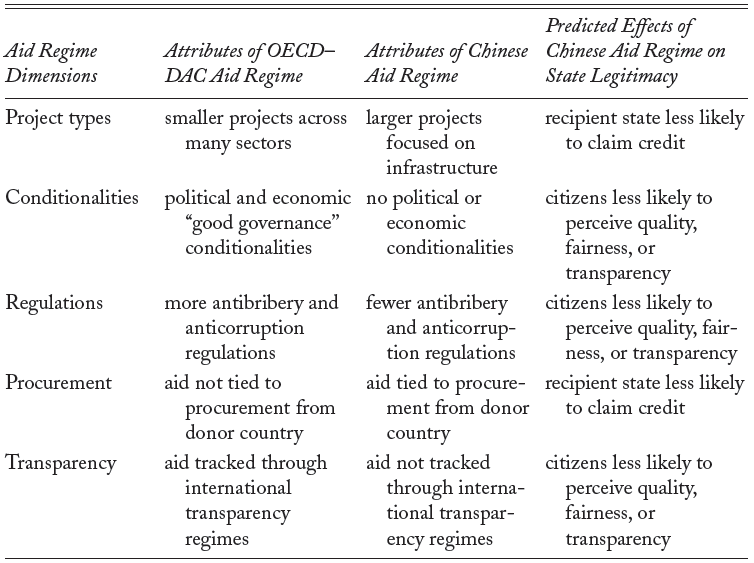
We highlight differences across five aid regime dimensions—project type, conditionalities, regulations, procurement, and transparency— that can have especially important implications for the legitimacy of recipient states. We summarize these differences and their implications in Table 1. First, whereas oecd donors typically fund a variety of relatively small-scale projects across multiple sectors, China tends to favor fewer larger-scale projects focused particularly on infrastructure (row one): transportation, communication, electricity, and so on. China explicitly promotes this focus as one of the defining characteristics of its aid regime, perhaps best embodied in its Belt and Road Initiative—the construction of transportation and energy infrastructure along corridors roughly corresponding to the historical Silk Road, accompanied by new trade deals and other agreements. Many developing countries need these higher-cost, higher-risk ventures, but more-traditional donors are often reluctant to undertake them.
Differences between Chinese and OECD–DAC Aid Regimes

Second, while many oecd donors attach political or economic conditionalities (row two) to the aid they provide, China does not. Indeed, the Chinese government views conditionalities of this sort as a threat to the sovereignty of recipient states. This position was most clearly articulated by President Xi Jinping at the 2018 Forum on China-Africa Cooperation (focac), where he laid out China’s “five-no” approach to aid—which includes “no interference in African countries’ pursuit of development paths that fit their national conditions,” “no attachment of political strings to assistance to Africa,” and “no interference in African countries’ internal affairs.”Footnote 46 This principle is perhaps the most defining feature of the Chinese aid regime.
Third, while oecd donors typically impose regulations (row three) to mitigate corruption, environmental degradation, and abusive or exploitative labor practices, China usually does not. For example, guided by its belief in noninterference, China generally doesn’t police the taking or giving of bribes. The absence of these safeguards may explain the finding that Chinese-funded projects tend to increase local corruption, while World Bank-funded projects do not.Footnote 47 But China’s lax regulations do reduce “up-front oversight in the form of planning meetings and impact assessments,” allowing it to implement projects more quickly and more cheaply than traditional donors.Footnote 48 Although efficiency is not as explicit a component of China’s aid regime as noninterference, it has been a priority since at least 1964, when former premier Zhou Enlai first outlined China’s “Eight Principles for Economic Aid and Technical Assistance to Other Countries”—principles that promised “quicker results” for recipient states.Footnote 49 African heads of state often cite efficiency as a difference between the Chinese aid regime and its oecd rivals.Footnote 50
Fourth, while the dac explicitly endorses untying aid (row four), China often ties projects to Chinese companies and products and typically relies on large numbers of expatriate Chinese workers (alongside local labor) for project implementation.Footnote 51 Given China’s reluctance to impose labor regulations, Chinese contractors face few constraints on wages or hiring and management practices in recipient countries beyond the local labor laws that recipient governments may or may not enforce.
Fifth, China doesn’t participate in the International Aid Transparency Initiative or in the other transparency regimes to which most oecd donors adhere (row five). As a result, there’s little publicly available information about Chinese aid flows to Africa and to other parts of the developing world. This has implications both for the perceived fairness and transparency of the Chinese aid allocation process, and also for our empirical strategy—a point to which we return below.
We argue that these features of the Chinese aid regime are likely to affect the perceived legitimacy of recipient states along all three of the dimensions described above: credit claiming (attribution), quality (outcome-based legitimacy), and fairness and transparency (procedural legitimacy). On the first dimension, China’s specialization in large-scale infrastructure projects may limit the opportunities for government officials to claim credit. These are precisely the sorts of projects usually financed through tax revenues, so citizens who learn about China’s role in funding them may conclude that their own governments are reneging on the fiscal contract. This problem is likely to be compounded by China’s procurement rules, which tie aid to the use of Chinese contractors and expatriate Chinese workers. Governments are less likely to be able to claim credit for projects that are so clearly a result of Chinese funds and labor.
But while recipient states may be less likely to claim credit for benefits provided by China, they may not escape blame for any harm that China causes. On the second dimension, although recipient governments may value the lack of regulations and the corresponding speed with which Chinese aid is disbursed, China is frequently accused of prioritizing speed over quality. Local and international media regularly publish reports of shoddy workmanship in Chinese-funded projects. Whether or not these reports are representative, they’ve clearly influenced public opinion: according to nationally representative surveys across thirty-six African countries, Africans cite the low quality of Chinese workmanship as the most important factor contributing to negative perceptions of China on the continent.Footnote 52 Citizens who share these views may conclude that Chinese aid won’t actually improve their welfare, and—crucially—they may blame their own governments for setting “poor quality requirements.”Footnote 53
On the third dimension, although recipient governments may appreciate receiving aid with no strings attached, citizens may worry that a lack of conditionalities, regulations, and transparency will encourage foul play. For example, without regulations on unfair or exclusionary labor practices, Chinese contractors are often accused of paying domestic workers less than Chinese expatriates and less than the local minimum wage. Some Chinese contractors have also been accused of engaging in abusive management practices and of undermining collective bargaining.Footnote 54 This may foment grievances not only against the contractors themselves, but also against the government agencies responsible for regulating them. As a recent rand Corporation report notes, “in some cases blame must be laid on African governments for failing to enforce their own labor laws.”Footnote 55
Of course, the schematic in Table 1 is highly stylized. Each feature of the Chinese aid regime may affect the legitimacy of recipient states through multiple mechanisms and along multiple dimensions simultaneously, making it difficult if not impossible to disentangle the dimensions empirically. For example, a lack of transparency may increase the risk of corruption during project implementation (procedural legitimacy), which may in turn diminish the quality of the project itself (outcome-based legitimacy). In addition, the features of the Chinese aid regime are not mutually exclusive. For example, failures of regulation may also be perceived as failures of transparency. Our aim in Table 1 is simply to show that the Chinese aid regime differs from its oecd counterpart in multiple ways, and that these differences can have important implications for the effects of Chinese aid on the legitimacy of recipient states.
Hypotheses
Our theoretical framework implies that aid should have negative effects on state legitimacy when donors provide services that (1) governments can’t easily claim credit for, (2) citizens perceive as low quality, or (3) citizens believe were allocated unfairly or nontransparently. In our preanalysis plan (pap), we hypothesized that the distinctive features of the Chinese aid regime would make it especially likely to have such negative effects, both in absolute terms and relative to aid from more traditional donors like the US. We predicted that Chinese aid would be more likely to have negative effects because citizens would be less likely to credit their own government officials for highly visible, large-scale infrastructure projects implemented by Chinese contractors and expatriate Chinese workers (attribution); because citizens would be more likely to view hastily implemented projects as low quality (outcome-based legitimacy); and because citizens would be less likely to perceive Chinese aid as fair and transparent due to China’s reluctance to impose conditionalities and regulations and to participate in international aid transparency regimes (procedural legitimacy).
Our goal was not to isolate these mechanisms—a challenge even in experimental researchFootnote 56—but rather to estimate the direct effects of Chinese aid on state legitimacy while minimizing threats to inference by triangulating across multiple measurement, identification, and estimation strategies. We opted to test the impact of Chinese aid at the microlevel because existing evidence suggests that Africans’ perceptions of Chinese aid are shaped less by its “political and macroeconomic implications” and more by their own “experience or exposure to Chinese economic and commercial activities.”Footnote 57 But our results provide little to no evidence in support of our predictions. To be consistent with our pap, and in the spirit of preregistration, we don’t retrofit our theory to accommodate our results. Rather, we test our hypotheses as prespecified and we consider potential explanations for our findings, as well as their theoretical and substantive implications, in the conclusion of this article.
Research Design
To test our predictions, we combine within-country analysis of original surveys, survey experiments, and behavioral games in Liberia with cross-country analysis of data from Afrobarometer, AidData, and the Aid Information Management Systems (aims) of African finance and planning ministries.
Within-Country Research Design
Our within-country research design focuses on Liberia, a small West African nation still recovering from fourteen years of civil war and, more recently, the devastating Ebola epidemic of 2014–2015. Liberia is one of the world’s least developed and most aid-dependent countries. It placed 177th out of 188 countries on the 2016 UN Human Development Index.Footnote 58 In 2015, the year we conducted our research, the oecd ranked Liberia as the second most aid-dependent country in the world, behind only the island nation of Tuvalu.Footnote 59 Tax evasion has long been pervasive in Liberia, and government resources have always been severely constrained. Underlying these problems is the nearly ubiquitous perception that government institutions are corrupt and inept—a perception that exacerbated, and was exacerbated by, the Ebola crisis.Footnote 60
In many ways Liberia is a most likely case for detecting the adverse effects of Chinese aid on state legitimacy. Anecdotally, China’s rapidly expanding presence in Liberia has stoked grievances and catalyzed civil unrest. Liberian consumers have complained of the low quality of Chinese-provided projects.Footnote 61 Liberian workers have accused Chinese contractors of “modern slavery,” and have appealed to government officials to “urgently intervene before the situation turns worse.”Footnote 62 A damning 2014 report by the Sustainable Development Institute observed that the Liberian government is widely believed to be “more concerned with facilitating a smooth operating environment” for Chinese firms than with ensuring the welfare of Liberian citizens.Footnote 63 Consistent with our theoretical framework, 75 percent of Liberians in our rural survey sample (described below) agree or strongly agree that the Liberian government deserves most of the blame for the bad things done by donors, compared to just 20 percent who agree or strongly agree that donors deserve most of the blame. The discrepancy is even starker in our urban survey sample (82 percent versus 17 percent). These descriptive statistics provide evidence of (potentially undeserved) blame attribution at work.
Behavioral Games
Our within-country research design begins with a modified version of the tax compliance game, a staple of behavioral economics.Footnote 64 In the conventional setup of the game, each participant receives an initial endowment—their “income”—and decides how much of that endowment to report to the tax “authorities.” Reported income is taxed at a constant rate. Unreported income isn’t taxed, but it’s subject to the possibility of an audit. Audited participants pay a fine on unreported income. Participants decide how much to report by maximizing their expected utility over four parameters: the size of their initial endowment, the tax rate, the probability of being audited, and the size of the fine.
In August 2015, we implemented a modified version of the game with a convenience sample of 740 residents of Gbarnga, Liberia’s second largest city and the capital of Bong County. Participants weren’t selected randomly, but Liberian facilitators were instructed to recruit from all neighborhoods in the city and to sample men and women, youths and elders, and members of majority and minority ethnic groups. Facilitators also administered prescreening questions to test for literacy and numeracy prior to recruitment. This likely made the sample less representative—our participants were younger and more educated than the average Gbarnga resident, and more likely to be male—but non-random selection was necessary to ensure comprehension of the game. It’s not obvious whether or how we should expect these features of the sample to affect our results, and in ancillary analyses we find no evidence of heterogeneous treatment effects by age, gender, education, or any of the other covariates we measure. Nonetheless, although convenience sampling is common in lab-in-the-field experiments, our results should be interpreted with this caveat in mind. The game was implemented over eleven days at the offices of Parley Liberia, a local ngo.
Upon arrival at the study site, participants were given unique identification numbers and randomly assigned to one of four rooms, each corresponding to a different treatment group, with eight participants and two facilitators per room. As we show in Section A.4 of the supplementary material,Footnote 65 treatment groups are balanced along covariates. To guarantee privacy, tall wooden dividers separated participants from each other and from the facilitators. Before the game began, facilitators administered an informed-consent form and a short survey. They then described the rules of the game, following a detailed script and stopping repeatedly to answer questions. We reproduce the script in Section A.11 of the supplementary material. To illustrate the game’s dynamics, facilitators guided the participants through three examples and three practice rounds, again stopping repeatedly to answer questions. We didn’t conduct formal manipulation checks, but we prioritized comprehension, and the three examples and three practice rounds provided ample opportunity for facilitators to correct misunderstandings.
After the practice rounds, facilitators read the treatment group participants one of three vignettes about services provision in Liberia, focusing either on the Liberian government or on Chinese or American donors. Control group participants didn’t hear a vignette. We chose to use American donors as a benchmark because of the traditional role of the US as a purveyor of aid to Africa, and because of Liberia’s deep historical ties to the US. (Liberia was founded by freeborn African Americans and emancipated slaves in the nineteenth century.) The vignettes emphasized that (1) the government uses Liberian tax dollars to provide services while foreign donors do not; (2) the government (or Chinese or American donors) plays a vital role in service provision; and (3) the government (or Chinese or American donors) may nonetheless mismanage funds or mistreat Liberian workers. We reproduce the text of the vignettes in Section A.12 of the supplementary material.
The vignettes addressed both positive and negative aspects of government-and donor-provided services. This bundled treatment more accurately captures the conflicting signals that citizens receive in the real world, and allowed us to avoid generating ill will toward donors or the Liberian government as a byproduct of treatment—an important ethical consideration in and of itself. We address this point in further detail below. Given that knowledge of and exposure to both Chinese and US aid are common in Liberia,Footnote 66 we designed the vignettes to prime respondents to consider issues with which they were likely already familiar rather than to provide new information (although for some respondents the information may have been new).
After listening to the vignettes, participants began the live rounds of the game. For each round, participants were given an opaque manila envelope containing between zero and two hundred fake Liberian dollars (ld), redeemable for real ld at the end of the game. (Two hundred ld is roughly equivalent to US $2.75—the average daily wage for Gbarnga residents at the time.) They were also given a template for anonymously reporting their income and instructed to complete it and return it to the facilitators in each round. Reported income was taxed at a flat rate of 25 percent. After deciding how much income to report, participants took turns privately drawing colored beans from a bag. Those who drew a black bean were audited; those who drew a white bean were not. The probability of being audited was announced beforehand, and was held constant at 10 percent.Footnote 67 For ease of comprehension, audited unreported income was fined at a flat rate of one hundred ld.Footnote 68 The game was played over ten rounds, but to minimize anticipation effects, participants weren’t told in advance how many rounds there would be.
After the ten rounds had been completed, facilitators conducted focus groups in which they asked participants six open-ended questions about their decision-making process during the game. (The text of the questions can be found in Section A.13 of the supplementary material.) Focus-group discussions were recorded, transcribed, and coded, allowing us to explore the internal and external validity of the game. Like all lab-in-the-field experiments, our tax compliance game was stylized. To minimize the gap between the lab and the field, facilitators informed participants at the outset that any taxes they paid would be delivered to the Liberian government, thus encouraging them to view their decisions as realistic and consequential. Results from the focus groups suggest that participants made this connection. When asked how they decided how much income to report, participants responded that they view tax compliance as necessary to “create the business-social network we are all yearning for” (focus group number 1.1.N.904), to “construct buildings and help our country build roads” (1.2.N.910), and to “be fair to the government” (10.2.U.921). Across the focus groups, participants almost invariably referred to the dynamics of taxation in the real world as motivation for their decisions. We provide additional excerpts from the focus groups in Section A.14 of the supplementary material.
Surveys and Survey Experiments
We supplemented the tax compliance game with surveys and survey experiments implemented in Gbarnga and in thirty-eight rural towns and villages throughout Bong, Lofa, and Nimba counties. We focused on these three counties because they have been priorities for both economic development and state consolidation in the postconflict period, and because they host a relatively large number of Chinese-funded projects, including the controversial Bong Mines iron ore project.Footnote 69 The three counties thus represent an important test case for the effects of Chinese aid on state legitimacy in Liberia. We implemented the survey in both urban and rural settings because urban populations in Africa tend to support incumbent governments at lower rates than do rural residents,Footnote 70 which we expected might make urban dwellers especially sensitive to (perceived) failures of government policy toward foreign donors.
The surveys were implemented between September and December in 2015. For the urban survey, we randomly selected 193 residents of nine randomly selected Gbarnga neighborhoods using the random walk technique, described in Section A.1 of the supplementary material. These respondents are broadly representative of Gbarnga. Although we can’t say for certain how representative Gbarnga is of other Liberian cities, a comparison to a representative survey of Monrovia, the Liberian capital, conducted around the same timeFootnote 71 suggests that our respondents are similar to Liberians in other urban settings. For example, the average age of respondents in our sample is thirty-nine, compared to thirty-seven in Monrovia. Ten percent of our respondents have only a primary school education, compared with 9 percent in Monrovia. Sixty-three percent of our respondents are female, compared to 57 percent in Monrovia. Ninety percent of our respondents are Christian, compared to 85 percent in Monrovia. The only marked difference is the proportion of our respondents who are farmers (15 percent, compared to 1 percent in Monrovia). This isn’t surprising, given that the agricultural sector is much smaller in Monrovia than anywhere else in the country. We discuss these comparisons in more detail in Section A.3 of the supplementary material.
For our rural survey, we sampled eighteen randomly selected residents of each of the thirty-eight communities, again using the random walk technique. These respondents are broadly representative of the communities from which they were sampled, but the communities themselves aren’t representative of Liberia or of the counties in which they’re located. Rather, the communities were the control group for an unrelated field experiment involving the Liberian National Police.Footnote 72 Eligibility for that experiment was restricted to communities located near a usable road and with at least five hundred residents. Our sample conforms to these criteria. Although these criteria may affect the generalizability of our results, residents of these relatively accessible communities are also more likely to be affected by donor-provided projects, making their responses especially informative for our purposes.
Moreover, comparison to a nationally representative survey from 2011Footnote 73 suggests that our thirty-eight communities don’t differ dramatically from the average Liberian town or village, either in the three counties covered in our survey or in the country as a whole. For example, the average age of respondents in our sample is forty, compared to thirty-seven nationwide. Eighty-six percent of our respondents are Christian, the same proportion as nationwide. Thirty percent of our sample has no education, compared to 35 percent nationwide. Sixty-one percent of our respondents work in agriculture, compared to 43 percent nationwide, but compared to 72 percent in Bong, 73 percent in Lofa, and 60 percent in Nimba. We discuss these comparisons in further detail in Section A.3 of the supplementary material. Although there are some disparities, the communities in our sample appear to be generally comparable to towns and villages across Liberia.
Both surveys included the same questions to measure respondents’ prior exposure to Chinese and US aid, including whether they (1) could name or (2) had used any Chinese- or US-provided projects, and also whether (3) they or (4) any of their friends or family members had worked for a Chinese- or US-funded contractor. We aggregate responses to the first two questions into a dummy for consumers of donor-provided services, and the latter two into a dummy for labor for donor-funded contractors. Liberian citizens don’t randomly select into either of these forms of exposure to aid, but fortunately for our analysis (although not for Liberia), access to services is very limited in rural areas, and rural Liberians who need these services typically don’t have multiple options from which to choose. The unemployment rate outside of subsistence agriculture is also very high—67 percent in our sample—and few rural Liberians have the luxury of declining a job offered by a potentially inequitable employer. Still, it’s possible that Liberians who use donor-provided services or work for donor-funded contractors differ from those who don’t along dimensions we can’t control for, and that may correlate with attitudes toward government.
To overcome this problem, both surveys also included a survey experiment in which respondents were randomly assigned to hear truncated versions of the vignettes used in the tax compliance game. We reproduce the text of the vignettes in Section A.8 of the supplementary material. Respondents were then asked whether they believe Liberians have an obligation to pay taxes even if (1) donors provide most services, (2) the government “eats” some of the taxes it collects, (3) Liberian taxpayers are very poor, and (4) the government makes bad policies. We added these conditional clauses to reduce the risk of social desirability bias: by offering respondents a possible justification for tax evasion, we hoped to alleviate any pressure to provide affirmative answers. A control group was asked the same four questions without the vignette. Treatment in the survey experiments was assigned on the spot. As a result, although the probability of assignment to each condition was fixed at 0.25, the sizes of the treatment groups varied. The treatment groups are balanced on covariates, as shown in Section A.4 of the supplementary material.
Cross-Country Research Design
For our cross-country analysis we combine Afrobarometer data with information on Chinese aid from AidDataFootnote 74 and information on US aid from the aims of African finance and planning ministries.Footnote 75 Aid-Data tracks aid from nontraditional donors like China, Russia, and the Gulf states. Because many of these donors don’t participate in international aid transparency regimes, details of the aid they provide are generally unknown. AidData fills this gap with information scraped from newspaper and academic articles, radio and television transcripts, the websites of recipient governments, and ngo reports. aims captures aid from various traditional donors, including the US. We merge these data sets with rounds two through six of the Afrobarometer survey, which AidData geocoded to the community (village) level.Footnote 76 Our analysis covers the six countries for which Afrobarometer, AidData, and aims data are all available: Burundi, Malawi, Nigeria, Senegal, Sierra Leone, and Uganda. (In Section B.9 of the supplementary material, we drop US aid and expand our analysis to cover all thirty-eight Afrobarometer countries. Our conclusions about the effects of Chinese aid on state legitimacy do not change.)
To operationalize exposure to aid, we code whether each Afrobarometer respondent lives within thirty kilometers of at least one Chinese or US project, the narrowest bandwidth for which precise geolocation data are available. Since aid isn’t randomly distributed, either within or across countries, we use a spatial difference-in-differences estimator to compare respondents living near planned (future) projects to those living near projects that were completed by the time of the survey, as in analyses by Ryan BriggsFootnote 77 and by Ann-Sofie Isaksson and Andreas Kotsadam.Footnote 78 Our identifying assumption is that the same selection process underlies the location of planned and completed projects, such that respondents living near planned projects serve as valid counterfactuals for those living near completed ones. If this assumption holds, we can estimate the net effect of the services actually provided by subtracting the coefficient on planned projects from the coefficient on completed ones.Footnote 79
One potential threat to this assumption is that recipient governments may prioritize projects that are sited in politically important areas. If these projects are more likely to be completed than those sited elsewhere, then different selection processes underlie project planning and completion, potentially biasing our results. We view this risk as relatively minor, as we see no reason to expect recipient governments to prioritize in this way during the implementation phase but not during the planning phase. In other words, if governments favor politically important areas, then intuitively we should expect this favoritism to manifest during project planning. Still, to mitigate the risk of bias, we control for a dummy indicating whether each project was sited in the region of the president’s birth, which has been shown to be an important source of variation in the subnational distribution of aid.Footnote 80
A second potential threat is that donors or recipient governments may complete the highest-priority projects first, such that planned projects are of lower priority than completed ones at any given moment in time. We explore this possibility in Section B.4 of the supplementary material, in which we compare the distribution of sectors (agriculture, communications, education, and so on) for all planned and completed projects in our analysis. If donors complete the highest-priority projects first, then intuitively we should expect high-priority sectors (like transportation and communications infrastructure) to constitute a larger proportion of completed projects than planned ones. As we show in Section B.4, this doesn’t appear to be the case.
A third potential threat is that citizens may protest projects during the planning or implementation phase, causing either the donor or the recipient government to cancel the projects outright. This is especially relevant for Chinese aid, which has generally been more controversial than aid from other donors. Again, we view this risk as relatively minor, as there seem to be few (if any) examples of Chinese projects being canceled due to protests in Africa during the period under study.Footnote 81 But as an imperfect proxy, we use the Armed Conflict Location and Event Dataset (acled) to control for the number of protests within thirty kilometers of each respondent before the first Chinese or US project was planned within that same radius.Footnote 82 We also include additional controls to mitigate any remaining biases, including gender, age, religion, distance to the capital city, a dummy for cities, and, as discussed above, a dummy indicating whether the respondent lives in the president’s home region.
Given the Chinese government’s lack of transparency about the aid it provides, an additional challenge is to identify the universe of Chinese-provided services. AidData has advanced our ability to do this, but because it relies on information scraped from secondary sources, the sample of projects in the data set, including their location and timing, is inevitably incomplete. In Section B.3 of the supplementary material, we discuss in detail our approach to dealing with missing data and show that the projects in our sample don’t appear to differ systematically from those in the rest of the AidData data set (or aims), which suggests that our coding rules aren’t likely to induce or exacerbate bias.
Another challenge is the often-blurry line between Chinese aid (Overseas Development Assistance, or oda) and the less concessionary loans and credits that China offers (Other Official Flows, or oof). Unfortunately, information on concessionality and intent is not available for many Chinese projects, and these distinctions can only be drawn suggestively.Footnote 83 We combine project types in our analysis and interpret our results as the impact of Chinese “aid,” broadly defined. But in Section B.10 of the supplementary material, we do distinguish infrastructure from other Chinese projects to assess the possibility that highly visible, large-scale infrastructure projects have de-legitimizing effects that projects in other sectors do not. We find that in either case, the risk of de-legitimizing effects is low.
In addition, it’s possible that planned projects themselves affect citizens’ attitudes through the anticipation of future services or employment opportunities. This wouldn’t bias our results, but it would change their interpretation. If planned projects affect citizens’ attitudes, then subtracting the coefficient on planned projects from the coefficient on completed ones would yield the impact of project completion net of both selection and anticipation effects. If planned projects don’t affect citizens’ attitudes, then subtracting coefficients would yield the effect of project completion net of selection effects alone. Either way the difference-in-differences would return the quantity of interest, which is the net effect of services that are actually provided. Nonetheless, to avoid ambiguities in interpretation, we define planned projects as those for which a formal agreement hasn’t yet been reached. These projects are in such a nascent stage of development that anticipation effects are highly unlikely, as we discuss further in Section B.5 of the supplementary material.
Advantages of Our Approach
None of the components of our research design is flawless, but each helps to compensate for the limitations of the others. Although surveys capture real-world, individual-level exposure to donor-provided services, they also rely on self-reports and are susceptible to selection bias and to nonrandom recall. AidData and aims capture real-world exposure to aid without relying on self-reports, but only indirectly, since not all individuals who live near donor-provided services use or even know about those services. AidData and aims also suffer from missing data. Survey experiments solve potential selection problems via randomization, but they’re more stylized and they still rely on self-reports to measure tax compliance and other outcomes. The tax compliance game solves the selection problem while capturing observed rather than self-reported tax compliance, but it’s even more stylized. Our within-country data are rich and highly detailed, but may not generalize to other countries; our cross-country data are coarser, but may have more external validity. Our ability to triangulate across the various components of our research design is an important advantage of our approach. The more consistent our results, the less likely they are to be artifacts of a particular method or sample.
Within-Country Results
Behavioral Game Results
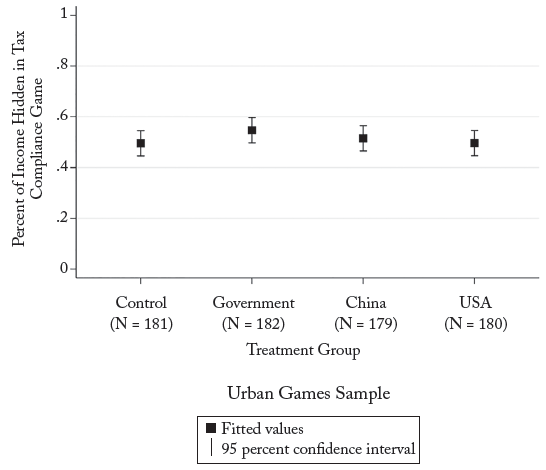
Figure 1 reports average treatment effects for our modified tax compliance game in Liberia.Footnote 84 We present our results graphically for ease of interpretation. Our proxy for tax compliance is the ratio of unreported income to total income over the ten rounds of the game; the lower the ratio, the higher the degree of compliance. The income received by participants in each round was randomized, but the total received (1,000 ld) was not, and the distribution of possible incomes was held constant across participants to eliminate differential income effects.Footnote 85 To increase precision and to mitigate incidental imbalance on individual covariates, we include controls for gender, age, employment, religion (a dummy for Muslims), and education (dummies for primary, junior high, and high school education).
Average Treatment Effects for Tax Compliance Game in Liberiaa
aAverage treatment effects on the percent of income hidden across ten rounds in the tax compliance game. We control for age, gender, education, employment, and religion at the individual level.

The squares in Figure 1 denote fitted values from an ordinary least squares regression given by  ${{y_i} = \alpha + \sum\nolimits_{j = 1}^3 {{\beta _j}{{\rm{T}}_{ji}} + } \sum\nolimits_{k = 1}^L {{\delta _k}{{\rm{X}}_{ki}}} + {e_i}}$ where yi denotes the ratio of unreported to total income, Tjt indexes the three treatment groups (with the control as the base category), and Xki indexes our L controls. The lines denote 95 percent confidence intervals. Our results in Figure 1 provide no evidence to suggest that information about aid decreases tax compliance. Although rates of tax evasion are generally high in the game—at or above 50 percent across the boardFootnote 86—they’re substantively similar and statistically indistinguishable across treatment groups, ranging from a low of 50 percent in the control and US treatment groups to a high of 54 percent in the government treatment group. Our confidence intervals are narrow, suggesting that these nulls are not likely to be artifacts of statistical imprecision.
Survey Experiment Results
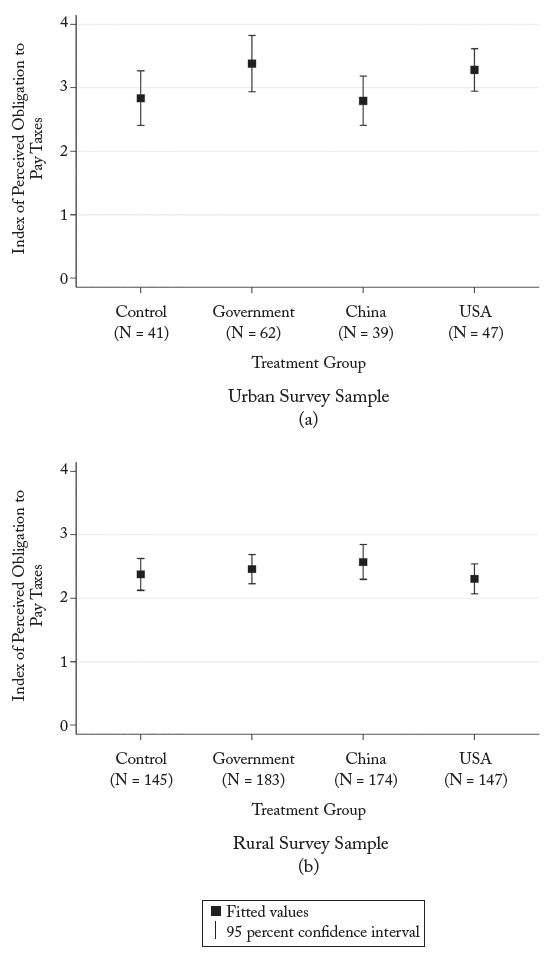
Figure 2 reports average treatment effects for our urban (panel [a]) and rural (panel [b]) survey experiment. The dependent variable is an additive index of dummies indicating whether respondents agree or strongly agree with each of the four statements about tax morale described above. (Our results are unchanged if we add the Likert scales without dichotomizing.) To increase precision and to mitigate any incidental imbalance, all specifications include individual-level controls for gender, age, employment, religion, education, and household wealth. For the rural sample, we also include district fixed effects and community-level controls for population, average household wealth, average literacy, average employment, and average education, gleaned from the 2008 census. Figure 2 reports fitted values and 95 percent confidence intervals with standard errors clustered by neighborhood (for the urban sample) or community (for the rural sample).
Average Treatment Effects for Survey Experiment in Liberiaa
aAverage treatment effects on the perceived obligation to pay taxes in the survey experiment in urban and rural Liberia. The dependent variable is an index scaled from zero to four. We control for age, gender, education, employment, religion, and wealth at the individual level in both samples. We also control for population, education, literacy, employment, and wealth at the community level in the rural sample, with district fixed effects. Standard errors are clustered by neighborhood (urban sample) or community (rural sample).

Again, we find little evidence to suggest that information about aid diminishes tax morale. Our point estimates are nearly identical across treatment groups in the rural sample, with almost fully overlapping confidence intervals. These nulls are also consistent across demographic and partisan subgroups, as we show in Section A.9 of the supplementary material. In the urban sample, respondents in the government and US treatment groups are more likely to believe they have an obligation to pay taxes relative to respondents in both the control and China treatment groups. On average, respondents in the government treatment group score a 3.38 out of 4 on our index of tax morale, compared to 2.84 in the control group and 2.79 in the China treatment group— an increase of 19 percent (p = 0.07) and 21 percent (p = 0.05), respectively. Respondents in the US treatment group score 3.28 on average, which is statistically larger than the average score in the control group (an increase of 16 percent, p = 0.08) and in the China treatment group (17 percent, p = 0.04).
This partially confirms our hypothesis that the American and Chinese aid regimes have differential effects on the legitimacy of recipient states. But contrary to our expectations, the difference is driven not by the adverse effects of Chinese aid, but rather by the beneficial effects of US aid. Priming urban respondents to reflect on the role taxation plays in service provision appears to reinforce their belief that tax compliance is an obligation shared by all citizens. But priming them to reflect on US aid has the same effect—which suggests that, if anything, exposure to US aid strengthens rather than weakens tax morale. Average scores between the control and the China treatment groups on our tax morale index are substantively similar and statistically indistinguishable. This suggests that information about China’s role in service provision neither increases nor decreases tax morale, relative to no information at all.
Survey Results
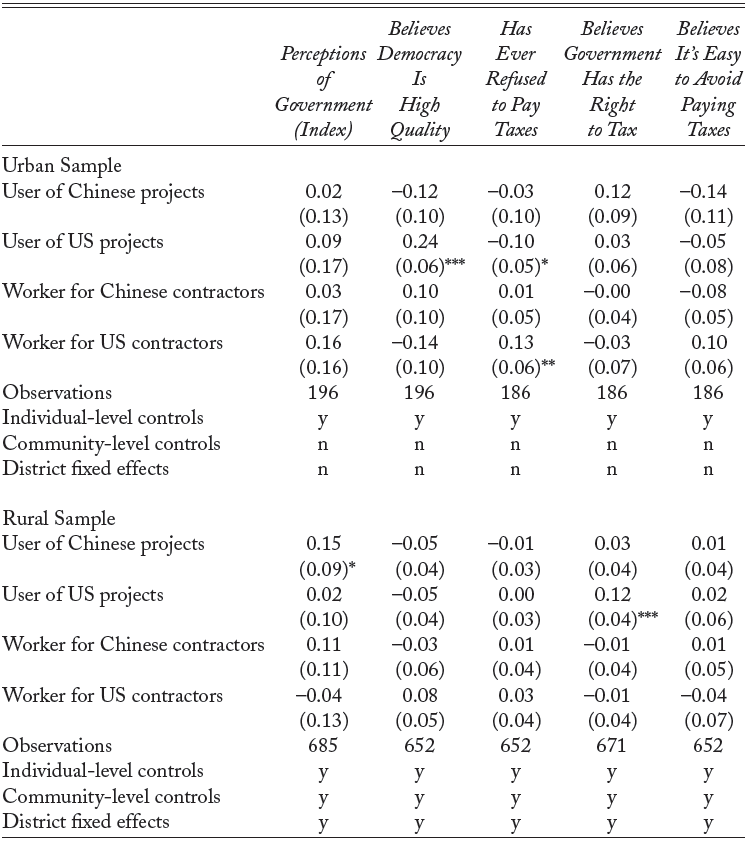
Table 2 reports correlations between exposure to aid and attitudes toward the Liberian government in our urban and rural survey samples. We distinguish between two types of exposure: consumers (those who know about or have used donor-provided projects) and labor (those who have worked for a donor-funded contractor or know someone who has). These different forms of exposure should affect citizens’ attitudes through different mechanisms. For consumers, it is primarily through the quality of donor-provided services. For labor, it is primarily through the wages and hiring and management practices of donor-funded contractors. These correspond to outcome-based and procedural legitimacy, respectively—although of course, consumers may also be sensitive to procedural legitimacy and labor may also be sensitive to outcome-based legitimacy.
Foreign Aid and State Legitimacy in Liberia Using Survey Dataa

*** p < 0.01, ** p < 0.05, * p < 0.01.
a Correlation between exposure to foreign aid and perceptions of government in urban and rural Liberia. The dependent variable in column 1 is an index scaled from zero to three; the dependent variables in columns 2 through 5 are dummies. We control for age, gender, and religion at the individual level in both samples. We also control for population, education, literacy, employment, and wealth at the community level in the rural sample, with district fixed effects. Standard errors, clustered by neighborhood (urban sample) or community (rural sample), are in parentheses.
To avoid posttreatment bias, we only control for individual-level characteristics that either are fixed over time or are extremely unlikely to be affected by exposure to aid: age, gender, and religion. We rely on the 2008 census as a source of additional community-level controls. At the community level we control for population, wealth, literacy, proportion of residents with no education, and proportion of residents who are unemployed. We report coefficients from ols regressions with standard errors clustered by neighborhood (for the urban sample) or community (for the rural sample).
Aid may affect tax compliance in part through its effect on citizens’ perceptions of government as fair and transparent (procedural legitimacy). To operationalize these perceptions, the dependent variable in column 1 of Table 2 is an additive index of three dummies indicating whether respondents believe the Liberian government (1) treats all Liberians equally, (2) makes decisions in an open and transparent manner, and (3) is free of corruption. As an additional measure of perceived government responsiveness, the dependent variable in column 2 is an indicator for whether respondents express satisfaction with the quality of democracy in Liberia. In columns 3, 4, and 5, our dependent variables are indicators for whether respondents have ever evaded taxes (a measure of tax compliance), believe the government has the right to collect taxes (tax morale), and believe taxes are easy to avoid, respectively. By measuring not only whether citizens believe government has a right to collect taxes, but also whether they believe taxes are easy to avoid, we’re better able to disentangle whether citizens pay taxes because they believe they have an obligation to do so or because they fear punishment if they don’t—or both.Footnote 87 The wording of the questions in columns 2 through 5 was taken from the Afrobarometer survey to facilitate comparison with the other countries in our study.
In the rural sample, the correlations between exposure to aid and attitudes toward government are almost uniformly null, regardless of which indicator we use. The only notable exception is that respondents who know about or have used US-provided projects are twelve percentage points more likely to affirm the government’s right to tax than respondents who haven’t used those projects (rural sample, column 4). This is consistent with the results of our (urban) survey experiment, as described above. Rural respondents who know about or have used Chinese-provided projects also tend to have more favorable perceptions of the Liberian government (rural sample, column 1), although this result is only weakly statistically significant at conventional levels. In Section A.7 of the supplementary material, we replicate our analysis from the rural sample using AidData to operationalize exposure to Chinese aid. Our results are similar.
Likewise, in the urban sample, respondents who know about or who have used a US-provided service are twenty-four percentage points more likely to describe Liberian democracy as high quality (column 2) and ten percentage points less likely to report ever refusing to pay taxes (column 3). This, too, is consistent with our urban survey experiment. Surprisingly, those who have worked for a US-funded contractor or know someone who has are thirteen percentage points more likely to report refusing to pay taxes (column 3) and ten percentage points more likely to believe taxes are easy to avoid (column 5)—although this correlation falls short of statistical significance at conventional levels (p = 0.12). But these workers are no more or less likely to endorse the government’s right to tax (column 4), which suggests that they may engage in tax evasion not because they believe it’s acceptable, but because they believe (probably correctly) that they’re unlikely to get caught. Taken together, these results suggest that exposure to aid generally has benign effects on state legitimacy in the eyes of Liberian citizens.
Cross-Country Results
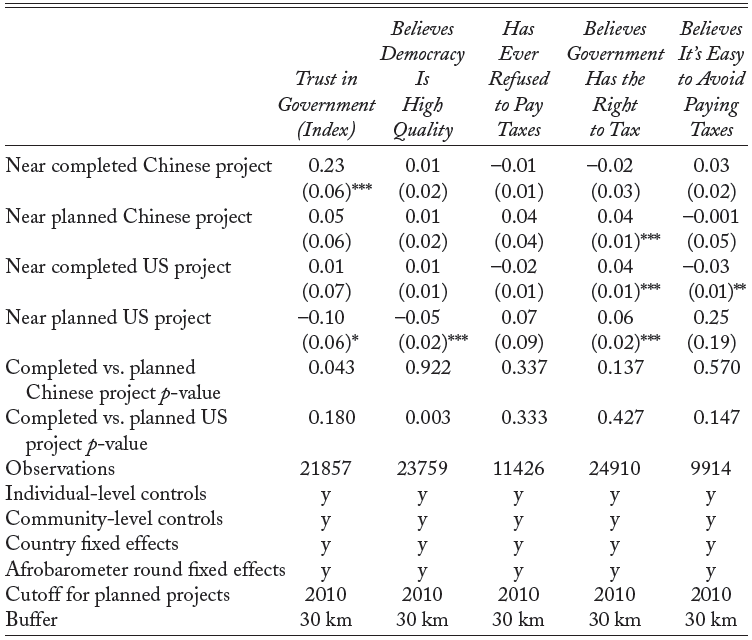
Table 3 tests the effects of Chinese- and US-provided projects on state legitimacy across the six African countries for which AidData, aims, and Afrobarometer data are all available. The dependent variable in column 1 is an additive index of dummies indicating citizens’ trust in six state institutions: police, military, local council, parliament, president, and courts. All other dependent variables are identical to those in Table 2. Two of our taxation measures (columns 3 and 5) are available only for rounds five and six of the Afrobarometer survey. Our remaining dependent variables are available for rounds two through four, as well. All specifications include country and Afrobarometer-round fixed effects, and controls for gender, age, religion, distance to the capital city, number of previous protests within a thirty-kilometer radius, a dummy for cities, and a dummy indicating whether the respondent lives in the president’s home region. Standard errors are clustered by community.
Foreign Aid and State Legitimacy across Six African Countriesa

***p < 0.01, ** p < 0.05, *p < 0.01.
a Correlation between exposure to foreign aid and perceptions of government across six African countries. The dependent variable in column 1 is an index scaled from zero to six; the dependent variables in columns 2 through 5 are dummies. Exposure is operationalized as a dummy for any completed or planned Chinese or US projects within a thirty-kilometer radius. We control for gender, age, religion, distance to the capital city, number of previous protests within a thirty-kilometer radius, a dummy for cities, and a dummy indicating whether the respondent lives in the president’s home region. Standard errors, clustered by community, are in parentheses.
We find no evidence to suggest that Chinese aid is eroding state legitimacy among these six countries. If anything, the opposite appears to be true. Completed Chinese projects are positively and statistically significantly correlated with our index of trust in government (column 1), and the difference between the coefficients on completed and planned projects is also positive and statistically significant. Nor do we find evidence to suggest that US aid diminishes state legitimacy. US projects tend to be sited in locations where trust in government is relatively low (column 1) and where perceptions of democracy are relatively negative (column 2). Interestingly, US projects also tend to be sited in locations where belief in the government’s right to tax is relatively high (column 4). Completed US projects are positively correlated with belief in the government’s right to tax (column 4) and negatively correlated with the perceived ease of tax evasion (column 5), but in both cases the coefficient on completed projects isn’t statistically different from the coefficient on planned ones. Nevertheless, US projects do appear to improve citizens’ perceptions of democracy after differencing away the selection effect. To the extent that US aid affects state legitimacy in the eyes of African citizens, the effects appear to be beneficial.
Discussion and Conclusion
In this study, we develop and test a theory to explain how different aid regimes might have disparate effects on the perceived legitimacy of recipient states. In our pap, we hypothesized that exposure to aid would diminish state legitimacy in Africa and that this effect would be especially pronounced for aid delivered by China. Our findings do not conform to these expectations. Why? What explains these null (and in some cases positive) results? Might they be an artifact of flaws in our research design, such as measurement error or lack of statistical power? Although we can’t definitively eliminate these concerns, there are several reasons to believe that they don’t explain our findings.
First and most important, our results are generally consistent across multiple approaches to measurement, identification, and estimation. Second, although scholars debate the extent to which tax compliance is a reliable proxy for state legitimacy,Footnote 88 it remains one of the most widely used proxies in the literatureFootnote 89—and in any event, our results are robust to other potential proxies as well (like trust in government). This suggests that problems with the conceptualization and measurement of our dependent variables are unlikely to explain our results. Third, as we show in Section A.5 of the supplementary material, in Liberia at least, our survey-based and AidData-based proxies for exposure to Chinese aid are highly positively correlated with each another. Both proxies are measured with some error, but the correlation between them suggests that they’re capturing exposure to aid in an empirically meaningful way. This suggests that problems with the conceptualization and measurement of our independent variables are unlikely to explain our results either. (Unfortunately, we can’t replicate this exercise for US aid because we don’t have aims data for Liberia.)
Fourth, most of our nulls are precisely estimated, with narrow confidence intervals and point estimates that are close to zero or, in the case of the behavioral game and survey experiment, similar to one another. If statistical power were a problem, we’d expect to see wider confidence intervals around more idiosyncratic point estimates. But we do not. A more formal ex ante power analysis confirms these intuitions. In both our behavioral game and our rural survey experiment, we have 80 percent power to detect an effect equal to roughly 0.29 standard deviations of the control group mean. There are no clear rules of thumb to apply here, but this would generally be considered a small effect. In our urban survey experiment, we have 80 percent power to detect an effect of roughly 0.51 standard deviations. This would be considered a moderate effect. While ex post power calculations should be interpreted with caution, they similarly suggest that statistical power is unlikely to explain our results, as we discuss in Section A.6 of the supplementary material.
Is it possible that the hypotheses we tested were implausible to begin with, or that our research design somehow guaranteed a null result, perhaps due to the bundled nature of our experimental vignettes? Again, we view these explanations as unlikely. As discussed above, there are many reasons to expect aid to diminish the legitimacy of recipient states and many reasons to believe Chinese aid is especially likely to have pernicious effects. Moreover, while our vignettes emphasized both the positive and negative aspects of Chinese (and US) aid, the fact that we find statistically significant beneficial treatment effects in the urban survey experiment suggests that nulls were not a foregone conclusion.
These bundled treatments also more accurately capture the mixed signals about aid that people actually receive in the real world and were primarily intended as a prime, not as a source of new information. We could have manufactured adverse treatment effects by heavily priming the (purported) problems with the Chinese aid regime, but this would have taught us little about the real world and would have raised serious ethical concerns. That neither our experimental nor our observational measures of exposure to Chinese aid are negatively correlated with perceptions of government lends additional credence to this interpretation of our results.
A potential concern with the design of the tax compliance game is that the treatment was weak—that given the extended length of the vignettes and given the novelty and complexity of the game, participants simply ignored or forgot about the vignettes as they decided how much of their income to report. This is indeed a concern. But the survey experiment is potentially susceptible to the opposite problem—that given the directness and simplicity of the vignettes and given the outcomes were measured immediately after treatment was administered, participants fixated on the vignettes when answering our survey questions. In other words, the tax compliance game may have risked underestimating treatment effects while the survey experiments may have risked overestimating them. The consistency of our conclusions across these two components of our research design suggests that they’re unlikely to be artifacts of overly weak or overly strong treatments. This, again, is an advantage of triangulation.
Is it possible that Chinese aid just happens to have had benign or beneficial effects on state legitimacy in Liberia and in the six countries in our cross-country analysis? Might we have found adverse effects in other settings? To explore this possibility, in Section B.9 of the supplementary material we expand our sample to the thirty-eight African countries for which AidData and Afrobarometer data are both available, but aims data are not. Our results are substantively similar to those reported here. After we difference away the selection effect, completed Chinese projects appear to improve citizens’ perceptions of the quality of democracy and to have no effect on trust in government, tax compliance, or tax morale. It’s possible that US aid might have more pernicious effects in an expanded sample, although we see no a priori reason to expect that.
If selection bias, measurement error, statistical power, and sample selection don’t explain our results, then what does? We can’t say for certain, and because we expected to find adverse effects—an expectation that we preregistered—any explanation is inevitably post hoc. Nonetheless, there are possibilities that future scholars might consider. First and most obvious, although critics view certain features of the Chinese aid regime as problematic, citizens of recipient countries may not share that view. For example, if citizens reject good governance conditionalities as paternalistic, they may prefer the unconditionality of Chinese aid. If citizens prioritize low cost over high quality, they may prefer the speed of China’s approach to implementation. And if citizens value large-scale infrastructure projects over smaller-scale alternatives, then the recipient government’s inability to claim credit for these projects may be irrelevant, especially if government officials can at least claim credit for attracting Chinese funds.Footnote 90
Second, aid may have positive effects on some citizens’ perceptions and negative effects on the perceptions of others, resulting in a net null. In Section A.9 of the supplementary material, we find only limited evidence of heterogeneous treatment effects among our sample of rural Liberians, but heterogeneity along dimensions we didn’t measure is possible. More intriguingly, if citizens value both outcome-based and procedural legitimacy, then aid may simultaneously have positive and negative effects on the perceptions of the same citizens. For example, citizens may perceive donor-provided services as high quality (outcome-based legitimacy), but may also perceive the implementation of those services as unfair and nontransparent (procedural legitimacy). If these positive and negative perceptions counterbalance one another, the result will be, at worst, a net null.
Our survey provides some evidence of these conflicting views at work. Respondents were asked to evaluate Chinese and American donors along seven dimensions, including the quality of the services they provide (outcome-based legitimacy) and the fairness of their hiring and management practices (procedural legitimacy). We use respondents’ answers to these questions to construct additive indices ranging from zero to seven; the higher the score on the index, the more favorable the respondent’s perceptions of the corresponding donor. In our rural sample, we find that nearly a quarter of all respondents (23 percent) score 3 or 4 on the index of perceptions of American donors—indicating an almost even mix of positive and negative perceptions—and nearly half (49 percent) score between 2 and 5. The average score is 3.3, which is almost exactly in the center of the distribution of possible scores. Perceptions of China are generally more negative—the average score on the index of perceptions of Chinese donors is 2.1—but more than one quarter of all respondents (28 percent) nonetheless score 3 or 4. Perceptions are similarly mixed in the urban sample. If respondents are ambivalent about aid, then exposure to it may have a net null effect on their perceptions of their own government.
Focus groups conducted after the tax compliance game provide further evidence of these conflicting views. Some participants reported that they “feel nice to see those people [donors] coming in to help us…. So I feel nice to our government for bringing them in” (focus group code 7.2.N.917). Other participants said they “feel happy when the government comes in with those investors” (10.1.U.919), or that they “feel good because it is good for foreigners to come to the country to help development” (2.2.G.911). But some were more circumspect, arguing that Liberians should not “depend on the outside world to keep developing our own country” (1.11.U.921), and that development “is something the government needs to do for our own country people” (1.1.C.921). As one participant pointedly stated, “It’s like my government is not able to handle her own country” (1.1.N.904). In some cases, the same participants expressed conflicting opinions in response to different questions, which also suggests ambivalence about the role of aid in Liberia.
Again, we predicted that Chinese aid would have negative effects on state legitimacy, and these explanations for our results are post hoc. But they are amenable to empirical evaluation. One way to test the first explanation might be to elicit citizens’ preferences before their exposure to aid, and then to assess whether the effects of aid vary with the intensity of those preferences. The second explanation could be tested by using a conjoint experiment to randomize information about different characteristics of the Chinese aid regime, and then to assess whether particular combinations of characteristics generate greater or lesser support.
Whatever the explanation, our results suggest that the relationship between aid and state legitimacy may need to be rethought. We find that Chinese aid is not damaging state/society relations, despite the warnings of policymakers in the US and elsewhere. More generally, our findings, combined with those of multiple recent studies across multiple contexts,Footnote 91 suggest that aid is not eroding the legitimacy of recipient states in the eyes of citizens, as critics have long feared it might.
Supplementary Material
Supplementary material for this article can be found at https://doi.org/10.1017/S004388712000026X.
Data
Replication files for this article can be found at https://doi.org/10.7910/DVN/5JH0WJ.
Data Availability Statement
Preanalysis Plan was registered at Evidence in Governance and Politics (EGAP) and can be found at https://osf.io/qek4v.
Acknowledgments
For helpful comments we thank Lucy Martin, Gwyneth McClendon, Bradley Parks and the rest of the AidData team, Paul Testa, Michael Tierney, participants at the Contemporary African Political Economy Research Seminar (CAPERS), the Boston University Comparative Politics Seminar, the New York University Center for Experimental Social Science Conference, the UC Berkeley Comparative Politics Seminar, and the Center for the Study of African Economies Conference, as well as three anonymous reviewers. For their excellent research assistance, we thank Omar Afzaal, Omar Alkhoja, Toly Osgood, Gauri Wagle, and especially, Robert Marty.
Funding
This research is funded by the Institute of International Education (IIE), under the Democracy Fellows and Grants Program (AID-OAA-A-12-00039), funded by usaid’s Center of Excellence in Democracy, Human Rights, and Governance. The content of this research does not necessarily reflect the views, analysis, or policies of IIE or USAID, nor does any mention of trade names, commercial products, or organizations imply endorsement by IIE or usaid.
Authors
Robert A. Blair is an assistant professor of political science and international and public affairs at Brown University. His research focuses on international intervention and the consolidation of state authority in conflict and postconflict settings. Blair is the author of Peacekeeping, Policing, and the Rule of Law after Civil War (2020). He can be reached at robert_blair@brown.edu.
philip Roessler is an associate professor of government at The College of William &. Mary. His research focuses on conflict, political economy of development, and African politics. He is the author of Ethnic Politics and State Power in Africa: The Logic of the Coup-Civil War Trap (2016) and coauthor, with Harry Verhoeven, of Why Comrades Go to War: Liberation Politics and the Outbreak of Africa’s Deadliest Conflict (2016). He can be reached at proessler@wm.edu.