1. Introduction
In China, public deliberation (or consultation) has been institutionalized in recent decades on topics ranging from government budgets to transportation prices and in locales from villages to metropolises (He, Reference He, Leib and He2006). These government-led deliberative practices in China are different from their counterparts in most liberal democracies, where they supplement existing aggregative democratic systems. In China, deliberations were introduced without regime-level democratization. ‘Authoritarian deliberation,’ a phrase coined by Baogang He and Mark Warren (He and Warren, Reference He and Warren2011), has been widely used to describe this form of deliberation. Citizens in this context are permitted and encouraged to participate in politics through deliberation, but they are discouraged from engaging in political activism and are not guaranteed to affect the decision-making process.
While He and Warren (Reference He and Warren2011) discussed several mechanisms of deliberation-led democratization and deliberative authoritarianism, they did not state which is more likely to happen; neither do they offer any survey based empirical evidence. To address this deficiency, Ma and Hsu (Reference Ma and Hsu2018) conducted a comparative survey based study of citizens’ perceptions of local elections and public deliberations and found the limitation of local deliberative democracy in China. Their survey results indicate that authoritarian deliberation tends to strengthen an authoritarian system rather than leading to democratization.
Our paper continues the work done by Ma and Hsu but with a different kind of survey work. Ma and Hsu's survey work randomly selected citizens from four places where local elections and deliberations are held, but these citizens were not participants in local public deliberation. In contrast, our study surveyed citizens who had taken part in participatory pricing and collected data about their perceptions and opinions on the deliberative processes in which they had participated. This method helps us understand the impact of public deliberations on citizens’ political attitudes.
To determine whether authoritarian deliberation will strengthen authoritarianism or lead to democratization, we examine one purpose of authoritarian deliberations: it is designed to solve practical problems and increase trust while reducing participants’ political activism. More specifically, it is intended to channel political involvement into what the government defines as orderly discussion, managing social conflicts, and avoiding and reducing civil engagement in terms of collective action. Citizens are allowed to use their voices to solve local issues peacefully but are discouraged from taking any political action against the government. This is the purpose and meaning of what the Chinese government calls ‘orderly citizen political participation’ (‘公民有序政治参与,’ which was written into the Reports of the 9th–15th National Party Congress). Few studies have been done to determine whether public deliberation indeed produces the government-desired effect, and we test this hypothesis in this study.
What makes authoritarian deliberation unique is that local governments must either transform one-way public consultation into two-way public deliberation or introduce limited empowerment into the deliberation process under the new market conditions. It differs from the pure political study of the Maoist era in that citizens are likely not to attend public hearings if their voices are not taken seriously or if their opinions have no impact on the decision-making process. Chinese villagers, for example, are too busy making money, and they will not waste their time attending a meaningless forum. Deliberation must include some element of empowerment. This is why the Wenling government, for example, announced the government's decision about citizens’ opinions to create the image that citizens’ opinions matter in the government's decision-making process; this is a feature of what John Keane (Keane, Reference Keane2017) calls ‘phantom democracy.’ However, citizens are not offered full empowerment, and governments must retain their discretionary power to make a final decision. This is a part of ‘orderly citizen political participation.’ How does this limited empowerment impact citizens’ political activism? Will citizens be encouraged by this limited empowerment to engage in more political activism? This paper will examine this issue empirically by testing the hypothesis of the effect of limited empowered deliberation.
Additionally, the existing literature on Chinese deliberative democracy has largely focused on local deliberative innovations such as deliberative polling and participatory budgeting (Fishkin et al., Reference Fishkin, He, Luskin and Siu2010; He, Reference He2011; Cabannes and Ming, Reference Cabannes and Zhuang2014; Ma and Hsu, Reference Ma and Hsu2018), but has overlooked public hearings on pricing, which is one form of nationwide deliberation. This paper aims to fill the gap by offering an empirical survey based study of the impacts of participatory pricings’ public deliberation on the participants’ political attitudes.
It should be noted that the research focus in this paper is merely on participatory pricing, and that we do not intend to infer that all forms of deliberative practices in China influence participants in the same way. According to the literature, some forms of deliberations in China, especially in rural areas, have achieved considerable success in participant empowerment (Fishkin et al., Reference Fishkin, He, Siu, Leib and He2006; Wu and Wang, Reference Wu and Wang2011; He Reference He2018). Participatory pricing differs from other forms of deliberative practices. First, the results of participatory pricing determine the prices of basic utilities and services, which affect everyone and naturally attract attention. The impact of price hikes in water, gas, and taxi is much stronger than that of a public spending project with a specific target audience. Additionally, participatory pricing is a nationwide deliberative practice that is legally required to take place in every province in China. As a result, although few people in China have heard of deliberative polling or participatory budgeting, let alone the deliberative innovations in specific villages for dispute resolution, most of them know about participatory pricing. This extensive public attention may explain why participatory pricing induces stronger government control and intervention compared with other forms of deliberations.
We merely focus on participants’ perceptions. Whether deliberation-led democratization is possible depends on a variety of factors, for example, the extent of the government's dependence upon deliberation as a source of legitimacy, changes in citizen expectations of empowerment due to experiences with deliberative engagement, elites’ desire to retain political control through the institutionalization of decision-making procedures, and the possibility of adopting voting to settle contentious deliberations (He and Warren, Reference He and Warren2011). Moreover, these factors interact with each other, which makes the causation and mechanisms by which they influence democratization even more complicated. These factors cannot be addressed simultaneously in a single study; therefore, in this study, we narrowly focus on participants’ perspective rather than on that of the government and elites. For that reason, our finding is at best indicative. Further research is required to develop a comprehensive examination of all the causal mechanisms identified by He and Warren (Reference He and Warren2011) to answer the question of whether Chinese deliberation will lead to deliberative authoritarianism or substantive democratization.
This paper has five sections. Section 1 introduces the key ideas of Western deliberative democracy, explicates the logic of authoritarian deliberation, and introduces our three hypotheses on the relationships among deliberative quality, demobilization, and empowerment. Our first hypothesis is that participants have a higher recognition of deliberative quality than of empowerment in an authoritarian deliberation, corresponding to the widely accepted interpretation of authoritarian deliberation: a high-quality process with low level of empowerment. Our second hypothesis is that participants’ activism is negatively associated with deliberative quality. In addition, we explain that the level of empowerment may have a moderating effect on demobilization, thus formulating our third hypothesis. Section 2 provides background information on participatory pricing. Sections 3 and 4 provide the data, variables, and results of the statistical testing of our hypotheses. In Section 5, we conclude that participatory pricing has a negative impact on participants’ attitudes toward political activism, and the level of empowerment moderates this relationship. Our survey results indicate that public deliberation in the area of participatory pricing tends to reinforce authoritarian rules.
2. Democratic vs authoritarian deliberation: theoretical discussion and hypotheses
2.1 An ideal of deliberative democracy and deliberative citizens
We offer an overview of the Western theory of deliberative democracy to highlight the difference between democratic deliberations in most liberal democracies and the authoritarian deliberation that has taken place in China, thus providing a theoretical background against which the demobilization hypothesis will later be introduced.
Deliberative democracy theory emerged in the 1990s as a ‘deliberative turn’ (Dryzek, Reference Dryzek2000) in democratic theories. It emphasizes that the conception of democracy should be ‘talk-centric’ rather than ‘vote-centric’ (Bohman and Rehg, Reference Bohman and Rehg1997; Chambers, Reference Chambers2003). More specifically, deliberative democracy theory turns away ‘from liberal individualist or economic understandings of democracy and toward a view anchored in conceptions of accountability and discussion’ (Chambers, Reference Chambers2003), through which the weaknesses of aggregative democracy are expected to be redeemed.
Aggregative democracy, with its voting-centric mechanism, is based on liberal understandings of politics. In this form of democracy, individuals are bearers of various preferences and are competing for power in a political arena. Success is measured by the fair rule of ‘one person, one vote’, through which the collective will is formed by mere aggregation without the reshaping of individual opinions. In this light, political communication is reduced to market competition, collective will formation to calculation, and citizens to agents with fixed preferences. This is why the deliberative view of democracy emerged as a theory that was critical of the liberal tradition: to remedy the deficiencies of aggregative democracy and complement the democratic system (Manin et al., Reference Manin, Stein and Mansbridge1987; Fishkin, Reference Fishkin1991; Habermas, Reference Habermas1994; Cohen, Reference Cohen, Bohman and Rehg1997). In the deliberative view, individuals offer and respond to reason rather than self-interest, threats, and coercion. The ‘unforced force of better argument’ (Habermas, Reference Habermas1990) conveyed by authentic ‘talk’ opens the possibility for the reshaping of the conflicting opinions of individuals, through which the collective will is formed. Thus, deliberation and its capacity to generate persuasion-based influence make it a non-coercive form of force that is distinguished from other mechanisms such as money (market) and administrative power (government) (Habermas, Reference Habermas1985; Warren, Reference Warren, Carter and Stokes2002).
The two ideals of democracy shape individual citizenship in different ways. The liberal idea is based on the antagonism between individuals and the government. It values the independence of individuals and prioritizes individual interests over those of the state. The government and state are always regarded as threats to individuals’ private interests in the name of the common good, which explain the need to guarantee individuals’ ‘negative rights’ against interference from society and the government. In sum, individuals are viewed as isolated and solitary monads that are separated from the community. Affected and encouraged by this liberal view, individuals may retreat into their private spheres, care more about their own interests, be alert to external interference and remain indifferent to the opinions of others.
The postulated impacts of deliberation on individuals are distinct from those of liberal ideals in the following two respects. First, deliberations encourage individuals to take public-spirited perspectives on collective issues (Gutmann and Thompson, Reference Gutmann and Thompson2009). ‘Democratic processes are oriented around discussing the common good rather than competing for the promotion of the private good of each. Instead of reasoning from the point of view of the private utility maximizer, through public deliberation citizens transform their preferences according to public-minded ends, and reason together about the nature of those ends and the best means to realize them’ (Young, Reference Young and Benhabib1996).
Second, compared with the liberal ideas that view citizens as bearers of fixed preferences with a priori social autonomy, deliberative theories foster citizens’ capacity for reflection, and promote mutual understanding. More specifically, deliberative democracy focuses on ‘the impact of deliberative experiences on individuals’ preferences, opinions, ethical horizons, understanding, information and appreciation of the position of others’ (Warren, Reference Warren, Carter and Stokes2002). By means of discussion and mutual justification, citizens may be willing to reflect on their received norms, revise their existing preferences, or at least understand and respect opposing opinions.
In summary, Western theories of deliberative democracy provide an ideal version of how public deliberation ought to be. In light of these theoretical benchmarks, Chinese authoritarian deliberation significantly deviates from Western theoretical requirements. It has its own purpose and logic, and it establishes its own criteria for how citizens should behave in public deliberation. Below, we will discuss these significant differences and introduce our three hypotheses about authoritarian deliberation.
2.2 The logic of authoritarian deliberation
In China, deliberation as the major method of political participation has been institutionalized since the country's founding. However, the deliberative approach did not receive much attention or scholarly treatment until the arrival of the new millennium and the ensuing governmental impetus toward a deliberative model. Since the late 1990s, a wide variety of deliberative innovations organized by the government – from the local to the national scale on topics from the governmental budget to transportation prices and in locales from villages to metropolises – have thrived (He, Reference He, Leib and He2006). According to the data, in 2004, the number of meetings with deliberative elements at the village level in China was estimated to be 453,000 (He, Reference He2007). Additionally, deliberative democracy and its effectiveness have become popular topics in academic studies, which have been selectively supported by generous government funding. In brief, the government plays the most important role in the development of Chinese deliberative democracy and functions simultaneously as its motivator, organizer, and assessor.
Considering that China's metapolicy (the constitutive rules and characteristics of a specific policymaking system) is to ensure unitary command under the Communist Party of China (CPC) leadership, the Chinese government will not share its monopolized power with the citizenry ‘unless legitimacy of its leadership becomes a compelling issue when massive scale rebellion surfaces’ (Chow, Reference Chow2010). As indicated by various researchers (Lum, Reference Lum2006; Tanner, Reference Tanner2004), the past two decades have seen a growing number of petitions and protests, strategies by which citizens try to participate in politics and force the government to respond to their claims. The rapid development of the Internet, even under surveillance and censorship, provides citizens with avenues to express their opinions, indignation, and demands. Traditional sources of political stability such as patriotism and Confucianism are no longer sufficient for the state to obtain citizens’ allegiance and deference, and the government has been forced to find new ways to increase the regime's legitimacy and avoid social instability.
As a result, extensive deliberative innovations were introduced concurrent with other administrative reforms, such as limited elections at the village level (He and Thøgersen, Reference He and Thøgersen2010). In recent years, citizen juries have been employed by some local governments to address the question of whether petitioners have reasonable justification for their grievances (He and Wang, Reference He and Wang2018). The Chinese government developed local deliberative democracy because of the government's functional need to reduce and control social conflicts (He and Wu, Reference He and Wu2017). It hopes that because of the emphasis on communicative interaction, common good, and mutual respect, deliberations will reinforce the collective mentality of citizens and ‘groom’ them to be good cooperators with the government rather than fighters for their rights. Interest in democratic reform for its own sake is limited. This is the widely accepted interpretation of Chinese authoritarian deliberation: it is a mechanism to improve legitimacy while circumventing substantive empowerment.
That said, on the one hand, participants in these events are asked to listen to and respect different standpoints, give and respond to reasons, and remain open to the ‘unforced force of better argument’ (Habermas, Reference Habermas1990) and to revise their opinions and preferences. They offer acceptable and persuasive considerations, which can be justified to others who reasonably disagree with them. Genuine communications do take place with the improvement in mutual understanding, respect, and information. In this sense we call them ‘deliberation.’Footnote 1
On the other hand, although participants are permitted to express diverse opinions freely, they are not guaranteed to have a final say in the result. The government retains the power of the final decision. In this way, ‘deliberation’ is not a sort of full empowerment discussed in the conception of ‘deliberative democracy’ and grafted onto the authoritarian context. A new form of participation is generated: genuine deliberation without the power to make a decision, or in Rodan's (Reference Rodan2018) words, ‘participation without democracy.’
Will this widely accepted interpretation of Chinese authoritarian deliberation be supported by empirical evidence? We examine this question by surveying the participants’ perceptions of deliberative quality and empowerment and testing the first hypothesis, which is set forth below:
Hypothesis 1:
Participants are likely to have perception of a higher deliberative quality compared with their perception of empowerment in an authoritarian deliberation.
It should be noted that the focus here is participants and their perception, since the objective of this study is the participants’ responses to the deliberations. It is about their ‘perception’ that influences participants’ responses and actions. In other words, it does not matter whether or not deliberative quality is actually high; as long as the participants ‘perceive’ quality as high, their subsequent actions can be affected (as stated in hypotheses 2 and 3). Thus, here we are not concerned about the facts of deliberative quality (information disclosure, freedom of speech, opinion diversity, and empowerment). Instead, our research aim is to find out participants’ perception of them, thus we collect the data through surveying the participants directly.
Now we move on to the hypothesis 2. The characteristic of authoritarian deliberation discussed above is not unique to authoritarian countries. Some democratic countries share the same feature. As exemplified by the case of the National Urban Renewal Program (NURP) in France (Romano, Reference Romano2018), the practices established as residents’ participation in this urban renewal project by local government shows similarities to authoritarian deliberation in at least three ways. First, decisions regarding the objectives and contents of the project were not decided together with the residents affected, but they were decided elsewhere and imposed on the residents. Propositions by residents that conflicted with previously made decisions were rejected in the name of ‘efficiency, effectiveness, and rapidity.’ Second, residents’ participation and deliberation were encouraged to merely ensure smooth implementation rather than providing a space for discussion and communication for residents to make a decision. Third, participation and deliberation were framed in a way that led residents to a specific direction for urban renewal, while individualized follow-up was introduced to demobilize the activism of the residents and reduce potential conflicts (Romano, Reference Romano2018). In a word, deliberations were reduced to informing, and they occurred in a top-down fashion for the instrumental aim of smoothing implementation and demobilization, which resembles deliberative practices in authoritarian context.
Although policy making and implementation process in France and China share many characteristics, authoritarian deliberation goes further in demobilizing participants through deliberation. The demobilizing effect of French local deliberations tends to focus on specific issues and activities; that of authoritarian deliberation is more general, with a consistent political agenda for the avoidance of a regime-level democratization.
More specifically, demobilization in an authoritarian context is expected to be achieved by the introduction of high-quality deliberation with a low level of empowerment to improve legitimacy and gain the participants’ recognition, which reinforces the participants’ relying on the government to solve problems. In China, at least in short term, this approach is likely to be effective for the following reasons. On the one hand, although Chinese society began to embrace a form of individualism during the economic reform in the 1980s (Moore, Reference Moore2005; Yan, Reference Yan2010), it is still a relatively collectivist country because of its prevailing ideology and the poor institutionalization of private rights (Lu and Gilmour, Reference Lu and Gilmour2004; Michailova and Hutchings, Reference Michailova and Hutchings2006). On the other hand, there is no liberal tradition in China's history, and citizens lack awareness of the preservation of negative liberty; liberal ideas and ways of thinking have never prevailed nationally. China lacks general multiparty elections for national leaders, independent political organizations, autonomous public spheres, and independent oversight. Even though civic and political rights are written into the State Constitution, citizens’ exercise of these rights is limited. As a result, the introduction of high-quality deliberations could develop an image of ‘good government’ and win participants’ recognition, and the limited empowerment strengthens participants’ mindset of relying on the government.
Studies of Chinese and French cases provide empirical evidence for the distinctions discussed above. In France, the local government officials in charge of the NURP lamented the difficulties encountered during the deliberation with residents, since the residents either showed apathy or employed violent modes of expressing their discontent (Bacque Reference Bacque, Deboulet and Lelevrier2014; Romano, Reference Romano2018). While in China, according to our interviews with participants in participatory pricings in Shanghai, a large variety of them showed satisfaction.
Therefore, considering the current political and social situation in China, the employment of high-quality deliberations by the government is likely to improve participants’ recognition and strengthen their dependence on the government to solve problems, which makes them more disengaged from political participation and reduces their activism to engage in politics. High-quality deliberation thus has a demobilizing effect on participants’ activism.Footnote 2 In this respect, we speculate that participants who have a higher level of recognition of deliberative quality are likely to have a lower perception of the need for political activism. Thus, we formulate our second hypothesis as follows:
Hypothesis 2:
Participants’ political activism is negatively associated with deliberative quality.
However, the demobilizing effect of authoritarian deliberation may be effective only when the participants are not fully empowered, since the improvement in empowerment regarding decision making would improve participants’ awareness of their political power and weaken their dependence on the government to solve problems. Thus, their activism may be motivated to replace the passive acceptance. They may no longer be satisfied with deliberations that are of high quality in process alone and may also actively create opportunities to participate in politics. In this way, the demobilizing effect of deliberative quality on activism will be attenuated. Stated in quantitative terms, the extent of participants’ empowerment will moderate the negative correlation between deliberation and activism. When the level of empowerment is low, deliberative quality will have a negative effect on participants’ activism; when the empowerment increases, the negative effect (demobilizing effect) will be weakened and may even transform into a positive. Thus, we make the third hypothesis as below:
Hypothesis 3:
The extent of participants’ empowerment in decision making moderates the negative correlation between deliberation and political engagement.
In this light, the combination of high-quality deliberation and a low level of empowerment is capable of producing a demobilizing effect on participants’ activism, which impedes the development of civil society and circumvents a regime-level democratization. However, the relationships between deliberative quality, empowerment, and activism are dynamic and associated with various factors. We do not exclude the possibility of a regime-level democratization in the long term, but according to the current data, the dynamics explained above are much more likely to be the case. In the following sections, our study explicates these dynamics in detail using quantitative methods to test the three hypotheses. To do so, the next section will provide background information on participatory pricing, with the data discussed and the three hypotheses tested in the following two sections.
3. Participatory pricing
Participatory pricing is one of the most important nationwide deliberative innovations in China. It is held by the government to collect stakeholders’ opinions before the ratemaking of utilities and specific public services (water, gas, electricity, public transportation, etc.). In the West, the prices of utilities and public services are largely determined by the market or the oligopolistic collusion between large energy companies, and citizens have limited access to the pricing process. Although economic regulatory authorities exist, such as the Office of Gas and Electricity Markets (Ofgem) in the UK and the Public Service Commission in New York, their roles concentrate mostly on market supervision and the delivery of governmental schemes; they are not directly involved in the process of pricing.Footnote 3 The Essential Services Commission in Australia states that consumers should be involved during the ratemaking process,Footnote 4 but the form and extent of involvement are left to the discretion of businesses. Most Western countries have no nationwide, periodic consumer engagement in ratemaking. However, in China, the government monopolizes utilities and public services, and rates are determined entirely by the government. In response to pressure from citizens’ concerns about utility prices, the Chinese government has introduced public consultation on prices to improve legitimacy. We call this deliberative innovation ‘participatory pricing,’ corresponding to another participatory practice – participatory budgeting (He, Reference He2011).
China first introduced legislation on participatory pricing in the late 1990s. In December 1997, Article 23 of the Law on Price passed by China's National People's Congress required that the price of public utilities and services must be discussed in participatory pricings. In the following 4 years, more than 1,000 participatory pricings were held across China.Footnote 5 By 2004, more than 11 provinces had developed local regulations on participatory pricings. Now, all 31 provinces in mainland China hold participatory pricings before making policy regarding prices.
The regulations on participatory pricing embody the idea of transparency and the spirit of democracy. For example, detailed information regarding the issue must be provided to the participants before the deliberations, and there must be at least one moderator during the process to ensure that every participant has an equal opportunity for expression. Different groups – including consumers, sellers, nongovernmental organizations (NGOs), experts and government representatives – are legally required to participate to guarantee diversity. Moreover, the news media are invited to take part in the process, and the results of the deliberations must be published on government websites for reference, through which transparency is achieved.
However, participatory pricings are often criticized as are merely token gestures made by the government to legitimize its actual purpose: to raise prices. Thus, participatory pricings have acquired the nickname, ‘Hearing and Price-Rising Meeting’ (‘tingzhanghui’). A few exceptions exist. For example, the participatory pricing on natural gas in Foshan in October 2015, that on transportation in Wuhan in November 2014, and that on motorway tolls in Haerbin in April 2014 all reduced prices. However, in these three cases, governmental intentions to reduce prices had been affirmed even before the deliberative processes were held, which makes it hard to say that the reduction was the consequence of the participatory pricing. We intend to discover whether the participants perceive low empowerment in their participation through our survey work.
We single out participatory pricing from the numerous deliberative processes in China for the following reasons. First, other forms of public consultation in villages and townships have been covered by many scholarly studies, whereas participatory pricing has not been systematically examined. We aim to fill the gap by surveying its participants. Second, participatory pricing is held periodically and nationally, providing a relatively large population for sampling. Third, the prices of basic utilities such as water and gas affect everyone. Therefore, problems such as the participant indifference that may exist in other forms of deliberations are not serious in this case. Moreover, having been improved and refined for more than 10 years since it was first legislated in 1997, participatory pricing now operates according to detailed procedures and is well-organized to ensure the implementation of the fundamental principles of inclusion, representativeness, and equality. However, despite these advantages, participatory pricing cannot represent all forms of deliberative practices in China. Processes with a mobilizing effect different from that of participatory pricing may exist. One-time deliberations, such as participatory budgeting, may produce a different outcome. Deliberative innovations occurring at the village level likely allow participants a higher level of empowerment (He, Reference He2018). The issue area being discussed by deliberations may also affect the outcome.
4. Method
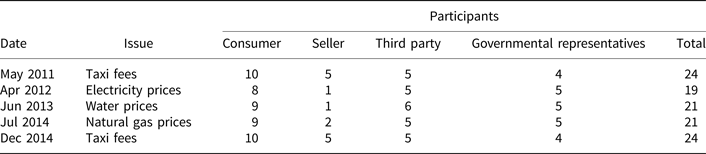
Between May 2016 and December 2016, we undertook an extensive survey of the participants in participatory pricing in Shanghai. Participants were drawn from the five participatory pricings that were held in Shanghai, which had 109 participants in a form of citizen jury. Details of the five deliberations are shown in Table 1 including the dates, topics, and participant composition. As detailed information on the participants is required to be posted publicly on government websites, we were able to trace all participants and contacted them through phone and social media for door-to-door surveys.Footnote 6 Respondents were instructed that participation was voluntary and the results would be used only for scholarly purposes. Due to the political sensitivity of the survey, we tried our best to convince them of the guarantee of confidentiality. For example, we did not collect identifying information such as names or email addresses. Considering that the number of participants was not large, we also excluded age and occupation from demographic data collection, since it would be easy to identify the respondent by the other information he or she provided, such as gender and education. In this way, respondents were given the assurance and security to submit honest opinions. Seventy two usable surveys were received. These respondents include sellers, consumers, third-party members, and government officers, which guarantees a diversity of opinions. The proportion of each group in the sample is similar to that in the population. In addition, widespread speculation holds that a large number of the participants are actually retirees employed by local governments to act as voluntary participants (‘听证专业户’) to ensure a smooth process; fortunately, this is not true in our cases. There are only nine retirees among all 109 participants in the five participatory pricings we surveyed, with no more than two in each of the processes. The name list and basic information can be reviewed on the government's website.Footnote 7
Five participatory pricings in Shanghai

Considering that the number of participants in participatory pricings in the last 5 years in Shanghai was only 109, the sample of 72 constitutes 66% of the participants and thus fairly representative of these participants in Shanghai. More than half of the public consultations’ participants were recommended by corporations and government departments, while the rest enrolled voluntarily. This method of participant selection results in a group that is relatively highly educated, more interested in politics, and perhaps more sympathetic to the position of the government. We believe it is important to examine their opinions and responses to deliberations, which can serve as a case study of the mini-impact of public deliberation on political activism to reach an empirical-based study of one mechanism of authoritarian deliberation.
We performed the survey in Shanghai rather than other cities in China due to the accessibility and frequency of participatory pricings held there. Additionally, we undertook a separate study that shows that Shanghai has relatively low governmental control of deliberative processes and a high degree of citizen political interest, making it distinct from other cities in China (Qin, Reference Qin2016). Thus, in Shanghai, the proportion of voluntary participants is larger than in other cities, and participants are given more freedom of speech in deliberation, which makes deliberations in this city closer to an authentic deliberative ideal. As a result, the choice of Shanghai as the survey location allows us to obtain the genuine attitudes and responses of the participants. In a word, we are not using Shanghai to represent the general situation in China, but we are using it as the best situation in China which to explore the logic of demobilization in this authoritarian context.
5. Questionnaire and variables
The survey draws on the questionnaire from ‘Participedia’ (Fung and Warren, Reference Fung and Warren2011). The Participedia questionnaire was translated into Mandarin and evaluated for accuracy before the survey was conducted. The Participedia survey uses a series of questions to assess participants’ perspectives on the deliberations.
Our major variable is political engagement, which is measured with one ordinal item. Another variable in this study is deliberative quality; it is measured by five ordinal items (information, opportunity to express, freedom to express, diversity of opinions, and reason behind arguments) with a Cronbach's α of 0.90. The selection of the five items was based on the standards of deliberative quality rooted in the Habermasian logic of communicative action. The moderator is empowerment, which is measured by two ordinal items with a Cronbach's α of 0.97; this variable pertains to the extent to which participants are empowered in decision making.
Additionally, myriad studies report that a gender gap exists in citizens’ political participation with women less politically engaged than men (Burns, Reference Burns2007; Dalton, Reference Dalton2008; Coffé and Bolzendahl, Reference Coffé and Bolzendahl2010) and that education positively correlates with political participation (Verba et al., Reference Verba, Schlozman and Brady1995; Hillygus, Reference Hillygus2005). Political interest is a critical part of having a psychological engagement with politics; hence, it is an indicator of participation (Olsson, Reference Olsson2014; Shapland, Reference Shapland2015). In addition, empirical evidence supports the proposition that high public trust will lead to an increase in civic engagement (LaPorta et al., Reference LaPorta, Lopez-de-Silanes, Shleifer and Vishny1997). As a result, we controlled for gender, education, level of political interest, and governmental trust in our model.
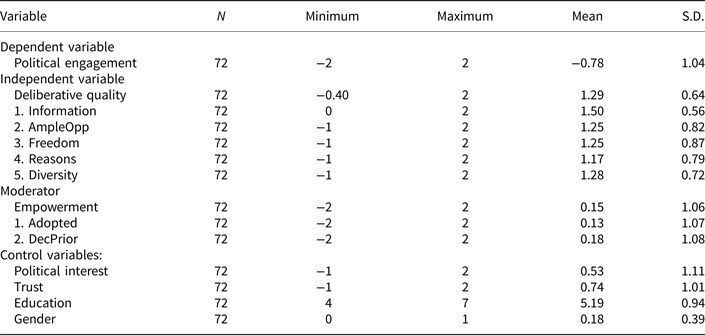
Below, we provide the survey questions and measurement for each variable. The descriptive statistics are shown in Table 2.
Descriptive statistics

5.1 Political activism
• (Activism) After participating in the deliberation, how likely is it that you would join other people to help make progress on the issues you worked on in this process? (−2 = very unlikely; 2 = very likely)
5.2 Deliberative quality
(Measured using the following five items with a Cronbach's α of 0.90.)
• (Information) How familiar are you with the issues that were the focus of the meeting or process? (−2 = very unfamiliar; 2 = very familiar)
• (Opportunity) How often did you have an opportunity to express your views in the small group discussions? (−2 = almost never; 2 = very often)
• (Freedom) Overall, how comfortable did you feel expressing what was truly on your mind? (−2 = very uncomfortable; 2 = very comfortable)
• (Reasons) When people expressed their views in discussions, how often did they give reasons? (−2 = never; 2 = always)
• (Diversity) How diverse was the range of opinions you heard in the discussions? (−2 = not diverse at all; 2 = very diverse)
5.3 Empowerment in decision making
(Measured using the following two items with a Cronbach's α of 0.97.)
• (Adopted) What is the likelihood that the process's recommendations will be adopted by those in power? (−2 = very unlikely; 2 = very likely)
• (Prior decision being made) Do you think you participated in a process that led to important decisions or a process that came after the important decisions were already made? (−2 = made none of the decisions; 2 = made all of the decisions)
5.4 Education
1 = no formal education; 2 = primary school; 3 = high school; 4 = some post-secondary education without degree; 5 = trade certificate; 6 = university degree; 7 = post-graduate degree
5.5 Gender
0 = man; 1 = woman
5.6 Political interest
How interested would you say you are in politics? (−2 = not at all interested; 2 = extremely interested)
5.7 Trust
How often do you trust the government to do what is right? (−2 = never; 2 = just about always)
6. Findings
6.1 Testing hypothesis 1
The mean values of deliberative quality and empowerment are respectively 1.29 and 0.15 on a five-point scale ranging from −2 to 2, and a gap of 1.14 exists. We therefore conducted a t-test, and the result is shown in Table 3, which indicates that the gap of 1.14 is statistically significant, supporting hypothesis 1. Considering that the scale has only five points ranging from −2 to 2, 1.14 is a large difference, which means that on average, participants’ perception of deliberative quality reaches the extent of ‘good,’ while their perception of empowerment reaches the level of ‘neither good nor bad.’
t-Test comparing citizens’ perception of deliberative quality and empowerment

***P < 0.001.
6.2 Testing hypothesis 2
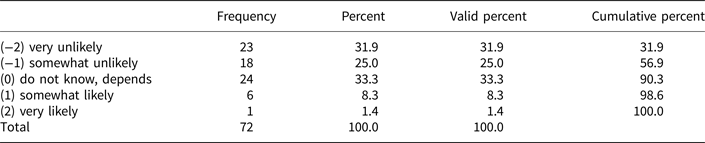
We then performed the correlation test pertaining to our next two hypotheses. Since the dependent variable here (political activism) is categorical, we use ordinal logistic regression rather than ordinary least squares (OLS) regression. Table 4 shows the details of the dependent variable with frequency and cumulative probability. Clearly, the cumulative probability for lower scores is high, and the approach to 1 is slow, which suggests the use of a negative log–log link function (in SPSS) to refine the model.
(DV: Activism) How likely is it that you would join others to help make progress on the issues that you worked on in this process?

The independent variable and moderator are continuous in nature: the empowerment index (summation of five ordinal items) and compromise index (summation of two ordinal items). All of the control variables except gender are ordinal and to retain as much information from the data as possible, we treat them as continuous variables. For the categorical variable of gender, we introduce dummy variables to test the correlation.
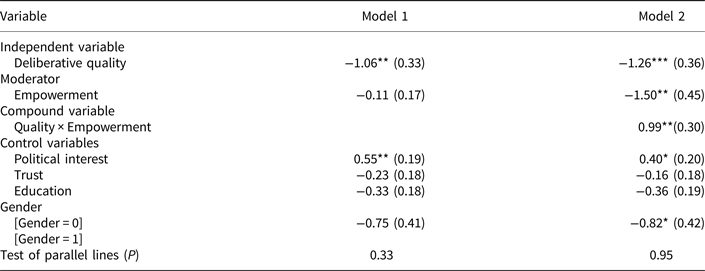
Model 1 in Table 5 shows the results of the logistic regression. The coefficient of the predictor of deliberative quality is negative and statistically significant at the 0.001 probability level. This result supports our second hypothesis. In the Chinese context, deliberative quality is negatively associated with political activism. For those participants with higher perceptions of deliberative quality, lower political activism can be observed. Political interest has a positive and statistically significant impact on participants’ activism, which is in accord with our literature review. The variables of empowerment, trust, gender, and education fail to predict the independent variable. A test of parallel lines is passed with P = 0.448.
Ordinal regression

*P < 0.05; **P < 0.01; ***P < 0.001. Link function: negative log–log.
6.3 Testing Hypothesis 3
Next, we introduced the logic of the moderator. Variables can be regarded as moderators when their existence changes the relationship between the dependent and independent variables, regardless of whether they attenuate or exacerbate that relationship. In this case, a moderation test was employed to test whether the extent of empowerment affects the relationship between deliberative quality and political activism. More specifically, it tests whether the negative relationship is attenuated when individuals have a certain extent of empowerment or exacerbated when they lack empowerment. A compound variable (deliberative quality × empowerment) is generated by multiplying the two variables together. We incorporated it into the regression model, and the results are presented in model 2 in Table 5.
The results show that the coefficient is positive and significant (0.99**, see Table 5) at the 0.001 probability level, which means that the moderator has a positive impact on the relationship between deliberative quality and empowerment. This result supports our final hypothesis. When the extent of empowerment is low, high-quality deliberation will have a negative effect on participants’ motivation to engage in politics, but this negative relationship will be attenuated when empowerment is increased.
7. Conclusion
This study tests the basic characteristic of authoritarian deliberation, namely, the asymmetry between deliberation and empowerment, and explores whether deliberations can enhance participants’ political activism independently of their empowerment. The results show that the participants’ perception of deliberative quality is relatively high while the empowerment perceived by the participants is low. The participants are allowed to access ample information in advance and communicate genuinely with few restraints, and the arguments offered during deliberation embody the idea of rational discourse. However, the extent to which the results of deliberations are adopted remains ambiguous, and the participants show no optimism that they will be.
Regarding the relationship between deliberation and political activism, the findings suggest the existence of a negative correlation. This result supports our hypothesis that the high-quality deliberations held by the government are likely to strengthen participants’ dependence on the government to solve problems, further disengaging them from political participation and reducing their political activism. However, it should be noted that the respondents surveyed here might be mobilized in other situations for other issues; and a demobilizing effect in one area does not mean that such an effect will be present in another area. Such a phenomenon would depend on many other conditions.
Furthermore, the moderating effect of empowerment on this demobilizing effect is statistically significant. Deliberation quality is negatively associated with participants’ political activism when empowerment is low, and this negative relationship will be attenuated when empowerment is increased. This finding illustrates the contradiction of authoritarian deliberation well: it intends to demobilize citizens’ political activism through phantom democracy. In doing so, local governments must offer limited empowerment to attract attendees and make public deliberation workable. However, this might undermine the demobilization effect.
In conclusion, the combination of high-quality deliberation and a low level of empowerment reduces participants’ political activism, which may impede the development of civil society and circumvent a regime-level democratization. Deliberations with a relatively high extent of empowerment and deliberative citizenship exist, especially in village-level innovations (He, Reference He2018). However, nationally, routine deliberations in which a low level of empowerment is observed – such as participatory pricings, public hearings, and Chinese People's Political Consultative Conferences – render the gap between deliberation and democracy advantageous to the reinforcement of authoritarian rules rather than deliberation-led democratization.
Finally, according to the idea of deliberative system (Mansbridge et al., Reference Mansbridge, Bohman, Chambers, Christiano, Fung, Parkinson, Thompson, Warren, Parkinson and Mansbridge2012), sometimes deliberations that are internally non-deliberative will contribute to the system as a whole. ‘In a complementary relationship, two wrongs can make a right. Two venues, both with deliberative deficiencies, can each make up for the deficiencies of the other. Thus an institution that looks deliberatively defective when considered only on its own can look beneficial in a systemic perspective’ (Mansbridge et al., Reference Mansbridge, Bohman, Chambers, Christiano, Fung, Parkinson, Thompson, Warren, Parkinson and Mansbridge2012: 3). As a result, although this study focuses on the control mechanism within the process and emphasizes authoritarian essence in the process, it does not arrive at the conclusion that participatory pricing has nothing to contribute. In a word, China has introduced various deliberative practices with different motivations, organizers, participants, and control mechanisms. Research findings for one form may not be applicable to another form. This study singles out participatory pricing. The connection and interaction between different forms of deliberation requires further study.
Xuan Qin is an assistant researcher (equivalent to tenure-track assistant professor in the US) in the Institute for Advanced Study in Social Sciences in Fudan University. Her research covers deliberative democracy, democratic theory, and political theory.
Baogang He is Alfred Deakin Professor, Chair in International Relations, School of Humanities and Social Sciences, Deakin University, and adjunct professor in Tianjin Normal University. Graduated with a Ph.D. in Political Science from Australian National University in 1994, Professor He has become widely known for his work in Chinese democratization and politics, in particular the deliberative politics in China as well as in Asian politics covering Asian regionalism, Asian federalism, and Asian multiculturalism. Professor He has published six single-authored books and 70 international refereed journal articles. His publications are found in top journals including British Journal of Political Science, Journal of Peace Research, Political Theory, and Political Studies and Perspectives on Politics. In addition, he has published three books, 15 book chapters, and 63 journal papers in Chinese.