Introduction
Among the numerous theoretical models developed to explain eating disorders (EDs), cognitive behavioural accounts have dominated (e.g. Garner & Bemis, Reference Garner and Bemis1982; Vitousek & Hollon, Reference Vitousek and Hollon1990; Fairburn et al. Reference Fairburn, Shafran and Cooper1999). Such models have centred on the importance of disorder-specific cognitions about eating, weight and shape in their explanations of the disorders, and the focus has been on the role that these types of cognitions might play in the maintenance of the disorders. Although this is undoubtedly important, we have limited understanding of whether biases in this type of cognition exist pre-morbidly and whether they contribute to vulnerability. Moreover, there is now growing evidence that there might be other factors (unrelated to eating, weight and shape) that are important (Fairburn et al. Reference Fairburn, Cooper and Shafran2003; Cooper et al. Reference Cooper, Wells and Todd2004; Cooper, Reference Cooper2005).
One area that has received particular attention is that of negative self or core beliefs (Cooper et al. Reference Cooper, Wells and Todd2004; Waller et al. Reference Waller, Kennerley, Ohanian, Riso, du Toit and Young2007b). These absolute negative beliefs (unrelated to eating, weight and shape) about the self are hypothesized to have a causal role in EDs, and their modification is thought to be necessary to achieve recovery (Cooper, Reference Cooper2005). More recent formulations of cognitive therapy for EDs include strategies to address these negative self-beliefs (e.g. Fairburn et al. Reference Fairburn, Cooper and Shafran2003; Cooper et al. Reference Cooper, Wells and Todd2004; Waller et al. Reference Waller, Cordery, Corstorphine, Hinrichsen, Lawson, Mountford and Russell2007a). Negative self-beliefs are also known to be important in depressive disorders (Teasdale et al. Reference Teasdale, Segal, Williams, Ridgeway, Soulsby and Lau2000), and there is considerable overlap in the content of these beliefs between patients suffering from depression and EDs. Emerging evidence, however, suggests that the specific content of some of these beliefs may be different between the two disorders (Waller et al. Reference Waller, Shah, Ohanian and Elliott2001; Cooper et al. Reference Cooper, Rose and Turner2005; Cooper & Cowen, Reference Cooper and Cowen2009). Like cognitions about eating, weight and shape, negative self-beliefs are thought to operate in a schematic fashion. That is to say, they form well-established knowledge structures that provide a framework for organizing cognition, enabling fast, automatic processing. Several information processing paradigms lend themselves to the investigation of these types of schematic beliefs. The emotional Stroop task (Stroop, Reference Stroop1935; Williams et al. Reference Williams, Williams and MacLeod1996) has been used extensively to investigate eating, weight and shape cognitions in EDs, and a Self-Schema Processing Task (SSPT) developed by Markus (Reference Markus1977) has been proposed as a useful means of investigating self or core beliefs (Cooper, Reference Cooper, Schumaker and Ward2001).
Emotional processing has also been investigated in EDs using tasks that assess the ability to recognize facial expressions of emotion, and several studies have reported findings indicative of deficits in this skill in EDs. Zonnevijlle-Bendek et al. (Reference Zonnevijlle-Bendek, van Goozen, Cohen-Kettenis, van Elburg and van Engeland2002) found that a mixed ED group performed generally more poorly than matched controls on a facial emotion recognition task. Anorexia nervosa (AN) patients have been reported to have poorer recognition of negative emotional facial expressions than matched controls (Kucharska-Pietura et al. Reference Kucharska-Pietura, Nikolaou, Masiak and Treasure2004). Furthermore, a Visual Evoked Potential (VEP) study found specific impairments in the recognition of neutral, sad and disgusted expressions in addition to an increase in the N200 component response to all emotional expressions and a decrease in the P300 component response to negative emotions in patients compared to controls (Pollatos et al. Reference Pollatos, Herbert, Schandry and Gramann2008). In bulimia nervosa (BN), poorer recognition of facial expressions of surprise has been reported (Legenbauer et al. Reference Legenbauer, Vocks and Rüddel2008). There are also reports of null findings in this literature (Mendlewicz et al. Reference Mendlewicz, Linkowski, Bazelmans and Philippot2005; Kessler et al. Reference Kessler, Schwarze, Filipic, Traue and von Wietersheim2006). It is highly likely that widely differing methodologies account partially for the discrepancies in these findings. In addition, in several of the studies, the effects of depression and anxiety have not been controlled for, and patients were taking selective serotonin reuptake inhibitors (SSRIs), which have been found to affect performance on this type of task (e.g. Harmer et al. Reference Harmer, Bhagwagar, Perrett, Vollm, Cowen and Goodwin2003). A recent study in AN patients has addressed some of these issues by using the well-characterized Facial Emotion Recognition Task (FERT; Harmer et al. Reference Harmer, Bhagwagar, Perrett, Vollm, Cowen and Goodwin2003) and considering both medicated and unmedicated AN patients (Jänsch et al. Reference Jänsch, Harmer and Cooper2009). Unmedicated patients were found to have greater reaction times (RTs) to facial expressions of anger, fear, sadness and surprise, and there was also a positive relationship in the unmedicated group between the level of ED symptoms and the number of expressions misclassified as anger. A second study used the FERT in two non-clinical groups with high and low levels of ED symptoms (Jones et al. Reference Jones, Harmer, Cowen and Cooper2008). Controlling for depression, women with high levels of ED symptoms showed specific impairments in recognizing happy and neutral emotional expressions. These results provide further support for the significance of emotional processing in EDs and, importantly, for the idea that it may be relevant to development and risk.
The present study therefore aimed to consider the role of biases in processing in relation to vulnerability to EDs. A battery of tasks was selected to probe the types of non-eating-, weight- and shape-related emotional processing discussed above and recently found to be impaired in EDs but little studied in vulnerability (self-schema processing and facial emotional expression recognition), in addition to the biases in cognitions about eating, weight and shape, which have been extensively investigated in relation to maintenance of the disorders but little in relation to vulnerability (emotional Stroop). Dieters were selected for the study as it is well established that they are a vulnerable group for EDs (Crisp, Reference Crisp1980; Vitousek & Ewald, Reference Vitousek, Ewald, Segal and Blatt1993; Gendall et al. Reference Gendall, Joyce, Sullivan and Bulik1998; Stice et al. Reference Stice, Mazotti, Krebs and Martin1998b; Jacobi et al. Reference Jacobi, Hayward, de Zwaan, Kraemer and Agras2004). Continuum theory posits that both eating difficulties and the psychological symptoms of EDs are also present in the healthy population in a graded fashion, increasing in severity towards clinically significant cases, such that they differ only quantitatively (not qualitatively) between healthy and unhealthy populations (Nylander, Reference Nylander1971; Striegel-Moore et al. Reference Striegel-Moore, Silberstein and Rodin1986; Pike & Rodin, Reference Pike and Rodin1991; Stice et al. Reference Stice, Killen, Hayward and Taylor1998a). This continuum allows the establishment of a gradient of risk within a dieting group by looking at levels of subclinical ED symptoms. It has been demonstrated previously that dieters with higher levels of ED-like symptoms, labelled as symptomatic dieters, show similar biases to ED patients in the processing of ED-specific stimuli (Cooper & Fairburn, Reference Cooper and Fairburn1992). Moreover, it has also been shown in a prospective study of dieters that those who eventually go on to develop an ED have higher levels of ED symptomatology at baseline (Fairburn et al. Reference Fairburn, Cooper, Doll and Davies2005).
Thus, the current study aimed to investigate whether the biases demonstrated in ED patients in cognitive and emotional processing are predictive of the level of ED symptoms experienced in an at-risk group, and therefore whether they are indicative of vulnerability.
Method
Participants
Female dieters (n=82) were recruited through advertisements for a study regarding attitudes to eating, weight and shape that sought healthy, female volunteers. Participants registered interest in the study by completing an online questionnaire, which served as a screening instrument.
Dieters were selected on the basis of a restraint subscale from the Eating Disorder Examination Questionnaire (EDE-Q, EDE-Q-R; Fairburn & Beglin, Reference Fairburn and Beglin1994), which was embedded in the online questionnaire. A cut-off of 0.8 on the EDE-Q-R was set as this represents either very frequent use of one dieting behaviour or infrequent use of several behaviours.
Volunteers who met this restraint criterion, were aged 18–30 years, native English speakers and not currently using any psychotropic medication were then screened for current and lifetime history of Axis I disorders using the Structured Clinical Interview for DSM-IV (SCID; First et al. Reference First, Spitzer, Gibbon and Williams1996) either face-to-face or by telephone.
Of the 571 females who completed the online screening questionnaire, 218 met the study criteria. Ninety-three of the suitable volunteers agreed to be interviewed using the SCID and to participate in the psychological testing. Ten volunteers were later excluded as they met criteria for an Axis I disorder and one volunteer did not complete the psychological testing.
The study was approved by the institutional ethics committees.
Psychological testing
Negative self-beliefs
SSPT
This task consists of four sets of personality/self words (matched for length and frequency): negative ED relevant (e.g. evil, repulsive), negative depression relevant (e.g. numb, excluded), generic negative (e.g. hostile, bossy) and generic positive (e.g. honest, pleasant). The negative ED-relevant words and the negative depression-relevant words were selected from a factor analytic study in which patients with an ED, patients with depression and healthy controls rated their self-belief in a large number of self/personality words (Cooper & Cowen, Reference Cooper and Cowen2009). The negative and positive words were taken from Anderson (Reference Anderson1968). Words were presented in a random order in the centre of the screen for 500 ms. Participants were asked to decide whether the presented word applied to them or could be used to describe them and to respond as quickly and accurately as possible by pressing labelled keys (‘me’, ‘not me’) on the keyboard.
Emotional processing
FERT
This is an emotional expression recognition task featuring the six basic emotions (happiness, sadness, fear, anger, disgust and surprise) taken from the Ekman & Friesen (Reference Ekman and Friesen1976) Pictures of Affect series. The expressions have been morphed between 0 (neutral) and 100% (full emotion) intensity of the emotion in 10% increments using techniques described by Young et al. (Reference Young, Rowland, Calder, Etcoff, Seth and Perrett1997). Four examples of each emotion are presented at each intensity, in addition to each face (total of 10 individuals) being presented in a neutral expression, giving a total of 250 stimuli presentations. Stimuli were presented in random order on a computer screen for 500 ms, followed immediately by a blank screen. Participants were asked to categorize the emotions by pressing labelled keys on the keyboard. Data from two participants were excluded due to technical failures during the task.
Cognitions about eating, weight and shape
Emotional Stroop
This task is a computerized version of an emotional ED-relevant Stroop. Four sets of emotionally relevant words were used: weight words, shape words, eating words and depression (social threat)-relevant words. Each set of emotionally relevant words had a corresponding set of neutral control words, matched for length and frequency; control words were also grouped into sets with neutral themes (transport, communication, household items and landscape). The weight, shape and eating words were drawn from Cooper & Fairburn (Reference Cooper and Fairburn1992), and the social threat words were drawn from Munafò et al. (Reference Munafò, Hayward and Harmer2006). Each word was presented once in each of the three colours used (red, green and blue) and remained on screen until participants made a response using a microphone connected to the computer. In addition to this overt version, a masked version of the task was used in which the words were presented for 14 ms followed by a string of random non-alphanumeric characters of the same length as the word and presented in the same colour ink. The words were always presented in blocks and an emotional block was always followed by its control block, but the order of the emotional blocks and the order in which the masked and overt versions were presented were rotated. Only correct responses were included in the analysis. The results were analysed as interference scores calculated as: (emotional – neutral)/neutral (e.g. Turken & Swick, Reference Turken and Swick1999).
Measures
Participants also completed the 26-item Eating Attitudes Test (EAT-26; Garner et al. Reference Garner, Olmsted, Bohr and Garfinkel1982) to assess the level of subclinical ED symptoms. This measure has been used extensively not only to identify those suffering from an ED but also to identify those at risk and to profile ED symptoms in analogue studies of non-clinical populations. The Hospital Anxiety and Depression Scale (HADS; Zigmond & Snaith, Reference Zigmond and Snaith1983) was used to assess depressive and anxious symptoms and the National Adult Reading Test (NART; Nelson, Reference Nelson1982) was used to measure verbal IQ.
Statistics
Regression analyses were used to explore the relationships between task variables and the level of ED symptoms as measured by the EAT-26. Given the large number of potential predictors, separate regression analyses for each task (SSPT, FERT, emotional Stroop) were performed initially. This allowed the selection of predictors of ED symptoms from each task for entry into the final regression analysis, which included predictors across all the tasks. Extraneous variables that could be associated with task performance and EAT-26 score [age, body mass index (BMI), depression (as measured by the HADS-D), anxiety (as measured by the HADS-A) and IQ (as measured by NART)] were entered into the initial regressions as control variables. A frequent criticism of this type of research is that it is difficult to differentiate between biases that are predictive of ED symptoms and those that are predictive of depressive symptoms. We therefore also conducted the analyses using the HADS-D score as the dependent variable. As all the analyses were exploratory in nature, the backwards stepwise procedure was chosen with the removal criteria set at 0.05.
We also wanted to explore whether there were significant interactions between different types of biases and therefore tested for moderation between emotional processing, negative self-beliefs and ED-specific cognitions. Where significant predictors were identified in the initial regression, moderation was testing using the method described by Baron & Kenny (Reference Baron and Kenny1986). Each of the interactions was tested separately, and significant interactions were then entered into the final regression model.
There were a few missing data in the SSPT, and these were imputed using the closest match method as suggested by Elliott & Hawthorne (Reference Elliott and Hawthorne2005).
Results
Sample description
The mean age of the sample was 20.44 (s.d.=2.73) years. BMI (mean 22.11, s.d.=3.07), depressive (HADS-D: 2.87, s.d.=2.23) and anxious symptoms (HADS-A: 7.06, s.d.=3.25) were all in the normal range, as was IQ (NART: 114.93, s.d.=5.66). Mean dietary restraint (EDE-Q-R) was 1.81 (s.d.=0.93) and, importantly, for a healthy but at-risk group, ED symptoms were in the normal range (11.66, s.d.=7.43).
Predicting vulnerability to eating disorders (EAT-26)
Initial multiple regressions for separate tasks
SSPT
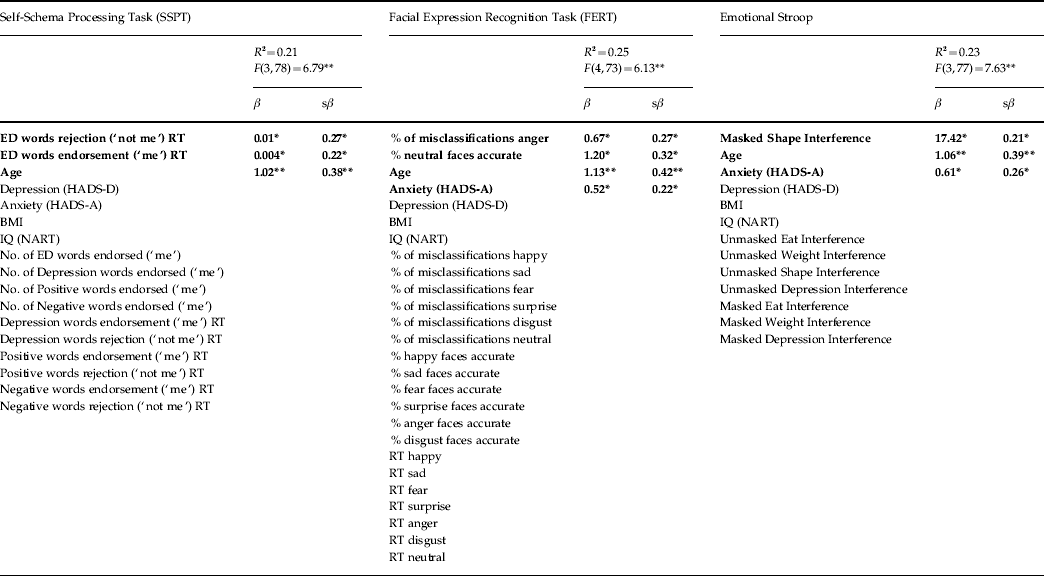
Both RT to endorse (‘me’) and RT to reject (‘not me’) ED-relevant personality and characteristic words were significant predictors of EAT-26 score, as was age (Table 1).
Predicting vulnerability to eating disorders (EAT-26 score): initial regressions for individual tasks

EAT-26, 26-item Eating Attitudes Test; ED, eating disorder; RT, reaction time; HADS-D, Hospital Anxiety and Depression Scale – depression subscale; HADS-A, Hospital Anxiety and Depression Scale – anxiety subscale; BMI, body mass index (weight/height2); NART, National Adult Reading Test; β, unstandardized beta; sβ, standardized beta. β coefficients are given for all the variables that contributed significantly to the model in the backwards regression model (criteria for removal p>0.05).
The results are shown from the initial regression analyses for each of the emotional processing tasks; these initial analyses were used to select predictors for the final analysis. For each of the tasks, all of the task variables for that task were entered into these regressions in addition to the control variables. Significant predictors are highlighted in bold.
* p<0.05, ** p<0.01.
FERT
The percentage of faces that were incorrectly classified as angry and the percentage of neutral faces that were accurately classified were both significant predictors of EAT-26 score, as were age and anxiety as measured by the HADS-A (Table 1).
Emotional Stroop
The interference score for shape words in the masked condition was a significant predictor of EAT-26 score, as were age and anxiety (Table 1).
Interactions
There was significant moderation of information processing biases in eating, weight and shape cognition by negative self-beliefs with an ED words endorsement RT×masked shape interference score interaction [β=–0.19, t(78)=s.d.=2.05, p=0.04]. This interaction indicated that masked shape interference scores were more strongly predictive of ED symptoms in a group that was faster to endorse ED-relevant words (Fig. 1).
Moderation of information processing biases in cognitions about eating, weight and shape by negative self-beliefs. The graph shows the interaction between reaction times (RTs) to endorse eating disorder (ED)-relevant personality words and the interference score for shape words on the masked version of the emotional Stroop. To create the graph a median split on RTs to endorse ED-relevant words was used to create a fast RT group ( ) and a slow RT group (▪). Axes show z scores, lines show linear trends for each group.

There were no other significant interactions in terms of moderation between emotional processing, negative self-beliefs or information processing biases in eating, weight and shape cognitions.
Final regression model
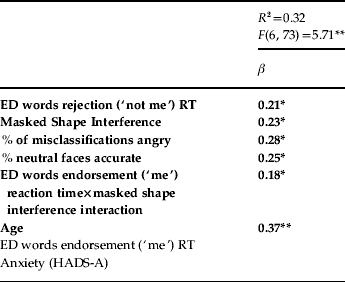
Using all the significant predictors from the initial regressions, the best-fit regression model consisted of six predictor variables and explained 32% of the variance in EAT-26 scores (Table 2).
Predicting vulnerability to eating disorders (EAT-26 score): final regression model

EAT-26, 26-item Eating Attitudes Test; ED, eating disorder; RT, reaction time; HADS-A, Hospital Anxiety and Depression Scale – anxiety subscale; β, unstandardized beta; β coefficients are given for all the variables that contributed significantly to the model in the backwards regression model (criteria for removal p>0.05).
The results are shown from the final regression analysis; the predictors from all the tasks (selected by means of the initial regression analyses) in addition to the control variables that were significant predictors in these initial analyses were entered into the model. Significant predictors are highlighted in bold.
* p<0.05, ** p<0.01.
Predicting depressive symptoms (HADS-D)
Initial multiple regressions for separate tasks
SSPT
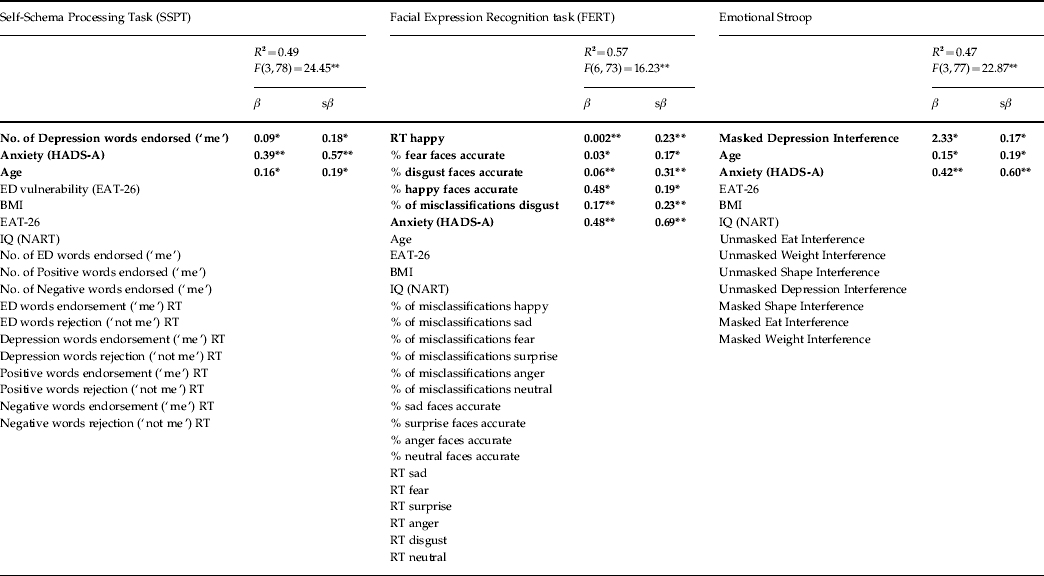
The number of depression-relevant personality and characteristic words endorsed (‘me’) was a significant predictor of HADS-D score, as were age and anxiety (Table 3).
Predicting depressive symptoms (HADS-D score): initial regressions for individual tasks

EAT-26, 26-item Eating Attitudes Test; ED, eating disorder; RT, reaction time; HADS-D, Hospital Anxiety and Depression Scale – depression subscale; HADS-A, Hospital Anxiety and Depression Scale – anxiety subscale; BMI, body mass index (weight/height2); NART, National Adult Reading Test; β, unstandardized beta; sβ, standardized beta. β coefficients are given for all the variables that contributed significantly to the model in the backwards regression model (criteria for removal p>0.05).
The results are shown from the initial regression analyses for each of the emotional processing tasks; these initial analyses were used to select predictors for the final analysis. For each of the tasks, all of the task variables for that task were entered into these regressions in addition to the control variables. Significant predictors are highlighted in bold.
* p<0.05, ** p<0.01.
FERT
RTs to classify happy emotional expressions, the percentage of fear, disgust and happy emotional expressions that were correctly classified and the percentage of faces that were incorrectly classified as disgust were all significant predictors of HADS-D score, in addition to age and anxiety (Table 3).
Emotional Stroop
The interference score for depression words in the masked condition was a significant predictor of HADS-D score, as well as age and anxiety (Table 3).
Interactions
There were no significant interactions between task variables that were identified as significant predictors of depressive symptoms in the initial analyses.
Final regression model
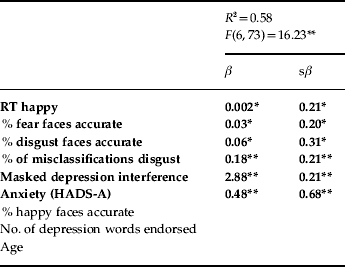
Using all the significant predictors from the initial regressions, the best-fit regression model consisted of six predictor variables and explained 58% of the variance in HADS-D scores (Table 4).
Predicting depressive symptoms (HADS-D): the final regression model

HADS-D Hospital Anxiety and Depression Scale – depression subscale; HADS-A, Hospital Anxiety and Depression Scale – anxiety subscale; RT, reaction time; β, unstandardized beta; sβ, standardized beta. β coefficients are given for all the variables that contributed significantly to the model in the backwards regression model (criteria for removal p>0.05).
The results are shown from the final regression analysis; the predictors from all the tasks (selected by means of the initial regression analyses) in addition to the control variables that were significant predictors in these initial analyses were entered into the model. Significant predictors are highlighted in bold.
* p<0.05, ** p<0.01.
Discussion
The current study investigated biases in cognitive and emotional processing in vulnerability to EDs. The final regression model explained 32% of the variance in ED symptoms, and gave the six significant predictors of age, a bias in processing ED-relevant self and personality words, attentional bias to shape words under subliminal conditions, anger misclassification, accuracy at identifying neutral faces and an interaction between the biasing of ED-relevant self words and attentional bias to shape words. The model is relatively novel in demonstrating that cognitive biases other than other than those relating to eating, weight and shape are predictive of vulnerability.
In the SSPT, longer RTs to reject the ED-relevant personality and self words were predictive of subclinical ED symptoms. This is consistent with the self-schema processing hypothesis, and is thought to represent interference when trying to reject schema-relevant attributes (Markus, Reference Markus1977). It is interesting that the bias was evident only in RTs rather than in the actual responses of participants, as this is at odds with previous findings using similar tasks (e.g. Markus, Reference Markus1977), and suggests that that implicit measure may be a more sensitive predictor of vulnerability. No other types of personality and self words were predictive of ED symptoms, and this provides support for the idea that it is possible to identify the specific content of self schemata and therefore to differentiate between depression-relevant biases and ED-relevant biases in vulnerability. It is important to emphasize that these personality and self words were ostensibly unrelated to eating, weight and shape.
In terms of facial expression recognition both the total number of neutral faces accurately identified and the number of faces misclassified as anger were significant predictors of ED symptoms. The finding that anger misclassification predicts ED symptoms is in line with earlier evidence that has demonstrated a positive relationship between the level of ED symptoms and anger misclassification in non-medicated AN patients (Jänsch et al. Reference Jänsch, Harmer and Cooper2009). One possible explanation for the total number of neutral faces accurately identified being predictive of ED symptoms is that, with increasing levels of ED symptoms, there is an increasing tendency to identify more faces overall as neutral, and that the side-effect of this response strategy is a tendency to get more neutral faces correct. However, there was no significant relationship between the number of faces misclassified as neutral and the level of ED symptoms, suggesting that this interpretation does not explain the data. Increased accuracy for neutral emotion recognition is at odds with findings both in AN patients (Pollatos et al. Reference Pollatos, Herbert, Schandry and Gramann2008) and in volunteers with high levels of ED-like symptoms (Jones et al. Reference Jones, Harmer, Cowen and Cooper2008). Although the volunteers in the Jones et al. (Reference Jones, Harmer, Cowen and Cooper2008) study are described as a non-clinical group, participants in the high symptom group of the study had a mean EAT-26 score indicative of clinically significant difficulties and several of their group reported histories of EDs. It is therefore possible that poorer recognition of neutral emotional expressions is present in illness, but that increased accuracy for neutral faces is indicative of vulnerability.
Biases in cognitions about eating, weight and shape are mostly cited with reference to the maintenance of EDs, and as cognitive theories might predict, a bias in the processing of shape-related words was predictive of ED symptoms in the emotional Stroop. This type of bias has been found previously in dieters with high levels of ED symptoms (Cooper & Fairburn, Reference Cooper and Fairburn1992). The bias was only important in the masked condition, suggesting that it is pre-attentive biases in processing that are more predictive of vulnerability. There was also an interaction between RTs to endorse ED-relevant self words and masked shape-related interference on the Stroop. This interaction indicated that the effect of increasing Stroop interference with ED symptoms was greater in those who were faster to endorse ED-related self words, suggesting that it is the combination of both strong negative self-beliefs and the biases in the processing of information about eating, weight and shape that is important in this vulnerable group.
In terms of the control variables that were entered on the basis of theoretical importance, only age and anxiety as measured by the HADS-A emerged as significant predictors. It is interesting that depression did not emerge as a predictor, as a frequent criticism of this type of research is that biases could also be explained by depressive symptoms. Moreover, in the tasks where depression-relevant stimuli were included as control variables (SSPT and Stroop), only the ED-relevant variables emerged as significant predictors of ED symptoms. As a further control we also repeated the analyses using depressive symptoms (HADS-D) as the dependent variable. Here, the final model explained 58% of the variance, with accuracy for fearful and disgusted facial expressions, RT for happy faces and the number of misclassifications that were disgust, in addition to the interference score for depression-relevant social threat words in the emotional Stroop and anxiety (HADS-A) all being significant predictors. These findings are consistent with the large body of evidence documenting negative biases in emotional processing in those at risk of depression and show a clear dissociation between those elements of the tasks that are predictive of depressive symptoms and those that are predictive of ED symptoms. The larger amount of variance explained in this model as opposed to the ED model is probably attributable to the very close relationship between depression and anxiety. Taken together, all of these results suggest that our findings are relatively specific to EDs.
Our final model explains 32% of the variance, and there are several factors that we have not included in the model that we hypothesize or acknowledge are important. First, there are sociocultural factors and family and life event variables that we acknowledge are important in explaining vulnerability, the inclusion of which we predict would increase the amount of variance explained. Moreover, longitudinal studies will be required to assess whether the biases seen here are predictive of change in ED symptoms over time. The present study did not include a control group of non-dieters with low scores on the EAT-26 as a correlational design was judged to be the most powerful method of investigating vulnerability. Although dieters are a vulnerable group for EDs, very few dieters will in fact go on to develop an ED (Fairburn et al. Reference Fairburn, Cooper, Doll and Davies2005). Dieters who demonstrate some ED-like symptoms are more at risk than other dieters (Cooper & Fairburn, Reference Cooper and Fairburn1992; Fairburn et al. Reference Fairburn, Cooper, Doll and Davies2005), and this enabled us to establish a gradient of risk using EAT-26 scores within our sample. Our participants did not have an ED history. In so far as those with ED symptoms are at risk of developing an ED, then it is possible that the biases we have identified here may be important in the development of a clinical ED. Further work is required to establish whether such biases predict the severity of the disorder, and its course over time in a clinical sample. It will be particularly important to establish the role of biases ostensibly unrelated to eating, weight and shape and, as in the current study, their relationship to depression.
In conclusion, these results show that the types of biases in emotional processing seen in patients suffering from EDs are also present in an at-risk (but not previously ill) group. These biases can be used to explain some of the variance in vulnerability, as they are predictive of the level of subclinical ED symptoms experienced within the group. Importantly, we are able to demonstrate that levels of depressive and anxious symptoms do not contribute to the model, and that biases in the processing of depression-relevant stimuli only are predictive of depressive symptoms. This suggests that our results are relatively specific to EDs. The contribution of negative self or core beliefs ostensibly unrelated to eating, weight and shape to the prediction of ED symptoms, measured using an information processing task, is a particularly novel finding and indicates that both the task and the construct are worthy of further investigation in relation to vulnerability to EDs and to EDs themselves.
Acknowledgements
We thank the School of Psychology, University of Birmingham for assisting in the recruitment of participants and for the provision of testing facilities, and in particular we thank Dr S. Higgs for her support. The study was funded by the Medical Research Council (MRC). A.P. is supported by an MRC studentship.
Declaration of Interest
C.H. has acted as a consultant for P1vital, Servier, Lundbeck and Merck, Sharpe and Dohme, and is on the advisory panel for P1vital.