Introduction
Dizziness and balance disorders are very common in the general population, with a reported one-year prevalence of 11 per cent and a lifetime prevalence of 35 per cent.Reference Formeister, Rizk, Kohn and Sharon1 Migraine headaches are the third most common disease worldwide, affecting an estimated one in six people over their lifetime.Reference Huang, Wang and Kheradmand2,Reference Lempert and Neuhauser3 Of those with migraines, 20–61 per cent suffer from concomitant vestibular symptoms, implying a lifetime prevalence of migraine-related dizziness of up to 10 per cent.Reference Formeister, Rizk, Kohn and Sharon1 While the association between migraine and vestibular symptoms has been recognised for over 100 years, only in the last three decades has this relationship taken shape as the distinct diagnostic entity of vestibular migraine.Reference Lempert, Olesen, Furman, Waterston, Seemungal and Carey4 Although previously reported to affect about 1 per cent of the population, a more recent epidemiological study has shown the one-year prevalence of vestibular migraine in the general population to be 2.7 per cent, making it a very frequent, yet underdiagnosed cause of dizziness.Reference Formeister, Rizk, Kohn and Sharon1
Diagnostic criteria for vestibular migraine were updated in 2012 by the Bárány Society and International Headache Society, to standardise diagnoses.Reference Lempert, Olesen, Furman, Waterston, Seemungal and Carey4 Subsequent research has shown that the risk factors for migraine are also associated with vestibular migraine, namely young age, female sex, psychiatric co-morbidities such as anxiety and depression, and prior head trauma.Reference Formeister, Rizk, Kohn and Sharon1,Reference Huang, Wang and Kheradmand2,Reference Lauritsen and Marmura5–Reference Beh, Masrour, Smith and Friedman7
While vestibular migraine is diagnosed based on history and physical symptoms, the effect of dizziness on a patient's well-being and quality of life can be understood through validated questionnaires, such as the widely used Dizziness Handicap Inventory. The Dizziness Handicap Inventory consists of 25 items sub-grouped into 3 domains: the physical manifestations of dizziness, vertigo and unsteadiness; and the functional and the emotional consequences of vestibular impairment.Reference Jacobsen and Newman8 The Dizziness Handicap Inventory has subsequently become the ‘gold standard’, in part due to its ease of use and strong validity. The questionnaire has since been reproduced and validated into over a dozen different languages.Reference Jacobsen and Newman8–Reference Van De Wyngaerde, Lee, Jacobson, Pasupathy, Romero-Brufau and McCaslin10
The historical deficiency of diagnostic consensus, along with overlapping symptoms with other disorders such as Ménière's disease, has somewhat slowed advances in treatment for vestibular migraine as a distinct disease entity. Available treatments focus on lifestyle and dietary modifications, vestibular rehabilitation, and medications. Current medications for vestibular migraine include prophylactic and abortive therapies. However, data on these medications are lacking, with only two randomised, controlled trials on the efficacy of preventive medications.Reference Huang, Wang and Kheradmand2,Reference Lauritsen and Marmura5,Reference Power, Shute, McOwan, Murray and Szmulewicz6,Reference Fernandez M, Birdi, Irving, Murdin, Kivekas and Strupp11,Reference Beh12 As a result, treatment of vestibular migraine is generally extrapolated from the treatment of migraines. This includes the use of botulinum toxin injections in patients with chronic migraines, who suffer more than 15 headaches a month that are unresponsive to trials of 2 preventive medications from 2 different classes.Reference Bikhazi and Ruckenstein13 The efficacy and safety of botulinum toxin injections for the prevention of chronic migraine, an aggressive type of migraine, is strongly supported in the literature, and has been approved by the Food and Drug Administration for this purpose.Reference Szok, Csati, Vecsei and Tajti14–Reference Bruloy, Sinna, Grolleau, Bout-Roumazeilles, Berard and Chaput18
Given the lack of a standardised treatment protocol for vestibular migraine, this study aimed to identify factors that may lead to pharmacological failure in the treatment of vestibular migraine, using progression to botulinum toxin injection as a marker of inadequate treatment with medications. Pre- and post-treatment Dizziness Handicap Inventory scores obtained at least six weeks apart were used as an objective measure of treatment response. This allowed assessment of the usefulness of the Dizziness Handicap Inventory as a tool to track the vestibular migraine disease burden.
Materials and methods
This study was approved by the institutional review board of our university hospital. A retrospective chart review was performed of patients seen in our multidisciplinary, vestibular-focused neurotology clinic, who were diagnosed with definite vestibular migraine between September 2015 and July 2019. Definite vestibular migraine was diagnosed using the 2012 consensus guidelines.Reference Lempert, Olesen, Furman, Waterston, Seemungal and Carey4 Patients with present or past Ménière's disease, who had undergone prior ear surgery (not including tympanostomy tube insertion), had a history of brain tumour, or who had been treated with botulinum toxin injection prior to the initial visit were excluded. Only patients with a single vestibular diagnosis of vestibular migraine, other than benign paroxysmal positional vertigo (BPPV), and who had completed at least two Dizziness Handicap Inventories, at least six weeks apart, were included.
Dizziness Handicap Inventory outcomes were compared between the initial visit and the last follow-up visit for all patients. In order to determine which factors may be associated with progression to botulinum toxin injection, patients who had shown improvement symptomatically or on the Dizziness Handicap Inventory were compared to those who eventually underwent botulinum toxin injection. Those patients who did not experience improvement and were undergoing treatment adjustments were excluded from the comparison.
Vestibular migraine is typically treated in our clinic with counselling about diet, stress reduction, sleep hygiene, as well as trigger identification and avoidance. When symptoms are severe and/or frequent enough, a medication regimen is implemented. For example, first-line treatment includes nortriptyline 20–50 mg at bedtime if the patient has insomnia issues, topiramate 50–100 mg daily if weight gain will be problematic, or venlafaxine 37.5 mg daily if there is underlying anxiety. Second-line treatment includes propranolol 80 mg two to three times daily, and verapamil 120 mg daily or twice a day if the patient has hypertension. Verapamil is favoured if there is a history of hemiplegic migraines. Magnesium is prescribed for those who do not wish to take, or cannot take, other medications. Botulinum toxin injection is offered for inadequate improvement of the associated headaches despite trialling at least 2 medications of different classes, and for patients who have chronic migraines, defined as more than 15 headaches a month including more than 8 that fulfil the International Classification of Headache Disorders-3 criteria.19 A vestibular physical therapist typically evaluates patients after their clinic visit and determines if vestibular rehabilitation sessions would be beneficial.
Statistics
All statistical analyses were performed with SPSS 25.0 software (IBM, Armonk, New York, USA). The student t-test was used to compare means, and analysis of variance was used to compare multiple means. Pearson correlation tests were used to determine factors associated with progression to botulinum toxin injection. Receiver operating characteristic curves were plotted for factors associated with progression to botulinum toxin injection. Area under the curve asymptotic significance was calculated for receiver operating characteristic curves. Means are reported as mean ± standard deviation. A p-value of less than 0.05 was used to establish statistical significance.
Results
Of 47 patients included in this study, 37 (78.7 per cent) were female, and 39 (83.0 per cent) were white (with 7 black patients and 1 Hispanic patient). The mean patient age was 50.2 ± 15.8 years (range, 24–86 years). Eleven patients (23.4 per cent) had Medicare coverage, 28 (59.6 per cent) had group insurance, 7 (14.9 per cent) had marketplace insurance and 1 (2.1 per cent) had Medicaid assistance. The mean follow-up time was 6.0 ± 6.0 months (median = 2.9 months; range, 1.5–25.5 months).
Symptoms and co-morbidities
Patients presented with the onset of dizziness a mean of 16.5 ± 28.1 months (median = 4.5 months; range, 0.5–144 months) before the first visit. Forty-three patients (91.5 per cent) had discreet vestibular episodes, while 5 (10.6 per cent) had chronic disequilibrium. Fifteen patients (31.9 per cent) experienced cervicalgia, 39 (83.0 per cent) had photophobia, 24 (51.1 per cent) had phonophobia, 22 (46.8 per cent) had motion sensitivity, 7 (14.9) had visual auras, 10 (21.3 per cent) had light-headedness, 29 (61.7 per cent) had imbalance with walking, and 6 (12.8 per cent) had oscillopsia. Twelve patients (25.5 per cent) had BPPV. The most common co-morbidities included depression (34.0 per cent), anxiety (55.3 per cent), hypertension (34.0 per cent) and diabetes (6.4 per cent).
Treatment and response
Nortriptyline was taken by 18 patients (38.3 per cent), venlafaxine by 17 (36.2 per cent), topiramate by 13 (27.7 per cent), propranolol by 3 (6.4 per cent) and verapamil by 3 (6.4 per cent). Twenty-nine patients (61.7 per cent) underwent an initial vestibular rehabilitation evaluation, and 22 (46.8 per cent) were compliant with vestibular rehabilitation. Five patients (10.6 per cent) eventually received botulinum toxin injections following inadequate medical therapy results.
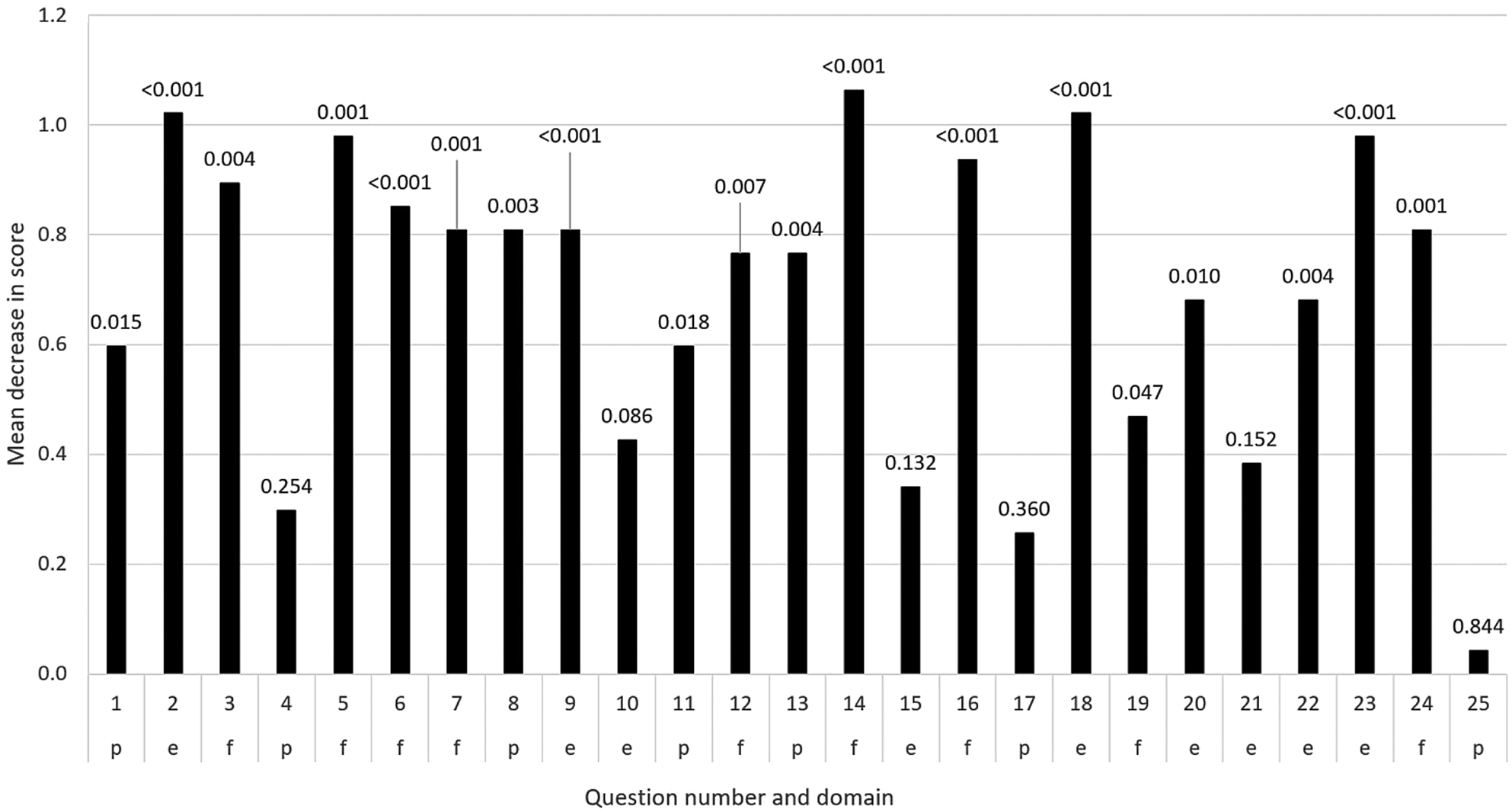
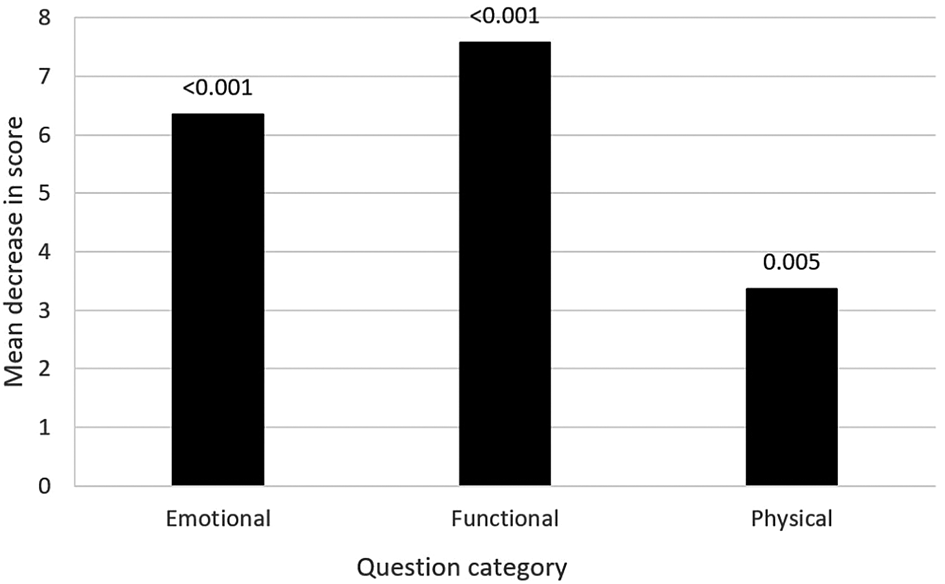
The mean Dizziness Handicap Inventory score was 57.5 ± 23.5 at the initial visit, and was 40.2 ± 26.1 at the last follow-up visit, resulting in a mean score reduction of 17.3 ± 25.2 (p < 0.001). There was a significant reduction in Dizziness Handicap Inventory score for each individual question (Figure 1), except for questions: 4 (p = 0.254, physical domain), 10 (p = 0.086, emotional domain), 15 (p = 0.132, emotional), 17 (p = 0.360, physical), 21 (p = 0.152, emotional) and 25 (p = 0.844, physical). The reduction in Dizziness Handicap Inventory score was also significant for each domain, but the three domains did not differ among one another in terms of the degree of score change (p = 0.166) (Figure 2). It is noteworthy that scores for all questions in the functional domain showed a significant improvement.
Decrease in Dizziness Handicap Inventory score by question. P-values are labelled above bars and refer to improvement in Dizziness Handicap Inventory score. p = physical domain; e = emotional domain; f = functional domain

Decrease in Dizziness Handicap Inventory score by domain. P-values are labelled above bars and refer to improvement in Dizziness Handicap Inventory score.

Factors associated with progression to botulinum toxin injection
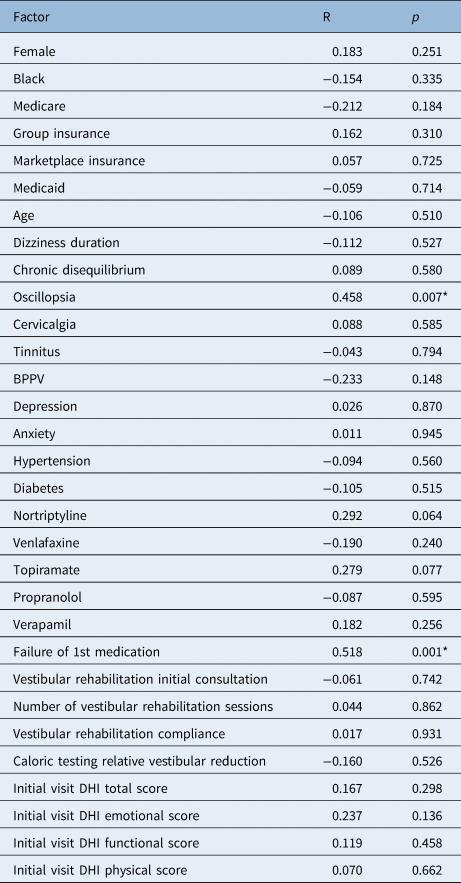
The following variables were examined for correlation with eventual progression to botulinum toxin injection (Table 1): female sex, black race, insurance type, age, duration of dizziness prior to first visit, chronic disequilibrium, oscillopsia, cervicalgia, tinnitus, BPPV, depression, anxiety, hypertension, diabetes, use of specific medications, inadequate improvement with or failure of first medication, participation in vestibular rehabilitation consultation, number of vestibular rehabilitation sessions, compliance with vestibular rehabilitation, caloric relative vestibular reduction if available, initial visit Dizziness Handicap Inventory question individual scores, initial visit Dizziness Handicap Inventory domain scores, and initial visit Dizziness Handicap Inventory total scores. Six patients were excluded from this analysis because they did not show improvement by their last follow up and were at risk of needing botulinum toxin injection in the future.
Correlation between various factors and eventual progression to botulinum toxin injection

*Indicates statistical significance (p < 0.05). BPPV = benign paroxysmal positional vertigo; DHI = Dizziness Handicap Inventory
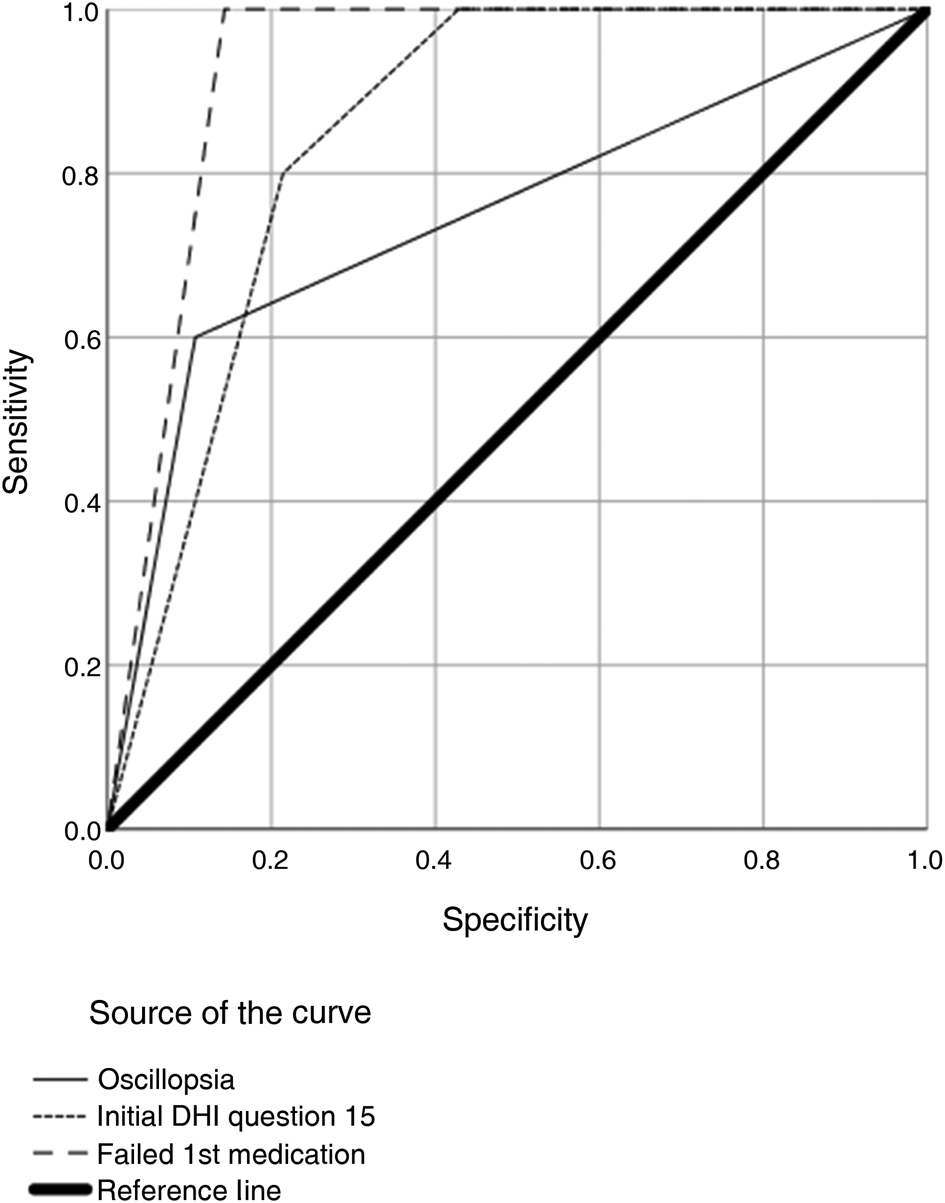
The only variables found to be significantly correlated with progression to botulinum toxin injection were: oscillopsia (r = 0.458, p = 0.007), failure of first medication (r = 0.518, p = 0.001) and initial visit Dizziness Handicap Inventory question 15 score (r = 0.364, p = 0.019). Receiver operating characteristic curves for predicting progression to botulinum toxin injections are shown in Figure 3. Area under the curve values were 0.746 (p = 0.083) for oscillopsia, 0.929 (p = 0.003) for failure of first medication, and 0.850 (p = 0.014) for initial Dizziness Handicap Inventory question 15 score. Failing a trial of the first medication yielded a sensitivity and specificity of 100 per cent and 85.7 per cent, respectively. Question 15 states ‘Because of your problem, are you afraid people may think you are intoxicated?’ A score of 2 (signifying ‘sometimes’) on question 15 yielded a sensitivity of 80–100 per cent and a specificity of 57.1–78.6 per cent, while a score of 4 (signifying ‘always’) yielded a sensitivity of 0–80 per cent and a specificity of 78.6–100 per cent. Furthermore, oscillopsia was found to have a sensitivity and specificity of 0–50 per cent and 94.3–100 per cent, respectively.
Receiver operating characteristic curves showing the ability of oscillopsia, initial Dizziness Handicap Inventory question 15 score, and failure of first medication to predict progression to botulinum toxin injections. Diagonal segments are produced by ties. DHI = Dizziness Handicap Inventory

Discussion
Although the diagnosis and treatment of vestibular migraine has improved meaningfully over the past decade, there are still many unknowns.Reference Naegel, Matharu and Obermann20 Following the 2012 consensus statement by the Bárány Society and International Headache Society, defining vestibular migraine improved dramatically, yet evidence-based treatment guidelines still do not exist.Reference Lempert, Olesen, Furman, Waterston, Seemungal and Carey4,Reference Lauritsen and Marmura5,Reference Naegel, Matharu and Obermann20 The majority of vestibular migraine therapy is derived from the literature on migraine treatment. Given the paucity of randomised, controlled trials on medications for vestibular migraine, medication management is generally performed according to the physician's discretion and their experience in treating vestibular migraine.Reference Naegel, Matharu and Obermann20 Our goal was to elucidate factors associated with pharmacological treatment failure and progression to other types of treatment, namely botulinum toxin injection.
Our results showed that oscillopsia was significantly associated with progression to botulinum toxin injection. Oscillopsia describes the perceived sensation of a blurring and jumping external world during either active or passive head movements, and is frequently described as a visual target moving to-and-fro in a rapid fashion.Reference Bender21–Reference Anson, Gimmon, Kiemel, Jeka and Carey23 Oscillopsia is the result of inadequate fixation of the retinal image during head movement. Although commonly associated with bilateral loss of vestibular function and the vestibulo-ocular reflex, oscillopsia can have an anatomical basis anywhere along the neural pathway from the labyrinth and vestibular nerve to the basal ganglia and cerebrum.Reference Bender21,Reference Anson, Gimmon, Kiemel, Jeka and Carey23 Furthermore, oscillopsia can also be caused by vestibular, oculomotor or cortical hyperactivity, which are all proposed pathophysiological mechanisms of vestibular migraine.Reference Huang, Wang and Kheradmand2,Reference Jones, Silkworth, Dusto, Pelak, Berliner and Buard24
The prevalence of oscillopsia in patients with vestibular migraine is unknown, although recent reports have described that approximately half of vestibular migraine patients report visual disturbance symptoms.Reference Power, Shute, McOwan, Murray and Szmulewicz6 Additionally, repeated episodes of vertigo have an association with progression to bilateral vestibular hypofunction, itself a cause of oscillopsia, and those vestibular migraine patients with oscillopsia may be further advanced in their disease state, predisposing them to medication failure.Reference Lucieer, Vonk, Guinand, Stokroos, Kingma and van de Berg25 Furthermore, when not related to bilateral vestibular hypofunction, oscillopsia perhaps points to poor vestibular signal processing, meaning that patients have a harder time adjusting to dizziness. Perhaps, more intolerable motion sensitivity is causing patients with oscillopsia to self-select to worse outcomes and subsequent progression from pharmacotherapy to botulinum toxin injection. If this were the case, tools such as the recently developed Oscillopsia Functional Impact Scale questionnaire, which quantifies the severity and functional effect of oscillopsia and the functional effect on a patient, may be of benefit for assessment and treatment planning in vestibular migraine patients with oscillopsia.Reference Anson, Gimmon, Kiemel, Jeka and Carey23
Failure of the first medication in vestibular migraine patients was significantly associated with pharmacological failure and progression to botulinum toxin injection. Given the paucity of research on medication management for vestibular migraine, no accepted outcome measures currently exist to assess a medication's efficacy. This study used patient-reported ineffectiveness of medication for symptom relief and an interest in switching medications to define medication failure. Outcome measures can be extrapolated from medication management in migraines, but these remain inadequate for vestibular migraine. The most commonly used outcome measures to determine the effectiveness of migraine treatment are whether a patient is pain free within 2 hours after taking the medication, followed by improvement in symptoms such as nausea and vomiting, photophobia, and phonophobia.Reference Tfelt-Hansen, Pascual, Ramadan, Dahlof, D'Amico and Diener26 These metrics were chosen by consensus among migraine specialists, but have been shown to be misaligned with how patients define medication efficacy.Reference Smelt, Louter, Kies, Blom, Terwindt and van der Heijden27 As the literature on medication management for vestibular migraine continues to grow, consensus on outcome measures to assess medication efficacy should be a priority.
An accepted set of outcome measures would allow for further research into predicting those patients at higher risk for medication failure, and would allow clinicians to target those predictors specifically. By comparison, predictors for medication failure in migraine treatment have been shown to include demographic factors such as sex and body mass index, specific headache features (including number of headache days per month and higher pain intensity), and co-morbidities such as depression.Reference Lipton, Munjal, Buse, Fanning, Bennett and Reed28 This study has found three such factors for vestibular migraine; namely, oscillopsia, failure of first medication and initial visit Dizziness Handicap Inventory question 15 score. Further research is necessary to optimise the treatment of vestibular migraine in order to minimise the delay to symptom relief. Although limited by a small sample size, this study's findings can make a reasonable argument for directly progressing to botulinum toxin injection over trialling a second medication, because the likelihood of progressing to botulinum toxin injection is high after first medication failure.
The Dizziness Handicap Inventory was employed pre- and post-treatment to quantitatively assess pharmacological failure and progression to botulinum toxin injection. Question 15, which asks ‘Because of your problem, are you afraid people may think that you are intoxicated?’, was significantly associated with progression to botulinum toxin injection in our study. Question 15 reflects the emotional domain, and it is uncertain why this question alone was statistically significant. While this question may at its root assess underlying anxiety in a patient, anxiety itself was not correlated with progression to botulinum toxin injection. This question may tap into a different type of anxiety or fear of social stigmatisation, which could play a role in catastrophising. Catastrophising has been studied extensively in chronic pain, and describes a negative mental set brought to bear on the actual or anticipated pain.Reference Darnall, Sturgeon, Cook, Taub, Roy and Burns29 This same mental process could play a role in vestibular migraine. This would be important to recognise because, for example, catastrophising in chronic pain has a high prognostic value for chronic pain incidence and treatment outcomes.Reference Darnall, Sturgeon, Cook, Taub, Roy and Burns29 Future research on catastrophising related to vestibular migraine specifically would be of benefit, especially when constructing a comprehensive assessment tool.
It is notable that an emotional subscale question was the only significant question associated with medication failure, because patients with dizziness tend to report relatively low scores in the emotional domain and higher scores in the physical and functional domains, suggesting that patients with dizziness perceive functional and physical consequences as more impairing than the emotional consequences.Reference Mutlu and Serbetcioglu9,Reference Ten Voorde, van der Zaag-Loonen and van Leeuwen30 Importantly, however, while this tendency has been studied for patients with dizziness as a whole, vestibular migraine patients likely represent a unique subgroup among the this population, with potentially different trends in Dizziness Handicap Inventory scores. This is supported by the fact that some questions on the Dizziness Handicap Inventory did not change in score from pre- to post-treatment in our study. These questions were mainly from the emotional and physical domains, and they may not matter as much in patients with vestibular migraine. Furthermore, physical domain questions, such as ‘Does walking down a sidewalk increase your problem?’ or ‘Do quick movements of your head increase your problem?’, showed the lowest improvement over the course of treatment. These questions are mainly associated with motion sensitivity and positional symptoms, and most of the pharmacological agents do not treat inherent motion sensitivity, suggesting that some physical related questions might not be as useful in the vestibular migraine population.
• There is no standardised treatment protocol for vestibular migraine
• More evidence is needed to guide which therapies should be used at which times to target specific symptoms in vestibular migraine
• Physicians should assess for motion hypersensitivity and catastrophisation in those with vestibular migraine
• In addition, physicians should counsel patients on the potential need for trials of different treatments, and consider more aggressive treatment earlier on
• Physicians should be wary of using only the Dizziness Handicap Inventory to assess vestibular migraine severity and treatment outcomes
In regard to the Dizziness Handicap Inventory as a tool for tracking improvement in vestibular migraine patients, perhaps a more concise and relevant survey is needed; for example, a survey similar to the four-question Migraine Assessment of Current Therapy (‘Migraine-ACT’) questionnaire, which can quickly identify patients who require a change in migraine treatment.Reference Dowson, Tepper, Baos, Baudet, D'Amico and Kilminster31 In addition, it should be noted that while the Dizziness Handicap Inventory may be imperfect, it is also incomplete, because the level of cognitive dysfunction in vestibular migraine patients is not assessed, even though vestibular migraine patients have higher levels of cognitive impairment relative to those with other vestibular disorders.Reference Liu, Locklear, Sharon, Lacroix, Nguyen and Rizk32
Competing interests
None declared