1. Introduction
During the Great Depression, a 77-year old Joseph John Thomson recorded a short instructional video at the Institution of Electrical Engineers, in London, praising the American tradition of embedding fundamental research in the culture of big industrial corporations: “It is said that the great electrical firms in America instruct the members of their research departments to discover something, no matter what, and then to leave to another department the business of making money out of it.” In what constitutes a clear example of the linear model from pure to applied science and technology, Thomson suggested that “all these discoveries have been made without any thought of practical application and some of them indeed seem at first sight quite unpicking for such a purpose.” Not surprisingly, his discovery of the electron would constitute one such episode. However “impractical” the electron might seem at first glance, “now [it] has come into commerce and large workshops and many thousands of workers are employed in its production. It is hardly an exaggeration to say that any new discovery contains the germs of a new industry” (Joseph John Thomson Reference Thomson1934). The linear model does not hold anymore among historians and philosophers of science and technology, but this anecdote can help us introduce the subject of this paper. J.J. Thomson's son, George Paget Thomson, was the first to take pictures of the diffraction patterns produced by electron beams through crystalline films, thus obtaining visual proof of de Broglie's principle of wave-particle duality. At first sight, this discovery might follow his father's pattern: G.P. Thomson was working in a small physics department, in Aberdeen, with no other ambition than to follow an academic career in pure research. In due course, the phenomenon of electron diffraction became a foundational stone of electron microscopy and, more immediately, a technique to study the structure of metal surfaces: electron diffraction cameras, as they were called, soon became a household instrument in a number of industries. As is well known, however, Thomson was not the only scientist to experimentally demonstrate electron diffraction. In 1937, he shared the Nobel Prize with Clinton J. Davisson, a physicist working at the Bell Laboratories, an industrial institution, and in a project initially aimed at solving a practical problem related to patents and long-distance telephony.
The discovery of electron diffraction by Thomson and by Davisson and his fellow worker Lester H. Germer in 1927 has often been presented as an instance of “simultaneous discovery,” particularly interesting due to the “radical diversity of the two experiments, a diversity that can be recognized in the experimental techniques, in the institutional contexts, and in the scientific paths that eventually led to the discovery” (Russo Reference Russo1981, 117). Indeed, as we shall discuss in this paper, the two stories leading to the discovery of electron diffraction are substantially different but they also share a few commonalities: First, in the 1920s, neither team contributed to the theoretical or experimental developments of quantum mechanics, but they ended up experimentally demonstrating one of its most striking phenomena; second, the serendipitous aspect of their discovery, since neither was directly looking for such phenomenon in their research programs; and third, both played an important role in the ulterior development of electron diffraction as a “research technology” (Shinn Reference Shinn2008). The third commonality will be the main subject of this paper.
As with most “discoveries,” historical accounts of electron diffraction normally finish with the final experiments that proved the phenomenon. The aftermath is often neglected perhaps because it is irrelevant for Nobel-prize type of stories or, as was the case here, because the aftermath was not relevant for the history of quantum physics. Already in their first papers, however, Thomson and Davisson and Germer pointed at the potentialities of electron diffraction as a tool for technological research, and that, not the intricacies of the dual nature of electrons, became their main goal. Research teams from around the world soon joined the electron diffraction project, mainly due to the parallelisms with x-ray spectroscopy, which had by then a long tradition, and a very successful one, in many scientific, technological, and industrial centers.
The history of electron diffraction qua research technology has scarcely been studied and this paper is an attempt to fill this historiographical gap.Footnote 1 I shall pay attention to the careers of Thomson and Davisson and Germer and their respective institutional settings, namely Imperial College, London, and the Bell Labs, in New York. A fourth character, George Ingle Finch, will come into the picture as a crucial element to understand the developments in London and how it was that by the end of the 1930s neither Thomson, nor Davisson or Germer, but “Finch” became shorthand for “electron diffraction camera.” As mentioned in the introduction to this topical issue, the disciplinary logic has more to do with research questions than with experimental and theoretical principles (see Katzir's Introduction to this issue). In this case-study I show how the backgrounds of the four characters under consideration shaped their appropriation of the phenomenon of electron diffraction and their transformation into a research technology.
I divide this paper in two parts. The first part, sections 2 and 3, deal with the run-up to the discovery of electron diffraction at the Bell Labs and in Aberdeen. These two episodes have been studied at large and my narrative relies upon those studies, but with an emphasis on the research traditions and interests of both teams. Sections 4 to 7 form the bulk of the second part, where the development of electron diffraction as a tool for research is discussed. As we shall see, Thomson, Davisson, Germer, and Finch followed different strategies partly due to their institutional affiliations, partly to their research programs and traditions and partly because of their different personalities.
Part I. The Road to Electron Diffraction: Logic and Image
2. Bell Laboratories A foundational phenomenon of quantum physics in an industrial context
The story of the run-up to the discovery of electron diffraction was told in detail by historian of science Arturo Russo (Reference Russo1981), and in this section I largely rely on his work. Trained as a physicist in Chicago and Princeton, in 1917 Clinton J. Davisson joined the research branch of the Engineering Department of Western Electric Company, a subsidiary of American Telephone and Telegraph Company (AT&T). In 1925, Western Electric research branch and other AT&T research units became an independent subsidy owned by the corporation Bell Telephone Laboratories. At first glance, Davisson was one of those scientists working in a private corporation and whose only duty was “to discover something, no matter what,” as J.J. Thomson put it. Certainly, his freedom of action was the main reason why he decided to stay at Bell Labs/AT&T all his life, but his research naturally pivoted around the commercial interests of the company (Kelly Reference Kelly1962). It was, in Russo's words, a “mission oriented” research, not too dissimilar to other academic laboratories of his time in America, except for the prodigality of economic and technological means at Western Electric.
During the Great War, Davisson worked on the improvement and speedy production of thermionic high-vacuum tubes, essential in long-range telephone communications. At the time, the standard theory to understand the emission of electrons by filaments of different metallic materials was Owen Richardson's (Reference Richardson1914) The Electron Theory of Matter. But when Western Electric started to use oxide-coated metallic filaments (known as Wehnelt cathodes) rather than the ordinary metallic ones, the theory proved limited due to the more complex structure of the oxide-coated filament. Davisson was asked to address the issue, specifically to study the thermionic emission of Wehnelt cathodes under positive-ion bombardment. And for this task, he was assigned a young student, Lester H. Germer who, initially trained at Cornell, had also joined Western Electric during the war and used his work in the company as a path to gain an M.A. in collaboration with Columbia University in what some in the firm regarded as the most ambitious “educational experiment” at AT&T (Russo Reference Russo1981, 120).
Their initial attempts with positive-ion bombardment proved to be of little new interest for the work on the thermionic emission of Wehnelt cathodes, and Davisson and Germer stopped working on that after Reference Davisson and Germer1920 (Davisson and Germer Reference Davisson and Germer1920). More interesting proved to be a similar experimental arrangement on oxide-coated metals but with electrons instead of positive rays as the incident beam. The study of the interaction of electrons with matter was certainly not new, but Davisson found an interesting new phenomenon: a small percentage of high-energy electrons (around 100 eV) were reflected back in what looked like an elastic collision. The similarities with the experiments of Ernest Rutherford, Hans Geiger, and Ernest Marsden with alpha particles on thin metallic foils that led to the Bohr-Rutherford atomic model, were tempting, and Davisson imagined that high-energy electrons might be a probe to study the inner structure of the atom.
From 1921 until 1925, Davisson performed a number of experiments to explore the scattering of electrons in several metals, and he tried to develop a theory to explain the observed distribution of energies. The scattering bore “no resemblance whatever to that deduced by Rutherford for α-particles,” and he assumed that the main reason was “the shielding action of the structural electrons,” i.e., the electrons in the inner orbits (Davisson Reference Davisson1923, 638). The results he obtained, first working with a new assistant Charles H. Kunsman, later back with Germer were totally inconsistent and the hopes to use high-energy electron scattering in vacuum tubes in order to “see” the inner structure of the atom proved increasingly remote.
A laboratory accident in early 1925 changed things. The vacuum tube broke, thus contaminating the nickel target they were using. Instead of replacing it, they used it again and the results of the scattering were totally different from previous ones, thus reviving their interest in studying the angular distribution of electrons. Instead of the usual one maximum, thought to be the result of an elastic collision of the incident electrons, they obtained a strange pattern with several maxima. Microscopic analysis of the new metal showed that the crystalline structure of the target had radically changed: “Before the accident and in previous experiments we had been bombarding many small crystals, but in the tests subsequent to the accident we were bombarding only a few large ones” (Davison and Germer Reference Davisson and Germer1927d, 706). The new pattern was, thus, more likely to be due to the crystalline structure of the atoms in the metal rather than the arrangement of the electrons inside the atoms. Thus, from that moment on, Davisson understood that the scattering of electrons might be used as a probe to investigate the surface of crystal structures and “accordingly altered the theory and aim of his research” (Russo Reference Russo1981, 140).
The new research avenue Davisson and Germer pursued was equally disturbing, and it could have gone on in random directions had it not been for the unsuspected introduction of de Broglie's principle into the picture. In the summer of 1926, Davisson decided to go with his wife on a long holiday in England, a kind of “second honeymoon” (Gehrenbeck Reference Gehrenbeck1978, 37), for a much-needed break. Just before returning to New York, Davisson attended the meeting of the British Association for the Advancement of Science in Oxford, where he heard his work quoted in the context of one of the strangest elements of the new quantum physics: the wave-particle duality of free electrons. Indeed, de Broglie's principle was relatively widely known among theoretical physicists, but few people had really considered that electrons might be acting as waves outside their atomic orbits before Erwin Schrödinger formulated his version of quantum mechanics.Footnote 2
Davisson was certainly not at the forefront of the theoretical development of quantum physics. Moreover, he had never even considered the idea that the strange scattering patterns he was registering were anything but the result of reflection of the incident cathode beam or the emission of secondary electrons. Diffraction never came to his mind: “We could see no evidence of a wave phenomenon in any of our previous results, and we did not expect to find any in the new experiments” (Davisson and Germer Reference Davisson and Germer1929a, 43). But conversations with Max Born, James Franck, Douglas Hartree, and Owen Richardson at the Oxford meeting changed things. Equipped with a German dictionary that Richardson lent him, Davisson spent the trip back to New York trying to understand Schrödinger's papers. In November 1926, he wrote to Richardson: “I am still working at Schrödinger and others and believe that I am beginning to get some idea of what this is all about. In particular I think that I know the sort of experiment we should make with our scattering apparatus to test the theory” (Gehrenbeck Reference Gehrenbeck1978, 38).
From early 1927, and with a new experimental arrangement, Davisson and Germer now looked for the diffraction of electrons in interaction with nickel and other metal crystals and finally obtained evidence for it by comparing the behavior of electrons with that of X-rays in similar experiments. Preliminary results were published in short notes in Nature and in the Bell Laboratories Records as well as at a presentation at the meeting of the American Physical Society, all in the spring of 1927, and the more elaborate results and explanation appeared in December in the Physical Review (Davisson and Germer Reference Davisson and Germer1927a, Reference Davisson and Germerb, Reference Davisson and Germerc, and Reference Davisson and Germerd). Up until 1931, the team worked both in improving and expanding their results as well as in lecturing about the surprising phenomenon to diverse audiences. We shall go back to the aftermath of their discovery in section 7.
3. Aberdeen. A foundational phenomenon of quantum physics in a classical context
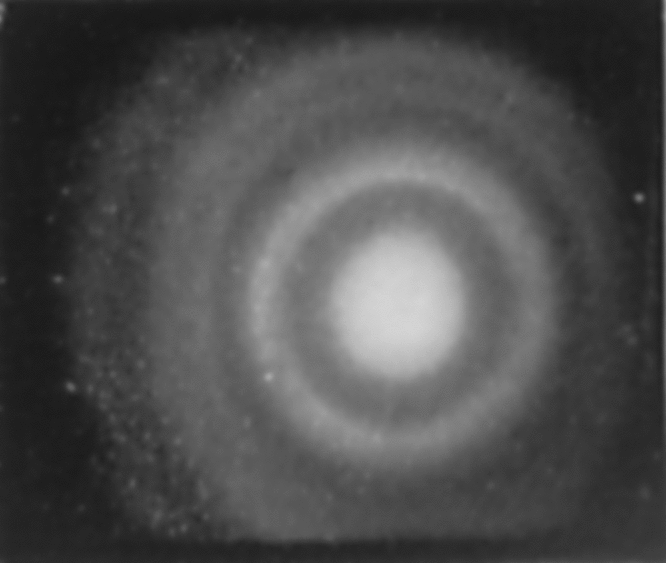
Borrowing Peter Galison's famous expression, one could say that the experimental demonstration of electron diffraction took place simultaneously in the dual traditions of “Image and Logic” (Galison Reference Galison1997). Davisson and Germer's were “logic” experiments: a moving electrometer measured the intensity of the reflected electron beam at different angles and the information plotted on a graph gave a clear pattern of successive maxima and minima which corresponded to diffraction patterns (fig. 1). G.P. Thomson's was a straightforward visual demonstration: the pictures he obtained of concentric circular halos around a central point were unequivocal and constituted a direct proof of the diffraction of an electron beam through a crystalline structure (fig. 2). Those images, known at the time as the Debye-Scherrer rings, were very well known as diffraction patterns from X-rays.
Logic in Electron Diffraction (from Davisson and Germer Reference Davisson and Germer1928).

Image in Electron Diffraction (from Thomson Reference Thomson1928a).

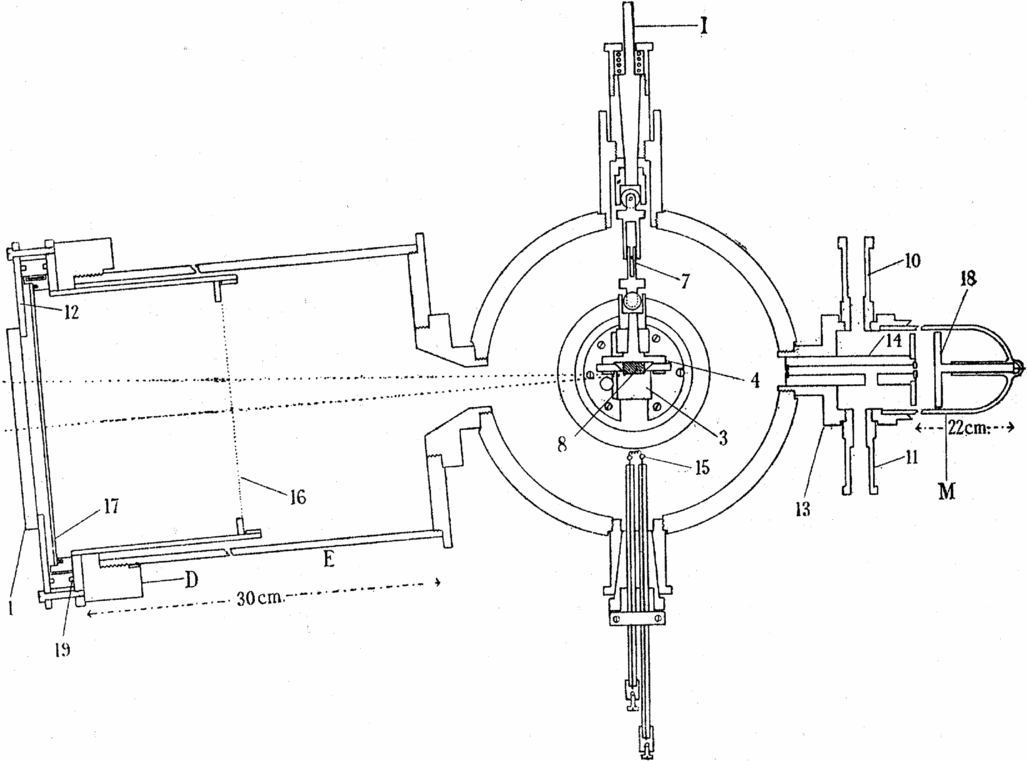
The first electron diffraction camera (Thomson and Fraser Reference Thomson and Fraser1930).

In the abovementioned article by Russo, the work of G.P. Thomson is contrasted to that of Davisson and Germer. While the latter were working in an industrial research institution in America, Russo regarded Thomson as an “insider” in the British academic establishment. Born in 1892, George Paget Thomson was the first son of Joseph John Thomson, the director of the Cavendish laboratory in Cambridge and one of the most influential physicists of his generation. With degrees in both mathematical and experimental physics in the old university, he continued his training at the Cavendish, with his father, until he was appointed, in 1922, professor of Natural philosophy at the University of Aberdeen (Moon Reference Moon1977). From this point of view, Thomson was certainly an insider in the British academic system. However, Russo's distinction between Davisson and Thomson cannot be taken too far, at least not in their respective run-up to the discovery of electron diffraction.
Davisson was trained first at the Universities of Chicago and Princeton (Kelly Reference Kelly1962), and at Western Electric (later Bell Laboratories) he was certainly much better equipped than Thomson, both financially and in terms of facilities and support staff. Indeed, Russo may have been influenced by K.K. Darrow's account of Davisson's “felix culpa,” which is the way the latter referred to the 1925 accident that shifted his experiments from polycrystalline scattering patterns to single crystal surfaces and, ultimately to the discovery of electron diffraction: “Had Davisson been a professor with a horde of graduate students besieging him for thesis subjects, the files of The Physical Review might exhibit dozens of papers on the scattering patterns of as many different metals, obtained by the students while the master was forging ahead in new fields” (Darrow Reference Darrow1962, 72). But this contrast between Davisson and Thomson relies on an inaccurate perception of Thomson's circumstances between 1922 and 1928.
G.P. Thomson's work leading to his experimental proof of electron diffraction was strongly linked to his father's career and interests who, from 1907 onwards, had started a research program, analogous to the one that had led him to the discovery of the electron, but focussing on positive electrification (Navarro Reference Navarro2009, Reference Navarro2012). The idea was, first, to perhaps find a similar ‘corpuscle’ with positive charge, soon to find out that positive ions proved more diverse than negative electrons (Falconer Reference Falconer1988). When, after graduating, G.P. Thomson decided to work on this project research on positive rays had become a technique of chemical analysis complementary to those of ordinary chemistry. Put it simply, positive ions in discharge tubes were submitted to electric and magnetic fields, and their deflection in such conditions could be related to their mass. When he moved to Aberdeen in 1922, G.P. Thomson continued to work on this project with the meagre means he had at his disposal in the Scottish university in what increasingly looked like an agonizing project. As he recalled years later in notes to his family, “by 1926 I was feeling depressed by having failed to produce anything of real note. In fact, positive rays, as distinct from the study of isotopes, were nearly worked out, at least for the time” (GP A, 7)Footnote 3.
As in Davisson's case, the BAAS meeting in the summer of 1926 triggered a turning point in his research interests. A year earlier, G.P. Thomson had published a rushed paper in the Philosophical Magazine trying to link de Borglie's theory of electron waves to his father's peculiar theory of quanta, electrons and the ether. In retrospect, he would regret publishing this paper, calling it “an example of a thoroughly bad theoretical paper” (G.P. Thomson Reference Thomson1961, 821), even though it was proof, in some of his reconstructions of history, that he had paid attention to de Broglie's theory as soon as it was published in the British scientific press. There are four points to emphasize here: first, that indeed Thomson was among the first British physicists to pay some attention to de Broglie's theory; second, that he did not however regard it as a theory for free electrons, least a theory that might imply the diffraction of electrons; third, that he related it to a speculative attempt of his father a year earlier to give a classical account of the quantisation of electronic orbits in the atom (J.J. Thomson Reference Thomson1925); and fourth, that he had never seen any link between his experiments on positive rays and electron diffraction. All that changed in the summer of 1926 in Oxford, where he “took part in talks on de Broglie's work with [Frederik] Lindemann and others” (GP A, 77), although, at least in retrospect, he did not recall having conversed about this with Davisson (G.P. Thomson Reference Thomson1961).
Straight after the BAAS meeting, Thomson spent a few weeks in Cambridge, where he discussed electron diffraction, especially with E.G. Dymond who thought he had obtained evidence of electron diffraction in experiments on the scattering of electrons in helium (Dymond, Reference Dymond1926). After all these conversations in Oxford and in Cambridge, Thomson became aware that his experimental device in Aberdeen was almost all that was needed to try electron diffraction through solids, thinking that Dymond's experiments with gases were conclusive (GP Thomson Reference Thomson1961). In the spring of 1927, and with the help of a young graduate student, Thomson obtained his first preliminary pictures hinting at halos resulting from the diffraction of electron beams (Thomson and Reid, Reference Thomson and Reid1927), but it was not until the end of that year that he could publish an unequivocal picture of the concentric halos of electrons diffracted when travelling across thin metallic films (G.P. Thomson Reference Thomson1927). Further results with quite an array of materials were published in the next two years in long articles in the Proceedings of the Royal Society (Thomson Reference Thomson1928a, Reference Thomsonb, Reference Thomson1929). The main goal of those papers was to prove a theoretical principle, i.e. de Broglie's wave-particle duality, by measuring the wavelengths associated to free electrons through their diffraction patterns. This assumed that the structure of the metals under scrutiny was relatively well known (through results from X-rays crystallography) and that the thing to explore was the behavior of electrons. This order of things would soon change.
Part 2. Putting Electron Diffraction to Work
4. The first electron camera
At the Bell Labs, Davisson and Germer obtained the diffraction patterns through a process of reflection of electrons on metal crystals. In Thomson's arrangement the electrons traveled across the thin metallic films: photographic detection took place on the other side of the metal. This difference is worth stressing for what shall come next: while Thomson's experiments were visual, and thus more pedagogical, in order to show electron diffraction as one curious, but central, phenomenon of the new quantum physics, Davisson and Germer's setting was more helpful for the analysis of crystals and crystalline surfaces. It was Thomson who first noticed the benefits of putting both elements together in what he called an “electron diffraction camera,” which may come as no surprise if we take into account his previous project with positive rays as a technique for chemical analysis.
In the last term of 1929, Thomson was invited to Cornell University where he gave a course on The Wave Mechanics of Free Electrons (Thomson Reference Thomson1930a). By then, electron diffraction had attracted the attention of physicists and chemists alike in several research institutions across the globe. One of the most prolific such physicists was Emile Rupp, a former student of Phillip Lenard who had just moved from Göttingen to work as a researcher at the Allgemeine Elektrizitäts Gesellschaft (AEG) in Berlin, an industrial institution analogous to the Bell Labs. In his 1929 lectures The Physical Principles of the Quantum Theory Heisenberg placed him alongside Davisson and Germer and Thomson as a pioneer in work on electron diffraction (Heisenberg Reference Heisenberg1930, 5). But Rupp's experiments, which tried to emulate those by Thomson, were suspicious and triggered much debate among early researchers on electron diffraction. As it turned out, Rupp is one of the most sensational cases of scientific fraud in early twentieth century physics and his deceitful career came to an abrupt end when his constant manipulation of experimental results since 1926 was exposed (French Reference French1999; van Dongen Reference Van Dongen2007).
More important and long-lasting early results were those obtained by Seishi Kikuchi, a young researcher working at the Institute of Physical and Chemical Research in Tokyo. Under the directorship of Nishikawa Shoji, the Institute had developed a long research culture in X-ray crystallography and the incorporation of electron diffraction was rather smooth (see Ito's contribution to this issue). Kikuchi used a single crystal of mica and obtained not circular hallos similar to the Debye-Scherrer structure but a pattern of points and lines similar to what crystallographers knew as Laue's diffraction patterns (Kikuchi Reference Kikuchi1928). The so-called Kikuchi lines immediately became yet another photographic proof of the diffraction of electrons.
Going back to his stay in Cornell, there Thomson undertook a series of experiments with a new device that merged the principles of his initial setting with those of Davisson and Germer. Thomson obtained photographic plates of diffraction patterns, a technique he had mastered through his more than a decade's work on positive rays. But the task of obtaining thin films of metals through which the electron beam travelled proved a hindrance for practical applications. Davisson and Germer's work had consisted in analyzing the nature of metallic surfaces such as cathodes by means of reflecting electrons. Thomson put both elements together – photography and reflection – and designed the first apparatus “which will be called for shortness an electron camera,” and which “is intended to study the diffraction patterns formed by the reflection of cathode rays from crystalline structures.” Interestingly Thomson introduced the electron diffraction camera or “electron camera” as a variation of Davisson and Germer's project rather than his own since the main goal of the camera was the study of surfaces from reflection of electron beams, but with two important modifications: “it differs from the original apparatus used by Davisson and Germer for this purpose in that the method of detection is photographic instead of electrical, and that the energy of the electrons is much greater, being at least 6000 volts (more usually 30,000) instead of about 300” (Thomson and Fraser Reference Thomson and Fraser1930, 641). As we shall see further on, low energy electrons were problematic since they gave patterns that did not fully agree with theoretical predictions, and they needed higher exposures to get photographic plates, making the whole process more cumbersome and less reliable.
Since they were obtained from reflection of electrons onto surfaces, photographs with the new kind of camera were only semi-circular halos but this did not diminish the information one could extract from them. Thomson managed to obtain the first reliable information with his electron camera during his stay at Cornell at the end of 1929. He used mainly polycrystalline targets like zinc, aluminium, platinized asbestos, barium oxide, oxidized copper, etc., which gave semi-circular halos, although he also experimented with a few single crystals which gave Laue points and lines (the Kikuchi lines) as their diffraction patterns. What interests us here, however, is the tone with which he presented his first experiments, emphasizing not so much the actual results but the potential of the new instrument:
The following paper is an account of experiments designed primarily to exhibit the possibilities of the method as a tool of research; up to the present I have tried to avoid being drawn aside into a close investigation of any of the tempting problems which the work has suggested. Some of these are now being made the subject of special researches, but it is hoped that the samples here exhibited may be sufficiently attractive to induce others to undertake similar investigations. The technique is not difficult, and the possible applications, especially to the study of surface chemistry, seem promising. (Thomson Reference Thomson1930b, 650)
This promising statement resembled what his father had expected from the technique with positive rays more than a decade earlier. In his Reference Thomson1913 book Rays of Positive Electricity and their Application to Chemical Analyses, J.J. Thomson said that “one of the main reasons for writing this book was the hope that it might induce others, and especially chemists, to try this method of analysis. I feel sure that there are many problems in Chemistry which could be solved with far greater ease by this than by any other method” (J.J. Thomson [Reference Thomson1913] Reference Thomson1921, Preface). Indeed, Aston's discovery of isotopes resulted from this project, but by the mid-1920s both Thomsons had exhausted the possibilities of their technique without much of an impact.
In this case, however, the electron camera would turn into a success story. By the early 1930s, most laboratories working on electron diffraction had built cameras following the initial idea of Thomson and Fraser. We shall continue with the story of the technique further on. For the moment it shall suffice to point out that by 1932 electron diffraction cameras were present not only in research laboratories in industrial and academic settings, but also began to be built for teaching purposes. Thus, for instance, one C.J. Phillips at the Physics Department of Oberlin College, in Ohio, built one such camera for instructional use in the classroom: “for class or lecture purposes they would form the most tangible and easily visualized proof of the wave nature of electrons.” The author acknowledged that the only novelty he was introducing was to grant enough stability to the apparatus so that it “is simple to build and operate, is reasonably stable, and furnishes diffraction photographs clear enough to allow optical projection for lecture demonstrations” (Phillips Reference Phillips1932, 48).
5. Thomson at Imperial College
In 1930, on the way back from Cornell, Thomson was appointed professor of physics at Imperial College, after the retirement of Hugh Callendar. The new position offered better possibilities than Aberdeen: London was a more attractive place for research and he could soon form a sizable team of collaborators and research students with which to pursue electron diffraction. The physics department had a long tradition on spectroscopic research under the leadership of Alfred Fowler and an important group on Technical Optics led by L.H. Martin. With the collaboration of Thomson, the latter built the first British electron microscope. According to his biographer, “Thomson did not continue with electron microscopes, but he had instigated British industrial involvement in their development,” through his close friendship with Charles McKerrow from Metropolitan-Vickers (Moon Reference Moon1977, 538).
Interestingly, however, Thomson did not publish much on the subject. Between Reference Thomson1931 and 1939 he produced only two papers on electron diffraction in the Proceedings of the Royal Society, the major journal for British physicists (Thomson Reference Thomson1931; Finch, Murison, Stuart & Thomson Reference Finch, Murison, Stuart and Thomson1933), and less than a dozen papers in other minor journals. This, together with the fact that since 1934 he became highly involved in research on the properties of slow neutrons eventually to become the chair of the MAUD committee, the British nuclear research program, may be misleading on how far he was actually involved in research on electron diffraction. The fact is that Thomson did indeed succeed in creating a tradition on electron diffraction at the Physics Department. Researchers, mainly young graduate students as well as visitors from other universities, received from Thomson support or even the very research topics on which to work, and they were supervised almost on a daily basis: “Thomson's daily round of visits to them was, if not timetabled, almost as regular as clockwork” (Moon Reference Moon1977, 539). He triggered research topics, personally communicated papers to the Philosophical Magazine, for instance, but he seldom co-authored any papers resulting from these researches. His leadership was well known and he had no need or willingness to appear as co-author of his students’ and collaborators’ work. As we shall later see, the situation at the Department of Chemical Technology, as it was known at the time, also at Imperial College, was rather different.
Among the researches he supervised only a handful were directly related to industrial applications of electron diffraction. The role of Imperial College in its relation to industry had always been a controversial issue (Gay Reference Gay2007, chap. 4) and in any case Thomson was more inclined towards fundamental science rather than direct industrial applications. Still, he supervised a few industry-related works, either directly in his department or in other institutions to test, for instance, a lubricant from EG Acheston Ltd (Jenkins Reference Jenkins1934), several oils to be used as lubricating materials (Murison Reference Murison1934; Andrew Reference Andrew1936) and surfaces for the Royal Aircraft Establishment (Hopkins Reference Hopkins1935).
Work in his department and under his supervision was mostly fundamental insofar as its main purpose was to understand the mechanism of electron diffraction, the comparison of experimental results with expected theoretical predictions, and the exploration of new avenues of research with the new phenomenon. Much of the work was done with cameras similar to the one he had designed in 1929 and with sources of high-energy electrons. Just to mention a few such researches, K.R. Dixit (Reference Dixit1933) explored the effect of temperature in the orientation of crystalline films with the camera, J. Cates (Reference Cates1933) the mechanism of corrosion in iron, and H. Gaertner (Reference Gaertner1935), a visitor from Berlin, the diffraction on oxide-coated filaments. J.R. Tillman (Reference Tillman1935), R. Beeching (Reference Beeching1935) and W. Cochrane (Reference Cochrane1936) followed the path of Kikuchi in Japan, to study the diffraction of single crystals.
In his first experiments with the electron camera in Cornell and Aberdeen, Thomson related some of the results he obtained from crystalline layers with the decade-old controversial hypothesis of the Beilby layer. In Reference Beilby1921, the Scottish chemist and metallurgist George T. Beilby suggested that the act of polishing metals destroyed the crystalline structure of the first layers: he thought that this process transformed the first two layers of atoms from their normally polycrystalline arrangement to an amorphous one (Cuff Reference Cuff1993, 1). The process resembled that of a super-cooled liquid: according to Beilby (Reference Beilby1921), in polishing the surface melted and froze again without time to re-crystallize. This hypothesis had been polemical among metallurgists and spectroscopists since there was no evidence of such structure with the use of microscopes or X-ray diffraction. In his early experiments with the diffraction camera, Thomson did not observe diffraction patterns when the incident electron beam reflected on polished metals: “no doubt the reason that polished metals fail to give rings is that their surface is covered with an amorphous layer of super-cooled liquid (Beilby layer)” (Thomson Reference Thomson1930b, 658).
The matter of fact attitude with which Thomson attributed his results (or lack thereof) to the existence of the Beilby layer contrasts with what came afterwards. In Reference French1932, a student of his, R.C. French was the first person to publish systematic research on the diffraction of polished metals attributing the fading of rings after polishing as proof of the Beilby layer (French Reference French1932, Reference French1933). Both his results and interpretation were opposed by people like Germer (Reference Germer1933) and Kirchner (Reference Kirchner1932), thus triggering a long-lasting interest on the topic at Imperial College. Just to give an example, in 1935, there was a three-day international meeting in London organised by the Faraday Society on Colloidal Electrolytes. The conclusions of the conference described the Beilby layer as a “vexed question” about which there were still some disagreements (Desch Reference Desch1935, 1288). Towards the end of the 1930s there were still studies on the matter in Thomson's department, the most influential of which were those by a Polish visitor, S. Dobinski, who showed that many controversies about the Beilby layer had to do with experimental protocols: after polishing, the metal had to be placed inside the camera, but in between, the surface was in contact with air. By carrying the polishing process in vacuum there was little room for contamination of the specimens before diffraction analysis took place (Dobinski Reference Dobinski1937). As we shall see later in the paper, the controversy around the Beilby layer was a key issue at Imperial College, and not only in Thomson's department.
After his 1930 Wave Mechanics of Free Electrons, which was the first book on electron diffraction, Thomson's group produced two more monographs on the question. R. Beeching, demonstrator in physics, wrote Electron Diffraction, a book that compiled most of the results and techniques developed with electron diffraction until 1935. In the preface, Thomson argued that, while still in its early stages, the new technique had already given promising results and “it is greatly to be hoped that the clear account here given . . . may induce many workers to try their luck with this fascinating new tool.” But for Thomson, the book was also important because besides the applications as a research tool, electron diffraction “supplies by far the most direct evidence for the principles of wave-mechanics on which the whole of atomic physics is now based” (Thomson, in Beeching Reference Beeching1936, v). With this dual justification of a monograph on electric diffraction Thomson was presenting himself as a man with something to say to theoreticians and experimentalists alike. Thomson's last shot on electron diffraction was his and Cochrane's 1939 Theory and Practice of Electron Diffraction already mentioned at the beginning of this section, and to which Moses Blackman, the in-house mathematical physicist who would take the lead of Thomson's group on electron diffraction, largely contributed with his theoretical calculations.
As the discoverer of electron diffraction, he constantly lectured on the wave-particle duality emphasising the foundational side of his discovery and not so much its applications. While keeping an eye on electron diffraction, Thomson's interest on the topic progressively lingered, partly because he was no man to stick to one topic only and, contrary to what had happened in his early career with positive rays, because he did not want to focus on one specific type of problem only. In his personal autobiography, he would say:
It is always a wrench to abandon a line of research in which one has worked for a long time. This feeling is partly sentimental and nostalgic but partly reflects the fact that one sacrifices a lot of know-how on the experimental side and also critical knowledge of other people's work. Perhaps I should not have done so but for my illness. I think that electron diffraction and allied techniques are the proper way to attack the problem of how reactions take place when at least one of the reagents is a solid. This seems to me a sufficiently general problem to interest a physicist in spite of its chemical content. I have never been much interested in problems which dealt only with the behaviour of one or two particular substances as was apt to be the case with some of the other applications of electron diffraction. Research students, notably I.H. Usmani now Head of the Pakistani Atomic Energy Service and D.W. Pashely, now with Tube Investments, did important work on these lines. But on the whole I do not regret the change. (GP A, 83)
As we shall see in the next section, reference to the contrast between physics and chemistry in this quotation is not accidental. Tensions between departments at Imperial College reflected the way electron diffraction developed in London.
6. George Ingle Finch at Imperial College
In the same biographical notes, Thomson laconically explained that
G.I. Finch became interested in electron diffraction soon after I came to Imperial College, and we were joint authors of a paper on catalysis by films of sputtered platinum. Afterwards he devised an apparatus for electron diffraction which was widely used and had a successful group working under him using electron diffraction for the study of crystals. (GP A, 83)
Born in Australia and educated in Europe, George Ingle Finch (1888-1970) studied physics in Zürich and continued his early career in Geneva before moving to England in 1912, at the age of 24. In 1913, he joined Imperial College as a demonstrator at the newly created Fuel Department, housed in the Chemistry Department. After service in the Army during the Great War, he was appointed Lecturer in Electrochemistry, Assistant Professor in 1927, and the Chair of Applied Physical Chemistry in 1936. In 1952 he moved to India to become the director of the National Chemical Department in Poona for five years. His youth in Switzerland shaped his main lifelong hobby: mountaineering. As a matter of fact, biographical sketches of Finch highlight that he was a physicist and highly skilled mountaineer but more attention has been given to the latter aspect of his life than to the former:Footnote 4 “his exploits in the Alps are legendary; his association with the Everest expedition of 1922 is memorable both for his performance with Bruce and in achieving the altitude record for climbs at that time, as well as for his pioneering activities in introducing the use of oxygen at high altitudes” (Blackman Reference Blackman1972, 224).
In the 1920s, Finch directed a long and systematic research project to study the mechanism of combustion under electric discharges. The subject was of course relevant to the development and improvement of internal combustion engines. His work showed that the cathode was not a passive element triggering the process but that the type of material and structure of the surface of the cathode was relevant to the ignition and combustion of the gases inside the tube. Moreover, he realized that the sputtering of ions from the cathode modified their surface and, thus, the conditions of the combustion. This started a parallel project to study the behavior of cathodes and, eventually, the structure of the metals on their surfaces. “It soon became evident, however, that the activity or otherwise of the films was in some manner intimately associated with the structural properties which, owing to their sub-microscopic nature, defied direct examination by the means at our disposal” (Finch, Murison, et al. Reference Finch, Murison, Stuart and Thomson1933, 415).
Indeed, the means at their disposal were microscopy and X-ray analysis and neither revealed any information on the crystalline structure of such layers. The arrival of Thomson at Imperial College came in handy and it gave this research an important boost: “in May, 1931, it was suggested to Professor G.P. Thomson, F.R.S., that an electron diffraction examination of these platinum surfaces might possibly disclose that feature of the structure upon which their catalytic properties appeared to depend.” Preliminary results were encouraging and “it was agreed to collaborate in a study of sputtered platinum films” (ibid.).
This was the only joint paper by Finch and Thomson and possibly their only direct collaboration even though they both continued to work on electron diffraction. Their research traditions and interests, their separate departmental affiliations and indeed their personalities were too different to grant possible a stable collaboration between them. While Thomson was a man of the old Cambridge tradition and an Anglican, Finch was a freemason (Gay Reference Gay2007, 79) and appeared to many in England as a man of no breeding: “he was a rebellious colonial from the bush of New South Wales, educated in the Continent . . . and he not only repudiated the role of gentleman . . . but was critical of those who embrace it as a birthright” (Wainwright Reference Wainwright2016, 313). In the words of a loyal friend of his, “he inspired great friendships and equally great enmities, for his personality and appearance made it scarcely possible for him to be ignored in any company” (Scott Russell, in Wainwright Reference Wainwright2016, 333).
Historian of Imperial College, Hannah Gay, refers to Finch's as a “rival group” to Thomson's and she mentions that both “had a number of intellectual disputes” (Gay Reference Gay2007, 178). One serious conflict seems to have been about the transfer of research students from Thomson's to Finch's, “notably H. Wilman with whom [he] much improved the technique” (Moon Reference Moon1977, 364) of electron cameras and with whom he co-authored a book-long review on “The Study of Surface Structure by Electron Diffraction” for the Ergebnisse der Exakten Naturwissenschaften (Finch and Wilman Reference Finch and Wilman1937a). In it, Finch and Wilman talked about ten main “research schools” in the world working with the technique of electron diffraction for the analysis of surfaces, two of them being, separately, Finch's and Thomson's (ibid., 364).Footnote 5 Another major difference was their respective publishing dynamics. Finch usually appeared as co-author in all the major research papers stemming from work done at his department and under his guidance. Thus, between 1926 and 1936 we find up to sixteen papers in the Proceedings of the Royal Society in which Finch appears as first author with up to twelve different co-authors, many of whom were research students of his.Footnote 6 In contrast, Thomson's name appears in only the final acknowledgments of many of his research students, collaborators, and visitors’ papers.
Certainly, Finch's was a more coherent and practical project than Thomson's. The latter had a wide range of interests and, as we have seen in the previous section, was not personally interested in going beyond the “proof of concept” as it were. Finch, on the other hand, spent the 1930s doing research almost exclusively on the improvement of the technique and the application of electron diffraction to as many substances as possible. Thus, for instance, there are many references to the importance of electron diffraction to the study of greases and oils for lubricants (Finch and Zahoorbux Reference Finch and Zahoorbux1938), especially relevant for the development of engines for the aeronautical industry,Footnote 7 or for the deposition of paint on metal surfaces (Finch and Quarrell Reference Finch and Quarrell1934). He also filed a couple of patents in the 1930s, one with Wakefield and Co. Ltd. in 1936 on a process for the coating of metal surfaces, and another with Ferranti Ltd. in 1938 on the coating of aluminium to be used in the pistons of engines.Footnote 8 Both patents were related to his work on the Beilby layer.
In December 1933, the Imperial College announced that George Ingle Finch had proved “for the first time” that “the surface of polished metal is ‘liquid’.” The self-promoting piece of news mentioned that such discovery “is likely to lead to important advances in the protection of iron and steel against corrosion, the manufacture of permanently stainless steel plating for motor cars and the use of lighter alloys in aircraft which will yet withstand the destructive action of rain and atmosphere” (in Wainwright Reference Wainwright2016, 358). The news referred to research conducted in Finch's laboratory supporting Thomson and French's stance on the Beilby layer against Germer and others’ criticisms. The idea that polished metals were like “liquids” was the analogy that Finch and his collaborators had used in their first published work: “when the diffraction pattern of the crystalline film freshly deposited on a polished surface is seen to fade it is as if we were observing through a powerful microscope the solution of crystals supernatant on a solvent” (Finch, Quarrell, and Roebuck Reference Finch, Quarrell and Roebuck1934, 680).
Finch's early work on the Beilby layer did not fully settle the question either, although it was rather convincing. Where French had previously analyzed with an electron diffraction camera the patterns obtained from mechanically polished metal surfaces only, Finch and Quarrell paid attention to the process of depositing metal vapors on polished substrates. In previous works they had been struck by the fact that crystalline zinc deposited on copper lost its organized structure (Finch and Quarrell Reference Finch and Quarrell1933, Reference Finch and Quarrell1934), and they related this absence to French and Thomson's contemporary work on the Beilby layer. What they did was to look at the diffraction patterns of the metals during the process of deposition and they observed that they progressively faded until they disappeared, while they did not when the substrate was not polished: “It is our view that these facts support the late Sir George Beilby's conception of the effects of polishing, according to which polishing destroys the crystalline structure of a surface and causes molecular flow, whereby the surface becomes covered with an amorphous layer which may properly be likened to a highly viscous liquid” (Finch, Quarrell, and Roebuck Reference Finch, Quarrell and Roebuck1934, 680). Finch remained interested in the nature and effects of polishing and the Beilby layer throughout the decade (Finch Reference Finch1936, Reference Finch1937).
Finally, Finch was also instrumental in the improvement of the technology of electron diffraction cameras to the extent that, towards the end of the decade Finch's was the most popular design in laboratories around the world. In January 1933, the Annual Exhibition of the Physical Society took place at the Imperial College. Instrument manufacturers displayed their latest equipment to an audience of almost 10,000 visitors in only three days. Among the exhibits in the research section, “a combined high speed cathode ray oscillograph and electron beam diffraction camera designed by Prof. G.I. Finch, of the Imperial College, in co-operation with the Cambridge Instrument Co., Ltd., attracted great attention” (Ockenden Reference Ockenden1933, 53). The specificities of the camera were sent for publication late that year (Finch and Quarrell Reference Finch and Quarrell1933; Reference Finch and Quarrell1934). While keeping the main idea of the Thomson-Fraser camera, Finch introduced a number of improvements, the most relevant of which were the following two: a magnetic coil to focus the electron beam, in what was one of the earlier applications of the recently discovered optical properties of electrons; and a complex mechanism to allow the specimen holder to move along linear and rotational axes. In this way, the holder served for both transmission and reflection diffraction analysis. This first model could also be transformed into a high-speed cathode-ray oscillograph by replacing the specimen-holder section with “a tube section fitted with crossed deflecting plate pairs” (Finch and Quarrell Reference Finch and Quarrell1934, 151). “This robust and practical apparatus was soon used in many research laboratories, both academic and industrial, including some abroad” (Wilman Reference Wilman and Goodman1981, 165).
A new version of the camera was displayed in the Physical Society Exhibition in 1935, this time with the Westinghouse Brake & Saxby Signal Co, while some of Finch's experiments were done with cameras that introduced some minor improvements on his initial design and which were built by other instrument makers such as Mssrs I.C.I., Ltd., Messrs. Ferranti, Ltd., or Imperial Chemical Industries, Ltd. Indeed, these firms benefited from building these cameras since they also used them in their own research laboratories (Derbyshire, in Discussion 1938, 964), and, as we have seen above, Ferranti even filed a patent on a coating technique with Finch. According to Blackman, Finch's department soon did become much better equipped than Thomson's in terms of electron diffraction cameras: “It was a matter of some envy, too, that our cameras were markedly inferior to those used in G.I. Finch's group” (Blackman Reference Blackman and Goodman1981, 84).
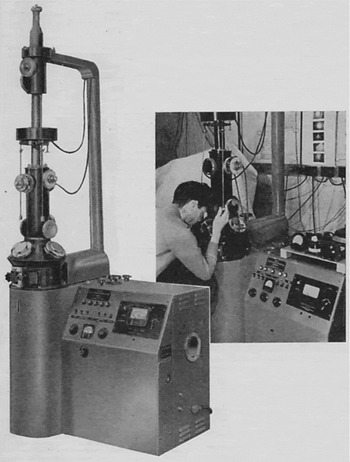
By the end of the 1930s, W. Edwards & Co, a manufacturer based in London would start commercializing the Finch Electron Diffraction Camera (see fig. 4). In a short note in Nature we read that “this instrument is noteworthy as it marks the entry of the diffraction camera into the industrial research laboratory, where it should yield valuable information upon metallic surface structure, to mention only one of the many possible industrial fields of investigation” (Nature 1939, 327–8). In just a decade, it was in operation in such laboratories as the ones in the British Iron Research Association, the Anglo Iranian Oil Company and a number of universities in the UK, according to one advertising brochure from the late 1940s.Footnote 9 The name of Finch, rather than Thomson, Fraser, Davisson, or Germer, had become shorthand for the standard electron diffraction camera.
The Finch electron diffraction camera, as it appears in a brochure of its producer W. Edwards & Co.

7. Davisson and Germer: Bound to the Bell Labs Needs
In his 1937 Nobel Prize speech, Davisson explained the importance of electron diffraction in the development and consolidation of quantum mechanics and its similarity with our understanding of light. The parallelism between Compton's earlier experiments that proved the corpuscular nature of light and his and Thomson's proof of the wave aspect of electron beams came in handy. But that solemn speech did not include any reference to the practical applications of electron diffraction since its discovery (Davisson Reference Davisson1937b). In contrast, earlier that year, at a Symposium on Metals in Cambridge, Massachusetts, Davisson gave a long speech, “What electrons can tell us about metals,” in which he gave a survey of “electron crystal analysis as a new research tool” to metallurgists (Davisson Reference Davisson1937a, 391). In it, he described in detail “three out of some 700 investigations which [had] been made by electron diffraction during the last ten years” (ibid., 392), which might be of interest to metallurgists. Specifically, electron diffraction “reveals the crystalline state of a surface layer of excessive thinness or, more often, the crystalline state of tiny points and edges which protrude from the surface and transmit parts of the incident beam. Invisible films of material, different chemically from the bulk of the specimen, are frequently discovered by this method” (ibid.). Not surprisingly, one of the three examples he chose was a series of experiments performed at the Bell Labs, yet carried out by Germer. Davisson did not author any of those 700 investigations he referred to.
Indeed, in the 1930s, Davisson scarcely published a handful of research papers and none of them directly related to investigations on electron diffraction. Only his many public lectures on the dual nature of electrons and his role in its discovery are witness to his continued interest in the topic. In his biographical sketch we read: “unfortunately, he did not publish much of the fine work that he did, although he reported on portions of it to scientific and technical groups. However, the effects of his work . . . were large. Dr. James B. Fisk, Dr. John R. Pierce, Dr. Leroy A. MacColl, Dr. Frank Gray and others of the Laboratories obtained guidance and inspiration from Davisson” (Kelly Reference Kelly1962, 57). According to Chester J. Calbick, a young researcher who joined the Davisson and Germer team in 1926, “he was always a patient, wise counselor, not only for us but for all of those who worked for him or who came to him for help in understanding physical problems” (Calbick Reference Calbick and Goodman1981, 67). This absence of research papers is certainly a sign of Davisson's personality as well as the research interests at the Bell Labs: having a well-established research career in an industrial setting, and having acquired world-wide fame with his discovery of electron diffraction, he did not need to publish in academic journals as much as university-based scientists did.
Davisson and Germer's experiments in the late 1920s confirmed de Broglie's principle but, indeed, they presented many uncertainties. Being “a perceptive and ingenious designer of experiments and an able mathematical physicist” (ibid.), Davisson tried to understand some such inconsistencies and to improve the experimental potentialities of electrons. Specifically, one of his first goals in the years immediately after the discovery of electron diffraction was to check whether electron beams were polarized, in analogy to the polarization of light. Their experiments in 1928 consisted in plotting the reflection of electrons of certain energy ranges directed onto a nickel crystal. These were interpreted “as the wave mechanics analogue of the regular selective reflection of monochromatic x-rays from a crystal face" (Davisson and Germer Reference Davisson and Germer1928, 619). At the same time, a young Hans Bethe completed his doctoral dissertation with a detailed quantum mechanical dynamical theory of electron diffraction and the experimental data obtained by Davisson and Germer almost fit the picture (Bethe Reference Bethe1928; see also Schweber Reference Schweber2012, 137–8), except for two regions of anomalous dispersion, which they assumed might be due to a double resonance phenomenon. This triggered the quest to see whether electron beams were polarized, attempts that proved to be unsuccessful (Davisson and Germer Reference Davisson and Germer1929b).Footnote 10
According to Calbick, “the difficulties with the polarization tube led Davisson and me directly into the research which culminated in our development of electrostatic electron optics” (Calbick Reference Calbick and Goodman1981, 70). Their experimental work showed how limited their knowledge of the shape of electron beams was. As we have seen, that was one of the improvements Finch did to his electron diffraction camera, and so did Davisson with Calbick. They calculated the deflections suffered by electron beams in their passage through geometrical holes in electrified surfaces “such as slits in cylinders and circular holes in plates,” and showed that “the interaction between the distorted field and incident electrons is similar to the interaction between an optical lens and incident light rays” (Davisson and Calbick Reference Davisson and Calbick1931, 585). With this knowledge on electron optics they built their first electron microscope.
Considering the priorities at Bell Labs, it comes as no surprise that Calbick and others were encouraged to use their knowledge on electron optics to develop television. Davisson and Calbick were key in the shift from a 72-line to a 240-line camera in 1935 at Bell: “In view of the ‘excellent images’ obtained [by the 72-line camera], it was decided to attempt ‘immediately’ to construct a 240-line camera tube. By 6 August 1935 Davisson had submitted a design for a 240-line electron gun” (Burns Reference Burns1998, 419). Their television receiving tube used the first coaxial cable and its success turned it into a priority for Bell Labs: “We were diverted into making a number of these tubes, rather than continuing into the more scientifically fascinating development of electron microscopy” (Calbick Reference Calbick and Goodman1981, 71).
In the above-mentioned 1937 lecture to metallurgists, Davisson referred to the camera used at the Bell Labs as “another embodiment of the same essential features” of the Finch camera (Davisson Reference Davisson1937a, 396). The main difference was that Finch's used a low-pressure gas discharge tube as the source of the cathode rays, while Bell Labs used electrons coming from tungsten filaments. The focussing mechanism was also different: as we have seen, Finch's used a magnetic coil, and Bell Labs used small geometric holes in electrified surfaces, following Davisson and Calbick's know-how on electron optics. In any case, and granting that Finch's camera was “capable of giving very fine results . . . almost every experimenter works with a camera of his own design which he regards as superior in some respects to all others” (ibid., 395–6). Details of Davisson and Calbick's camera had been published by Germer in 1935, but with the following acknowledgement: “Dr. C. J. Davisson, under whose direction this experimental apparatus has been built and used, is responsible for many of its features” (Germer Reference Germer1935, 142).
Finally, let us see how Germer's career proceeded in the 1930s. While Davisson did not publish on electron diffraction, Germer did. As a matter of fact it became his main research topic until the end of his career. Already in 1929, for instance, he published a paper in German, in the Zeitschrift für Physik, advertising electron diffraction as a new and promising research technique: “When our measurements [in 1927 and Reference Davisson and Germer1928] were made our interests were quite naturally centered upon the phenomenon that electrons are diffracted, and we neglected many lines of physical investigation which were open to us.” The time had already come to start thinking of electron diffraction as a “useful method of crystal analysis, occupying a field entirely distinct from the field of X-ray analysis” (Germer Reference Germer1929, 604).
But Germer, and Davisson behind the scene, had to change a basic trait of their experimental setting. One of the main differences with Thomson's approach was the energy of the electrons, which was of the order of 104 volts in Aberdeen (and later in London), and between 10 and 200 volts only at the Bell Labs. Diffraction patterns at low energies were more difficult to obtain due to a larger refraction index as well as the distorting effect on them from gases normally surrounding specimens, and it soon became clear that higher energies were, at least for the time being, more efficient.Footnote 11
As mentioned in section 5, in 1933 Germer opposed Thomson, French, and Finch's interpretation of diffraction (or lack thereof) from polished surfaces in terms of the Beilby layer (Germer Reference Germer1933). The subject occupied him throughout the 1930s. In Reference Finch1936, for instance, he presented what he regarded as evidence that challenged even further the increasingly accepted interpretation, “particularly in England, as is evident from the favourable consideration it received at a symposium of the Faraday Society” (Germer Reference Germer1936, 163). Specifically, he obtained similar diffuse halos in the diffraction of electrons from both polished and non-polished surfaces from one particular type of surface (silicon carbide), thus challenging the idea that polished layers did not have a crystalline structure at all due to the formation of a Beilby layer. Such was the interest of “the English” that Finch and Wilman soon replied with an alternative interpretation; i.e., that for some reason unpolished silicon carbide did not have the same crystalline structure on the surface even without polishing (Finch and Wilman Reference Finch and Wilman1937b).
Most of Germer's published work was, indeed, not polemical, but contributed to the increasing amount of research done using electron diffraction, both on metal and organic substances. On the latter, he and his fellow co-worker at the Bell Labs, K.H. Storks, began work on compounds from biological rather than mineral origin. So far, research at Imperial College and elsewhere on greases had paid attention to substances derived from petrol. Storks and Germer (Reference Storks and Germer1937) analyzed the diffraction patterns of commercial lard, a grease form animal origin, when laid on metal surfaces, and Germer even advocated the use of electron diffraction in biology: “No attempt has yet been made, so far as I know, to use electron diffraction as a research tool in biology. The newness of electron diffraction, as well as newness of the entire science of biophysics, leads one to suspect that applications to biology may have been simply overlooked” (Germer Reference Germer1938, 143). Certainly, he was aware of, at least, two main problems, namely the need to have stable samples in vacuum, and the interpretation of structures that will be more complex than the simpler crystalline structures of metals. But still, Germer and Storks did experiment on a subject related to a biological problem: the protective role of aluminum to prevent silicosis, an illness developed by rabbits in their lungs when in an atmosphere containing quartz particles. Their analysis contributed to understanding the structure of the protective film created by the reaction of aluminum and water in the lungs in what they regarded as “an interesting application of electron diffraction” (Germer and Storks Reference Germer and Storks1940).Footnote 12
8. Conclusion
What did Thomson, Davisson, and Germer do with their 1927 discovery of electron diffraction? In their popular lectures they stressed, almost exclusively, that their work had demonstrated one of the most extraordinary notions of the new quantum mechanics; i.e., that electrons were both particles and waves. But their actual research in the 1930s largely shifted towards the use and promotion of electron diffraction as a technique for research. This is not surprising if we take into account that both research teams had a long tradition in laboratory work and in the development of research tools. As shown in the sections above, the Bell Labs team was used to systematically measuring electron emission and scattering as part of the bigger quest to develop technologies related to telephony, radio, and television; and in this context the development of electron diffraction cameras was only a natural outcome of their particular research interests. Concurrently, Thomson was also prone to developing the fundamentals of research instruments: since 1923, his extended work with positive rays had albeit unsuccessfully tried to show their potentialities as a tool for chemical analysis. His ground-breaking design of the first electron diffraction camera in the immediate aftermath of his discovery can be understood in terms of his tendency towards the practical applications for physics and chemistry of fundamental physical problems.
But neither team can be considered to have fully entered the realm of “research technologies” in the sense of Terry Shinn (Reference Shinn2008). Certainly, the Bell Labs or AT&T were not in the business of producing research instruments for the market. Neither did Thomson start a career in the production and commercialization of electron cameras: his were the aims of the traditional academic scientist of his time. Both teams can easily fit the category of “method makers” that Carsten Reinhardt (Reference Reinhardt2006) coined for those physicists and chemists turning a physical phenomenon into a chemical instrument. More ambitious in this regard was G.I. Finch: by the time electron diffraction came into Imperial College, Finch had already filed a few patents from his studies in the improvement of explosion engines. Moreover, his life as a modern mountaineer, having developed one of the first oxygen bottles with which he attempted the ascension of Mount Everest in 1922, shows a man for which inventions and practical applications were part and parcel of his scientific work. Finch somehow occupied a space between Davisson and Germer, whose research was linked to the needs of the communications industry, and Thomson's approach to science as mainly academic. Indeed, his career had been shaped in a technology-oriented university, where links with industry and general practical needs were important. This, as well as his impetuous character and eagerness for recognition help us understand why it was that he ended up taking a leading role in the improvement and later commercialization of electron cameras as a “research technology.”