Introduction
Due to the belief that satisfied workers are more productive than are unsatisfied workers, satisfaction has become one of the most widely researched topics in vocational psychology (Berry, Reference BERRY1998). By the year 2000, there had been approximately 5000 research studies focusing on job satisfaction (Spinelli & Canavos, Reference SPINELLI and CANAVOS2000). Since people spend a lot of time in their jobs, ‘many of us believe it ought to be quality time’ (Berry, Reference BERRY1998, p. 294).
Job satisfaction, by definition, is the degree to which employees are happy or unhappy with their jobs (Kunin, Reference KUNIN1955). According to the job characteristic model, it consists of five components: skill variety, task identity, task significance, autonomy and feedback (Hackman & Oldham, Reference HACKMAN and OLDHAM1975). In light of this model, repetitious jobs that require few skills are ‘usually thought to lack meaning and dissatisfy those who perform them’ (Berry, Reference BERRY1998, p. 281).
Some theories of job satisfaction, such as Holland's theory (Holland, Reference HOLLAND1959) and the theory of work adjustment (Dawis & Lofquist, Reference DAWIS and LOFQUIST1984), stress the importance of a person–environment fit in job satisfaction. Holland's theory has been the most widely researched vocational theory since its introduction in 1959 (Spokane et al., Reference SPOKANE, LUCHETTA, RICHWINE and Brown2002). According to this theory, there are six personality types (realistic, investigative, artistic, social, enterprising and conventional) and six types of work environments with the same names (realistic, investigative, artistic, social, enterprising and conventional). People's job satisfaction and vocational success depends largely on the congruence between their personality and work environment. For example, individuals with artistic type personality traits are more likely to demonstrate vocational success and satisfaction in artistic type work environments, whereas social type people are usually more successful in social type work environments. The teaching profession has characteristics of a social type work environment. Therefore, individuals with social type personality traits tend to be successful and feel satisfied in this profession.
The utility of Holland's theory has been examined in the field of music education (Teachout, Reference TEACHOUT2001). According to this theory, each profession has a three-letter environment code. For example, the profession of teaching music has the environment code of A-S-I (Gottfredson & Holland, Reference GOTTFREDSON and HOLLAND1996), as it has artistic (A), social (S) and investigative type environmental attributes. Thus, people with artistic, social and investigative type personality traits tend to enter the career of teaching music and feel satisfied in this profession. A number of researchers (e.g. Teachout, Reference TEACHOUT2001; Cevik & Perkmen, Reference CEVIK and PERKMEN2010) tested this prediction. Teachout (Reference TEACHOUT2001) examined vocational personality types of 84 pre-service music teachers in the USA and found that they had artistic, social and investigative type personality traits, which fully supported the theoretical prediction. Cevik and Perkmen (Reference CEVIK and PERKMEN2010) conducted a similar study with Turkish pre-service teachers and found that they had artistic, social and conventional type personality traits, which partially supported the theoretical prediction.
Personality is an important construct that influences music teaching success (Schneider & Cady, Reference SCHNEIDER and CADY1965; Wink, Reference WINK1970; Krueger, Reference KRUEGER1976), career choice regarding music education (Vuust et al., Reference VUUST, GEBAUER, JØRGENSEN, HANSEN, MØLLER and LINNET2010), and satisfaction with becoming a music teacher (Cevik & Perkmen, Reference CEVIK and PERKMEN2010; Cevik, Reference CEVIK2011). Schneider and Cady (Reference SCHNEIDER and CADY1965) stated that ‘personality weakness’ is a fundamental cause of music teacher failure. Thus, it is likely that personality variables are significant predictors of music teaching success. Krueger (Reference KRUEGER1976) indicated that ‘the major causes for music teacher failure, however, are personality weakness, emotional instability and tactlessness’ (p. 11). Grounded in Holland's (Reference HOLLAND1959) theory, Cevik and Perkmen (Reference CEVIK and PERKMEN2010) found that pre-service teachers high in artistic and social type traits were more satisfied with studying in the department of music education than were those low in these dimensions of personality. Using another framework (big five model of personality), Cevik (Reference CEVIK2011) found that the personality traits of extroversion and openness had low but significant correlation (r = 0.25, p < 0.05) with Turkish pre-service music teachers' beliefs about the congruence of their personality with music education. In the interview part of Cevik's study many pre-service teachers indicated that their personality fit music education. However, they thought that they most probably would not be satisfied with becoming a music teacher in the future because they believed that this profession probably would not enable them to make use of their abilities, give them a sense of accomplishment or provide opportunity for advancement.
It is clear that personality fit is a necessary factor but not sufficient enough by itself for pre-service music teachers to be satisfied. Pre-service music teachers' values and needs should be met in their department and future work to increase their satisfaction. Based on her research findings, Cevik (Reference CEVIK2011) advised future researchers to use the theory of work adjustment to better understand pre-service teachers' vocational satisfaction and the role of values in the level of satisfaction. Inspired by her suggestion, we conducted this study.
Theoretical frameworks
The current study was grounded in three theories: (i) the theory of work adjustment (Dawis & Lofquist, Reference DAWIS and LOFQUIST1984); (ii) Herzberg's (Reference HERZBERG1966) two factor theory; and (iii) Locke's (Reference LOCKE1969) value discrepancy theory. The theory of work adjustment (Dawis & Lofquist, Reference DAWIS and LOFQUIST1984) focuses on people's needs and values. According to this theory, there are 21 kinds of needs that make up six types of values. For example, advancement, recognition, authority and social status are needs that constitute the ‘status’ value. The names and definitions of these values are:
1. Achievement: the importance of using one's abilities and having a feeling of accomplishment.
2. Comfort: the importance of feeling comfortable and not being stressed.
3. Status: the importance of recognition and being in a dominant position.
4. Altruism: the importance of harmony with, and being of service to, others.
5. Safety: the importance of stability, order and predictability.
6. Autonomy: the importance of being independent and having a sense of control. (Dawis, Reference DAWIS and Brown2002, p. 440)
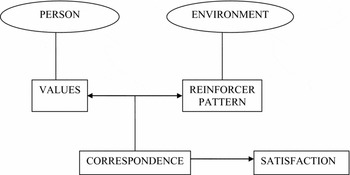
The central postulate of this theory is that satisfaction depends on the correspondence between individual values and rewards available in the environment (called a reinforcer pattern). Correspondence is defined as a ‘harmonious relationship between the individual and the environment’ (Lofquist & Dawis, Reference LOFQUIST and DAWIS1991, p. 22). High correspondence causes satisfaction, whereas low correspondence results in dissatisfaction (see Fig. 1). For instance, if a person values advancement and the job provides him or her with an opportunity for advancement, this person would probably be satisfied with this job as a result of the high correspondence between his or her values and the reinforcer pattern. According to this theory, satisfaction is ‘an affect–feeling that is produced when one perceives a need to be filled’ (Dawis, Reference DAWIS and Brown2002, p. 433).
Prediction of work adjustment

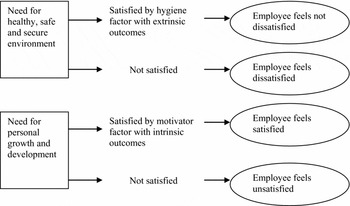
Like the theory of work adjustment, Herzberg's (Reference HERZBERG1966) two-factor theory focuses on the fulfilment of needs. This theory offers a different perspective to understand the role of needs in vocational satisfaction, so we decided to include it in our study in addition to the theory of work adjustment. According to Herzberg's two-factor theory, people have two sets of needs in the workplace: (a) the need for a healthy, safe and secure environment and (b) the need for personal growth and development. Needs in the first set are satisfied by ‘hygiene’ factors that are external to the individual (e.g. pay, job security and physical work conditions). If such needs are not satisfied, an employee feels ‘dissatisfied’; if satisfied, an employee feels ‘not dissatisfied’. Thus, satisfying the first set of needs does not result in satisfaction; it does, however, prevent dissatisfaction. The second set of needs is satisfied with motivator factors that are internal to the individual (e.g. the feeling of accomplishment, recognition and responsibility). If such needs are satisfied, an employee feels ‘satisfied’; if not, the employee feels ‘unsatisfied’. Thus, employee satisfaction is met through motivator factors with intrinsic outcomes, not through hygiene factors with extrinsic outcomes (see Fig. 2). For instance, pay is considered a hygiene factor. Low pay results in dissatisfaction, but high pay does not cause satisfaction. On the other hand, if employees have a feeling of accomplishment and responsibility and make use of their abilities in their job, they would probably be satisfied with their job.
Herzberg's two-factor theory predictions (Berry, Reference BERRY1998, p. 242)

Unlike the two-factor theory and the theory of work adjustment, Locke's (Reference LOCKE1969) value discrepancy theory posits that satisfaction is more likely to spring from the fulfilment of wants than from the fulfilment of needs. In other words, what one sees as important or valuable has bigger effects on one's satisfaction. Thus, satisfaction depends on the value of the job factor (e.g. pay) and the ‘difference between what is desired of it and what is received’ (Berry, Reference BERRY1998, p. 270). Furthermore, a discrepancy springing from receiving less than one desires causes dissatisfaction. That is, satisfaction is diminished when discrepancies get bigger.
From the theoretical frameworks and previous research findings, it is evident that people should work in environments that fit their personal characteristics (e.g. personality and values) and enable them to fulfil their needs. To date, personality has received the central attention in the field of music. Researchers have mainly focused on the personality characteristics of musicians and music educators (Kemp, Reference KEMP1982; Wubbenhorst, Reference WUBBENHORST1994) and the role of personality in music teaching success (Krueger, Reference KRUEGER1976; Teachout, Reference TEACHOUT2001) and satisfaction (Cevik, Reference CEVIK2011).
Purpose and research questions
Although personality has been extensively studied in the music literature, we failed to identify any study which examined what music educators value most and the extent to which fulfilments of their needs and values play a role in vocational satisfaction. Based on Cevik's study (Reference CEVIK2011), we also believed that theory of work adjustment, the two-factor theory, and the value discrepancy theory would provide a helpful and different perspective to examine the pre-service teachers' satisfaction with becoming a music teacher in a public school.
Pre-service music teachers go through a 4-year education in Turkey to be certified as a music teacher. They receive several classes on pedagogy and music instrument playing throughout their education. Those who would like to become a music teacher in a Turkish public school enter a nation-wide exam that measures their verbal and analytical skills and knowledge of teaching and learning. This exam does not assess candidates’ knowledge of how to teach music and instrument-playing skills.
Based on three theories in vocational psychology, the purpose of this study was to investigate pre-service music teachers' values and the role of correspondence in their predicted vocational satisfaction. To help meet the purpose, we addressed four research questions in our study:
(1) What do pre-service music teachers value most?
(2) Do they believe that their values and needs will be met in their future profession?
(3) Which factors are related to their future vocational satisfaction?
(4) Do the theory of work adjustment, the two-factor theory, and the value discrepancy theory offer a useful framework for understanding pre-service music teachers' vocational satisfaction?
Findings
Participants
The participants included 85 pre-service music teachers (53 female, 32 male) enrolled in the department of music education in a university in western Turkey; 26% of the participants were freshmen (n = 22), 24% sophomores (n = 28), 21% juniors (n = 25) and 18% seniors (n = 21). In addition, five senior students who have received many classes from the second researcher were selected for interview.
Procedure
The participants were asked to complete a survey during one of the regular class sessions in the final week of the spring term of 2010. The researchers of the current study received permission from class instructors to collect data from the students who enrolled in their class. All of the students were given research instruments and a consent form which explained the purpose and importance of the study. Those who were willing to participate filled out the research instruments. The response rate was 88%. The interviews took place in the second researcher's office. Each interview lasted about 5 minutes. The participants’ responses were tape-recorded. To ensure anonymity and privacy, tapes were burned after the study.
Research instruments
The research instrument used in the current study consisted of four sections: (a) demographic information; (b) the Predicted Vocational Satisfaction (PVS) scale; (c) the Minnesota Importance Questionnaire (MIQ; Rounds et al., Reference ROUNDS, HENLEY, DAWIS, LOFQUIST and WEISS1981); and (d) the Predicted Reinforcer Pattern (PRP) scale. Participants indicated their academic level and gender in the demographics section. For the PVS scale, participants indicated the extent to which they would be satisfied with their job if they were employed as a music teacher in a public school. The PVS scale is an 11-point Likert-type scale ranging from 0 (not satisfied at all) to 10 (very satisfied). Higher scores indicated higher predicted vocational satisfaction.
The MIQ consists of 21 ‘needs’ items that make up six types of values (dimensions): (a) achievement (2 needs items), (b) comfort (6 needs items), (c) status (4 needs items), (d) altruism (3 needs items), (e) safety (3 needs items) and (f) autonomy (3 needs items). Some of the items were: ‘I could do something that makes use of my abilities’ (ability utilisation need/achievement value); ‘The job would have good working conditions’ (working conditions need/comfort value); ‘I could get recognition for the work I do’ (recognition need/status value); ‘I could do things for other people’ (social service need/altruism value); ‘My boss would train the workers well’ (supervision–technical need/safety value); and ‘I could try out some of my own ideas’ (responsibility need/autonomy value). All 21 items were translated into Turkish by the first researcher.
To address face validity, the initial Turkish Version of the MIQ was pilot tested with 15 pre-service music teachers. Some items were revised slightly in response to issues raised by students concerning phraseology and clarity. Questionnaire items were then reviewed by two experts in the area of vocational psychology to establish content validity. Expert reviewers agreed that items were consistent with the constructs they were intended to measure. Participants indicated their level of importance with each item on a 5-point likert-type scale ranging from 0 (not important at all) to 4 (very important). Items were added up and divided by the number of items in the respective dimension to calculate the total score for each dimension. Scores on each dimension ranged from 0 to 4. Higher scores indicated higher values.
The purpose of the PRP scale was to identify pre-service music teachers' perceived probability that their needs and values would be met if they were employed as a music teacher in a public school. Like the MIQ, the PRP scale consisted of 21 items. Items in the MIQ were changed slightly to make them relevant for the purpose of the study. For example, the first item in the MIQ (‘I could do something that makes use of my abilities’) was rewritten as ‘I believe that becoming a music teacher in a public school will allow me to do things that make use of my abilities’ and the seventh item (‘The job would provide an opportunity for advancement’) was rewritten as ‘I believe that becoming a music teacher in a public school will provide me an opportunity for advancement’. The scale consists of six dimensions: predicted achievement (2 items); predicted comfort (6 items); predicted status (4 items); predicted altruism, (3 items); predicted safety (3 items); and predicted autonomy (3 items). Participants indicated their level of agreement with each item on a 5-point Likert-type scale ranging from 0 (do not agree at all) to 4 (totally agree). Items were added up and divided by the number of items in the respective dimension to calculate the total score for each dimension. Scores on each dimension ranged from 0 to 4. Higher scores indicated a more positive perceived reinforcer pattern.
Based on the participants’ responses to the MIQ and PRP scales, correspondence scores for each type of value were calculated by subtracting the value scores from their associated perceived reinforcer pattern scores. For example, if a pre-service teacher's comfort value score in the MIQ scale was 3 and his/her predicted comfort score in the PRP scale was 1, the correspondence score for this value was found to be −2 (1 minus 3). Lower negative scores indicated lower correspondence. A correspondence score of 0 indicated perfect correspondence. A positive correspondence score indicated that the participant's predicted reinforcement pattern score was higher than his/her associated value score.
To shed more light onto the role of values in predicted vocational satisfaction, we also interviewed 5 senior music pre-service teachers. Interview questions included: ‘Can you give us some information about your career plans?’; ‘Why did you decide to become a music teacher?’; ‘What will you value most in your professional life?’; ‘To what extent do you believe that your needs and values will be met in your profession?’; and ‘If your salary were to increase significantly, do you think that your satisfaction with working as a music teacher would increase remarkably?’
Data analysis
The data analysis consisted of five steps. In the first step, reliability and validity analyses on the MIQ and PRP scales were conducted. Cronbach's alpha values of these scales and their associated sub-scales were calculated to examine the participants’ consistency in their responses to the scale items. Principal component analysis was conducted to establish the construct validity of the scales. In the second step, descriptive statistics including mean and standard deviation of each scale item were calculated and presented in graphical form. This analysis enabled us to visualise where discrepancies between values and reinforcer pattern occurred. The third step involved correlating the correspondence scores with the predicted satisfaction scores. Correspondence scores included achievement correspondence, comfort correspondence, status correspondence, altruism correspondence, safety correspondence and autonomy correspondence. We examined which correspondence scores had a high correlation with satisfaction with becoming a music teacher in the future. In the fourth step, a stepwise regression analysis was conducted to examine which correspondence scores are significant predictors of vocational satisfaction. All of the correspondence scores served as the predictor variables in the regression equation. The dependent variable was the participants’ vocational satisfaction scores. In the final step, the pre-service teachers' responses to the interview questions were analysed in light of the theoretical frameworks used in the current study. The researchers examined the difference and similarities between the responses and made an effort to identify themes.
Results
Reliability and validity analysis of the instruments
Internal consistency analyses were performed on the MIQ and PRP scales. Cronbach's alpha for the entire MIQ scale was 0.76; with 0.79 for the Achievement subscale, 0.71 for the Comfort subscale, 0.78 for the Status subscale, 0.70 for the Altruism subscale, 0.78 for the Safety subscale and 0.82 for the Autonomy subscale. Cronbach's alpha for the entire PRP scale was 0.97; with 0.94 for the Achievement subscale, 0.90 for the Comfort subscale, 0.90 for the Status subscale, 0.83 for the Altruism subscale, 0.89 for the Safety subscale and 0.89 for the Autonomy subscale. These coefficients show the internal consistency of the MIQ and PRP scales and their associated subscales. We also conducted principal component analysis separately for the MIQ and PRP scales to examine their construct validity. All of the scale items loaded onto their respective factor, which provided evidence for the construct validity.
Descriptive statistics
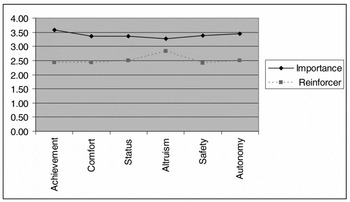
Participants’ responses to MIQ items revealed that they value ‘achievement’ (M = 3.59, SD = 0.69) most, followed by ‘autonomy’ (M = 3.49, SD = 0.68). This suggests that the majority of pre-service music teachers would like to make use of their abilities and try out some of their own ideas in their future job. Their highest score in the PRP scale was for ‘altruism’ (M = 2.86, SD = 0.76), and their lowest score was for ‘achievement’ (M = 2.11, SD = 1.09). This suggests that if they were to become a music teacher in a public school, they believe that they would probably do things for other people but not be involved in vocational activities that enable them to make use of their abilities.
The pre-service music teachers' values and their predicted reinforcer pattern for each type of value are shown in Fig. 3. An examination of this figure reveals that there was a remarkable discrepancy between their achievement value scores and their predicted reinforcer pattern score for this value. The achievement correspondence score was found to be –1.14 (SD = 1.42). However, a small discrepancy existed between their altruism value scores and their predicted reinforcer pattern score for the altruism value. The altruism correspondence score was found to be –0.44 (SD = 0.98).
Discrepancy between pre-service teachers' values and their predicted reinforcer pattern

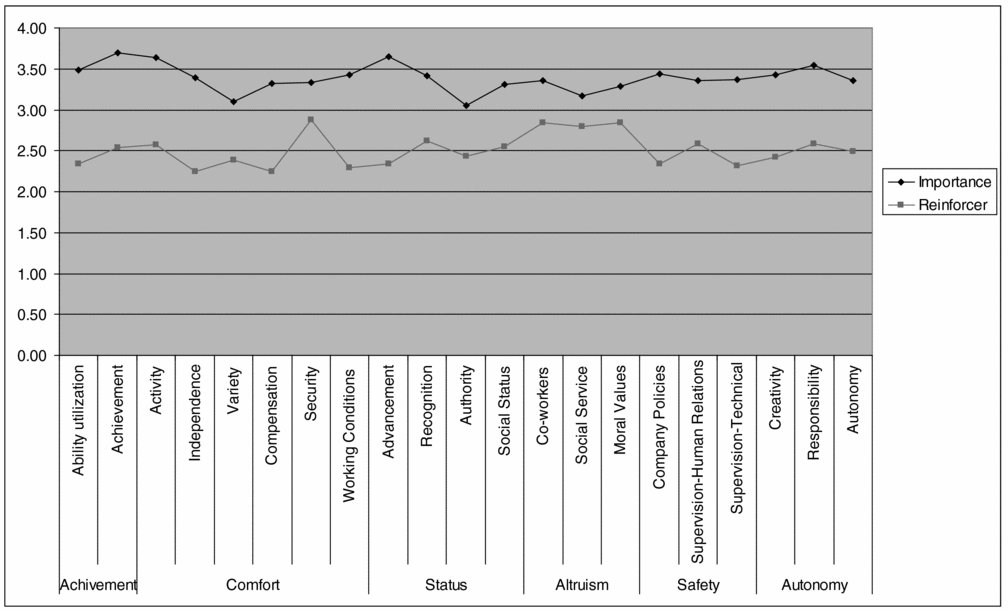
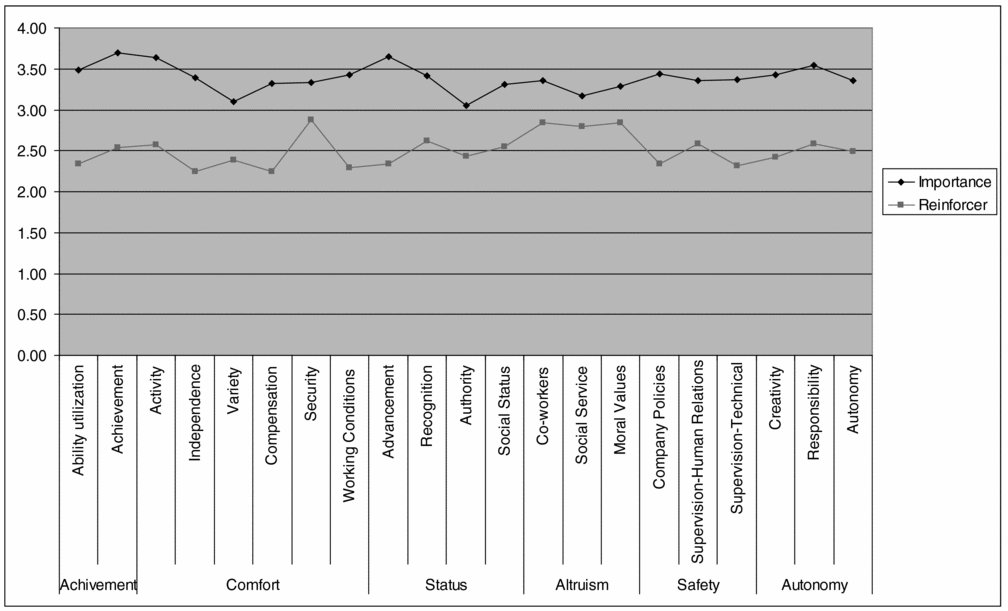
The pre-service music students’ needs and their predicted reinforcer pattern for each type of need are shown in Fig. 4. A close examination of this graph reveals that there was a remarkable discrepancy (or low correspondence) between their achievement and advancement needs and their predicted reinforcer pattern for these two types of needs. This result suggests that the majority of pre-service music teachers believe that becoming a music teacher in a public school will probably not provide them an opportunity for advancement and to make use of their abilities.
Discrepancy between pre-service teachers' needs and their predicted reinforcer pattern
Correlation and regression analysis
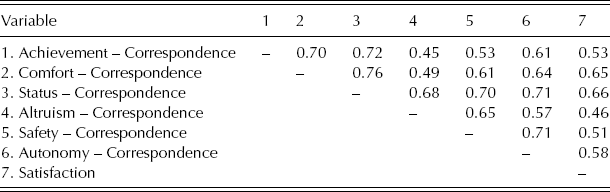
After examining the correspondence scores for each type of value, a correlation analysis was conducted to examine the relationship between correspondence and predicted vocational satisfaction. Results, presented in Table 1, revealed that all of the correspondence scores were significantly related to each other and to predicted vocational satisfaction. The status correspondence (r = 0.66, p < 0.01) had the highest correlation with predicted vocational satisfaction, followed by the comfort correspondence (r = 0.65, p < 0.01). The other correspondence scores were also moderately correlated with the predicted vocational satisfaction.
Correlations among variables
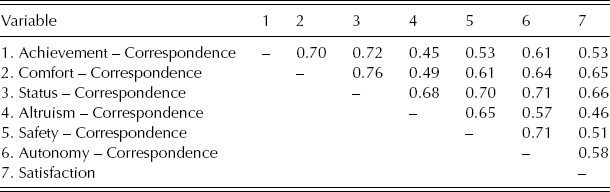
Note: All of the correlations were significant at the 0.01 level.
Following the correlation analysis, a stepwise regression analysis was conducted to examine the relative contribution of correspondence scores for each type of value in predicting satisfaction. The results revealed that only status correspondence and comfort correspondence made a significant contribution to predicting satisfaction. These two factors, collectively, accounted for 48% of the variation in satisfaction (see Table 2). Status correspondence (β = 0.39, p < 0.01) emerged as the most significant predictor in the regression equation and alone accounted for 43% of the variation in vocational satisfaction. Comfort correspondence (β = 0.36, p < 0.01) accounted for an additional 5% of the variation above and beyond the effects of status correspondence. Although the other correspondence variables were found to be significantly correlated with satisfaction in the correlation analysis, they did not make a significant contribution to predicting satisfaction in the regression equation.
Stepwise regression predicting satisfaction

* p < 0.01.
Interviews
As indicated earlier, we conducted interviews with five pre-service music teachers to shed light on their career plans and factors that affected their satisfaction and career choice. Regarding their career plans, the majority of the students indicated that they would like to work as a music teacher in a public school because this profession offers them a secure position, although it most probably would not enable them to make full use of their abilities or provide an environment for advancement. A pre-service teacher who wanted to pursue an academic career instead of becoming a music teacher in a public school stated:
I realised that my friends would like to become music teachers in a public school not because they actually wanted it much. Economic instability in our country causes them to think that becoming a music teacher in a public school is a viable and wise option. My friends are afraid of losing their jobs in case an economic crisis occurs in the future. They are aware that their musical talents will probably fade if they become a teacher. I am not like my friends. I do not value job security much. I value advancement, making use of my abilities, good physical conditions, and a chance to work independently. I believe that an academic career will enable me to meet my values. I know that I have to work hard to become a university professor. But it will be worth trying it.
Individual differences among these five students were observed in terms of their values. A pre-service teacher who seemed to value status highly stated:
I want students, colleagues and other people to say that I am a very good teacher. I value social recognition and respect from others a lot. I hope that my students will see the music class as important, take it seriously, and respect my teaching.
Another student who seemed to value working conditions and school culture stated:
I hope I will have co-workers and a supervisor who value me and my music class. I hope that they will support what I do. It is also important that the supervisors administer the school policies fairly and back me up in case of difficulties that I might encounter in my teaching.
Another student indicated:
I would like to improve my piano skills after my graduation. I believe that becoming a music teacher in a public school will not give me this opportunity. I will probably have a heavy work load as a teacher. I will spend most of my time teaching students basic music knowledge. Actually, I would like to become a pianist in the future. However, this job will not offer me a secure position. I might lose my job in an economic crisis. The public schools in Turkey offer a secure position to its teachers. That's why I will try to become a music teacher in the future instead of working as a pianist.
None of the students indicated that money was very important. They thought of money is a means to enable people to survive, not to be happy. They further indicated that if their salary would increase significantly in the future, their satisfaction with their job would not increase remarkably. In addition, they emphasised that their satisfaction in becoming a music teacher would increase if they receive social recognition from others and have a sense of accomplishment with the job they do.
Finally, two students indicated that they wanted to become a teacher because they liked music teachers in their primary school years. Another student saw herself as a person who has the personality characteristics of a good teacher including being warm, talkative, helpful, friendly and patient. She indicated that, besides her musical talents, these personality characteristics played an important role in her deciding to become a music teacher. In addition, she said:
I view every student as a seed. I would like to be proud of making a positive contribution to their growth. I want to educate students who have good moral values and stick to traditional Turkish culture.
In sum, our interviews with the pre-service teachers indicated that job security seemed to play the most important role in which career they would pursue after graduation. Although they believe that working as a teacher in a public school will probably not give them a sense of accomplishment, they would like to become a music teacher due to job security. In addition, individual differences were found among the pre-service music teachers in terms of what they value most in the workplace.
Discussion
Guided by three theories in vocational psychology, the purpose of this study was to investigate Turkish pre-service music teachers' values and the role that correspondence plays in their predicted vocational satisfaction. The pre-service teachers valued achievement most followed by autonomy. Status correspondence and comfort correspondence were found to be the best predictors of vocational satisfaction. Hygiene factors that are external to the individual seemed to result in higher levels of satisfaction. These results supported the usefulness and predictive ability of these theories.
To begin with, according to Holland's (Reference HOLLAND1959) theory, music education is a teaching profession with a social-type work environment. Thus, people with social-type personality traits tend to be satisfied in this profession. In general, people with a social-type personality value altruism and like being involved in altruistic activities that require sacrificing for others (Spokane et al., Reference SPOKANE, LUCHETTA, RICHWINE and Brown2002). Consistent with this prediction, the pre-service music teachers' scores in the dimension of ‘altruism’ value were relatively high. Moreover, they believed that working as a music teacher in a public school would probably enable them to do things for other people (high correspondence). It seems that becoming a music teacher is an ideal career for those who value altruism.
It is important to note that high correspondence existed only in the ‘altruism’ value. We found a big discrepancy (or low correspondence) between other values and the predicted reinforcer pattern associated with those values. Achievement correspondence was very low. This suggests the pre-service teachers value making use of their abilities and would like to have a feeling of ‘accomplishment’ in their future job, but they also believe that becoming a music teacher would not give them this opportunity. As predicted by the theory of work adjustment and the value discrepancy theory, this low correspondence was moderately correlated with their predicted vocational satisfaction. In addition, the low correspondence between status value and the predicted reinforcer pattern was noteworthy as it emerged as the most significant predictor of predicted future job satisfaction, accounting for an impressive amount (43%) of the variation in satisfaction. This suggests that the pre-service teachers believed that the job of teaching music would most probably not provide an opportunity for advancement or enable them to get recognition for the work they do. This situation seems to have a big influence on their predicted vocational satisfaction.
Comfort correspondence accounted for an additional 5% of the variation in predicted vocational satisfaction above and beyond the effects of status correspondence. Status correspondence and comfort correspondence, collectively, accounted for 48% of the variation in satisfaction. This suggests that the theory of work adjustment offers a very good framework for understanding pre-service music teachers' satisfaction with becoming a music teacher.
The predictive utility of the two factor theory is also noteworthy. This theory states that external factors (like pay) prevent dissatisfaction but do not result in satisfaction. Consistent with this prediction, the pre-service teachers we interviewed indicated that a salary increase would not increase their job satisfaction remarkably. They further indicated that their satisfaction depends on the degree to which they receive social recognition from others and get a feeling of accomplishment from the work they do.
Based on Herzberg's (Reference HERZBERG1966) two-factor theory, motivator factors with intrinsic outcomes (e.g. a feeling of accomplishment, social recognition) may cause music teachers' satisfaction. If they work in an environment in which they receive social recognition from others, get a feeling of ‘accomplishment’ for the work they do, and make use of their abilities, they are likely to be satisfied. If they do repetitious jobs that require few skills, they probably do not experience the meaningfulness of their work, which results in low internal work motivation. It is also important to satisfy the teachers' need for a healthy, safe and secure environment through hygiene factors with extrinsic outcomes (e.g. pay, job security). Although these factors do not result in satisfaction, they prevent dissatisfaction.
Implications for practice and future research
Researchers in the area of music and music education have focused mainly on personality (Wubbenhorst, Reference WUBBENHORST1994) and its role in music-related behaviour (Teachout, Reference TEACHOUT2001). We failed to identify any study that focused on the role of values in satisfaction. To fill this gap, we conducted this study, which has several implications for faculty members and those who would like to study music education and become a music teacher. Two students we interviewed in our study indicated that they wanted to become a music teacher because they liked their music teacher in the past. This does not seem to be a good basis for a career choice. Parsons (Reference PARSONS1909), considered the pioneer of vocational psychology, indicated:
In the wise choice of a vocation, there are three broad factors: (1) a clear understanding of yourself, your aptitudes, abilities, interests, ambitions, resources, limitations, and knowledge of their causes; (2) a knowledge of the requirements, conditions of success, advantages and disadvantages, compensation, opportunities, and prospects in different lines of work; (3) true reasoning on the relationships of these two groups of facts. (p. 5)
Based on this framework, those who would like to enrol in music education programmes and become a music teacher should reflect on their values. They should ask themselves: ‘What do I value most?’; ‘Will becoming a music teacher satisfy my needs and values?’; and ‘What is the likelihood that I will be a satisfied music teacher in the future?’ As indicated earlier, personality fit is necessary but not sufficient for job satisfaction. From this point of view, even though music teachers possess artistic, social and investigative personality traits, they might not be satisfied with their job if their needs and values are not met in their profession. Thus, pre-service music teacher candidates will have made a wise career choice if they reflect on their values as well as their personality and musical talents.
The current study has also practical implications for faculty members. First, some pre-service music teachers might do well in their classes, have good musical abilities, play a music instrument well, and possess the personality characteristics of good music teachers. However, they might not be happy with becoming a music teacher in the future. In such situations, the three theories used in this study may offer a different and helpful perspective to faculty members in music education programmes to examine other possible reasons behind vocational dissatisfaction of their students. Second, these three theories also can be used as a guide to pre-service music teachers who are having difficulty deciding which career to pursue after graduation. The faculty members can administer the MIQ and PRP scales to such pre-service teachers to identify different possible career paths (e.g. music teacher, musician, academic career) and help them decide which career seems to be the best for their future.
It is important to note that we tested the utility of a number of vocational theories with pre-service teachers enrolled in one institution. Thus, it would not be easy to draw strong conclusions regarding the role of values in satisfaction. In addition, it would not be easy for some pre-service teachers to estimate their future working conditions. We believe that additional research is needed to validate these theories with practicing music teachers in the workplace. Through future research, it is hoped that the degree to which values play a role in job satisfaction will be addressed more thoroughly and clearly.