Introduction
Chronic fatigue syndrome/myalgic encephalomyelitis (CFS/ME) is characterized by a range of symptoms, namely fatigue (often triggered by minimal activity), malaise, headaches, sleep disturbances, difficulties with concentration and muscle pain. The symptoms can fluctuate in their intensity. The severity of the disease varies considerably and CFS/ME can be a disabling condition, placing a substantial burden on patients, their carers and health-care professionals. The population prevalence is estimated at about 0.4% for adults in the UK, making it a relatively common condition (Department of Health, 2002).
Widely accepted criteria for case definitions are the Oxford criteria (Sharpe et al. Reference Sharpe, Archard, Banatvala, Borysiewicz, Clare, David, Edwards, Hawton, Lambert, Lane, McDonald, Mowbray, Pearson, Peto, Preedy, Smith, Smith, Taylor, Wessely and White1991) and the Centre for Disease Control (CDC) definition (Fukuda et al. Reference Fukuda, Straus, Hickie, Sharpe, Dobbins and Komaroff1994). The condition has been the topic of much discussion over the past two decades (Prins et al. Reference Prins, van der Meer and Bleijenberg2006). Research continues to investigate potential causes (Afari & Buchwald, Reference Afari and Buchwald2003; White, Reference White2004), how to diagnose the condition (Bagnall et al. Reference Bagnall, Hempel, Chambers, Orton and Forbes2005) and what its treatment and management (Chambers et al. Reference Chambers, Bagnall, Hempel and Forbes2006) should involve. Children and severely affected patients are of special interest to clinicians as not all treatments can be applied and very little is known about the effectiveness of treatment in these groups (Bagnall et al. Reference Bagnall, Hempel, Chambers, Orton and Forbes2005).
Given the potential impact of the condition on patients, their carers and health-care professionals, the ability to identify risk factors involved with the development of the condition would be a crucial breakthrough. Specifically, in people presenting with early suspected CFS/ME (e.g. before the 6 months' illness duration necessary for a formal diagnosis), it would be useful to know what the risk factors or prognostic flags are that might be linked with progression to CFS/ME and possibly indicate early interventions. We therefore conducted a systematic scoping review, bringing together all available studies in the literature that use an appropriate research design in order to identify risk factors for the development of CFS/ME. This was part of a larger project to find evidence to support the development of guidelines on the diagnosis and management of CFS/ME in adults and children.
We systematically searched the literature for studies that met strict inclusion criteria. Studies were considered that explicitly had the syndrome CFS/ME according to recognized case definitions as the outcome and used multiple factors to predict the progression to the development of the syndrome. The review aims at documenting which potential risk factors have been assessed and which factors appear to be significantly associated with the development of the syndrome.
Method
Literature search
We searched the databases Medline (1966 to May 2005), EMBASE (1980 to May 2005), PsycINFO (1872 to April 2005), CENTRAL (May 2005), Social Science Citation Index (1945–2005), Science Citation Index (1945–2005), Index to Scientific and Technical Proceedings (1982–2005), PASCAL (May 2005), Inside Conferences (May 2005), AMED (1985–January 2005) and HEED (June 2005). For each database, individual search strategies were developed (these are available from the authors). The search was broad with the objective of identifying all studies of CFS/ME and possible synonyms. We applied no language restriction. Further references were sought by scanning the reference lists of retrieved articles and submissions of study references from stakeholders involved in the development of the UK CFS/ME guidelines for the National Institute for Health and Clinical Excellence (NICE). On peer review of this publication, referees identified three more papers that met inclusion criteria and had been published after the search dates.
Study selection
Two reviewers independently assessed all titles and abstracts identified from the literature searches for potential relevance to the review questions. Potentially relevant papers were retrieved in full and assessed by two independent reviewers, applying the specified inclusion criteria. Two reviewers are commonly used in systematic reviews to minimize the risk of introducing bias to the results of the review. If the two reviewers cannot agree, a third reviewer is consulted to resolve the differences.
Inclusion criteria
Study type
Any study aimed at identifying potential risk factors or prognostic flags for the development of CFS/ME. Studies focusing on fatigue rather than the defined syndromes CFS or ME were not eligible for inclusion in the review. Studies that only assessed factors affecting the progression of the disease severity in the course of the condition were also excluded.
Population
Adults and/or children aged 5 years or more.
Study design
Any study reporting a multivariate or regression analysis. Studies only reporting rates of occurrences of individual sample characteristics or only reporting correlations with single risk factors were not eligible for inclusion in the review because of the high potential for bias associated with these study types.
Study characteristics, data extraction and study quality
The study information regarding participants, setting, study design, statistical method, analysed predictor variables and findings was extracted into standardized forms. Studies were formally classified (e.g. case-control study, cohort study) and the data collection methods regarding the predictors of CFS/ME were classified as retrospective (the diagnosis was established first and characteristics were assessed later), concurrent (the diagnosis and the predictor variables were assessed at the same time) or prospective (the study was designed prospectively, the risk factors were assessed at baseline and the diagnosis was established at follow-up).
The data extraction and assessment were carried out by one reviewer and checked by a second reviewer. Discrepancies were resolved by reference to the original study. Where necessary, arbitration was by a third reviewer.
Data synthesis
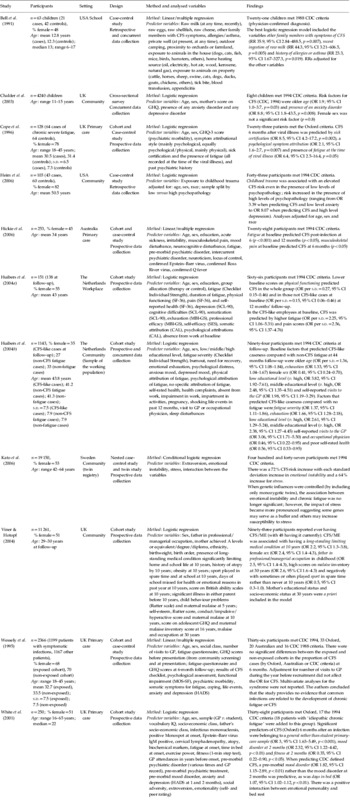
The findings are synthesized in a narrative review and summarized in a concise table to facilitate the comparisons of individual study results (see Table 1). The replication of results and discrepancies were investigated. Data relating to the pre-specified subgroups of children and patients severely affected by CFS/ME were considered separately.
Study characteristics and results

CFS, Chronic fatigue syndrome; ME, myalgic encephalomyelitis; s.d., standard deviation; OR, odds ratio; CI, confidence interval; RR, relative risk; GP, general practitioner; GHQ, General Health Questionnaire; SF-36, Short Form Health Survey; SCL-90, Symptom Checklist 90; MBI-GS, Maslach Burnout Inventory – General Survey; SES, Self-Efficacy Scale; CAL, Causal Attributions List; MOS-SF, Medical Outcome Study 20-item questionnaire; HADS, Hospital Anxiety and Depression Scale; IgM, immunoglobulin M.
A detailed data extraction table can be obtained from the authors.
Results
Search results
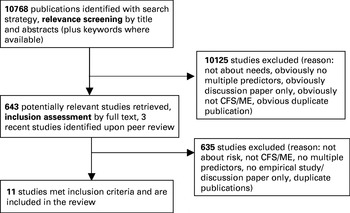
The literature search identified 10 768 publications. Their titles and abstracts were screened: 643 full paper copies were retrieved and assessed for inclusion in the review (see Fig. 1). Eleven studies met the inclusion criteria (Bell et al. Reference Bell, Cookfair, Bell, Reese and Cooper1991; Wessely et al. Reference Wessely, Chalder, Hirsch, Pawlikowska, Wallace and Wright1995; Cope et al. Reference Cope, Mann, Pelosi and David1996; White et al. Reference White, Thomas, Kangro, Bruce-Jones, Amess, Crawford, Grover and Clare2001; Chalder et al. Reference Chalder, Goodman, Wessely, Hotopf and Meltzer2003; Huibers et al. Reference Huibers, Bleijenberg, van Amelsvoort, Beurskens, van Schayck, Bazelmans and Knottnerus2004a, Reference Huibers, Kant, Knottnerus, Bleijenberg, Swaen and Kaslb; Viner & Hotopf, Reference Viner and Hotopf2004; Heim et al. Reference Heim, Wagner, Maloney, Papanicolaou, Solomon, Jones, Unger and Reves2006; Hickie et al. Reference Hickie, Davenport, Wakefield, Vollmer-Conna, Cameron, Vernon, Reeves and Lloyd2006; Kato et al. Reference Kato, Sullivan, Evengard and Pedersen2006).
Study flow.

Study characteristics and quality
One cross-sectional survey (Chalder et al. Reference Chalder, Goodman, Wessely, Hotopf and Meltzer2003), one nested case-control and twin study (Kato et al. Reference Kato, Sullivan, Evengard and Pedersen2006), two case-control studies (Bell et al. Reference Bell, Cookfair, Bell, Reese and Cooper1991; Heim et al. Reference Heim, Wagner, Maloney, Papanicolaou, Solomon, Jones, Unger and Reves2006), four cohort studies (White et al. Reference White, Thomas, Kangro, Bruce-Jones, Amess, Crawford, Grover and Clare2001; Huibers et al. Reference Huibers, Bleijenberg, van Amelsvoort, Beurskens, van Schayck, Bazelmans and Knottnerus2004a, Reference Huibers, Kant, Knottnerus, Bleijenberg, Swaen and Kaslb; Viner & Hotopf, Reference Viner and Hotopf2004) and three studies that combined a cohort study with a case-control study design (Wessely et al. Reference Wessely, Chalder, Hirsch, Pawlikowska, Wallace and Wright1995; Cope et al. Reference Cope, Mann, Pelosi and David1996; Hickie et al. Reference Hickie, Davenport, Wakefield, Vollmer-Conna, Cameron, Vernon, Reeves and Lloyd2006) were identified. The majority of studies used a prospective design (Wessely et al. Reference Wessely, Chalder, Hirsch, Pawlikowska, Wallace and Wright1995; Cope et al. Reference Cope, Mann, Pelosi and David1996; White et al. Reference White, Thomas, Kangro, Bruce-Jones, Amess, Crawford, Grover and Clare2001; Huibers et al. Reference Huibers, Bleijenberg, van Amelsvoort, Beurskens, van Schayck, Bazelmans and Knottnerus2004a, Reference Huibers, Kant, Knottnerus, Bleijenberg, Swaen and Kaslb; Viner & Hotopf, Reference Viner and Hotopf2004; Hickie et al. Reference Hickie, Davenport, Wakefield, Vollmer-Conna, Cameron, Vernon, Reeves and Lloyd2006; Kato et al. Reference Kato, Sullivan, Evengard and Pedersen2006), one prospective study (Huibers et al. Reference Huibers, Kant, Knottnerus, Bleijenberg, Swaen and Kasl2004b) combined prospective and concurrent data (measurements at baseline and at follow-up) to predict CFS/ME, one study combined retrospective and concurrent data collection (Bell et al. Reference Bell, Cookfair, Bell, Reese and Cooper1991) and one cross-sectional study used a concurrent data collection (Chalder et al. Reference Chalder, Goodman, Wessely, Hotopf and Meltzer2003). In nine studies the focus of the publication was on predicting CFS/ME in adults, although the birth cohort study of Viner & Hotopf (Reference Viner and Hotopf2004) used the prediction of ever having had or currently suffering from CFS/ME. Two studies examined the development of CFS/ME in children (Bell et al. Reference Bell, Cookfair, Bell, Reese and Cooper1991; Chalder et al. Reference Chalder, Goodman, Wessely, Hotopf and Meltzer2003). The quality of the reporting varied; several publications failed to present detailed descriptions of their statistical methods and not all studies reported the goodness of fit of the final prediction model.
Cope et al. (Reference Cope, Mann, Pelosi and David1996)
Sixty-four adult patients with chronic fatigue (3 months' duration and a score of 9 or more on a fatigue questionnaire) and 64 matching controls were identified from a cohort of primary-care patients recruited 6 months previously with a clinically diagnosed viral illness. Twenty-three of the cases fulfilled criteria for CFS.
Heim et al. (Reference Heim, Wagner, Maloney, Papanicolaou, Solomon, Jones, Unger and Reves2006)
This case-control study compared self-reported childhood trauma and psychopathology in participants with clinically confirmed CFS and a matched control group. Forty-three cases met the 1994 CDC criteria for CFS.
Hickie et al. (Reference Hickie, Davenport, Wakefield, Vollmer-Conna, Cameron, Vernon, Reeves and Lloyd2006)
Identified patients with Epstein–Barr virus, Coxiella burnetii or Ross River virus (n=253) were followed from the time of acute infection. At 6 months, 28 patients met diagnostic criteria for CFS and these were followed for a further 6 months and compared to a matched control group.
Huibers et al. (Reference Huibers, Bleijenberg, van Amelsvoort, Beurskens, van Schayck, Bazelmans and Knottnerus2004a)
Employees (n=151) who were on sick leave because of fatigue were followed for 12 months. Of these, 66 were CFS-like cases (met research criteria for CFS without a formal diagnosis) at baseline. All persons with medical conditions that could explain fatigue were excluded. At follow-up, 28 participants met CFS criteria.
Huibers et al. (Reference Huibers, Kant, Knottnerus, Bleijenberg, Swaen and Kasl2004b)
Employees (n=1143) with unexplained fatigue (excluding somatic conditions that could explain fatigue) were followed prospectively for 44 months. At follow-up, 94 participants met research criteria for CFS without a formal diagnosis (CFS-like caseness), 457 were non-CFS fatigue cases and 592 were no longer fatigue cases.
Kato et al. (Reference Kato, Sullivan, Evengard and Pedersen2006)
This study linked data on personality traits and stress obtained previously in a large twin sample (n=19 150) and a diagnosis of CFS or CFS-like illnesses established in a telephone interview. In this sample, 447 participants met the 1994 CDC criteria, all participants who reported fatigue at the time of the personality and stress assessment were excluded.
Viner & Hotopf (Reference Viner and Hotopf2004)
Data obtained from a national birth cohort (babies born in England, Scotland and Wales, 5–11 April 1970) followed up at 5, 10, 16 and 29–30 years were analysed. At the last follow-up, 93 of 11 261 participants (0.8%) reported ever having CFS/ME and 48 (0.4%) reported having the condition currently.
Wessely et al. (Reference Wessely, Chalder, Hirsch, Pawlikowska, Wallace and Wright1995)
Questionnaires to assess fatigue and psychiatric morbidity were sent to over 2000 adult patients in participating general practices. Prevalence of chronic fatigue and CFS was subsequently assessed in patients who attended the surgery with a symptomatic infection (exposed cohort) or for other reasons (non-exposed cohort). Most (84%) were followed up at 6 months.
White et al. (Reference White, Thomas, Kangro, Bruce-Jones, Amess, Crawford, Grover and Clare2001)
Primary-care patients, including a cohort of students, with infectious mononucleosis or an upper respiratory tract infection were followed until 6 months after onset. The sample included patients meeting the Oxford criteria, the 1994 CDC criteria and patients with not otherwise specified fatigue or idiopathic chronic fatigue at follow-up.
Subgroups
Children and adolescents
Bell et al. (Reference Bell, Cookfair, Bell, Reese and Cooper1991)
All 914 students in a school district were sent a questionnaire regarding CFS symptoms. Thirty-three children with symptoms were interviewed, 21 had a physician-confirmed diagnosis of CFS. These were each matched with two randomly selected asymptomatic controls from the sample. Numerous risk factors and exposures were tested.
Chalder et al. (Reference Chalder, Goodman, Wessely, Hotopf and Meltzer2003)
Mothers (n=10 438) of children aged 5–15 in a survey of families living in private households in England, Scotland and Wales in 1999 were asked whether their child had ME or CFS. They were then asked to complete a General Health Questionnaire (GHQ). A sample (n=4240) of children aged 11–15 was interviewed. The prevalence of CFS/ME was eight out of 4240 (0.19%).
Severely affected
No study was identified that predicted severe CFS/ME seperately.
Identified cases with CFS/ME and prevalences
The number of patients with CFS/ME who were identified in the individual studies and formed the basis for the outcome prediction varied from eight (Chalder et al. Reference Chalder, Goodman, Wessely, Hotopf and Meltzer2003) to 447 (Kato et al. Reference Kato, Sullivan, Evengard and Pedersen2006). The outcome CFS/ME was defined as meeting published criteria in three of the studies (Cope et al. Reference Cope, Mann, Pelosi and David1996; Huibers et al. Reference Huibers, Bleijenberg, van Amelsvoort, Beurskens, van Schayck, Bazelmans and Knottnerus2004a, Reference Huibers, Kant, Knottnerus, Bleijenberg, Swaen and Kaslb), in one study the self-report of having CFS or having had CFS was used (Viner & Hotopf, Reference Viner and Hotopf2004), in four studies the participants seem to have been assessed in a diagnostic interview (Wessely et al. Reference Wessely, Chalder, Hirsch, Pawlikowska, Wallace and Wright1995; White et al. Reference White, Thomas, Kangro, Bruce-Jones, Amess, Crawford, Grover and Clare2001; Chalder et al. Reference Chalder, Goodman, Wessely, Hotopf and Meltzer2003; Kato et al. Reference Kato, Sullivan, Evengard and Pedersen2006) and in three studies the participants had a diagnosis explicitly confirmed by a physician (Bell et al. Reference Bell, Cookfair, Bell, Reese and Cooper1991; Heim et al. Reference Heim, Wagner, Maloney, Papanicolaou, Solomon, Jones, Unger and Reves2006; Hickie et al. Reference Hickie, Davenport, Wakefield, Vollmer-Conna, Cameron, Vernon, Reeves and Lloyd2006).
The prevalence of CFS/ME was 0.19% in the social survey (Chalder et al. Reference Chalder, Goodman, Wessely, Hotopf and Meltzer2003), 0.43% (0.83% for lifetime prevalence) in the birth cohort study (Viner & Hotopf, Reference Viner and Hotopf2004), 6.8% in the study of patients with infectious mononucleosis or upper respiratory infections (White et al. Reference White, Thomas, Kangro, Bruce-Jones, Amess, Crawford, Grover and Clare2001), 8.2% in the sample of fatigued people within the working population of The Netherlands (Huibers et al. Reference Huibers, Kant, Knottnerus, Bleijenberg, Swaen and Kasl2004b) and 18.5% in the group of fatigued employees (Huibers et al. Reference Huibers, Bleijenberg, van Amelsvoort, Beurskens, van Schayck, Bazelmans and Knottnerus2004a).
Identified risk factors
The individual studies varied greatly in number and type of risk factors they analysed (see Table 1). These ranged from psychological characteristics (e.g. Huibers et al. Reference Huibers, Bleijenberg, van Amelsvoort, Beurskens, van Schayck, Bazelmans and Knottnerus2004a) to very specific exposure incidences such as raw shellfish ingestion (Bell et al. Reference Bell, Cookfair, Bell, Reese and Cooper1991).
Factors that were found to be significantly associated with the development of CFS/ME in the final predictive models included: older age (Chalder et al. Reference Chalder, Goodman, Wessely, Hotopf and Meltzer2003; Huibers et al. Reference Huibers, Kant, Knottnerus, Bleijenberg, Swaen and Kasl2004b), being female (Huibers et al. Reference Huibers, Kant, Knottnerus, Bleijenberg, Swaen and Kasl2004b; Viner & Hotopf, Reference Viner and Hotopf2004), low or middle rather than high educational level (Huibers et al. Reference Huibers, Kant, Knottnerus, Bleijenberg, Swaen and Kasl2004b), father in professional/managerial occupation in childhood (Viner & Hotopf, Reference Viner and Hotopf2004), the presence of an anxiety disorder (Chalder et al. Reference Chalder, Goodman, Wessely, Hotopf and Meltzer2003), mood disorder (pre-morbid or 2 months post-infection, White et al. Reference White, Thomas, Kangro, Bruce-Jones, Amess, Crawford, Grover and Clare2001), personality trait emotional instability (Kato et al. Reference Kato, Sullivan, Evengard and Pedersen2006), stress (Kato et al. Reference Kato, Sullivan, Evengard and Pedersen2006), history of allergies or asthma (Bell et al. Reference Bell, Cookfair, Bell, Reese and Cooper1991), a long-standing limiting medical condition aged 10 years (Viner & Hotopf, Reference Viner and Hotopf2004), musculoskeletal pain (Hickie et al. Reference Hickie, Davenport, Wakefield, Vollmer-Conna, Cameron, Vernon, Reeves and Lloyd2006), sick certification after viral illness (Cope et al. Reference Cope, Mann, Pelosi and David1996), low fitness 2 months post-infection (White et al. Reference White, Thomas, Kangro, Bruce-Jones, Amess, Crawford, Grover and Clare2001), no sport in spare time at 10 years old (Viner & Hotopf, Reference Viner and Hotopf2004), lower physical functioning at baseline assessment (Huibers et al. Reference Huibers, Bleijenberg, van Amelsvoort, Beurskens, van Schayck, Bazelmans and Knottnerus2004a), exhaustion (Huibers et al. Reference Huibers, Kant, Knottnerus, Bleijenberg, Swaen and Kasl2004b), the presence of fatigue at time of viral illness (Cope et al. Reference Cope, Mann, Pelosi and David1996; Hickie et al. Reference Hickie, Davenport, Wakefield, Vollmer-Conna, Cameron, Vernon, Reeves and Lloyd2006), fatigue severity (Huibers et al. Reference Huibers, Kant, Knottnerus, Bleijenberg, Swaen and Kasl2004b), days spent in bed at the onset of an infection (White et al. Reference White, Thomas, Kangro, Bruce-Jones, Amess, Crawford, Grover and Clare2001), visits to the general practitioner (GP) or occupational physician (Huibers et al. Reference Huibers, Kant, Knottnerus, Bleijenberg, Swaen and Kasl2004b), poor self-rated health (Huibers et al. Reference Huibers, Kant, Knottnerus, Bleijenberg, Swaen and Kasl2004b), higher scores on malaise inventory at 30 years (Viner & Hotopf, Reference Viner and Hotopf2004), childhood trauma (Heim et al. Reference Hickie, Davenport, Wakefield, Vollmer-Conna, Cameron, Vernon, Reeves and Lloyd2006), psychological symptom attribution (Cope et al. Reference Cope, Mann, Pelosi and David1996), other family members with symptoms of CFS (Bell et al. Reference Bell, Cookfair, Bell, Reese and Cooper1991), recent ingestion of raw milk (Bell et al. Reference Bell, Cookfair, Bell, Reese and Cooper1991) and belonging to a general rather than a student primary-care sample (White et al. Reference White, Thomas, Kangro, Bruce-Jones, Amess, Crawford, Grover and Clare2001).
All studies assessed the age of the participants and in most studies the association of age and the development of CFS/ME appeared to have been analysed. However, age was only found to be a significant predictor in two of the 11 studies: one a study predicting CFS/ME in children in England, Scotland and Wales (Chalder et al. Reference Chalder, Goodman, Wessely, Hotopf and Meltzer2003) and one a sample of the working population of The Netherlands (Huibers et al. Reference Huibers, Kant, Knottnerus, Bleijenberg, Swaen and Kasl2004b). Gender was a predictor of CFS/ME in the final model in two out of the 11 studies, one following the working population sample (Huibers et al. Reference Huibers, Kant, Knottnerus, Bleijenberg, Swaen and Kasl2004b) and the other the birth cohort study by Viner & Hotopf (Reference Viner and Hotopf2004). All included studies assessed the gender of the participants and several of the studies tested the association of gender and CFS/ME but in no other study was gender reported as a predictor in the final predictive model.
The educational level of the participant or the parents of the participating child was assessed in several studies. This variable was reported as significantly related to the development in CFS/ME in the final prediction model in two studies but conflicting effects were found; while a birth cohort study (Viner & Hotopf, Reference Viner and Hotopf2004) found that growing up with a father in professional/managerial occupation increased the chances of developing CFS/ME slightly, Huibers et al. (Reference Huibers, Kant, Knottnerus, Bleijenberg, Swaen and Kasl2004b) reported that those employees with a higher educational level had lower odds of developing CFS/ME.
Several studies identified a medical or psychological vulnerability in the history of the participants who suffered from CFS/ME; that is, history of allergies or asthma in children (Bell et al. Reference Bell, Cookfair, Bell, Reese and Cooper1991), presence of an anxiety disorder in children (Chalder et al. Reference Chalder, Goodman, Wessely, Hotopf and Meltzer2003), sick certification related to a viral illness and presence of fatigue at the time of viral infection (Cope et al. Reference Cope, Mann, Pelosi and David1996), a long-standing limiting medical condition at 10 years of age and scoring high on a malaise assessment inventory (Viner & Hotopf, Reference Viner and Hotopf2004), high stress levels previous to diagnosis (Kato et al. Reference Kato, Sullivan, Evengard and Pedersen2006), musculoskeletal pain (Hickie et al. Reference Hickie, Davenport, Wakefield, Vollmer-Conna, Cameron, Vernon, Reeves and Lloyd2006) or a mood disorder (White et al. Reference White, Thomas, Kangro, Bruce-Jones, Amess, Crawford, Grover and Clare2001). Childhood trauma was also associated with an elevated risk of CFS (Heim et al. Reference Heim, Wagner, Maloney, Papanicolaou, Solomon, Jones, Unger and Reves2006). Studies that followed up fatigued individuals seem to indicate that higher scores on defining or related CFS/ME criteria at the start of the study increases the likelihood of developing or continuing to suffer from CFS/ME (Huibers et al. Reference Huibers, Bleijenberg, van Amelsvoort, Beurskens, van Schayck, Bazelmans and Knottnerus2004a, Reference Huibers, Kant, Knottnerus, Bleijenberg, Swaen and Kaslb).
In some studies a defining characteristic of CFS/ME was used, such as fatigue (e.g. Huibers et al. Reference Huibers, Kant, Knottnerus, Bleijenberg, Swaen and Kasl2004b), to predict CFS/ME, or the differentiation between risk factor and defining characteristic or cause of CFS/ME was not made.
Discussion
For the presented systematic scoping review we searched the existing international literature thoroughly, applied strict inclusion and exclusion criteria, and took measures to reduce errors and bias to provide a comprehensive and clear overview of the existing multiple predictor studies on risk factors for the development of CFS/ME. This overview demonstrates clearly which potential risk factors have been assessed in the literature, which factors have shown a significant association with the development of CFS/ME, which results have been replicated and where there are inconsistencies in the existing literature.
The review identified 11 studies that met the specified inclusion criteria. These used a variety of methodological designs such as case-control study, cross-sectional survey, cohort studies including a study following a birth cohort, a combined cohort and case-control study design and a nested case-control study using data from a twin registry. Several studies used a prospective data collection design. In most studies the focus of the publication was on predicting CFS/ME in adults. No study was identified that predicted severe CFS/ME separately. The quality of the reporting varied but was poor overall, especially with regard to the statistical methods, given the dependency of the results on the methods used.
The existing literature shows that a large number and a great variety of potential risk factors for CFS/ME have been assessed. However, the included studies did not appear to reveal risk factors that are evidently useful for clinicians in assisting them to establish a diagnosis for patients presenting with potential symptoms of CFS/ME. Significantly associated with the development of CFS/ME in the final predictive model were: older age, being female, low or middle rather than high educational level, father in professional/managerial occupation in childhood, presence of an anxiety disorder, mood disorder (pre-morbid or 2 months post-infection), emotional instability, childhood trauma, history of allergies or asthma, long-standing limiting medical condition aged 10 years, sick certification after viral illness, low fitness 2 months post-infection, no sport in spare time at 10 years old, lower physical functioning at baseline assessment, exhaustion, presence of fatigue at time of viral illness, fatigue severity, days spent in bed at onset of an infection, visits to GP or occupational physician, musculoskeletal pain, poor self-rated health, higher scores on malaise inventory at 30 years, stress, psychological symptom attribution, other family members with symptoms of CFS, recent ingestion of raw milk and belonging to a general rather than a student primary-care sample.
The included studies varied in the number and types of potential risk factors that they tested, ranging from psychological characteristics (e.g. Huibers et al. Reference Huibers, Bleijenberg, van Amelsvoort, Beurskens, van Schayck, Bazelmans and Knottnerus2004a) to very specific exposure incidences such as raw shellfish ingestion (Bell et al. Reference Bell, Cookfair, Bell, Reese and Cooper1991). It stands to reason that only when potential factors have been assessed can an association be tested. Not all studies seem to have excluded CFS/ME-defining factors from the prediction of CFS/ME, which makes the studies difficult to compare.
The factors age and gender were kept in the final predictive model in two studies indicating that older age (in a sample of children and a working population sample of adults) and female sex increased the risk of developing CFS/ME. In other included studies these factors seem to have been assessed but the influence of the variable was negligible in the presence of other risk factors; for example, Chalder et al. (Reference Chalder, Goodman, Wessely, Hotopf and Meltzer2003) explicitly reported that being female was not a significant risk factor. In the literature the prevalence of CFS/ME is reported to be approximately twice as common in women (e.g. Jason et al. Reference Jason, Richman, Rademaker, Jordan, Plioplys, Taylor, McCready, Huang and Plioplys1999; Department of Health, 2002; Reyes et al. Reference Reyes, Nisenbaum, Hoaglin, Unger, Emmons, Randall, Stewart, Abbey, Jones, Gantz, Minden and Reeves2003). Educational level was also kept as a predictor in two of the included studies but the effects were in opposite directions. Even though CFS/ME was initially linked to a higher socio-economic status (‘yuppie flu’), overall the studies included in the review do not suggest this, nor do other existing empirical studies (Department of Health, 2002).
Several predictors were clearly study specific (e.g. the sample affiliation the participant stemmed from; see White et al. Reference White, Thomas, Kangro, Bruce-Jones, Amess, Crawford, Grover and Clare2001) or had not been assessed in other review eligible studies (e.g. raw milk ingestion; Bell et al. Reference Bell, Cookfair, Bell, Reese and Cooper1991). Some identified risk factors have been reported previously in studies predicting chronic ill health (e.g. being less fit or active after infectious mononucleosis has been replicated as a predictor of prolonged fatigue and state of illness; see Candy et al. Reference Candy, Chalder, Cleare, White and Hotopf2002).
Several studies identified a medical or psychological vulnerability in the history of the person that will develop CFS/ME (e.g. the presence of an anxiety disorder in children or a history of allergies or asthma). However, the identified characteristics seem to be either common occurrences in people with or without CFS/ME or not sufficiently specific to CFS/ME, so it remains unclear whether health-care professionals could use these as a prognostic flag in clinical practice. Acute physical or psychological stress has been discussed in the literature as a precipitating factor that might trigger the onset of CFS/ME (see Prins et al. Reference Prins, van der Meer and Bleijenberg2006). While it does appear that the identified factors cannot be used easily in clinical practice to specifically identify those people presenting with early suspected CFS/ME symptoms who will progress to develop CFS/ME, it is noteworthy that several characteristics could be addressed clinically and do not represent perpetuating or untreatable factors. Similarly, Candy et al. (Reference Candy, Chalder, Cleare, Peakman, Skowera, Wessely, Weinman, Zuckerman and Hotopf2003) also concluded, regarding predictors of fatigue following the onset of infectious mononucleosis, that the individual identified psycho-behavioural predictors were characterized by being amenable to clinical interventions.
Our review was restricted to studies that used a specific type of analysis considered to be a suitable source of evidence to answer questions about the empirical evidence of risk factors for CFS/ME. Only studies that predicted the syndrome CFS/ME rather than fatigue or similar single characteristics of the syndrome were considered. Additionally, we set out to review studies that used a methodological design that allowed the simultaneous assessment of multiple potential risk factors, that is the syndrome had to be predicted in a multivariate analysis, a multiple regression or logistic regression. There are several other approaches to determine risk factors, one example being studies that count the prevalence of CFS/ME in a group that has been exposed to a discussed risk factor such as glandular fever (e.g. White et al. Reference White, Thomas, Amess, Crawford, Grover, Kangro and Clare1998), studies comparing the prevalence of CFS/ME in particular subgroups such as patients with or without co-morbid psychological disorders (e.g. Wessely et al. Reference Wessely, Chalder, Hirsch, Wallace and Wright1997) or studies listing the prevalence of exposures or characteristics comparing a case and control group for CFS/ME (e.g. Reyes et al. Reference Reyes, Dobbins, Mawle, Steele, Gary, Malani, Schmid, Fukuda, Stewart, Nisenbaum and Reeves1996). The studies included in this review, by contrast, present a more focused, with regard to the outcome, and more advanced analysis with regard to the field of potential risk factors.
The studies varied greatly in the number of participants they identified that fulfilled agreed case definitions of the syndromes, with prevalences ranging from 8 to 447. From this, it follows that some of the studies had only a very small sample of patients with CFS/ME (e.g. Chalder et al. Reference Chalder, Goodman, Wessely, Hotopf and Meltzer2003), which provided the basis for finding characteristics that differentiate CFS/ME cases from non-cases that weaken the validity of the studies. The prevalences in the included cohort studies varied depending on the composition of the analysed sample of participants. Some studies were based on unselected samples such as a birth cohort study (Viner & Hotopf, Reference Viner and Hotopf2004) and social survey data on children (Chalder et al. Reference Chalder, Goodman, Wessely, Hotopf and Meltzer2003) while others stemmed from selected populations such as a sample of fatigued employees absent from work (Huibers et al. Reference Huibers, Bleijenberg, van Amelsvoort, Beurskens, van Schayck, Bazelmans and Knottnerus2004a, Reference Huibers, Kant, Knottnerus, Bleijenberg, Swaen and Kaslb) or a follow-up of patients diagnosed with viral illnesses (e.g. Cope et al. Reference Cope, Mann, Pelosi and David1996). Large sample sizes are required in unselected samples, given that the prevalence of CFS/ME is an estimated 0.4% for adults in the UK for instance (Department of Health, 2002; replicated in the included birth cohort study by Viner & Hotopf, Reference Viner and Hotopf2004).
The quality of the evidence depends on the quality of the study design and analysis and whether these allow correct inferences. However, the quality of the research depends also on the questions that are being asked, that is the selection of potential risk factors that are assessed and used as predictors for CFS/ME. The existing body of evidence is characterized by factors that were analysed in several studies but a significant association was not replicated in more than two studies, or by studies that showed significant associations of factors that no other study analysed. Further studies should answer the question of risk factors for CFS and ME with sufficiently large samples and by taking the existing body of evidence on risk factors into account.
Acknowledgements
We thank Vickie Orton for performing the literature searches, members of the NICE Guideline Development Group for the provision of additional literature, and Paul Wilson, Jeremy Miles and two anonymous reviewers for valuable comments on earlier drafts of the manuscript. The project was funded by the National Institute for Health and Clinical Excellence who commissioned the National Collaborating Centre for Primary Care (part of the Royal College of General Practitioners) to produce guidelines for ‘The Diagnosis and Management of Chronic Fatigue Syndrome/Myalgic Encephalomyelitis (or Encephalopathy) in Adults and Children’. The work forms part of the independent synthesis of research evidence to support the development of these guidelines.
Declaration of Interest
None.