The late eighteenth century brought deep changes to the Atlantic World. Imperial competition, warfare, revolutions and a general increase in transatlantic commerce changed the balance of power among European empires and their overseas territories. The Spanish empire in particular faced multiple challenges, especially intermittent warfare and economic crises, which many historians regard as having paved the way for the Spanish American independence movements after 1808. Warfare in Europe and in the Atlantic weakened Spain's economy and its control over trade and administration in its American territories. Military conflicts in the 1790s and 1800s disrupted the commercial routes connecting the Peninsula and the colonies, forcing the opening of the colonial economies to foreign agents. Because of the perils faced by Spanish vessels crossing the Atlantic, the Castilian crown allowed colonial merchants to trade directly with foreign neutral nations. Apart from legal commerce, contraband trade also flourished.
Historians have regarded the breakdown of the crown's control of trade as crucial to the collapse of the Spanish colonial system.Footnote 1 However, analysis of commercial and administrative records produced by local authorities in Río de la Plata and Rio de Janeiro reveals that direct trade between Spanish Americans and merchants of foreign countries did not mean the interruption of established trade routes with Spain. Actually, trade with foreign nations, especially between Spanish territories in Río de la Plata and Luso-Brazilians, allowed Spanish American merchants not only to maintain regional commercial activity, but also to use foreign vessels and ports to maintain the flow of goods, capital, and information between Spain and its American territories during periods of war.
After the foundation of the viceroyalty of Río de la Plata (1776), and the expulsion of the Portuguese from the region (1777), Río de la Plata merchants reorganized their previously illegal trade routes connecting the region to Brazil. During the last quarter of the eighteenth century, Río de la Plata merchants, especially in Montevideo, engaged in trans-imperial trade with neutral nations and used Portuguese commercial routes to ship and deliver goods, transport people, and send information from Río de la Plata to Cádiz. Spanish American merchants involved in such trade not only profited from the commercial intercourse with foreigners, but used the informal networks connecting them to Brazil to support the maintenance of Spanish dominion in the Río de la Plata. Río de la Plata merchants developed higher levels of autonomy in their interactions with foreigners, but rather than weaken the empire, these extra-imperial connections maintained the debilitated links connecting the Peninsula to the South Atlantic during times of warfare.
Commerce was the cornerstone of the eighteenth-century Atlantic empires.Footnote 2 Trade was not only a crucial source of fiscal revenue, commodities, and an outlet for metropolitan products, but merchant ships were essential agents for circulating administrative and commercial information throughout the Atlantic. Twentieth-century historians suggested that eighteenth-century wars in the Atlantic led to a “virtual shutdown of maritime communications” between Spain and its American colonies, and that this crisis contributed to the process that led to Latin American independences.Footnote 3 According to this historiography, Spain progressively lost control over trade routes as a result of its intermittent wars with Britain and France, which made Atlantic crossing perilous for Spanish vessels. British historian John Fisher argues that from 1796 onward, or even from a few years earlier, Spanish American trade with Spain was “paralyzed” as Spanish ships waited in port to gather strong convoys that would allow them to cross the Atlantic safely.Footnote 4
Furthermore, the incapacity of Spain to maintain communication and exchanges with its colonial territories allowed foreign penetration in previously closed commercial routes, through the dispersed trade with neutral nations and contraband trade. By the time of the crisis of authority and legitimacy triggered by the imprisonment of Fernando VII (1808), increased foreign commercial exchanges had already played a critical role in weakening the Spanish empire and influencing colonial elites in pursuing emancipationist projects and free trade.Footnote 5 In effect, intermittent warfare in the Atlantic simultaneously undermined the Spanish control over its American territories, paralyzing commerce, and stimulated the Spanish American elites to seek ever-greater autonomy in Atlantic commerce.Footnote 6
Trade Opening to Neutral Nations
In response to the heightened perils of crossing the Atlantic, Spain adopted exceptional rules for loosening commercial regulations, including allowing Spanish American subjects to trade with both foreign merchants of neutral nations and other Iberian-American territories.Footnote 7 Neutral-nation trade regulations allowed Spanish merchants to trade with subjects of other empires in the Americas, effectively incorporating within the Spanish American commercial system previously existing routes of trans-imperial trade.Footnote 8 Spanish American merchants now enjoyed increased autonomy regarding commercial matters.
Although the commercial crisis of the late eighteenth century was highly detrimental to the economy of Spain, the Spanish American colonies' experience was different. In recent decades, scholars working within the Atlantic framework have produced a wealth of research on sources from both the colonies and the metropole. Historians of the Spanish and Portuguese Americas have demonstrated that trade with foreigners was neither an exception nor an innovation, but had been an important element in colonial economies before the promulgation of neutral trade regulations.Footnote 9 From Cartagena, to Veracruz, from Rio de Janeiro and Bahia to Río de la Plata, trans-imperial trade, both legal and illegal, was part and parcel of colonial societies.Footnote 10 In the Caribbean, neutral trade regulations allowed for a steep growth in the trade (legal and illegal) between Spanish colonies and British, US, and French colonies.Footnote 11 In the circum-Caribbean region subjects traded in agricultural products, foodstuffs, textiles and other Atlantic goods, and slaves. For the Río de la Plata region, neutral trade became the safety valve that allowed Spanish colonial territories to export their agricultural production and obtain Atlantic products and slaves through commercial interactions with Luso-Brazilian and Anglo-American traders.Footnote 12 Thus, the increasing trans-imperial interaction, despite its adverse impact on traditional peninsular trade routes, constituted a dynamic force for Spanish American societies and their neighboring territories.
The heightened risk in crossing the Atlantic provoked the disruption not only of Spanish trade routes but also of Spanish routes of communication—leading to what Jeremy Baskes has described as a “communication breakdown” within the Spanish empire.Footnote 13 Atlantic shipping moved goods and people, but it was also critical for the circulation of intelligence on markets, military, and administration.Footnote 14 Like the trade routes, Spanish official communication channels were jeopardized by warfare, but such was not the case with communication connecting Iberia and the Americas through the less formal trans-imperial networks.
In times of war, the rise of trans-imperial trade routes permitted Spanish American communities to maintain both their internal economic activities and the flow of goods, capital, and information with Spain. In the late eighteenth century, Spanish-American merchants dealt with the insecurity of the Atlantic crossing by using foreign ports, flags, and ships. In the South Atlantic, neutral trade routes connecting Río de la Plata to Luso-Brazilian agents and ports enabled communication and the flow of goods and people between Cádiz and the Río de la Plata territories. Trans-imperial trade and the commercial autonomy of colonial subjects constituted a main force in shaping imperial policies and the political culture of the Iberian South Atlantic in the late eighteenth century.
Fall of Colonia, Rise of Montevideo
With the second founding of Buenos Aires in 1580, the city's economy was under control of the Spanish commercial system, with goods to be received via Lima. Nevertheless, direct and then extralegal trade with merchants from other Atlantic empires proved more profitable, and soon came to dominate the region's commerce. From 1580 to 1640, Portuguese merchants, prominent players in the Buenos Aires commercial community, held the asiento, or contract, for the introduction of slaves in Spanish dominions. During the seventeenth century, Dutch, British, French, and Portuguese traders regularly arrived in the Río de la Plata, and from about 1680 to the late 1700s, the Portuguese Colonia (the settlement named Colonia do Sacramento) on the north side of the estuary offered an entrepôt for what Spanish authorities considered contraband trade. The regular presence of foreign traders in the region contrasted with the dearth of official Spanish vessels arriving in Buenos Aires; fewer than two ships per decade docked there during the first half of the eighteenth century.
In Buenos Aires, there emerged a powerful merchant community, which derived its wealth from acquiring cheap European and American goods, as well as slaves, from Portuguese and other European traders. By the mid 1750s, Buenos Aires merchants controlled commercial networks that fanned out through the interior of the region, reaching as far as Alto Peru. Thus, Buenos Aires merchants supplied a vast market, often relying on foreign goods, and were able to tap huge amounts of silver in Alto Peru and the Spanish provinces of the interior—access to silver was one of the main attractions of the region's commerce for foreigners. Because of the close connections between Luso-Brazilian and British traders, the old Colonia city was a hub for Anglo as well as Portuguese merchants; this meant that the region had easy access to cheap Atlantic goods purveyed by foreign powers
By the 1770s, Colonia had become a very important and reliable source of cheap European and Luso-Brazilian goods and of slaves for the powerful merchants of Buenos Aires. Although illegal, the trade between Portuguese and Spanish merchants flourished. A striking piece of evidence is that in the period between 1765 and 1775, more than a thousand slaves were allegedly confiscated as contraband by Spanish authorities.Footnote 15 Nevertheless, Spanish efforts were never sufficient to suppress smuggling nor to discourage Buenos Aires merchants from carrying out extra-legal commerce. The mercantile transactions conducted between Colonia and Buenos Aires merchants, although informal for the most part, were based on stable networks of trade, family, and friendship, involving authorities on both banks of Río de la Plata.Footnote 16 The creation of the viceroyalty (1776), the Spanish conquest of Colonia, the destruction of the town, and the subsequent expulsion of the Portuguese from the region (1777) imposed a rearrangement of ports and an overhaul of the logistics of trade in the estuary.
When the Spanish empire proclaimed free trade for the Río de Plata region in 1778, Montevideo joined Buenos Aires to become an authorized Atlantic port. Endowed with an excellent natural harbor at the entrance to the estuary, Montevideo became the region's Spanish naval base. The north bank of the estuary, where Montevideo sits, became the mandatory port of call for Atlantic trading vessels and the administrative seat of the Resguardo, the Spanish office in charge of repressing contraband trade. In effect, Montevideo became the port of Buenos Aires and the seat of authorities in charge of naval, customs, and additional port logistics. Although the Portuguese Colonia had been taken, Buenos Aires remained dependent on an Atlantic port. In the following decades, Montevideo became the main Atlantic port in the region, replacing Colonia do Sacramento as the locus of trans-imperial commerce for the merchant elites of Buenos Aires and Portuguese America.
In the last quarter of the eighteenth century, the Río de la Plata region was the fastest- growing area in Spanish America. The bureaucratic reform that created the viceroyalty and the economic policy that opened both Buenos Aires and Montevideo to Atlantic trade contributed to demographic and economic development. Buenos Aires became the seat of the viceroyalty and the Audiencia, and it was home to the wealthiest merchants, who controlled the commercial networks to the interior. However, Montevideo's status as the officially designated port of call for all transatlantic vessels visiting the region, as well as the only port authorized to disembark slaves, ensured relative advantages in relation to the capital city. By the end of the eighteenth century, Buenos Aires has become a thriving commercial center, due in significant part to the ease with which colonial merchants could acquire foreign goods from foreign traders.
Montevideo's emerging merchant community derived extensive economic and political benefit from the city's position as the Atlantic harbor for Buenos Aires's trade. After 1778, Montevideo became the primary exporter of hides in the region. Argentine historian Juan Carlos Garavaglia has shown that between 1779 and 1784, the city accounted for 53 percent of all hide exports from the Río de la Plata.Footnote 17 In 1790, Montevideo's share of total hide exports was 56 percent, whereas Buenos Aires's share was 44 percent.Footnote 18 Garavaglia also demonstrates, based on tax records, that both Montevideo and Buenos Aires experienced rapid economic growth, with the total wealth collected by the crown jumping from 3,000 pesos (Montevideo) and 16,000 pesos (Buenos Aires) in the years between 1761 and 1765, to 21,000 pesos and 35,000 in 1798 for Montevideo and Buenos Aires respectively.Footnote 19
Montevideo's inhabitants benefited extensively from the outfitting of ships at the port. The Buenos Aires merchants relied on their Montevideo agents to handle the logistical and legal procedures involved in sending and receiving goods: the Montevideo agents served as proxies in handling the payment of legal fees and dealing with the commercial agencies that conducted long-distance trade. This was possible because Montevideo's deepwater port hosted its own independent customs and port authorities. Local apoderados (attorneys) were responsible for paying customs, posting bail for ships, acting on legal disputes, reporting prices and other commercial information, storing and moving merchandise, and dealing with other informal agencies, including those involved in contraband trade. Between 1778 and the British invasions of 1806–07, 21 of 77 Montevideo merchants were agents or attorneys of Buenos Aires merchants and commercial houses, which numbered 26 in all.Footnote 20 By 1803, Montevideo was responsible for 73 percent of all transatlantic naval movement in the Río de la Plata estuary, effectively functioning as the principal port of Buenos Aires.Footnote 21
Trade Strategies in Time of War
The region's merchants and traders had to adapt commercial strategies that would allow them to maintain trade, legal and illegal, during the intermittent wars. In the 1780s and 1790s, merchants and captains manipulated colonial law to engage in trans-imperial trade by two important means: obtaining licenses for trade with neutral nations and using the right of emergency landing (arribada) to conduct trade with foreign agents. These transactions ultimately allowed trans-imperial trade to acquire semi-legitimate status within the Spanish empire. Rather than paralyzing colonial trade, the war fostered colonial subjects' participation in trans-imperial commerce and facilitated the use of legal excuses provided by the new Atlantic conjuncture.Footnote 22
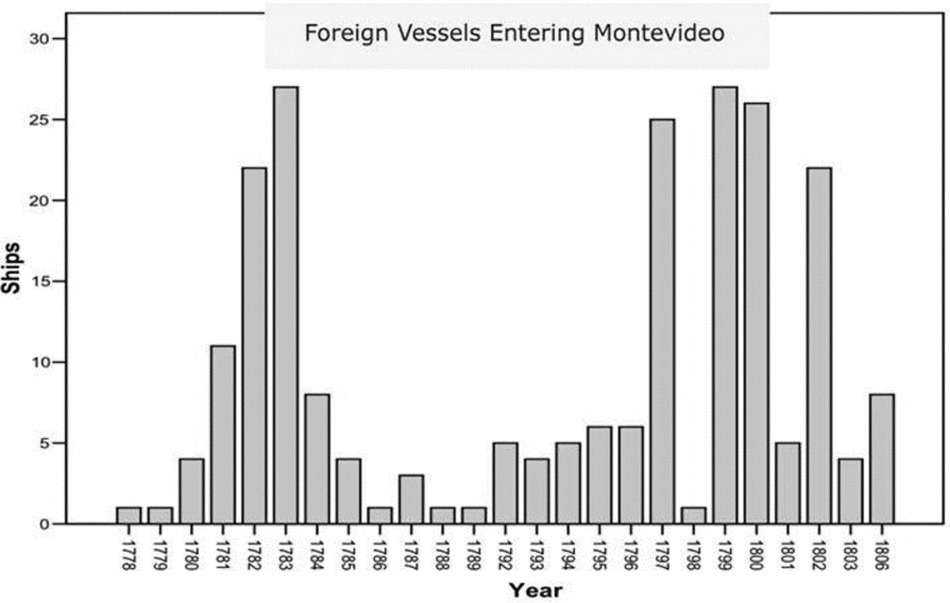
Between 1778 and 1806, a minimum of 231 ships were involved in trans-imperial trade with Río de la Plata (Montevideo). Of these ships, 116 were Portuguese (48.1 percent), 81 Spanish (33.6 percent), 14 Anglo-American (5.8 percent), eight British (3.6 percent), three French (1.2 percent) and one Danish. In some cases, there was no information, and in other the documents were mutilated in a way that the flag of origin was not legible; this occurs in 18 records (7.1 percent).Footnote 23 Of these ships, 85 docked at Montevideo, 47 at Rio de Janeiro, three at Santa Catarina, and four at Lisbon. Such a pattern shows, again, the strength of the connection between Montevideo and Rio de Janeiro mercantile elites during this period. Among the 81 Spanish vessels, 32 arrived in Montevideo after passing through Portuguese ports, and 44 others declared Rio de Janeiro as an outbound port of call.
As the distribution of the vessels' ports of origin and flags shows, trans-imperial trade involved not only Spanish vessels sailing to foreign ports, but also a heavy concentration of Portuguese merchant ships inbound to Montevideo, where they delivered cargos belonging to Spanish, Montevidean, Portuguese, and Buenos Aires merchants. The majority of Spanish vessels that arrived in Montevideo touched Portuguese ports before entering Montevideo.
The ships' itineraries were extremely varied and might include South American, European, North American, Caribbean, Pacific, West and East African, and Atlantic island ports. Spanish ships departing Montevideo most frequently declared Cádiz or other ports in Spain (often Santander) as their final destination, but those vessels commonly docked en route in Rio de Janeiro. Other regular destinations included Spanish ports in the Americas such as Havana and Callao, or foreign ports such as Mauritius, Manila, points along the coast of Africa, Cayenne, Providence, Boston, or simply “foreign colonies.” A significant number of ships sailed with official recognition from Montevideo to Rio de Janeiro using the formal prerogatives of neutral trade, although their merchandise might be transhipped to Portuguese vessels, or proceed to Europe in a convoy of Portuguese ships. Discrepancies between the official destinations and the actual routes these ships sailed reveal that Río de la Plata subjects enjoyed a level of autonomy and confidence in conducting trans-imperial trade in the South Atlantic.
Colonial subjects of both the Spanish and Portuguese empires exploited the opportunities presented by the newly legal status of trans-imperial trade and the opportunities for transhipment of goods at Brazilian ports. Where transhipment took place, the Spanish ships normally returned to La Plata loaded with Brazilian and European products, or with slaves. Spanish officials in Seville were aware that sending information, people, and goods via the Portuguese route was the safest way across the Atlantic and, although reluctantly, often accepted colonial merchants' use of the Portuguese route.Footnote 24 Conversely, Portuguese authorities saw in this system of cooperation a possibility for obtaining Spanish silver and hides, goods that had not arrived on a regular basis in Portugal since the fall of the Colonia. In spite of the legal restrictions applied to such trade, the periods of war opened up new opportunities for local authorities. Colonial subjects were able to adapt imperial law to suit the interpretations and economic interests of local elites, including public officials and merchants.
Although trans-imperial trade between Río de la Plata merchants and Rio de Janeiro slowly regained its former prominence after 1777, the number of Spanish vessels arriving in Rio de Janeiro increased more rapidly during the turbulent decade of 1790s (see Figure 1). Between 1778 and 1792, port authorities in Montevideo recorded 67 arrivals of Portuguese vessels in Río de la Plata.Footnote 25 For the same period, Portuguese customs officials inspected 15 Spanish vessels entering the harbor at Rio de Janeiro. From 1793 to 1802, 53 Portuguese ships arrived in Montevideo (the total is 64, if the arrivals to Buenos Aires are included), and 57 Spanish ships entered Rio de Janeiro, a dramatic increase.Footnote 26 Historian Ernst Pijning estimates that the coastal trade between Rio de Janeiro and Río de la Plata in the early nineteenth century involved from 30 to 40 ships of varied sizes annually.Footnote 27
Foreign Vessels Entering Montevideo, 1778–1806

The last decade of the eighteenth century was a turning point, during which the patterns of trade between Portuguese American ports and the Río de la Plata changed substantially. After 1790, in the face of increasing war-related perils in the Atlantic crossing, Spanish vessels entering Brazilian ports outnumbered Luso-Brazilian ships entering Río de la Plata ports. The number of Spanish vessels arriving in Río de Janeiro reached its peak during that period, between 1797 and 1799. However, port records for this period show that European ports, rather than Rio de Janeiro, were the final destination for many of those ships and their cargos. During this period, at least 40 vessels used Portuguese routes to reach Spanish ports. In other cases, ships from Río de la Plata had Rio as their final port of call, but the goods they carried were to be transhipped to the Peninsula via Portuguese vessels. Spanish commerce involving foreign ships and agents was extensive enough to constitute 20 to 40 percent of the regular transatlantic trade activity during periods of peace in Río de la Plata.Footnote 28 In light of such trans-imperial networks, the notion of the Atlantic as being closed to Spanish commerce must be reconsidered.
The importance of the route connecting Rio de Janeiro and Río de la Plata had grown to such an extent by 1799 that Brazilian merchants and farmers from all along the “road to Minas Gerais” could make available more than 200 products for export to Río de la Plata, as evidenced in documents showing prices and rates of profitability. The list included both Luso-Brazilian and European goods.Footnote 29 Not all of this trade could pass official inspection, as local authorities and merchants interpreted imperial laws according to their own best interests. Under the ambiguous regulations, mercantile elites with connections to local authorities could use the gray areas of law to manage trans-imperial trade. Ernst Pijning, writing about contraband trade in Rio de Janeiro, makes clear the integration of the Río de la Plata trade into Rio de Janeiro's mercantile circuit with contraband trade and semi-legal operations.Footnote 30
The decade that followed the fall of Colonia in 1777 was a time of heightened diplomatic tension between Spain and Portugal.Footnote 31 Nevertheless, it was during these years that the Río de la Plata to Rio de Janeiro trade route was revived, with new political and commercial arrangements.
Reconnecting Río de la Plata to Rio de Janeiro
While the Bourbon reforms may have elevated Montevideo's political and economic stature by making it the principal Atlantic port of the viceroyalty of Río de la Plata, it was trade with the Portuguese after 1777 that contributed most to enriching the city and its merchant class. Montevideo benefited more than other Platine ports from the Spanish conquest of Colonia, as a result of the subsequent decline in Portuguese arrivals further up the estuary, and the relocation of merchants and ship captains from Colonia into the city. The port of Montevideo, replacing Colonia as the new center of trans-imperial trade, benefited from commercial advantages afforded by its relationship to Buenos Aires, the main political and commercial center in Río de la Plata.
Despite the fact that Buenos Aires became the capital of the viceroyalty and thus the seat of the Audiencia after 1777, it was Montevideo that benefited more from the fall of Colonia and the subsequent Portuguese arrivals.Footnote 32 After 1777, Portuguese traders who resettled in Spanish possessions brought their families, capital, and Brazilian connections with them. In 1778, Manuel Cipriano de Melo, born in Portugal and previously established in Colonia do Sacramento, was appointed a comandante del resguardo, an official of the newly created office charged with repressing contraband trade. Cipriano de Melo was naturalized as a Spaniard and rapidly became one of the wealthiest merchants of Montevideo.Footnote 33 Possessing many connections within the local community as well as in Brazil, he was able to convert his family's Colonia real estate into commercial credit in Montevideo, and in the following years he asked permission to bring in another 30,000 pesos from Brazil.Footnote 34 Cipriano de Melo, along with other Montevideo merchants and public officials, was instrumental in reconnecting the trade routes between Brazil and Río de la Plata, thereby profiting economically and politically from the expulsion of the Portuguese from Colonia.
Merchants and authorities in Montevideo developed commercial and political networks to ensure the viability of trans-imperial trade. Men like Cipriano de Melo played a crucial role in controlling and participating in smuggling activities, since they had the power to determine whether or not a ship could enter the port legally.Footnote 35 Thus, Cipriano's allies, including the Montevideo merchants Francisco de Medina, Melchor de Viana, Francisco Maciel, Francisco Joanico, and other traders with interests in Brazil, played a pivotal role in restructuring the connections between Río de la Plata and Portuguese America. These merchants were commercially supported by important Buenos Aires merchants including Tomas Antonio Romero, Manuel de Aguirre, and Domingo Belgrano Pérez, who could ensure access to the trade networks active in the interior of the viceroyalty.Footnote 36 Merchants and local authorities in both Montevideo and Rio de Janeiro ensured that colonial interests were ascendant in the trade with foreigners along the coasts of their region.
Pushing the Limits of Official Restrictions
In 1778, the port authorities of Rio de Janeiro recorded the arrival of the Spanish ship Nossa Senhora de Begonha from Montevideo. The Begonha was carrying soldiers and correspondence to Cádiz and entered to Rio de Janeiro's harbor under pretext of emergency landing (arribada forzosa), which was a commonly used legal strategy deployed by ships captains to request permission to enter ports of foreign empires.Footnote 37 It was the beginning of the process by which Rio de Janeiro came to function as the main port of call between Río de la Plata and Spain. A few months later, the viceroy of Brazil, in a letter to the Portuguese Overseas Council, detailed some of the new arrangements to be adopted to keep the trade going, even though they went against previous regulations.
In January 1780, the Spanish ship San Juan y San José docked in Rio de Janeiro under the pretext of an arribada. Although the crew never unloaded the official cargo, the Brazilian viceroy Luís de Vasconcelos e Sousa reported to the Overseas Council in Lisbon that the officers of the vessel had come prepared with silver to acquire tobacco, iron, sugar, and slaves from Brazil. The viceroy also stated that he wanted to acquire and retain as much silver as possible in Rio.Footnote 38 Therefore, he had made arrangements to supply the Spanish crew with all the goods they demanded and slaves. The total value of the operation was nearly 29,000 pesos; Vasconcelos reported that it could have been even greater:
The amount of silver that remained here could have been much larger if I had been able to provide more tobacco. . . . They also took much timber, goldsmith tools, some wine, thirty arrobas of sweets, [plus] textiles, iron, and wire, and, finally, 93 slaves. Regarding the slave transaction, in the first place I tried to create difficulties, but I ended up allowing such transaction as a big favor,. . . [and] in truth, went against the prohibition on selling slaves for areas that are not under the dominion of Your Majesty, passed October 14, 1751. However, since the publication of this resolution, practices to the contrary have been common; from Colonia and other locations of this Government, slaves always had been exported to Spanish dominions without any action against such trade by the Authorities, and this is. . . because such regulations were created only to satisfy foreigners that complained about contraband slave trade.Footnote 39
In this letter, Vasconcelos reveals the methods deployed by Spanish captains and officers to acquire goods without touching the official cargo and thereby avoid charges of smuggling. Moreover, the scheme described shows that such practices were not newly created but were rather an adaptation of methods tested in previous experience, beginning with the forced arribadas that pretended to extend the rights of protection and help established in natural law but were in truth elaborate masquerades.
Arribadas were not surprises; the staging was prearranged. Although the original destination of the ship was officially another port in the Spanish empire, the captain would bring it into Rio de Janeiro under the pretext of an emergency, somehow already “prepared” with reserves of silver to acquire goods and buy slaves. This practice, and others like it, suggest that by 1780 the old trade networks were being reestablished. Spanish traders knew just what they needed to acquire in Rio: tobacco, timber, iron and slaves, the same products that Río de la Plata had bought via Colonia do Sacramento prior to 1777. Platine merchants' acquisition of slaves in Rio de Janeiro revealed the continuity of trans-imperial trade networks between Río de la Plata and Brazil; buying slaves had been a regular practice in the days of the Colonia. The location and leverages had changed.
Viceroy Vasconcelos's communication with the Overseas Council demonstrates the Portuguese interest in accumulating silver and the high level of autonomy local authorities and merchants enjoyed. Vasconcelos stated outright that his main goal in welcoming the Spanish arribadas was to obtain the maximum amount of silver possible, even though the transaction might violate imperial laws. Regardless of what might be reported, the sale of significant amounts of tobacco, wood, iron, and tools was not strictly necessary for the vessel to continue its voyage or to return to its port of origin. Vasconcelos did not report all of these transactions, but he did reveal one very notable one: the sale of the 93 slaves to the Spaniards. Although the sale violated a royal ordinance of 1751, the viceroy's correspondence shows that this law was not observed; many Portuguese authorities believed that such a decree was meant to only to satisfy the inquiries of foreign powers. Furthermore, Vasconcelos mentioned that Colonia had long been the source of slaves for Río de la Plata, and how in practice, such trade had always been conducted without official impediments.Footnote 40 Vasconcelos did not dwell on the legal issue, but instead emphasized the recovery of the flow of silver, the incorporation of the Spanish market into economic routes of Rio de Janeiro, and the increased tax income that would result for the crown.
In spite of the regulations governing trade with foreigners, the authorities and merchants of Rio de Janeiro and their partners in Río de la Plata enjoyed a relative level of autonomy in their transactions. With the formal support of local authorities, no previous authorizations were needed from metropolitan powers. On the contrary, as seen in his letter to the council, Vasconcelos informed authorities in Lisbon only after the sales had taken place. Colonial subjects were deciding de facto on how to manage trade with foreigners in the colonial space. Less than a year later, trading connections were again brought to the attention of the Overseas Council in Lisbon when the viceroy reported in greater detail about the growth of the trade with Río de la Plata. In this report of 1781, Vasconcelos revealed that the number of Spanish vessels arriving in the port of Rio, and other Brazilian ports, had increased because of the war between Spain and Britain. If in the past the Spanish merchants had been willing to come to Rio, they were now also willing to harbor Portuguese vessels in the La Plata estuary.Footnote 41 Moreover, Río de la Plata authorities wanted to make clear to the merchants in Rio that Portuguese vessels would be welcomed in Montevideo:
[The authorities] would welcome Portuguese ships that would ask for safe harbor presenting a pretext of arribada, but in fact wanted to trade. In order to emphasize their interest, the Spanish envoy brought more than 100,000 pesos to show that they are willing to spend such amount in the trade, and this convinced some ship owners to send their ships officially to Santa Catarina, Rio Grande, and other Southern ports, but the vessels would sail to Montevideo under pretext of arribada. Footnote 42
In addition, the Spanish envoy assured Vasconcelos that such ships would return “loaded with hides and silver, since the Spaniards would facilitate that with abundance.”
Because the Atlantic was becoming progressively more dangerous for Spanish vessels, the captains who arrived Rio from Río de la Plata also wanted to establish partnerships with Rio de Janeiro merchants. The merchant emissaries from Río de la Plata wanted reassurance that traders from Montevideo and Buenos Aires could ship large quantities of hides, silver, and other products from Río de la Plata to Europe using Portuguese ships.Footnote 43 Vasconcelos confirmed to the Overseas Council that some merchants from Rio had already sent a ship to Montevideo a couple of months earlier and that it had been welcomed by the port authorities.
Brazilian authorities, however, were somewhat suspicious of the “good faith” of Río de la Plata merchants. Vasconcelos mentioned to the Overseas Council that the Spaniards would seek options to make cheaper shipments to Europe, since they had to pay a high premium for transhipment at Rio de Janeiro: the additional cost of shipping goods from Rio de Janeiro, rather than Río de la Plata, could reach 60 percent of the total cargo price to Europe.Footnote 44 The Brazilian viceroy also manifested his concerns about possible smuggling activities, since the growth in the number of Spanish vessels arriving in Rio was making control of illegal exchanges more difficult. Nevertheless, the viceroy himself was in favor of the trade, and, he attached to his memorandum documents supporting this viewpoint. Among these documents was a letter from a powerful and respected merchant of Rio de Janeiro, Brás Carneiro Leão.
Carneiro Leão supported the creation of partnerships to manage transhipment of Río de la Plata products to Europe, as well as to send Portuguese vessels to Montevideo. According to Carneiro Leão, the European wars had made the ocean crossing too risky for Spanish ships, and some Cádiz merchants had obtained authorizations to send capital and information via Portugal. Moreover, the circuitous route offered several advantages to the merchants of Rio. For example, almost all the silver transported from Río de la Plata to Rio de Janeiro would remain there because silver was not shipped across the Atlantic; bills of exchange (letras de cambio) were sent instead. Finally, the existence of willing and trustworthy merchants in both Cádiz and Montevideo should be considered an advantage in terms of safety for the enterprises.
Carneiro Leão, one of the wealthiest merchants of Rio, had lengthy experience in dealing with the Platine market, dating back to the years of Colonia. In 1775, he had formed a partnership with the Colonia-based merchant João de Azevedo Sousa, and together they had advanced to the Colonia administration more than 1,300 pesos. Between 1778 and 1786, Brás Carneiro Leão appeared repeatedly as a trade partner of Manuel Cipriano de Melo, the same man who was comandante del resguardo of Montevideo. Brás Carneiro Leão attested that Cipriano de Melo had credits in Rio de Janeiro amounting to 30,000 pesos, and proclaimed that he had traded slaves and other goods in partnership with the comandante del resguardo. Furthermore, Carneiro Leão was also involved with captains and merchants commonly seen in Río de la Plata, such as Manuel João da Cunha and the popular contrabandist known as Capitão Barriga (Captain Belly), who was a close friend of Cipriano de Melo.Footnote 45
The justifications that merchants and officials used to legitimize disobedience to imperial commercial regulations emphasized the economic benefits of the Río de la Plata trade and its relative legality. Without such restrictions, they believed, the growth of commerce and the access to silver could be a major impetus for the Rio de Janeiro economy. Viceroy Vasconcelos's letter mentioned another semi-legal aspect of the trade: the fake licenses given by Spanish authorities that allowed Spanish ships and traders to arrive in Rio de Janeiro. Portuguese authorities could not deny help or admittance to Spanish ships because of the neutral status of Portugal.
Vasconcelos also mentioned other possible advantages of such trade: “As for the intended purpose of these shipments,. . . the merchants can make great use of the neutrality of our flag and of the liberties assured by the agreements between Portugal and Great Britain that declare free and exempt, the merchandise of enemies on board of our ships.”Footnote 46 According to the viceroy, warfare could be profitable for the Portuguese, because they would benefit from the legal treaties between the Atlantic empires. The transhipment of Spanish cargo by Portuguese ships allowed Portuguese ship owners and merchants to profit as well as to reinforce trade and political alliances with Spanish subjects. At the same time, it allowed Portugal to maintain both its neutrality and its role as a primary partner of Britain. It is important to recall that in Portugal some politicians were well able to remember the British lack of support and protection during the Colonia defeat of 1777. Portuguese intelligence reports had made clear to the British the nature of the Spanish expedition to Río de la Plata, but British authorities had insisted in denying the truth of the Portuguese information.Footnote 47
At the close of his long letter to the Overseas Council, Vasconcelos reminded metropolitan agents of the commitment of local authorities in Río de la Plata to the semi-legal trade. Platine officers were already using many different pretexts to authorize Spanish subjects to sail from Montevideo to Brazilian ports, but their real goal was to trade and tranship merchandise. One example was the 1781 arrival of the Spanish merchant don Francisco de Medina in Rio. Medina was not only a trading partner of Cipriano de Melo but one of the merchants active in negotiating informal trade agreements with Rio merchants. Officially, Medina was sent by Montevidean merchants to research tobacco cultivation and to buy skilled slaves for such agriculture, and he indeed returned to Río de la Plata with large amounts of tobacco and slaves. However, his efforts seem to have been directed to trade rather than research. He brought back no information about tobacco factories, and of the workers he brought back not a single one was able to produce tobacco.Footnote 48
The positive results of these efforts at trade agreements can be observed in another letter, in 1783, which indicates that transhipment and the incorporation of Spanish ships into the Brazilian fleet were already facts of commercial life in the Río de la Plata. But on March 19, 1783, the Portuguese viceroy reported to the Overseas Council that he would not allow ships to sail from Rio de Janeiro straight to Cádiz, nor accept Spanish ships coming straight from ports in Spain to Rio de Janeiro. According to him, such itineraries would raise great suspicion if those ships were intercepted by the British in the passage; thus, Spanish ships bound for Rio de Janeiro should sail only from Portuguese ports. In addition, the viceroy was concerned that the direct trade between Río de la Plata and Rio de Janeiro would facilitate contraband traffic and evasion of the transhipment fees paid in Portuguese ports.Footnote 49
Portuguese-Spanish Commercial Networks in Río de la Plata
During the early years of the 1780s, war between Spain and England encouraged Spanish and Portuguese colonial subjects to deepen trans-imperial cooperation. By helping Spanish authorities and merchants during these difficult times, Portuguese traders gained privileged access to Spanish territories and markets. The events surrounding the British capture of the Spanish ship Carlota in 1782 provide an example. The Carlota, carrying from Spain the surveyors that would demarcate the boundary between Spanish and Portuguese territory as stipulated in 1777, was caught by British privateers close to the Madeira Islands. The Carlota's crew, officers, astronomers, and some of its cargo were transported in Portuguese ships to Rio, where Domingos Mendes Viana, the powerful director of Rio's whaling contract, offered help. Viana extended loans and cash advances, to be collected in Montevideo, and provided the crew and passengers of the Carlota with transportation to the same port.Footnote 50
A reciprocal act of cooperation was recorded in Montevideo almost two decades later, when French corsairs arrived there with three Portuguese ships that had been captured while crossing the Atlantic. Authorities in Rio soon reported on the important help provided by their “Spanish friend,” Francisco de Medina. In 1799, Medina not only housed and provided loans for the officers, but also helped the Portuguese officer in charge of liberating the confiscated ships. Medina interceded with local authorities to reinforce the Portuguese claim that the ships had been apprehended illegally and pointed out the legal implications for the Spanish authorities in allowing such captures to happen.Footnote 51
The exchange of information on prices, markets, political developments, and naval movements was another important form of trans-imperial cooperation that reveals how Luso-Brazilians and Spanish-American networks cooperated and contributed to reducing risk during wartime.Footnote 52 In 1799 when the French privateers arrived in Montevideo, the authorities and merchants of Río de la Plata saw business opportunities, but they also responded to the possible repercussions. Whereas the French could offer trade in goods and the confiscated ships, their presence made clear that Portuguese ships entering the estuary might well face danger from the French warships. Losing no time, Río de la Plata's authorities and merchants sent fast-sailing boats with experienced crews to Santa Catarina and Rio de Janeiro to warn Luso-Brazilian authorities and merchants about the French presence in the region.
Antonio Olaguer Feliu, the acting viceroy of Río de la Plata and a recent former governor of Montevideo, felt that his warning was urgent, even though he had no idea of what the French might be planning. He asked the Luso-Brazilians to exercise great caution in sending ships to Río de la Plata and indicated that his own ability to help was restricted:
Not having received any orders from my Corte that would allow me to dock [merchant] ships, and because it goes against the law and the royal ordinances that I am supposed to enforce, I can not avoid asking Your Excellency to be sensitive to the repercussions of such news; because I am not a legislator, but only in charge of executing orders that I have sworn to protect, I would be delighted to help the. . . S. M. Fidelissima if it were an option for me, without sacrificing our respective responsibilities.Footnote 53
The Platine viceroy wanted to be clear that he and the Río de la Plata merchants were unable to protect and harbor Portuguese merchant ships. Although this type of interaction appeared to be commonplace, it was nonetheless illegal. Here again is an illustration of how colonial subjects in the Americas, in spite of imperial laws, created and used powerful trade and information networks that crossed imperial boundaries.
The end of hostilities between Britain and Spain after 1783 did not diminish the commercial flow between the Portuguese and Spanish possessions along the Río de la Plata to Rio de Janeiro route. Spanish ships continued to sail into Rio on their way to Cádiz to send silver and hides via the Portuguese fleet and to acquire slaves and other goods. The most frequent excuse for ships' arrival there was that they had faced storms in the Atlantic, and had headed to Rio because it was the nearest port for repairs.Footnote 54 Once in port, the ship commanders would be granted time to perform repairs; this could vary from 15 days to six months. In many cases, Spanish captains would use this time to arrange to tranship their cargoes to Portuguese ships, which sailed them on to their final destination in Cádiz, via Lisbon. Typically, fees of four percent for transhipment and three percent for port use were applied in Rio de Janeiro. The existence of such standing transhipment procedures and fees shows the everyday character of such interactions.
Arribadas, Reciprocity, and Maritime Protections
The use of the arribada as a pretext for illicit or semi-illicit trade was a well-known and predictable commercial strategy. In the Río de la Plata, its use was commonplace, and Dutch, French, British, and Portuguese captains had employed it to enter the port of Buenos Aires since the early seventeenth century.Footnote 55 Claims of maritime distress were less common during most of the eighteenth century, because Colonia provided a safe haven for Portuguese and British vessels. After 1777, however, Spanish ships began to appear off the port of Rio de Janeiro requesting the right of emergency landing.Footnote 56 On one occasion in 1785, the Spanish captain Ignacio Sestiaga declared that he needed to land in order to sell his cargo of hides, copper, and silver to pay for repairs and acquire necessary goods for continuing the voyage. This case is a clear instance of how the arribada had become a routine method for gaining access to a port. Captain Sestiaga planned the arribada in advance, loading his vessel with silver and 11,000 hides.Footnote 57
In the early 1790s, contacts between Spanish and Portuguese subjects intensified, and the number of ships from Río de la Plata entering the port of Rio de Janeiro rose significantly. Both the arribada and transhipment continued, but there were other pretexts as well. Spanish ships often came to seek protection to cross the Atlantic with the Portuguese convoy. The protection might involve substituting the Spanish flag for the Portuguese one, or the transfer of merchandise from Spanish ships to Portuguese ships. Río de la Plata merchants had often used this and other such pretexts during periods of war, when British ships would prevent Spanish ships from sailing to Europe. Footnote 58 But even in 1796, during a brief interregnum in the warfare, ship captains who claimed to have licenses granted prior to the cessation of hostilities continued to use the Portuguese route. Ship captains also deployed the strategy of using previously granted licenses to ship merchandise from Cádiz to Río de la Plata via Lisbon and Rio de Janeiro, and continued to sail Spanish ships flying the Portuguese flag.Footnote 59 Both methods proved to be effective. As the captain of La Judit reported, his ship sailed in 1799 from Lisbon to Rio de Janeiro with a cargo owned by Buenos Aires merchants and originating in Cádiz, with Montevideo as its final destination. La Judit crossed the Atlantic in a convoy of 136 ships. At 5 degrees north, the convoy was approached by two British privateers, but Portuguese officers made sure that none of the Spanish ships were confiscated.Footnote 60
The use of Portuguese ports, ships, and intermediaries became common practice, but the shipments were costly. In 1802, the Buenos Aires merchant Francisco de Necochea presented a petition in Brazil and in Lisbon to end the practice of forcing Spanish merchants to pay port fees twice, once in Brazil and once in Portugal, plus the transhipment fee. Necochea asked for a regulation that would allow Spaniards to use the Portuguese routes regularly, pointing out the potential benefits to their Portuguese associates in Rio and Lisbon. Necochea's main complaint was the required payment of two port fees, of 3 percent each. In lieu of paying the two port fees plus the mandatory 4 percent fee for transhipment, Nechochea's proposal called for a total fee of 7 percent, based on the argument that the existing fees made the costs of trade too high. Although we do not know the outcome of this case, it testifies once more to the importance and regular use of the Portuguese route by Spanish merchants.
During the 1790s and early 1800s, the pretext most frequently used by Spanish captains to enter Luso-Brazilian ports was to claim that their ships needed repairs due to storms encountered in the South Atlantic. Even during periods of war, many captains requested entry for that reason.Footnote 61 In 1796, for example, the Spanish ship Jesús María José, owned by influential Buenos Aires merchant Tomás Antonio Romero and bound for the Cape of Good Hope, attempted to enter Rio de Janeiro. Local authorities initially considered the arrival of the ship illegitimate, but they admitted it after the captain, José Antonio Sarzetea, and his high officers, who were Luso-Brazilians, explained the need for repairs to the ship's sails and rigging. The admission granted them not only permission to harbor but the de facto opportunity to sell part of their cargo as well.Footnote 62 It is noteworthy that Portuguese ships would deploy the same kind of excuse when docking in Río de la Plata ports, with the same purpose: to exploit the benefits of trans-imperial trade. The storm damage pretext worked well: between 1800 and 1806, 70 percent of the Spanish ships arriving in Rio de Janeiro claimed to need repairs as the result of damages caused by South Atlantic storms.Footnote 63
The Trans-Imperial Slave Trade
During the 1780s, merchants from Río de la Plata had obtained licenses to bring home significant numbers of slaves from the coast of Brazil, turning Montevideo into the region's gateway for the introduction of slaves. This was no small trade agreement: a record from 1783 shows that the powerful merchant Domingo Belgrano Pérez owed fees of about 20,000 pesos to Montevideo customs for taxes on his slave trading operation.Footnote 64 Merchants from Río de la Plata used licenses to acquire slaves in foreign ports and bring them to Rio de la Plata. In addition to slaves they would acquire goods like tobacco, cachaça (a liquor distilled from sugar cane), sugar, and textiles. Although Spanish laws explicitly forbade the introduction of any goods other than slaves, the prohibition was widely ignored.Footnote 65 In many cases, the number of slaves transported on these voyages was relatively small, sometimes fewer than a dozen.Footnote 66 The main difference between this pretext and the others already considered is that these ships did not cross the Atlantic, nor were they attempting to bring cargos to Europe by other means such as intermediaries.
Giving impetus to the slave trade were new and favorable Spanish laws enacted from 1791 onward. Influenced by land-as-wealth notions of the Enlightenment, Spanish reformers set out to increase the empire's participation in the slave trade. The crown granted licenses to Spanish colonial subjects to acquire slaves from Africa—and from neutral powers.Footnote 67 However, the merchants who traded in slaves were still prohibited from dealing in other goods. The 1790s also brought new Portuguese regulations unfavorable to the slave trade: laws forbidding the export of slaves to foreign regions were now to be enforced. According to Luso-Brazilian authorities, the large numbers of slaves sent to Río de la Plata had provoked a doubling of slave prices in Rio de Janeiro, from 50,000 reis (66 Spanish pesos) to 100,000 reis (132 pesos), causing damage to rural producers, since slaves were “the arms of the farmers in this land.”Footnote 68
Nevertheless, the contraband trade in slaves was extremely hard to control. Authorities complained repeatedly that they could not patrol the harbor properly, since Rio de Janeiro merchants would send small boats with slaves to other nearby areas along the coast and then embark the slaves directly onto Spanish ships outside their purview.Footnote 69 Through the slave trade and other commerce, legal and contraband, the exchanges between Rio de Janeiro and Río de la Plata proved essential to the economic, commercial, and political development of Río de la Plata as part of the Spanish empire during the 1790s and the following decade.
Conclusion
In the late eighteenth century, intermittent warfare between European empires provoked a profound change in South Atlantic patterns of trade. The Spanish colonies had experienced impressive growth after the free-trade reforms of the late 1770s, but the wars of the following decades threatened to destroy that advantage. However, that did not happen. Historians have argued that Spanish ships were impeded from crossing the Atlantic in the 1790s and that Spain was left without control over trade and without a means to support and communicate with its colonies. To keep the colonies going, imperial officials allowed them to trade with neutral powers and permitted Spanish subjects to acquire goods in other regions of the Americas. However, Spanish colonists from Río de la Plata, evading the dangers of the Atlantic crossing in wartime, used Portuguese ships to send silver, goods, commercial administrative information, and people to Spain. Moreover, on many occasions Spanish ships crossed the Atlantic in the Portuguese convoys.
The Río de la Plata was one of the most dynamic regions of the Spanish empire in the last decades of the eighteenth century. After expelling the Portuguese from Río de la Plata in 1777 and then securing both banks of the estuary, the crown opened both the ports of Buenos Aires and Montevideo for Atlantic trade within the Spanish Empire. Montevideo became the principal deep-water port of the region, and Buenos Aires merchants had to depend on agents and authorities there. The empire's requirement that most legal and logistical procedures for transatlantic shipping had to be conducted in Montevideo (for example, payment of port fees and the leasing of warehouses), coupled with the renewed connections with Portuguese America, gave the city's merchants relative advantages in relation to Buenos Aires. Montevideo benefited from the inflow of former Colonia merchants and ship captains to Montevideo after 1777. The new arrivals brought not only their capital, but also their commercial connections. As a result, more transatlantic trade opportunities opened up, and allowed for the rapid growth of Montevideo's merchant community and institutions. Between 1778 and 1806, more than 200 ships sailed between Brazil and Río de la Plata.
Benefiting from laws for permitting trade with neutrals and from existing trade networks, Spanish subjects in Río de la Plata were able to keep up a reduced but significant flow of goods between Spain and its South Atlantic colonies during wartime. Such commerce involved stable partnerships, credit exchanges, and other cooperation between Luso-Brazilian and Spanish American merchants and authorities. Such interactions were not always legal, and a variety of subterfuges were employed to make transactions work and deflect attention from their questionable legitimacy. Extralegal or not, such arrangements allowed the Spanish empire to maintain contact with its colonies to a greater degree than previous historiography has suggested. The agency of colonial subjects in establishing these connections with foreign merchants shaped the very nature of the Spanish and Portuguese empires in the South Atlantic in the last decades of the eighteenth and early nineteenth century.