Introduction
Even though home care remains the predominant care setting for older adults (Gasior et al., Reference Gasior2012), the absolute number of dependent older persons receiving institutionalized care will remain high or even increase in the developed world (European Commission and Economic Policy Committee, 2012). Among nursing home (NH) residents, depressive symptoms are highly prevalent with estimates of up to 45% (Hyer et al., Reference Hyer, Carpenter, Bishman and Wu2005). Furthermore, depressive symptoms are associated with cognitive decline, subjective health problems, impaired activities of daily living (ADL), increased need of care, and mortality (Fries et al., Reference Fries, Mehr, Schneider, Foley and Burke1993; Blazer, Reference Blazer2003). In ecological terms, the NH context may be considered a special setting concerning residents’ depressive symptoms as it may foster and counteract depressive symptoms. For example, functional impairment may restrict residents’ activity, thus foster depressive symptoms, whereas the numerous group activities offered may facilitate residents’ activity, thus counteract depressive symptoms.
To conceptualize depressive symptoms and bridges to activity (Lewinsohn et al., Reference Lewinsohn, Hoberman, Teri, Hautzinger, Reiss and Bootzin1985), now classic approach to depression provides a useful background. Briefly, the authors assume that depression-evoking events disrupt everyday activities, thereby elevating the rate of aversive experiences and reducing the rate of positive experiences, thus increasing negative cognitions, and “initiating the depressogenic process” (p. 344). Meeks and Depp (Reference Meeks and Depp2003) adapted the model to explain NH residents’ depression and particularly refer to physical disability as a potentially depression-evoking event. Therefore, this cross-sectional study aims to emphasize the role of everyday competence regarding depressive symptoms in the NH. Furthermore, this study aims to examine the potentially mediating role of perceived control between residents’ everyday activity and their depressive symptoms.
The role of basic and expanded everyday competence regarding residents’ depressive symptoms
The everyday competence model by Baltes et al. (Reference Baltes, Maas, Wilms, Borchelt, Little, Baltes and Mayer2001) differentiates between everyday competence in terms of basic (BaCo) and expanded everyday competence (ExCo) to better understand daily autonomous activities. We argue that this model is promising to better understand interdependencies between everyday activity impairment and depressive symptoms. BaCo comprises activities that are routinized, essential for survival, and universally normative (e.g. basic ADL like walking or bathing). BaCo impairments may restrict independent daily activities, hence disrupt daily routines and elevate the rate of aversive experiences due to its immediate dependency-provoking character. Consistent with this assumption, empirical data support the relationship between functional impairment and residents’ depressive symptoms (Parmelee et al., Reference Parmelee, Lawton and Katz1989; Kaup et al., Reference Kaup2007). Therefore, the connection of BaCo impairment with depressive symptoms may be expected substantial and of considerable magnitude in the NH ecology.
In some contrast to BaCo, ExCo comprises activities that primarily stem from individual preferences, give life meaning beyond basic self-preservation, and are strongly culturally determined (e.g. leisure activities). An important component of ExCo is social activity. Considering Lewinsohn et al.’s (Reference Lewinsohn, Hoberman, Teri, Hautzinger, Reiss and Bootzin1985) model of depression, social activity as a potentially reinforcing event can be expected to correlate with lower depressive symptoms, whereas reduced social activity as a reinforcement-undermining event should correlate with higher depressive symptoms. Indeed, a perceived loss of activity participation, or perceived (un-)friendliness of staff and cohabitants was associated with residents’ depressive symptoms (Park, Reference Park2009; Mortenson et al., Reference Mortenson, Miller, Backman and Oliffe2012). Therefore, the connection of ExCo – and particularly its social activity element – with residents’ depressive symptoms may also be expected to be substantial.
Based on conceptual and empirical reasoning, the respective relationships of BaCo and ExCo with residents’ depressive symptoms may be qualified in at least two ways. First, BaCo's may exceed ExCo's impact on residents’ depressive symptoms. Several models imply a multi-layer hierarchy of behavioral competencies (Lawton, Reference Lawton1983a; Baltes et al., Reference Baltes, Maas, Wilms, Borchelt, Little, Baltes and Mayer2001) with BaCo being less complex than ExCo but playing the more fundamental role. Impairments in previously available BaCo may directly and severely disrupt daily routines, coming with dependencies and a lowered rate of positive reinforcement, which may heighten depressive symptoms (Lewinsohn et al., Reference Lewinsohn, Hoberman, Teri, Hautzinger, Reiss and Bootzin1985; Meeks and Depp, Reference Meeks and Depp2003). Moreover, the more impaired BaCo is, the less complex ExCo-related activities can be conducted. Furthermore, in terms of time budgeting, the more time basic daily activities consume, the less time remains for ExCo-related activities (Baltes et al., Reference Baltes, Maas, Wilms, Borchelt, Little, Baltes and Mayer2001).
Second, ExCo's may surpass BaCo's impact on residents’ depressive symptoms, because greater ExCo (but not so much BaCo) expands the range of potentially reinforcing activities. For example, having social contacts in the NH context should be of greater reinforcing value than walking around. ExCo may be more important predicting depressive symptoms in the NH as compared to the community context, as NHs offer a range of services to compensate for functional impairment. Consequently, enhancing ExCo-related activities may counteract residents’ depressive symptoms (Meeks et al., Reference Meeks, van Haitsma, Schoenbachler and Looney2015). Besides, the socioemotional selectivity theory claims that emotionally meaningful social goals become more relevant as the individual's future time perspective shrinks (Carstensen et al., Reference Carstensen, Fung and Charles2003). Therefore, potentially reinforcing social activities could be especially important for NH residents who generally represent a very vulnerable subpopulation of old-age individuals (Kelly et al., Reference Kelly2010). In conclusion, we state the hypothesis 1: BaCo and ExCo both reveal strong relations with NH residents’ depressive symptoms.
Also of importance, the process model of depression posits disruptions of regular routines, increased negative affect, and loss of control over daily activities to mediate between the antecedents and residents’ depressive symptoms (Meeks and Depp, Reference Meeks and Depp2003). As reasoned above, we hypothesize that dependency-provoking disrupted daily routines may mediate between everyday competence and residents’ depressive symptoms. The concept of generalized control expectancy (Rotter, Reference Rotter1966) appears to capture this perceived dependency versus perceived control very well. Rotter (Reference Rotter1966) proposes two poles of the generalized expectancy of control of reinforcement: External locus of control describes the extent to which a person perceives – and with time expects – events to be out of her/his control, while internal locus of control describes the extent to which a person perceives events to be contingent on her/his action. Empirically, a review found that locus of control was associated with depression in old age (Bjørkløf et al., Reference Bjørkløf, Engedal, Selbæk, Kouwenhoven and Helvik2013). Therefore, perceived control was also considered as a potential mediator between both BaCo and ExCo and depressive symptoms. We state the hypothesis 2: Perceived control mediates between NH residents’ BaCo as well as ExCo and their depressive symptoms cross-sectionally.
Methods
Sample
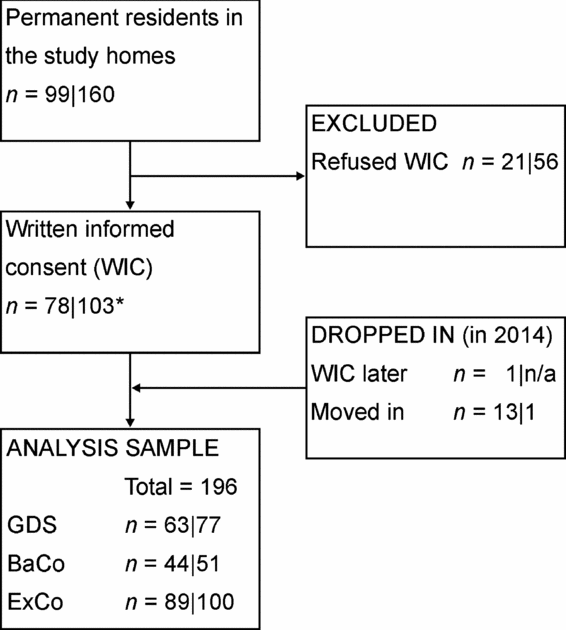
Data were drawn from the baseline measurements of the study Long-Term Care in Motion (LTCMo, Current Controlled Trials ISRCTN96090441), which installed a resident- and staff-oriented intervention aiming to promote NH residents’ physical activity (Jansen et al., Reference Jansen, Claßen, Hauer, Diegelmann and Wahl2014). Ethic approval for the project was obtained from the Ethic Review Board of the Faculty of Behavioral and Cultural Studies at Heidelberg University (approval letter from December 19, 2012; no code provided). Residents were approached without any pre-selection in terms of physical and mental functioning and they (or their legal representative) provided written informed consent. To enhance assessment reliability, research assistants were trained in interview techniques with NH residents, comprising dealing with cognitively impaired individuals’ potential answering behavior, and received two field supervisions to provide extensive feedback on interviewers' techniques. If research assistants doubted that the resident understood the content of a question well, the answer was coded as missing. Furthermore, performance-based and proxy-rated information were collected to obtain a comprehensive picture of all residents. Figure 1 displays the recruitment process. Data from n = 196 NH residents from two homes in Heidelberg, Germany, were used. The homes were located in the same neighborhood, run by the same organization; they offered equally high care standards and similar activity programs.
Recruitment. Notes. n(NH 1)|n(NH 2). The first measurements of new study participants before 2015 were included as drop-in measurements; as post-baseline measurements in NH 2 started in 2015, these drop-ins were not included. *2|1 persons did not participate at the respective first measurement, t 2 measurements were used for the two residents from NH 1.

Measures
Depressive symptoms
Residents were interviewed using a German version of the 15-item Geriatric Depression Scale (GDS-15; Bach et al., Reference Bach, Nikolaus, Oster and Schlierf1995; Yesavage and Sheikh, Reference Yesavage and Sheikh1986), which offers a dichotomous response format. The scale has been translated into German by the expert task force “Geriatric Assessment” (Bach et al., Reference Bach, Nikolaus, Oster and Schlierf1995) and showed good sensitivity and specificity in the German NH context (Allgaier et al., Reference Allgaier, Kramer, Mergl, Fejtkova and Hegerl2011). Since a more parsimonious GDS-12R has been suggested for use with NH residents (Sutcliffe et al., Reference Sutcliffe2000), it was tested whether removal of the items “Do you prefer to stay at home, rather than going out and doing new things?”, “Do you feel you have more problems with memory than most?”, and “Do you think that most people are better off than you are?” downgraded the internal consistency. Computing the scale reliability for binary measures (Raykov et al., Reference Raykov, Dimitrov and Asparouhov2010) yielded
 ${\hat{\rho }_{{\rm{GDS - 15}}}} = 0.83$
and
 ${\hat{\rho }_{{\rm{GDS - 12R}}}} = 0.84$
with
 ${\widehat {{\rm{\Delta }}\rho }_{{\rm{GDS}}15 - {\rm{GDS12R}}}} = - 0.01$
(ns) indicating that excluding the above items did not attenuate the GDS's reliability.
The GDS-15 has been validated in old-age samples including persons with mild-to-moderate cognitive impairment (Conradsson et al., Reference Conradsson, Rosendahl, Littbrand, Gustafson, Olofsson and Lövheim2013). Negatively worded items were reverse-coded and GDS-12R scale scores were calculated by multiplying the mean scores (i.e. the number of depressive symptoms present divided by the number of items answered) by 12 to allow for missing data. If more than three items were missing, the scale score was set missing (Sutcliffe et al., Reference Sutcliffe2000).
Basic everyday competence
Baltes et al. (Reference Baltes, Maas, Wilms, Borchelt, Little, Baltes and Mayer2001) operationalized BaCo by ADL indicators and found an equally high loading of performance-based mobility measures on BaCo as of BaCo on ADL. Furthermore, several studies showed the capacity of performance-based gait speed in explaining ADL (Seino et al., Reference Seino2012). Therefore, BaCo may be indicated by performance-based measures and was operationalized by two 4-m and two 10-m walks at maximum speed with walking times recorded in seconds (i.e. higher times indicating less functional ability) using a stop watch. Residents started from a standing stop and used their usual walking aids if necessary.
Expanded everyday competence
According to Baltes et al. (Reference Baltes, Maas, Wilms, Borchelt, Little, Baltes and Mayer2001), social activity is an important indicator of ExCo. ExCo was operationalized applying a proxy-rated care and behavior assessment for NHs (Köhler et al., Reference Köhler, Schäufele, Hendlmeier and Weyerer2010) to provide reliable and NH-specific assessments for very fit, cognitively impaired, and potentially depressive residents alike. To enhance assessment reliability, questions on items were discussed with staff members and examples for activity categories were given. First, staff assessed residents’ self-initiated social contact rating the frequency of residents’ self-initiated contact with caregivers, and with other residents during the last two weeks on a scale ranging from 0 (does not communicate) to 2 (approaches them often and willingly). Second, to operationalize activity participation, staff members rated the frequency of residents’ participation in 12 activities during the last two weeks (e.g. in-home events, entertaining activities) on a scale ranging from 0 (never) to 3 (very often (nearly daily)). One of the items was added in the present study and concerned physical activities. The item “other activation” as well as two items on outdoor activities were excluded. Four further items were excluded as most residents never participated in “creative activities” (73.6%), “household activities” (77.9%), “animal contact” (79.4%), or “sensory stimulation” (84.0%). In a previous validation study, the inter-rater reliabilities for social contact from three studies in German NH/residential homes were moderate to satisfactory (Köhler et al., Reference Köhler, Schäufele, Hendlmeier and Weyerer2010; unweighted κ = 0.46–0.66), but the item on participation in in-home events (the only one included in these studies) revealed quite low to moderate inter-rater reliabilities (unweighted κ = 0.29–0.49). In the present study, the inter-rater correlation of the social contact and activity participation sum scores for a randomly selected subgroup (n = 10) was satisfactorily high (r = 0.95 and r = 0.80, respectively).
Perceived control
To keep the measurement battery as short as possible for our fragile NH population, perceived control was operationalized by the ultra-short IE-4 (Kovaleva et al., Reference Kovaleva2012), which measures internal and external control each with two items each ranging from 1 (does not apply at all) to 5 (applies completely). The scale was psychometrically evaluated in two large-scale samples of community-dwelling adults (aged 18+) stratified by sex, age, education, and federal state (Kovaleva et al., Reference Kovaleva2012). In these general samples, the internal and external control components’ retest reliability and homogeneity were satisfactory (r tt = 0.56 to r tt = 0.64 in the first sample; ω = 0.53 to ω = 0.64 across samples). Given the ultra-short battery and the original proposal of a unidimensional construct (Rotter, Reference Rotter1966), both internal and external control components indicated a single latent perceived control factor in the present study. The external control items were reversed only to calculate the internal consistency for the four items, which was acceptable (Cronbach's α = 0.63).
Covariates
Cognitive impairment, sex, calendar age, and home were included as confounding variables. No other covariates were included in the analysis for reasons of parsimony. Cognitive disability is proposed to antecede depressive symptoms (Meeks and Depp, Reference Meeks and Depp2003) and was related to everyday competence (Baltes et al., Reference Baltes, Maas, Wilms, Borchelt, Little, Baltes and Mayer2001) and depressive mood (Parmelee et al., Reference Parmelee, Lawton and Katz1989). Staff members rated residents’ cognitive impairment on the seven-item Dementia Screening Scale (DSS), which has been developed as a proxy rating for NH residents (Köhler et al., Reference Köhler, Weyerer and Schäufele2007). In a previous validation study, the inter-rater reliabilities from three studies in German NHs/residential homes were satisfactory (Köhler et al., Reference Köhler, Schäufele, Hendlmeier and Weyerer2010; unweighted κ = 0.42–0.79 for DSS items). The scale showed also good sensitivity (81.4%) and specificity (90.9%) when validated against the Washington University Clinical Dementia Rating (CDR) in German old-age homes (Köhler et al., Reference Köhler, Weyerer and Schäufele2007). Instead of the original “Could he/she orient him/herself in his/her room?” the formulation “Did he/she know that he/she is in a nursing home?” was used, which has been used in former NH studies. To enhance reliability, qualified missing categories were offered for two items (e.g. “no longer leaves the institution”) and questions on items were clarified before the first measurement. As the raters indicated for 43.2% of the sample that the item “Could he/she orient him/herself in the neighborhood of the home?” could not be answered since the resident ceased to leave the home, the item was excluded from the measurement model. Ratings were given on a scale ranging from 0 (always) to 2 (never). The six-item scale was internally consistent (Cronbach's α = 0.91) and the inter-rater correlation of the sum score was satisfactory (r = 0.87). Scale values were calculated by multiplying the mean scores of answered items by six to allow for missing data. If more than one item was missing, the scale score was set missing. Higher scores indicate more cognitive impairment in terms of memory and orientation. Residents also rated their current vision and hearing ability in single-item questions with answer options ranging from 1 (very bad) to 5 (very good). Age was mean centered before it was entered into the model.
Data analysis
Descriptive analyses were performed using SAS version 9.4 (SAS Institute Inc., 2013). SEM was performed to examine latent inter-relations among the study variables using MPlus version 7.31 (Muthén and Muthén, Reference Muthén and Muthén1998–2012). Full information maximum-likelihood estimation (FIML) was used to compensate for missing values using all available data from all respondents. Model fit was considered good for all analyses, if χ²/df < 2, root mean square error of approximation (RMSEA) ≤ 0.05; comparative fit index (CFI) ≥ 0.95, and Tucker–Lewis Index (TLI) ≥ 0.95. Latent modeling with categorical outcomes was used to specify the measurement models for the latent depressive symptoms, social contact, activity participation, cognitive impairment, and perceived control factors (Muthén and Asparouhov, Reference Muthén and Asparouhov2002). That is, a normally distributed, continuous latent response variable y* i was assumed to underlie each manifest categorical variable (e.g. the GDS items), and the categorical variable's relation to its latent response variable was modeled by threshold parameters, which denote the point(s) on the standard normal distribution of y* i dividing the response categories of the observed indicator. The latent response variable, in turn, was regressed linearly on its respective latent factor, yielding the item's loading. Please note that categorical indicator thresholds and loadings are conceptually equivalent and can be transformed to item difficulty and item discrimination parameters of item response theory's two-parameter logistic model (Muthén and Muthén, Reference Muthén and Muthén2013). Mean- and variance-adjusted robust weighted least-squares estimation was used (WLSMV; for details, see Muthén and Muthén, Reference Muthén and Muthén1998–2012). Latent factors were standardized.
First, separate measurement models were run for depressive symptoms, BaCo, ExCo, cognitive impairment, and perceived control to confirm the appropriateness of the latent construct operationalizations before fitting the full structural model of the hypothesized relationships. Concerning BaCo, the walking times were log-transformed before the analysis to approximate the normal distribution. As the gait performances are supposed to be parallel tests, equal unstandardized factor loadings were modeled for all indicators and equal intercepts and residual variances for the two 4-m and the 10-m walks, respectively.
ExCo was modeled as a latent second-order factor that was indicated by the latent social contact and activity participation factors. As the latent social contact factor was built on only two items, the item loadings of residents’ contact with caregivers and their contact with other residents were set equal for model identification. Concerning residents’ activity participation, an exploratory factor analysis using polychoric correlations with oblique Geomin rotation was run prior to the structural model computations. Model fit was assessed as stated above; the best-fitting model was chosen. Items would be excluded, if they loaded higher on the second factor than on the first factor. The analysis supported a two-factor model and the item “cognitive activation” was excluded as it loaded on a second factor. This resulted in a single four-item in-home activity participation factor (participation in in-home events, musical, entertaining, and physical activities) that was internally consistent (Cronbach's α = 0.82). The factor loadings of the latent ExCo factor on social contact and activity participation were set equal for model identification.
Second, BaCo's and ExCo's association with residents’ depressive symptoms was modeled and their regression coefficients were tested for difference from zero. Moreover, a Wald test (model test) of parameter equality was conducted.
Third, additional analyses were conducted to check for the robustness of the SEM estimates. That is, a simulation was conducted that aimed to determine the power to detect the associations, given our sample size and missing data patterns, as well as to determine potential estimation biases (Muthén and Muthén, Reference Muthén and Asparouhov2002). Parameter estimates from the measurement model (loadings, thresholds, and residual variances) and from the structural model (path coefficients, covariance, and residual variances) were used as population values in the simulated replications. Also, missing data patterns were generated if they occurred three or more times in the present sample. Less frequently appearing patterns were summarized in an additional pattern. An MLR estimator was available for this analysis. A sample size of 196 – as in the main analysis – was used for 10,000 replications. The power to detect non-zero regression paths was considered good, if it exceeded 0.8; the estimates were considered acceptably unbiased, if the relative biases in the point estimates as well as in their standard errors were below 5%. Then, a model including cognitive impairment, sex, age, and home as covariates was run.
Fourth, to analyze the potential mediation via perceived control, BaCo's and ExCo's direct and indirect relations with depressive symptoms were specified in a single model to analyze the potential cross-sectional mediation via perceived control.
Results
Descriptive analysis
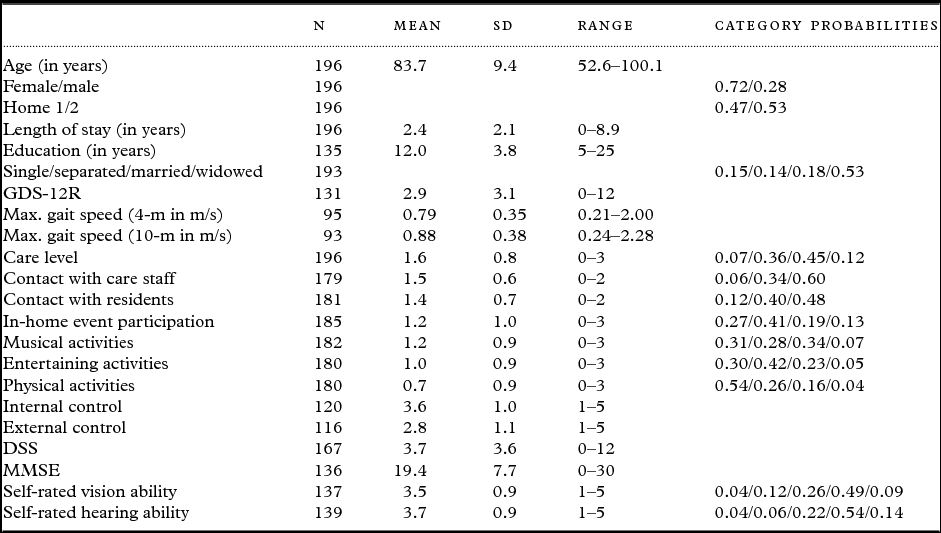
Regarding the GDS-12R, 140 residents provided some answers, the remaining residents refused or were too handicapped (e.g. cognitively, due to aphasia) to be interviewed. According to the 4/5 GDS-12R cut-off criterion (Sutcliffe et al., Reference Sutcliffe2000), 26.0% of the residents showed clinically relevant symptoms of depression. Table 1 displays descriptive data of the sample.
Sample description of study variables

Notes. GDS-12R = Geriatric Depression Scale-Residential; DSS = six items of the Dementia Screening Scale; MMSE = Mini-Mental State Examination.
Hypothesis 1: Latent inter-relations between everyday competence and depressive symptoms
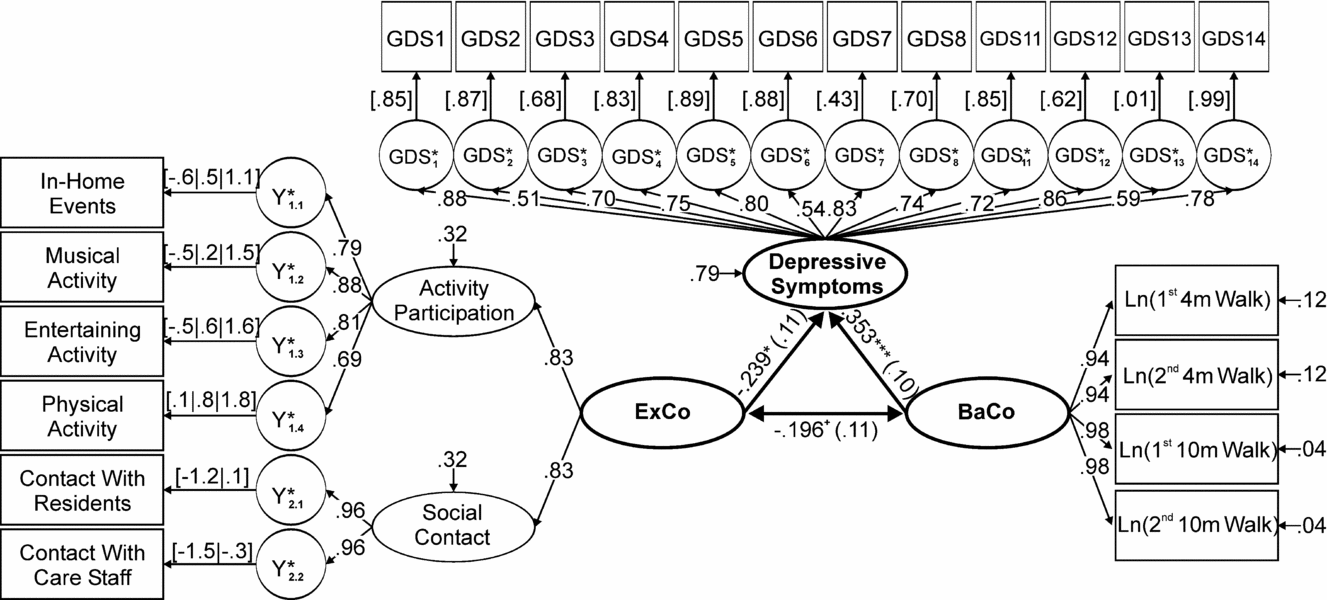
The full structural model fit the data very well (χ²(213) = 216.64, χ²/df < 2, RMSEA = 0.009, CFI = 0.998, TLI = 0.998, 54 free parameters; see Figure 2). BaCo and ExCo were both significantly related to residents’ depressive symptoms. A difference of one SD in the latent BaCo factor (i.e. an increase of one SD in functional impairment) was associated with a difference of 0.35 SD (bootstrapped confidence interval 0.12–0.56) in the latent depressive symptoms factor (p < 0.001). A difference of one SD in the latent ExCo factor (i.e. an increase of one SD in social activity) was associated with a difference of –0.24 SD (bootstrapped confidence interval –0.46 to 0.00) in the latent depressive symptoms factor (p < 0.05). BaCo and ExCo correlated marginally (r = –0.20, bootstrapped confidence interval –0.45 to 0.07, p < 0.1). Overall, residents’ everyday competence in terms of BaCo and ExCo explained 21.5% of the latent depressive symptoms factor (p < 0.05).
Path Diagram of nursing home residents’ depressive symptoms predicted by their basic and expanded everyday competence. Notes. χ²(213) = 216.64, p > 0.1; RMSEA = 0.009; CFI = 0.998; TLI = 0.998. Standardized estimates with standard errors in parenthesis. Latent response variables y* i of measurement models, thresholds τ in brackets. + p ≤ 0.1; *p ≤ 0.05; ***p ≤ 0.001.

The Wald test of equally strong relations between BaCo versus ExCo and residents’ depressive symptoms was not rejected when the path coefficients were set equal (χ²(1) = 0.49, χ²/df < 2, bootstrapped confidence interval –0.24 to 0.46).
Robustness checks
The simulation study revealed that the relative bias in the parameter estimates of the structural model – which the study focuses on and hence are relevant regarding power estimates – was below 3% with bias in standard errors below 2%. The power to detect non-zero path coefficients was acceptable (power = 0.82 and 0.76 for depressive symptoms regressed on BaCo and ExCo). The power to detect a significant correlation was 0.61. Concerning the measurement models, it should be noted, however, that it revealed some indication of bias in some loadings and intercepts/thresholds.
When cognitive impairment, sex, age, and home were included in the model (with all correlations between predictors set free), the model fit the data (χ²(423) = 487.58, χ²/df < 2, RMSEA = 0.028, CFI = 0.985, TLI = 0.983). No covariate was significantly related to depressive symptoms, but the relationships between both BaCo and ExCo with depressive symptoms did not become weaker (the path coefficients were marginally lower by –0.02 and –0.03, respectively). Finally, as the model complexity including all covariates may be too high (96 free parameters) taking into account the sample size, a more parsimonious version was checked by dichotomizing activity participation (0 = never participated), social contact (0 = does not communicate), and cognitive impairment items (0 = no sign of impairment), which yielded a model with 80 free parameters. Again, no covariates, but BaCo and ExCo were significantly related to depressive symptoms.
Hypothesis 2: Perceived control as a mediator between everyday competence and depressive symptoms
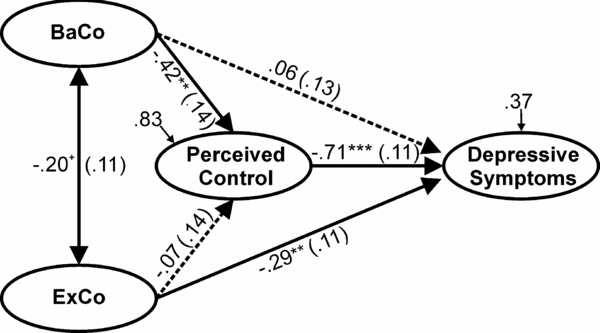
When perceived control was included in the model as a mediator between BaCo, ExCo, and depressive symptoms (see Figure 3), the model fit the data very well (χ²(300) = 311.14, χ²/df < 2, RMSEA = 0.014, CFI = 0.994, TLI = 0.993). Results confirmed the mediator effect of perceived control regarding BaCo, which was connected to depressive symptoms only indirectly (bootstrapped confidence interval of the unstandardized indirect effect 0.06–0.71). ExCo, however, was connected to depressive symptoms only directly (bootstrapped confidence interval of the unstandardized direct effect from –0.55 to –0.06). BaCo, ExCo, and perceived control explained 62.9% of the latent depressive symptoms factor (p < 0.001). To deal with the high model complexity (77 free parameters), a more parsimonious version was checked again by dichotomizing the ExCo items as above and the perceived control items (0 = internal/external control does not apply at all), yielding a model with 55 free parameters. Then BaCo was totally (i.e. direct and indirect paths combined) and ExCo was only directly significantly related to depressive symptoms.
Structural model of nursing home residents’ depressive symptoms predicted by their basic and expanded everyday competence and their perceived control. Notes. χ²(300) = 311.14, p > 0.1, RMSEA = 0.014, CFI = 0.994, TLI = 0.993. Standardized estimates with standard errors in parenthesis. Dashed paths for non-significant coefficients. + p ≤ 0.1; **p ≤ 0.01; ***p ≤ 0.001.

Discussion
The interplay of BaCo and ExCo for depressed mood in older adults, particularly NH residents, has mostly remained unexplored in previous literature. We found that BaCo and ExCo were substantially associated with residents’ depressive symptoms cross-sectionally. A simulation supported the path coefficients’ robustness. The regression weights were both significant, which confirmed hypothesis 1; they were equally strong, and were independent of residents’ cognitive impairment, sex, age, or home. Furthermore, a mediation analysis revealed that BaCo but not ExCo was related to depressive symptoms indirectly via residents’ perceived control, which partly supported hypothesis 2.
Descriptively, the portion of residents who showed clinically relevant symptoms of depression was consistent with previous findings on major depressive disorder in long-term care (Hyer et al., Reference Hyer, Carpenter, Bishman and Wu2005). The present sample appears as relatively fit, given that participants’ maximal gait speed (using their walking aid) was in the upper range of maximal speeds found in other NH samples (Kuys et al., Reference Kuys, Peel, Klein, Slater and Hubbard2014) and their category probabilities of the ExCo items – i.e. social contact with staff or residents and in-home activity participation – were slightly above the ones reported for another German NH sample (Köhler et al., Reference Köhler, Schäufele, Hendlmeier and Weyerer2010). Therefore, our findings may not be directly generalized to the full NH population.
BaCo impairment was substantially associated with residents’ depressive symptoms. As we have argued, a BaCo loss may hinder a resident from performing daily activities independently, thus it may disrupt daily routines. Taking gait performance as an example, a resident may no longer be able to walk outside or she/he may have to accept the help of others, which also changes her/his daily routines and may alter the rate of positive reinforcement.
ExCo performance was also substantially associated with residents’ depressive symptoms. This association is in line with the socioemotional selectivity theory, which posits an increasing importance of emotionally meaningful relationships given residents’ limited time horizon. The relevance of ExCo's self-initiated social contact suggests that residents can actively enlarge the number of potentially gratifying encounters. For example, a bedfast resident may often and willingly summon care staff to her/his bed. It might be interesting to explore the role of staff's reaction (i.e. the intensity of gratification provided) for residents’ depressive symptoms. The association of ExCo with depressive symptoms is especially striking in the NH context, as staff work does not imply being (close) friends with residents, as other residents largely suffer from impairments (e.g. sensory, mobility-related, and cognitive), which limit their ability to communicate and build gratifying relationships (Park et al., Reference Park, Zimmerman, Kinslow, Shin and Roff2012), and as most in-home activities are group activities without much opportunity for close interaction between residents. ExCo's activity participation element, likewise, negatively explained their depressive symptoms. This suggests that staff may compensate for residents’ functional impairments, providing opportunities for social participation and potentially reinforcing situations. For example, activity coordinators wheel non-ambulant residents to activities or offer special groups for persons with dementia.
Perceived control, as operationalized by a latent internal and external locus of control factor, mediated between BaCo but not ExCo and residents’ depressive symptoms. This finding, however, should be interpreted cautiously given the restrictions of our cross-sectional data and the rather low sample size. Lower BaCo (i.e. higher walking times) was associated with lower perceived control, which in turn was associated with higher depressive symptoms. Once the mediator effect of perceived control was considered in the model, BaCo was no longer directly associated with depressive symptoms. In contrast, ExCo was associated with depressive symptoms directly and independently of perceived control, which could indicate that a resident's social activity is relevant for depressive symptoms, apart from whether she/he perceives reinforcement to depend on her/his action or not. Considering perceived control besides BaCo and ExCo nearly tripled the explained variance of depressive symptoms. This may be because perceived control is theoretically a more proximal predictor of depressive symptoms than the distant antecedent everyday competence; also perceived control shares method effects with depressive symptoms as both rely on self-reports.
Future longitudinal research is needed to more comprehensively understand the relationships between BaCo, ExCo, and residents’ depressive symptoms as well as the mediating role of residents’ perceived control. For example, the tripartite model of depression proposes a negative affect (or general distress), and a depression-specific positive affect factor of depression (Clark and Watson, Reference Clark and Watson1991). Considering Lawton's (Reference Lawton1983b) findings, BaCo's effect on depressive symptoms should be mediated by negative affect and ExCo's effect by positive affect. Furthermore, though ExCo was not mediated by perceived control cross-sectionally, it might be so longitudinally. For example, a person might regain perceived control if pleasant activities are increased systematically, as it is a part of the rationale behind the pleasant events-based behavioral intervention (Meeks and Depp, Reference Meeks and Depp2003). Future longitudinal studies should also investigate the effect of everyday competence on mean changes in depressive symptoms. This analysis would be especially interesting in the NH context, in which care provides a range of options to compensate for BaCo losses (Freedman and Spillman, Reference Freedman and Spillman2014). Future studies may also trace how an individual's adaptation efforts in response to a change in BaCo or ExCo affect their intra-individual relations to depressive symptoms. For example, a resident may consciously accept her/his dependency in case of an irreversible functional impairment (Heckhausen et al., Reference Heckhausen, Wrosch and Schulz2013), which could moderate BaCo's association with depressive symptoms. Once a resident has adapted to functional losses, social activity may become more important (i.e. more closely related to depressive symptoms), she/he may draw greater satisfaction from social interactions, which, in turn, should protect her/him from depressive symptoms.
Regarding limitations, first, our study is cross-sectional, wherefore the path coefficients do not imply causal relationships. Second, our sample is of restricted size and several items revealed substantial missing data (n = 86 participants provided answers on all three latent factors). The FIML estimation to handle missing data provides unbiased estimation under the assumption that data were missing at random (MAR; Asparouhov and Muthén, Reference Asparouhov and Muthén2010). Although the MAR condition has been considered a reasonable state-of-the-art missing data treatment (less restrictive than the missing completely at random assumption, quite robust in many cases when it does not hold; Schafer and Graham, Reference Schafer and Graham2002), it should be considered that non-random missing data might have biased the results. In particular, a portion of missing BaCo data may be due to walking inability or dementia-related communication barriers. However, the sample's salient missing data patterns were incorporated in the simulation analysis, which supported the robustness of our structural estimates. Third, the power to detect a significant correlation between BaCo and ExCo was only 0.61. Though the present study focused on the paths between everyday competence and depressive symptoms, and this power to detect significant paths was sufficiently high (0.76 and 0.82). Fourth, a self-report measure was used instead of clinical assessments of depressive symptoms. To acknowledge this limitation, the term “depressive symptoms” was used throughout the manuscript. Fifth, the operationalizations of BaCo and ExCo only approximate the ones originally used (Baltes et al., Reference Baltes, Maas, Wilms, Borchelt, Little, Baltes and Mayer2001). Though a direct ADL measure was not available and maximum gait speed comes with its own problems (e.g. the comparability of those using vs. not using walking aids), it may be a good surrogate for functional ability (Seino et al., Reference Seino2012). Likewise, though the yesterday interview giving detailed times per activity was not feasible in our NH sample, the staff-rated activity participation and social contact information may approximate residents’ ExCo – and even more objectively. Sixth, the latent ExCo factor was developed ad hoc, wherefore its validity cannot be determined. Though the items conceptualize ExCo theoretically, wherefore we are confident that it may be validated in future studies.
In summary, this study showed the independent, substantial, and equally sized associations of NH residents’ BaCo and ExCo with their depressive symptoms using performance-based and proxy-rated predictors of subjective depression ratings and an elaborated analysis strategy. Furthermore, perceived control mediated between BaCo and depressive symptoms. Future longitudinal research may further elucidate how everyday competence impacts residents’ depressive symptoms and whether losses really “initiate the depressogenic process” as theoretically stated (Lewinsohn et al., Reference Lewinsohn, Hoberman, Teri, Hautzinger, Reiss and Bootzin1985, p. 344).
Conflict of interests
None.
Description of authors’ roles
HWW and KH designed and headed the study, they supervised the paper. MD conducted the statistical analyses. MD, HWW, and OKS interpreted the data and drafted the paper. OKS supervised the statistical analyses. CPJ, KC, and MD collected the data. All authors revised the draft.
Acknowledgments
We thank the study NHs’ residents and staff, particularly their directors, Michael Thomas and Sonja Wendel, as well as Kurt Hoffmann, Ina Lebeda, Wolfgang Merkel, and Birgit Webster. This research was supported by the European Commission (Health-F3-2012-306058) as part of the project “InnovAge – Social Innovations Promoting Active and Healthy Ageing” and its subproject, “Long-term Care in Motion” as well as a scholarship of the Cusanuswerk to MD. We thank the European Commission and the Cusanuswerk for their support.