Significant outcomes
-
∙ This study shows that a majority of adults with attention deficit hyperactivity disorder (ADHD) are afflicted with mind wandering.
-
∙ Mind wandering is more prevalent among adults who have higher inattention scores.
-
∙ The presence and severity of two particular inattention symptoms (‘making careless mistakes’ and ‘trouble following instructions’), are most strongly correlated with severity of mind wandering.
Limitations
-
∙ While our results suggest a way to operationalise mind wandering using ADHD symptoms, replication of the present findings with different assessment measures is needed.
Introduction
Mind wandering commonly refers to the unintentional shifting of attention towards internal thoughts (Reference Smallwood and Schooler1–Reference Seli, Smallwood, Cheyne and Smilek3). Mind wandering has also been associated with other mental functions including impulsivity (Reference Cheyne, Solman, Carriere and Smilek4), poor sustained attention (Reference Seli, Carriere, Levene and Smilek5,Reference Seli, Cheyne and Smilek6), and fidgeting (Reference Seli, Carriere, Thomson, Cheyne, Martens and Smilek7). As these latter problems are also correlates of ADHD, there has been an increasing interest in the association between ADHD and mind wandering.
While mind wandering can be deliberate or spontaneous (Reference Seli, Smallwood, Cheyne and Smilek3,Reference Carriere, Seli and Smilek8–Reference Shaw and Giambra11), as shown by studies by Shaw and Giambra (Reference Shaw and Giambra11) and Seli et al. (Reference Seli, Smallwood, Cheyne and Smilek3) it is the spontaneous, unintentional shifting of attention that seems most relevant to ADHD (Reference Carriere, Seli and Smilek8,Reference Seli, Carriere and Smilek10). While this emergent work suggests that mind wandering may be an important component of the clinical picture of ADHD, there is little information on how to best define mind wandering in ADHD or whether specific symptoms of ADHD might be good measurement proxies for mind wandering.
Whether subjects with ADHD with mind wandering can be identified has important implications. Clinically, such subjects may have unique correlates and outcomes and may respond differently to available treatments for ADHD. Scientifically, such information can help define a more homogeneous subgroup of ADHD patients with unique neurobiological underpinnings.
Aims of the study
The main aim of this study was to investigate whether specific symptoms or symptom dimensions of ADHD identify a group of ADHD patients with significant mind wandering. To this end, we assessed the association of mind wandering scores with ADHD symptom dimensions and specific symptom dimensions in a sample of adults with ADHD.
Material and methods
Subjects
Subjects were unmedicated adults ages 18–55 of both sexes referred to the Adult ADHD Program at the Massachusetts General Hospital specifically for the assessment of ADHD. The diagnosis of ADHD was confirmed through the completion of the ADHD module of the Schedule for Affective Disorders and Schizophrenia for School-Age Children Epidemiologic Version (K-SADS-E) (Reference Orvaschel and Puig-Antich12). The ADHD module of the K-SADS-E consists of 18 items that assess inattention and hyperactivity/impulsivity symptoms and has been used extensively to assess ADHD in adults (Reference Faraone, Biederman and Spencer13–Reference Surman, Biederman and Spencer15). Individual ADHD symptoms were rated as not present (Reference Smallwood and Schooler1), present sometimes (Reference Smallwood, Mcspadden and Schooler2) and present consistently (Reference Seli, Smallwood, Cheyne and Smilek3). Subjects with comorbidities were excluded. Subjects also completed the Mind-Wandering Questionnaire (MWQ) (Reference Mrazek, Phillips, Franklin, Broadway and Schooler16), a five-item scale that assesses mind wandering traits using a Likert scale from one (almost never) to six (almost always).
Statistical analysis
We examined the correlations between total score on the MWQ and symptoms of ADHD assessed through the ADHD module using: (1) the total score for the ADHD module, (2) the total score for the inattention subscale, and (3) the total score for the hyperactivity subscale. We also examined the correlation between total score on the MWQ and scores of individual questions of the ADHD module. All correlation analyses were performed using Spearman’s rank correlation. Demographic and clinical characteristics were compared between subjects using Pearson’s χ2 tests for parametric data and Wilcoxon’s rank-sum and Fisher’s exact tests for non-parametric data. We used receiver operating characteristic (ROC) analysis and the area under the curve (AUC) statistic to evaluate the diagnostic efficiency of the ADHD module. All analyses were two-tailed and performed at the 0.05 alpha level using Stata® (Version 14).
Results
Associations between ADHD symptoms and mind wandering scores
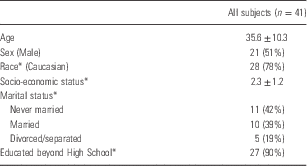
A total of 41 subjects had the MWQ scores and ADHD symptom data required for our analyses. As shown in Table 1, the average age of participants was 35.6 years; 51% of subjects were male and 78% were Caucasian. The majority of subjects had never been married and had completed education beyond high school. The average socio-economic status was 2.3 on the Hollingshead scale.
Demographic characteristics of all subjects (n=41)

Data are presented as mean±standard deviation or n (%).
* Smaller sample sizes: race: n=36; socio-economic status: n=27; marital status: n=26; education: n=30.
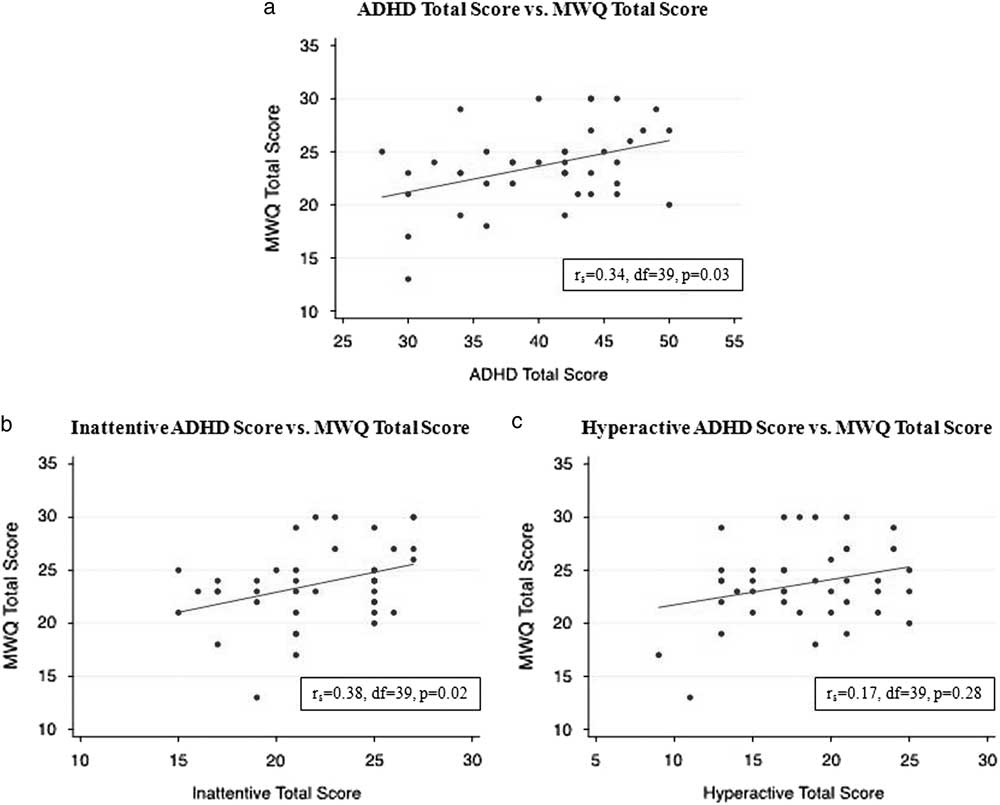
First we examined the associations between the three ADHD symptom domains (total ADHD symptoms, inattentive ADHD symptoms, and hyperactive ADHD symptoms) and the MWQ using correlation analyses. There was significant evidence of a moderate, positive association between the total ADHD score and the total MWQ score (r s=0.34, df=39, p=0.03) (Fig. 1a). This association was accounted for by the moderate, positive association between inattentive ADHD scores and the MWQ (r s=0.38, df=39, p=0.02) (Fig. 1b). In contrast, there was no association between hyperactive ADHD scores and MWQ scores (r s=0.17, df=39, p=0.28) (Fig. 1c).
The associations between the three attention deficit hyperactivity disorder (ADHD) symptom domains and Mind-Wandering Questionnaire (MWQ) total score using correlation analyses. The scores of the three ADHD symptom domains include (a) the ADHD total score, (b) the inattentive ADHD score and (c) the hyperactive ADHD score.

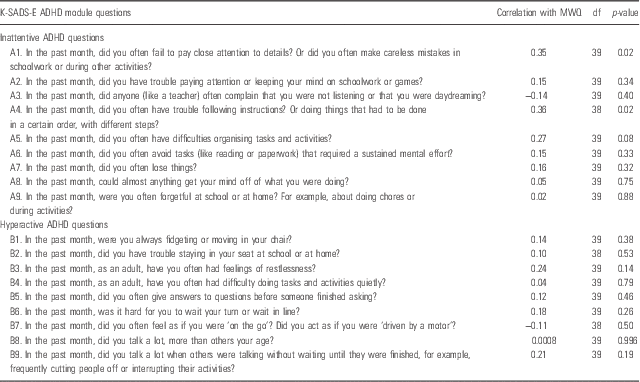
When we further examined the relationship between individual questions of the ADHD module and total MWQ scores, we found that two inattention items (‘fails to pay close attention to details/makes careless mistakes’ [A1] and ‘trouble following instructions’ [A4]) were associated with the MWQ (Table 2). For both inattention items there was significant evidence of moderate, positive associations with total MWQ score (A1: r s=0.35, df=39, p=0.02; A4: r s=0.36, df=38, p=0.02). In contrast, no hyperactivity items were associated with the total MWQ score (Table 2).
Spearman’s rank correlation of individual Schedule for Affective Disorders and Schizophrenia for School-Age Children Epidemiologic Version (K-SADS-E) attention deficit hyperactivity (ADHD) module questions with Mind-Wandering Questionnaire (MWQ) total score

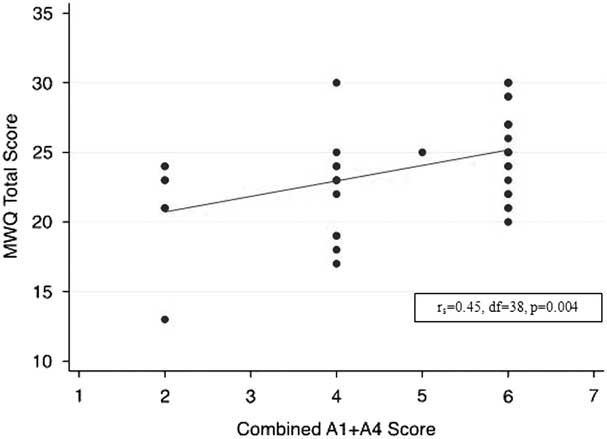
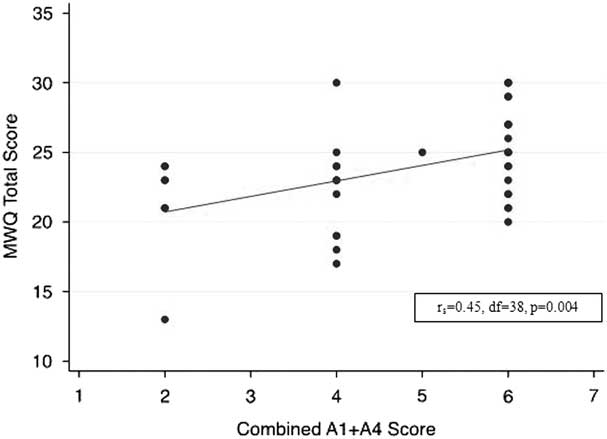
Using the combined score of the two significant inattention items (A1: ‘fails to pay close attention to details/makes careless mistakes’ and A4: ‘trouble following instructions’), we observed a moderate to strong, positive association between the two-item combined score and the total MWQ score (r s=0.45, df=38, p=0.004) (Fig. 2). This combined score had a stronger correlation with the total MWQ score than the individual A1 (fails to pay close attention to details/makes careless mistakes) and A4 (trouble following instructions) scores.
The association between the two combined inattention items (A1 and A4) and Mind-Wandering Questionnaire (MWQ) total score using correlation analysis.
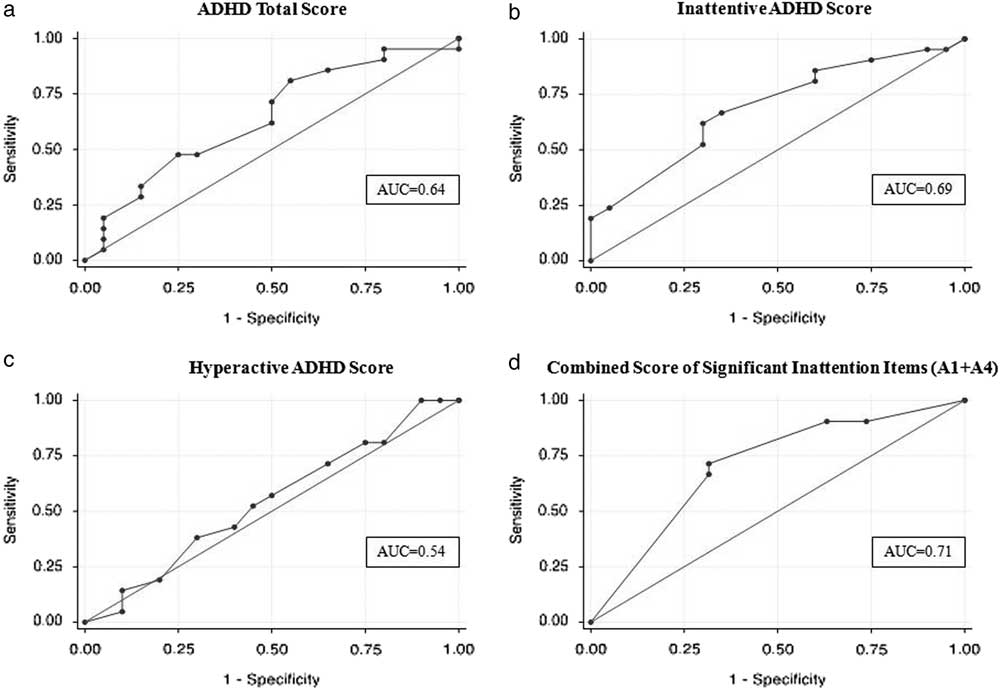
Based on the median split of scores on the MWQ, we categorised subjects as having high- versus low-level mind wandering if they had a total score ≥24 on the MWQ. We then used ROC analyses to evaluate the diagnostic efficiency of the ADHD module. The ROC analyses were highly consistent with what we found in our correlation analyses (Fig. 2). The inattentive ADHD scores were better at separating high- versus low-level mind wandering compared with the ADHD total scores (inattention: AUC=0.69 vs. ADHD total: AUC=0.64) (Figs 3a and b). The hyperactive ADHD scores were not useful in separating the two levels of mind wandering (AUC=0.54) (Fig. 3c). The combined score of the two significant inattention items (A1: ‘fails to pay close attention to details/makes careless mistakes’ and A4: ‘trouble following instructions’) showed the highest diagnostic efficiency with an AUC of 0.71 (Fig. 3d). The third cutpoint on the ROC curve for these two items provides us with the best sensitivity (71.4%) and specificity (68.4%) to detect high- versus low-level mind wandering. This cutpoint corresponds to scoring ≥5 on the combined score. Using this information, we can categorise high-level mind wandering as scoring ≥5 on the two combined inattention items (A1: ‘fails to pay close attention to details/makes careless mistakes’ and A4: ‘trouble following instructions’) and low-level mind wandering as scoring <5.
Receiver operating characteristic (ROC) curves examining the discriminating ability of (a) the attention deficit hyperactivity disorder (ADHD) total score, (b) the inattentive ADHD score, (c) the hyperactive ADHD score, and (d) the combined score of the significant inattention items (A1+A4) to identify subjects with high-level mind wandering. The combined score of the significant inattention items had the best diagnostic efficiency.

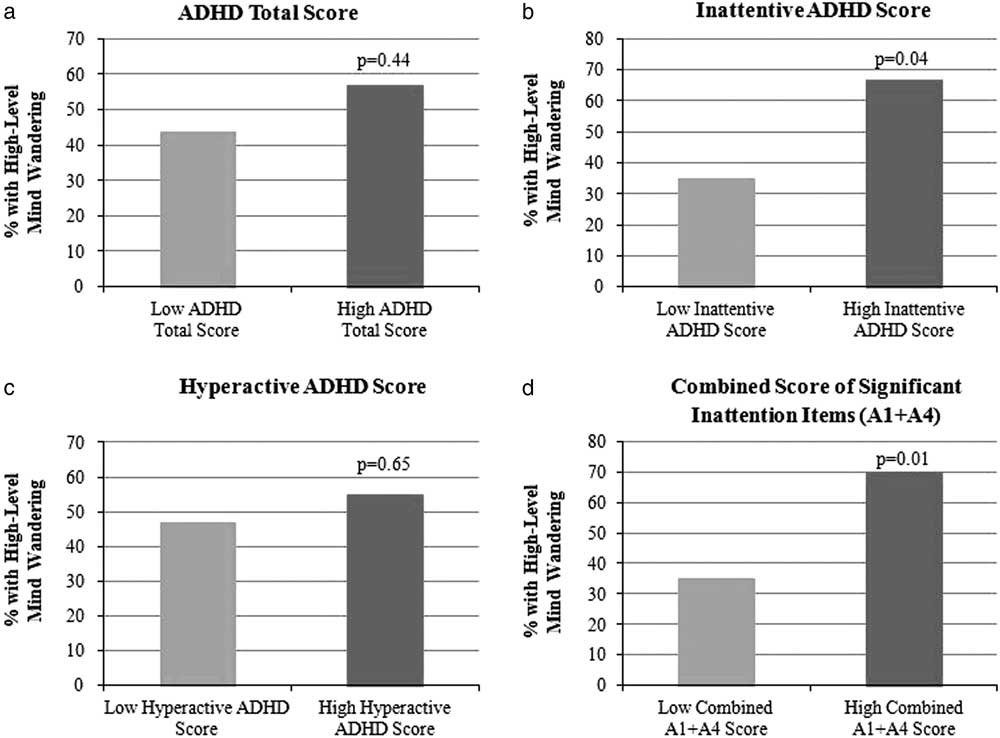
To further explore the association between mind wandering scores and ADHD symptoms, we grouped subjects into high- versus low-scorers using median splits for each of the three ADHD symptom domains and using the ROC curve cutpoint for the combined significant inattention items (A1: ‘fails to pay close attention to details/makes careless mistakes’ and A4: ‘trouble following instructions’) and examined the rates of high-level mind wandering. There was no significant difference in the rate of high-level mind wandering between subjects with high (≥42) versus low (<42) ADHD total scores (χ2=0.59, p=0.44) (Fig. 4a). However, rates significantly differed between subjects with high (≥22) versus low (<22) inattentive ADHD scores (χ2=4.11, p=0.04) (Fig. 4b) but not between subjects with high (≥18) versus low (<18) hyperactive ADHD scores (χ2=0.21, p=0.65) (Fig. 4c). Using the two combined inattention items, the rate of high-level mind wandering significantly differed between subjects with high (≥5) versus low (<5) scores (χ2=6.35, p=0.01) (Fig. 4d). Consistent with the correlation and ROC analyses, the two combined inattention items best identified high-level mind wanderers.
Rates of high-level mind wandering as defined by the Mind-Wandering Questionnaire (MWQ) in attention deficit hyperactivity disorder (ADHD) subjects stratified by having scores above (HIGH) and below (LOW) the median in each ADHD domain or scores above (HIGH) and below (LOW) the ROC cutpoint for the two significant inattention items. The graphs depict the rates of high-level mind wandering in those with high and low (a) ADHD total scores, (b) inattentive ADHD scores, (c) hyperactive ADHD scores, and (d) combined scores of the significant inattention items (A1+A4). The combined score of the significant inattention items best identified high-level mind wanderers.

Discussion
This study investigated whether the symptom dimensions of ADHD identify a group of patients with significant mind wandering. Findings showed that severity of mind wandering scores correlated with inattention items in general and with two specific inattention symptoms, ‘Making careless mistakes’ and ‘Trouble following instructions’, in particular. The presence of these two specific inattention symptoms discriminated subjects with ADHD with high versus low scores on mind wandering.
Mind wandering refers to a reduction in processing external stimuli (Reference Barron, Riby, Greer and Smallwood17). Moreover, as shown by Shaw and Giambra (Reference Shaw and Giambra11) and Seli et al. (Reference Seli, Smallwood, Cheyne and Smilek3), the type of mind wandering associated with ADHD is not only the spontaneous type (vs. the directed type) but, also the type in which subjects are unaware of their mind wandering. Thus, mind wandering can be best conceptualised as ‘internal distractibility’, a novel concept in the field of ADHD that has focussed on external distractibility only.
The finding that a majority of adults with ADHD are afflicted with mind wandering is consistent with findings reported in recent studies by Shaw and Giambra (Reference Shaw and Giambra11) and Seli et al. (Reference Seli, Smallwood, Cheyne and Smilek3) indicating that mind wandering is an important component of the clinical picture of ADHD. They also support the idea that, like other features of the disorder, mind wandering is not a universal component of ADHD.
Seli et al.’s observation of an association between spontaneous mind wandering and ADHD also supports the view that mind wandering represents a complex and heterogeneous group of mental function and not a unitary and homogeneous experience (Reference Seli, Carriere and Smilek10,Reference Smallwood and Andrews-Hanna18). This heterogeneity of mind wandering may help explain why for some individuals, mind wandering is a source of unhappiness (Reference Killingsworth and Gilbert19) and error (Reference Mcvay and Kane20), while for others, a source of creativity (Reference Baird, Smallwood, Mrazek, Kam, Franklin and Schooler21).
Our findings need to be viewed in light of some methodological limitations. Our conclusions need to be tempered by the fact that our sample size was small and suffered from some missing points in socio-demographic variables. In addition, the small size precluded our ability to correct for multiple comparisons. Therefore, our findings need be viewed as preliminary until replicated in larger samples. In the absence of adequate guidance on how to best define mind wandering, we used the median split to classify our ADHD subjects into high- and low-mind wandering. Thus, we cannot rule out the possibility that other approaches could have been equally informative. More research is needed for further investigate this issue. Another limitation is that although reasonable, the sensitivity and specificity values were relatively modest. Although we lacked healthy controls, we were interested in identifying which aspect of the clinical picture of ADHD can help distinguish ADHD subjects with and without mind wandering. Because the sample was referred, our findings may not generalise to community samples. While our study focussed on ADHD, more work is needed to investigate mind wandering in other clinical states.
While replication of the present findings with different assessment measures is needed, our results suggest a way to operationalise mind wandering using the symptoms of ADHD and could provide fruitful ground for further research on the topic. More research is needed to explore the underlying neurobiology and neurophysiology of mind wandering within and without the context of ADHD.
Acknowledgements
This study was supported in part by the Pediatric Psychopharmacology Council Fund.
Authors’ Contributions: All authors played a role in the conception and design or acquisition of data or analysis and interpretation of data, drafting or critically revising the article for important intellectual content, and all authors gave their final approval of the version of the article to be published.
Conflicts of Interest
Dr. Joseph Biederman is currently receiving research support from the following sources: The Department of Defense, Food & Drug Administration, Lundbeck, Merck, Neurocentria Inc., PamLab, Pfizer, Shire Pharmaceuticals Inc., SPRITES, Sunovion, and NIH. Dr. Biederman has a financial interest in Avekshan LLC, a company that develops treatments for ADHD. Dr. Biederman’s interests were reviewed and are managed by Massachusetts General Hospital and Partners HealthCare in accordance with their conflict of interest policies. Dr. Biederman’s programme has received departmental royalties from a copyrighted rating scale used for ADHD diagnoses, paid by Ingenix, Prophase, Shire, Bracket Global, Sunovion, and Theravance; these royalties were paid to the Department of Psychiatry at MGH. In 2016, Dr. Biederman received honoraria from the MGH Psychiatry Academy for tuition-funded CME courses, and from Alcobra and AACAP. He is on the scientific advisory board for Arbor Pharmaceuticals. He has a US Patent Application pending (Provisional Number #61/233,686) through MGH corporate licensing, on a method to prevent stimulant abuse. In 2015, Dr. Biederman received honoraria from the MGH Psychiatry Academy for tuition-funded CME courses, and from Avekshan. He received research support from Ironshore, Magceutics Inc., and Vaya Pharma/Enzymotec. In 2014, Dr. Biederman received honoraria from the MGH Psychiatry Academy for tuition-funded CME courses. He received research support from AACAP, Alcobra, Forest Research Institute, and Shire Pharmaceuticals Inc. Dr. Thomas J. Spencer receives research support or is a consultant from the following sources: Alcobra, Enzymotec Ltd, Heptares, Impax, Ironshore, Lundbeck, Shire Laboratories Inc., Sunovion, VayaPharma, the FDA and the Department of Defense. Consultant fees are paid to the MGH Clinical Trials Network and not directly to Dr. Spencer. Dr. Thomas Spencer is on an advisory board for the following pharmaceutical companies: Alcobra. Dr. Spencer receives research support from Royalties and Licensing fees on copyrighted ADHD scales through MGH Corporate Sponsored Research and Licensing. Dr. Spencer has a US Patent Application pending (Provisional Number 61/233,686), through MGH corporate licensing, on a method to prevent stimulant abuse. Dr. Ronna Fried receives honoraria from the MGH Psychiatry Academy for tuition-funded CME courses. During previous years, Dr. Fried received research support from the National Institutes of Health and Shire. In the past year, Dr. Stephen Faraone received income, potential income, travel expenses and/or research support from Rhodes, Arbor, Pfizer, Ironshore, Shire, Akili Interactive Labs, CogCubed, Alcobra, VAYA Pharma, NeuroLifeSciences and NACE. With his institution, he has US patent US20130217707 A1 for the use of sodium-hydrogen exchange inhibitors in the treatment of ADHD. In previous years, he received income or research support from: Shire, Alcobra, Otsuka, McNeil, Janssen, Novartis, Pfizer, and Eli Lilly. Dr. Faraone receives royalties from books published by Guilford Press: Straight Talk about Your Child’s Mental Health, Oxford University Press: Schizophrenia: The Facts and Elsevier: ADHD: Non-Pharmacologic Interventions. He is principal investigator of www.adhdinadults.com. Ms. Fitzgerald, Dr. Uchida, Ms. Wicks, and Ms. Saunders report no financial disclosures.
Ethical Standards
The authors assert that all procedures contributing to this work comply with the ethical standards of the relevant national and institutional committees on human experimentation and with the Helsinki Declaration of 1975, as revised in 2008.