1. Introduction
Digitization of the global economy has revolutionized the existing paradigm of industrial production, services supply, and commercial transactions. Business models are increasingly leveraging the digital platform for the production, marketing, and distribution of their goods and services. Physical goods are not only being manufactured digitally using 3D printing but also incorporate digital components (‘smart goods’) and are connected to other such devices over the internet using network infrastructure (commonly referred to as the ‘Internet of Things’). Goods and services are also being bought and sold on digital platforms such as the internet and being delivered with the help of artificial intelligence such as drones and driverless cars.
The digital revolution has penetrated almost every aspect of socio-economic relations and its pervasive impact has the potential to wreak unprecedented disruptions to the structure and pattern of how global trade is carried out and how it is regulated. This article begins by tracing the challenges that the digital economy poses to the regulation of the global trading system.
Firstly, the framework that regulates the conduct of international trade pivots around the conventional bifurcation of products into goods and services. At the multilateral level of the WTO, this regulatory bifurcation is absolute with Annex 1A Agreements of the Marrakesh Agreements Establishing the World Trade Organization dealing with trade in goods and Annex 1B agreement regulating the trade in services. In the digital economy, much of the value of an increasing number of manufactured goods is being captured in the smart services that they incorporate (servicification of manufacturingFootnote 1). Products that were hitherto traded in tangible form, such as books, music, and films and software, are now transmitted digitally through the flow of data. Hybrid products of the digital economy do not respect the traditional bifurcation of products into goods and services. Since such a product could conceivably be both a good and service at the same time, it raises the question of whether the GATT or GATS disciplines should apply to the trade in such products which could consequently also have a bearing on WTO disputes involving such products. The structural incompatibility of hybrid products with the GATT–GATS layout is a complex but ineluctable challenge that will have to be addressed if such products are to be absorbed into the rule-based multilateral trading ecosystem.
The second challenge in formulating trade rules for the digital economy arises from an intrinsic feature of digital markets – that they are overwhelmingly dominated by a few big players and tend to be oligopolistic in nature. After adducing empirical evidence to bring out how at least some segments of the digital market – software, e-retail, streaming entertainment – are oligopolistic in nature, the article examines certain elements of the digital market and business strategies of firms that are operating in the digital market and that have contributed to this oligopolistic market structure. I argue that this market structure raises serious anticompetitive concerns. The challenge, therefore, for framers of digital trade rules will be to draw an appropriate balance between promoting global market access for digital products and maintaining policy space for governments to curb the trade distorting and anticompetitive nature of digital markets. Any normative discussion of the need for multilateral disciplines that regulate the conduct of digital trade must incontestably respond to these fundamental challenges.
The article then proceeds to gauge the direction of discussions on e-commerce under the WTO Work Program on Electronic Commerce to examine whether these disciplines can address these fundamental challenges. Acknowledging the potential of the digital trade agenda of the TPPFootnote 2 to influence multilateral discussions on e-commerce I argue that, far from obviating the structural incompatibility issues with the current trading regime or arriving at an equanimous balance of interests between market access and legitimate regulatory objectives of governments, the TPP model tends to perpetuate the oligopolistic market structure of the digital economy.
2. Definitions and assumptions
Throughout this article, the phrase ‘digital trade’ has been used interchangeably with ‘electronic commerce’ to refer cumulatively to the entire gamut of commercial transactions in hybrid products and commercial transactions that use a digital platform. The article desists from prejudging a definition or arriving at a scope for the products or platforms that are covered under these umbrella terms because that would amount to begging the very problem that the article seeks pose regarding the classification of products into goods and services.
Secondly, after identifying the challenges in framing trade rules on digital trade, the article does not pose the binary question of whether the global trading community needs to have multilateral rules on digital trade. Neither does it consider whether the WTO has the mandate or the institutional wherewithal to facilitate international co-operation in digital trade. Assuming that negotiations for digital trade disciplines are undertaken at the WTO, the article highlights why choosing the model followed in extant FTAs such as the TPP would lead to sub-optimal outcomes. The larger questions of efficacy or need for multilateral convergence on digital trade rules and the appropriateness of the WTO as a forum to negotiate such disciplines, albeit of extreme importance, unfortunately remain outside the discussion of this article.
3. Challenges posed by the digital economy
3.1 Square Pegs for a Round Hole? The Classification Conundrum with Digital Products
The rule framework that regulates the conduct of international trade pivots around the bifurcation of products into goods and services. At the multilateral level of the WTO, this bifurcation is accomplished with two distinct agreements: the General Agreement on Tariffs and TradeFootnote 3 (GATT) and General Agreement on Trade in ServicesFootnote 4 (GATS) applying to international trade in goods and international trade in services respectively. Consequently, while determining the disciplines that will guide trade in a product, the applicability of one agreement precludes the applicability of another agreement. In other words, the regulatory framework of the WTO does not envisage that a product could be both a good and service. However, the digital revolution has muddied the waters of GATT–GATS based distinction with the arrival of hybrid products that eschew such classifications into goods and services. I begin by disaggregating the digital products into categories in order to survey how the literature has dealt with the classification issue of each category of digital products.
Physical goods ordered over the internet
This category refers to tangible goods that are purchased from e-retail stores such as Amazon or E-bay and are identical to their counterparts in physical brick and mortar retail shops. A good example is of a consumer ordering an Apple Macbook Air on Amazon, paying for it online, and having the laptop delivered to her house. The laptop that is ordered online is indistinguishable from the one she could have purchased directly from one of the many Apple Stores and there is broad consensus that we are in the vicinity of a ‘good’ in both cases under WTO parlance.Footnote 5
Digitizable media
Digitizable media, such as music, software, and books, present a far more challenging case for classification. Traditionally regarded as goods, these products are increasingly being transmitted and consumed electronically without being stored in DVDs, Blu Rays, or books.Footnote 6 There is almost no consensus on the classification status of digitizable media content. To help clarify issues pertaining to classification, the economic development opportunities afforded by e-commerce for developing countries, and other issues the members of the WTO agreed in 1999 that the General Council embark on a comprehensive analysis of all trade-related aspects of electronic commerce.Footnote 7 But, to the present day, members of the WTO have not agreed upon the nature or treatment of electronic transmission of digital content. In 1999, the European Union put out a communication which asserted that all electronic transmissions consist of services and, therefore, these products should fall under the purview of GATS.Footnote 8 The US and some other countries posit that the GATT disciplines should control trade in digital media favoring its classification as a good or a hybrid between goods and services.Footnote 9
The implications of not having a final determination on the classification status of digitizable media is best understood in the case of software which is not sold on CD-ROMs but delivered over electronic transmissions. Whether such transmissions constitute a trade in goods would determine whether Annex 1A Agreements of the WTO, such as the Agreement on Technical Barriers to Trade,Footnote 10 would apply. In light of recent security concerns arising out of unauthorized surveillance and theft of personal data, regulatory authorities have a compelling reason to confirm that software does not carry malicious backdoors and ensure that they meet mandatory technical regulations. The scope of technical regulations and conformity assessment procedures are guided by the TBT Agreement. The treatment of transmission of digital media as a supply of a service would eliminate the applicability of the TBT Agreement to the trade in such products.
3D Manufactured products
Additive manufacturing or 3D manufacturing operates by applying consecutive layers of materials such as plastic, metal, ceramic, cement, wood, food, and human cells onto a flat surface until those layers form a three-dimensional object. 3D printers are similar to 2D printers to the extent that they need to first create a Computer-Aided Design (CAD) file that will generate an electronic blue print for the printer.Footnote 11 Users can create CAD files by designing from scratch or scanning an object, then edit and share CAD files with others through the Internet. 3D printers print by setting raw ingredients into two-dimensional patterns on a platform and gradually raising to stack one layer on top of another until completion.Footnote 12 Although, presently a niche category in the realm of international trade, 3D printing has the potential to reconfigure global value chains for two main reasons. First, the variety of products that can be manufactured using 3D printing – from toys and micro-batteries to human kidneys and entire houses – includes almost everything.Footnote 13 Secondly, a major proportion of the value of 3D manufactured goods will be captured in designing and generating the CAD file which is the electronic blue print of the final manufactured product. Once the CAD file is generated, the actual printing simply requires the manufacturer to have a 3D printer and the required material for printing.
The legal question that arises with regard to the classification of 3D printed products is whether the CAD file can be classified as a good or a service. Once again, there is no consensus or authoritative literature that points in an unequivocal direction with regard to this question. However, in a matter before the US Federal Circuit Court where a US company that sells dental aligners sent measurements of its customers’ teeth to engineers in Pakistan who generated a CAD file of the dental aligners and sent it back to the US Company, the issue was whether the CAD file was an ‘article’ that should be regulated by US Customs and Border Protection when it enters the US. The Court found that ‘articles’ mean ‘material things’, and that electronic transmissions of data are not articles that can give rise to Commission jurisdiction.Footnote 14 Although the interpretation of the US domestic statute by its federal courts has little bearing on WTO law, the implications of this ruling are hard to miss: there is a growing incidence of servicification of manufactured products and in future it will be difficult to reason against this blurring of boundaries between goods and services.
Smart goods
An overwhelming number of daily use devices, ranging from mobile phones and watches to washing machines and air conditioners, incorporate a digital component through which they interconnect with the world electronically over the internet and are commonly referred to as ‘smart objects’ or the Internet of Things (IoT).Footnote 15 To begin with, it is important to draw a line of distinction between conventional electronic goods and contemporary smart goods. Electronic devices that carry a computer chip and process data in digital circuits have been with us since the beginning of the computing age. What sets smart devices apart is their path-breaking ability to send and receive data to and from similar smart devices and gather data using cloud computing so as to leverage the data for a variety of purposes. The value of the devices arises from and depends upon the constant and instantaneous flow of data between sensors and machines. More importantly, a large proportion of the value-in-use of such devices is derived from their ability to send and receive data by being connected to the IoT infrastructure. The Vice President of the multinational automobile manufacturer Daimler was referring to this IoT revolution when he remarked that traditional carmakers may get reduced to becoming the Foxconn (the China-based iPhone manufacturer) of the car industry, while tech-giants own the all-important digital operating systems.Footnote 16
International trade law offers scant clarity regarding the classification status of IoT devices, whether they constitute a good or a service. EC–Bananas III Footnote 17 was the primordial dispute where the WTO Dispute Settlement Body (DSB) had to make a determination on whether the measure targeted a good or a service and the interpretation employed by the Appellate Body of the DSB offers some help with the classification of IoT devices. The Appellate Body of the WTO found that ‘particular measures could be found to fall within the scope of both GATT and GATS’ and that ‘such measures include those that involve a service relating to a particular good or a service supplied in conjunction with a particular good’. In Canada- Periodicals,Footnote 18 the dispute involved a tax on ‘split-run’ periodicals equal to 80% of the value of all the advertisements contained in the split-run edition. Alleging a violation of national treatment obligations guaranteed under the GATT, the US challenged the Canadian tax on split-run periodicals. Canada argued that the tax targeted advertising services which were not bound by obligations under the GATT. The Appellate Body, concurring with the Panel Report, rejected Canada's characterization of the measure. It observed that the final product was ‘a good which comprises of two components’: editorial content and advertising content. Both components can be viewed as having services attributes, but they combine to form a physical product: the periodical itself. The finding of the Appellate Body contains an express acknowledgement that a product can be a good and have service attributes simultaneously. It also laid down that while determining whether GATT or GATS would be the controlling agreement, the adjudicating body should turn to an examination of the measure at issue rather than sticking to an examination of the product itself.Footnote 19 The Appellate Body found that the ‘measure at issue in this appeal … is a measure which clearly applies to goods’. The findings of the Appellate Body (which were more recently confirmed in China–Audiovisuals Footnote 20) obviate the need to determine whether an IoT product is a good or a service by focusing instead on the measure. Where the measure targets the service component of a product, the GATS would apply, and where the measure targets the goods attribute of a product, the GATT would apply. However, this does not completely resolve the issue at hand. So as to determine whether a measure is targeting the ‘service attribute’ or ‘goods attribute’ of a product, there has to be a conclusive understanding on whether that attribute is a good or a service. In the absence of consensus on whether data flow constitutes a good or a service (the dissonance among powerful players at the WTO over this has been recorded above), the DSB would still have no answer to the question on whether the ‘measure at issue’ is targeting a good or service, when the measure regulates flow of data.
The question of whether flow of data constitutes a good or a service, which seems to underpin the classification dilemma in all four cases mentioned above, is one that can be resolved only through legislative clarity and not through judicial interpretation. A multilateral agreement on digital trade must conclusively address this classification question of whether data are a good or a service so as to determine the applicability of GATT or GATS disciplines. Meanwhile, it is submitted that there are strong reasons to create a presumption that flow of data constitutes a good. First, electricity, which is essentially the flow of electrons, falls under the Harmonized System of Tariff Nomenclature (HS 2716.00) and, for the purpose of WTO law, electricity comes under the purview of GATT.Footnote 21 There obtains no reason to treat the flow of data any differently from that of the flow of electricity for the purposes of classification under international trade law. Secondly, the Geneva Ministerial Declaration on Global Electronic CommerceFootnote 22 provided for a temporary moratorium on imposing customs duties on electronic transmissions which has been extended at subsequent ministerial conferences. The potential to impose tariffs and the subsequent waiver of that right by WTO members seem to suggest once again that flow of data constitutes a trade in goods rather than services.
3.2 The Data Demagogues of the digital economy: anticompetitive concerns in the digital market
An analysis of the size and structure of markets in certain segments of e-commerce reveals that they tend to be dominated by a few firms. This finding and the reasons that underpin this finding have crucial ramifications when determining the appropriate legal framework for regulating trade in the digital industry.
On the basis of the entities involved, digital markets are generally divided into three broad segments: Business to Business (B2B); Business to Consumer (B2C); or Consumer to Consumer (C2C). Although B2C is often used interchangeably with online retail, it also spans growing categories such as marketing platforms, cloud computing services, travel services, ride sharing platforms, social networking sites, online payment services, and paid media content providers.
This section looks at the B2C segment of the digital market, drawing attention to the overwhelming dominance of a few players in this segment. I have attempted to cognize the reasons behind this skewed market structure and posited that they raise serious anticompetition concerns. A multilateral agreement regulating digital trade, therefore, must acknowledge and respond to these anticompetition challenges.
Market structure analysis
As has been noted above, the B2C segment of the digital market spans a wide variety of services from e-retail and marketing platforms to payment services and media production. According to UNCTAD, the size of the global B2C market stood at $2.2 trillion in 2015 and was growing rapidly, particularly in emerging economies like Brazil, China, India, the Republic of Korea, and Russia.Footnote 23 An analysis of the market structure of these online platforms reveals that they are overwhelmingly dominated by a few firms, most notably Alphabet (the parent company of Google), Amazon, Apple, Facebook, and Microsoft. These technology companies are today also the largest companies in the world by market capitalization.Footnote 24 The oligopolistic shadow that they cast on the digital economy is so complete that they can effectively impede the entry of new technology companies into these markets for the foreseeable future.Footnote 25
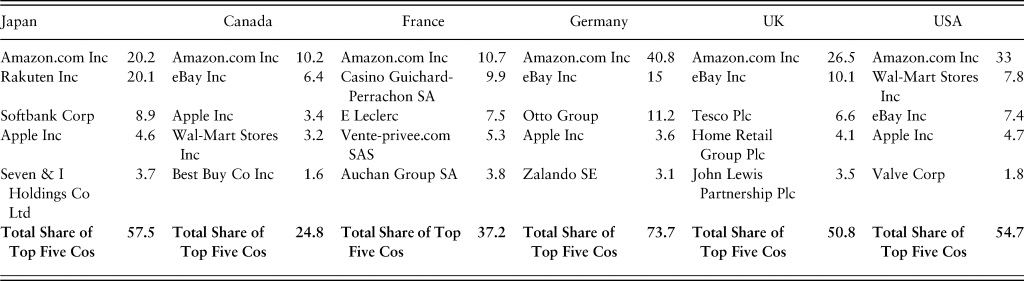
Table 1 brings out the market share of e-retailers in selected countries. What is immediately striking is Amazon's overwhelming dominance in most e-retail markets. Amazon is not just the largest online retailer globally, but as of 2013, it sold more online than its next 12 competitors combined.Footnote 26 By some estimates, Amazon's market share in e-retail is growing faster than the sector as a whole.Footnote 27 Even in countries like the US, Germany, and the UK, which have matured e-commerce markets and a well-evolved regulatory environment, Amazon's market command is formidable and well-established.
Market Share (in Percentage) of Top Five E-Retail Companies in Select Countries

Source: Author's compilation based on data available on Euro Monitor.
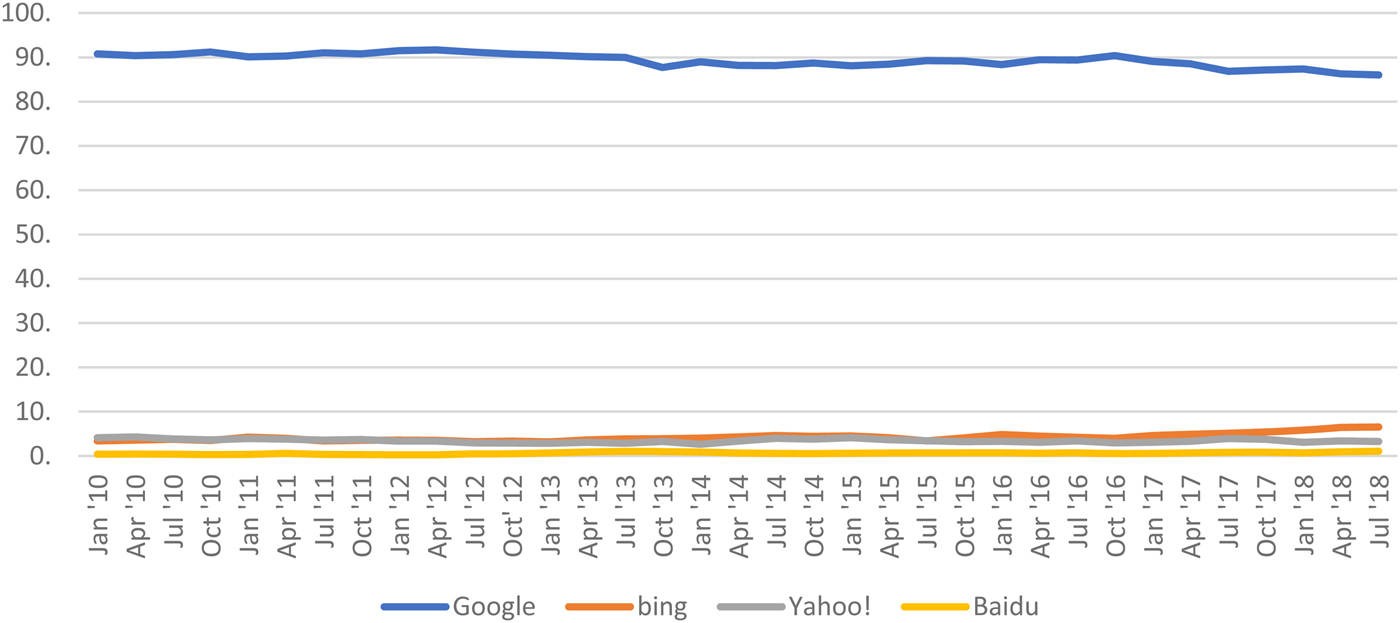
This disproportion in market share is discernible in other segments of the digital market such as that for search engines. Figure 1 captures the global market share of search engines for the period 2010–1018 and shines a light on the dominance of Google in the search engine market.
Global market share (in Percentage) of search engines, 2010–2018

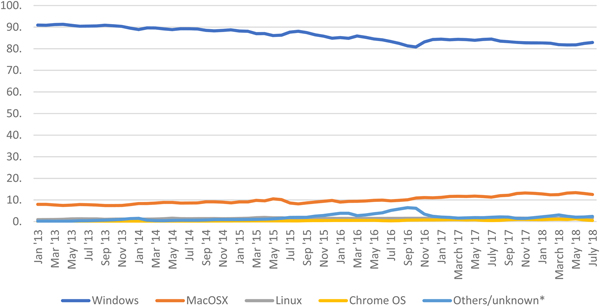
What is important to note here is that a firm that is dominant in one sector has spread its tentacles to other sectors of the digital economy. Google's presence is not just colossal in the search engine market, but it also controls five of the top six billion-user universal web platforms and leads in 13 of the top 14 commercial web functions.Footnote 28 On the other hand, Google recently stated that its biggest rival in search engine platforms is not Bing or Yahoo, but Amazon as more and more consumers are now directly going to Amazon.com to search for products.Footnote 29 Similarly, Microsoft has important presence not just in the operating systems market (Windows, as shown in Figure 2) but search engine platforms (Bing) and social networking (Linkedin) amongst others.
Global Market Share (in Percentage) of Operating systems, 2013–2018

Factors that Contribute to the oligopolistic market structure
Understanding the factors that drive the disproportionate market share enjoyed by these few firms could help in understanding whether they raise anticompetitive concerns and how trade agreements could address these concerns if any. It is undeniable that the dominance of most of these firms is at least partially attributable to first-mover advantages. Most of the technology giants of today were, once upon a time, fledgling garage experiments or PhD projects that pioneered the very innovation that created the markets for these online platforms. However, there are other factors to which their continuing unassailability could be attributed.
Network effects have a major role to play in the concentration of few dominant players in digital markets. Network effects are conventionally understood as a phenomenon in which the value that a consumer places on a product increases as more consumers use that good or service.Footnote 30 Studying the unique features of the digital economy, a research paper published by the European Parliament observes how digital business models are all based on exploiting network effects and how these pose fresh challenges while framing competition policy.Footnote 31 Elaborating on the implications of network effects, the paper argues how markets that exhibit such network effects ‘have a tendency towards high concentration or even tip over in the sense that the winner takes all. The reason is that while a particular platform grows, the network effects make it increasingly difficult for competitors to challenge the position of that platform. As such, first-mover advantages can make huge differences and the competitive game may result in a winner-takes-all outcome.’Footnote 32 Network effects result in an unfortunate position, known as ‘lock-in’, where front-runner firms with a large base of embedded users will continue to enjoy market monopoly even when superior substitutes are available and the costs of switching to the substitute are less than the benefits that the collective base of users would receive from switching. Essentially, any first mover advantages that a firm has becomes self-reinforcing and can act as an entry barrier to other firms which could be very high.Footnote 33 Adam Candeub argues that network effects could produce anticompetitive results in digital markets, such as those for search engines because of the ‘cognitive effort’ necessary to switch search engines.Footnote 34
The anticompetitive concerns raised by network effects in the digital industry dictate that any initiative to regulate digital trade should necessarily be accompanied with a strong competition policy, whose tools can be harnessed to dismantle lock-ins and allow emerging players to disrupt technology platforms. This calls for active state regulation and the need for regulatory autonomy in trade agreements to enforce such regulations.
Standard Essential Patents (SEPs) constitute another factor that drives market concentration by embedded players in digital markets. SEPs refer to the incorporation of a patented technology into a standard. Technology patents that were substitutable, to the extent that there were competing technology variants, become indispensable upon being incorporated into a standard by a standard setting organization providing a steady stream of revenue in the form of royalty to the innovators. That there are high stakes involved in getting one's technology incorporated into standards and that IP owners vie each other to have their technology embedded into standards is well understood from the much-contested legal battle between Apple and Samsung, which involved ten jurisdictions and ran into over 50 law suits until their May 2014 settlement,Footnote 35 and other such ‘patent wars’.Footnote 36 IP holders of SEPs are granted licenses on fair, reasonable, and non-discriminatory (FRAND) terms. The meaning and scope of terms such as ‘fair’ and ‘reasonable’ have been contentiously litigated with opposing views raised on whether they should reflect the ex-ante value of the technology or the ex post monopoly price situation. SEPs operate by insulating a technology from its competing variants and perpetuating its superior position by embedding it in a standard. Disruptive technologies will not be able to offer competition or even enter the market because prior technology has been standardized and achieved market validation through inter-operability. The standardization, inter-operability, and high switching costs effectively act as market barriers to the entry of new technology. The steady stream of royalty from the use of their IP in SEPs also helps firms to buttress their R&D into the underlying technology and complete the monopoly/oligopoly loop.
Another crucial reason behind the oligopolistic market structure of e-commerce markets is the business choice made by these firms to opt for growth over profits. This is best captured in a statement made by a global e-retailer cited in an UNCTAD report that the ‘key to long term success in e-commerce is achieving a large market share fast. If this required huge investments with implausibly long pay-back periods, so be it. Profits would come later, as e-commerce markets matured.’Footnote 37 The focus is to expand market share and establish scale and thereafter reap windfall profits in the long term. Dominant firms have been able to establish scale by employing strategies that raise serious anticompetition concerns such as pricing their products and services below cost to drive out their rivals. The classic example of a technology company that has pulled off this ‘miraculous’ trade-off between growth and profits is Amazon. Lina Khan has extensively documented the business strategy underlying Amazon's decision to report meagre profits, by pricing below-cost and investing aggressively.Footnote 38 She also argues in the paper that Amazon's preference for scale over profits undercuts conventional tools for competition enforcement such as predatory pricing. Predatory pricing doctrine assumes that predation is irrational and unlikely to occur because firms prioritize profits over growth. Courts, while discussing the likelihood of predatorial conspiracy have consistently assumed that firms value profit maximization over growth.Footnote 39 Once again, a trade agreement regulating the digital economy will have to ensure that governments have regulatory autonomy to develop and enforce new rules to check anticompetitive behaviour by such dominant firms.
4. The digital trade agenda of the TPP
4.1 What is sauce for governments is not sauce for big tech
From the discussion above, it can be surmiszed that a digital trade agreement, if facilitated by the WTO, must (a) bring legislative clarity to the classification of digital products; and (b) be mindful of the anticompetition concerns that prevail in the digital industry. With regard to the latter challenge, a multilateral agreement needs to recognize that, in e-commerce, the potential or the incentive to distort trade and skew markets in favour of a few players lies not just with governments but equally, if not more so, with private players. This calls for a dual focus on the need to discipline State behaviour and, crucially, the behaviour of private businesses. While realizing the objective to expand the market and eliminate the barriers to e-commerce, a multilateral trade agreement must, therefore, also recognize the need to preserve the regulatory autonomy of members to devise and enforce modern policy tools that respond to features that are idiosyncratic to digital markets and the anti-competitive business strategies of technology companies so as to ensure that global electronic commerce is free and fair.
However, there exists a potential that the discussions on e-commerce at the WTO could be influenced by the digital trade agenda of the TPPFootnote 40 which, far from addressing the challenges in regulating digital trade, are designed to perpetuate the dominance of the established players in the digital market. The digital trade agenda of the TPP, as reflected in its E-Commerce chapter and Telecommunications chapter, places its unwavering focus on curtailing the regulatory space of governments and forever future-proofing trade disciplines from curbing the dominance of US firms in the global digital markets. Moreover, no effort has been made to resolve the goods–services classification dilemma that digital products pose. An analysis of the TPP's political economy considerations and the legal disciplines provides incontrovertible evidence that its parties envisaged the TPP to espouse a laissez-faire approach that aimed to minimize government interventions in the e-commerce market.
First, the systematized and concerted efforts the Silicon Valley-based tech firms have invested in shaping the global e-commerce agenda is well documented.Footnote 41 More specifically, Shamel Amzeh and Christopher Foster studied how the growing political power of global digital industry leaders led to the adoption of the ‘digital trade agenda’ in the TPP.Footnote 42 The footprint left behind by these firms on the TPP text becomes far more evident if one was to compare the proposals contained in letters written by e-commerce business associationsFootnote 43 with the Digital2Dozen principles which were adopted by the USTRFootnote 44 and which later got fully incorporated into the E-commerce chapter of the TPP. The overwhelming political and economic influence that the titans of the digital industry exerted over the shaping of the TPP's digital agenda leaves no doubt about the political economy considerations that underpin the TPP.
Secondly, an analysis of the legal disciplines of the TPP further reinforce the argument that the singular purpose of these provisions is to regulate government intervention with no attempt to strike a balance between the market access priorities of digital firms and the legitimate regulatory objectives of signatory governments or of addressing the systemic incompatibilities between digital trade and the multilateral trade regulatory system. An analysis of some of the TPP provisions on prohibitions on mandatory disclosure of source code, network neutrality, and data localization could help in bringing this out.
Upholding the proprietary interests of digital industry by prohibiting disclosure of source code
The TPP contains disciplines prohibiting the transfer of, or access to, source codeFootnote 45 of software owned by a person of another party, as a condition for the import, distribution, sale, or use of such software, or of products containing such software, in its territory (Article 14.17). Such a provision invites serious questions regarding a state's right to regulate against security vulnerabilities arising from malicious software and cyber-malfeasance. Currently, under the WTO regime, members have the right to ensure that its imports conform to the characteristics and qualities specified in the technical specifications for that product as long as the procedures to verify this conformity (conformity assessment procedures) are consistent with the rules laid down in the WTO TBT Agreement. Regulatory authorities would often need access to the source code of a software for the purpose of these conformity assessment procedures, a fact that has become sufficiently clear in the enquiries that followed the Volkswagen emissions scandal.Footnote 46 In recent years, security vulnerabilities are being reported not just from modems and PCs but also from daily use devices, such as smoke alarms, motor vehicles, drink mixers, medical devices. The TPP provisions have imposed an absolute ban on audit/verification of source code by regulatory authorities other than for devices that are used in ‘critical infrastructure’ and those that are not meant for mass markets. The exceptions contained in TPP text on source code transfer obligations are ambiguous, ill-nuanced, and do not protect from security vulnerabilities or curtail regulatory overreach by way of breach of privacy or censorship.Footnote 47
The provision also has ramifications on the competitive environment in the software industry, which hitherto has been dominated by a handful of players based in Silicon Valley. To begin with, economic theory and empirical evidence suggests that open source licensing of software induces a higher rate of innovation and security features in a given software.Footnote 48 If the source code of a software remains open, the importing nation could incubate an indigenous pool of software developers who could then perform bug fixes and upgrades on the software at the domestic level. The disciplines on trade secrets under the WTO Agreement on Trade Related Aspects of Intellectual PropertyFootnote 49 and technology transfer under the WTO Agreement on Trade Related Aspects of Investment MeasuresFootnote 50 offer ample policy flexibility for WTO members to pursue such legitimate regulatory objectives that would broaden the pool of software developers and infuse healthy competition into the software industry. However, the TPP Agreement, desirous of curbing the growth of new players, has invoked restrictive provisions prohibiting the transfer, access, or disclosure of source code.
Network neutrality provisions
The network neutrality provision in the TPP does not create any strong legal obligations on the parties to ensure that consumers have unfettered access to the internet. TPP Article 14.10 providing for ‘Principles on Access to and Use of the Internet for Electronic Commerce’ uses best-endeavor language: ‘Parties recognize the benefits of consumers in their territories having the ability to (a) access and use services and applications of a consumer's choice available on the Internet, subject to reasonable network management’ (emphasis added). It stays clear of creating any mandatory obligation against discrimination on internet networks. Further, it subjects consumer's choice available on the Internet to ‘reasonable network management’ and does not offer any explanation or definition as to what constitutes reasonable network management. The best endeavor nature of the obligation makes it clear that the domestic implementation of this provision depends on the political will of the TPP country.Footnote 51 Also, the vague and ambiguous tone of the exception provides regulatory flexibility to allow ISPs to manage the network for regulating data traffic. Footnote 7 to Article 14.10 further clarifies that this provision shall not curtail the rights of ISPs to offer its subscribers certain content on an exclusive basis. In sum, the provisions on net neutrality contained in TPP instill no pressure on its parties to implement strong net neutrality rules in their domestic jurisdictions to check discriminatory network management practices deployed by ISPs to favour big players.
Prohibiting data localization requirements and promoting free cross border flow of data
Article 14.11.2 of the TPP requires all TPP parties to ‘allow the cross-border transfer of information by electronic means, including personal information, when this activity is for the conduct of the business of a covered person’. ‘Covered person’ excludes any kind of ‘financial institutions’ or ‘cross-border supplier of financial services’ but broadly covers all other service suppliers and investments. The implication of this obligation is that digital firms relying on cloud computing and delivering Internet-based products and services cannot be mandatorily required to build physical infrastructure and expensive data centers in every country they seek to serve. This obligation is undesirable and could have adverse implications for economic development such as affecting continued access to critical services at crucial times, raising privacy concerns of data stored in cloud computing facilities of foreign nations, and raising questions of applicability of privacy laws of server–host nations in case of disputes. Neha Mishra has documented the disagreement among TPP parties to data localization parties when the proposal was tabled by the US.Footnote 52
Some commentators have observed that the TPP provisions prohibiting localization of data should be viewed as a welcome move that is championing the campaign for free cross-border flow of data against data protectionist policies of some governments that are fragmenting the Internet. However, to better understand the implications that prohibition on localization of data would have on the continued hegemony of the technology giants, one needs to recognize the role and use of data in digital markets. The bedrock of the power that these tech companies enjoy is the need for and the ability to concentrate, systematize, and analyze large volumes of data (Big Data) that have been aggregated from the shopping history, travel itinerary, daily physical activity log, dietary preferences, search history, and ideological positions of users which is then used to tailor pricing, suggest recommendations, target advertisements, or make future deals. Attempts by governments to de-centralize data through server localization hits at the very root of the power of tech companies to aggrandize and process large swathes of data. The aggressive campaign against such data localization requirements stems from the awareness among Big Tech as to how fundamental Big Data are to their continued dominance. As Nathan Newman argues, the concentration of data in the hands of a few players creates ‘an insurmountable barrier to entry for new competition’.Footnote 53 Given the interest groups that lobbied for the TPP's e-commerce chapter and the larger political economy considerations underlying the agreement, it would be naïve to believe that the resolve to impose prohibitions on data localization in the TPP stems from considerations of allowing the free and seamless flow of data over the internet underpinned by liberal notions of freedom of speech and expression. To the contrary, with the revelations made regarding the misappropriation and improper use of data by Facebook and Cambridge Analytica,Footnote 54 the Uber data breach and the subsequent cover upFootnote 55 which compromised the data of millions of customers and drivers around the world, and allegations of Amazon staff leaking out personal data for commercial gains,Footnote 56 among many others,Footnote 57 it can be argued that there in fact exists an inverse relation between free cross-border flow of data and protection of civil rights.
5. Conclusion
Structural incompatibility of digital products with the established trade regulatory framework and anticompetition concerns are fundamental challenges that have to be addressed by a multilateral agreement regulating digital trade. The digital economy has introduced a wide variety of ‘hybrid products’ that do not respect the traditional bifurcation of products into goods and services. Since a product could conceivably be both a good and service at the same time, it raises the question of whether the GATT or GATS disciplines should apply to the trade in such products, which could consequently also have a bearing on WTO disputes involving such products. The structural incompatibility of hybrid products with the current layout is a complex but ineluctable challenge that will have to be addressed if such products are to be absorbed into the rule-based multilateral trading ecosystem.
Digital markets are also overwhelmingly dominated by a few big players and tend to be oligopolistic in nature. This market structure of digital platforms is not just attributable to idiosyncratic features of the digital economy such as network effects and SEPs but is also attributable to concerted efforts by embedded players to establish scale and drive out competition. This raises serious anticompetition concerns and the challenge for framers of digital trade rules will be to draw an appropriate balance between promoting global market access for digital products and maintaining policy space for governments to curb the trade distorting oligopolistic nature of digital markets. This is because, in the absence of prompt and incisive regulatory intervention, e-commerce markets would develop in a manner that would allow the concentration of wealth in the hands of a few players. Any normative discussion on the need for multilateral disciplines that should regulate the conduct of digital trade and the shape such disciplines should take must incontestably respond to these fundamental challenges.
There exists a very high potential for the discussions under the WTO Work Program on Electronic Commerce to be influenced by the digital agenda of the TPP as delineated in the e-commerce and telecommunications chapter of the TPP Agreement. However, far from addressing the challenges in absorbing digital trade into the multilateral trade regulatory system or acknowledging the need for regulatory autonomy, the e-commerce agenda of the TPP places its unwavering focus on minimizing or eliminating government interventions in e-commerce markets so as to protect the oligopolistic power of Big Tech and perpetuate their present dominance. This approach of the TPP creates compelling reasons to reject its disciplines as a normative benchmark for discussions on a multilateral agreement on digital trade.