Introduction
Peritonsillar abscess is one of the most common emergency presentations to ENT acute services, with an incidence of around 8000 cases a year in the UK. 1 Internationally, it is common for patients to be managed in an out-patient setting, with drainage achieved in the emergency department, prior to discharge with oral medications.Reference Millar, Johnson, Drummond and Kellner 2 , Reference Chau, Seikaly, Harris, Villa-Roel, Brick and Rowe 3 In the UK, out-patient management has also been demonstrated to be effective.Reference Al, Cruise, Kapoor, Singh and Harcourt 4 , Reference Garas, Ifeacho, Cetto, Arora and Tolley 5 However, anecdotally, in-patient management remains the default strategy in many centres.
The use of corticosteroids in the acute management of peritonsillar abscess has been shown to be efficacious and safe in randomised controlled trials.Reference Chau, Seikaly, Harris, Villa-Roel, Brick and Rowe 3 , Reference Ozbek, Aygenc, Tuna, Selcuk and Ozdem 6 Steroids have the potential to alleviate symptoms of trismus and pain, and therefore expedite recovery.Reference Hardman, McCulloch and Nankivell 7 Yet routine administration of steroids appears to be sporadic, with significant variation amongst clinicians. A national audit would help clarify variations in peritonsillar abscess management, and enable correlation of these variations with outcomes.
Trainee-led research collaboratives have recently been established in several surgical specialties in the UK. These collaboratives have proved effective at instigating and delivering multicentre observational and experimental studies, the findings of which have been published in high impact factor journals.Reference Pinkney, Calvert, Bartlett, Gheorghe, Redman and Dowswell 8 , 9 Trainees are ideally placed to lead audits of emergency management given their exposure to emergency patients, with frequent on-call service and rotations through multiple units.
At the inception of this project, there was no such collaborative functioning nationally within otolaryngology. A collaborative audit of current practice was envisaged as a vehicle to establish this network. Consequently, the objectives of this study were two-fold, as described below.
Objectives
The first objective was to examine the incidence and outcomes of suspected peritonsillar abscess management, and to correlate these variables with variations in management across the UK. The second objective was to promote the development of a trainee collaborative network for multicentre research in otolaryngology in the UK.
Materials and methods
This manuscript was prepared in accordance with the Strengthening the Reporting of Observational Studies in Epidemiology (‘STROBE’) statement (an international, collaborative initiative of epidemiologists, methodologists, statisticians, researchers and journal editors involved in the conduct and dissemination of observational studies).Reference Von, Altman, Egger, Pocock, Gøtzsche and Vandenbroucke 10 The protocol for this study was published in advance online. 11
Ethical considerations
This study documented current practice. In order to contribute data to this study, the audit was pre-registered with each centre's local audit department, in accordance with their local policy. All patient identifiable data were held locally, and only fully anonymised data were handled and analysed by the steering committee. Therefore, no ethics committee approval was required.
Study design and setting
A prospective cohort study was conducted to record the management of consecutive patients, presenting to acute ENT services based in secondary care hospitals, who were treated for suspected peritonsillar abscess.
Inclusion criteria
Any patient diagnosed clinically and treated as a suspected peritonsillar abscess case was included. It was not necessary for the diagnosis to be confirmed by drainage of pus. Patients of any age were included.
Exclusion criteria
Referrals for suspected peritonsillar abscess were excluded where this diagnosis was deemed clinically incorrect following review by an otorhinolaryngology clinician and without subsequent management as a peritonsillar abscess.
Data collection and governance
Data were collected anonymously via a bespoke online proforma hosted at www.enttrc.com. Anonymised data were submitted to servers housed in a secure underground facility hosted by www.krystal.co.uk. These servers were Payment Card Industry Data Security Standard (‘PCI-DSS’) certified and International Organization for Standardization (‘ISO’) 27001 compliant. Information was passed to the servers over a 256-bit encrypted connection using Transport Layer Security (‘TLS’) 1.0.
Each site was given an individualised login and personal identification number. Data were collected at three time points: initial presentation, discharge and after 30 days of follow up.
Pilot study
To trial the data collection tool, and provide an estimate of recruitment, a pilot study was conducted in 10 centres from the West Midlands over a 2-week period, commencing 9 December 2013. This pilot period identified nine peritonsillar abscess cases contributed by four centres. With this recruitment rate, and an intended target of 100 peritonsillar abscess cases, the study was designed to run for 2 months in 20 centres. In order to enlist further centres, the study was advertised nationally via the Association of Otolaryngologists in Training and via personal communications with individuals who had expressed interest in developing trainee collaboratives in their regions.
Outcome measures
The primary outcome measure was the occurrence of an ‘adverse event’ within 30 days of the initial presentation. This was a composite measure incorporating the need for attempted peritonsillar abscess re-drainage, as either an in-patient or out-patient, and/or re-presentation to another healthcare professional related to the same peritonsillar abscess episode within 30 days. The use of this measure was intended to identify failures of primary management. Complications arising from suspect peritonsillar abscess and details of their management were also recorded.
Data regarding length of stay, medical management including steroid usage, the adoption and success of differing drainage techniques, and follow-up arrangements were also collected. Cases were classified as confirmed peritonsillar abscess if pus was seen at the time of drainage or the patient reported a history of spontaneous pus discharge at any time.
Analysis
Descriptive analyses were undertaken using Microsoft Excel for Mac 2011 software, version 14 (Microsoft, Redmond, Washington, USA). Regression analyses were conducted using SPSS software, version 17 (SPSS, Chicago, Illinois, USA). Funnel plots were prepared to identify variations in outcomes between individual anonymised centres using a tool provided by Public Health England. 12
The specific numbers of cases included in each separate analysis are highlighted in the Results section. Missing data were treated as null data points, with affected cases excluded from the relevant analysis. To maximise data completeness, the online proforma would not allow submission if certain data fields were left unfilled.
Results
Recruitment
Across the UK, 46 centres expressed interest in participating in this study and were supplied with login details for the data collection tool. A total of 42 centres actively participated during the data collection period, from 14 April to 16 June 2014. The centres treated a mean (± standard deviation) of 7.7 ± 5.4 peritonsillar abscess cases over this period (median = 6 cases; range, 0–28 cases). These 42 centres cover an estimated population of 16 million people who were eligible for inclusion. 13 – 15 Therefore, the annual incidence of peritonsillar abscesses in this study is calculated as approximately 12 per 100 000 population. Details of participating centres are provided in the Authorship and participation section.
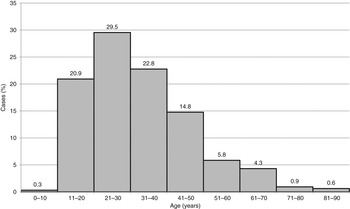
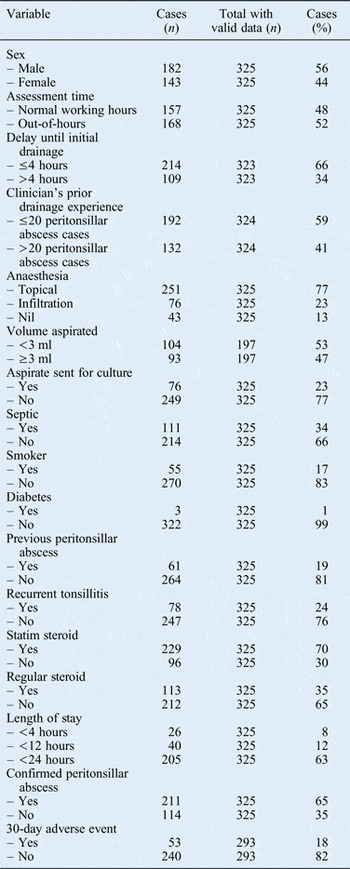
Over the data collection period, information on 325 anonymised cases of suspected peritonsillar abscess was entered into the database. The mean age of patients in the cohort was 33.0 ± 14.4 years (median = 30 years; range, 6–82 years; 95 per cent confidence interval (CI) = 31.46–34.60). Age distribution is represented in Figure 1. Follow-up data were available for 90.2 per cent of cases (293 out of 325). Peritonsillar abscess was confirmed in 65 per cent of cases (211 out of 325) by either the clinician reporting pus on drainage, a history of spontaneous discharge and/or radiological imaging. All patients received antibiotic therapy. Table I summarises descriptive data from the study.
Age distribution of suspected peritonsillar abscess cases.

Demographics, patient characteristics and outcome data*

*For peritonsillar abscess patients presenting to 42 centres between April and June 2014.
Practice by centre
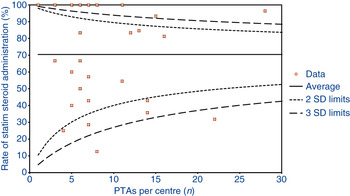
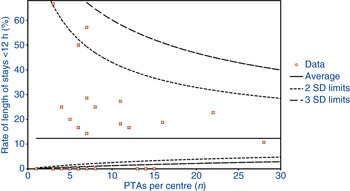
Funnel plots are presented to allow visualisation of variations in practice between anonymised centres. Data for Belfast and South Eastern Health and Social Care Trusts are combined into a single data point. Rates of steroid usage appear to show no relation to the number of peritonsillar abscess cases seen per centre and are widely distributed around the mean of 70.5 per cent (Figure 2). In relation to length of stay, most centres had low rates of discharge within 12 hours (Figure 3). The mean percentage of patients discharged within 12 hours was 12.3 per cent (range, 0–66.7 per cent), with 21 centres managing none of their patients in less than 12 hours.
Funnel plot showing rates of administration of a statim dose of steroids by centre. PTAs = peritonsillar abscess cases; SD = standard deviation

Funnel plot showing rates of lengths of stay of less than 12 hours by centre. H = hours; PTAs = peritonsillar abscess cases; SD = standard deviation

Thirty-day adverse events
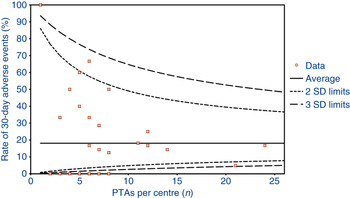
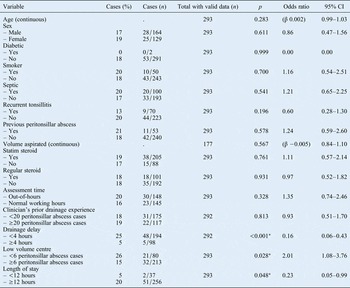
The mean 30-day adverse event rate was 18.1 per cent (range, 0–100 per cent) (Figure 4). Univariate regression analyses were completed to determine factors predictive of an adverse event (Table II). Patients treated in low volume centres (below the median of six peritonsillar abscess cases over the audit period) were more likely to experience an adverse event (26 per cent vs 15 per cent; odds ratio = 2.01; 95 per cent CI = 1.08–3.76; p = 0.028). Patients with a length of stay of less than 12 hours were less likely to experience an adverse event (5 per cent vs 20 per cent; odds ratio = 0.23; 95 per cent CI = 0.05–0.99; p = 0.048). Those patients who stayed less than 12 hours had rates of confirmed peritonsillar abscess comparable to those staying longer (73 per cent (29 out of 40) vs 64 per cent (182 out of 285)). Patients with a delay in drainage of over 4 hours were less likely to experience an adverse event (25 per cent vs 5 per cent; odds ratio = 0.16; 95 per cent CI = 0.06–0.43; p < 0.001). However, the number of confirmed peritonsillar abscess cases in this group were comparatively lower (12 per cent (13 out of 109) vs 92 per cent (197 out of 214)), suggesting that the reason for delay may have been diagnostic uncertainty.
Funnel plot showing rates of 30-day adverse events by centre. PTAs = peritonsillar abscess cases; SD = standard deviation

Univariate regression data for factors predictive of 30-day adverse event

*Statistically significant result. CI = confidence interval
Steroids
Dexamethasone was the corticosteroid administered as a one-off in 228 out of 229 cases, with only 1 patient receiving prednisolone. The median one-off dose of dexamethasone was 8 ± 1.54 mg (range, 2–8 mg; mean = 7.1 mg).
Volume aspirated
Needle aspiration was performed in 90.2 per cent of cases (293 out of 325); the volume of pus aspirated was recorded in 66.9 per cent of cases. The mean volume aspirated was 4.1 ± 3.05 ml (median = 3 ml; range, 1–20 ml; 95 per cent CI = 3.67–4.53).
Management of confirmed peritonsillar abscess within 4 hours
Nearly two-thirds of the suspected peritonsillar abscess patients underwent attempted drainage within 4 hours (66 per cent (214 out of 325)). Drainage was declared successful in 93 per cent of those for whom data were available (197 out of 212). Of those who had successful drainage, 17 had a length of stay of less than 4 hours. This suggests that less than 9 per cent of confirmed peritonsillar abscess cases in this study were managed on a timescale that would meet current UK and emergency department guidelines.
Follow up
The majority of patients were offered no follow up or surgery (63 per cent (n = 206)). Of these, 21 per cent (n = 44) had a history of either recurrent tonsillitis (n = 32) or of previous peritonsillar abscess (n = 12) and may have met criteria for tonsillectomy. A minority of patients were offered an out-patient appointment after discharge. Routine out-patient clinic appointments were arranged for 23 per cent of patients (n = 73), and 3 per cent (n = 11) were seen in an emergency clinic setting. Tonsillectomy was offered to 25 per cent of patients (n = 80) at the time of discharge, with 41 per cent (n = 33) being scheduled for surgery directly and the remainder being asked to attend an out-patient appointment first.
Complications
A free text field was used to record any complications arising in each case of suspected peritonsillar abscess. In two patients (0.6 per cent), a parapharyngeal abscess was diagnosed alongside a peritonsillar abscess within their acute admission time. There were no other reported complications of peritonsillar abscess, such as Lemierre's syndrome, or complications associated with abscess drainage or the use of corticosteroids.
Discussion
Key findings
This study demonstrates the efficacy of a trainee-led collaborative research network in ENT. A total of 157 clinicians were involved in co-ordinating and delivering this project in 42 centres in the UK. Involving trainees in collaborative projects, such as this one, has the potential to foster a culture of multicentre research in the consultants of tomorrow.
The current management of peritonsillar abscess in the UK is highly variable. Only 12 per cent of the 325 cases in this observational study were discharged within 12 hours. In practice, the majority of cases with a length of stay of longer than 12 hours will have been admitted to a ward environment. This is at odds with standard practice in many Western countries where peritonsillar abscess cases are managed routinely as out-patients.Reference Millar, Johnson, Drummond and Kellner 2 , Reference Chau, Seikaly, Harris, Villa-Roel, Brick and Rowe 3 , Reference Wikstén, Blomgren, Eriksson, Guldfred, Bratt and Pitkäranta 16 Regression analysis showed a significant increase in adverse events in those patients with a longer length of stay (5 per cent vs 20 per cent; odds ratio = 0.23; 95 per cent CI = 0.05–0.99; p = 0.048). Drainage and discharge has not been shown to result in any increased harm, though it is acknowledged that the cases discharged early in this observational study may represent patients with milder symptoms.
Many factors may have influenced the low rate of out-patient management reported in this study. Higher attendance rates in emergency departments can lead to delays in referrals to ENT on-call services. 17 The implementation of European Working Time Directive restrictions has led to an increase in the number of specialties covered out-of-hours, and there is a higher chance that the clinician covering ENT will have had little experience in this specialty.Reference Biswas, Rafferty and Jassar 18 , Reference Radford, Unadkat, Rollin and Tolley 19 Consequently, the contemporary ENT first-on doctor may be busier, with less experience managing ENT patients, and they may receive referrals later in the patient journey.
One-off steroid administration was common in this study (70 per cent of cases (229 out of 325)), though this was not linked to a significant increase in adverse events. Further, no other deleterious side effects from steroid usage were reported during the study or follow-up period. These findings, along with the findings of two randomised controlled trials addressing this issue,Reference Chau, Seikaly, Harris, Villa-Roel, Brick and Rowe 3 , Reference Ozbek, Aygenc, Tuna, Selcuk and Ozdem 6 support the safe use of steroids in peritonsillar abscess cases.
Strengths and weaknesses
This study constitutes the largest national prospective cohort study of peritonsillar abscess management and outcomes in the literature. Its robust design, with centralised real-time data collection and compulsory data fields, resulted in a very high follow-up rate of 90.2 per cent, with complete data in the majority of in-patient and discharge fields for all cases. Participation in the study was voluntary. Despite this, the study covered a significant proportion of the UK population thanks to the enthusiasm of ENT trainees. Although not an experimental study, these real-world data will provide valuable background population baselines for a subsequent experimental study of peritonsillar abscess management in the UK.
Where cases had missing data, the analysis treated these as null data points. An alternative method would have been to include all cases in the analysis regardless of data completeness. As can be seen in Table I, given the way the data collection proforma was designed, the majority of parameters had complete data for all 325 cases. There were two parameters where data completeness was notably lower. Firstly, data on the volume of pus drained on needle aspiration were only available for 66.9 per cent of the 293 cases undergoing needle aspiration. However, the intervention was recorded as ‘unsuccessful’ for the remaining cases and so a volume was not required by the proforma. As such, this 66.9 per cent rate did not represent a lack of data and so should not have biased any analysis. Secondly, 30-day follow-up data were only available for 90.2 per cent of cases (293 out of 325). Follow-up data were only considered valid if the clinician taking responsibility for data entry at the site (the site lead) had confirmed an adverse event within the 30-day period or had actively confirmed a lack of such an event after 30 days had elapsed. Cohort studies conducted retrospectively may assume perfect follow up.Reference Millar, Johnson, Drummond and Kellner 2 Inclusion of all these cases in subsequent analysis has the potential to underestimate the incidence of subsequent events, and may introduce a potential for non-random bias in the analysis. The policy of data analysis was specified in the protocol prior to the start of data collection, with the intention of treating all cases equally and minimising the risk of introducing bias.
Comparisons with other studies
The authors were unable to identify any other prospective multicentre cohort studies of peritonsillar abscess management and outcomes. Garas et al. conducted a three-cycle audit of peritonsillar abscess management in the UK, principally investigating the practicalities of implementing an out-patient management protocol in their centre.Reference Garas, Ifeacho, Cetto, Arora and Tolley 5 They were able to effectively manage over 80 per cent of their 60 cases of confirmed peritonsillar abscess presenting over a 6-month period as out-patients. In this study, only 9 per cent of confirmed peritonsillar abscess patients underwent drainage and were discharged within 4 hours. The national data we present suggest that out-patient management is not the practised mode of treatment for the majority of peritonsillar abscess cases presenting in the UK.
In 2002, a postal survey found that 68 per cent of UK ENT consultants reported treating all their peritonsillar abscess cases as in-patients.Reference Mehanna, Al-Bahnasawi and White 20 No respondents reported managing all their patients as out-patients. The average duration of in-patient stay was reported as being 1 day by only 6 per cent of respondents, with the mode reported as 2 days. Our study revealed that 63 per cent of patients stayed less than 24 hours. As such, our study suggests that current UK practice may be shifting towards out-patient peritonsillar abscess management, with shorter lengths of stay becoming more common.
Millar et al. conducted a retrospective study of suspected peritonsillar abscess management in children presenting to five centres in Canada.Reference Millar, Johnson, Drummond and Kellner 2 In the 229 cases they identified, steroid usage was successful in reducing the length of stay, though this was not statistically significant (2.52 vs 2.95 days; p = 0.29). More importantly, they too identified a significant variation in management between centres, with steroid utilisation ranging from 17 to 67 per cent. Crucially, they similarly did not report any complications as a result of steroid usage, though the duration of follow up is unclear for these cases.
Chung et al. retrospectively reviewed 172 patients who had been treated for peritonsillar abscess, in order to identify risk factors for recurrence.Reference Chung, Lee, Shin and Eun 21 Extraperitonsillar spread on computed tomography imaging and a history of recurrent tonsillitis were found to be significant risk factors for peritonsillar abscess recurrence. It was proposed that tonsillectomy may be indicated in these patients to reduce the incidence of recurrence. The present study did not examine computed tomography findings, and did not find a history of recurrent tonsillitis to be a significant risk factor for re-accumulation or re-presentation. However, the present study was prospective and was designed to investigate failures of primary management in the acute episode. As a result, it had a shorter follow-up period of only 30 days, compared to the mean reported by Chung et al. of 31.85 months. Consequently, the studies are not directly comparable, and the lack of significance found in our study should not be seen as a deterrent to tonsillectomy (which may prevent peritonsillar abscess recurrence) in patients with a history of recurrent tonsillitis.
Clinical applicability
With data contributed from over 40 centres in the UK, the findings of this study are generalisable. Both high and low volume centres contributed patients. Given the existing evidence for steroid usage from randomised controlled trials, in combination with the longer follow-up period contributed by this study, a one-off dose of steroids appears to be safe and effective in the management of acute peritonsillar abscess. It is likely that a one-off dose of corticosteroid for peritonsillar abscess at presentation may help to control symptoms and may prevent unnecessary admission to hospital. Further, this study has shown that shorter length of stay was associated with a lower incidence of adverse events. This supports a move towards out-patient management of peritonsillar abscess in the UK.
-
• Peritonsillar abscess is one of the most common ENT emergencies
-
• Needle aspiration or incision and drainage remain the mainstay of treatment
-
• Variation in management was seen between centres within the UK
-
• In-patient management was linked to increased incidence of re-drainage and re-presentation within 30 days
-
• A single dose of corticosteroids appears safe in peritonsillar abscess cases
Authorship and participation
The study steering committee consists of: Alistair Mitchell-Innes, Ameera Abdelrahim, Jameel Muzaffar, James Douglas, Jenny Walton, John Hardman, Laura Jackson, Hisham Mehanna, Paul Nankivell, Prabjhot Sekhon and Somiah Siddiq.
The study writing committee consists of: John Hardman, James Douglas, Jameel Muzaffar, Ameera Abdelrahim, Tamsin Mayberry, Paul Nankivell and Hisham Mehanna.
The following centres and investigators participated in the study (supervising consultant denoted by ‘*’, study lead denoted by ‘†’): Addenbrooke's Hospital, Cambridge University Hospitals NHS Foundation Trust – C Deutsch†, P Jani*, I Eladawy; Altnagelvin Area Hospital, Western Health and Social Care Trust – C Smith†, G McBride*, H Abdalla, S Boyle, N Hope, L Irwin; Antrim Area Hospital, Northern Health and Social Care Trust – F Toner†, C Scally*, J McShea, D Neeson; Barnet and Chase Farm NHS Hospitals Trust – N Can†, RS Natt*; Belfast Health and Social Care Trust – C Leonard†, S Hampton*, S Cassidy, D Dick, L Hamilton, A Hodgkinson, T Logan; Birmingham Children's Hospital NHS Foundation Trust – N Sharma†, AL McDermott*; Birmingham City Hospital, Sandwell and West Birmingham Hospitals NHS Trust – A Abdelrahim†, M Oluwole*, N Gill, K Kulendra, E Menon, S Rajput; Broomfield Hospital, Mid Essex Hospital Services NHS Trust – A Navaratnam†, A Pace-Balzan*; Colchester Hospital University NHS Foundation Trust – M Cresswell†, A Maheshwar*, R Cresner, M Latchman, F McClenaghan; Craigavon Area Hospital, Southern Health and Social Care Trust – M Adams†, P Leyden*; Cumberland Infirmary, North Cumbria University Hospitals NHS Trust – A Moore†, P Counter*; Darlington Memorial Hospital, County Durham and Darlington NHS Foundation Trust – H Blanchford†, S Lester*, M Ellis, J Maw; Freeman Hospital, Newcastle upon Tyne Hospitals NHS Foundation Trust – A Gungadeen†, D Meikle*, A Jessett, R Lisseter, H Shillitoe, P Thompson; Gloucestershire Royal Hospital, Gloucestershire Hospitals NHS Foundation Trust – L Jackson†, T Galm*, H Duff; Guy's and St Thomas’ NHS Foundation Trust – J Barr†, E Chevretton*; Heartlands Hospital, Heart of England NHS Foundation Trust – N Oswald†, E Fisher*, L Jiang; Ipswich Hospital NHS Trust – A Vijendren†, M Salam*; James Cook University Hospital, South Tees Hospitals NHS Foundation Trust – G Alder†, S Lester*, C Bowmer, V Veer; Luton and Dunstable University Hospital NHS Foundation Trust – Panagiotis A. Dimitriadis†, P Kothari*, A Alabim, A Carstea, T Doke, T Munroe-Gray; New Cross Hospital, Royal Wolverhampton NHS Trust – T Mayberry†, C Spinou*, JA Douglas; Northwick Park Hospital, London North West Healthcare NHS Trust – J Manjaly†, A Albeyatti†, T Tatla*, J Ferreira-Martins, H Segar; Princess Royal University Hospital, King's College Hospital NHS Foundation Trust – N Watson†, D Golding-Wood*, F Medhi, N Obeid; Queen Elizabeth Hospital Birmingham, University Hospitals Birmingham NHS Foundation Trust – E Young†, H Mehanna*, C Benning, J Danino, G Rakhra, R Ziyara; Queen's Hospital, Barking, Havering and Redbridge University Hospitals NHS Trust – H Kanona†, A Eweiss*, N Akuji; Queen's Hospital, Burton Hospitals NHS Foundation Trust – J Muzaffar†, P Lee*; Royal Cornwall Hospitals NHS Trust – N Ronan†, P Flanagan*; Royal Stoke University Hospital, University Hospitals of North Midlands NHS Trust – J Fussey†, H Uppal*, N Ahmed, I Natalwala, K Wong; Royal Sussex County Hospital, Brighton and Sussex University Hospitals NHS Trust – T Hampton†, P Das*, S Coombes, F Crabtree; Russell's Hall Hospital, Dudley Group NHS Foundation Trust – S Siddiq†, Spinou*, H Jeon, U Qayyum, J Walton; Salisbury District Hospital, Salisbury NHS Foundation Trust – M Ward†, M Brockbank*; Shrewsbury and Telford Hospital NHS Trust – A Mitchell-Innes†, D Bowyer*, C Campbell, E Holmes, M Jackowiak, M Osborne, S Patel; South Eastern Health and Social Care Trust – C Leonard†, S Hampton*; St George's Hospital, St George's Healthcare NHS Trust – A Takhar†, R Harris*, Y Burns, E English, S Goh, P Mutty, R Naik, H Tetlow, DR van Gijn, K Whitcroft; Sunderland Royal Hospital, City Hospitals Sunderland NHS Foundation Trust – D Cartilage†, S Yelnoorkar†, H Cocks*, L Abou-Nader, H Akram, S Milev, C Ritchie; Torbay Hospital, South Devon Healthcare NHS Foundation Trust – S Bola†, J Powles*; Tunbridge Wells Hospital, Maidstone and Tunbridge Wells NHS Trust – S Maskell†, P Cheang*; University Hospital Bristol NHS Foundation Trust – G Chivers†, C Langton-Hewer*; University Hospital of Wales, Cardiff, NHS Wales – H Fox†, D Owens*, L Sanyaolu; Walsall Manor Hospital, Walsall Healthcare NHS Trust – D Karamchandani†, A Dezso*, J Fong, E Jackson, M Sinha; West Suffolk Hospital, West Suffolk NHS Foundation Trust – M Smith†, F Fahmy*; Worcestershire Royal Hospital, Worcestershire Acute Hospitals NHS Trust – S Mitchell†, M Porter*; and Worthing Hospital, Western Sussex Hospitals NHS Foundation Trust – P Bowles†, M Harries*, J Timms.