Research on how individuals respond to disease outbreaks is a burgeoning area of focus that synthesizes findings across multiple disciplines, including public health, psychology, sociology. and epidemiology. Reference Weston, Hauck and Amlôt1 Despite recent increases in relevant studies, Reference Weston, Hauck and Amlôt1 how individual- and population-level experiences of prior epidemics influence public preparedness for future pandemics remains an underrepresented topic. This is important because the global abundance of diseases with epidemic potential (including pandemics) makes it highly probable that many communities will experience multiple large-scale outbreaks of dangerous infections within the same generation. Following the present coronavirus disease 2019 (COVID-19) outbreak, it might be tempting to assume that individuals whose lives were severely impacted would respond to future disease outbreaks with different behavioral responses to subsequent outbreaks. Such influences may be critical for shaping public health messaging and public preparedness during the next emerging threat.
COVID-19 has severely impacted many axes of everyday life; this paper focuses on outcomes associated with contracting COVID-19. Affliction with a serious case of COVID-19 can result in trauma Reference Einvik, Dammen and Ghanima2 that may occur in 3-8% of the population during the current pandemic, with patient symptom load being the strongest predictor. Reference Einvik, Dammen and Ghanima2 These lived experiences may impact perceptions of risk—the cognitive process assessing the likelihood of contracting a disease and/or the severity of illness. Perceptions of risk can be a strong factor in the actual realized risk of contracting a disease, since a high perceived risk can alter the probability of practicing protective behaviors (such as social distancing). Reference Weston, Hauck and Amlôt1 Therefore, trauma can directly and/or indirectly inform individual decision making, especially under risk during similar future circumstances. How these differences in risk perception, derived from individual lived experiences, scale up to influence public disease preparedness and population-level behavioral responses is poorly described.
This study presents a model, modified from previous publications, Reference Silk, Carrignon and Bentley3 to consider the potential influence of a traumatized subset of the population on future public responses to novel outbreaks. More specifically, several scenarios are considered in which direct life experiences with prior disease (ie, hospitalizations with COVID-19) either sensitize or desensitize individuals. (De)sensitization is used here to signify differences in the magnitude of reaction and effectiveness of response to perceived disease risk, altering how quickly individuals are concerned by the risk of contracting a disease relative to the general public. Traumatic experiences are not strictly defined in this study as to whether they definitively sensitize or desensitize an individual; rather, this study explored a subsequent epidemic under the assumption that trauma may alter perceptions of risk when confronted with future health concerns. Responses to health risks or reminders of mortality, however, are not always associated with an increase in health-protective behaviors. To avoid explicit assumptions about how lived experiences may alter decision making in response to perceived and actual disease risk, this model included three scenarios in which a selected population subset was assumed to be either equally, more, or less sensitive to concern-generating processes than the general population. Consequently, this subset will be equally, more, or less responsive in practicing mitigating behaviors (ie, actions, such as social distancing, that reduce the probability of disease transmission from infected to susceptible individuals). This subset of individuals (ie, some or all of those who previously were hospitalized with COVID-19) is part of the general population, all of whom are connected through coupled disease and communication network layers.
Population responsiveness to disease outbreaks was simulated using concern-generating processes that involve individual and social learning of disease risk, as detailed previously. Reference Silk, Carrignon and Bentley3 To model a subsequent outbreak, the model was modified to be methodologically similar but instead included the epidemiological dynamics for a commonly recurring disease: measles. Due to pockets of unvaccinated communities, measles outbreaks continue to reoccur. Reference Fiebelkorn, Redd and Gastañaduy4 This approach is not necessarily suggesting that the next outbreak of epidemiological concern will be measles. The etiological and epidemiological features of measles mean it can serve as a model outbreak, representing any disease that is likely to result in a rapid local outbreak due to high transmissibility. Furthermore, the timely and effective outbreak management of such epidemics must include the critical components of local disease awareness, responsiveness, and adherence to preventative behaviors. In this way, measles’ disease dynamics are used to explore how individuals’ prior experience with COVID-19 may (de)sensitize them to concern and potentially influence behavioral responses, as well as resulting disease outcomes. This model is presented with the primary aim to stimulate conversations about future preparedness, as well as future research on how lived experiences may alter broader behavioral responses to disease outbreaks in a complex system, with disease and communication networks.
Methods
Basic Model Design
A multiplex coupled-dynamics model Reference Silk, Carrignon and Bentley3 was used to simulate how prior hospitalization with COVID-19, as a traumatic lived experience in a subset of the population, would scale up to influence public disease preparedness for a subsequent disease risk. This model included coupled communication and disease layers that were dynamically altered at each time-step based on local information and disease transmission. Information received by individuals included: local number of direct connections in their communication layer who were symptomatic (awareness), who were adherent to social distancing (social construction), or who were healthy (reassurance). Awareness, social construction, and reassurance altered concern, which determined the probability of social distancing. Individuals previously hospitalized with COVID-19 might be more or less responsive to concern-generating processes (awareness and social construction).
Population and Network Structure
The multiplex coupled-dynamics model Reference Silk, Carrignon and Bentley3 included 2000 individuals comprised of 3 age groups (24% children, 63% younger adults, 13% older adults) across 10 equally sized communities, connected by means of coupled communication and disease network layers. For simplicity of analysis, homophily was assumed to be absent in both layers, and lower Qrel modularity was assumed between the 10 communities for the communication network layer (0.4) versus the disease layer (0.6); the effects of variation in homophily and Qrel modularity have been analyzed previously. Reference Silk, Carrignon and Bentley3
Model Progression and Concern Altering Processes
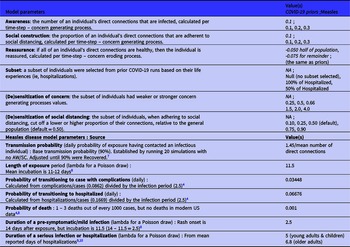
Each run was initiated with 5 randomly selected individuals for both disease’s initial infections, and the model was advanced for 300 time-steps, or until there were no longer infected and exposed individuals, whichever came first. At each time-step, adult individuals updated their concern by means of awareness, social construction, or reassurance (Table 1). Awareness and social construction increased concern as a function of the number and proportion of direct connections, respectively, while reassurance eroded concern per time-step. Concern was used in a Bernoulli probability draw to determine whether individuals would become adherent to social distancing. Adherent individuals effectively severed (cut to 0.001) a proportion of connections (50%, default).
Model parameter definitions, sources, and values

COVID-19 Baseline Runs
Prior work was used to establish baseline parameters, which were obtained by running 6 iterations of the model using previously utilized COVID-19 dynamics Reference Silk, Carrignon and Bentley3 to produce initial conditions for the experimental runs. To ground this example in a reproducible subset of the population, only hospitalized individuals were assumed to be susceptible to trauma, resulting in ∼3.70-7.38% of the population. To generate initial conditions, awareness and social construction were set to 0.1; reassurance was -0.050 for half of the population, and -0.075 for the remainder to simulate a heterogenous population; starting concern was 0.1; potential deaths were removed to avoid having to adjust for unequal population sizes in the subsequent model runs. These resulted in a median of 7.375% of the population (median = 147.5; min = 125; max = 160) being hospitalized.
Novel Disease Runs
The previously extracted subset of the population was, either, assumed to be fully (de)sensitized or a random sampling of half of this subset (median = 3.7% of the population) was assumed to be (de)sensitized; these values approximated the empirical range of trauma caused by COVID-19 (3-8% Reference Einvik, Dammen and Ghanima2 ). The intervening time between the COVID-19 epidemic and measles outbreak was not explicitly modeled, with no changes in age-class compartments (eg, births, growth, deaths). (De)sensitized subsets of individuals were run as either (A) no individuals (the “null”), (B) all previously hospitalized individuals, or (C) half of the previously hospitalized individuals (individuals in [B] and [C] were identified by simulations establishing initial conditions). The selected subset was primed to have either higher (sensitized), or lower values (desensitized) of social construction and awareness relative to the general population for the subsequent measles outbreak. This study also examined the possibility that the subset would be more predisposed to altering the proportion of connections that they socially distance from (0.75, 0.90 for sensitized; 0.25, 0.10 for desensitized), relative to the general population (0.50). For simplicity of analyses, awareness and social construction of concern were modified together for the general population, in fixed steps with varying degrees of responsiveness; reassurance and starting concern were kept the same as for the prior COVID-19 runs. For the measles model, 10 replicates were run for each set of parameter values, using output from the 6 priors to select the subset of (de)sensitized individuals, totaling 7670 runs.
Results
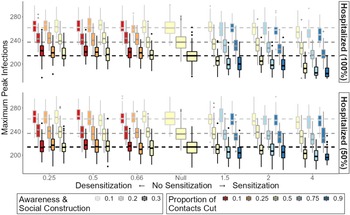
Examination of this model reveals that a concern-sensitized or -desensitized subset did not have a substantial mitigating or exacerbating effect on the epidemic peak (Figure 1). The only exceptions to this observation were with the following assumptions: (A) high awareness and social construction in the general population, (B) sensitization resulting in an extreme individual response (4 times the population average), or (C) an extreme change in social distancing behavior (ie, 90% of connections cut rather than 50%). An assumption of a larger subset of the population being sensitized (Figure 1, top) did result in a more pronounced population-level effect relative to a smaller subset (Figure 1, bottom).
Effect of each subset’s (de)sensitivity on epidemic peaks. Each box represents 10 replicate runs across 6 priors, except the null which each represent 360 runs. The panel rows signify the 2 analyzed subsets, with the x-axis showing variation in concern-generating sensitivity for the relevant subset. The y-axis shows the maximum epidemic peak, with each box and whisker showing the median and inter-quartile ranges. Outline shading represents values of the general population’s concern-generating processes. Box fills represent the proportion of contacts cut for each subset. The horizontal dashed-lines represent the medians for each of the nulls, projected for ease of relative comparison. Some outliers were outside of the plotted space (1.04% of runs).

Discussion
These results indicate that, when confronted with a future disease threat, a sensitized or desensitized (based on their past experience with COVID-19) subset of the population is unlikely to dramatically shift behavioral mitigation to reduce the epidemic peak beyond the bounds of the general population-level’s collective response, at least for rapidly spreading diseases. This model, however, does indicate that some populations could be expected to show increased responsiveness when a subset of the population is markedly sensitized from their prior experience. Reduced infection peaks were observed due to direct mitigating action facilitated by a larger population subset, both by means of social knock-on effects (eg, by means of social construction) and direct actions (by means of self-isolating from a greater number of direct connections).
This study’s analyses were limited to trauma through personal experiences (hospitalization) but trauma may be induced through significant shared experiences (eg, death of a loved-one) or cumulative experiences of more diffuse events. Also, mental health outcomes resulting from personal experiences need not be dependent on hospitalizations, a point that has had growing interest and equivocal support. Reference Bourmistrova, Solomon and Braude5 While the cause of the total values of induced trauma may vary, the percentage of traumatized individuals may be similar to disaster events (5-10% of victims). Reference Einvik, Dammen and Ghanima2 Additionally, if it is assumed that social norms could also result in an erosion of adherence, then a desensitized subset could potentially have a similar result as the sensitized subset. Finally, behavioral mitigation may be more pronounced for slower spreading diseases. While an important and well-known disease, measles is exceptionally transmissible and so less impacted by social dynamics in response to disease prevalence.
Public awareness of past pandemics has been suggested to predict knowledge of emerging epidemics. Reference Lin, McCloud and Bigman6 Expectations of effective action resulting from a more experienced public, however, might undermine the efficacy of policies that depend on the veracity of that assumption. In preparing for future outbreaks, assuming that the public is experienced and disease-aware may compromise effective design of public health messaging and mitigative action. Traumatic lived experiences of pandemics are an under-researched and increasingly emergent issue. Reference Einvik, Dammen and Ghanima2 Although public health agencies are still grappling with “what now?”, this brief report urges discussion on “what next?”, especially given the large number of people psychologically affected by the COVID-19 pandemic and the high probability of future novel disease outbreaks. These results show that, while individual trauma may continue to shape isolated responses, it might not be productive to assume that a subset of the population will lead the general public to behave in more informed ways to a subsequent serious outbreak of infectious disease.
Supplementary material
To view supplementary material for this article, please visit https://doi.org/10.1017/dmp.2022.240.
Acknowledgments
We thank Matthew Young and Clarissa Castillo for their discussions during conceptualization and analysis, and especially Simon Carrignon and Alexander Bentley for their work on previous publications with a similar model.
Author contributions
A.J.P., Conceptualization, Coding - model, Analysis, Figures, Write-up - original draft; M.J.S., Conceptualization, Coding - original model, Figures, Write-up - review & editing; N.H.F., Funding Acquisition, Conceptualization, Write-up - review & editing.
Funding
Supported by the National Science Foundation DEB #2028710.
Conflict of interests
The authors declared no potential conflicts of interest with respect to the research, authorship, and/or publication of this article.
Ethical standards
Ethical approval was not required for this brief report. We did not collect data from human participants or animal subjects.