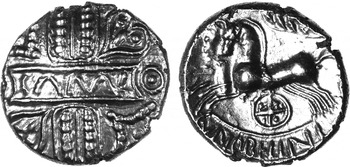
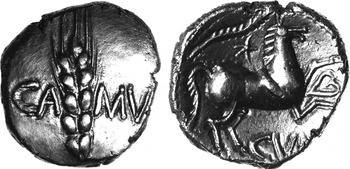
Allen divided the gold staters of Cunobelinus into five main successive series — the Biga series, the Linear series, the Wild series, the Plastic series, and the Classic series.Footnote 140 In the case of the first series, the obverse depicts an abstract design about a central panel bearing the legend CAMVL, an abbreviation of the name of Camulodunum, while the reverse depicts a representation of a biga where the chariot is represented by a wheel beneath two horses charging to the left ( fig. 10).Footnote 141 The other four series share the same main obverse design, a large ear of corn, and the same main reverse design, a horse rearing up on its back legs, but are distinguished by their different stylistic treatments of these designs. All of the series can be subdivided further according to various minor details. In the case of the Wild series, Allen subdivided it into two groups, Wild Series A, without the ring-and-dot below the horse, and Wild Series B, with the ring-and-dot below the horse, with further minor variants within each. One such variant within the Wild Series A depicts a heart-shaped object between the forelegs of the horse on the reverse, so producing what has come to be called the ‘Wild Heart’ stater ( fig. 11).Footnote 142
A Biga series stater of Cunobelinus. Scale 2:1. (© Chris Rudd (www.celticcoins.com))

A ‘Wild Heart’ stater of Cunobelinus. Scale 2:1. (© Chris Rudd (www.celticcoins.com))

Only five specimens of this variant seem to have survived.Footnote 143 John Evans commented that ‘its principal characteristic is the heart-shaped figure between the fore-legs of the horse, the meaning of which I am at a loss to discover’, and little progress has been made since.Footnote 144 This object seems to be without precedent on the coinage of either the Catuvellauni or the Trinovantes. To focus on the gold staters in particular, these had often depicted a large variety of objects in association with the horse on the reverse in addition to the almost ubiquitous ring-and-dot device — a wheel, cogwheel, spiral device, wing, bucranium, or cornucopia — but never anything that resembled a heart.Footnote 145 It has recently been suggested that this heart-shaped object serves two purposes, that it acts both as a sort of ‘squashed letter O’ in continuation of the legend CVN beneath the horse and as a tribal or dynastic symbol.Footnote 146 Neither explanation convinces. In the case of the first suggestion, it is important to note that two of the five surviving specimens reveal that, when the legend beneath the horse survives in full, it actually reads CVNO rather than CVN.Footnote 147 Hence a second letter O would be superfluous. As for the second suggestion, this is based on the apparent similarity between this heart-shaped object and a heart-shaped ‘face’ that appears twice on the obverse of the staters in the Biga series where this ‘face’ seems to derive from features that had already appeared on a stater of Cunobelinus' father, Tasciovanus.Footnote 148 However, there are two important differences between these two heart-shaped objects. The object on the Wild stater firstly lacks the two large dots that form the ‘eyes’ and secondly lacks the large ‘nose’, both of which are found in the case of the ‘face’ on the Biga stater. A short stroke does descend down into the ‘heart’ from between its upper arches in the case of the Wild stater, but it has a different appearance to the large stroke forming the ‘nose’ in the case of the Biga stater which normally appears unconnected to the surrounding heart-shape.Footnote 149 In summary, the similarity between these objects does not proceed beyond their apparent heart-shape.
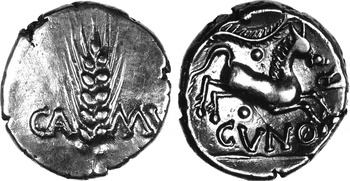
So what is the heart-shaped object on the Wild stater? Is it what it looks like, a heart, or something else altogether? There are three points to bear in mind here. The first is that the location of this object suggests that it may have been intended to complete the name CVNO. Another variant within the same Wild series depicts the final O of CVNO above the forelegs, so illustrating that the potential zone for continuation of the name of Cunobelinus passed beyond the forelegs.Footnote 150 A variant in the Plastic series reinforces this point when it depicts a letter B above the forelegs of the horse in continuation of the legend CVNO below ( fig. 12).Footnote 151 The second point is that Cunobelinus seems generally to have preferred to include as much of his name as possible on the coinage. For example, the Biga series of staters included his full name upon the reverse as a Latin genitive — CVNOBELINI; and while this was abbreviated to read only CVN on the coins of the Linear series, it seems to have been felt that this was not enough, so that the legend was expanded slightly to read CVNO in the three subsequent series.Footnote 152 Furthermore, the fact that, as already indicated, the legend was expanded to read CVNO – B on a variant of the Plastic series highlights how unsettled this matter was even as late as the Plastic series.Footnote 153 Indeed, the name was often preserved in far fuller form on many of the silver and bronze types.Footnote 154 Finally, it is noteworthy that the upper arches of the heart-shaped object resemble the curved double-arches of a letter B rather than, for example, the angular double-arches of either the letter M or of the letter E as found on the rest of Cunobelinus' coinage.
A Plastic series, CVNO – B type stater of Cunobelinus. Scale 2:1. (© Chris Rudd (www.celticcoins.com))

Given both the position of the heart-shaped object and its apparent resemblance to the letter B, two possible interpretations suggest themselves. One possibility is that it is a monogram combining several different letters.Footnote 155 In support of this one notes that the use of monograms to help pack as much of the desired legend as possible into the limited space available was a distinguishing feature of Cunobelinus' early coinage in all three metals — gold, silver, and bronze. Hence one early bronze unit bears the legend CAMVL where a separate C is followed by a monogram formed from the letters A, M, V and L.Footnote 156 Similarly, an early silver unit also bears the legend CAMVL where a separate C is followed by a slightly different monogram formed from the letters A, M, V and L.Footnote 157 Another silver unit bears the legend CVNO where a separate C is followed by a monogram formed from the letters V and N with a separate letter O at the end.Footnote 158 Finally, the obverse legends of the late types of gold stater within the Biga series use a monogram formed from the letters M, V and L to produce the legend CAMVL, while the quarter-staters produce the same legend using monograms sometimes for A, M and V, and sometimes for A, M, V and L.Footnote 159 In the light of this evidence, therefore, it is tempting to argue that the apparent heart on the ‘Wild Heart’ stater is a monogram, where the angular lower part of the apparent heart is to be read as an angular letter L, exactly as already found in the monograms on the staters and quarter-staters of the Biga series, and the arches of the upper part act as a letter B when read in one direction, and as a letter E when read in the other, the whole resolving to produce three letters, B, E and L, where these should be read in continuation of the letters CVNO below to create the legend CVNOBEL.
However, there is a major objection to this interpretation in that it requires developments in the composition of a monogram, or of a series of ligatured letters, without parallel within either Cunobelinus' coinage or, indeed, the coinage of the south-eastern dynasties more generally. Hence there is no parallel within the coinage of the south-eastern dynasties for the depiction of a letter B without its back, or for the disappearance of any of the major components of a letter.Footnote 160 Letters may share the same components, or lines, within a monogram or series of ligatures, but these components never disappear altogether. Similarly, there is no parallel for the reading of a feature in reverse, as is required here to turn an E into a letter B, nor for the drawing of the letter E with curved arches rather than in its normal angular form.Footnote 161 Finally, one should note that there is no precedent for the use of this alleged monogram on the coinage of the late Roman Republic, although the moneyers did sometimes use a variety of other monograms to render their names.Footnote 162
The second possibility is that this heart-shaped object represents a badly drawn B. But what could have caused the engraver of the original model for this type to err in such a fashion? Obviously, carelessness must have played some part in this process, but the question still remains as to how he produced a heart-like object if what he had originally intended to draw was a letter B. One possible explanation may lie in the fact that another variant of the Wild series depicts the final letter O of CVNO above the forelegs, as already noted. This letter O was often drawn to resemble an ellipse with pointed ends rather than a proper circle, and this is how it appears on the reverse of the only two surviving specimens of the ‘Wild Heart’ stater to preserve the final O of the legend CVNO. Hence the heart-shaped object may be explained as an attempt to correct an elliptical O to form a letter B instead by an engraver who had carelessly begun to draw an O between the forelegs of the horse in loose imitation of the variant depicting an O above the forelegs, before realising that he had already included the letter O on the exergue below. The intention may always have been to draw a letter B in a manner anticipating the CVNO – B variant within the Plastic series, before a moment of inattention caused him to begin to draw the wrong letter instead.
Against this interpretation is the fact that the engraver then seems to have felt that this distorted letter B was acceptable, and that he, or his colleagues, continued to produce new dies with the same distorted form of the letter, which does not encourage one to believe that they possessed any strong understanding of Latin letter-forms or what exactly it was that they were supposed to be reproducing. Hence it may be simpler to suppose that the original engraver had misunderstood the shape of the letter B right from the start, and failed to realise that it never took the form which he had given it. It could be argued that he had intended to draw a B lying flat on its back — in the same position as the B of the CVNO – B variant within the Plastic series later — but that he made the upper arch too large in proportion to the lower arch, so creating an unintended resemblance to a heart. Finally, one should not forget what it was that led Allen to describe this series as ‘Wild’ in the first place, that is his claim that ‘the engraving has gone Wild’ in comparison to that of the Linear series, so that the ear of corn loses its previously ordered appearance and the horse seems more savage also. It is arguable that the engraver displayed this same freedom, if not more, in his depiction of the letter B.
In conclusion, the heart-shaped object of the so-called ‘Wild Heart’ stater is probably best explained as a letter rather than a symbol, and perhaps most simply as a letter B exuberantly drawn by an engraver unfamiliar with the correct form of this Latin letter. It is arguable, therefore, that the nickname of this stater should probably be changed from the rather romantically entitled ‘Wild Heart’ stater to the more prosaic ‘Wild B’ stater.
ACKNOWLEDGEMENTS
I would like to thank the anonymous referee for pointing me back in the right direction, and Chris Rudd for permission to reproduce the photographs above.