


Introduction
In an increasingly competitive and technologically driven global economy, developing workforce capability is recognized as a key means of achieving economic competitiveness and growth (International Labour Organization, 2010; OECD, 2019). However, changes in technology and an increasingly aging population are creating critical skills shortages in many countries which is impeding their ability to be competitive in a global environment. A recent report by the World Economic Forum (2018) shows that in the next few years, more than half of all employees will require significant upskilling and reskilling to enable organizations to respond to future workforce demands. While the number one workforce strategy in responding to extant employment trends is reskilling of current employees, training appears to be limited to those already performing in-demand jobs (ibid). In the face of worldwide population decline in many OECD countries and an aging workforce, the need to develop the capability and learning orientations of all employees is paramount (Blomé, Borell, Håkansson, & Nilsson, Reference Blomé, Borell, Håkansson and Nilsson2020; Kyndt, Govaerts, Dochy, & Baert, Reference Kyndt, Govaerts, Dochy and Baert2011).
The benefits of capability development are clear: Employees who believe their organization supports learning and development are more motivated to learn, to participate in development activities, and to transfer of learning to the workplace (Birdi, Allan, & Warr, Reference Birdi, Allan and Warr1997; Tharenou, Reference Tharenou2001; Warr & Birdi, Reference Warr and Birdi1998). In addition, organizations who support learning report higher levels of employee job satisfaction, organizational commitment, productivity, work quality, teamwork, innovation and reduced costs associated with production and turnover (Maurer, Lippstreu, & Judge, Reference Maurer, Lippstreu and Judge2008; Park, Kang, & Kim, Reference Park, Kang and Kim2018; Salminen & Miettinen, Reference Salminen and Miettinen2019; Tannenbaum, Reference Tannenbaum1997). Consequently, one of the central concerns of human resource development is improving organizational performance through the development of individual skills, knowledge, and ability.
Fundamental to developing employee capability is the need for individuals to engage in learning – both in their current jobs and over the course of their working lives. This is important for both older workers who need to develop new skills and knowledge to remain employable and for younger workers who are learning to work as well as ‘learning to learn’ at work. However, a recent study by the OECD showed that 75% of adults were not interested in further learning (OECD, 2013). This is an alarming statistic in the face of growing skill shortages and aging workforces where the need for lifelong learning is greater than ever. While younger workers – ‘Gen Y’ or ‘Millennials’ – reportedly have an ‘urge for learning’ and are keen to develop knowledge and skills (Naim & Lenka, Reference Naim and Lenka2018), research has not yet examined this in a comprehensive theoretical or empirical manner.
Over recent decades research has significantly advanced our understanding of the factors that facilitate and hinder learning and development for adults, and particularly older workers (e.g., Blomé et al., Reference Blomé, Borell, Håkansson and Nilsson2020; Fisher, Chaffee, Tetrick, Davalos, & Potter, Reference Fisher, Chaffee, Tetrick, Davalos and Potter2017; Kyndt & Baert, Reference Kyndt and Baert2013), however less is known about how best to develop younger, novice workers. This is important as young people may have different experiences of learning to their older, more established work colleagues. Moreover, their experiences of learning during ‘emerging adulthood’ may be critical to the development of their beliefs, attitudes, behaviors, and outcomes as adults (Tanner & Arnett, Reference Tanner, Arnett and Furlong2016). In summary, research is needed to identify the factors that underpin younger worker's motivation to learn, and to determine the extent to which motivation translates into desirable behaviors.
According to social cognitive theory (SCT), cognitive appraisals such as efficacy beliefs are fundamental in influencing and guiding behavior (Bandura, Reference Bandura1997; Schunk & DiBenedetto, Reference Schunk and DiBenedetto2020; Schunk & Usher, Reference Schunk, Usher and Ryan2019). Research shows that self-efficacy – an individual's belief that they can achieve certain outcomes – plays a central role in learning and development (Bandura, Reference Bandura1997; Bell, Tannenbaum, Ford, Noe, & Kraiger, Reference Bell, Tannenbaum, Ford, Noe and Kraiger2017; Colquitt, LePine, & Noe, Reference Colquitt, LePine and Noe2000). Self-efficacy is therefore expected to provide important insights into learning-related motivation and behaviors of younger workers. This study develops and tests a theoretical model of learning and development for younger workers whereby ‘development self-efficacy,’ as a domain-level construct, plays a central mediating role. Specifically, it examines the extent to which development self-efficacy mediates the relationship between salient aspects of the work environment (organizational, manager, and co-worker support) and individual beliefs (general self-efficacy, improvability beliefs, and anxiety), with learning-related attitudes, motivation, and behavioral intentions of younger workers. Younger workers are defined in this study as those aged 16–24 years who work full-time. The paper reviews the literature on learning and development focusing on key outcomes and antecedents of development self-efficacy; and identifies specific relationships for inclusion in the hypothesized model.
Literature review
Self-efficacy
Self-efficacy has been conceptualized and examined at three levels of specificity – general, domain, and task-specific. General self-efficacy is an individual's global belief regarding their ability to attain successful outcomes in a variety of domains and activities (Chen, Gully, & Eden, Reference Chen, Gully and Eden2004). Domain-level beliefs relate to a more specific area of functioning, such as learning or development (Maurer, Wrenn, Pierce, Tross, & Collins, Reference Maurer, Wrenn, Pierce, Tross and Collins2003) or work (Carter, Nesbit, Badham, Parker, & Sung, Reference Carter, Nesbit, Badham, Parker and Sung2018; Elias, Barney, & Bishop, Reference Elias, Barney and Bishop2013), while task-specific efficacy beliefs relate to one's confidence to attain successful outcomes in relation to a specific task or activity (Colquitt, LePine, & Noe, Reference Colquitt, LePine and Noe2000). Despite its recognized importance in regulating behaviors and outcomes, self-efficacy continues to be relatively overlooked in the management literature (Carter et al., Reference Carter, Nesbit, Badham, Parker and Sung2018; Elias, Barney, & Bishop, Reference Elias, Barney and Bishop2013; Schunk & DiBenedetto, Reference Schunk and DiBenedetto2020).
Self-efficacy – at various levels of specificity – has been shown to play a significant role in learning motivation and behaviors which are fundamental for the development of capability (Chiaburu & Marinova, Reference Chiaburu and Marinova2005; Colquitt, LePine, & Noe, Reference Colquitt, LePine and Noe2000; Maurer, Lippstreu, & Judge, Reference Maurer, Lippstreu and Judge2008; Tracey, Hinkin, Tannenbaum, & Mathieu, Reference Tracey, Hinkin, Tannenbaum and Mathieu2001). While generalized and task-specific efficacy beliefs provide useful information regarding behaviors and outcomes, experts (e.g., Elias, Barney, & Bishop, Reference Elias, Barney and Bishop2013; Kyndt & Baert, Reference Kyndt and Baert2013; Maurer et al., Reference Maurer, Wrenn, Pierce, Tross and Collins2003) suggest that domain-level beliefs have a number of advantages in understanding the employee development process. First, because they are related to a domain of functioning, they are more indicative of behavior than generalized beliefs and should, theoretically, generalize across similar situations and contexts. In addition, because domain-level beliefs are believed to be more malleable than general beliefs (Bandura, Reference Bandura1997; Gist & Mitchell, Reference Gist and Mitchell1992), they may be more amenable to influence in organizational settings.
Research shows that self-efficacy is informed by a range of contextual and individual factors (Bandura, Reference Bandura1997; Maurer et al., Reference Maurer, Wrenn, Pierce, Tross and Collins2003; Schunk & DiBenedetto, Reference Schunk and DiBenedetto2020; Usher & Weidner, Reference Usher, Weidner, Liem and McInerney2018), yet few studies have specifically and/or quantitatively examined the impact of organizational and interpersonal support on younger workers' domain-level self-efficacy beliefs. Given that self-efficacy beliefs are fundamental to the development of knowledge, skills, and abilities (Maurer, Reference Maurer2002; Noe & Wilk, Reference Noe and Wilk1993; Tharenou, Reference Tharenou2001) as well as transfer of learning to the workplace (Ford, Baldwin, & Prasad, Reference Ford, Baldwin and Prasad2018), a more complete understanding of the factors that influence learning-related self-efficacy in the workplace is essential.
Development self-efficacy
In relation to learning and development, self-efficacy has been conceptualized by scholars as both a specific and domain-level belief. This study examines self-efficacy for learning and development as a domain belief. As such, self-efficacy describes an individual's confidence for learning or developing new work-related skills, knowledge, or abilities in a particular context or through a variety of interconnected activities (Birdi, Allan, & Warr, Reference Birdi, Allan and Warr1997; Maurer, Reference Maurer2001, Reference Maurer2002; Potosky & Ramakrishna, Reference Potosky and Ramakrishna2002). However, different terms have been used for the same level of efficacy belief, causing some confusion in the literature. For example, ‘self-efficacy for learning and development,’ ‘development self-efficacy’ (Maurer et al., Reference Maurer, Wrenn, Pierce, Tross and Collins2003), and ‘learning self-efficacy’ (Kochoian, Raemdonck, Frenay, & Zacher, Reference Kochoian, Raemdonck, Frenay and Zacher2017; Kyndt et al., Reference Kyndt, Govaerts, Dochy and Baert2011; Potosky & Ramakrishna, Reference Potosky and Ramakrishna2002) are all domain-level conceptualizations of self-efficacy for learning and development. The present study uses the term ‘development self-efficacy’ (DSE) to refer to an individual's self-referenced confidence for successfully learning new and challenging occupationally relevant knowledge, skills, and tasks via various developmental activities.
Outcomes of development self-efficacy
Self-efficacy is considered a central component of the development process because of its effects on affective, motivational, and behavioral outcomes. As a domain-level construct, self-efficacy for development has been shown to predict motivation (pretraining motivation and motivation to learn) (Chiaburu & Marinova, Reference Chiaburu and Marinova2005; Colquitt, LePine, & Noe, Reference Colquitt, LePine and Noe2000; Tracey et al., Reference Tracey, Hinkin, Tannenbaum and Mathieu2001) and attitudes to learning (Maurer et al., Reference Maurer, Wrenn, Pierce, Tross and Collins2003; Maurer & Tarulli, Reference Maurer and Tarulli1994; Maurer, Lippstreu, & Judge, Reference Maurer, Lippstreu and Judge2008). It is also an important factor in the transfer of training (Ford, Baldwin, & Prasad, Reference Ford, Baldwin and Prasad2018). However, despite suggestions that the relationship between self-efficacy and motivation may be partially mediated by attitudes (Carlson, Bozeman, Kacmar, Wright, & McMahan, Reference Carlson, Bozeman, Kacmar, Wright and McMahan2000), this claim has not yet been substantiated. One reason for Carlson et al.'s failure to support this claim may be the relatively small sample size (n = 158), thus investigation of this triadic relationship with a larger sample is needed.
Development self-efficacy has also been found to be directly related to developmental behaviors (e.g., participation in training) (Maurer & Tarulli, Reference Maurer and Tarulli1994; Potosky & Ramakrishna, Reference Potosky and Ramakrishna2002). However, because behaviors can be problematic to measure, researchers have often examined intentions as a predictor of subsequent behaviors as per Ajzen's (Reference Ajzen1991) Theory of Planned Behavior. Indeed, intentions to engage in learning and development activities explain notable variance in actual behavior (Hurtz & Williams, Reference Hurtz and Williams2009; Kyndt & Baert, Reference Kyndt and Baert2013; Maurer et al., Reference Maurer, Wrenn, Pierce, Tross and Collins2003). Studies also show that developmental intentions are related to an employee's attitude, self-efficacy, and career-related variables (Kyndt & Baert, Reference Kyndt and Baert2013). Given the importance of intentions in predicting behavior, the present study examined two antecedents of younger workers' developmental intentions: motivation to learn and career-job congruence.
Motivation to learn is indicative of a person's ‘tendency to act’ (Birdi, Allan, & Warr, Reference Birdi, Allan and Warr1997: 854) and is an important predictor of their developmental intentions and subsequent behaviors (Birdi, Allan, & Warr, Reference Birdi, Allan and Warr1997; Noe & Wilk, Reference Noe and Wilk1993; Warr & Bunce, Reference Warr and Bunce1995). Research shows that motivation to learn is negatively related to age (Kochoian et al., Reference Kochoian, Raemdonck, Frenay and Zacher2017), thus motivation to learn is predicted to be directly and positively related to younger workers' intentions to participate in development activities.
Studies have found that career-related variables are positively related to learning intentions (Kraimer, Seibert, Wayne, Liden, & Bravo, Reference Kraimer, Seibert, Wayne, Liden and Bravo2011; Kyndt et al., Reference Kyndt, Govaerts, Dochy and Baert2011; Maurer et al., Reference Maurer, Wrenn, Pierce, Tross and Collins2003; Sanders, Oomens, Blonk Roland, & Hazelzet, Reference Sanders, Oomens, Blonk Roland and Hazelzet2011); however, these relationships have received little attention in relation to the development of younger workers specifically. As Pinquart, Juang, and Silbereisen (Reference Pinquart, Juang and Silbereisen2003) suggest, young people who view their job as being relevant to their career interests and goals – termed in this study as ‘career-job congruence’ – are more likely to be motivated to learn and to engage in skill development activities. Thus, it is hypothesized that career-job congruence will be related to younger workers' intentions to participate both directly and indirectly via motivation to learn.
Sources of self-efficacy
Given self-efficacy's influence on affective, motivational, and behavioral outcomes, a key focus for researchers is identifying how self-efficacy can be enhanced in organizational settings. Self-efficacy beliefs are informed from an individual's experiences in different contexts and their interpretations of those experiences (Bandura, Reference Bandura1997; Gist & Mitchell, Reference Gist and Mitchell1992; Usher & Weidner, Reference Usher, Weidner, Liem and McInerney2018). While many efficacy beliefs are formed early in life, they retain a dynamic quality and change over time in response to new information from subsequent experiences and contexts (Bandura, Reference Bandura1997; Gist & Mitchell, Reference Gist and Mitchell1992). Scholars agree there is a need for a better understanding of the responsiveness of self-efficacy to external and internal sources of information (Carlson et al., Reference Carlson, Bozeman, Kacmar, Wright and McMahan2000; Maurer, Reference Maurer2002; Schwoerer, May, Hollensbe, & Mencl, Reference Schwoerer, May, Hollensbe and Mencl2005; Usher & Pajares, Reference Usher and Pajares2006). There has been a significant amount of research exploring the role of teachers and parents as sources of efficacy information (Usher & Weidner, Reference Usher, Weidner, Liem and McInerney2018; Won, Lee, & Bong, Reference Won, Lee and Bong2017), yet still little is known about the role of managers and co-workers, as well as an individual's characteristics, as sources of learning-related self-efficacy in work contexts. This study examines six potentially salient sources of self-efficacy information pertaining to the work environment and the individual, discussed following.
The work environment
An important context in which efficacy beliefs are developed is the work environment (Bell et al., Reference Bell, Tannenbaum, Ford, Noe and Kraiger2017; Maurer, Reference Maurer2001, Reference Maurer2002). However, an essential part of developing employee capability is identifying which aspects of this context have the most influence on various affective, motivational, and behavioral components of the development process. To date, only a small number of studies have examined the work environment as an antecedent of employee self-efficacy beliefs for learning and development, and findings have been mixed (Maurer et al., Reference Maurer, Wrenn, Pierce, Tross and Collins2003; Maurer, Lippstreu, & Judge, Reference Maurer, Lippstreu and Judge2008; Tracey et al., Reference Tracey, Hinkin, Tannenbaum and Mathieu2001). Moreover, the majority of studies have focused on workers generally and have not specifically explored these relationships in relation to younger workers who, as previously argued, have distinctly different experiences of learning to their more established colleagues. Because future workforce capability requires employees to be engaged in continuous learning, understanding what influences learning-related efficacy beliefs in work environments is highly relevant to management scholars.
Three salient aspects of the work environment are organizational, manager, and co-worker support for employee learning and development. Studies with established employees show that an organization's support for learning and development enables employees to participate in a variety of formal and informal developmental activities, and to learn through a range of indirect experiences and interactions with other organizational members (Maurer, Reference Maurer2001, Reference Maurer2002). Employees who perceive their organization as supporting learning and development are more motivated to learn, to participate in development activities, and to transfer learning to the workplace (Lancaster & Di Milia, Reference Lancaster and Di Milia2014; Park, Kang, & Kim, Reference Park, Kang and Kim2018; Tharenou, Reference Tharenou2001).
Support from managers and co-workers is also important for employee learning and development. Research shows that manager support influences employee motivation, transfer of learning, and development behaviors (Noe & Wilk, Reference Noe and Wilk1993; Tharenou, Reference Tharenou2001). Work colleagues are particularly important for younger workers' learning and development by encouraging novice workers to participate in development activities and modeling positive developmental behaviors (Smith, Reference Smith2002; Taylor, Reference Taylor2002). Managers and co-workers may also directly influence efficacy beliefs as key sources of social persuasion by encouraging employees to persevere in difficult situations and providing informal training, advice and feedback during learning situations (Maurer, Reference Maurer2001, Reference Maurer2002), however this has not yet been empirically demonstrated.
Despite general agreement that the work environment is an important context for learning, findings regarding specific relationships have been mixed. One reason for this may be the approach taken in some studies in aggregating aspects of the work environment into a global measure (e.g., Maurer et al., Reference Maurer, Wrenn, Pierce, Tross and Collins2003; Tracey et al., Reference Tracey, Hinkin, Tannenbaum and Mathieu2001). This approach limits our understanding regarding which sources of support have the greatest impact on learning, and self-efficacy beliefs in particular. It may also explain the mixed findings in these studies. For example, one study (Tracey et al., Reference Tracey, Hinkin, Tannenbaum and Mathieu2001) found that aggregate training climate (e.g., comprising organizational, manager, and job support) predicted employee pretraining self-efficacy, while others (Maurer et al., Reference Maurer, Wrenn, Pierce, Tross and Collins2003; Maurer, Lippstreu, & Judge, Reference Maurer, Lippstreu and Judge2008) have not supported a causal link between work support (e.g., comprising manager, co-worker, and job support) and development self-efficacy beliefs. Usher and Pajares' (Reference Usher and Pajares2006) study signals the importance of distinguishing between different sources of interpersonal support in examining the development self-efficacy beliefs of younger workers.
Individual self-beliefs
Efficacy beliefs are also informed by a number of internal cues such as an individual's characteristics, beliefs, and attitudes relevant to an anticipated task or domain of functioning (Bandura, Reference Bandura1997; Gist & Mitchell, Reference Gist and Mitchell1992; Maddux, Reference Maddux1995). This study examines three salient individual characteristics (‘self-beliefs’) as sources of younger workers' development self-efficacy beliefs: general self-efficacy, improvability beliefs, and learning anxiety. These self-beliefs have been suggested as affecting learning-related self-efficacy, attitudes, and motivation (Maurer et al., Reference Maurer, Wrenn, Pierce, Tross and Collins2003) but have yet to be empirically examined with younger workers.
General self-efficacy (GSE) is an individual's beliefs about their ability to succeed across a range of life activities (Chen, Gully, & Eden, Reference Chen, Gully and Eden2004). Its trait-like nature means that GSE should explain much of the variance in a variety of individual beliefs, attitudes, and behaviors (Woodruff & Cashman, Reference Woodruff and Cashman1993). However, its effects on attitudinal and motivational variables may be mediated through domain-level self-efficacy beliefs (Gibbons & Weingart, Reference Gibbons and Weingart2001; Maurer et al., Reference Maurer, Wrenn, Pierce, Tross and Collins2003; Warr & Bunce, Reference Warr and Bunce1995).
Another internal source of efficacy information is an individual's beliefs about the improvability of skills, knowledge, and abilities. ‘Implicit theory of ability’ suggests that individuals hold particular beliefs regarding the malleability of their skills, knowledge, and abilities (Dweck, Reference Dweck1999). Those holding an ‘incremental’ view believe that individual characteristics are able to be improved – in other words, they hold a growth mindset (Dweck, Reference Dweck1999, Reference Dweck2006). Viewing ability as being improvable is thought to influence motivation and behavior through an individual's self-efficacy beliefs (Bandura, Reference Bandura1997; Maurer, Reference Maurer2002).
Emotional arousal is also suggested as being an important internal source of efficacy information. Anxiety for learning is a specific type of emotional arousal and is defined as an individual's anticipated level of negative arousal in learning or training situations (Maurer et al., Reference Maurer, Wrenn, Pierce, Tross and Collins2003; Warr & Bunce, Reference Warr and Bunce1995). To date, only one study has examined anxiety as a source of development self-efficacy as a domain-level belief, but did not find support for this relationship (Maurer et al., Reference Maurer, Wrenn, Pierce, Tross and Collins2003). Given the debilitating effect of anxiety on self-efficacy beliefs in specific learning situations for both adults (Barbeite & Weiss, Reference Barbeite and Weiss2004; Colquitt, LePine, & Noe, Reference Colquitt, LePine and Noe2000) and adolescents (Anderson & Betz, Reference Anderson and Betz2001; Zimmerman, Reference Zimmerman and Bandura1995), the relationship between anxiety and domain-level self-efficacy merits further investigation.
Hypothesized relationships and proposed models
Based on the review of the literature, we proposed a total of 15 hypothesized relationships (see Table 1) and a series of nested models (see Figure 1) depicting these relationships. Models are ‘nested’ when the parameters within subsequent models are a subset of the original model (Schumacker & Lomax, Reference Schumacker and Lomax2004). Model 1 hypothesized a fully mediated model containing 10 hypotheses (H1 through H10) whereby development self-efficacy fully mediates the influence of the work environment and self-beliefs on the developmental outcomes examined. This initial model serves as the core model for the analysis. However, the literature suggests that some relationships may be partially mediated; that is, that they may have direct relationships with other variables that are not (or only partially) via development self-efficacy. Thus, five additional paths were hypothesized and examined in a successive manner in models 2, 3 and 4.
Hypothesized structural models.

Summary of hypotheses

Model 2 tested three additional direct paths from perceived organizational, manager, and co-worker support for learning to motivation to learn (H11, H12, H13, respectively). These constructs have been previously examined and supported as antecedents of motivation to learn (Chiaburu & Marinova, Reference Chiaburu and Marinova2005; Tracey et al., Reference Tracey, Hinkin, Tannenbaum and Mathieu2001), but have not been examined in relation to younger workers. In addition, only one of these studies (Tracey et al., Reference Tracey, Hinkin, Tannenbaum and Mathieu2001) examined work support as both a direct and indirect antecedent of motivation to learn; however, in that study, the dimensions of work support measured were aggregated together in the analyses and did not include co-worker support.
Model 3 proposed a direct relationship between personal improvability beliefs and attitudes to continuous learning (H14). Findings from a recent study also indicate that an employee's beliefs about their learning qualities are strongly related to their attitudes to learning (Maurer et al., Reference Maurer, Wrenn, Pierce, Tross and Collins2003) and may directly enhance these beliefs.
Finally, a direct path between organizational support and career-job congruence (H15) was included (model 4). The literature indicates there is substantial instability and readjustment of occupational interests and aspirations during the late teens and early twenties (Rindfuss, Cooksey, & Sutterlin, Reference Rindfuss, Cooksey and Sutterlin1999). As young people engage in learning and development activities in their work, their perceptions about their job and career may change. Kraimer et al. (Reference Kraimer, Seibert, Wayne, Liden and Bravo2011) found that perceived organizational support was significantly related to perceived career opportunity, suggesting that organizational support for learning may enhance young people's beliefs about their current job as being a ‘career-job.’
Method
Procedure
A preliminary study was conducted to check and refine the survey design, measures, and administration method before proceeding to the main study. Thirty-two employees from eight organizations in a small regional city in New Zealand participated in a pilot study. A multi-stage stratified random sampling method was then used to sample a diverse and comprehensive sample of younger workers (aged 16–24 employed >30 hr per week) via their employing organizations. This sampling technique was selected as an effective way of maximizing the coverage of the target population whilst enabling the research to be conducted in an efficient and feasible manner.
Surveys were distributed to eligible employees from small, medium, and large organizations across four main industries (business, construction, manufacturing, and retail – comprising almost half of the target population) and six geographical regions in New Zealand using a combination of site-visit and postal distribution methods. Of 4,302 surveys distributed, 1,758 employees from 709 physical worksites across the four industries participated in the study. Following data screening, a final sample of N = 1,732 was achieved; a net response rate of 40%. The final sample comprised 40% from the business sector, 18% construction, 24% manufacturing, and 18% retail. Sixty percent of employees had been employed with their current employer for more than 1 year. Fifty-eight percent were employed in small-to-medium enterprises (20–99 employees), and 36% in large. Fifty-five percent were male and 45% female. Forty-three percent were aged 16–21 years and 57% aged 22–24 years. The final sample was split into three randomly selected sub-samples for different stages of the planned analyses (Mulaik & Millsap, Reference Mulaik and Millsap2000) as described shortly.
Measures
All items were measured using a 5-point Likert scale (1 = strongly disagree, 2 = disagree, 3 = neutral, 4 = strongly agree, 5 = strongly agree), except for those relating to behavioral intentions which used different anchor descriptions (1 = not at all likely, 5 = very likely).
The work environment
Perceived organizational support for learning and development (POSL) was measured using nine items taken from existing measures (Coetzer, Reference Coetzer2006; Maurer et al., Reference Maurer, Wrenn, Pierce, Tross and Collins2003). Four items were retained for the structural model (α = .89). A sample item is ‘my organization offers excellent training opportunities.’ Perceived manager support for learning and development (PMSL) was assessed using four items drawn from previous measures (Coetzer, Reference Coetzer2006; Maurer et al., Reference Maurer, Wrenn, Pierce, Tross and Collins2003) (α = .89). A sample item is ‘my manager encourages me to believe I can improve my skills and abilities.’ Perceived co-worker support for learning and development (PCWSL) was measured using five items based on previous research (Maurer et al., Reference Maurer, Wrenn, Pierce, Tross and Collins2003; Tharenou, Reference Tharenou2001) (α = .72). A sample item is ‘my workmates encourage me to practice skills I've learned.’
Individual self-beliefs
General self-efficacy (GSE) was measured using Chen, Gully, and Eden's (Reference Chen, Gully and Eden2001) four-item New General Self Efficacy Scale (α = .82). To reduce the complexity of the measure for the target population, the description of some items was shortened. A sample item is ‘I believe I can succeed at almost anything to which I set my mind.’ Personal improvability beliefs (PIB) were assessed using four items based on Maurer et al.'s (Reference Maurer, Wrenn, Pierce, Tross and Collins2003) measure of ‘personal learning qualities’ (α = .92). A sample item is ‘I have what it takes to keep learning new things.’ Learning-related anxiety (ANX) was measured using four items adapted from the Emotional Arousal subscale of Anderson and Betz's (Reference Anderson and Betz2001) Social Sources Scale (α = .80). A sample item is ‘I feel anxious about learning new things.’
Development self-efficacy
Development self-efficacy (DSE) reflects an individual's confidence for successfully learning new and challenging occupationally relevant skills, tasks, and activities. Development self-efficacy was measured using four items adapted from previous measures (Maurer et al., Reference Maurer, Wrenn, Pierce, Tross and Collins2003; Potosky, Reference Potosky2002) (α = .73). A sample item is ‘when I'm given new work to do, I'm usually confident I can do it.’
Attitudes, motivation, and behavioral intentions
Attitudes to continuous learning (ATCL) reflects an individual's desire to continue learning over the course of their lives. This was measured using four items adapted from previous measures (Carlson et al., Reference Carlson, Bozeman, Kacmar, Wright and McMahan2000; Maurer et al., Reference Maurer, Wrenn, Pierce, Tross and Collins2003) (α = .88). A sample item is ‘improving my skills and abilities is something I want to do over the rest of my life.’
Motivation to learn (MTL) reflects an individual's proximal desire to pursue and participate in learning and development activities in their work environment. MTL was measured using four items from previous measures (Birdi, Allan, & Warr, Reference Birdi, Allan and Warr1997; Noe & Wilk, Reference Noe and Wilk1993) (α = .80). A sample item is ‘I look for opportunities to develop new skills.’
Career-job congruence (CJC) is defined at the extent to which an individual believes their current job is congruent with their career goals or aspirations. CJC was measured using four items adapted from previous measures (Dockery & Strathdee, Reference Dockery and Strathdee2003; Pinquart, Juang, & Silbereisen, Reference Pinquart, Juang and Silbereisen2003) (α = .92). A sample item is ‘my job/occupation is the type of job I'd like as a career-job.’
A measure of intentions to participate (INT) was adapted from Maurer et al. (Reference Maurer, Wrenn, Pierce, Tross and Collins2003). Respondents were asked to indicate how likely they were, given the opportunity, to participate in each specified learning or development activity in the next 3 months on a 5-point response continua (1 = not at all likely, 2 = probably not; 3 = possibly; 4 = probably; 5 = very likely). Four items reflecting intentions to participate in commonly occurring and informal on-the-job activities were retained (α = .73). A sample question is ‘if you had the opportunity in the next three months, how likely are you to ask your manager for feedback, coaching or advice?’
Analytical strategies
A series of exploratory factor analyses (EFAs) were conducted using the first sample (n = 500) to explore the structure of the data and select a smaller number of suitable indicators for the structural model (Brown, Reference Brown2006). The EFAs were conducted using Statistical Package for the Social Sciences (SPSS) and principal factor analysis (or principal axis factoring, ‘PAF’). PAF was selected as it is more robust to departures from normality and less prone to producing improper solutions than other methods of extraction (Brown, Reference Brown2006; Costello & Osborne, Reference Costello and Osborne2005). The second (n = 817) and third (n = 394) samples were used for confirmatory analysis (CFA) and cross-validation of the structural model using structural equation modeling techniques using Analysis of Moment Structures (AMOS) with SPSS and maximum likelihood estimation (Byrne, Reference Byrne2010).
Results
Exploratory analyses
A series of EFAs were used to analyze the structure of the data and select a reduced number of indicators to represent latent constructs in the structural model. The data was subsequently analyzed for measurement invariance (Byrne, Reference Byrne2010; Schumacker & Lomax, Reference Schumacker and Lomax2004). A series of t-tests and ANOVAs were conducted using sample 2 (n = 817) to establish invariance for each of the 11 constructs in the structural model in relation to gender, ethnicity, qualification level, occupation type, industry, and organizational size. A total of 66 analyses were conducted. To address the issue of finding statistically significant differences when conducting multiple analyses with large samples, a Bonferroni adjustment to the p-value was made (p < .05/66 = p < .001) (Hair, Anderson, Tatham, & Black, Reference Hair, Anderson, Tatham and Black1998). Of the 66 tests conducted, no substantive differences were detected. Descriptive statistics for the study variables are shown in Table 2.
Descriptive statistics means, standard deviations, and inter-correlations amongst latent constructs in the structural model

Note. All correlations (two-tailed) are significant at p < .001 except: **significant at p < .01, *p < .05 level, and ‘ns’ (nonsignificant, p > .05); α reliabilities are presented along the diagonal (in parentheses). Means for all scales: 1 = minimum (low), 5 = maximum (high). n = 817.
Although structural equation modeling techniques enable researchers to test measurement and path models simultaneously, experts recommend these be conducted in distinct phases (Byrne, Reference Byrne2010; Mulaik & Millsap, Reference Mulaik and Millsap2000; Schumacker & Lomax, Reference Schumacker and Lomax2004). This two-step approach enables the adequacy of the measurement component to be verified before proceeding to testing of a full structural model. The results of the CFA showed the measurement models indicated good fit to the data [results provided]. Consistent with previous research (Maurer, Lippstreu, & Judge, Reference Maurer, Lippstreu and Judge2008), the hypothesized structural models were then tested and cross-validated using structural equation modeling techniques in a series of steps.
Model fit
The four hypothesized models were tested in a nested sequence (Schumacker & Lomax, Reference Schumacker and Lomax2004). The results of these analyses are presented in Table 3. First, a fully mediated model (model 1) was tested. This model was supported and demonstrated reasonable fit to the data (χ2 = 2578.3, df = 927, p < .001, TLI = .92, CFI = .92, PCFI = .86, RMSEA = .05, SRMR = .11, AIC = 2,794.3; n = 817). Of the 12 paths examined, 11 were statistically significant (p ⩽ .05). The unsupported path was POS→DSE (H5) (β = −.04, p > .05).
Fit statistics for hypothesized structural models
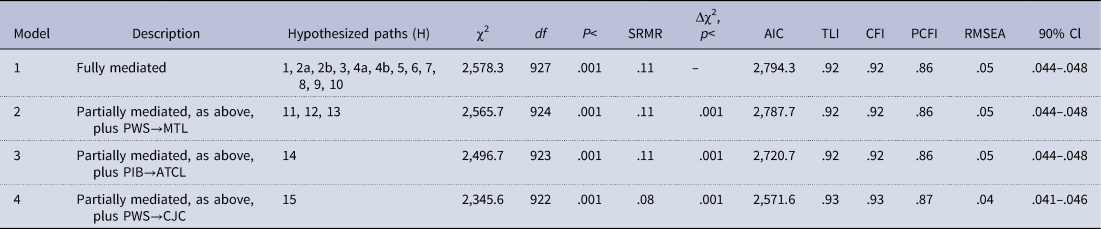
All structural models were examined using sample 2 (n = 817)
As discussed in the literature review, a number of alternative paths were added to the model and tested in a sequence of nested models. The adequacy of competing models was assessed by examining the change in χ2 (Δχ2) test of statistical significance (p < .01) using a series of nested model comparisons (Anderson & Gerbing, Reference Anderson and Gerbing1988; Tracey et al., Reference Tracey, Hinkin, Tannenbaum and Mathieu2001). This approach required nonsignificant paths from model 1 to be retained. In addition to change in χ2, changes to the comparative fit index (ΔCFI) and the Akaike information criterion index (AIC) were also considered in determining the superiority of competing models (Byrne, Reference Byrne2010). Post-hoc fit statistics (e.g., modification indices, multivariate outliers) were also inspected for each of the models.
The first three models were supported, however the final partially-mediated model (model 4) demonstrated better overall fit to the data and was accepted as the final solution. In total, 12 of the 17 hypothesized relationships were found to be statistically significant.
To increase confidence in the adequacy of the final model, cross-validation with the third sample (n = 393) was conducted. All nonsignificant paths were removed prior as recommended (Schumacker & Lomax, Reference Schumacker and Lomax2004). The model was supported and demonstrated good fit to the data (χ2 = 1,646.7, df = 927, p < .001, TLI = .92, CFI = .93, PCFI = .87, RMSEA = .05, SRMR = .09; n = 393). In total, 11 of the 12 hypothesized relationships were confirmed. A summary of these results is shown in Table 1. The final (cross-validated) model is presented in Figure 2.
Final (cross-validated) model.
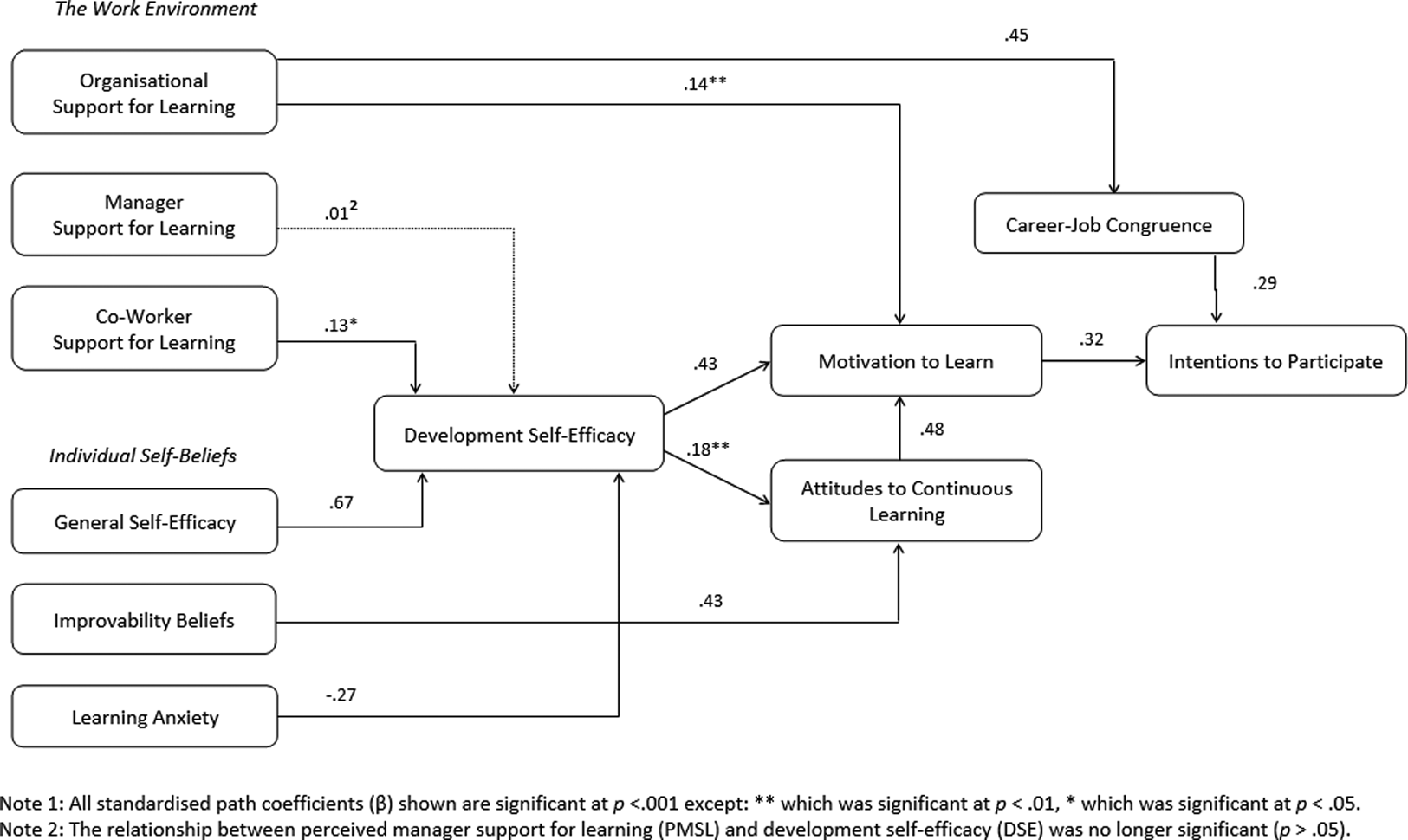
The cross-validation procedure confirmed three of the four previously supported antecedents of development self-efficacy: co-worker support (H7 β = .13, p < .05), general self-efficacy (H8 β = .67, p < .001), and learning-related anxiety (H10 β = −.27, p < .001). Together these explained a significant proportion (69%) of the variance in self-efficacy. However, the relationship between manager support and development self-efficacy was not supported. As this relationship could not be replicated, the support for hypotheses 6 is regarded as being equivocal.
Motivation to learn was predicted by three variables: development self-efficacy (H2b), attitudes to continuous learning (H1), and organizational support for employee development (H11). Together, these variables accounted for 61% of the variance in motivation to learn, each exhibiting moderate relationships with the dependent variable (H2b DSE→MTL, β = .43, p < .001; H1 ATCL→MTL, β = .48, p < .001; H11 POSL→MTL, β = .14, p < .01).
The improvement to the squared multiple correlation (R 2) in the final partially-mediated model as compared to the fully-mediated model is notable. Including organizational support as a predictor of motivation to learn improved this by 7% compared to the fully-mediated model where 53% of the variance in motivation was accounted for by development self-efficacy (H2b, β = .49, p < .001), attitudes to learning (H3, β = .35, p < .001), and career-job congruence (H4b, β = .09, p < .01). However, the partially-mediated model did not support career-job congruence, manager support, or co-worker support as antecedents of motivation to learn, thus hypotheses H4b, H12, and H13 were not confirmed.
Both hypothesized antecedents of attitudes to continuous learning (development self-efficacy and improvability beliefs) were supported and accounted for 29% of the variance in attitudes to learning (H2a, β = .18, p < .001; and H8, β = .43, p < .001, respectively), compared with 22% in the fully-mediated model when development self-efficacy was the sole antecedent (H2a, β = .47, p < .001). As hypothesized, intentions to participate in development activities were predicted by motivation to learn (H3, β = .32, p < .001) and career-job congruence (H4a, β = .29, p < .001), together explaining 20% of the variance in intentions. Finally, organizational support was found to be strongly predictive of career-job congruence (H15, β = .45, p < .001), explaining 20% of the variance in this construct.
As a way of increasing confidence in the cross-validation procedure, the two CFA samples were inspected for measurement invariance using a multi-group analysis (Byrne, Reference Byrne2010). Inspection of the nested model comparisons revealed no statistically significant differences between the data sets in relation to the measurement weights (factor loadings), structural weights (path coefficients), or structural co-variances (factor variances and co-variances) (Δχ2 p > .001). The two samples were found to be invariant, providing support for the robustness of the cross-validation procedure.
Discussion
Organizational capability depends on workers of all ages engaging in skill development and life-long learning. However, as concerns about the aging population in many countries grow, the engagement of younger workers in learning and development becomes increasingly critical for organizational success and longer-term economic growth. Understanding the factors that enhance younger, novice workers' motivation, confidence, and participation in learning and development is therefore vital for management theorists and practitioners. The primary aim of this study was to develop, test, and determine a model of learning and development for younger workers in which development self-efficacy played a central mediating role. The study found that the learning and development of younger workers can be understood as a series of relationships between salient self-beliefs and aspects of the work environment which affect learning-related attitudes, motivation, and self-efficacy and, in turn, behavioral intentions.
Examination of a series of nested structural models showed that a partially mediated model provides the best explanation of the role of development self-efficacy in the development process. Specifically, younger worker's development self-efficacy beliefs mediated the relationship between their general self-efficacy beliefs, learning anxiety, and perceived support from co-workers with their attitudes to continuous learning and motivation to learn. Beliefs about the improvability of skills and knowledge were directly related to employees' attitudes to continuous learning and were not mediated via development self-efficacy. In addition, young people's perceptions regarding their organization's support for development were directly related to their motivation to learn and career-job congruence beliefs. Motivation to learn and career-job congruence both influenced younger workers' intentions to participate in development activities.
The findings from this study advance our understanding of learning and development of younger workers. First, they suggest that a person's evaluations of themself and their beliefs about learning have a significant impact on their engagement in learning. Young people who are confident in their ability to succeed across a range of areas of life, who believe that their skills and abilities are able to be improved, and are confident they can successfully improve those are more likely to seek out and participate in learning and development activities. In addition, they provide empirical support for a number of theoretical relationships that have not previously been demonstrated in the literature; in particular, general self-efficacy, learning anxiety, and co-worker support as predictors of development self-efficacy, and improvability beliefs as a predictor of attitudes to learning (Maurer et al., Reference Maurer, Wrenn, Pierce, Tross and Collins2003). These findings provide support to the utility of SCT for younger workers. SCT identifies the importance of self-beliefs such as self-efficacy and attitudes in regulating motivation and behavior (Bandura, Reference Bandura1997; Schunk & Usher, Reference Schunk, Usher and Ryan2019); however, these relationships have not previously been empirically examined in relation to younger workers.
The findings also have several implications for HRD practitioners. From a selection perspective, employees who have positive self-beliefs are more likely to benefit from learning and development activities than individuals who are weighed down by self-doubts or anxiety. Thus, selecting individuals with positive self-beliefs will result in desirable outcomes such as engagement in learning activities and the development of new knowledge and skills. However, research shows that self-beliefs such as self-efficacy and improvability (incremental growth mindset) beliefs are not fixed, but can be enhanced through various strategies (Dweck, Reference Dweck2006; Schwoerer et al., Reference Schwoerer, May, Hollensbe and Mencl2005). A recent study also found that incremental beliefs can be socially transmitted – that is, passed from one person to another via role modeling (Burkley, Curtis, & Hatvany, Reference Burkley, Curtis and Hatvany2017). Thus, any improvements to individual's ability perceptions may have a positive effect not only on their own confidence, interest, and engagement in learning, but also that of others.
The extent to which self-efficacy beliefs can be modified may, however, depend on the initial level of the belief. Research shows that self-efficacy is most amenable to influence when initial levels of self-beliefs are low and when perceptions are inaccurate (Creed, Bloxsome, & Johnston, Reference Creed, Bloxsome and Johnston2001; Gist & Mitchell, Reference Gist and Mitchell1992). Thus, greater benefits may result from improving the self-beliefs of less-confident employees.
Another implication from the study is the importance of lowering anxiety to reduce its negative effects on learner motivation and engagement. Strategies that can be used to enhance self-efficacy and growth mindset beliefs may also be useful for lowering anxiety. Personal mastery experiences, exposure to successful behaviors through role modeling and observation, and encouraging learners to ascribe failures to situation factors rather than personal capability are potentially effective interventions (Bandura, Reference Bandura1997; Burkley, Curtis, & Hatvany, Reference Burkley, Curtis and Hatvany2017; Maddux, Reference Maddux1995; Maurer, Reference Maurer2001).
The study also corroborates the importance of the work environment for the development of younger workers as specific but understudied group of employees. Importantly, it extends a fairly small body of literature (Smith, Reference Smith2002; Taylor, Reference Taylor2002; Vaughan, Reference Vaughan2010) by demonstrating that specific aspects of the work environment affect the development process in different ways and to different extents. For example, when younger workers perceive their organization as being supportive of learning and development, they are more motivated to learn, are more likely to see their job as being relevant to their career, and to participate in development activities.
The importance of collegial relationships in developing younger workers study is also illustrated. While previous studies have shown that a significant proportion of learning occurs alongside and through other people (Bell et al., Reference Bell, Tannenbaum, Ford, Noe and Kraiger2017; Hughes, Reference Hughes2004; Vaughan, Reference Vaughan2010), no studies have specifically demonstrated a link between co-worker support and confidence for learning (development self-efficacy) for younger workers. This study suggests co-workers play an important role in the development of younger workers by enhancing self-efficacy beliefs. Organizations wishing to build strong learning cultures should look at equipping employees to support one another in the learning process (Burkley, Curtis, & Hatvany, Reference Burkley, Curtis and Hatvany2017). Strategies such as role modeling, the use of verbal persuasion, and cognitive priming can be used to enhance self-efficacy and improvability beliefs and lower anxiety (Bandura, Reference Bandura1997; Burkley, Curtis, & Hatvany, Reference Burkley, Curtis and Hatvany2017; Eden & Kinnar, Reference Eden and Kinnar1991; Won, Lee, & Bong, Reference Won, Lee and Bong2017). Having a workforce that values, supports, and actively engages in learning will enable organizations to respond more quickly and effectively to changing work environments. It will also enable them to attract and retain learning-focused employees.
An important outcome of this study is the value of disaggregating aspects of the work environment to better understand its specific effects on the development process. The findings from this study suggest that support from organizations, managers, and co-workers have different effects on the development of younger workers. The approach taken by some scholars in forming composite work environment measures (Maurer et al., Reference Maurer, Wrenn, Pierce, Tross and Collins2003; Tracey et al., Reference Tracey, Hinkin, Tannenbaum and Mathieu2001) may explain why previous findings regarding the influence of the work environment on development self-efficacy beliefs have been mixed.
Limitations
While much care was taken to develop and conduct a robust study, a number of caveats need to be considered when interpreting the results. Although intentions are strongly associated with subsequent behavior (Kyndt & Baert, Reference Kyndt and Baert2013; Maurer et al., Reference Maurer, Wrenn, Pierce, Tross and Collins2003), including a direct measure of behavior in future studies would help strengthen our understanding of young people's actual engagement in learning and development activities. It would also be useful to examine other factors that may affect young people's developmental behaviors such as perceived need for development and perceived valence of development activities (Kochoian et al., Reference Kochoian, Raemdonck, Frenay and Zacher2017; Maurer et al., Reference Maurer, Wrenn, Pierce, Tross and Collins2003; Sanders et al., Reference Sanders, Oomens, Blonk Roland and Hazelzet2011; Tharenou, Reference Tharenou2001).
Although the present study examined only the experiences of younger workers, the findings suggest that some factors may be differently important for younger and older age cohorts. For instance, general self-efficacy, learning anxiety, and perceptions of co-worker support were significantly related to the development self-efficacy beliefs of younger workers in this study, but have not been found to be significant for established employees (e.g., Maurer et al., Reference Maurer, Wrenn, Pierce, Tross and Collins2003). Other individual factors such as learning goal orientation and job involvement have been demonstrated as important sources of self-efficacy beliefs for more experienced workers (Maurer, Lippstreu, & Judge, Reference Maurer, Lippstreu and Judge2008; Potosky & Ramakrishna, Reference Potosky and Ramakrishna2002; Tracey et al., Reference Tracey, Hinkin, Tannenbaum and Mathieu2001). Further research is needed to establish whether these are also important sources of younger workers' development self-efficacy beliefs.
The study used cross-sectional data for testing the hypothesized models, and while inferences can be made regarding the causal nature of relationships using structural equation modeling techniques, longitudinal design would enable true causality to be determined. It would also provide important insights regarding the influence of different strategies and sources of information on self-efficacy and improvability beliefs. Notwithstanding these limitations, the methods adopted in this study resulted in a large and diverse sample of younger workers which allow for confidence in the findings.
Future research
There are several opportunities to further extend our understanding of younger workers' learning and development. A key finding from the study was the importance of self-beliefs in the learning process. Given the malleability of self-beliefs in response to different stimuli (Burkley, Curtis, & Hatvany, Reference Burkley, Curtis and Hatvany2017; Dweck, Reference Dweck2006; Schunk & DiBenedetto, Reference Schunk and DiBenedetto2020), and particularly at younger ages (Schwoerer et al., Reference Schwoerer, May, Hollensbe and Mencl2005; Tanner & Arnett, Reference Tanner, Arnett and Furlong2016), a greater understanding is needed as to how various beliefs may be enhanced in the work environment. In particular, knowing how organizations can enhance younger workers' development self-efficacy and improvability beliefs, and lower anxiety, would provide valuable insights for increasing learner engagement.
The findings also signal the importance of differentiating between sources of support to better understand the development process. Determining what types of interpersonal support are most important for developing younger workers would enable organizations to focus their efforts on these more specifically. Despite assertions in the literature regarding the importance of managers for employee motivation and learning generally (Chiaburu & Marinova, Reference Chiaburu and Marinova2005; Coetzer, Reference Coetzer2006; Tharenou, Reference Tharenou2001) and younger workers specifically (Smith, Reference Smith2002; Taylor, Reference Taylor2002), the current study found limited support for this. Further exploration of how managers may influence young people's self-beliefs, motivation, and engagement in learning would also be beneficial.
The study found that organizational support for learning is related to career-job beliefs and subsequently behavioral intentions, suggesting that organizational support has multiple paths in enhancing the development of younger workers. It would be useful to explore how other work-related variables, such as job involvement and work centrality (Maurer & Tarulli, Reference Maurer and Tarulli1994), influence younger workers' developmental intentions and behaviors. Including a broader range of individual and job-related attributes and examining these over a period of time would contribute to a more complete understanding of younger workers' engagement in learning.
Numerous studies show that age is a significant factor in the learning process and that specific strategies can be used to enhance learning, especially for older workers (Blomé et al., Reference Blomé, Borell, Håkansson and Nilsson2020; Fisher et al., Reference Fisher, Chaffee, Tetrick, Davalos and Potter2017; Kyndt & Baert, Reference Kyndt and Baert2013; Maurer, Reference Maurer2001). Similarly, younger workers are likely to learn and develop in different ways to their older colleagues and may require different types of support, resources, and information for developing their skills and abilities (Tanner & Arnett, Reference Tanner, Arnett and Furlong2016). Further research that focuses specifically on the development of younger workers is needed to ensure that the efforts to enhance capability are optimized for different age cohorts.
Conclusion
Over the last few decades, research has significantly advanced our understanding of the factors that facilitate (and hinder) adult's engagement in learning and development; however, researchers have focused predominately on older workers (Fisher et al., Reference Fisher, Chaffee, Tetrick, Davalos and Potter2017; Kyndt & Baert, Reference Kyndt and Baert2013) or workers generally without disaggregating by age, life stage, or work experience. Consequently, little is known about the developmental processes of younger, novice workers. This study extended the literature in this regard by developing, testing, and validating a comprehensive, theoretical model of learning and development specifically for younger, novice workers. The model showed that development self-efficacy plays a central role in learning and development, and that other salient self-beliefs are also fundamental in developing these workers. Further research that explores the malleability of individual beliefs about oneself and about learning in response to different sources and types of support will help develop a more complete understanding of these relationships. Enhancing self-beliefs about learning may be particularly important for young people who have had poor prior experiences of learning at school and may lack the confidence or inclination to develop skills in the workplace (Kyndt et al., Reference Kyndt, Govaerts, Dochy and Baert2011; Sanders et al., Reference Sanders, Oomens, Blonk Roland and Hazelzet2011). Moreover, as the self-beliefs of younger adults are more amenable to influence than those of their older peers (Schwoerer et al., Reference Schwoerer, May, Hollensbe and Mencl2005; Tanner & Arnett, Reference Tanner, Arnett and Furlong2016), greater gains may be achieved by enhancing the beliefs of younger workers. Overall, the model developed in this study provides a platform for research to explore how organizations can best support younger, novice workers to become confident, learning-focused employees of the future.
Supplementary material
The supplementary material for this article can be found at https://doi.org/10.1017/jmo.2020.28
Acknowledgements
The authors wish to thank all the younger workers who took part in this study, without whom this would not have been possible.
Dr. Robyn Mason is a lecturer in the Massey Business School, Massey University, with teaching, research, and supervision responsibilities in human resource management and employment relations. Robyn's research interests include learning and development, work–family conflict, and productive employment relationships.
Dr. David Brougham is a Senior Lecturer in the Massey Business School, specializing in the future of work. His research looks at how smart technology, artificial intelligence, automation, robotics and algorithms are changing the workplace.



