INTRODUCTION
One of the most hotly debated topics in language acquisition research over the last two decades has been when and how children learn to comprehend and produce sentential constructions such as the active transitive (e.g. Miles scratched Jem). Explanations have tended to come from either a usage-based/emergentist perspective (e.g. Goldberg, Reference Goldberg2006) or from a more linguistic nativist perspective (e.g. Fernandes, Marcus, DiNubila & Vouloumanos, Reference Fernandes, Marcus, DiNubila and Vouloumanos2006). Unfortunately, the theoretical debate has also been confounded by disagreement over the appropriate methodology. Strong versions of the usage-based theory such as the verb-island hypothesis (Tomasello, Reference Tomasello1992) have tended to rest on empirical findings from elicited production and act-out studies involving novel verbs (see Tomasello, Reference Tomasello2003, for an overview). On the other hand, researchers from other perspectives have tended to invoke findings from preferential looking (Fisher, Reference Fisher2002; Naigles, Reference Naigles2002).
One study which has found some evidence for the early discrimination of agent and patient roles is that of Gertner, Fisher and Eisengart (Reference Gertner, Fisher and Eisengart2006), who tested English-speaking children with transitive sentences in a preferential-looking paradigm. In the test trials the children looked at two scenes involving two different novel causative actions with role reversal; that is, they involved the same two characters but the agent of one was the patient of the other scene. They found that children aged 2 ; 1 and even 1 ; 9 indeed looked significantly longer than chance to the target screen. The authors suggest that this indicates that English-speaking children aged 1 ; 9 use word order to interpret transitive sentences and they know that the preverbal noun links to the agent and the postverbal noun links to the patient.
However, it is not so easy to use preferential looking to examine the developmental trajectory of performance with a particular aspect of grammar because of certain assumptions underlying the dependent variable. The main assumption is that if children understand the sentence correctly, they will look longer at the matching screen overall for the duration of the test trial. However, test trials are typically at least 6 seconds if not 8 seconds long. An older child might therefore focus on the correct video clip very rapidly but then get bored and spend more time looking at the ‘non-matching’ clip for the rest of the trial. Thus, non-significant results for the dependent variable overall could mean that a particular age group has not yet ‘acquired’ the target aspect of grammar. But it could also mean that the test sentences are too easy for that particular age group. This appears to have been the case in at least one preferential-looking study by Kidd, Bavin and Rhodes (Reference Kidd, Bavin, Rhodes, Almgren, Barreña, Ezeizabarrena, Idiazabal and MacWhinney2001), which found that children aged 2 ; 6 looked overall at chance with familiar verbs in transitives although they looked at the matching screen above chance with novel verbs in the same construction. Presumably if this age group could understand transitives with novel verbs, they were also able to understand the same sentence structure with familiar verbs. The only logical conclusion here is that the latter sentences were too easy and thus the looking-time measure was not appropriate (see also Chan, Meints, Lieven & Tomasello, Reference Chan, Meints, Lieven and Tomasello2010).
In addition, findings of early productivity using preferential looking are open to more than one interpretation. To illustrate, Dittmar, Abbot-Smith, Lieven and Tomasello (Reference Dittmar, Abbot-Smith, Lieven and Tomasello2008b) replicated Gertner et al.'s (Reference Gertner, Fisher and Eisengart2006) study with German children aged 1 ; 9. The replication – like the original study – involved test trials which were preceded by training trials of active transitive sentences with familiar verbs, all involving the same agent and patient (The frog is washing the monkey.). In a second (between-subjects) condition, in which the children saw the same training clips but heard only the verb instead of full active transitive sentences during the training trials (e.g. This is called washing.), performance dropped to chance. This implies that in order to look at the matching clip significantly above chance the English-speaking children aged 1 ; 9 in Gertner et al.'s (Reference Gertner, Fisher and Eisengart2006) original study had needed to hear these particular lexical noun phrases (e.g. bunny and duck) used in the same sentence structure with a familiar verb. Thus, these children might have had already some level of abstract representation of the transitive prior to the experiment, but this appears to be weak and needs to be syntactically ‘primed’ in order for evidence of this to be revealed.
One way of looking at the apparent discrepancy between performance in preferential looking and performance in other comprehension tasks, such as act-out or pointing, is to look more carefully at what is required of the child in terms of the dependent variable. In act-out and pointing tasks, the dependent variable is basically categorical and essentially measures accuracy, in that a correct act-out or point will receive a score of 1 and the reverse will receive a score of 0. In preferential-looking tasks, however, the children as a group can look at the mismatching screen 40% of the time but still ‘pass’ the test (Chang, Dell & Bock, Reference Chang, Dell and Bock2006). Thus, the dependent variable in preferential-looking tasks is inherently scalar and essentially measures a looking preference. Thus, above chance looking in children aged 1 ; 9 (Gertner et al., Reference Gertner, Fisher and Eisengart2006; Dittmar et al., Reference Dittmar, Abbot-Smith, Lieven and Tomasello2008b) indicates that they have learned quite a bit about English word order and how this maps onto semantic roles. But their stage in development might not be sufficient to drive their deliberate decision-making. Results from preferential-looking studies, whilst of crucial importance to our understanding of when abstract grammatical representations of some kind or another are in place, do not tell us when children can access these representations to carry out ‘deeper’ sentence comprehension where listeners are forced to choose one possible real-world interpretation over another (see also Townsend & Bever, Reference Townsend and Bever2001, for a discussion of deep vs. shallow processing).
Active behavioural comprehension tasks, however, require the children to correctly interpret a sentence and retain that sentence in memory until making a decision and carrying out the demanded action. In act-out tasks this takes for sometimes up to 30 seconds or more whilst planning and coordinating the requisite motor movements, including picking up the correct agent first and making it move in a particular direction in order to create the event that matches the sentence (e.g. Chan et al., Reference Chan, Meints, Lieven and Tomasello2010). In pointing tasks, in contrast, retaining the sentence in memory and motor planning are reduced substantially. Preferential-looking may not even require the retention of a sentence in memory, if eye-gaze is measured whilst the children hear the sentence in real time. Thus, as a child's syntactic representation gains in strength, the children might first ‘pass’ a test involving the preferential-looking measure, then the equivalent using the pointing measure, then the equivalent using the act-out measure.
Therefore, if one wishes to know when children can use syntactic representations with above-chance accuracy, then the pointing paradigm is the method of choice. Indeed, stronger evidence that young two-year-old English-speaking children do have an abstract representation of the transitive comes from a recent novel verb pointing comprehension study by Noble, Rowland and Pine (in press). This study found that English children with a mean age of 2 ; 3 pointed significantly more frequently to the causative video clip out of two which matched the transitive sentence they heard. The video clips and presentation thereof were very similar to those used in Gertner et al.'s (Reference Gertner, Fisher and Eisengart2006) and Dittmar et al.'s (Reference Dittmar, Abbot-Smith, Lieven and Tomasello2008b) studies, including the fact that the two novel actions which the child had to choose between were actually different actions.
Thus in the current study we primarily asked two questions. First, how young can one take the pointing paradigm for this type of task? It is known that children point in order to inform adults by age 1 ; 0 (e.g. Liszkowski, Carpenter, Striano & Tomasello, Reference Liszkowski, Carpenter, Striano and Tomasello2006) and there is a reasonable body of evidence from the preferential-looking paradigm that English-speaking children can access an abstract representation of the transitive by 2 ; 1 (e.g. Naigles, Reference Naigles1990; Gertner et al., Reference Gertner, Fisher and Eisengart2006; although see caveat above). So can English-speaking children aged 2 ; 1 also demonstrate this knowledge in the pointing task?
Our second question was whether young two-year-olds can still do this task if the two novel simultaneously presented actions are identical, so that the focus is only on mapping semantic roles to word order/grammatical roles. Thus, we adopted Dittmar, Abbot-Smith, Lieven and Tomasello's (Reference Dittmar, Abbot-Smith, Lieven and Tomasello2008a: Study 3) version of the pointing comprehension task, in which the two actions the child is asked to choose between are identical.
METHOD
Participants
All children were monolingual speakers of English. They were brought by a caregiver to and were tested at the Max Planck Child Study Centre, Manchester University, UK. Twenty-three children aged 2 ; 1 (mean=25·25 months, range=24–26 months; 14 girls, 9 boys) and twenty-three aged 2 ; 7 (mean=31·0 months, range=30–32 months; 16 girls, 7 boys) participated in the study and a further thirty-two children had to be excluded due to either showing a side bias (ten aged 2 ; 1 and five aged 2 ; 7), fussiness (eight aged 2 ; 1 and two aged 2 ; 7), failure to understand the task (one aged 2 ; 7), experimenter error (three aged 2 ; 1 and one aged 2 ; 7), hearing problems (one aged 2 ; 1) or mother error (one aged 2 ; 1).Footnote 1
Materials
Three novel verbs and three familiar verbs were used in the study. The novel verbs and actions were identical to those used in Dittmar et al. (Reference Dittmar, Abbot-Smith, Lieven and Tomasello2008a: Study 3). All verbs referred to prototypical causative-transitive actions, involving direct contact between a volitional agent and an affected patient (Hopper & Thompson, Reference Hopper and Thompson1980; Meints, Reference Meints and Kokinov1999). All actions were reversible, involved direct contact between two animals and involved a patient which was affected by the action (see Appendix, B). The three novel verbs (weefing, tamming and baffing) were used to describe three novel transitive actions that were performed with three novel apparatuses. For all three, the causality of the new events was emphasized by some kind of change in the patient at the end of the scene. Weefing referred to one animal rocking another animal which stood on a rocking-chair-like apparatus. It did this by hooking its head around the patient's head and then pulling the patient backwards with its head three times. With the third motion the agent forced the patient into a handstand. Tamming referred to an animal pushing down another animal which stood on a platform on top of a spring by jumping on its back. With the third motion the agent forced the patient to fall sideways. The third novel verb baffing referred to an animal spinning around another animal which stood on a spinning disk. With the third motion the location of the patient was changed from being next to the agent to being further away. We used three familiar transitive verbs pushing, washing and brushing. Agents and patients of the presented events were animals which were all on the Bates-MacArthur Communicative Development Inventories (Fenson, Dale, Reznick, Bates, Thal & Pethnick, Reference Fenson, Dale, Reznick, Bates, Thal and Pethnick1994): bear, bunny, dog, elephant, frog, lion and monkey.
Design
We tested each child with six different verbs (three familiar verbs and three novel verbs), in one trial each, in transitive sentence structures using a pointing task. During the session the children sat on their caregiver's lap in front of a 31×49 cm computer screen. For the salience and test trials the child saw two film scenes on the computer screen, each starting simultaneously and lasting 6 seconds. Both involved animals enacting the same causative event and differed only in that agent and patient roles were reversed. Additionally, the parents were asked to complete the Oxford version of the Bates-MacArthur CDI which 70% of parents for each age group did.
Counterbalancing
Half the children within an age group started with a familiar verb and the other half with a novel verb. Following this familiar (F) and novel (N) verb trials were alternated (either FNFNFN or NFNFNF). The order of the particular verbs which came in each familiar or novel slot was counterbalanced according to Latin squares. The target screen order for the test trials was counterbalanced so that each side (left or right) was correct 50% of the time for each child. The same side was never the correct choice more than twice in a row. No child experienced a condition in which the correct choice alternated regularly (e.g. LRLRLR). For half the children the first correct side in the first trial was left and vice versa. There were thus twelve possible orderings for correct side and these were distributed evenly over the children within each group. For each test trial scene pair we also counterbalanced which particular scene correctly matched the test sentence (e.g. for the pair ‘dog push lion’ and ‘lion push dog’ half the children heard the dog is pushing the lion and the other half heard the reverse). The direction of the action (from left to right or from right to left) was also counterbalanced.
Procedure
A camera from behind the children recorded their pointing behaviour. The caregivers were asked to close their eyes during the test trials and they listened to music played through headphones so as not to influence their children.
Pointing practice training
To teach the children that the aim of the task was to point to one of two pictures on a computer screen we showed the child a series of object pairs, for example, ‘dog’ and ‘duck’ which appeared on the screen simultaneously. Then the children were asked to point to one of the two objects (e.g. ‘Show me: where is the dog?’). The pictures were from the vocabulary comprehension subtest of the SETK-2 (Grimm, Reference Grimm2000). We repeated this task ten times with different objects and all children performed very successfully.
‘Live’ word-learning training
Prior to each test sentence each child was taught the name of each verb in the following manner. Using two animals (e.g. cow and duck), every verb (novel and familiar) was presented to each child in a live act-out by the experimenter in a variety of argument structures: in the citation form with no arguments (e.g. ‘This is called weefing’) as well as in transitive argument structure with two neutral pronouns (which are both identical for subject and object position) in three different tenses (‘It's going to weef it’; ‘It's weefing it’; ‘It weefed it’). The child was also asked to repeat the verb in the citation form (e.g. ‘Can you say this: weefing?’).
Film familiarization trials
Following the live enactment, for each verb the child then saw a familiarization trial, in which s/he watched each of the two film scenes individually and heard the experimenter describing them in the citation form, e.g. ‘Look, this is called weefing’, while the other half of the screen remained blank. The side where the children saw the first picture (left or right) was counterbalanced across and within subjects. At the end of each film scene the experimenter pointed to each animal and asked the child: ‘Who's that?’ The majority of the children had no problem spontaneously naming the participating animals. If a child did not name one of the animals, the experimenter told the child the name and asked him/her to repeat it, which almost all children then did.
Salience trial
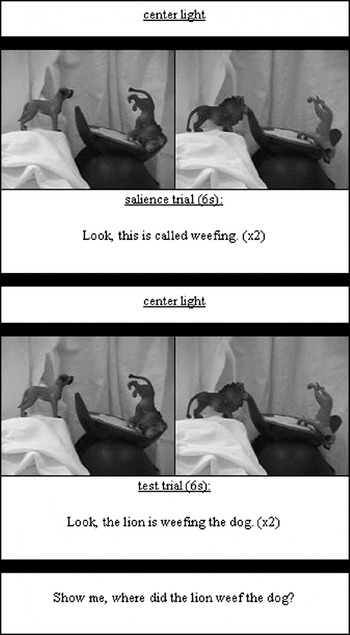
For each verb, following the familiarization trial, a red centre point focused the child's attention on the centre of the computer screen. Then, in the salience trial, s/he watched the same two scenes as in the familiarization trials. Here they appeared simultaneously and were accompanied by a prerecorded voice describing them in the citation form, e.g. ‘Look, this is called weefing’ (×2). We ran this salience trial to get the children used to watching two films simultaneously and to equalize the grade of novelty of both films before the test trial.
Test trial
Following this another red centre point centred the child's attention to the centre of the computer screen. Then, the test trial began. This was identical to the salience except that the child heard a prerecorded linguistic stimulus with the target verb in transitive argument structure, e.g. ‘Look, the lion is weefing the dog’ (×2). After the videos had stopped the experimenter asked the child to point to the correct still picture by asking, e.g. ‘Show me: Where did the lion weef the dog!’ If the child did not point the experimenter repeated the question a second time, but she never asked the child to point again once s/he had already done so (see Figure 1).
Procedure.

Coding
For every pointing test trial, pointing to the target was assigned the value 1 and pointing to the distracter the value 0. If the child did not choose either scene, i.e. some children pointed to both scenes, we excluded those trials. This was necessary for 11 out of 276 trials (5 out of 138 in the novel verb condition and 6 out of 138 in the familiar verb condition).Footnote 2 All children were coded by the first author, and one additional coder coded 17% of all trials for reliability with high agreement with the first author (Cohen's kappa=92·38%).
RESULTS
1 Main analyses
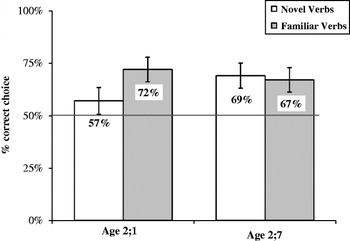
We found that both age groups pointed to the target screen above chance in the familiar verb condition (age 2 ; 1: t 22=3·700, p=0·001; age 2 ; 7: t 22=2·857, p=0·009). The older children chose the correct scene above chance also in the novel verb condition (t 22=3·164, p=0·005) whereas the younger children pointed to target and distracter equally often. Consequently, the children aged 2 ; 1 were significantly better at pointing in the familiar than in the novel verb condition (t 22=−2·056, p=0·052, d=0·518). The data are shown in Figure 2. The same pattern of result was found with non-parametric (Wilcoxon) tests.
Mean number of correct points to the target screen (out of three trials).

2 Analyses for individual verbs
Paired samples t-tests for the novel verbs found a significant difference between weefing (72% correct, conflated over age groups) and baffing (M=51%,Footnote 3t 41=2·152, p=0·037). Exactly the same pattern of results was found with non-parametric (Wilcoxon) tests. No such main effect was found for the familiar verbs.
Therefore, as shown in Table 1, we compared the performance on each individual novel verb against chance (which would be 50%), for each age group separately. The results support the conclusions from the main analysis that the children aged 2 ; 1 perform at chance with the novel verbs, whereas those aged 2 ; 7 perform above chance at least two-thirds of the time. That said, there are clearly some effects of the semantics (or salience) of individual novel actions, with baffing (see Appendix, B, last row) being particularly difficult and weefing (see Appendix, B, fourth row) being the easiest. However, if we leave out baffing from our final analysis the results do not change. Children aged 2 ; 1 are still at chance level with the novel verbs (M=59%) whereas those aged 2 ; 7 perform above chance (M=76%, t 22=4·219, p<0·001).
Performance of the different age groups on the three different novel verbs

3 Analysis of performance on the first two trials
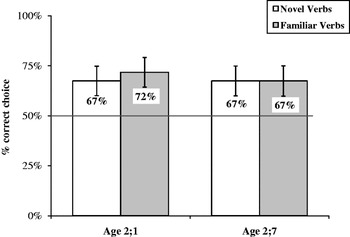
However, it is possible that the difficulties shown by the younger children with the novel verb might have been due to performance effects, such as tiring during the task. To investigate this, we carried out the analysis again but this time only the first two novel verb and the first two familiar verb trials were included (thus omitting the last two trials). The data are shown in Figure 3.
Unlike the main analyses, the children aged 2 ; 1 did not perform significantly better in the familiar (M=72%) than in the novel verb condition (M=67%). The same pattern of results was found with non-parametric (Wilcoxon) tests. For the first two trials the children aged 2 ; 1 did point correctly above chance in the novel verb condition (t 22=2·336, p=0·029).Footnote 4 For the children aged 2 ; 7 and the familiar verb condition, the pattern of significance found with one-sample t-tests remained identical to that found for the main analyses (i.e. always above chance performance).
Mean number of correct points to the target screen (only first two trials).

4 Effects on lexical development
We also found effects when we conflated the two age groups and then re-divided these children into ‘high’ and ‘low’ vocabulary based on the median split for the Bates-MacArthur CDI. That is, the ‘low’-vocabulary children, of whom there were ten aged 2 ; 1 and five aged 2 ; 7, only pointed above chance in the familiar verb condition (M=66%, t 14=2·352, p=0·034) but not in the novel verb condition (M=55%). The ‘high’-vocabulary children, of whom there were six aged 2 ; 1 and eleven aged 2 ; 7, pointed above chance in both the familiar (M=71%, t 16=3·114, p=0·007) and in the novel verb conditions (M=68%, t 16=2·671, p=0·017). Since there were proportionally more children aged 2 ; 7 than 2:1 in the high-vocabulary group, this latter finding basically supports the results from the main analyses indicating that only the older two-year-olds had a robust representation of the active transitive construction, with the added information that this ‘age’ effect is principally based on the increased vocabulary knowledge of the older children.
DISCUSSION
Noble et al. (in press) found that when English-speaking children aged 2 ; 3 heard a transitive sentence with a novel verb, such as The bunny glorped the duck, they pointed significantly above chance at the correct video scene. The current study brought the age at which English-speaking children can do this down by an average of two months. When the last trial for each condition was removed, the children aged 2 ; 1 pointed at the correct clips in the novel verb condition significantly above chance 67% of the time. Moreover, in the current study the two novel actions which the children had to choose between were identical, so that the focus is only on mapping semantic roles to word order.
One finding which does clearly emerge from the current study is that English-speaking children aged 2 ; 1 do have a sufficiently abstract representation to allow them to comprehend sentences with novel verbs accurately. This was only revealed when the testing session was approximately 10 minutes long (i.e. when the last two trials are omitted from analyses) as opposed to approximately 15 minutes long (i.e. when all trials are included). Interestingly, by age 2 ; 7 children perform equally well in this task in both the novel and familiar verb conditions, indicating that the presence of novel verbs in a sentence does not necessarily make the particular syntactic structure more difficult to process than the same sentence with a familiar verb.
The key finding of the current study is that English-speaking children at 2 ; 1 are able to comprehend active transitive sentences with novel verbs to the extent that they can make an active behavioural choice in terms of their semantic role interpretation, even when the action concerned is identical in both the target and the foil. However, the ability to override fatigue in combination with accommodating novel verbs is clearly something which becomes more robust with development; the fact that the two-year-olds with the higher vocabulary scores performed better indicates that the child's growing mastery of his or her own language plays a role. Further studies are needed to investigate the relationship between children's growing vocabularies, sentence processing speed, the potential for uptake of new words and the performance of children in these types of tasks.
APPENDIX
A. Test sentences (half of the children heard the sentences with changed agent and patient):
a. with familiar verbs:
The lion is pushing the bear.
The monkey is washing the bunny.
The elephant is brushing the dog.
b. with novel verbs:
The dog is weefing the lion.
The bear is tamming the elephant.
The frog is baffing the monkey.
B. Actions presented to the children in the pointing task
a. familiar actions:

1. pushing
2. washing
3. brushing
b. novel actions:
1. weefing
2. tamming
3. baffing