Mrs Cornwallis (as she has often told us) together with her Companion Mrs Austin, was instructed [by F. Prasset] in the Rudiments of Greek and Hebrew, Geography and Astronomy, which occasioned a certain Chamber, in which they studied to be called the Globe Room. A name which likely as long as the House stands, will perpetuate the memory of the wise method he took to train up two young Gentlewomen, and to fit them for the task they had undertaken of qualifying young Ladies with a suitable Education.Footnote 1
My design is to model, raise and continue a school which may educate young Gentlewomen til their Parents think it proper to send them abroad, and give a Christian Institution to others whom the foundress or circumstances of their Parents will not suffer to cross the Seas.Footnote 2
Although the word ‘exile’ is used in the title of this article, both these quotations come from archives of the school established by the Mary Ward Sisters at their convent in Hammersmith, then just outside London. This points to some of the complexities relating to the study of convent schooling for English girls in the period between 1600 and 1800. The convent in Hammersmith was opened by Frances Bedingfield in 1669 in contravention of the laws that forbade the presence of convents or Catholic schools in England.Footnote 3 Indeed, until the re-migration of the enclosed convents, together with some of their schools, at the time of the French Revolution, the Mary Ward Sisters provided the only Catholic schooling for girls on English soil. The first quotation demonstrates the standard of education associated with the convent school in Hammersmith: the teachers, Cecily Cornwallis and Mary Austen, had themselves been educated to an unusually high level by the convent's Jesuit chaplain. Such standards equipped them to deliver high-quality education to their pupils, although it would have been difficult to replicate this in a small community over time. The second quotation tells us more about the purpose of the school, which aimed to provide a Catholic education on home soil as an alternative to schooling in exile. It also indicates the cautious approach of the sisters in their unwillingness to challenge the authorities too directly about the Catholic nature of the religious instruction that was undertaken in the school: here they refer to ‘Christian’ rather than ‘Catholic’. A boarding school was started at Hammersmith by Frances Bedingfield around 1677 and functioned there until 1771, under the noses of the authorities, attracting the daughters of many prominent Catholic families, including the Petres, Talbots, Brownes, Giffords and Shelleys.Footnote 4 Records show that some girls went on to join other religious institutions or schools on the Continent, although for many the school at Hammersmith was their only school experience. The school, like the convent, breached the regulations which forbade parents to educate their daughters as Catholics either at home or abroad, and from the outside, the buildings at Hammersmith (and from 1686 also at York) looked like a row of ordinary houses, to avoid attracting attention.Footnote 5 Such was the determination of some English families to bring up their daughters in the Catholic faith that parents seeking to provide their daughters with a Catholic education flouted the law.Footnote 6
Considering the importance of girls’ education, very little research has been undertaken on schooling for English girls in the early modern period. In 1999, Kenneth Charlton published an important survey of girls’ education in early modern England, which focused mainly on Protestant girls.Footnote 7 My doctoral research studied parental attitudes to girls’ education in order to explore reasons for the wide variations in the educational experience of English girls and led to the publication of two articles on convent education.Footnote 8 I concluded that differences in fathers’ attitudes to the future roles of their daughters were crucial to decisions being made regarding their schooling and that wide variations were to be found in both Catholic and Protestant families. The penal laws applying to the Catholic community from the reign of Elizabeth until Catholic emancipation in 1828 not only hindered access to Catholic schooling but also imposed such severe financial penalties for those practising Catholicism that some families would not have been able to afford to pay school fees and travel costs.Footnote 9
Convent Schooling
Most of the convent schools discussed in this article were located on the Continent, identified in the section on ‘Schools and Pupils’ below and listed in the Appendix. In addition to the English schools, some space is given to French Ursuline schools, whose pupils included a few English girls amongst their number, such as Christina Dennett, who later became a reforming head teacher at the Sepulchrine school at Liège, and Charlotte Jerningham, part of a family of letter-writers who provide a vivid account of schooling at the Ursuline convent in Paris at the end of the eighteenth century.Footnote 10
New convents for English women were established initially in the southern Netherlands from 1598, and from 1634 in France. They committed themselves to accepting only English members and remaining financially independent.Footnote 11 This commitment to being self-supporting meant that members of the convent communities had to devise means of raising revenue, for instance taking in boarders, making lace or, in most cases, establishing schools. These schools had to be incorporated into convent property without encroaching on the enclosure of the choir nuns.
The majority of pupils went to school at one of the enclosed communities in exile, but, as I have already suggested, in any discussion of girls’ education it is essential also to recognize the significant role and influence of the Mary Ward Sisters, also known as the Institute of Mary, whose way of life and schools were distinctive, being based on a Jesuit model.Footnote 12 Reflecting her determination to educate girls, Mary Ward quickly established schools when she opened houses on the Continent, including St Omer, Rome and Munich.Footnote 13 It was through the success of the school in Munich that, with the support of the elector of Bavaria, her work survived the institute's suppression by the papacy in 1631 and became the only community to establish houses on English soil during the period under consideration here.Footnote 14 Mary Ward Sisters did not wear habits: they dressed as respectable lay spinsters. In England they had to be particularly careful not to draw attention to themselves because of the penal laws, for instance, by using appropriate titles such as ‘Mistress’ as lay women. They provided as much teaching as they could themselves, hiring additional teachers when necessary. Unlike most girls’ schools in England during the period, which tended to be short-lived, the school at Hammersmith operated successfully for over a century. However, such was the demand for convent schooling that most English girls attending a convent school between 1600 and 1800 had to cross the Channel.
The English convents varied in the way they arranged and managed teaching in their schools. Orders such as the Benedictines and Poor Clares, who were contemplatives, generally saw teaching primarily as part of the preparation of future members, to be combined with the formation of candidates.Footnote 15 The rule for the Canonesses created a combination of the contemplative and active religious life, with the teaching of girls being a core part of the canonesses’ daily routine. Although Canonesses were enclosed, like the contemplative orders, their performance of a reduced office went some way to accommodate their teaching roles. Their schools tended to be larger, and the curricula broader, while still retaining significant religious elements. The schools of the contemplatives were generally small and more likely to be based round devotions because the nuns’ own lives focused on prayer, reading and writing. Teaching was an incidental part of this work and it was given less time in the structure of the choir nuns’ day, in contrast to the Canonesses’ daily timetable. Like the Canonesses, the Mary Ward Sisters had teaching girls at the heart of their religious life: Mary Ward planned to establish two schools connected to each house, one a boarding school, the other a free school for poorer girls.Footnote 16
As I have already suggested, it is important to include the schools of the French Ursulines in a study of convent education for English girls. Founded in 1535 by Angela Merici, the Ursulines decided in 1612 to accept enclosure as required by the Tridentine reforms, rather than close down their schools.Footnote 17 By the end of the eighteenth century they had around four hundred convents and schools in France, with a wide-ranging curriculum, and were providing most of the schooling for women. Some English convents, including the Canonesses at Bruges, sent a number of their own postulants to the Ursulines so that they could immerse themselves in a French religious environment and learn French more quickly. In addition, several contemporary accounts record that English parents (both Catholic and Protestant) from south-east England sent their daughters to boarding schools in Channel ports such as Boulogne. These were said to be less expensive than girls’ boarding schools in England.
An item on the front page of a 1766 issue of the St James’ Chronicle claimed to be a ‘Copy of a letter from an English Gentleman in Paris on his travels to a friend in London’.Footnote 18 The article covered education for boys and girls, and made the claim, as yet uncorroborated, that thirty Protestant girls from the Dover area of Kent were boarding at a French convent school in Boulogne (probably the Ursuline school) and a further forty-seven at Calais.Footnote 19 There were several reasons why Protestant parents might send their daughters to a French convent boarding school apart from cost: for instance, admiration of French language skills and French manners, and the opportunity to mingle with well-bred French girls. Additionally, Ursuline schools were held in high esteem for the quality of their teaching. However, one point exercising the anonymous author was his view that Protestant girls were being subjected to Catholic religious propaganda which they could pass on to their families once they married. He was also concerned that the girls were being given only a ‘partial History of England: and taught to believe that the true King of England is in Exile in Rome’.Footnote 20 While the piece contains a number of factual errors and is unreliable as evidence regarding pupil numbers, it nevertheless offers an interesting contemporary insight into the perceived influence of convent schools.
Sources
The search for material regarding convent schools and the identification of pupils and their families proved to be a complex process, often yielding only fragmentary evidence. The primary purpose of the religious communities was the religious life of their members. It is understandable that when faced with catastrophes such as fires and floods, or disasters such as having to deal with French revolutionaries hammering at the door, when nuns had to make extraordinarily difficult decisions about what they could keep, school records were not the top priority.Footnote 21 Several communities were barely able to escape with their lives and what they could carry in their pockets. However, a mixture of good fortune and careful planning led to the survival of a surprising amount of material from the exile period, particularly about the members, although it is harder to piece together details about schooling. Fortunately, some letters between families and the convents have survived which provide glimpses of the experience of attending school. By piecing together convent material with letters and other personal documents from family archives, it is possible to begin producing a cultural history of the education of girls in early modern English convent schools. The names of the English girls who attended French Ursuline schools remain elusive, although enough material survives to suggest that further research would make a significant contribution to understanding the full range of convent education available to English girls. Even for the English convent schools, research is still in its early stages and this overview can only touch briefly on some important areas of interest. It is essential to acknowledge how much remains to be done, particularly regarding the curriculum and teaching. For the foreseeable future, research into convent schooling will remain a work in progress.
Parental Attitudes to Convent Education
Surviving evidence shows that, like Protestant parents, Catholic parents were identifying the importance of girls’ education to their roles in the family as wives and mothers; however, unlike Protestant parents, Catholic parents had the religious life as an alternative for their daughters. Both these paths for women could help to secure the future of English Catholicism. The parents of daughters who saw their future outside the convent aimed to create potentially model wives whose marriages would fit familial expectations, reflect well on their parents and ensure the survival of a beleaguered minority. Within the overarching parental ambitions for their daughters were wide variations about desirable intellectual outcomes, even amongst families of similar social backgrounds and levels of income.Footnote 22 As a result, amongst the English aristocracy and landed gentry – both Catholic and Protestant – there were women who found writing letters challenging whilst others could translate from Latin and French and were accomplished authors or musicians. Such disparities and uneven standards can also be seen in the education of pupils who attended convent schools. Nevertheless schooling, even of an elementary nature, was viewed by parents (with some justification) as providing the basis for later improvement.Footnote 23 Educated girls might become mothers who were able in turn to play a significant role in the upbringing of children, and to provide a sound moral example especially to their daughters. In many cases parents were prepared to make considerable personal sacrifices to achieve those ends.
One Catholic parent who gave his opinion on girls' education was Sir Thomas Strickland of Sizergh Castle, Westmorland, who in 1692 wrote a letter of advice to his son:
It is hard for a young man to know how to Chuse or value a virtuous Woman … therfor endeavor to Chuse a Woman whose Education and character is virtuous, and modest, and let not fortune be the sole ame of Marriage, though I know they Condition will much require it and there are good Women with great fortunes. But let the main ground of they Marriage be grounded in the fear of God and trew affection and that will sweeten all the troubles of married life.Footnote 24
Sir Thomas also commented specifically on his wife Winifred's capabilities, both as a manager and a mother: ‘I am Confident she will have Care of that poor temporall estate I shall leave her, and will bring the[e] up in the fear of God and his Catholic Church’. She must have been educated to fulfil these obligations.
Increasingly, research on lived religion in the early modern period is showing that divisions between Catholics and Protestants in England were not nearly as sharply defined as has previously been thought.Footnote 25 For instance, some families chose to intermarry; at parish level neighbours managed to get along for most of the time, and, as we have seen, some Protestant girls were sent to Catholic boarding schools. Like better-off Catholic parents, some Protestant parents wanted to secure an education for their daughters in boarding schools, away from worldly influences, and they were attracted by the reputation of the Catholic schools they chose.
Schools and Pupils 1600–1800
What do we know about pupils who faced the challenges and undertook what were often hazardous journeys in search of a convent education? Finding names and family details of pupils in convent schools is challenging: lists that survive exist in a range of formats, with some only fragmentary. Young women arrived at convents either to try out the religious life or as schoolgirls; some changed from one category to another. Numbers must therefore be treated with caution. In compiling lists of names, I focused on girls known to have arrived at a convent for schooling: these numbers are still provisional. It is evident from the sources that school careers were generally very short, and many schoolgirls only spent a couple of years at most at a convent school.
Mary Ward Institute Schools (in England)
The Mary Ward schools at Hammersmith and in York provided a choice for Catholic parents who preferred to keep their daughters nearer home or were unable to afford the cost of sending them abroad. A few English girls were sent to continental schools belonging to the institute, including those at Paris and Munich, but most English girls attending Mary Ward schools did so in England. The legal position of the schools made the sisters act cautiously in public, but it did not seem to deter parents.Footnote 26 For the Bar Convent, York, which opened its school in 1686, more than eight hundred eighteenth-century names have been listed.Footnote 27 Numbers entering the school at Hammersmith remained relatively constant at around ten a year, even as numbers entering community dwindled; the names of 841 girls attending the school between 1669 and 1771 were recorded.Footnote 28 The school finally closed in 1781. Some names on the list were annotated, indicating pupils who left to marry, some who moved to York and others who went on to the religious life in continental convents. In its way, Hammersmith was a feeder institute.
Canonesses
In Liège, the Sepulchrine Canonesses opened a school when the convent was founded in 1642, but this remained small. However, following restructuring and reforms from October 1770 to May 1794, initiated by Christina Dennett, 350 pupils of six different nationalities passed through the school, several of whom spent more than five years there.Footnote 29 In Bruges, the Augustinian Canonesses listed 695 names of girls attending their school between the mid-seventeenth century and 1793.Footnote 30 By contrast, no trace of a list of names of those attending the school of the Augustinian Canonesses in Louvain has yet been found, although a building for a school appears on the contemporary plan of the convent.Footnote 31 The school of the Paris Augustinian Canonesses has only a partial listing of pupils, which includes 123 names for the period from 1676 to 1720; this is supplemented by an undated notebook containing the names of many of the French pupils, which is still to be fully deciphered.Footnote 32
Poor Clares
All four convents had small schools, although nothing has so far been found about pupils at Dunkirk and Gravelines. The little evidence that survives suggests that pupils arrived as a result of recommendations passed mainly through family networks. The only comments about the school at Aire appear in letters from the printer and bookseller J. P. Coghlan. In 1779, he removed his daughters from the Benedictine school at Cambrai after he had been advised that they were backward in reading, and transferred them to Aire. By 1782, he commented that his daughter Elizabeth was very much improved and he was impressed by the school, ‘as the best of any, either for duty to God or instruction for worldly business … as I have known anything of’.Footnote 33
The convent at Rouen also had a small school. There is no convent list; however, Ann Forster provisionally listed 103 names for the period from 1646 to 1770.Footnote 34 Occasionally schoolgirls are discussed in the convent chronicles. For instance, Mary Strickland arrived there in 1713, aged ten, brought by her father, Walter Strickland.Footnote 35 Mary exhibited model behaviour and entranced the nuns. She was sent to a French Benedictine convent to improve her language skills, but became ill and returned to Rouen. She died in the convent aged thirteen. The account of her life in the convent annals contains nothing about schooling and is similar to a hagiography of a young and devout religious made particularly appealing because of her youth and tragic death. Another pupil, Harriet Goldie, later wrote her own version of her life as a schoolgirl at Rouen: this is included as one of the case studies below.Footnote 36
Franciscans
From the community's foundation, the Franciscan sisters established a small school focused primarily on devotional teaching. By the time they moved to the Prinsenhof in Bruges in 1662, the school had two mistresses, who were ‘to instruct the pupils in all piety and devotion, not permitting any vaine secular discourse contrarie to virtue’.Footnote 37 The pattern of the day was linked to the liturgical rhythms of the convent set by the performance of the office. It was described by the author of the convent history as ‘turning girls into devout Catholic maidens, ready to take up their role as nuns or as obedient wives keen to instruct their future children in the faith’. Here is a contemplative community which clearly saw a double purpose in the education they provided.
Benedictines
The situation regarding the existence of schools seems to have been different in each of the Benedictine convents, and so far little is known about arrangements for schoolgirls. A brief reference in the convent history to the fact that ‘our Sisters … had always occupied themselves with education’ points to the presence of a school at Dunkirk. We also know the names of two pupils (Margaret and Katharine Ireland) who were sent to school at Dunkirk around 1670, when their newly widowed father decided to become a Jesuit.Footnote 38 Brussels was known to have a school from the early days of its foundation, with a few pupils named from 1609, although there are no sign of any school buildings on plans of the convent.Footnote 39 Little evidence has been found regarding schoolgirls at Ghent.Footnote 40 Eighty-five names of schoolgirls between 1625 and 1725 are included amongst the lists of religious and aspirants from Cambrai, but no other information about the school has yet been found.Footnote 41 From Pontoise, the names of 240 Pensionnaires aged between five and seventeen who attended between 1658 and 1782 have survived.Footnote 42 However, it seems that the community was unable to make enough money from their boarders: although the pupils paid fees, Pontoise failed financially and was sold at auction in 1786.
The Conceptionists (familiarly known as the Blue Nuns):
The names of 155 pupils have survived for a period between 1733 and 1792.Footnote 43 This Paris school became well known, and the pupils include many names from elite French and English families, among them Charlotte Jerningham's mother, Frances. There are hints in several sources that this school was akin to a finishing school, with a focus on accomplishments and manners as well as learning to move in the right social circles. For instance, Lucy Rothe arrived as a schoolgirl in August 1757, her parents paying £25 per annum, and she brought a maid for whom she paid £15 per annum. The Jerningham letters offer us insights into the experience of attending this school at the end of the eighteenth century.Footnote 44
A small Dominican school at the Spellikans, near Brussels, which took mainly French and Flemish girls has been identified by Whelan, but no further details are currently known.Footnote 45 No evidence of schools has yet been found at the Bridgettines in Lisbon, or from three houses of Carmelites in the southern Netherlands. All these were contemplative convents. Geography may have played a role here: the journey to Lisbon would have been hard and expensive to arrange, particularly for young girls. However, the contemplative life must have represented an additional obstacle. Carmelite houses were small and Carmelites spent long periods of time in solitary prayer in their cells, a discipline which would not easily have accommodated teaching.
Pupils appear in the school records at all ages from five upwards, with a few even younger. Of necessity far from home and in exile, these girls were boarders who might have long gaps between parental visits or opportunities to return home. In addition, the position of these schools within the convent precincts must have influenced the behaviour of young girls trying to fit in to the quiet of monastic life. Rules governing enclosure were strictly laid down and exactly followed in the English convents in exile. The reputation which helped to attract new members depended on exactly following the rule which governed every aspect of life in the convent. It stipulated where candidates for membership could go and how they fitted into the community, but schoolgirls were a separate category and needed their own spaces and different rules. Such complications affected decision-making about creating and managing schools.
Even with the best of intentions, having young children in a convent must have disturbed the peace of the enclosure and increased the need for lay sisters to look after them. When in 1674 two daughters of the earl of Powis, Lucy and Winefrid Herbert, aged five and four, became pupils with the Pontoise Benedictines, they paid extra to have a lay sister to wait on them.Footnote 46 Their parents held appointments at the Jacobite court of James II in exile at St Germain, outside Paris. The school career of three Stafford (Howard) girls can be traced through three separate convents. In 1725, following the death of their mother, Anne, that year, the younger two were placed by their father, William Stafford-Howard, with the Mary Ward Sisters in Hammersmith, where the eldest was already a pupil. Two years later, the three sisters, now aged seven, five and three, were taken in by the Poor Clares at Rouen at their father's request. In May 1733, the eldest, Mary, was sent to the Blue Nuns in Paris, where two of Lord Stafford's sisters had been professed and where he was a generous benefactor. Following his death in 1733, there appears to have been something of a tussle between the Poor Clares and the Blue Nuns over the girls’ future, but finally in 1735 the younger sisters, Anastasia and Ann, left Rouen, much to the nuns’ grief and affliction.Footnote 47 The loss of either parent always destabilized families; it was particularly disruptive for Catholics trying to avoid losing their children to a Protestant parent-substitute as required by officials under the penal laws.Footnote 48
Teaching and Learning
The evidence outlined above has drawn attention to the wide range of ages and experience of pupils and to the diversity of the provision of schooling. There was a degree of interconnectedness between the convents, with the movement of girls carrying with them their experiences from one school to another and reporting back to parents in their letters. It is not possible from the sources currently available to study the curricula on offer in the schools. What was feasible depended largely on the qualities of the choir nuns at a particular time, the charism of the convent, the structure of the religious life and the number and ages of the pupils.
Convent schools appear to have accommodated parents’ wishes as far as they could, and provided a personal experience. The image of the Blue Nun with a single pupil, her hand held by a choir nun, actually represents reality in some schools.Footnote 49 Girls might arrive at any time of the year, there was a wide range of ages at entry and it was possible that only four pupils might come over a whole year. There was flexibility, too, over the length of stay: some girls stayed only a few weeks, whereas others remained several years. Even where numbers were growing, we can see that school mistresses focused on the individual experience. For instance, the Sepulchrines at Liège kept a book from 1785 in which they noted parental requirements for their daughters, such as the language to be used in letters home, extras to be taught, whether the pupil had had smallpox and whether she had been confirmed. The first page concerns the Misses Dillon, who arrived on 10 December 1785: ‘They take all the common lessons. Three of dancing every week – The same of Music – They are to write to their father once a month in French. They are never to go out. They must attend particularly to French. They have never been confirmed.’Footnote 50 They are noted in the register as having left in September 1786: if the parental request regarding not going out had been followed they would have spent nine months within convent walls. During 1787, fifteen pupils arrived over the course of the year, each with her own page of special instructions.
Across Europe, the eighteenth century saw the gradual spread of new ideas regarding girls’ schooling, as well as changes in parental attitudes towards girls’ education. Several convents appointed reforming heads who introduced changes which transformed learning experiences in their schools. For instance, a broader curriculum including geography, history and languages can be seen in the changes introduced by Sepulchrine Canoness Christina Dennett (1730–81) at Liège. She was determined to include the education of girls in her reforms of the community, and had experienced a broader curriculum herself as a schoolgirl with the Ursulines. Her contemporary biographer wrote about her plans: ‘She set her heart on giving Catholic girls the same advantages which they would have had in the great schools in England.’Footnote 51 Dennett's ambition chimes closely with the aim of Sir Thomas Gascoigne nearly a century earlier, when he financed the foundation of the Bar Convent School, York, in 1686.Footnote 52
The Sepulchrines had run a school since their foundation, but it remained very small. Dennett's ambitious plans required new school buildings and she emphasized that she wanted to teach girls who would become wives and mothers, as well as those who wished to enter religious life. The curriculum included reading, writing, French, Italian, letter-writing for every occasion, arithmetic, double-entry book-keeping, history (both secular and religious), geography, globes and presentations. Masters were to be employed for extras such as dancing, painting and music. It was a scheme which appealed to parents: within four years, sixty boarders were in residence and further buildings were needed.Footnote 53 A similar curriculum is reflected in the accounts for the schoolgirls at York, in which payments for globes, equipment for painting and drawing and extra masters for music and dancing are visible.Footnote 54
This breadth of studies can also be seen in the Ursuline schools in France attended by a number of English girls. From the beginning of the eighteenth century, the Ursulines had expanded their educational programme, adding secular and religious history, biographies of famous people, dictionaries, geography, astronomy, geology and natural history to the studies of their pupils. However, the content of the lessons was only part of the girls’ education. At the same time, the convents were teaching the pupils good manners and instructing them as to how to comport themselves well and speak correctly as part of developing body and mind.Footnote 55
Life as a Convent School Pupil
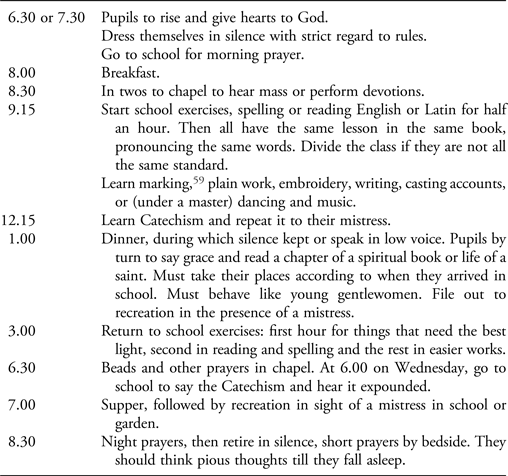
The convent schools had no terms: holidays fitted the liturgical calendar. Schoolgirls did not go home for the holidays, although they did write letters to their parents giving them news of life at school.Footnote 56 Some of them remained at the convent without a break for their whole time in the school, up to three years in a few cases. Some schools permitted visitors and exeats; others were more restrictive and only permitted pupils to talk to their families at the grate like the nuns, otherwise keeping them confined to their part of the enclosure. Unlike the membership of the convents, which was almost entirely English, in the schools there were pupils of different nationalities. This was particularly true of Sepulchrines in the 1770s and 1780s after Christina Dennett's reforms. The Paris schools had many local pupils, as did the English convent in Bruges in the second half of the eighteenth century, and there was often a substantial number of Irish pupils also.Footnote 57 Table 1 gives one of the few examples from the period setting out the pattern of the school day, indicating how the Mary Ward Sisters integrated elements of the religious life with school studies. The pattern of the day for schoolgirls at enclosed contemplative convents tended to allocate more time for them to follow the divine office with the community. At Hammersmith, pupils were in chapel only twice a day.
A School Day, reconstructed from details in a Hammersmith manuscript.Footnote 58

As the size of the community of sisters reduced, the school at Hammersmith employed additional lay teachers to teach French and supplement the instruction given by the sisters. A manuscript setting out the duties of officials in the house includes a section headed ‘The Office of the Mistress of the School’. From this, it is apparent that considerable thought had gone into how teaching was carried out and the kind of teachers that were wanted. For instance:
Mistresses … ought to be Persons of extraordinary Genius, Patience and Discretion; and never give themselves the Liberty of committing any of those Faults, which they should correct in their Scholars. A fond Partiality ought particularly to be avoided, because it makes the Favourite odious, and the Mistress despicable to the Rest.Footnote 60
There were enough pupils to divide them into classes of different levels and we can imagine the atmosphere and procedure in the class room from the following instruction:
Each Class shall have their Lesson out of the same Book, whether English or Latin, and being seated before the Mistress shall in silence attend to their Lesson, till they are calld up to say all or a part of it, or to spell or pronounce some word, which another seems not able to do.Footnote 61
Learning was reinforced by repetition: on Mondays the girls had to repeat the previous week's lessons. The pupils were to be constantly watched, partly to ensure that their manners and deportment at all times were correct: any punishments should be appropriate to the offence. The development of character is also covered: for instance, children should learn how to become good Christians by learning how to work and avoid idleness. They must report scandalous behaviour, but not trivial vexations, so as not to be a gossip or talebearer.Footnote 62
Family Archives and Convent Schooling: Two Case Studies
Documents in these families illustrate aspects of life in eighteenth-century convent schools. These are rare, chance survivals which allow readers to approach the lived experience of schooling and to begin to understand how families made choices regarding girls’ education. Space permits only brief consideration; nevertheless, they reveal a range of experiences from the latter part of the exile period.
The Huddleston Family
The Huddleston family owned an estate and a substantial country house at Sawston, near Cambridge. Ten Huddleston girls attended the school run by the Augustinian Canonesses at Bruges between 1688 and 1781, and at least four moved to school in Paris in the 1780s.Footnote 63 Four Huddleston women were professed as choir nuns at Bruges and could provide support which might serve to soften the school experience for individual pupils. Letters from Sister Justina Huddleston (d. 1787) reveal the importance of having family members at hand for girls boarding far from home.Footnote 64 Furthermore, the letters demonstrate that Sister Justina enjoyed the contact, to the extent of keeping an eye out for her great-nieces even after they left Bruges, reporting back to their parents on their academic progress and manners. Outside the convent, the young Huddlestons, both girls and boys, were taken under the wing of their aunt, Mary Bostock, who lived in Paris and acted in loco parentis while they were at school. Mary Bostock took care of Polly when it was decided she should change schools and her husband acted as an interim teacher so that Polly's progress should not be lost. He commented on Polly's French: ‘Our neice Polly's French letter is in a manner entirely her own, with but little correction on my [part] I wish I may be able to bring her to a more regular formed hand-writing, & at the same time that it may become a more free, easy hand-writing.’Footnote 65
Polly was taken away from the convent school at Bruges on the grounds that she was unhappy there, and sent to the Augustinian school in Paris.Footnote 66 Mrs Bostock reported her opinion on schools in Paris compared with Bruges:
my brother in his letter to Mr B says he hopes Jenny[’]s education here will not exceed 40 pounds a year[.]Footnote 67 I fear it will come to much more, the pension is not more then in Flanders, what runs away with the money is the masters who are paid very high endead, the same dancing master who is as he ought to be for his price a very good one teaches all the young ladys in their schole, the other masters wee have desired may be got as reasonable as possible. The French master wanted each a guinea a month but, how ever he [h]as agread to take that for both of them, these are all the masters they have at present. Polly wishes to learn to paint in water colours & wee are desirious she should, musick she does not seem to have much turn for, Jenny has learnd to draw at Bruges[.] she wishes to have a master to continue to learn that & allso her musick[.] every one seems to think she will have a strong good voice, on the other side I will give you a list of the prices of all the masters which the superior Mrs LancasterFootnote 68 gave me for your information & then you can determine whither you chuse Jenny should learn the musick & the drawing[.] their cousin who is now with us tells me the nuns doe not chuse to take more young ladys then a limited number that they can attend properly too, that several have been refused, but th[at] Mrs Lancaster told her she would not refuse any of the Huddlestons. It is a house where they are clever & therefore very desireable, very expensive to be sure, but you will have some thing for your money, whereas at Bruges laterly you have had very little[.] their schole is crouded with Flemish dowdys & the time takeing up in teaching them English, their duty excepted they learn very little … .Footnote 69
I have quoted at length because the letter makes some significant points about convent schooling. We see how pupils moved between schools, the importance of the masters who taught the extras, what the extras were, comparative costs and evidence of considerable care being taken over the choice of school. Members of the Huddleston family were aware of variations in the quality of teaching across the schools and were trying to make informed decisions.
Once Polly and Jenny were at school in Paris with the Augustinians, they were allowed out of the convent on occasion for expeditions. One letter they wrote home reported that the mother superior had allowed them to go to an exhibition of pictures and to see a procession of a hundred captives redeemed from Algiers, still wearing the same clothes they had worn on their release at Marseille.Footnote 70 The letters that Huddleston school girls wrote in English to their parents suggest that the teaching that they received allowed them to write fluently and easily. They wrote affectionately about their families and all of them married after they left school. Convent schooling seems to have broadened their experiences and expanded their horizons.
Harriet Goldie (1781–1845)
Two years before she died, Harriet Goldie began writing a memoir of her childhood and her days at two convent schools, which she entitled ‘Days of Yore’.Footnote 71 The manuscript is thought to have been destroyed during World War II, but fortunately a typescript had already been made. The memoir provides rare personal insights into one girl's experience of convent schooling at the end of the eighteenth century. Harriet (also known as Henrietta) was the daughter of a Protestant Edinburgh banker and his wife Sophia Macdowell. Mr Goldie died in 1785, when the children were still very young, and their mother took Harriet and her brother George to live in the country outside Edinburgh, where she taught them herself. In 1788, the Goldies went to stay with Catholic friends, Cecilia and Gerard Strickland at Sizergh Castle, Westmorland.Footnote 72 Following the death of her first husband, Charles Strickland, in 1770, Cecilia had decided to educate her daughter in convent schools. Mary Cecilia was sent in 1772 to the Bar Convent, York, then to the Poor Clares at Rouen, and finally from 1778 to the Sepulchrines at Liège for four years.Footnote 73 Through the Stricklands, Mrs Goldie became interested in the Catholic faith and, perhaps influenced by her friend's experience of the school, decided around 1790 to take her children to the Poor Clares at Rouen, where the family were, one after another, received into the Catholic Church. Harriet attended lessons in the convent and also took extra classes outside. The nuns taught the girls catechism and religious studies; feminine accomplishments were gained from masters and, together with her brother George, Harriet also undertook more advanced studies with other masters in the town. Harriet wrote that there were about fifteen or twenty students in the school, English, French and Portuguese.
In a somewhat haphazard fashion Harriet managed to learn a range of subjects and skills: Latin (with her brother), French translation, dancing, plain work and music, including the harp, piano and singing. Harriet's experience indicates the individuality of convent education at this period. She benefited from the presence of her mother and brother in Rouen, and from her mother's determination to facilitate her studies and expand her educational opportunities. The Goldies were caught up in the events of the French Revolution and endured imprisonment with the nuns in the convent, but they were able to return to England in December 1794. Mrs Goldie spent the first months of 1795 trying to find suitable schools for her children. After visiting several, she decided to send Harriet to the Sepulchrine school newly opened at Dean House, outside Salisbury. Although Harriet was writing fifty years later, she clearly differentiates her year with the Sepulchrines from her time in Rouen, making clear the difference between schooling with a primary religious focus and the revised curriculum of the Sepulchrines following Christina Dennett's reforms.Footnote 74 Dean House continued the broader curriculum brought from Liège, which was more suited to those who had no intention of entering the convent as nuns. Harriet was its first pupil,Footnote 75 and in her memoir she recorded her time and the members of the community with affection. Mother Agatha Laurenson, responsible for the school, was clearly highly educated and determined to develop her pupils’ learning.Footnote 76 Harriet comments on how clever Mother Laurenson was, knowing five languages, teaching interesting history, writing a new history text book for themFootnote 77 and showing Harriet how to make presentations. These (as in the Mary Ward schools) were regarded as part of the learning process and were performed by pupils to important visitors such as potential parents and benefactors.
Conclusion
These two case studies illustrate the points made earlier regarding the individuality of the experience of convent education during this period and the ways in which families and nuns adapted the programmes on offer. Girls from these families made the most of their opportunities and wanted more than devotional reading and catechism, needlework and feminine accomplishments from their schooling: others had very different attitudes and experiences. These girls had parents who recognized the importance of education for girls, sought advice and chose institutions that were recommended to them. We see how each pupil's timetable could be tailor-made according to parental wishes; but we can see also that this was expensive and thus beyond the reach of many families. Even the two boarding schools in England were too expensive for many parents, although travel costs were lower. The level of parental involvement in their daughter's schooling in these examples is considerable, and it is hard to imagine that this could be widely replicated, given the complications of cross-Channel contacts and arrangements.
The case studies illustrate a range of variables. There is the initially Protestant Goldie family, headed by a widow, all three of whom converted to Catholicism while Harriet was attending school in Rouen. The Huddleston correspondence shows the transnational contacts made by Polly, Jenny, Harriet and Charlotte through their encounters with local fellow pupils at Bruges. The case studies bear witness to the broad curriculum introduced for girls at the schools of the Canonesses and the Mary Ward Sisters, rather than schooling which focused primarily on religious instruction. These girls were sent away in their teenage years, suggesting their mothers were responsible for their early childhood education and upbringing. Like many convent schoolgirls, none of these girls entered religious life, and Harriet Goldie never married. The evidence shows mothers closely involved in the choice of school and Mrs Goldie (unusually) accompanying her daughter to Rouen; other children were sent over with chaperones. This was possibly due to her circumstances as a widow and her interest in receiving religious instruction. Other parents chose to travel from England to visit their children when they were at school abroad.Footnote 78
Taken overall, the evidence demonstrates that convent schooling for English girls could be made to fit a range of aspirations and appears to have been very flexible to suit parental wishes. It has also been argued that, in a survey of convent schooling for English girls, it is important to include girls who attended the French Ursuline boarding schools. The Mary Ward Sisters’ schools at Hammersmith and York, operating through much of the exile period in spite of the penal laws, provided education with a formal structure and a broad syllabus for girls in schools nearer at hand, representing schooling that would provide Catholic girls with similar opportunities to those then available in Protestant schools. Christina Dennett's reforms at Liège enabled the Sepulchrine school to flourish and to establish a successful school when they migrated to England. Piecing together sources over this long timespan, we can start to uncover what is meant by convent schooling during the exile period. The aim here has been to provide enough pointers to suggest directions for future research and to introduce readers both to individuals who experienced life in convent schools and to some of the members of convents who were influential in managing them. Set against a backdrop of penal laws intended to prevent the survival of Catholicism, the creation of girls’ schools on this scale is a remarkable achievement. The easing of the application of the penal laws in the eighteenth century and changes in attitudes towards girls’ schooling are reflected in the growth in size of Catholic schools and reforms in their curricula that gave rise to the experiences described in the case studies.
Appendix: Foundations of English Convents, grouped by Order
Those known to have schools are marked*.
*Louvain, Augustinian Canonesses, 1609, arrived in England 1794.
*Bruges, Augustinian Canonesses, 1629, in England 1794–1802, still in Bruges.
*Paris, Augustinian Canonesses, 1634, in Paris until 1911.
*Liège, Sepulchrine Canonesses, 1642, arrived in England 1794.
*Gravelines, Poor Clares, c.1606, arrived in England 1795.
*Dunkirk, Poor Clares, 1625 (temporary), 1652 (permanently) from Gravelines, arrived in England 1795.
*Aire, Poor Clares, 1629, offshoot of Gravelines, arrived in England 1799.
*Rouen, Poor Clares, 1644 from Gravelines, arrived in England 1795.
*Brussels, Franciscans, 1619, to Nieuport 1637, to Bruges 1662, arrived in England 1794.
*Paris, Franciscans / Conceptionists (‘Blue Nuns’), 1659, arrived in England by 1799, died out 1838.
*Brussels, Dominicans, 1660, arrived in England 1794.
*Brussels, Benedictines, 1599, arrived in England 1794.
*Cambrai, Benedictines, 1623, arrived in England 1795.
*Ghent, Benedictines, 1624, from Brussels, arrived in England 1794.
Paris, Benedictines, 1653, from Cambrai, arrived in England 1795.
*Pontoise, Benedictines, c.1658, started in Boulogne 1652, offshoot of Ghent, closed 1786.
*Dunkirk, Benedictines, 1662, from Ghent, arrived in England 1795.
Ypres, Benedictines, 1665, became Irish convent and remained until 1914.
Antwerp, Carmelites, 1618/19, arrived in England 1794.
Lierre, Carmelites, 1648, from Antwerp, arrived in England 1794.
Hoogstraten, Carmelites, 1678, from Antwerp, arrived in England 1795; some left in 1790 to found a convent in Maryland.
*St Omer, Mary Ward Sisters, 1609, suppressed 1630/1.
*Liège, Mary Ward Sisters, 1616, suppressed 1630/1.
*Paris, Mary Ward Sisters, 1650–1705.
*Hammersmith, Mary Ward Sisters, 1669–1795.
*York, Bar Convent, Mary Ward Sisters, 1686, still open.
Lisbon, Bridgettines, 1594. The Bridgettines were the only community founded before the Reformation (at Syon). They returned to England under Mary Tudor and went into exile a second time in 1558, moving round the Southern Netherlands, and then leaving for Rouen in 1580. Most returned from Lisbon to England in 1809.