The history of the Catholic Church in the Democratic Republic of the Congo, now sub-Saharan Africa's largest country, has proved of great interest to scholars of late. Historians’ interest in the Congolese colonial mission encounter has ranged from the Jesuits’ work in Lower Congo to that of the White Fathers in the Kivus and the former Katanga province.Footnote 1 However, the Benedictines, whose labours in the Congo began in the early twentieth century, has so far only attracted the attention of a small clutch of scholars, most notably Eva Schalbroeck and Gaëtan Feltz.Footnote 2 The Benedictines, though, occupied a very important place in the mission history of the Congo largely on account of the resources and the political influence they had.
Unlike some of their co-religionists elsewhere in colonial Africa, such as the Franciscans, the Benedictines eschewed an approach that focused on adaptationism or, in Schalbroeck's words, ‘basing religious action upon indigenous concepts and adapting the evangelisation endeavour to local circumstances by using indigenous knowledge’.Footnote 3 Instead, the Benedictine leader in the Congo, Jean-Félix De Hemptinne, pursued an aggressively assimilationist approach to his work. This is to say that he expected elite Congolese adults, known widely after the Second World War as évolués, to ‘gradually integrate into the Christian, European, Latin and technocratic civilisation, in opposition to so-called primitive collectivism and fetishism’.Footnote 4
Assimilation and adaptationism were, of course, two sides of the same racist, paternalist coin. Just as assimilationists wanted to impose a series of beliefs onto African societies, adaptationists wanted to ensure the latter gradually inculcated them. Put differently, the idea that African expressive cultures were substantially deficient in and of themselves and thus in need of mission salvation was common to both approaches. That De Hemptinne would be assimilationist specifically, though, was unsurprising. The discourse of assimilation, the approach that was more dismissive of local cultures, was popular among a number of senior clerics by the time that De Hemptinne arrived into the Belgian Congo, not least Victor Roelens – the pugnacious Apostolic Vicar of Upper Congo.Footnote 5 And, much as René Devisch suggested, ‘capitalist enterprises and the church agreed on the fact that conversion to Christianity and education should instil modern bourgeois notions of discipline, self-control, perseverance, and obedience to public authorities’.Footnote 6
De Hemptinne's assimilationist approach mattered, first, because of his position as leader of the Benedictines in the Congo and, secondly, because he lived so long. Having begun to work in the Congo in late 1910, the so-called ‘Lion of Katanga’ continued to preach there until his death in 1958.Footnote 7 This article explores the material rather than theological factors pertaining to the question of how De Hemptinne was able to follow an assimilationist rather than adaptationist approach to his mission work in spite of the pressures he and his missionaries faced in the Congo. To do so, it proposes two main hypotheses. First, the Benedictines made use of what Chris Bayly described as ‘lateral connections’; that is to say that the order had experience in another part of the globe, namely Brazil, which it used to further its work in the Belgian Congo and particularly during the opening phase of its work in the colony.Footnote 8 Secondly, the Benedictines had a very close – if turbulent – working relationship with the colonial state that it could use to its advantage. These two factors, the Church-State relationship and lateral connections, were not mutually exclusive since, as will be shown, they intertwined on several occasions, not least in the formation of the Benedictine project in the Congo.
To support these arguments, this article mainly – but not exclusively – uses the sources available in the Benedictine archive. This archive unsurprisingly contains unsurpassed information about the ways in which the Benedictines worked and, at times, how they reflected on what they were doing in Belgium's largest colony. What is more, it also boasts an extremely diverse repertoire of sources ranging from newspaper clippings to mission diaries. Like a number of European mission archives, however, one thing that the Benedictine archive noticeably lacks is a detailed exposition of African voices and perspectives. As such, the African voice on many occasions either has to be reconstructed from reading relevant sources against the grain or from using the few sources that do include an African voice.Footnote 9 Regrettably, therefore, the sources reflect the main argument of the article and that is that the Benedictine mission hierarchy operated at a noticeable ethnographic distance from the African societies that they encountered. In other words, evidence of conversations between European missionaries and African catechists and converts is hard to find. The archive's main strength, though, is in its rendering in a clear manner the thinking, as well as the actions, of senior clergy, such as De Hemptinne.
The argument is structured chronologically, beginning with the Benedictines' early years in the Congo. This structure emphasises the article's two major themes – lateral connections and the close Church-State relationship – throughout. The first section focuses on the Benedictines’ formative years in the Belgian Congo. It argues that the order enjoyed a close Church-State relationship from the very beginning and one that was nurtured by precisely the lateral connections that would later help to sustain it. The next section continues the story by suggesting that some monks, who had gained crucial experience during the Benedictine restoration in Brazil, helped the order adapt to the Congolese hinterland without much assistance from local African societies. Agricultural and logistical expertise was not important solely in a survival sense but also as part of the emphasis on ‘ora and labora’ (prayer and work) in the Benedictine Rule.Footnote 10 The final part focuses more on the close but sometimes difficult relationship that the Benedictine missionaries had with the state. It agrees with other authors who have argued that the Church did not work seamlessly with the colonial administration such as in the case of the Belgian labour recruitment that frequently deprived the Benedictines of converts.Footnote 11 However, it suggests that, unlike the Protestant missionaries with whom they were competing, the Benedictines could still rely on significant state patronage and labour to further their ambitions. Yet, just as they helped to sustain the order, such close connections meant that it was bound tightly to the colonial administration in such a way as to make it vulnerable to decolonisation later on. As such, the Benedictine experience in the Belgian Congo exemplifies Jehu Hanciles's argument that imperial patronage proved a ‘double-edged sword’ for Christian missionaries.Footnote 12 While colonial patronage worked to finance many Benedictine facilities, it tied the order closely to Belgian rule making it exposed to nationalism and anti-clericalism during the process of political decolonisation in Central Africa.
‘To Share their Life and Interests with the Congolese People’
The beginning of the Benedictines’ mission in Congo offers some of the strongest evidence of the close relationship the Benedictines had with the Belgian state and by extension the colonial Congolese administration. As opposed to the Spiritans, whom Léopold ii had exiled from the Congo Free State (1885–1908) because they had collaborated too closely for his liking with the French-backed Italian explorer Pietro Paolo Savorgnan de Brazzà, the Benedictines were among the Belgian monarchy's most trusted allies.Footnote 13 Léopold had died, however, by the time the Benedictines came to work in Central Africa. As such, their arrival in the colony coincided with the succession of Albert i of Belgium to the throne in 1909. The new king was keen to recruit the Benedictines as educators to rehabilitate the reputation of Belgian rule on the continent after the horrors of the Free State had been brought to international attention by the Congo Reform Association.Footnote 14
Albert i had been struck by Monseigneur Gérard van Caloen's frenetic work reviving the Benedictine communities in Brazil after the fall of the country's empire there in the late 1880s.Footnote 15 In 1896, van Caloen, a Belgian by birth, had described himself as ‘a Brazilian by affectation and by naturalisation’.Footnote 16 In 1905, he was appointed as the abbot of a church in Rio de Janeiro, Nosso Senhora do Monserrate, and by 1906 he was ordained bishop of the titular see of Phocaea.Footnote 17 Monseigneur van Caloen's devotion and acculturation to his Brazilian surroundings had persuaded Albert i that the Benedictines were well-placed to help him refashion the image of Belgian rule in Africa. In the words of the Benedictine chroniclers Pierre Legrand and Benoît Thoreau, he wanted the Benedictines to ‘share their life and interests with’ the Congolese peoples, presumably just as he believed that Monseigneur van Caloen had shared in the lives of the Brazilians he worked with.Footnote 18 Monseigneur van Caloen's work in Brazil was a vitally important lateral connection in the initial formation of the Benedictines' work in the Congo – even if De Hemptinne would never aspire to von Caloen's affinity with his local congregants.
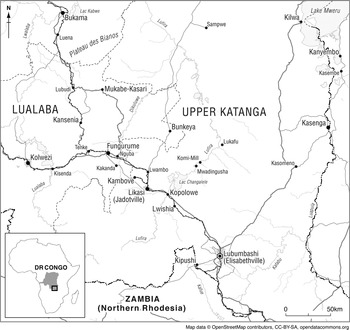
Very few Catholic missionaries operating in the Congo boasted De Hemptinne's close personal connection to the Belgian throne, with his even having been rumoured to be the illegitimate son of Léopold ii.Footnote 19 Even other Catholic groups, such as the White Fathers, which had a close relationship to the Belgian administration, did not have such significant royal connections. Having received the warm support of both the colonial administration and Albert i, the Benedictines were granted a very large concession in south-eastern Congo in 1910 in an arrangement that was also blessed by Pope Pius x.Footnote 20 This concession was based in what was for a long time known as ‘Katanga’, a region in the Congo roughly the size of France. Katanga was itself divided into districts with the one most relevant to the Benedictines’ work being ‘Upper Katanga’ (see Figure 1 below). Not only had the Benedictines gained a concession in Katanga due to the support of the Belgian king but they were well connected to leading Belgian statesmen also, not least to Jules Renkin, the first Minister of the Colonies to govern the Belgian Congo. It was not surprising, therefore, that the Ministry got in touch with van Caloen merely days before Léopold ii's death in 1909 to try to enlist his support for a Congolese Benedictine mission.Footnote 21 Crucially, the Benedictines, along with the Salesians whom they often regarded as their competitors, had also been assigned to educate the miners employed by the Mining Union of Upper Katanga (Union Minière du Haut Katanga) to perform technical duties and so their work was doubly aided by their relationship with Belgian officialdom.Footnote 22
Map of south-eastern Congo, c.1910–c.1960

While the Benedictines could rely on state funding towards the end of the colonial period, much of the money for their Congo mission in its early days came directly from the De Hemptinne family and especially from De Hemptinne's acknowledged father Joseph.Footnote 23 Joseph De Hemptinne was an influential member of the European Ultramontanist movement, which eagerly embarked upon what Emiel Lamberts has called the Church's ‘struggle with Leviathan’.Footnote 24 In other words, Joseph De Hemptinne sought to diminish the influence of liberal and socialist currents in European culture and politics. To this end, he worked to ensure that Catholicism would gain a foothold in the Belgian Congo and, afterwards, act as a powerful counterpoint to the anticlericalism that he saw as on the rise in Western Europe. As a successful textile merchant and one of the ‘grand bourgeois’ of Ghent, Joseph De Hemptinne had the means to pursue these aims and he did so in large part by funding his son's Congolese mission.Footnote 25
Having secured land and patronage, one of Jean-Félix De Hemptinne's first Benedictine out-stations in rural Congo was Nguba (see Figure 1 above). Nguba was a large village situated around 100 kilometres to the north of what would later become Jadotville (Likasi). De Hemptinne, together with five other Benedictine missionaries, arrived there on 21 October 1910 after a long and arduous journey through central Africa.Footnote 26 As was unsurprising given their leadership's close relationship with the Belgian crown, the Benedictines were warmly welcomed by the colonial administration once they got to south-eastern Congo. As well as seeing them as important providers of education, it saw them as vital allies in the struggle against Anglophone Protestant influence in the region which it saw as a fifth column for British and potentially American imperial ambitions.Footnote 27 Crucially, at this very early stage, the Benedictines’ relationship with the Belgian administration meant that the latter requisitioned around forty porters for use by the missionaries on their mission, which was dedicated to St Andrew (St André).
De Hemptinne's choice of Nguba had been influenced by the expectation of the construction of a railway nearby, which would run to the town of Kambove that was fast becoming a burgeoning administrative centre.Footnote 28 Life on the Nguba mission, part of the St Andrew mission overall but called La Toussaint as an individual out-station, was tough for De Hemptinne and his men. Despite having successfully requisitioned African labour, survival remained very precarious. The main concern was the constant lack of food, much as the historian Bruno De Meulder suggests.Footnote 29 More specifically, it was hard to rear cattle on Nguba's poor grazing land and even the labour that the colonial state had requisitioned for them was not enough to produce much food.Footnote 30 The missionaries’ work was also held back by their having arrived in south-eastern Congo during the rainy season. The inclement weather meant that it was difficult to establish durable buildings and nearly impossible to travel.Footnote 31 It was only with the help of some twenty additional African labourers, in all probability coerced by the Belgian administration, that the missionaries built a road into the bush and started to evangelise the local population.Footnote 32
The Benedictines' relationship with the colonial state did not save them from a number of other tribulations, however. For example, even with the new road built, transport remained a challenge throughout the early years. Even worse, after the wet season had subsided, the dry season brought its own problems with the worst of them being famine.Footnote 33 The lack of rain in May 1911 meant that the harvest that year was completely spoiled. And food shortages during the Benedictines' first year in Nguba did not escape the Belgian public's notice. De Hemptinne was forced to admit to hostile reporters that by far the most pressing daily question during the sweltering summers of 1911 and 1912 was what exactly his missionaries would eat.Footnote 34
With the coming of the dry season and its problems, an important opportunity emerged for the Benedictines to enter into a more meaningful dialogue with the African societies nearby. This was because the missionaries survived during this fraught time by trading with locals whenever they could in order to acquire maize and potatoes. Despite their vital trading relationships with local African groups, there is little in the Benedictines’ archives to suggest that this influenced any kind of change from De Hemptinne's assimilationist doctrine, even if this episode doubtless accelerated their language learning. Whether assimilationist or adaptationist, De Hemptinne acknowledged in the Socialist newspaper Le Peuple that ‘there was all to be done in Katanga’.Footnote 35 By December 1910, he grew even more pessimistic; as he put it in another letter to Le Peuple, ‘our material concerns occupy . . . nearly all our time’.Footnote 36
On 21 April 1912 Le Peuple assessed the situation in Nguba to be so dire that the Benedictines might have abandoned their presence in Katanga altogether.Footnote 37 Le Peuple acquired at least some of its information from an anonymous member of the newly founded Belgian Solvay Institute of Sociology; this member's comments on the Congo situation had frequently proved to be true.Footnote 38 Despite all their tribulations, the order had not, in fact, abandoned Nguba.Footnote 39 Dom Théodore Nève, one of De Hemptinne's followers, wrote angrily that ‘they had never dreamed of [leaving]’ and that he did not know ‘from which source’ Le Peuple heard the rumour.Footnote 40 While acknowledging that ‘certain regions of Katanga in general and of our N'Guba mission in particular have suffered from a lack of food’, he went on to write that ‘we do not seek to discuss it, nor to hide it’.Footnote 41 Given the famine conditions, it can be of little surprise that Benedictine authors initially involved in the Congolese mission, notably Pierre Legrand and Benoït Thoreau, dedicated much space in their publications to justifying why they had chosen Nguba.Footnote 42
While with hindsight the choice of Nguba as a place for a first out-station appears misjudged, the Benedictines’ tough early experiences there were not so far removed from those of many other Catholic missionaries working in Africa at the same time. The White Fathers and the Spiritans, for example, each had difficult experiences in south-eastern Congo during the early twentieth century.Footnote 43 The Benedictines had also had a difficult time in sub-Saharan Africa even before their Congolese mission. In German East Africa, for example, they had had to deal with the Maji Maji rebellion (1905–7) as well as severe food shortages.Footnote 44 Yet they had been able to call on the colonial state for aid in the Congo and – crucially – one that remained in situ longer than the Germans did in Tanganyika.
As scholars have maintained, the Benedictine-state relationship was not absolutely seamless but it was still powerful enough to maintain De Hemptinne's assimilationist approach at the outset. Furthermore, the order had a closer relationship with the state than did other Catholic orders.Footnote 45 The pressures to adapt to African life-cycles and styles, as opposed to adapting these into the Benedictine rule, remained nevertheless. Artisanal mining and agricultural cultivation were popular survival strategies in the village and so the Benedictines were constantly frustrated by the emphasis on material welfare that the inhabitants demonstrated.Footnote 46 Like their co-religionists working elsewhere in south-eastern Congo, they were also frustrated that young women were married to polygamous elders and so were difficult to convert.Footnote 47 If they were to succeed, the Benedictines would thus have to at least work around some of the economic concerns of their surrounding populations.
Mission death and resurrection, 1913–22
The hardships De Hemptinne and his followers encountered in Nguba made it clear that they would have to build other stations to ensure their survival but – initially at least – it was not clear where these would be.Footnote 48 To that end, the sub-tropical climate of the Plateaux des Bianos to the north of Nguba soon appealed to the missionaries. Kansenia (see Figure 1 above) was the nearest town to the Plateaux and, for a period of eight years after their time in Nguba, this became the ‘centre of Benedictine activity and the prospective seat of the mission’.Footnote 49 The Benedictines had first prospected Kansenia as early as 1911, and began to construct buildings there shortly thereafter. From Kansenia, they proselytised European settlers (the colonat) as well as Africans.Footnote 50 De Hemptinne continued his interest in the colonat, and especially in educating their children, throughout his time in the Congo in a move that, again, distanced his Benedictines from African societies on the Copperbelt.Footnote 51
The Kansenia mission was lent added impetus by a number of secular priests, such as the abbés Moreau and Maes, who joined it shortly after it began. These new hands were able to do mission work but – importantly – they were also able to offer agricultural guidance from expertise that they had acquired during their long service in Brazil. This did not mean that the mission at Kansenia did not experience some of the same difficulties the Benedictines had encountered in Nguba; Kansenia too was vulnerable to bad harvests and destruction of crops by marauding elephants, for example. And, as in Nguba, African labour was essential for Kansenia's survival. The twenty-five Africans requisitioned by the colonial state within the Benedictine compound assisted in the irrigation of the land surrounding Kansenia to allow the production of crops even during dry seasons.
But the Brazilian expertise brought by Moreau and Maes, particularly in relation to the irrigation of dry lands, meant that the situation in Kansenia was nowhere near as bad as things had been beforehand. So, while the soil in Upper Katanga was just as dry as Bruno De Meulder and Bruce Fetter have observed, the Benedictines at Kansenia did manage to farm the land once it was properly irrigated.Footnote 52 The monks eventually managed to cultivate around four acres of land around the station and the addition of a road ensured that the mission could purchase foodstuffs when required. Edmond Leplae, the colonial Director of Agriculture, believed that a decent road suitable for motor travel was essential for the development of the region; accordingly he lobbied the administration successfully.Footnote 53 Leplae's road project took some time to complete but it was ready by 1913.
Although the colonial state had helped Kansenia's growth in terms of its requisitioning of African porters, it also posed problems for the Benedictines. Kansenia frequently faced a shortfall of potential converts that was caused by the removal of men by a para-statal organisation, the Katangese Labour Exchange (Bourse du Travail du Katanga) (BTK). The BTK requisitioned African men to work in mining centres such as Elisabethville (Lubumbashi) and Jadotville (Likasi) and this meant that there were fewer of them to be converted.Footnote 54 The labour dynamics that the BTK set in motion were important to the Benedictines’ plans because the beginning of their mission in Katanga coincided with a time of increasing prosperity for the mining concessions there.Footnote 55 The rising global demand for metals, notably copper in the context of Katanga, meant that colonial recruitment became a prominent part of village life in the 1920s. This demographic shortfall of men in many rural areas was not lost on De Hemptinne who railed against the fast pace of industrialisation.Footnote 56
De Hemptinne chose to draw as many of those who were not chosen by the BTK to labour in the mines to the Church even if he was initially undecided about how best to do this. Much like Gérard van Caloen, De Hemptinne had been torn between a more traditionally cloistered Benedictine existence and a more evangelical approach to his work in the Congo. It was, for example, a perennial Benedictine dream to found a Monte Cassino in the Congolese bush.Footnote 57 Yet the Benedictines would have to wait for a number of years after the 1920s for a viable monastery to be constructed in Katanga. The Mukabé-Kasari site (see Figure 1 above), near what is now Likasi and close to many of the UNHK mining facilities, eventually became a modest success for the Benedictines. But this monastery would not properly flourish until the Great Depression.
So, soon after he arrived in Central Africa, De Hemptinne sought a balance between monastic versions of the religious life and a more evangelical approach to his work by attempting to borrow from each, as befitted the circumstances that he encountered. Initially, he believed that the evangelical approach of building an orphanage would draw more Africans to the Kansenia mission. However, given that African families on the Copperbelt, much as in the Congo as a whole, were not all constituted of nuclear units but usually of extended kinship groups, this was mostly impracticable.Footnote 58 In practice, if a child lost its parents then it would be taken care of by a relative. Given that children were indispensable sources of labour for extended families, it was rare, therefore, for any child to be entirely abandoned.
Instead of attracting orphans to Kansenia, De Hemptinne opted to attract entire villages. And so he reverted back to his initial strategy of building a monastery that would trade in meat, salt and tobacco – all goods that were desirable by those working on the largely fallow terrain of the Copperbelt and its hinterland.Footnote 59 De Hemptinne's idea of attracting large numbers of Africans to a mission centre might have sounded over-ambitious, not least given his Nguba experience, but it proved something of a success in Kansenia. By 1919 there were around 250 head of cattle on the farm in the mission.Footnote 60 Vegetables were also growing in abundance in the order's gardens. So, even as early as 1913, soon after Kansenia was established, four petits chefs wanted to install themselves and their subjects nearby.Footnote 61 These chiefs’ subjects were grouped into villages of some fifteen to twenty homes, and helped realise the Benedictines’ vision. With the arrival of these new inhabitants, the Benedictines even opened a school in Kansenia. They also began building schools en route to Panda.
After his early experiences in the field, De Hemptinne demonstrated that he was taking evangelical missionary methods much more seriously. In keeping with his newfound flexible approach, the missionaries at Kansenia began to evangelise the local population. As well as trying to convert whole communities, the Benedictines also pursued a ‘Constantine’ strategy that had its roots in the Jesuits’ mission encounters in the Congo during the early modern period. So, they attempted to convert the leaders of African communities in the hopes that their faith would be adopted by their followers. When they started mission work in Kansenia's villages they aimed at converting chiefs, who in turn might spread the gospel message among their people.Footnote 62 In their account of the Benedictines’ first decades in Katanga, the Benedictine chroniclers Legrand and Thoreau celebrated the fact that Mutobo, a major chief from the Kansenia hinterland, asked a Benedictine brother to share some pombe (local beer) with him.Footnote 63
But De Hemptinne was also keen to evangelise beyond the chiefly class and so he translated the catechism into Sanga, a local southern Katangese tongue that is part of the Luba language family.Footnote 64 In undertaking his translation, De Hemptinne had been strongly influenced by Victor Roelens who had translated the catechism into Swahili earlier in the colonial period.Footnote 65 The Benedictines taught the catechism, alongside mathematics and French, in the network of schools they built in Kansenia and its surroundings. Around 1,300 Africans were attending the Benedictine schools there by the end of the First World War. The mission counted 600 catechumens and thirty catechist teachers among its number, and conducted its first six baptisms by the 1920s.
The translation and dissemination of a Sanga catechism was no doubt an important step for De Hemptinne in engaging meaningfully with one of the main cultures that he had encountered in Katanga, given that its production presupposed an in-depth knowledge of the local language. However, much like Roelens in the Kivus and northern Katanga, De Hemptinne did not adopt any parts of local cosmological thought and ritual into the Catholicism that took root in his mission out-stations. Rather than a sign of adapting to local circumstances, the translation of the catechism was more a sign that De Hemptinne's Catholicism could be articulated more comprehensively to Africans in his out-stations. It was not a meaningful intellectual engagement with their culture(s). Other Benedictines, such as Dom Jerome, were also skilled linguists but wanted to convey their own message in Sanga rather than engage with local religious beliefs.
Many Benedictines during this period – and not just De Hemptinne – looked down on local traditions and the Africans who adhered to them, frequently using the words ‘pagans’ or ‘savages’ to describe them throughout their time in the Congo.Footnote 66 They were convinced of the superiority of Europeans over Africans – not unlike a number of their co-religionists elsewhere in the Belgian Congo. As the historian Laurenti Magesa suggests, De Hemptinne ‘argued that the term “civilization could not be applied to black people as they could not write”’.Footnote 67 As opposed to embarking on an intellectual odyssey as the Franciscan Placide Tempels did later on, the Benedictines retained a belief in the superiority of their race and of their religion.Footnote 68 It is also worth noting that De Hemptinne was continually hostile to Tempels and repeatedly attempted to bring about his downfall by raising questions about his work with his superiors in Rome.Footnote 69 When Tempels initiated a discussion with De Hemptinne about incorporating African beliefs into the Church, the latter stated that for him, ‘customs are nothing, and to defend them is to play into the hands of Bantu nationalism’.Footnote 70
Even without significant adaptation to their African hosts’ cultures, the Benedictines experienced a great deal of success on their own terms once their Nguba episode had ended. In large part, the stabilisation of their mission was due to the relationship they had had not with Africans but instead with the state and its ability to requisition African porters. Even the site of the Cathedral of SS Peter and Paul was funded not by African converts, but by members of the colonat. The Benedictines’ lateral connections also had an important impact in terms of the knowledge that Moreau and Maes had brought with them from Brazil. As the challenge of survival became less pronounced, though, such lateral connections were less important than the subsidies, mainly for educational activities, which the Benedictines received from the state.
Education, Protestantism and the Benedictines' work in Haut Katanga Industriel, 1923–59
Having worked hard to establish themselves in south-eastern Congo, the period after the First World War saw the Benedictines make significant headway in the Katangese hinterland. Even though work on Lukafu was held up by the onset of the Second World War, the missionaries took advantage of peacetime conditions to re-start their evangelisation campaigns. Rather than having to focus on bare survival, they could concentrate far more on limiting the Protestant presence that had grown considerably since the turn of the century. At first, the Benedictines' opposition to Protestantism might appear to be solely a religious matter. However, in opposing Protestant expansionism, the Benedictines’ mission dovetailed with a key colonial state objective.Footnote 71
While some individual Belgian administrators looked favourably on Protestantism, they were hardly the rule.Footnote 72 Generally, the colonial administration was hostile to it.Footnote 73 And, in the period after the Second World War, De Hemptinne exploited the colonial administration's fears about industrial unrest by suggesting to them that there was ‘an identity between the political programme of the American missions and the political programme of Moscow’.Footnote 74 Though De Hemptinne's statement was palpably absurd, the Benedictines continued to present themselves to a ‘nervous’ Belgian administration as a bulwark against what they argued was Protestant–Communist expansion in a move that served to reinforce an already close relationship between them and the state.Footnote 75
One of the most important out-stations on the Catholic/Protestant frontier in south-eastern Congo was the Lukafu l'Immaculée mission. It sat on the fringes of the Katangese mining complexes and so was in a strategically important position given its proximity to the Copperbelt labourers there. As Benedictine missionaries settled in Lukafu, they hoped to advance on to Bunkeya (see Figure 1 above), an important Protestant stronghold, later on.Footnote 76 Frederick Stanley Arnot, a member of the Protestant Plymouth Brethren, was among the first Protestants to evangelise Africans in and around Bunkeya after he arrived there in 1886.Footnote 77 Once Arnot returned to England in 1888, Dan Crawford took over his work and founded the influential Garanganze Evangelical Mission (GEM).Footnote 78 Although GEM did not grow much before World War I, the creation of a railway nearby caused the influx of many potential converts into the area and renewed the mission. Around the same time, Protestantism in the Congo was spurred on when William Burton and James Salter created the Congo Evangelistic Mission in 1915.Footnote 79
For the Benedictines, Lukafu was thus not only an important out-station in its own right, but a crucial instrument in their attempts to curb Protestantism in Bunkeya and south-eastern Congo writ large. The order benefitted from the fact that the colonial regime had already established a presence in Lukafu. This made access to food and other essential supplies far easier than elsewhere and so prevented any recurrence of the Nguba episode.Footnote 80 In 1923 Boniface Pullons became the first Benedictine to start mission work there, with Robert Allain taking over the construction of facilities shortly afterwards.Footnote 81 Like Kansenia before it, Lukafu exemplified the tension within the minds of senior Benedictine figures like De Hemptinne between living their traditional cloistered lives and their increasing desire to evangelise like the White Fathers and the Spiritans. Tellingly, in this regard, one of the first buildings the missionaries constructed in Lukafu was a boarding school (internat), a mission building, and not a monastic facility.Footnote 82
Boarding schools served some of the functions that farm-chapels (ferme-chapelles) or school-chapels (écoles-chapelles) did in other missions in the Congo by separating children from their parents and so from their traditions.Footnote 83 Internats aimed to train children to become catechists who would then transmit the gospel message to those in the surrounding villages. By 1924 the Benedictines had constructed two internats that served 1,644 pupils in Lukafu and its environs.Footnote 84 Those pupils who did not become catechists sometimes taught in the very schools from which they graduated. To this end, by 1927, an école normal or teacher training college was established alongside the internat. In some instances the two categories – catechists and teachers – were not mutually exclusive since catechists would often be teachers. Schools also hired African monitors, albeit with state funds, from among their former pupils. By 1951 Mutombo Louis, Mwaba Luc and Mikombe Germain had taken up this role and were receiving a decent yearly salary of over 6,000 francs as a result.Footnote 85
The internats and écoles normals and the whole Lukafu mission were sustained by good harvests of the kind that were so notoriously absent in Nguba at the turn of the century. Even though crop production in Lukafu was not always very high, it was nearly always enough to sustain a considerable mission station.Footnote 86 In 1927 the Lukafu mission diarist observed that following the summer, ‘the residents [of the boarding school] returned without being exposed to hunger’.Footnote 87 Successful harvests followed from an improved understanding of the climate and seasons by the Benedictines after their original experiences in Nguba. They worked hard to make the most of the planting season and had encouraged their congregation to do the same.
In some situations in the Congo, Catholic missionaries learnt agricultural techniques from the African societies that surrounded them. But this was not the case with the Benedictines or at least this was not how it is presented in their archives. Instead of Benedictines learning African farming techniques, in the relevant archives the missionaries paint a picture of themselves disseminating best practice to their erstwhile hosts. In their correspondence the missionaries suggested that some African congregants eventually became farming experts as a result of following the good practices of the Benedictines and not the other way around. Indeed, agriculture became another means by which local people, at least according to the Benedictines, became assimilated into the mission world rather than vice-versa.
From Lukafu, the Benedictines had Bunkeya firmly in their sights – by far the greatest prize for De Hemptinne's missionaries. The Benedictines had reached the town soon after they had got to Lukafu and had been evangelising there for four years by the time the Great Depression struck. Although the Protestant presence there meant that the Benedictines faced considerable competition in Bunkeya, it had some positive consequences for them. The fact that Protestants such as Dan Crawford had been to the town already meant that people had been exposed to Christianity and so were familiar with at least some of its key tenets.Footnote 88 In fact, former Protestants formed the nucleus of the emergent Benedictine congregation in Bunkeya.Footnote 89 Thomas Kisela, for example, became one of the Benedictines' most successful catechists. In this instance, the evidence for the large number of Protestant converts, such as Kisela, comes from the Benedictines' own internal report for 1926. Even so, it is not hard to imagine it would have been easier to convert existing Christians to Catholicism than those who had less experience of the Gospel.
The Benedictines frequently claimed that their – as opposed to the Protestants’ – liturgy attracted the congregations of the Copperbelt during the inter-war period. Yet over and above the liturgy, the resources that the Benedictines had at their disposal must have been one of their major advantages over many of their Protestant competitors. Protestant missionaries in the Belgian Congo usually had Nonconformist and low-church tendencies, such as the Plymouth Brethren in Bunkeya, and often struggled for money in the absence of a state patron. The American Methodists under the Revd John Springer, who arrived in Bunkeya in the late 1920s, were admittedly better financially endowed than their Protestant forebears. Yet even they could not compete with the Benedictines, who were lavishly subsidised by a colonial administration keen to curb Anglophone influence. The emergence of an indigenous Church, known as Kimbanguism, founded by a Baptist catechist, Simon Kimbangu, only increased the administration's fear of Protestant groups gaining power in Katanga.Footnote 90
After the Second World War, thanks to increased state funding, the Benedictines expanded their presence in the Katangese hinterland in a way that pressured their Protestant competitors even if they did finally close their station at Nguba. The capacity of a girls’ school that the Benedictine sisters built in Bunkeya in 1934, for example, was significantly increased in 1947. Likewise, in 1949, the order established another girls’ school in Kapolowe, 88 kilometres south of Bunkeya, with the state paying 37,400 francs to support this project.Footnote 91 The success of the girls’ school followed on from the establishment of the first canonically recognised monastery in the town, St-Gérard, in 1930.Footnote 92 As the expansion of the girls’ schools suggests, the period after the Second World War was one in which the Benedictine sisters’ work became every bit as important as that of their male counterparts.
The Benedictines' work in the period following the Second World War admittedly relied less on the Benedictines’ lateral connections than during its opening encounters with the Congolese people, and much more on its relationship with the colonial state. Thanks to their continuing favour, the Benedictines managed to curtail Protestant expansion at a time in which without Catholic opposition it could have been even more successful than it evidently was.Footnote 93 This article has not, however, suggested that the relationship that the Benedictines had with the Belgian administration in the Congo – as well as in the Belgian metropole – could be taken for granted. Instead, the relationship between the Benedictines under De Hemptinne and the colonial administration could be turbulent on occasion.Footnote 94 The two institutions clearly retained decidedly different agendas throughout the Belgian colonial presence. De Hemptinne constantly critiqued the colonial administration and its early proclivity to adaptationist indirect rule, which protected the very cultures that he so despised. Thus, De Hemptinne and the Benedictines were caught from the moment they arrived in the Belgian Congo in the perennial colonial debate between whether European mission cultures should adapt to elements of African expressive cultures, broadly defined, or should assimilate into European cultures, again, broadly defined.
Yet the material imperatives of the mission encounter in Katanga, which included the ever present need for supplies and the fierce competition for souls with Protestants, meant that De Hemptinne was always careful to maintain his close relationship with the Belgian administration. Even if he was uncompromising in his belief that assimilation and not adaption was part and parcel of his and his missionaries’ perspectives, he relied on his connections to colonial officials. As such, the Benedictine experience in Congo contributes to an on-going literature about the ways in which missionaries with close relationships to imperial regimes succeeded or failed to establish lasting congregations. The Benedictines might have benefitted from state assistance in the colonial era but they were exposed once the formal process of decolonisation began due to their reliance on Belgian rule. This article has stopped short, though, of total agreement with Jehu Hanciles's argument that imperial patronage often condemns mission work once the regime in question has been overturned.Footnote 95 Unlike the East Syrian missionaries, whose Church collapsed following the end of the Chinese T'ang Dynasty in the early tenth century, the Benedictines continue their work in the Congo today in cities such as Kinshasa, even if these communities are not usually a continuation of those that existed in the colonial period and even if their houses are demographically less significant than they were in the mid-twentieth century.Footnote 96 Exceptions aside, given De Hemptinne's lasting influence and firm disdain for African cultures, it cannot be surprising that there are relatively few Benedictines in the Congo today. Even if the Benedictines have an interesting post-colonial history in Congo, which more than merits further research, the departure of most of the colonat after independence undermined the uncompromising and significant monastic world that De Hemptinne had helped to build.