INTRODUCTION
Sexuality has long been acknowledged as a legitimate aspect of health care.1 More recently it has been recognised as having an important role in the holistic care of cancer patients.2,3 Prostate cancer is the most common cancer in men in the United KingdomReference Grönberg4 and curative treatment often includes hormone therapy and radiotherapy both of which may impact on the sexual function of this group of patients and intimate relationships with their partners.Reference Schover, Fouladi, Warneke, Neese, Klein, Zippe and Kupelian5–Reference Hassouna and Heaton7 It is essential that this group of patients receive sufficient information that enables them to make informed decisions about their treatment and care.
During their education student radiotherapists and assistant practitioners are expected to receive the knowledge, skill and experience to practise lawfully, safely and effectively and in ways that allow them to meet all their professional obligations.8–11
Locally within their role in the multidisciplinary team radiotherapists and assistants provide information to this group of patients in the form of a ‘first day chat’ immediately before the patient commences radiotherapy. The aim of the consultation is to provide information to ensure the patient is fully informed of the side effects of treatment, how those effects will be managed and to answer any questions regarding the treatment the patient may have. This ensures the patient is appropriately informed and continues to consent to the treatment.
The personal attitudes and beliefs of the radiotherapist may influence their willingness to incorporate sexuality information into their daily practice.Reference Magnan, Reynolds and Galvin12,Reference Katz13 Environmental and cultural factors may also impact on their readiness to start such discussions.
This study aimed to measure the attitudes and beliefs of a small group of radiotherapists and assistants both before and after an educational intervention, to ascertain whether education in sexuality improves their attitudes and beliefs and ultimately their confidence in meeting their obligatory and supportive role to patients with prostate cancer.
BACKGROUND
Is there a need to provide sexuality information?
The prevalence of erectile dysfunction after curative treatment for prostate cancer is widely reportedReference Incrocci, Slob and Levendag14 and despite the newer treatments that purport to spare sexual function it appears to be a persistent and severe problem for most men.Reference Schover, Fouladi, Warneke, Neese, Klein, Zippe and Kupelian5
In good health, people are often unaware of their bodily function and it is often during times of illness and disease that sexual identity may be in a process of changeReference Lemieux, Kaiser, Pereira and Meadows15 and the patient in need of information. It is recognised that in the promotion of supportive holistic care, good face-to-face communication where quality information is imparted is of great value2 as it helps the patients live as well as possible with their disease. However the taboo of talking about sexReference Brennan16 may make it a difficult for the professional to deliver sexuality information or for the patient to ask questions.
The literature suggests that even when a patient requires information regarding sexual issues they would prefer that the professional raise the subject first.Reference Lemieux, Kaiser, Pereira and Meadows15 Facilitating this may help legitimise patient sexuality, promote sexual rehabilitation if desired and help improve quality of life post treatment.2 If the radiotherapist fails to mention sexual dysfunction as a side effect of treatment the patient may receive the implicit message that it is inappropriate for them to mention it even if they have concerns or want advice.
Nursing literature identifies several barriers to giving sexuality information. The main barriers being personal discomfort, lack of knowledge and education, too little time and the assumption that it is ‘someone else’s job’.Reference Magnan, Reynolds and Galvin12,Reference Katz13,Reference Lemieux, Kaiser, Pereira and Meadows15,Reference White and Heath17–Reference Herson, Hart, Gordon and Rintala19
Although the Standards of Proficiency8 and the Learning and Development Framework (LDF)9 both outline the mandatory standards of knowledge and communication for clinical practice both talk in general terms and although the LDF9 does outline role specific skills, neither state that the communication of sexuality information as an explicit area of learning. However, the LDF9 does suggest that communicating in situations where there maybe barriers may actually be an advanced practitioner role.
Sexuality education was introduced locally into the undergraduate programme in February 2007. If the radiotherapist has never received academic or clinical education they may, when giving information, simply practice in the manner they were taught or rely on the ‘casualty model’ where the patient is viewed as fine unless they externalise their concerns.Reference White and Heath17,Reference Wright20 If they do receive academic education but do not observe it in practice, it may discourage consolidation of academic learning. Combined with their beliefs and the prevailing organisational culture it may seem easier not to enter this sensitive area. However, this may lead to an ethical blindnessReference Wright20 and a failure to inform the patient and address consent issues appropriately. Radiotherapists have an obligation to give prostate cancer patients all relevant information regarding the side effects of treatment and not just those felt comfortable with. In order to give sexuality information it may require the radiotherapist to look at their own attitudes and beliefs and ascertain what actually prevents them from opening such discussions with patients.
Theoretical framework
One of the key considerations was to ensure that the theoretical framework chosen complemented the overall purpose of the study and provided a clear context for the research approach. This was to challenge commonly held beliefs and raise awareness in a broad and general manner. The aim of the Reflective Learning Package (RLP) was to demonstrate generally how attitudes and beliefs may be formed, how these can be changed and what psychological purpose they may serve to the individual.
Three theories were considered: the Reinforcement Perspective,Reference Eagly and Chaiken21 the Cognitive Consistency TheoryReference Hogg and Vaughan22 and the Functional Perspective.Reference Katz23 They were multi-faceted and demonstrated overlapping concepts. Both the Reinforcement PerspectiveReference Eagly and Chaiken21 and the Cognitive Dissonance TheoryReference Hogg and Vaughan22 centred on complex issues which explored very individual and personal elements of belief and attitude formation. These theories to some extent explain the individual’s motivation and expression of beliefs and attitudes, but perhaps do not wholly address the issue that faces the practice of discussing sexual dysfunction by this professional group. The impetus for this study was to explore the range of anecdotal beliefs and attitudes about discussing sexual dysfunction, expressed by radiotherapists in clinical practice.
Although the reasons for these beliefs appeared to be entirely idiosyncratic to those who expressed them, the study was not seeking to establish and understand where individual attitudes originated, but wished to gain a broad and general view of beliefs and attitudes.
The Functional TheoryReference Katz23 suggested that the strategy best suited to change beliefs depends on their functional basis. So rather than trying to identify where individual beliefs originated, consistent in part with the Reinforcement PerspectiveReference Eagly and Chaiken21 and the Cognitive Dissonance TheoryReference Hogg and Vaughan22 the study attempted to set the radiotherapists beliefs and attitudes into context and explain them in terms of what function they may serve within the environment of clinical practice. This seemed the most appropriate framework to use given the aims of the study; to ascertain if sexuality education improved the attitudes and beliefs of radiographers rather than to establish the origins of those beliefs.
The Functional TheoryReference Katz23 has four primary motives or reasons for holding beliefs and attitudes and explains how individuals apply beliefs and attitudes to make sense of, interact with and fit into our complex clinical environment. It also showed how attitudes and beliefs are used to keep clinical practice safe and secure by avoiding any threat, real or imagined. It also demonstrated how both conscious and unconscious elements are at play and the importance of social and clinical cultures which influence clinical practice.
The Functional TheoryReference Katz23 was chosen for the theoretical framework of this study primarily due to the ease with which the key aspects of it could be applied to demonstrate the possible motivational factors that may result in radiotherapists informing or failing to inform patients and confirm consent appropriately. Deliberate avoidance of the subject of sexuality, conscious or not, corresponded with the avoidance of admitting personal deficiencies and moved appropriately towards the educational input, which was an important element of the study.
Beliefs
It is thought beliefs are learned through affective, cognitive and behavioural processes.Reference Eagly and Chaiken21 Personal belief systems may be formed from implicit or explicit messages received throughout life from everything that surrounds and informs us. Family, authority figures, friends and the media have all influenced the beliefs we hold today.
Professional and clinical education, clinical practice and clinical cultureReference White and Heath17,Reference Wright20 may all impact on the professional beliefs held. The information received and processed by the individual used in the formation of their beliefs, because of its source, may be inaccurate or incomplete. Beliefs are thought to be the building blocks of attitudes and influence the attitude formed, the strength of which can be anywhere between positive to negative along a continuum.Reference Eagly and Chaiken21
Attitudes are believed to provide a shortcut to making sense of every day life. They are thought to equip the individual with quick ready-made reactions and interpretations of events so that individuals do not have to spend time and energy working out feelings every single time they have contact with situations or events.Reference Eagly and Chaiken21
The attitude held may manifest itself in the behaviour of the radiotherapist. Although they may know that their professional responsibilities include informing the patient appropriately and clarifying continuing informed consent10 they may, because of their own feelings, be intentionally or unintentionally selective of what information they disclose during the ‘first day chat.’ They may act within Knowledge FunctionReference Katz23 as there may be time constraints to consider and therefore a need to control what is discussed during the patient encounter.
Their unconscious Ego DefenceReference Katz23 may protect them from admitting personal deficiencies such as lack of confidence or knowledge. It may be protecting them from feeling embarrassment or discomfort. It also facilitates maintaining a sense of superiority over others and control during the professional-patient encounter.
If the workplace environmental culture is negative towards giving sexual information the Adjustive and Value Expressive function of attitudesReference Katz23 may mean radiotherapists avoid disapproval from colleagues/ doctors and focus on receiving reward, either by expressing genuinely held beliefs that confirm personal value or integrity or for displaying attitudes, genuinely believed or not, that are socially or professionally acceptable.
Even if the radiotherapist has favourable beliefs and holds a positive attitude towards giving sexuality information they simply may never have received the clinical or academic education that adequately prepares them to give sexuality information in a clinical situation, there may be a fear of ‘opening a can of worms’, one that the radiotherapist feels ill equipped to deal with.
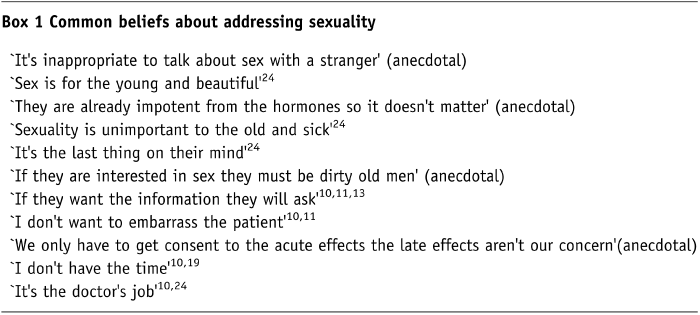
The avoidance of giving sexuality information to prostate patients may be as a result of beliefs that are negative as shown in Box 1. Most of these beliefs are barriers discussed in the literature12,13,15,17–19,24 but all were anecdotal statements given by colleagues as possible reasons why sexuality information is not given to this group of patients. These beliefs, which may be held only by a few, may lead to a negative attitude towards addressing sexuality with prostate cancer patients.
Changing attitudes
There are several theories of attitude change.Reference Wright20,Reference Cooper, Kelly, Weaver, Brewer and Hewstone25 Given that attitudes are the culmination of a series of beliefs possibly formed on inaccurate or incomplete information, it may be possible to change the beliefs held by participating in education. Raising the level of knowledge and awareness of personal and patient sexuality may impact the belief system and therefore it may be possible to ultimately change the attitudinal position held.
METHODS
This was a single centre study, utilising a quantitative approach, with a minor qualitative element incorporated. Permission and ethics were sought from Sheffield Hallam University, University Hospital Bristol Healthcare Trust and the South West Region National Research Ethics Committee.
A simple pre–post test design was employed, utilising a slightly amended version of the Sexual Attitudes and Beliefs’ (SAB’s) QuestionnaireReference Magnan, Reynolds and Galvin12 to ascertain whether a formal education intervention results in a significant change in professional’s attitudes, beliefs and knowledge about sexual issues in prostate cancer patients.
Although identical SAB’s questionnaires were used pre- and post-education, the pre-education questionnaire also included questions requesting demographic information and the ancillary qualitative element of the study. Information was given and consent was sought in writing and those who agreed to participate were sent the pre-education questionnaire and allowed two weeks for its completion and return.
Once the pre-questionnaire was returned participants were given both the self administered RLP, which was in the form of a booklet, and the post-education questionnaire. They were asked to individually engage with and complete the RLP and then allow time for consolidation of learning. They were asked to complete and return the post-education questionnaire 4 weeks later.
Participants
Participants were qualified radiotherapists and radiotherapy assistants who performed ‘first day’ consultation chats with prostate cancer patients, drawn from a single radiotherapy treatment centre.
Questionnaire
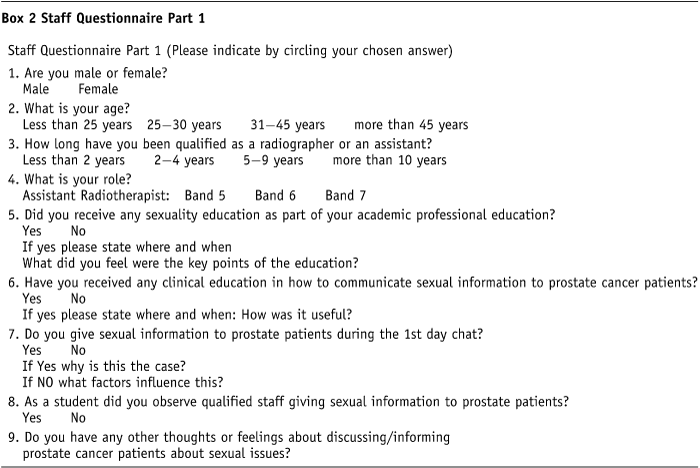
The questionnaire consisted of two parts (see Boxes 2 and 3). Part 1 consisted of nine questions requesting demographic information and whether or not the participant had received academic or clinical sexuality education for this group of patients. They were asked whether they currently gave sexuality information and to identify reasons why they did or did not do so. Lastly, they were asked whether when they were students they had observe qualified staff giving sexuality information to this group of patients. Space was given on the questionnaire for participants to elaborate on the answers given.

Part 2 was an adapted 12 questions Reynolds and Magnan (2005) SAB’s questionnaire.Reference Magnan, Reynolds and Galvin12 The questionnaire was primarily directed at nurses and their patients. This aspect was adapted so that the emphasis became radiotherapists and prostate cancer patients. The SAB’s questionnaire utilised a 6-point Likert response format (1 = strongly disagree; 6 = strongly agree) to obtain self-reports across 12 statements, some of which are reverse coded. The achievable scores ranged between 12–72, the higher scores indicating more attitudinal barriers to addressing sexuality with prostate cancer patients.
The original authors investigated the reliability and validity of the SAB’s questionnaire. It was found to have good test–re-test reliability and consistent support for the construct validity. They also found the SAB’s scores are not influenced excessively by social desirability bias.Reference Magnan, Reynolds and Galvin12
The RLP
The RLP was designed by the author and had the approval of an experienced oncology urological consultant. The strategy for its design was to equip participants to give sexuality information to prostate cancer patients without the prejudice of negative personal beliefs that may hinder the process. The aim was to enhance the levels of knowledge and understanding of the issues and to raise the participants own levels of self awareness through reflective activities, so that they could identify factors that may disincline them from giving sexuality information.
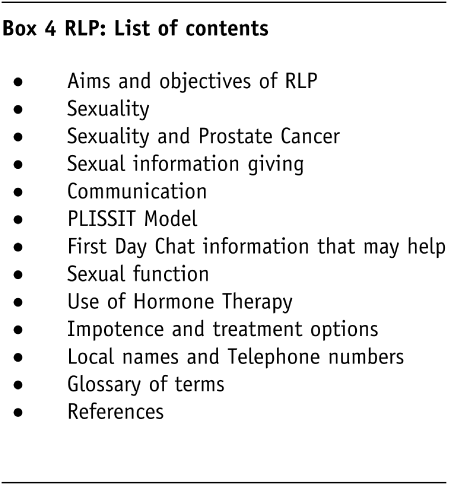
The RLP was a 15-page booklet, the content included professional and legal obligations and why sexuality may be important to prostate cancer patients and their partners especially in times of illness. It discussed potential barriers, the origins of individual embarrassment and offered a model as an aid to communication. It gave clinical information to assist in the ‘first day chat’, local contacts and telephone numbers together with a glossary of terms.
The format of the booklet encompassed several reflective tasks asking the participant to think about their practice and record, if they wished any thoughts and feelings with their origins before engaging with the educational content. This aimed to enhance awareness and understanding and maximise learning.
A list of the contents their awareness included in the RLP can be found in Box 4.
RESULTS
Fifty-six participants agreed to take part in the study and returned the pre-education questionnaire. However, the total response rate was 87.5% resulting in 49 paired sets of data. Of the respondents only 6.1% (3) were male.
The number who received sexuality education as part of their academic professional education was seven (14.30%); 42 participants (85.70%) did not recall receiving any academic education relating to patient sexuality.
Only one participant (2%) received clinical education in how to communicate sexual information, 48 (98%) did not recall receiving any clinical education relating to patient sexuality.
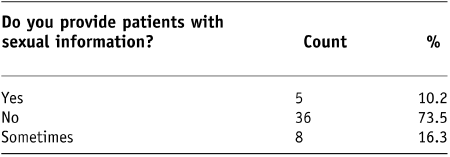
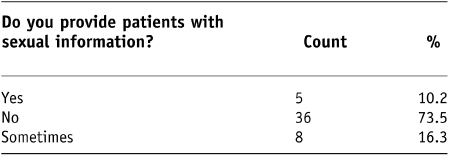
The number of participants who gave sexual information to prostate cancer patients prior to this study is illustrated in Table 1.
Distribution of sexual information given to patient prior to study
As students, only seven (14.30%) participants observed qualified staff giving sexual information to prostate cancer patients, 42 (85.70%) did not.
The achievable scores from the RLP ranged between 12 and 72. Higher scores indicated more attitudinal barriers to addressing sexuality with prostate cancer patients. Pre-education scores were between 27 and 50. Post-education scores were between 19 and 44; 96.4% of participants reduced their total score after the education.
Chart 1 shows the distribution of the scores both before and after the educational input.
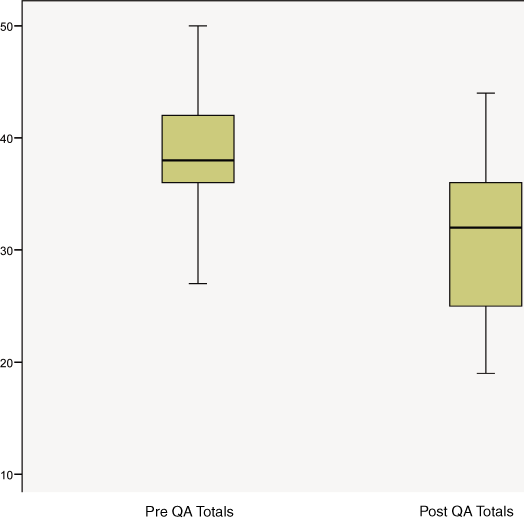
Having confirmed the data status by application of the Shapiro–Wilks test the Wilcoxon signed ranks test for two related samples of non-parametric data was used to ascertain whether the difference between the scores before and after the educational intervention was significant. Table 2 illustrates the results of the analysis.
Difference between pre- and post-total scores using Wilcoxon signed test

Wilcoxon test 0.000 p < 0.001 very highly significant effect.
The Wilcoxon test gives a p-value of 0.000 therefore p < 0.001 indicating that education had a very highly significant effect.
The Wilcoxon test was then applied to the scores of each question pre- and post-education to ascertain areas where the education may have been of most benefit. Table 3 illustrates the findings.
Difference between scores for each question pre- and post-education

p -Values below 0.05 = significant. p-values below 0.01 = highly significant. p-values below 0.001 = very highly significant.
Inter-item correlations were performed on the data both pre- and post-education. The data was non-parametric and therefore Spearman’s ρ correlation coefficient was utilised. Several correlations were consistent across both questionnaires.
Radiotherapists who understood how prostate cancer might affect patient sexuality felt more confident in their ability to address patients’ sexual concerns, pre-education r = 0.566**p < 0.01, post-education r = 0.440**p < 0.01. Radiotherapists who feel confident in their ability to address sexual concerns are more inclined to make time to give sexual information; pre-education r = 0.373**p < 0.01, post-education r = 0.453**p < 0.01.
In contrast, those radiotherapists who believed prostate patients were too old to be interested in sexuality information were also more apt to believe sexuality was too private to discuss; pre-education r = 0.608**p < 0.01, post education r = 0.469**p < 0.01, and also more apt to believe sexual information should only be given if the patient asked; pre-education r = 0.506**p < 0.01, post-education r = 0.558**p < 0.01.
Interestingly those radiotherapists who believed they were confident in their ability to address prostate patients sexual concerns were also more inclined to refer patient’s back to their consultant when asked a sexually related question, pre-education r = 0.566**p < 0.01, post-education r = 0.350*p < 0.05.
To analyse the total difference scores between the pre- and post-questionnaires with the demographic data the Mann–Whitney test was utilised. The only significant result was that those radiographers who as students observed sexual information being imparted to prostate patients may have benefited most from the education (Asymptotic significance (two-tailed) 0.006 and Exact Significance (two-tailed) 0.004).
A qualitative element of this study was included in the pre-education questionnaire. When completing the demographic questionnaire participants were asked to qualify their chosen answers and asked to offer any other thoughts and feelings they may have about discussing/informing prostate patients about sexual issues.
Of the seven participants who received sexuality education as part of their academic education three said this related to general side effects of treatment only, two said female concerns had been the key issues and two said communication of sexuality issues had been addressed. Only one participant received clinical education in how to communicate sexuality information. This was in the workplace observing first day chats.
Of the five participants who routinely gave sexuality information comments as to why they did are shown in Box 5.

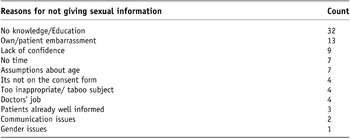
Eight participants sometimes gave sexuality information and all of them identified the reason for this as ‘Only when the patient asks’. The explanations given by those who do not routinely give sexuality information (36) were sorted into themes and are shown in Table 4 with the number of participants that expressed them along side.
Reasons why sexual information not given

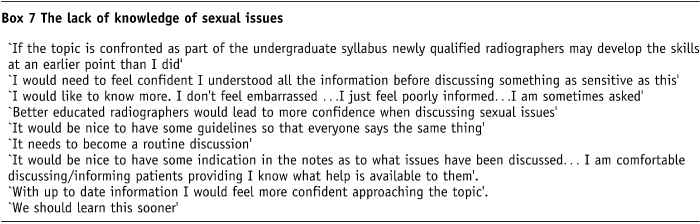
When offering other thoughts and feelings forty participants answered this question the main theme was the identification of the importance and difficulties of giving this information and the lack of knowledge and education surrounding it. Some of the comments are shown in Box 6. Importantly many of the participants recognised that their knowledge was lacking and wanted to know more. With greater knowledge they would be happy to give sexuality information. Some of their comments are shown in Box 7.

Limitations
This study had a small sample size from a single centre and it utilised convenience sampling, therefore this may limit the generalisability of the findings. Gender may have been confounding variable in this study as it may have influenced the academic—undergraduate and the professional-patient interaction in what appears to be a female dominated environment. To avoid response set biasReference Polit and Hungler26 reverse coding was applied to six of the 12 questions on the SAB’s questionnaire,10 although a good validity check it introduces a confounding variable and participants may misinterpret what is being asked and treat all the questions as equal. Data input error may also be a consideration.
DISCUSSION
The most important finding from this study is that the radiotherapists and assistants, who took part, received little or no education in sexuality issues for this group of patients or how to communicate sexuality information prior to this study. Identified by the participants in this study and consistent with the literature.Reference Magnan, Reynolds and Galvin12,Reference Wright20,Reference Eagly and Chaiken21 lack of knowledge and education were the main barriers to giving sexuality information to prostate cancer patients. The few who had received academic input felt that the key aspects were the side effects of treatment and not how to communicate with patients. Two participants reported that female issues were more readily discussed which may be a reflection of the gender and/or the level of comfort and knowledge of those who provide the academic education in what is a female dominated profession. The respondent demography of this study reflected this (male respondents = 3). Although the majority of participants reported they did not receive any education in this area the impact of gender in educating staff and giving patient’s sexuality information cannot be under estimated. Data and findings specific to the three male respondents will not be discussed as it would be ethically inappropriate. There were few participants who specified communication as an area of study and they had both attended the same University, this may indicate that this is an area currently undergoing change. Interestingly seven participants observed sexuality information being given while a student yet only one perceived this as clinical education, maybe there was a need to define the terms used in the study more clearly.
There was no statistical difference with regard to pre- and post-scores relating to the age of the patient. However this does not demonstrate that learning did not take place or that age is a barrier for the participants. Only one participant believed patient age should be a consideration with regard to giving sexual information.
The fact that the majority of participants in this study did not observe sexuality information being given when they were students’ may be relevant as to why they do not raise the subject themselves as independent practitioners. Although the learning package may have been successful at changing knowledge and beliefs in several areas, workshops or demonstrations may be a more appropriate teaching method to help more students address issues of comfort, and allow role-play/rehearsal to take place in a safe environment.
Table 3 indicates the areas where the learning package had most impact. Most benefit was achieved in the areas of knowledge, making time to give sexual information, increasing levels of confidence and a greater awareness that the patient may expect the subject to be raised. Other areas of benefit were the importance of giving sexuality information, a reduction in the likelihood of referring back to the consultant and giving prostate cancer patient’s permission to talk about sexual concerns in the first day chat.
Although levels of comfort pre and post-questionnaire did not statistically significantly differ, the distribution of scores indicated that personal comfort levels improved for 49% (24) of participants. However, it was notable that more participants (>10) scored higher post-education to questions 3, 4 and 11. These questions related to the levels of comfort and whether sexuality information should only be given if the patient asks. This may suggest that having engaged with the RLP and being more aware of the facts, some participants now felt less comfortable about giving sexuality information than they had previously and felt more strongly that sexuality information should only be given if the patient asks.
The higher number of participants who now thought this, may be the result of an ego-defence mechanismReference Gross and Kinnison27 stimulated by the level of discomfort it provoked. It may indicate that there may be some people who simply find giving sexuality information too uncomfortable. Therefore it may be inappropriate for them both personally and professionally to take on this role as their level of discomfort may be apparent to the patient and prevent an open dialogue. The fact that 20.4% of participants felt less comfortable with greater knowledge and less inclined to give sexuality information unless asked for, may imply that discomfort is an important barrier to giving sexuality information. The data also showed that both pre and post-education those who were confident in their ability to address sexual concerns were also more likely to refer back to the doctor and this increased post-education. This may indicate a willingness to broach the subject, but a feeling that they were less able to address the issue raised.
With recent emphasis and identification of the differing professional roles and responsibilities of radiographers with regard to information, communication and consent,8–11 There may be a need to recognise that obtaining a patients signature on a consent form, without appropriately addressing the side effects of the treatment, may not be promoting supportive holistic care2 and may be ethically and legally questionable.Reference White and Heath17 ‘First day chats’ which may be a task performed by the more junior practitioners and assistants, leaving the more experienced staff on the treatment sets to treat patients and perform more senior clerical duties may be at odds with the Society of Radiographers LDF which advocates that where there are barriers to communication it may indicate the need for skills that are consistent with an advanced practitioner role. However, regardless of status it is important to ensure that those performing this role are educated and comfortable to do so.
When comparing themselves with colleagues only 20% (10) participants felt more comfortable than they had previously. However, on reflection this question may not have been applicable or appropriate in this study, as it invites comparison of self against colleagues and this is not possible as first day chats are usually delivered by a radiotherapist working alone.
Although confidence was shown to have increased statistically (Table 3), and levels of comfort in 49% (24) of participants had increased it was difficult to know how many professionals, if any, now incorporated sexuality information giving into ‘the first day chat’ as this was not measured post-education. This is an area worth further investigation.
CONCLUSION
Overall the RLP had a very highly significant effect in changing the attitudes and beliefs held by the participants. It was shown to statistically improve the participant level of knowledge and confidence (p < 0.001).
It is not known how the educational institutions view the giving of sexuality information or the process of ensuring the patient gives continued consent to treatment. In this study, the participant perception is that sexuality appears to be under addressed in undergraduate education which may be an indication that it is viewed as a subject for postgraduate education and/or advanced practice, which would be consistent with the LDF.9 Yet all radiotherapists and assistants locally, even the newly qualified, may be called upon to ensure prostate cancer patients are adequately informed and continue to consent to their treatment. Even with improved education and greater knowledge the impact of embarrassment cannot be under estimated. There may be a need to recognise that the subject of sexuality may simply be too sensitive for some radiotherapists to address.
Few participants perceived they received any academic or clinical education, or witnessed qualified staff giving sexual information this may indicate a gap, not only in the professional education process but, in the information giving and ongoing consent systems that currently operate in radiotherapy departments nationally. It may also raise questions regarding the quality and consistency of the information and service provided to this group of patients.
There is a responsibility to ensure all staff adequately inform and confirm continuing consent of this group of patients. This process may differ from centre to centre. This study may indicate a need to clarify the role of the ‘first day chat’ and to assess the quality and consistency of the information given in order to adequately inform and confirm consent. It may be important to ensure that those performing this significant role are appropriately educated, posses the necessary communication skills and hold a positive attitude toward this particular group of patients.