


While Orthodox and Protestant Christians could seek divorce when a marriage was truly unbearable (as could Jews and Muslims), the Catholic Church held—and technically still holds—firm in its position that marriage is indissoluble except for particular circumstances that qualified for annulment. In other faith traditions, couples might cite irreconcilable differences, adultery, cruelty, “hardness of heart,” and other such causes, but Catholics had to argue much more technical problems to annul a marriage. These more emotional or personal motivations could grant an unhappy couple the right to live separately and possibly provide spousal support to women (dependent on the circumstances), but separation did not allow either party to remarry until after the death of the other; they remained married even if they never saw one another again.
There were several grounds on which a marriage could be declared null in early modern Catholic Europe. The most common strategy, particularly after the reforms of marriage introduced at the Council of Trent,Footnote 1 was to claim a lack of proper consent. In these cases, mostly women claimed that they had been forced into marriage against their will, under credible threat of violence or other dangers. As the Tametsi decree of 1563 re-enshrined the importance of free will to marriage, a credible claim of force was sufficient.Footnote 2 Men had a much harder time proving force and fear (vis et metus), however, unless they could demonstrate that they were, for example, marched to the church at gun or knifepoint.Footnote 3 The fact that women were deemed much more vulnerable and that they were often younger at the age of marriage than men meant the ecclesiastical courts were far more likely to believe they had been coerced.
Another reasonably common post-Tridentine strategy was to claim that the marriage had not been performed according to canonical expectations. The Tridentine decree required banns for three weeks (unless the couple sought dispensation from the bishop), marriage in a church by a priest, at least two witnesses, and the recording of the marriage in the parish register. Deviations from these requirements, or errors in the ceremony made by the priest, could give a couple the grounds for annulment.Footnote 4
There were also other reasons why a marriage might be declared null, some of which were easier to prove in court. Bigamy, fraud, impotence, and consanguinity or affinity (marrying within prohibited degrees of relation by blood, marriage, or spiritual relationship), for example, were all grounds for annulment. The Tridentine decrees also clarified and restricted the impediments of public honesty and affinity arising from fornication. The first impediment, which restricted a person from marrying a close relative of someone to whom he or she had been betrothed, was limited to the first degree.Footnote 5 Henceforth, only the parents, siblings, and children of a former fiancé(e) were off limits. The second impediment, which restricted a person from marrying a close relative of a former sexual partner, was limited to the second degree.Footnote 6 In addition to parents, siblings, and children, this also made marriage to a former lover’s aunts, uncles, and first cousins illegitimate. These marriages could still take place if the couple sought a dispensation, including after the celebration of the marriage if the impediment had not been known at the time of marriage. If the impediment was known and no dispensation sought prior to the marriage, however, the dispensation would not be granted after the fact.Footnote 7
Much of the historiography of early modern Catholic marriage focuses on either the changes wrought by the Council of Trent or the more common cases that were heard by ecclesiastical tribunals and occasionally secular courts. Historians who focus on the changes wrought by Trent tend to examine the frequently slow or incomplete imposition of changes or the persistence of clandestine marriage.Footnote 8 Scholars examining the cases in tribunals tend to look predominantly at cases for separation (typically on the grounds of male abuse, female adultery, or abandonment), or at the more common types of annulment cases.Footnote 9 Debates in this scholarship tend to focus on the framing of narratives presented in court (predominantly those presented by women), the proceedings of the courts themselves, and the ways in which cultures of gender and honor impacted both testimonies and the court’s decisions. However, there is very little in the historiography that delves into the particulars of impediments and annulments.Footnote 10 Instead, these are often catalogued or mentioned alongside the other sorts of trials or disputes that were adjudicated before marriage tribunals but not subject to more in-depth analysis.Footnote 11 This article seeks to bring greater attention to annulments on the grounds of impediments of affinity from fornication and public honesty through the analysis of the cases heard by the Patriarchal tribunal in Venice in the eighteenth century.
It seems clear from the eighteenth-century cases that Venetians—likely with the assistance of legal professionals—understood the Tridentine rules for these impediments. In pre-Tridentine affinity cases across Europe, it was much more common for the impediment-causing relationship to be a distant one, often third or fourth degree.Footnote 12 However, Venetians clearly knew that Trent had declared that relationships beyond the second degree no longer mattered: over 80% of the cases claimed first-degree affinity (parents, children, or siblings); the remainder were second degree (uncles and first cousins). Likewise, the public honesty cases all seem to conform to Tridentine regulations.Footnote 13 In Venice, while men were more likely to be the ones who had created the impediment, women claimed to have done so in a third of cases.Footnote 14 In total, the court heard at least twenty-nine of these cases (twenty-four alleging affinity by illicit sex, five relating to public honesty) across the eighteenth century.Footnote 15
In addition to bringing to light this relatively understudied phenomenon, this article argues that these cases provide strong evidence of the flexibility of the Venetian Patriarchal tribunal. The extent to which the Patriarchal tribunal was “sympathetic” to unhappy spouses (particularly wives) has been the subject of some debate with regard to the sixteenth and seventeenth centuries, most particularly in the work of Joanne Ferraro and Daniela Hacke.Footnote 16 Ferraro convincingly demonstrates that women adopted a common legal language in order to meet canonical expectations. Moreover, many had been married for years before they sought annulment, suggesting that their claims of force and fear might be a legal fiction or at least exaggerated.Footnote 17 The same may be true of affinity cases, but they carried a greater reputational risk to the petitioner. When a woman made a case that she was forced into marriage by her parents, there was little social risk. Whereas in the affinity cases discussed here, men and women had to explain often in fairly graphic detail how they had, for example, conducted a sexual relationship with their now-wife’s mother or their now-husband’s brother. This was surely a daunting prospect and bore the risk of reputational damage for those implicated; as Hacke has noted, going to the Patriarchal tribunal was quite a public affair.Footnote 18 And yet, nearly thirty couples did just that, with the assistance and support of family, friends, and neighbors who testified on their behalf. This article argues that annulment by affinity cases in the eighteenth century offer strong evidence that the judges and lawyers of the Patriarchal tribunal were open to annulling bad marriages when somewhat plausible impediments were presented with sufficient support from witnesses. The testimonies in court and the decisions made by officials hint at both collusion within communities to manipulate canon law to achieve a desired outcome and a willingness on the part of legal professionals to cooperate with this manipulation.
The Venetian Patriarchal Tribunal
Spouses who sought annulment for any reason had to “go to Castello,”Footnote 19 the seat of the Venetian Patriarch. Although technically the judge in their case could be the Patriarch himself, this role often was filled by his vicar general. Venetian Patriarchs were elected by the Senate from among Venice’s patriciate, and they were rarely legal experts. Thus one of their first acts was typically to nominate a vicar general, whose duties included overseeing the criminal, civil, benefice, and marriage cases.Footnote 20 The vicar general was always a legal expert, as was the promotor fiscalis, whose appointment was likewise one of the first tasks of a new Patriarch. The promotor fiscalis was tasked with representing the Church in cases heard in the tribunal; in marriage cases this meant defending the sacrament or arguing against annulment or separation.Footnote 21 Both of these men were chosen from a pool of lawyers, or avvocati ecclesiastici, already working in the tribunal, who also served as the procurators for those seeking annulments.Footnote 22 While there is little information available about these men, they were clearly carefully chosen by each Patriarch to oversee the legal affairs in his jurisdiction, and as many scholars have noted, the Venetian Patriarchs themselves were carefully chosen by the Venetian Senate for their loyalty to the state (rather than to Rome, in the context of a perpetually tense relationship that was neither limited to nor fixed by the 1606–1607 Interdict).Footnote 23 Although the Patriarch seems to have rarely appeared in the tribunal during eighteenth-century marriage cases, it is reasonable to presume that the men he appointed were trusted to work in accordance with his own aims.
The trial records provide little insight into the thoughts or rationale of these legal experts or even how individual lawyers were chosen or appointed in cases, though Daniela Hacke notes that as the lawyers were employed by the court, cost was not a barrier and the same lawyers represented petitioners regardless of social status.Footnote 24 Depending on the nature of the case, each spouse might have a procurator, or only one spouse might, if the other was not contesting the petition. The petitioner’s procurator set out the claims and presented a list of questions to put to witnesses; the promotor fiscalis presented counter-claims and/or a list of questions to cross-examine witnesses. Once all evidence was presented, the two lawyers set out their final positions, and the judge came to a conclusion, unfortunately without leaving a written record of his rationale.Footnote 25
It is also important to note that Venice’s approach to marriage cases in the eighteenth century was not in line with Roman expectations. In 1741, Pope Benedict XIV issued the bull Dei Miseratione in an attempt to limit the number of successful annulment cases, judging that people were finding it too easy to annul marriages that were perhaps actually legitimate. According to this bull, ecclesiastical tribunals had to appoint a “Defender of Marriages,” who either served as the lawyer for the spouse fighting against annulment, or if neither spouse objected to the annulment, this lawyer simply defended the marriage on behalf of the Church. Moreover, one decision of nullity was no longer sufficient. If the judge in the initial tribunal declared the marriage null, the Defender of Marriages was obliged to appeal the decision. The appeal either went to the metropolitan diocese or, if it began there, went to Rome. If the higher court agreed, the Defender of Marriages could appeal a second time if he felt the decision was incorrect.Footnote 26 The 1741 bull was ignored in Venice, however, consistent with a 1625 decree that declared all bulls or other documents from foreign states to have no power in the Venetian dominions unless introduced with the signature of the secretary of the Senate. This was further clarified in 1754 with a decree that specifically related to papal bulls.Footnote 27 For all the cases under consideration here, Dei Miseratione was not observed. The Venetian use of the promotor fiscalis essentially did fulfill the first requirement, but none of those cases was appealed to Rome.
It was only at the end of the century that Venice came more into alignment with Rome. By 1782, it seems that the Venetian state shared Benedict XIV’s earlier assessment that annulments and “divorces” (separations) were being granted too easily, and so they sought legal advice from canonists at the University of Padua.Footnote 28 As a result of this consultation, they issued decrees in 1782 and 1785 that strengthened their oversight of the Patriarchal tribunal with regard to marriage cases, though not without protest from the Patriarch.Footnote 29 Then in 1788, they issued a twelve-page printed document outlining the changes and specifically noting their concern about lawyers and fiscali who they felt were manipulating cases for their own “base interests.”Footnote 30 To mitigate against lawyers’ becoming complicit in “seductions, connivances, and other bad arts,” the Council of Ten declared that before taking on a marriage case, the lawyer must appear to the Council and swear an oath, included in the document, which verified that he felt the case was just and honest.Footnote 31 In response to this, the Patriarch Federico Maria Giovanelli wrote to the doge in 1788 noting that what Venice was doing was largely the same as Benedict XIV’s bull issued forty-seven years earlier and suggesting that they simply ratify the bull. This was finally done two years later on 13 March 1790.Footnote 32
Annulment Cases in 18th-Century Venice
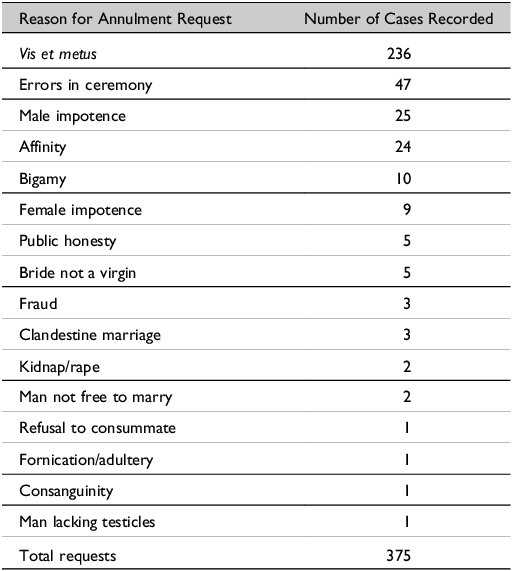
Most Venetian annulment cases were based on vis et metus. Joanne Ferraro has studied the proliferation of these cases after the Council of Trent and has demonstrated that women must have been coached how to present their cases, repeating stock phrases like “I said yes with my voice but not with my heart” to achieve their desired goal.Footnote 33 In the eighteenth century, these continued to be the most common cases. The tribunal heard at least 236 of them, accounting for 63% of all cases. All other causes were claimed far less frequently (see Table 1).Footnote 34
Eighteenth-Century Venetian Annulment Cases

Table 1. Long description
There are 16 reasons for annulment requests. There were 236 recorded cases of vis et metus, or force and fear, 47 cases recorded for errors in ceremony, 25 cases recorded of male impotence, 24 cases recorded of affinity, 10 cases recorded of bigamy, and 9 cases recorded of female impotance. There were 5 cases of both public honesty and bride not a virgin, 3 cases of both fraud and clandestine marriage, and two cases of both kidnap/rape and man not free to marry. There was one case recorded of each of the following: refusal to consummate, fornication/adultery, consanguinity, and man lacking testicles. There were a total of 375 cases overall.
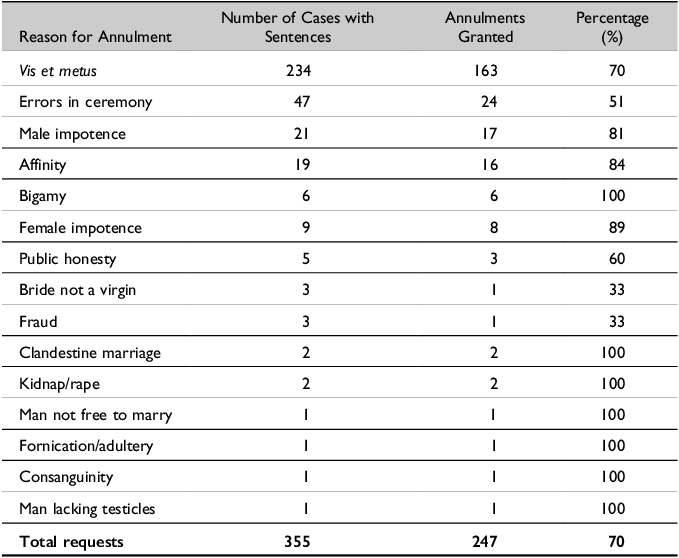
Although force and fear and errors were claimed far more frequently than other grounds for annulment, they were not the most successful strategies. Overall, Venetian annulment cases had a roughly 70% success rate, which is also the rate for force and fear cases (see Table 2). The most successful strategy was bigamy (100% of marriages annulled), but of course this was also easy to prove; one spouse either had a living first wife/husband or not. Impotence was also reasonably successful; overall it had an 83% success rate. Impotence, while not as easy to prove as bigamy, did require gathering medical evidence through examination by a doctor or midwife. Affinity and public honesty cases more closely resembled force and fear cases in terms of evidence; the couple and people who knew them testified, but there were rarely official records or other forms of more direct evidence presented. While the much smaller number of cases means the results are difficult to compare, nineteen affinity cases include sentences, and sixteen marriages were annulled (84%). Public honesty cases had a 60% success rate (three of five cases annulled). Thus, for unhappy couples who could not come up with medical or official evidence of grounds for annulment, affinity by fornication was the pathway most likely to lead to freedom.
Rates of Success for Eighteenth-Century Venetian Annulment Cases
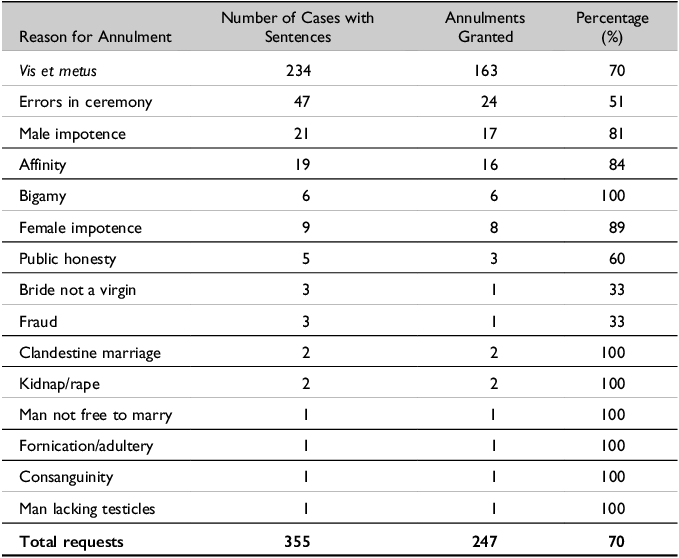
Table 2. Long description
There are 15 types of annulment cases for which sentencing data is available. Of 234 vis et metus or force and fear cases, 163 annulments or 70% were granted. Of 47 cases for errors in ceremony, 24 annulments or 51% were granted. Of 21 cases for male impotence, 17 annulments or 81% were granted. Of 19 cases for affinity, 16 annulments or 84% were granted. Of 6 cases for bigamy, 6 annulments or 100% were granted. Of 9 cases for female impotance, 8 annulments or 89% were granted. Of 5 cases for public honesty, 3 annulments or 60% were granted. Of 3 cases each of both bride not a virgin and fraud, 1 annulment for each reason or 33% were granted. Of 2 cases each of both clandestine marriage and kidnap/rape, 2 annulments for each reason or 100% were granted. Of one case each of man not free to marry, fornication/adultery, consanguinity, and man lacking testicles, 1 annulment for each reason or 100% were granted. Overall, of 355 cases, 247 annulments or 70% were granted.
The cases of affinity by fornication (and public honesty) can be grouped into a few basic narratives. In the early eighteenth century, there were a number of cases in which the wives were former sex workers or at least reputed to be of looser sexual morals. In these cases, either their sister was also a sex worker, and their eventual husband was involved with both women, or the wife counted both her eventual husband and one of his close relatives, typically his brother, among her clients. Throughout the period, there are other cases in which men began a sexual relationship with an older woman (usually a widow, though not always) and then ultimately married her daughter. Somewhat similar are the cases in which a man courted one daughter from a family but took advantage of his access to the family home to seduce her sister(s) as well. And finally, there are cases in which the threat of social consequences for something like a pregnancy, life-threatening illness, or an accusation of defloration that could have led to a criminal case was seen as worse than the impediment of affinity.
Depending on the basic narrative (and of course the specific details of the case), unhappy couples presented different stories to the Patriarch’s tribunal. But in all cases, they told plausible tales of how their supposedly invalid marriages came to be. In most cases, they also attempted to claim that they did not knowingly ignore a diriment impediment. Evidence from earlier periods, as well as the stories told by witnesses in these cases, suggests that knowledge of such impediments was fairly widespread.Footnote 35 In most cases, the couple were cooperating, which suggests that their marriage had broken down and both were in agreement that it should end. Typically the implicated family member also testified, laying bare very intimate details of a supposed past relationship and thus admitting at least to fornication and, in some cases, to the far more serious sin of adultery. If the couple and the implicated relative were telling the truth, one might argue that this served as a way both to end an unhappy marriage and to unburden one’s conscience. But there are hints in many cases that these stories were embellished or invented as a convenient way to exit an unpleasant relationship while preserving the right to remarry.Footnote 36
Moreover, it is rare for a case to rest only on the couple and the implicated relative (who might have a very compelling reason to stretch the truth or outright perjure themselves; one can easily imagine a mother willing to do so to free her unhappy daughter, for example). Cases also generally include testimony from neighbors and acquaintances, who provided corroborating evidence about theoretically secret affairs that typically happened years ago; on average, these cases sought to end marriages of about seven and half years (shortest is two years, longest is fifteen years). On average, cases had four witnesses, excluding the couple seeking annulment; the largest had nine. Only one case failed to produce any witnesses except for the husband seeking annulment, and it was denied. The cooperation of these witnesses, who easily could have told the court they knew nothing or indeed cast doubt on the story, suggests that ordinary Venetians understood the need for a way to end an unhappy marriage and were willing to support neighbors and friends, even if the Church continued to tell them marriage was a sacramental bond that could not be broken. For the peace of the community or neighborhood, the good of the unhappy spouses, and perhaps even the safety of women, they carefully framed testimonies to support annulment cases.
In order to tease out some sense of what was going on behind the scenes of these cases, this article will now examine each type of narrative in turn. The focus will be on cases that succeeded, but I will also examine some that failed to see why the judges may not have accepted the stories presented.
Promiscuous Women
Particularly in the early eighteenth century, a number of cases brought to the Patriarch’s court alleged that sex work or female promiscuity was to blame for the impediment of affinity through illicit sex. These cases often seem quite plausible, whether the claim was that the wife had had sexual relationships with multiple men from the same family or that the wife’s sister, also a sex worker, had counted the husband among her clients at some stage. Sex workers would have had little opportunity to refuse a client and no particular reason to refuse two men from the same family, and similarly men had little compunction about visiting two different sex workers, even if they happened to be sisters.
The case of Francesco Rizzi and Maddalena Lorenzoni provides a clear example of a sex worker having two brothers as clients. Francesco Rizzi brought the case to the Patriarch’s court in 1711, alleging that before their marriage, Maddalena had counted his brother Paolo Rizzi among her clients.Footnote 37 Francesco presented a convoluted story to the court about a particular afternoon and evening in the summer of 1709. Paolo, he claimed, was seeking an “amorous” encounter with Maddalena and wrangled an invitation to her house the following day. When he arrived, he found her socializing with a woman named Margarita, a man named Giovan Battista, and his brother Francesco, certainly not who he wanted to see! They all sat together briefly before Giovan Battista took his leave. Paolo then invented some urgent errand for Francesco and sent him away. With the other men gone, he “took greater liberties” and began discussing “lascivious things and carnal pleasures” with Maddalena,Footnote 38 which was enough of a hint for Margarita to take her leave of the pair as well. Finally alone, Maddalena and Paolo went into a bedroom and had sexual intercourse.
Several hours later, Margarita returned to Maddalena’s house and found the place completely closed up. She knocked loudly on the door, and Maddalena pretended not to be there because Paolo was still in her bed. Margarita decided to wait outside. Maddalena attempted to sneak Paolo out of the house, even going out on her balcony to ask the hat-maker below if there was anyone at her front door, but Paolo’s exit was seen by Margarita, the recently returned Francesco, and a third man. After this, Paolo continued to visit Maddalena, and his conduct apparently created conflict between him and Francesco, which ultimately led to Paolo ceasing his relationship with Maddalena. At some point in the intervening two years, Francesco had married Maddalena in spite of this earlier affair.
Maddalena confirmed Francesco’s story, as did Paolo. Margarita, Giovan Battista, and two other acquaintances of Francesco also testified, each confirming the parts of the story they knew (and none mentioning why or when Francesco and Maddalena married). They all spoke quite candidly of Maddalena’s profession; Giovan Battista answered the court’s question about Maddalena’s “life, customs, and profession,”Footnote 39 saying, “She is a prostitute… I know because of the practice that many of my friends have with her, and also for the practice that I have had with her for dishonest appetites.”Footnote 40 This trial folio may be incomplete (at the very least it contains no sentence), but the sentence register confirms that the marriage was annulled.Footnote 41
In this case, the story is perfectly plausible; Maddalena may well have taken one brother as a client and married the other (whether or not he was also her client before marriage is never indicated). Paolo provided her with some income—as did apparently many of the men in the neighborhood—while Francesco gave her a path towards a more stable future. Given that Francesco admitted in his own initial “Positiones” that he knew Paolo had been intimately involved with Maddalena, he could not claim that he wanted to end the marriage simply because of this, nor did he state that he had been unaware that the sexual relationship created an impediment. Presumably, the marriage, which lasted at most two years, was an unhappy one, and one or both of them saw this as a good way out. But this also suggests that at least for lower-class Venetians, this type of affinity was not seen as a block to marriage; none of the witnesses expressed any surprise that both brothers were involved with Maddalena, nor that Francesco married her.
Although the story rings true, of course it could still be a lie. In that case, we have to wonder what would convince Francesco, Maddalena, Paolo, and five witnesses to perjure themselves. Again, it is perhaps easier to accept that the first three were willing to lie, to escape an unhappy match or help a brother to do so. But the witnesses are more difficult to explain. The court explained the penalties for perjury to each witness, so no one could claim ignorance. But when we look more closely at the witness testimonies, they are very careful. Each testified that Maddalena was indeed a sex worker; this is certainly true and would have been something everyone knew. Francesco’s friend also knew that Paolo spent a lot of time in Maddalena’s house and acted in a very familiar way with her and that his behavior made Francesco angry. Giovan Battista and Margarita both testified about the afternoon they had all passed together, but both left before the supposed sexual intercourse happened. Margarita was even careful to tell the court that after Paolo and Maddalena’s conversations got more intimate, she took the hint to leave, and after that “she [did] not know what followed between Signor Paolo and Maddalena.”Footnote 42 She could certainly infer, having returned to find the house completely closed up and ultimately seeing Paolo leave, but she could not confirm that they had indeed consummated their relationship. This is a common feature in witness testimonies; witnesses testified to concrete things they saw, such as someone visiting a house at unusual hours or a degree of familiarity or intimacy between two people in public, which hinted at impropriety but did not actually constitute proof of it. Assuming they did see something to this effect, they were not committing perjury, even if they doubted there was anything untoward going on.
Less commonly, cases with sex workers could involve issues of class difference, which complicated matters. In the attempt to nullify the marriage of the nobleman Marc’Antonio Pasqualigo to Vittoria Falardi, which seems to have been brought by Pasqualigo’s father, Francesco, affinity was likely used by a patrician family to undo a young son’s mesalliance.Footnote 43 In this case, it was alleged that Marc’Antonio had started visiting Cattina Falardi, a sex worker, around 1700, when he was twenty years old. During this time, he met Cattina’s sister Vittoria, also a sex worker living under the same roof, and he began a sexual relationship with her too. Cattina apparently did not appreciate his indiscriminate tastes and rebuked him, but Vittoria must have continued to accept his company. In 1701 they requested a dispensation of banns and permission to have a secret marriage ceremony outside of their home parish of Santa Maria Formosa, in the parish of San Polo (across the Grand Canal, now about twenty minutes away on foot). The Patriarch granted this permission, and the two were married in March 1701 by the parish priest of San Polo, clearly to avoid the Pasqualigo family’s interference.
This case dragged on, and it seems not to have had either Marc’Antonio or Vittoria’s cooperation, at least at the start. In the first phase, two current or former employees of the Pasqualigo family testified; both confirmed that Marc’Antonio had spent plenty of time in Cattina and Vittoria’s house and that Marc’Antonio kissed Cattina and acted quite freely and intimately with her. They also both stated that their relationship was a matter of public gossip in Santa Maria Formosa.Footnote 44 Another witness was a friend of Vittoria’s, who told the court she knew that this was about Vittoria and Marc’Antonio, because a month before she had been summoned to visit Francesco Pasqualigo, who wanted to know if she knew about his son’s relationship with Cattina Falardi. She also saw some signs of physical intimacy between them but said that Marc’Antonio had never admitted to having sex with Cattina and that she had been present when Vittoria asked him directly if he had, and he had always denied it.Footnote 45 As with the previous case, we can see that this evidence mostly suggests a sexual relationship but could also be defended as true even if Marc’Antonio had only been sexually active with Vittoria.
In 1706, Marc’Antonio’s procurator submitted new articles that filled in a few of the blanks and indicated that he had been at least somewhat convinced to cooperate with the proceeding. The timing of this was potentially strategic; Patriarch Giovanni Alberto Badoer, who had also granted the dispensation of banns, was transferred to the diocese of Brescia in June 1706, and the new articles were presented in July.Footnote 46 Marc’Antonio’s positions disclosed a meeting he had with the parish priest of Santa Maria Formosa (at his father’s insistence) at which the priest asked him if he had had a sexual relationship with Cattina before marrying Vittoria. According to these articles, Marc’Antonio admitted to the relationship with Cattina but maintained that he doubted that he had fully consummated with her (in other words, that he had ejaculated inside her vagina, which was a canonical requirement for the creation of affinity).Footnote 47 Vittoria’s interrogation, written by her procurator, makes the alliance between father and son by 1706 clear, as they are declared to be questions “about the articles for the part of the noblemen Francesco and Marc’Antonio Pasqualigo.”Footnote 48
With these new articles and questions, the court interviewed the priest of Santa Maria Formosa and two former boatmen of the Pasqualigo family. The priest confirmed that Marc’Antonio had confessed his relationship with Cattina to him (and confirmed the doubt about ejaculation). He also showed himself to be very clearly on the side of the Pasqualigo family, telling the court that in the early days of this marriage, he had scolded Vittoria for marrying Marc’Antonio, accusing her of “deceiving a poor son of an innocent family.”Footnote 49 Both boatmen confirmed dropping Marc’Antonio off at Cattina and Vittoria’s house, and they added that there were plenty of rumors about the two.
This case is as plausible as the first; plenty of noblemen were frequent clients of sex workers, and Marc’Antonio was almost certainly a younger son not destined for a noble marriage, instead expected to live a bachelor’s life. But there is equally room for the truth to be that while Marc’Antonio took some liberties with Cattina, he only had fully consummated sex with Vittoria. But when the family found out about his impetuous secret marriage, they latched on to rumors as a way to extricate him and preserve family honor. It seems the court felt the latter was more plausible, as they denied the annulment. However sympathetic they surely were to Francesco’s frustration with his son, they were not convinced the marriage was null. But this was not the end of the story. Three years later, they were back in the Patriarch’s court to appeal the decision, pleading before a different vicar general.Footnote 50 No new evidence was presented, but Vittoria did appear to say that she would remove her earlier objections to the Pasqualigo’s claims. Presumably the family had convinced her, likely through bribery, to acquiesce. This was seemingly sufficient, as the marriage is listed as annulled in the sentence register.Footnote 51
From Mother to Daughter
Of the nineteen cases with folios, nearly a third (six) of them alleged that husbands had premarital affairs with their eventual mothers-in-law. Typically, the wives in these cases claimed they had no knowledge of these relationships, but surely the mothers knew who their daughters were going to marry; these were not clandestine marriages. While again they present somewhat credible stories, it seems equally plausible that a mother might be willing to mislead the court to help her daughter escape an unhappy marriage.
In 1732, the court heard from a woman named Giovanna Lavedi, who, after nine years of marriage to Giuseppe Fereton, claimed that she had just learned of his prior sexual relationship with her mother, Maria.Footnote 52 She asserted that in 1719, her widowed mother became friends with some women of the Fereton family and began spending time in the house of Piero Fereton, Giuseppe’s father. This led to Giuseppe beginning to spend time in the Lavedi household, and, according to Giovanna’s claims, within “a few days” of coming to the house, “he had carnal confidence with [Maria].”Footnote 53 Three years later, he sought to contract marriage with Giovanna, who knew nothing of this relationship, only finding out about it shortly before coming to the court. Beside the couple and Maria, the only witnesses were Giovanna’s two siblings.
Giuseppe testified first, confirming his wife’s story. His introduction to the Lavedi house was explained sensibly enough; he became friends with Maria’s son and went to visit him. Sometimes he would be there quite late, and they offered him a place to sleep. He was just a teenager, about seventeen years old, so this all seems plausible. Then, in what sounds like teenage braggadocio, he claimed that on one of these nights, Maria sought him out in his borrowed bed and seduced him. After this “first time,” he continued to have sex with Maria “day and night.”Footnote 54 He claimed that he did not realize this created an impediment that should have blocked his marriage to Giovanna, so he continued to receive the sacraments “without scruple.”Footnote 55 When Giovanna found out, he offered to seek a dispensation from Rome, but she refused.
Several months later, Maria, then aged fifty-three, testified and confirmed everything as well. She told the court that this affair, which began when he was seventeen and she was forty, continued for six or seven years. When asked if the sex was “perfectly consummated,” she confirmed that it was.Footnote 56 In her telling, she shared a bedroom with her two daughters and would sneak out of bed to go have sex with Giuseppe, then sneak back in. She thought that perhaps her daughter Cattina knew, as Cattina was disabled and always home, but did not think Giovanna knew before her marriage. She offered no explanation as to why she did not object to the marriage (nor was she asked), but she admitted to telling Giovanna this awkward secret three years earlier. According to Maria, Giovanna eventually told her confessor and was obligated by the priest to separate.
After Maria testified, her other two children were also summoned to the court. Cattina, aged twenty-three, would have been about ten when Giuseppe began visiting her house. She claimed, quite plausibly, not to know much about his activities. She knew he sometimes slept over, but on those days she said Maria and Giovanna shared a bedroom while she had her own space as she was ill. She never saw Maria and Giuseppe in bed together but did admit to seeing signs of confidence between them, which made her suspect that Giuseppe might want to marry her mother.
Her brother Giovanni, five years her senior and Giuseppe’s friend, had little more to share. Maria claimed she only slept with Giuseppe on nights when Giovanni was elsewhere, so it is reasonable that he would not have seen anything pass between them. But he did, apparently, hear rumors about his mother and Giuseppe. His story was very vague, however. He was told by “some women in [the parish of] San Silvestro, whose names he does not know,” that his mother had slept with Giuseppe.Footnote 57 His uncle, now dead, had asked him if his mother was frequenting the sacraments, as she was living in suspicion. And after the wedding, the same women from San Silvestro, along with other women from San Cassan, “were shocked and could not accept that the marriage had happened.”Footnote 58 Finally, many years after marrying Giovanna, Giuseppe admitted the affair to him, and this encounter escalated to shouting, Giuseppe yelling that Maria was “the cause of all ruin, that she deserved to be punished.”Footnote 59 Giovanni further added that although his sister did not know for sure, she did have suspicions before her marriage. She had told Giuseppe that if he had any entanglement with her mother, he should be with her instead, but Giuseppe had gone ahead with the wedding. Giovanni also claimed that Maria must have consented to the marriage, as Giovanna was under their mother’s direction, but he did not attend the wedding himself.
Similar to the cases discussed above, the parties in this case presented a reasonably plausible and consistent story, but one that could just as easily be manufactured to end an unhappy marriage. Perhaps Maria was a lonely widow tempted by easy access to her teenage son’s friend, and perhaps her daughter was a sufficiently sound sleeper for her to sneak out of bed regularly for years without arousing more than mild suspicion. Equally likely is that Giuseppe, spending time in his friend’s house, became interested in his sister, proposed marriage, and years later the couple were deeply unhappy. All that was required to end it was some cooperation from Giovanna’s family. If this relationship had not happened, her mother perjured herself, but the siblings did not either way; none of their evidence claimed more than an impression or rumor about a possible sexual relationship, and otherwise they simply confirmed Giuseppe’s frequent presence in the house. The story also has several holes: why did Maria not object to the marriage in 1722? If Giovanna found out around 1728 that there was an impediment to her marriage, why did she hold off for several years before telling her confessor? If the marriage was an otherwise happy one, why would she not consider the dispensation? In spite of these questions and the somewhat mediocre witness testimonies, the court annulled the marriage.
Swapping Sisters
Men having a relationship with multiple sisters before marrying one of them was just as common in the archival cases as men moving from mother to daughter. Six cases involved husbands who had slept with one sister before marrying another. While some of these cases involved two sex workers, three cases instead involved men who took advantage of having access to multiple young women of the same family while courting in their household. Two public honesty cases also revolved around the same dynamics.
The most dramatic of these cases came before the court in 1746, when Girolamo Condio sought annulment of his marriage to Felicita Cialis on the grounds that he had slept with both of her sisters before they were wed.Footnote 60 According to Condio, he spent a lot of time in the Cialis household while he was courting Felicita. While there, he met Maria and Margarita and began sleeping with all three women, supposedly unbeknownst to the others. Margarita was dead by the time of the trial, but Maria testified, as did Girolamo and five witnesses (Girolamo’s mother, aunt, and cousin; a male neighbor; and Girolamo’s employee’s wife).
According to Girolamo’s testimony, his connection to the Cialis family began roughly two decades earlier, when he made a contract with Felicita’s brother Antonio (who was the head of household) to marry Felicita. He then began spending time in the family home, and about nine months before his eventual marriage he began a sexual relationship with Maria. He was less specific about the start of his sexual relationship with Margarita and Felicita but clearly admitted to having sex with all three. Apparently he was not nearly careful enough, and after about eight months Maria feared she was pregnant. He tried to find a way to marry her instead, but then Felicita fell pregnant, and Maria realized that she was not, so he stuck to his original contract. Apparently, he was so wracked with guilt over this that he fell seriously ill only days after the wedding, but he feared retribution from Felicita’s brother, so he did nothing. Eventually he did confess to a Franciscan, who told him he needed to separate from Felicita and seek a dispensation from Rome, advice he ignored. It seems that Antonio had recently died, thus providing Girolamo an opportunity to finally seek the annulment.
Girolamo’s mother confirmed his testimony and made it clear to the court that she disapproved of his behavior. When she heard from him that Maria was pregnant (which ultimately was a false alarm), she yelled at him for wanting to marry Maria in spite of the obligation he had made to Felicita, which would have invalidated that marriage if he had not sought dispensation. Then Felicita “got fatter and needed to marry,” which Girolamo did not want to do anymore, but ultimately he went through with it.Footnote 61 Maria’s testimony also largely aligned with Girolamo’s, though she did not tell the court of a pregnancy scare, only that she feared pregnancy because she thought that he sometimes ejaculated inside her in spite of her worries and requests that he not. She also told the court that she had warned Girolamo that he could not marry her sister without a dispensation, but he ignored her too.
As we might expect, the other witnesses presented mostly hearsay and very circumstantial evidence. They saw Condio in the Cialis household at all hours of day and night, which was certainly suspicious but offered no proof as to which sister he was visiting, and they repeated what Condio had told them about his dalliances with the three sisters. Some also repeated that there was neighborhood gossip about Condio and Maria and about Maria’s suspected pregnancy. The court annulled the marriage.
A few things stand out in the Condio-Cialis case. Condio combined the general pattern of affinity cases with a hint of a force and fear case, claiming that he married Felicita even though he knew he should not because he feared a violent reaction from her brother (who was a priest) if he learned of the dishonor of his sisters. By marrying Felicita, he legitimized their child, born six months later, and, as Maria was not actually pregnant, managed to keep his relationship with her and Margarita a secret from Antonio. This quandary, if we accept the premise that somehow Condio was sleeping with three sisters in the same home without anyone in the house knowing, seems plausible enough. But Condio’s refusal to seek a dispensation once advised to do so is less justifiable. So as with the other cases, it seems much more likely that recently this marriage had broken down and that this asserted affinity (true or not) was a good way to end the marriage, particularly now that the threatening priest-brother was no longer alive to object.
Another case involving two sisters, which is unfortunately incomplete and lacks a sentence, demonstrates both the likelihood of family collusion and the pitfalls of insufficiently understanding canon law. In this disturbing case from 1731, Francesco Toscani sought annulment of his marriage to Antonia Vescova on the grounds that he had slept with her sister Giustina while courting Antonia. In Francesco’s initial claim, this seems like an ordinary case. But then Giustina testified about the relationship, adding some crucial details. She met Francesco when he began courting Antonia, about a year before they married, when Giustina was just thirteen. Anytime he could get her alone in her home, he kissed her and touched her. Then one day her mother sent her to bring something to Francesco’s house, and he raped her.Footnote 62 Their sexual relationship continued in his house and in hers, both before and after his marriage to her sister.
While a modern reader is no doubt horrified by a grown man violating his fiancée’s young sister, the court was much more interested in whether affinity had truly been created. They asked the then twenty-eight-year-old Giustina if Francesco had actually penetrated her fully and if the sex was consummated. She responded that he had penetrated her but had ejaculated outside of her to avoid pregnancy. Not satisfied with this answer, the court asked for clarification: how did she know this? Not only did they talk about avoiding pregnancy – he assured her there was no danger if he ejaculated elsewhere – but she also saw him withdraw and saw his semen on clothing or the floor afterwards. Despite repeated questioning, she was adamant that he had never ejaculated inside her. This, of course, was a problem for the case: without “perfect consummation,” no affinity had been created – Francesco was just a creep.
Evidently, Giustina must have discussed her testimony with someone after the fact, as two months later she came back to the court to “correct” her statements. Now she told the court that she had thought back and that she was not truthful the first time; Francesco did “perfectly corrupt himself in her vessel,” not every time but often.Footnote 63 Unfortunately, this case has no sentence, though one imagines that the judges may not have found this “recollection” very convincing, especially after giving her multiple chances to provide more helpful testimony the first time. Regardless, however, this case too presents a plausible story; courting Antonia gave Francesco access to her young sister, and the family likely felt he could be trusted and so did not worry about their other daughter’s safety around him. That he would fear pregnancy and take precautions as he assaulted a young teenager is equally plausible. Then, fourteen years later, when the marriage soured, this history provided a path out, though clearly their witness preparation left something to be desired.
Rash Decisions
The final type of annulment cases for affinity can be classified as ill-advised marriages that were contracted due to pressing external forces. The need to hide an inconvenient pregnancy, the threat of a court case for defloration, the need to cover up an extramarital affair, or pressure from a priest during a time of severe illness could all induce one or both people in a relationship to ignore impediments to marriage. Then, years later, when the marriage turned out to be an unhappy one, that same rash decision (or a plausible retelling of one) could provide an escape route.
One such case was brought before the court in 1733. According to the case, Margarita Santi had an illicit affair with Don Antonio Ferrucci before marrying his father, Giovan Battista Ferrucci, in 1729.Footnote 64 She became pregnant, and although Antonio had not yet become a priest, he was a cleric in the church of San Appolonia and thus could not restore her honor himself. Instead, he somehow convinced his father to marry Margarita and, after the wedding, went through with his ordination. Five months after the marriage, Margarita went to the home of her neighbor Faustina Angelini. There she gave birth to a “perfect” baby girl,Footnote 65 whom Faustina took to the Pietà, Venice’s orphanage. Faustina also went to see Giovan Battista and told him that his wife had had a miscarriage. Antonio paid for all Margarita’s childbirth expenses.
Although witnesses were not sure if Giovan Battista knew that Margarita was pregnant when he married her, Antonio and Margarita both told the court that he was unaware. Having the baby outside her home and telling Giovan Battista that she had suffered a miscarriage was not only meant to hide the infant but also to convince him that her pregnancy had been legitimate. According to other witnesses, of whom there were five (Margarita’s two sisters, Faustina, and two priests from San Appolonia), Giovan Battista frequently complained that his wife loved Antonio more than she loved him, so from their perspective he was not completely clueless.
Unfortunately, this file lacks a sentence, but it is a reasonably strong case. Faustina’s testimony in particular is more specific than many witness testimonies, as she admits to concrete actions to hide the birth. Rumors about the intimacy between Margarita and Antonio, the suggestion that Margarita’s mother (who was living in Corfu and thus unavailable to testify) had caught them in flagrante delicto, and rumors about the childbirth and Giovan Battista’s complaints could all be hearsay and provide witnesses plausible deniability if they were bending the truth. But the infant was either taken to the Pietà or it was not. The court did not attempt to find the infant (although infants often were dropped off anonymously, Venetian courts could attempt to work out the identity of an infant).Footnote 66 The case is also plausible; both Margarita and Antonio would have found their standing in the community threatened by an unplanned pregnancy. Abortion or marriage were Margarita’s only options, and according to one of the priests, she had attempted the former without success before marrying Giovan Battista.Footnote 67 Antonio could not marry her without abandoning his path and disgracing himself and his family, so he found someone else to stand in for him. Presumably, seeking an annulment by affinity was not part of the original plan; this required Antonio, now a priest, to stand before an ecclesiastical court and admit his role in this whole affair. However, the marriage must have been sufficiently dysfunctional to convince him to assist in the case for the sake of his former lover and his father.
The need to cover up an affair was also the foundation of the story told by the noblewoman Doralice Soranzo when she sought annulment from the nobleman Giovan Andrea Pasqualigo in 1761.Footnote 68 According to Doralice, her family had been living on the island of Veglia (now Krk, Croatia), then part of the Venetian stato da mar. In 1746, NH (Nobilis Homo) Giovan Andrea Pasqualigo arrived in Veglia and became NM (Nobilis Mulier) Rosa Bollani Soranzo’s lover. In spite of their sexual relationship, Pasqualigo married Rosa’s daughter Doralice in Veglia in 1747. The marriage was an unhappy one; Doralice alleged that Giovan Andrea was abusive and that in his abuse he also taunted her, saying that she was not really his wife; he was just keeping her like his woman. Doralice separated from him (whether due to the abuse alone or the revelation that he had been sleeping with her mother is not made clear). He attempted to convince her to come back and even enlisted the help of some clergy to obtain an apostolic dispensation, but Doralice refused to return home and wanted an annulment.
From the initial positions, it is unclear why Giovan Andrea went from conducting an affair with Rosa to marrying her daughter, but the first witness, NH Domenico Querini, filled in the blanks for the court. Giovan Andrea had told him that Rosa arranged the marriage when rumors began to circulate about her affair, presumably to prevent her husband from discovering it. In the end, according to Domenico, NH Piero Soranzo did learn about the affair; he recalled a day eight or nine years earlier in the Soranzo house in Venice when the disgust Piero felt for his son-in-law was palpable. Domenico also confirmed that Giovan Andrea mistreated and taunted his wife.
The story was also backed up by two additional witnesses. Giovan Andrea’s cousin Lionello Lion—like Querini—said that he knew of the affair from Giovan Andrea and had personally witnessed his abuse of Doralice. Then finally the court heard from Fra Giacondo, a minor Capuchin of the Redentore, who had possessed the dispensation. He told the court he had tried for seven years to reconcile the couple to no avail, which he could not understand until Giovan Andrea finally explained the full story to him and asked for his help. Finally, Giovan Andrea himself testified, confirming that he had slept with Rosa before marrying Doralice, and naming witnesses in Veglia who could testify to this. He also confirmed that he had confided in Fra Giacondo in order to obtain a dispensation, which they had received, but after seven years of trying to convince Doralice to reconcile, the friar had burned it. In the end, the court annulled the marriage.
As with other cases, this one rested primarily on hearsay evidence. This is a case in which the breakdown of the marriage is extremely clear: regardless of the affinity, this was an abusive marriage, and witnesses close to Giovan Andrea had no problem providing direct testimony to that element. But juridically the abuse was not especially relevant; the court was asked to decide on the issue of affinity. For this, the witnesses could only say that Giovan Andrea had told them about the affair and provide some sort of corroboration, such as witnessing Piero Soranzo’s animosity or recalling Giovan Andrea’s taunts that Doralice was a kept woman, not a wife. But if the affair was fabricated, Piero may have simply felt disgust towards the man who mistreated his daughter, and Giovan Andrea may have just wanted to insult his wife’s honor. Both Rosa and Piero were dead by the time Doralice brought her case; she explained it had taken years to seek resolution because she felt ashamed to bring this to light while they still lived. So in this case, only the couple seeking an escape from an untenable marriage might have had to perjure themselves; Rosa could not testify to the relationship, nor could Piero explain his attitude towards his son-in-law. But the circumstantial evidence of Giovan Andrea’s eminent friends served as sufficient proof for the court, it seems, since the annulment was granted.
Conclusion
Overall, the annulment cases claiming affinity through illicit sex were carefully supported by family, friends, and neighbors of the unhappy couple seeking a way out. Although the problems in the marriages are rarely evident in the testimony, occasional hints of discontent do enter. Moreover, the fact that these marriages went on for years before the issue of affinity was seen as one requiring solving (and the fact that couples typically did not seek dispensation first) strongly suggests that the impediment was not the only problem. This is equally true in many other annulment cases; plenty of force and fear cases, for example, were brought years or even decades after the supposedly coerced vows, suggesting that many annulment cases were brought to end unhappy marriages, rather than just canonically irregular ones. Catholicism banned divorce, but the determined could often find a way.
The importance of witnesses in the Venetian cases demonstrates that this determination to work around church restrictions went beyond the unhappy couple. When witnesses did not want to participate in any sort of court case, they could easily resort to claiming they knew nothing or could not remember. Given that witnesses were asked to testify to private intimacies that had occurred years earlier, ignorance or forgetfulness would be entirely plausible. And yet instead they crafted careful statements that provided strong circumstantial corroborating evidence while avoiding perjury, with the possible exception of those claiming to have been sexual partners. Family, friends, and neighbors must have either felt sympathy for the couple’s unhappiness or perhaps found that a turbulent marriage was disturbing the community. Either way, they proved willing to support the couple’s claims under the intimidating interrogation of the Patriarch’s tribunal. And, in the case of relatives who testified to having created the affinity, they also were willing to admit sexual sins to an ecclesiastical court and potentially suffer reputational damage in their own communities, reviving or perhaps creating rumors about their behavior years after the fact. Clearly, gaining a legal annulment for their relative was worth the not insubstantial risks.
Finally, in accepting sometimes weak evidence or choosing not to probe too deeply into the stories witnesses and spouses presented, the judges seem to have had some sympathy for these couples too. Perhaps this explains, for example, the judges’ repeated questions to Giustina Vescova about perfect consummation. While it is possible that they simply wanted to ensure their decisions conformed with canon law, at the very least the success rate of these cases suggests that the judges were inclined towards a charitable reading of evidence. Moreover, the Venetian state seems to have come to similar conclusions by the 1780s, leading to its attempt to exert more control over the tribunal.Footnote 69 Particularly by the eighteenth century, when legal divorce was available to many Europeans, it seems some Venetians found a way to circumvent the Catholic Church’s insistence on the indissolubility of marriage, and some ecclesiastical authorities provided a modicum of flexibility to accommodate them.
Acknowledgements.
The author wishes to thank Dr Ross Carroll, Dr Sparky Booker, and the anonymous reviewers for their helpful feedback. This work also benefitted from audience feedback at seminars at the University of Galway and Dublin City University.
Funding statement
This research was supported by the Gladys Krieble Delmas Foundation and Dublin City University.
Competing interests
The author declares none.

 Open access

