1. Introduction
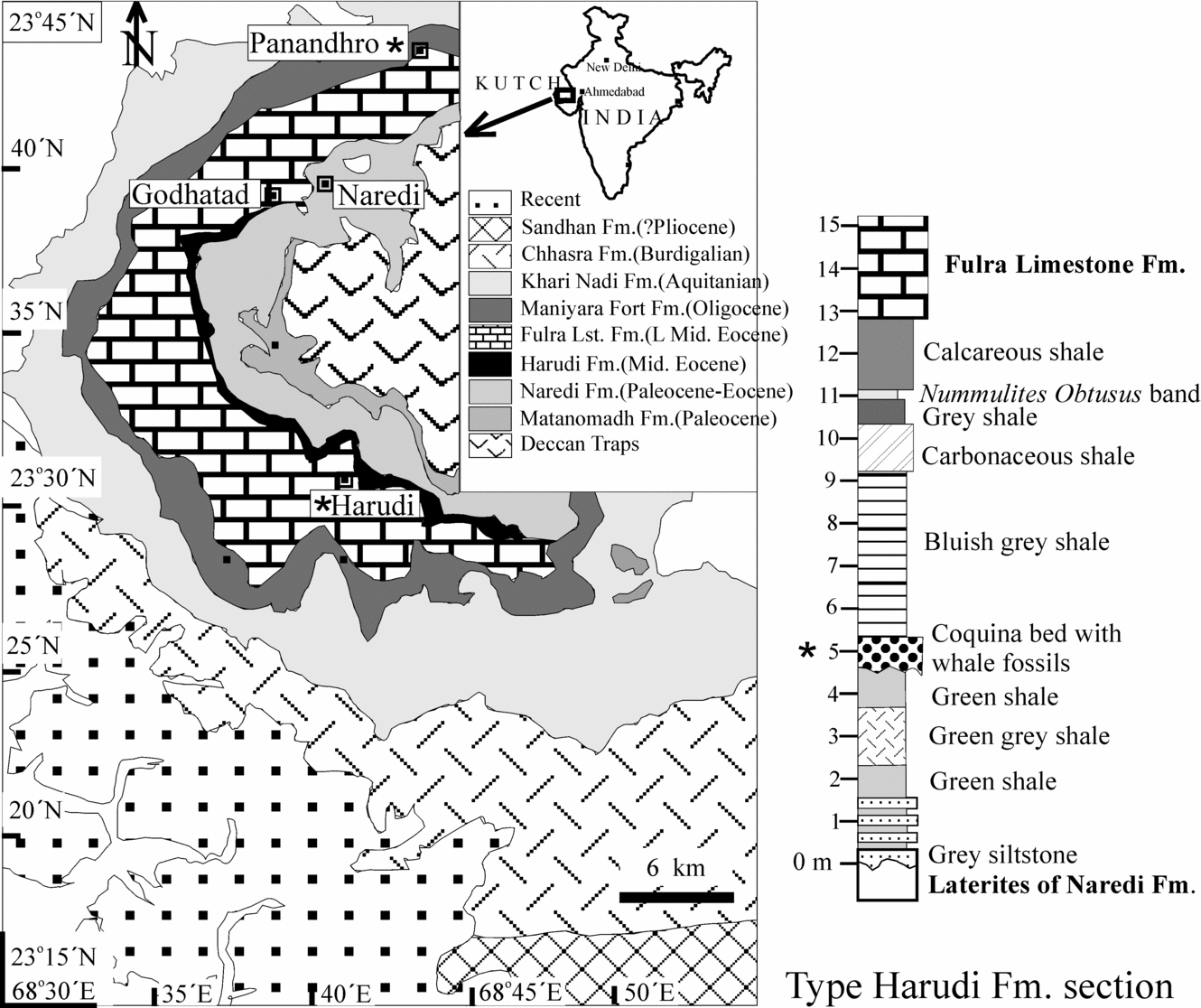
In recent years, the Indian subcontinent has been shown to be the centre of origin and early evolution of whales (Cetacea), and a variety of Eocene whales have been described from this region, especially from western India and northern and central Pakistan (e.g. Bajpai & Thewissen, Reference Bajpai, Thewissen and Thewissen1998, Reference Bajpai and Thewissen2001; Thewissen & Bajpai, Reference Thewissen and Bajpai2001, Reference Thewissen and Bajpai2009; Thewissen & Williams, Reference Thewissen and Williams2002; Gingerich Arif & Clyde, Reference Gingerich, Arif and Clyde1995; Gingerich et al. Reference Gingerich, Arif, Bhatti, Anwar and Sanders1997, Reference Gingerich, Ul-Haq, Khan and Zalmout2001). In India, middle Eocene whales as well as associated sea-cows (Sirenia) have long been known to occur in the Harudi Formation of Kutch, in northwestern Gujarat (Fig. 1) (e.g. Sahni & Mishra, Reference Sahni and Mishra1972, Reference Sahni and Mishra1975; Kumar & Sahni, Reference Kumar and Sahni1986; Bajpai & Thewissen, Reference Bajpai, Thewissen and Thewissen1998, Reference Bajpai and Thewissen2001; Williams, Reference Williams and Thewissen1998; Bajpai et al. Reference Bajpai, Thewissen, Kapur, Tiwari and Sahni2006, Reference Bajpai, Domning, Das and Mishra2009; Thewissen & Bajpai, Reference Thewissen and Bajpai2009). Depositional environments of the Harudi strata vary from coastal to inner shelf, with the whale-bearing interval indicating deposition in protected bays and swamps. The Harudi whales are of considerable importance in documenting whale origins (e.g. Thewissen & Bajpai, Reference Thewissen and Bajpai2001) and comprise members of at least two families: the morphologically unusual remingtonocetids which are endemic to Indo-Pakistan, and the cosmopolitan protocetids. Remingtonocetids, which are particularly abundant in Kutch, are an archaic cetacean family of highly specialized amphibious forms that represent an important intermediate stage in the evolutionary transition of whales from land to sea (Thewissen & Bajpai, Reference Thewissen and Bajpai2009).
Geological map of Kutch (after Biswas, Reference Biswas1992) and type lithological section of the Harudi Formation showing the location of the sampled whale-bearing bed.

The age of the Harudi Formation has long remained poorly resolved because of the absence of age-diagnostic microfossils, such as planktic foraminifers and calcareous nannoplankton. Current opinions favour a Lutetian or Bartonian stage of the middle Eocene (see Biswas, Reference Biswas1992; Singh & Singh, Reference Singh and Singh1991; Gingerich, Arif & Clyde, Reference Gingerich, Arif and Clyde1998; Gingerich et al. Reference Gingerich, Ul-Haq, Khan and Zalmout2001). Clearly, a precise age of the whale-bearing horizons (Fig. 1) is important in constraining the stratigraphic distribution of the various taxa and the timing and rates of morphological and ecological change associated with the land-to-sea transition of cetaceans. In particular, dating the Kutch remingtonocetids is significant from the perspective of rate of evolution because this archaic family documents a critical intermediate stage in the aquatic adaptations of major organ systems, such as hearing, balance, locomotion and feeding, that characterized the transition of whales from terrestrial to fully marine conditions. This study reports on an independent approach, 87Sr/86Sr analysis of marine biogenic carbonates, to obtain a numerical age of the Kutch cetaceans. As is well known, changes in strontium isotopic composition of seawater are recorded in the 87Sr/86Sr ratio of marine biogenic and authigenic carbonates, which, when well-preserved, can be compared to the seawater Sr isotope evolution curve (Burke et al. Reference Burke, Denison, Hetherington, Koepnick, Nelson and Otto1982; Elderfield, Reference Elderfield1986; Veizer, Reference Veizer1989; Howarth & McArthur, Reference Howarth and McArthur1997; Veizer et al. Reference Veizer, Buhl, Diener, Ebneth, Podlaha, Bruckschen, Jasper, Korte, Schaaf, Ala and Azmy1997, Reference Veizer, Ala, Azmy, Bruckschen, Buhl, Bruhn, Carden, Diener, Ebneth, Godderis, Jasper, Korte, Pawelleck, Podlaha and Strauss1999; McArthur, Howarth & Bailey, Reference McArthur, Howarth and Bailey2001) to obtain numerical ages of the material analysed.
2. Material and analytical methods
Well-preserved samples of molluscan shells, smaller benthic foraminifer (Elphidium sp.) and a shark tooth (Isurus sp.) were obtained from the principal cetacean-bearing horizon of the Harudi Formation exposed in four different sections. The fossils were carefully selected on the basis of having a pearly luster, aragonitic structure (microscopic examination) and powder XRD analyses (as summarized in Banner, Reference Banner2004) that attest to their being essentially diagenetically unaltered. Powder XRD diffractograms indicate that the fossil shell material consists dominantly of aragonite with a minor (< 6%) calcite component. The fossil samples were cleaned in ultrapure water, followed by brief cleaning with 0.02N HCl, and rinsed with ultrapure water, to remove surface contaminant Sr.
These cleaned samples were then totally dissolved in 0.5 ml quartz-distilled 2.5M HCl and the solution was centrifuged. The clear supernatant solution was loaded on conventional small Teflon columns packed with 2 ml BioRad AG50×8 200–400 mesh cation-exchange resin and eluted in 2.5M HCl. The Sr fraction was evaporated, dissolved in 1 μl 1M HNO3 and loaded on tungsten filaments with 1 μl TaF5 as an activator. Isotope measurements were carried out using a ThermoFinnigan Triton T1 thermal ionization mass spectrometer at the Institute Instrumentation Centre, Indian Institute of Technology, Roorkee. The 87Sr/86Sr ratios were measured in static multicollector mode and normalized to 86Sr/88Sr = 0.1194. Isobaric interference from 87Rb was corrected online.
During the period of data collection the value of measured NIST 987 strontium standard was higher by 0.000012 than the 0.710248 value and all measured 87Sr/86Sr ratios of samples were adjusted to this value. To check accuracy of the procedure, the Sr isotopic composition of a recent bivalve, following the same procedure, was measured and yielded a ratio of 0.709200, similar to the accepted value of 0.709175; internal precision (2 standard error on mean) of standards was better than 20 ppm and those of samples are as reported in Table 1. Total procedural blank was < 2 ng for Sr. The corrected mean (of at least two replicates) isotopic ratios were converted to a best-fit age using the LOWESS fit to the marine Sr evolution curve of Howarth & McArthur (Reference Howarth and McArthur1997) and McArthur, Howarth & Bailey (Reference McArthur, Howarth and Bailey2001) (see Look-up Table in McArthur, Howarth & Bailey, Reference McArthur, Howarth and Bailey2001, v 4: 08/04).
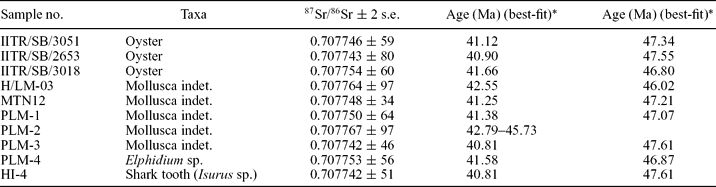
Strontium isotopic data for analysed fossil taxa from the mammal-bearing Harudi Formation, Kutch district, Gujarat

Upper and lower confidence limits, including analytical error on ratios, are within ± 2 Ma of the best-fit age.
3. Results
The corrected present-day Sr isotopic ratios, measured on three groups of fossil taxa from the Harudi Formation, are tightly constrained between 0.707742 and 0.707764; these ratios, along with the corresponding numerical best-fit ages, are given in Table 1. As the fossil samples were not significantly altered during diagenesis, they record the original seawater 87Sr/86Sr ratios which can be converted into numerical ages. These numerical ages, from molluscs, the smaller benthic foraminifera (Elphidium sp.), and the shark Galeocerdo, form two distinct clusters because of ‘shape’ constraints of the Sr-seawater curve for the middle Eocene age interval. The older age cluster is tightly constrained between 40.90 and 42.36 Ma, and 41.58 and 42.55 Ma, based respectively on the molluscs and foraminifera. One mollusc sample yielded a ratio corresponding to an older age range of 43 to 45 Ma (Table 1). The older age cluster, based on molluscs, is constrained to between 46.19 and 47.55 Ma, while that based on the smaller benthic foraminifera is 46.87 Ma. The mollusc sampled from the section at the Panandhro Lignite Mine also yielded two sets of older numerical ages corresponding to either 42 Ma or 47 Ma. Enamelloid scraped from a shark tooth also yielded a 87Sr/86Sr ratio of 0.707742, corresponding to a numerical age of either 40.81 or 47.61 Ma. Thus, the younger ages cluster between 40.81 and 42.55 Ma, whereas the older age data cluster between 46.19 and 47.55 Ma, both corresponding to a late Lutetian age (Gradstein & Ogg, Reference Gradstein and Ogg2004).
4. Discussion
The cetacean-bearing Harudi Formation of Kutch consists of a ~ 14 m thick sequence of brown, grey and olive green shales (occasionally with limonite and gypsum nodules), limestones and coquinas rich in oysters and other molluscs in the lower part, and carbonaceous shales, thin lignites, gypsified and calcareous clays and marls in the upper part (Bajpai & Thewissen, Reference Bajpai, Thewissen and Thewissen1998). A thin coquina bed (often called the Chocolate Limestone) in the lower part yields fossils of marine mammals (whales and sea cows), and a marker bed of marl containing the larger benthic foraminifer Nummulites obtusus occurs near the top of the formation.
The age of the Harudi whales has long been problematic, mainly because the lower (whale-yielding) part of the formation is devoid of age-diagnostic fossils. Such fossils (planktic foraminifera and calcareous nannofossils) occur only in the uppermost part of the Harudi formation. Singh & Singh (Reference Singh and Singh1991) and Rai (Reference Rai1997) reported the presence of the NP16 Discoaster tani Zone from the upper part of the type Harudi Formation (Rato Nala) and argued in favour of a late Middle Eocene (Bartonian) age for the entire formation. However, Biswas (Reference Biswas1992, pp. 12–13) favoured an early Middle Eocene (Lutetian) age for the Harudi Formation, and also postulated a paraconformable break in sedimentation in the upper part of the formation, above the Nummulites obtusus band (Biswas, Reference Biswas1992, p. 7). Consistent with Biswas’ (Reference Biswas1992) observations, Saravanan (N. Saravanan, unpub. Ph.D. thesis, Indian Inst. Technology, Roorkee, 2007), based on sequence stratigraphic considerations, suggested a diastem of unknown magnitude in the upper part of the Harudi Formation, well above the whale-bearing level. It is important to note that Rai's (1997) assemblage of calcareous nannoplankton from the Harudi Formation includes an abundance zone of Sphenolithus spiniger, a taxon restricted to the Lutetian part of zone NP16.
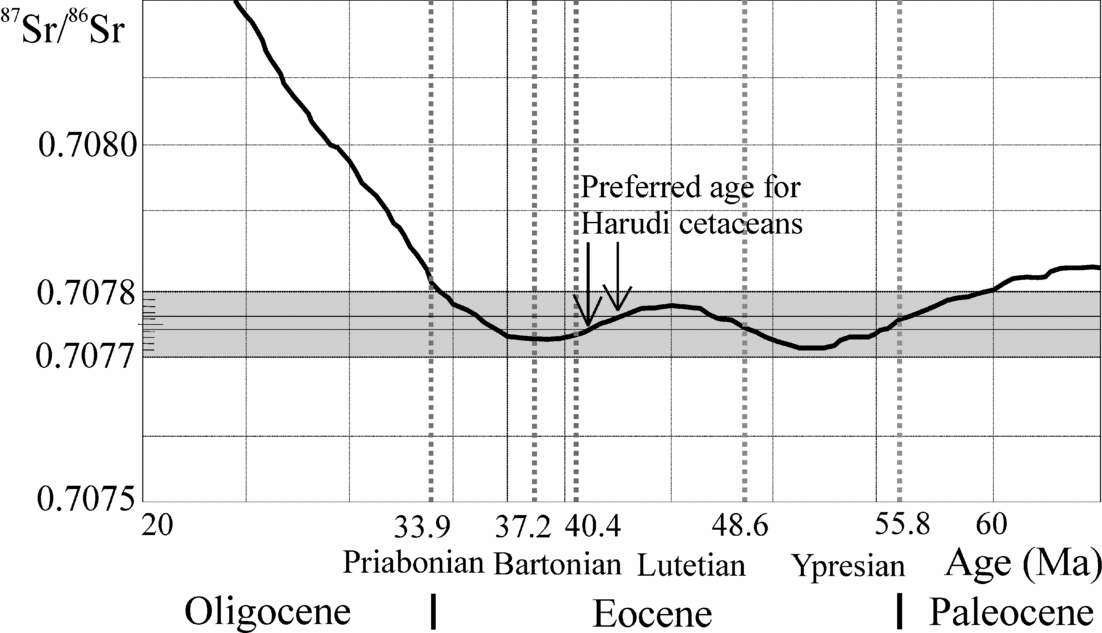
The most significant result obtained in this study is that the Sr isotopic compositions of the various marine biogenic carbonate fossils from whale-bearing horizons of the Harudi Formation can be converted to numerical ages corresponding to two distinct clusters, at 41–42.5 Ma or 46–47.5 Ma, of the possible four Eocene age intersections observed in the Sr evolution curve. The oldest (53.96–55.50 Ma) and the youngest (35.87–37.44 Ma) of these four age clusters can be easily ruled out, because the Harudi Formation unconformably overlies the Naredi Formation of late early Eocene age and is, in turn, overlain by the well-dated Fulra Limestone of Bartonian age (e.g. Biswas, Reference Biswas1992). These four clusters reflect the fact that the rate of change in 87Sr/86Sr values during the Eocene (shown in Fig. 2) was much smaller in comparison to changes during the Oligocene and Neogene, making age interpretations for the Eocene difficult. The scatter in the median values of the 87Sr/86Sr ratios probably is due to the minor calcitic component incorporated due to alteration during burial. The overall confidence limits on the best-fit age, taking into account the higher standard errors on mean, would be ± 2 Ma. In spite of this limitation, the Sr data presented here allows an assessment of the numerical age of the whale-bearing strata of Kutch, because available biostratigraphic and lithological constraints (see above) help narrow down the potential ages derived from 87Sr/86Sr values. These constraints are most consistent with the younger of the two numerical age clusters preferred here (that is, 41–42.5 Ma), corresponding to a late Lutetian age (Gradstein & Ogg, Reference Gradstein and Ogg2004) for the Harudi strata including the marine mammal horizon. This determination makes a departure from previous assessments that favour an exclusively late middle Eocene (Bartonian) age for the entire Harudi Formation (e.g. Singh & Singh, Reference Singh and Singh1991; Gingerich et al. Reference Gingerich, Ul-Haq, Khan and Zalmout2001). The whale-bearing strata of the Harudi Formation are here considered correlatable with those of the Domanda Formation of Sulaiman Range, Pakistan, consistent with the common occurrence of remingtonocetid whales in the two formations.
Eocene part of the seawater Sr evolution curve (LOWESS-fit; McArthur, Howarth & Bailey, Reference McArthur, Howarth and Bailey2001) showing the low rate of change in marine 87Sr/86Sr values; Eocene time divisions from Gradstein & Ogg (Reference Gradstein and Ogg2004).

Acknowledgements
SB acknowledges funding from the Department of Science and Technology (Ramanna Fellowship). This is a contribution from the DST-sponsored National Facility for Geochronology and Isotope Geology. We thank our former students (A. Rohan, Piyali Chanda and Ayan Das) for help during the course of this work.