Perioperative complications, developing during the surgical procedure and the post-operative period, play a key role in hospital morbidity and mortality associated with paediatric cardiac surgery. Complications negatively affect patient outcomes, including operative mortality, length of stay in the intensive care, and long-term quality of life.Reference Ferraris and Ferraris1,Reference Benavidez, Gauvreau and Del Nido2 Complication is defined as “an event or occurrence that is associated with disease or a healthcare intervention that is (a) a departure from the desired course of events and (b) may cause or be associated with suboptimal outcome.”Reference Jacobs, Jacobs and Mavroudis3 Many of these complications are the result of the so-called “human factor”, being in fact the product of human errors, either directly or indirectly related to factors such as lacking staff expertise and limited resource base.Reference Shearer, Marshall and Buist4,Reference Donohue and Endacott5 Other complications can be related to the characteristics of patients or procedural factors, and although not directly associated to human errors, their impact on surgical outcomes depends on the capability of cardiac surgery team performance.
In recent years, the medical community began to understand more clearly the approaches to eliminate complications. Specifically identifying three main components of reducing the number of complications associated with errors: adequate prevention, timely detection, and full compensation of existing complications.Reference de Leval, Carthey and Wright6 The inadequate response to the complication, the so-called “failure-to-rescue”, contributes significantly to a perioperative morbidity and mortality.Reference Ghaferi, Birkmeyer and Dimick7,Reference Pasquali, He and Jacobs8 The modern medical community has made great efforts to develop methods for the elimination of complications. For instance, the active implementation of surgical safety checklists has convincingly shown to be effective in improving outcomes of surgical treatment.Reference Walker, Reshamwalla and Wilson9 The widespread use of protocols for post-operative management, including computer algorithms for early sepsis detection or post-operative bleeding, it is also aimed to reduce the number of complications by facilitating the processes of problem detection and compensation.Reference Hodgetts, Kenward and Vlachonikolis10,Reference Johnston, Arora and King11
Most of the literature related to management of perioperative complications pertains to the Western hemisphere, whereas the situation in low- and middle-income countries is less known. The goal of the present study is to assess the complications profile, their impact on the outcome, and significance of the failure-to-rescue concept for the paediatric cardiac surgery program in low- and middle-income countries with limited systemic resources.
Materials and methods
Site
The cardiac surgical program is located in a regional general and urgent surgery hospital without a specific service for children. The referral population is more than 3 million. The cardiac facility includes 1 operation room, 9-bed Cardiac Intensive Care Unit, single-plane catheterisation laboratory, and fifty-bed ward and provides cardiac surgical and interventional service for more than 1200 adults and 170–190 children annually. There is no separated paediatric cardiac service, but two cardiac surgeons, cardiologist, interventional cardiologist, perfusionist, anaesthesia, and Cardiac Intensive Care Unit teams were trained in paediatric cardiology and cardiac surgery. More details of the infrastructure, human resources, and training process have been previously described.Reference Polivenok, Molloy and Gilbert12
Study design
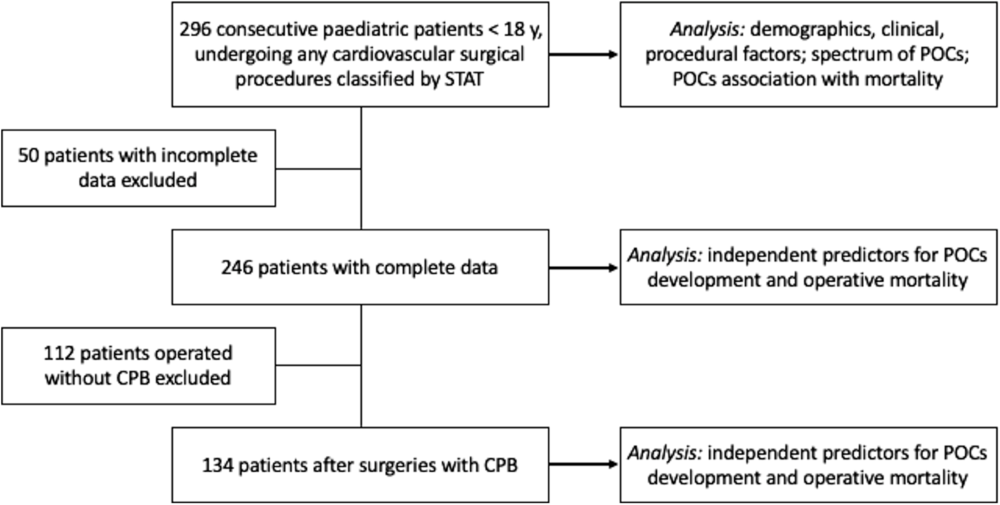
A retrospective observational analysis of a single cardiac surgery centre database was performed (Fig 1). A total of 370 paediatric surgical and interventional cases were selected over a 2-year period from January 1, 2014 to December 31, 2015. The analysis included 296 consecutive children up to 18 years, undergoing any cardiovascular surgical procedures classified by the Society of Thoracic Surgeons–European Association for Cardiothoracic Surgery risk stratification systemReference O’Brien, Clarke and Jacobs13 from January 1, 2014 to December 31, 2015. Only the first cardiovascular procedure for the patient’s admission was analysed.
Study flowchart. CPB, cardiopulmonary bypass; POCs, perioperative complications; STAT, Society of Thoracic Surgeons–European Association for Cardio-Thoracic Surgery.

Initially, the database was queried for patient demographics, pre-operative clinical status, and the spectrum of perioperative complications. The classification of perioperative complications adhered to the nomenclature for intraoperative and post-operative complications of the Society of Thoracic Surgeons Congenital Database Full Specifications, v.2.5.14 Four more additional types of complications were introduced by us: bleeding requiring transfusion – all emergent transfusion to compensate active bleeding in ICU, excluded transfusions in the operation room and transfusions beyond active bleeding; unexpected post-operative pulmonary overcirculation – clinically relevant high Qp/Qs in post-operative period; post-operative arterial hypertension – requiring prolonged hypotensive medication; intracranial haemorrhage – clinically relevant intracranial bleeding, since they occurred more than once in our cohort and were considered relevant. All perioperative complications were collated, and the association with hospital mortality was analysed.
The second part of the study was focused on the identification of the independent predictors for perioperative complications development and operative mortality. Data were incomplete on fifty patients, and they were excluded from multi-variate analysis. The following variables of 246 remained patients were analysed: age; gender; pre-operative haemoglobin level; pre-operative SpO2; nutritional status; pre-maturity; major chromosome anomalies; previous cardiac surgeries; extracardiac structural anomalies; concomitant diseases; pre-operative pulmonary hypertension; pre-operative infection; pre-operative inotropes; prostaglandin E1 infusion before surgery; pre-operative ventilation; pre-operative interventional procedures; emergency surgery; Society of Thoracic Surgeons–European Association for Cardiothoracic Surgery risk stratification system mortality score; and use of cardiopulmonary bypass. All major chromosome anomalies were divided into two groups for simplification: “Down’s syndrome” and “Other chromosome anomalies”. These variables were analysed as risk factors of perioperative complications. For analysis of the association of patient’s and procedural variables with operative mortality, the additional variables were complementarily enrolled: re-intubation, any percutaneous intervention after surgery, total number of perioperative complications per patient, and total number of cardiac surgeries during the same hospitalisation. Also, we made a similar analysis for a subgroup of 134 patients who underwent cardiopulmonary bypass with the replacement of variable “Use of CPB” by “CPB time”.
Statistical analysis
Continuous variables were summarised as medians and interquartile ranges, unless stated otherwise, and compared with the Mann–Whitney U-test. Categorical ones were expressed as a number and a percentage and compared with chi-square or Fisher’s exact test. To determine the risk factors for perioperative complications during the hospital stay, a multi-variate analysis considering any perioperative complication developed during the hospital stay as the dependent variable was performed by a logistic regression model with a forward stepwise method. The same method was utilised to identify the predictors of operative mortality considering selected variables as covariates and operative death as an outcome (dependent variable). All reported p values are two-sided. Significance was set at a p value of less than 0.05. The Statistical Package for the Social Sciences statistical software package (version 15.0; SPSS Inc., Chicago, Illinois, United States of America) and Internet-based software (www.graphpad.com/quickcalcs) were used.
Results
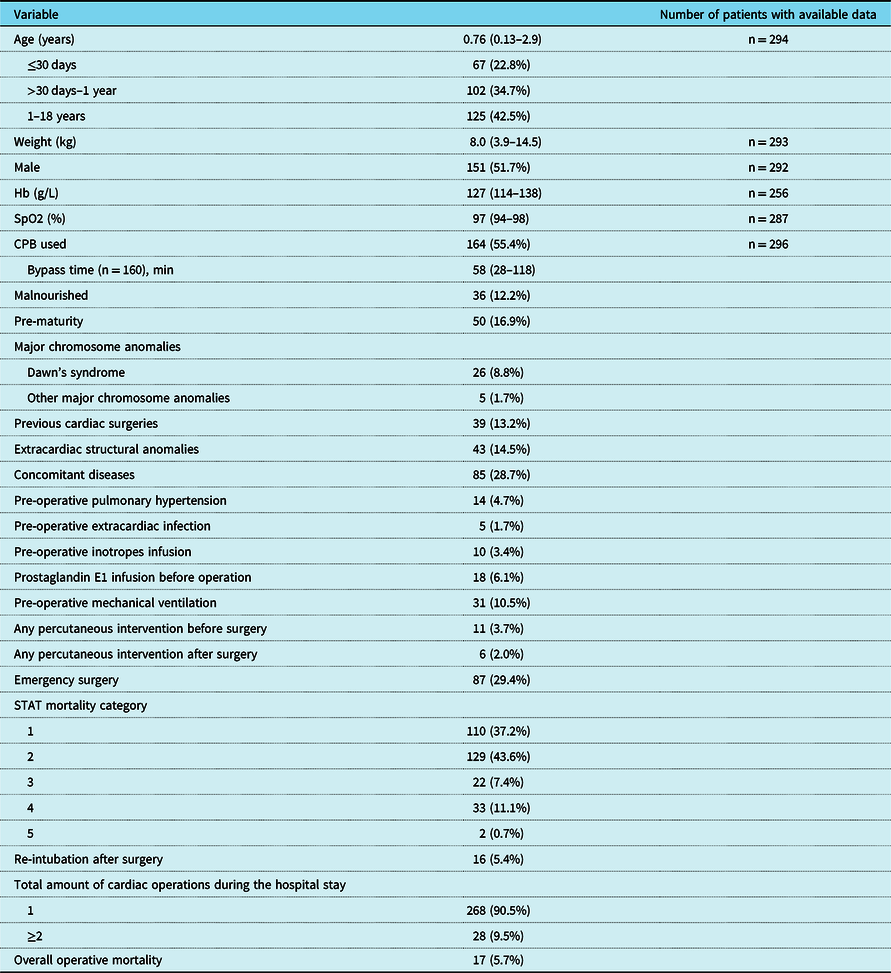
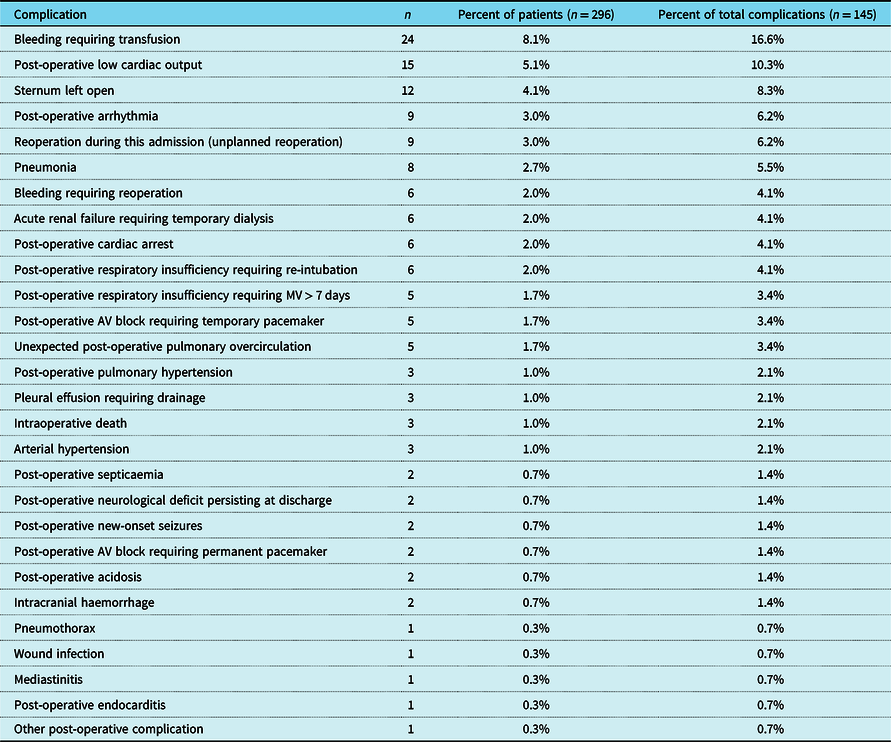
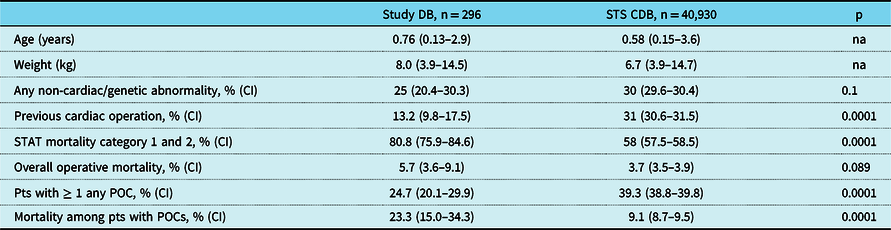
The demographic, clinical, and procedural factors are represented in Table 1. Of the 296 patients studied, 145 perioperative complications developed in 73 patients (24.7%; 95% confidence interval 21.1, 29.9). Overall hospital mortality for the entire cohort was 5.7% (confidence interval 3.6, 9.1); however, hospital mortality among patients with at least 1 perioperative complication was 23.3% (confidence interval 15, 34.3). There was a strong association between the number of perioperative complications per patient and mortality (Table 2). There was no mortality in the subgroup of patients without complications. The most frequent perioperative complications were post-operative bleeding requiring transfusion, post-operative low cardiac output, and sternum left open after surgery. Other complications were less common (Table 3). Our data were also compared with the Society of Thoracic Surgeons Congenital Database.Reference Pasquali, He and Jacobs8 It was found that the patients in our study were older, bigger, less complex, had less previous cardiac surgeries and fewer perioperative complications than patients in the Society of Thoracic Surgeons Congenital Database cohort (Table 4). The observed mortality in our study was not statistically different from the Society of Thoracic Surgeons Congenital Database, whereas failure-to-rescue (i.e., mortality among patients with perioperative complications) was significantly higher in our series.
Demographic, clinical, and procedural factors.*

CPB = cardiopulmonary bypass; Hb = haemoglobin; STAT = Society of Thoracic Surgeons–European Association for Cardio-Thoracic Surgery.
*Data displayed as median (interquartile range) and number (percent). Valid percent only is indicated.
Complications and operative mortality (n = 296)

CI = 95% confidence interval; POC = perioperative complication
*The difference in mortality between groups is statistically significant (p = 0.007 by chi-square contingency table)
Spectrum of POCs

AV = atrioventricular; MV = mechanical ventilation; POC = perioperative complication
Comparison of patient characteristics, POCs rates, and mortalities in the study DB and STS CDB

CI = 95% confidence interval; DB = database; na = not applicable; POCs = perioperative complications; pts = patients; STAT = Society of Thoracic Surgeons–European Association for Cardio-Thoracic Surgery; STS CDB = Society of Thoracic Surgery Congenital Database
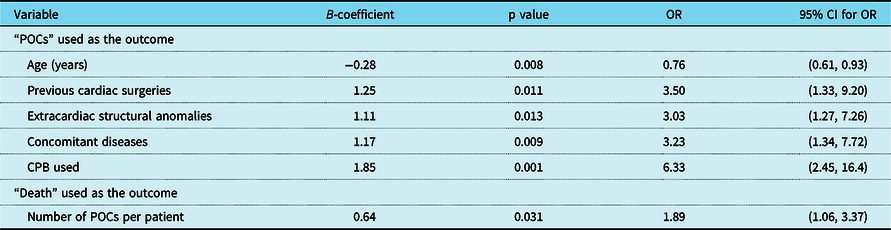
Young age, previous cardiac surgeries, extracardiac structural anomalies, concomitant diseases, and the use of cardiopulmonary bypass were identified as risk factors of perioperative complications (Table 5).
Multi-variate logistic regression analyses for prediction of POCs and operative mortality (n = 246)

CI = confidence interval; CPB = cardiopulmonary bypass used; POCs = perioperative complications; OR, odds ratio
In order to assess the influence of the patients’ and periprocedural variables on the in-hospital death, we added to the analysis some specific post-operative variables – re-intubation, any percutaneous intervention after surgery, total number of perioperative complications, and total number of cardiac operations during the same admission. The total number of perioperative complications per patient was the only independent risk factor for operative mortality (Table 5).
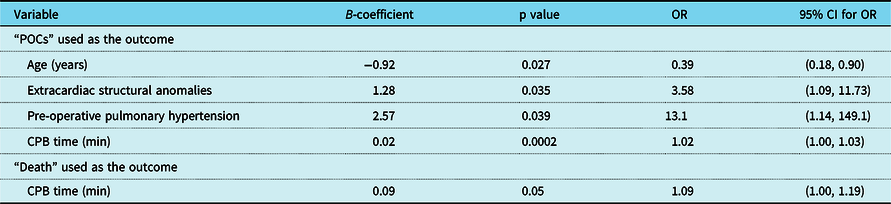
In the analysis of the subgroup of patients with cardiopulmonary bypass, such variables as young age, concomitant diseases, intravenous inotrope agents before operation, and cardiopulmonary bypass time were the risk factors of perioperative complications (Table 6).
Multi-variate logistic regression analyses for prediction of POCs and operative mortality in a subgroup with CPB (n = 134)

CI = confidence interval; CPB = cardiopulmonary bypass; OR = odds ratio; POC = perioperative complications
Considering the impact of patient status and periprocedural variables on operative mortality in the cardiopulmonary bypass subgroup, cardiopulmonary bypass time was found to be the only independent predictor for post-operative death (Table 6).
Finally, the multi-variate analysis of all perioperative complications for mortality revealed that post-operative low cardiac output state and acute renal failure requiring replacement therapy were significantly associated with operative mortality (Table 7).
Multi-variate logistic regression analysis of all POCs only for operative mortality prediction (n = 296)

CI = confidence interval; OR = odds ratio; POC = perioperative complications
Discussion
Our data have demonstrated that perioperative complications occurred in 24.7% of our surgery patients, which is lower in comparison to high-income countries, where the complication rates ranged from 39 to 44%.Reference Pasquali, He and Jacobs8,Reference Agarwal, Wolfram and Saville15,Reference Belliveau, Burton and O’Blenes16 The difference can be explained by the lower complexity of our patient cohort compared to Society of Thoracic Surgeons Congenital Database and the weak data collection discipline in our program during this stage of evolving. Data collection for national or international registries is relatively new in low- and middle-income countries.
Analysis of the operative mortality among patients with complications revealed a significantly higher mortality rate in our series (23.3%) compared to a similar cohort of Society of Thoracic Surgeons Congenital Database (9.1%). Pasquali et al previously showed the strong association between lower hospital volume and higher mortality among patients with post-operative complications (i.e., Failure to Rescue) in paediatric heart surgery.Reference Pasquali, Li and Burstein17 Also, Chan et al found that Hispanic ethnicity was associated with increased odds of experiencing a complication; however, Black race and other ethnicity were risk factors for failure-to-rescue when compared with White race.Reference Chan, Lion and Mangione-Smith18 Such racial disparities are hardly applicable to our study, which had a homogeneous ethnic population. The data obtained in our analysis suggest that Failure to Rescue is likely to have a greater impact on operative mortality in the program with limited resources.
The three most common perioperative complications in our study were post-operative bleeding, low cardiac output status, and sternum left open. Previous studies results reported a low cardiac output status, use of inhaled nitric oxide and hyperglycaemiaReference Agarwal, Wolfram and Saville15 or unplanned reoperation, acute renal failure requiring dialysis and surgical wound infectionReference Althabe, Rodríguez and Balestrini19 as the most common events.
Although the spectrum of complications is largely dependent on case-mix, nevertheless actual features of the particular program, such as the lack of adequate monitoring of coagulation status after surgery (e.g., unavailability of thromboelastography or other blood viscosity tests, protein C or anti-Xa activity test) and/or the limited availability of blood products for haemostasis (e.g., platelets are not available urgently, fibrinogen and clotting factors concentrate are not available at all or very expensive), also cannot be ignored. Moreover, we know that delays in recognising and instituting corrective interventions are a significant cause of higher mortalities in failure-to-rescue differences seen between programs.Reference Pattisan and Eastham20–Reference Calzavacca, Liuari and Tee22 Additionally, one must consider the higher mortality in patients with perioperative complication in the context of the local situation, we do not have any device (extra-corporeal membrane oxygenation, Ventricular Assist Device) for extracorporeal support for those cases with low cardiac output or severe post-operative pulmonary hypertension.Reference Alsoufi, Al-Radi and Gruenwald23,Reference Sivarajan, Almodovar and Rodefeld24
The other most common complication in our series was the delayed sternal closure, although it was not statistically associated with mortality. Previous studies showed that delayed sternal closure, mainly used for haemodynamic instability and uncontrolled bleeding, was associated with an increased rate of surgical infectionReference Özker, Saritaş and Vuran25,Reference Nelson-McMillan, Hornik and He26 and operative mortality.Reference Hurtado-Sierra, Calderón-Colmenero and Curi-Curi27 Other authors, using delayed sternal closure more electively to avoid post-operative cardiac or respiratory compromise, support an acceptable morbidity and mortality associated with delayed sternal closure in a paediatric population.Reference Tabbutt, Duncan and McLaughlin28,Reference McElhinney, Reddy and Johnson29
Such a spectrum of complications in various programs emphasises the need for routine identification and monitoring of complications in each specific program as the part of an effective quality improvement projects. It should be noted that the number of infectious complications was quite low in our series, in spite of the limitations of system resources. We attribute this result to the active implementation of infection control protocol and hand hygiene culture in our practice in the framework of the International Quality Improvement Collaborative project IQIC.Reference Balachandran, Kappanayil and Sen30,Reference Jenkins, Castaneda and Cherian31
We have demonstrated that experiencing complications after paediatric cardiac surgery is an independent risk factor for death and failure-to-rescue is the major contributor for operative mortality in a program with limited systemic resources. Identifying the patterns of perioperative complications, their nature, and significance can provide the valuable material for the development of strategies for their reduction. During the development of such strategies, one should take into account all three components of perioperative complications management – prevention, detection and compensation. Moreover, for most perioperative complications, the significance of each of these components is also different. For instance, it is clear that prevention plays a key role in the reduction of surgical infection rate, but adequate compensation may be the best strategy to manage low cardiac output syndrome with extra-corporeal membrane oxygenation playing a significant role. Considering the spectrum of perioperative complications in our series, we think that the availability of: (1) paediatric transoesophageal echo, (2) thromboelastography-based blood management protocol, and (3) extra-corporeal membrane oxygenation could significantly decrease complication rates and improve failure-to-rescue. Current economic constraints in Ukrainian healthcare prevent these acquisitions at this time.
Limitations
Our study has some limitations. First, the retrospective design with a limited number of patients at a single institution prevents extrapolation of the obtained data to other programs. Second, the lack of a proper culture of data management typical of low- and middle-income countries could potentially affect the accuracy of the complications screening.
Conclusion
In countries with limited systemic resources, failure-to-rescue is a major contributor to operative mortality in paediatric cardiac surgery. Further efforts are likely to be addressed to both the reduction of complications development (failure-to-prevent) and to improve the compensation for an already existing complication (failure-to-rescue) by developing algorithms, protocols, and checklists adjusted for the conditions of a particular program.
Acknowledgements
None.
Financial Support
This research received no specific grant from any funding agency, commercial, or not-for-profit sectors.
Conflict of Interest
None.
Ethical Standards
The study was approved by the Ethical Research Committee of Zaitcev V.T. Institute of General and Urgent Surgery and a waiver granted for the need of additional consent.