Introduction
The Mediterranean region is one of the most biologically diverse in the world (Prendergast et al. Reference Prendergast, Quinn, Lawton, Eversham and Gibbons1993). It is characterized by a distinctive climate with marked seasonality in rain pattern. Precipitation is almost completely absent in summer, hampering the survival of species in the middle of the growing season. Several studies that have examined the effect of seasonality on lichens, have identified contrasting responses between species from Mediterranean and boreal regions (e.g. MacKenzie et al. Reference MacKenzie, MacDonald, Dubois and Campbell2001, Reference MacKenzie, Król, Huner and Campbell2002; Vráblíková et al. Reference Vráblíková, McEvoy, Solhaug, Barták and Gauslaa2006; Baruffo & Tretiach Reference Baruffo and Tretiach2007; Tretiach et al. Reference Tretiach, Piccotto and Baruffo2007; Pirintsos et al. Reference Pirintsos, Paoli, Loppi and Kotzabasis2011). A marked depression of maximum PSII efficiency (F v/F m) during the Mediterranean summer has been observed in several epiphytic foliose species (Baruffo & Tretiach Reference Baruffo and Tretiach2007; Pirintsos et al. Reference Pirintsos, Paoli, Loppi and Kotzabasis2011), matching the period of water unavailability. Furthermore, the amplitude in F v/F m response in Mediterranean species was much wider than that previously found in boreal lichens (Vráblíková et al. Reference Vráblíková, McEvoy, Solhaug, Barták and Gauslaa2006). So far, the effects of summer drought on lichens have been studied in epiphytic lichens, and it is not known whether similar responses would be found in saxicolous species.
Previous studies on seasonal variation in the physiological performance of lichens have mostly relied on the use of chlorophyll fluorescence. This is a powerful tool, highly sensitive and non-invasive, with which to assess the effectiveness of photosystem II, as a proxy for photosynthesis (Maxwell & Johnson Reference Maxwell and Johnson2000). For this reason, it has been widely used to (1) assess lichen response to environmental stresses (e.g. Bilger et al. Reference Bilger, Rimke, Schreiber and Lange1989; Scheidegger et al. Reference Scheidegger, Frey and Schroeter1997; Barták et al. Reference Barták, Vráblíková and Hájek2003), (2) detect lichen physiological activity, (3) deduce carbon budgets and potential growth in long-term monitoring experiments (Schroeter et al. Reference Schroeter, Kappen and Moldaenke1991; Lange et al. Reference Lange, Green and Reichenberger1999; Raggio et al. Reference Raggio, Pintado, Vivas, Sancho, Büdel, Colesie, Weber, Schroeter, Lázaro and Green2014), (4) assess the effect of pollution (Calatayud et al. Reference Calatayud, Sanz, Calvo, Barreno and del Valle-Tascón1996; Niewiadomska et al. Reference Niewiadomska, Jarowiecka and Czarnota1998; Candotto Carniel et al. Reference Candotto Carniel, Zanelli, Bertuzzi and Tretiach2015) and (5) determine the effectiveness of biocide treatments (Speranza et al. Reference Speranza, Wierzchos, De Los Ríos, Pérez-Ortega, Souza-Egipsy and Ascaso2012).
Chlorophyll fluorescence is not without problems when used for the study of cryptogams. Unlike vascular plants (Demmig & Björkman Reference Demmig and Björkman1987; Genty et al. Reference Genty, Briantais and Baker1989), there is no direct and clear relationship in bryophytes and lichens between ETR (electron transport rate, as a parameter obtained from fluorescence measurements) and CO2 fixation (Leisner et al. Reference Leisner, Green and Lange1997; Green et al. Reference Green, Schroeter, Kappen, Seppelt and Maseyk1998; Proctor & Smirnoff Reference Proctor and Smirnoff2011). Owing to different photoprotective mechanisms operating in lichens, an F v/F m (maximum quantum efficiency of PSII) as high as that for vascular plants (c. 0·83) is not to be expected, with normal values for lichens lying between 0·63 and 0·76 (Demmig-Adams et al. Reference Demmig-Adams, Máguas, Adams, Meyer, Kilian and Lange1990) and only exceptionally exceeding 0·80 (Baruffo & Tretiach Reference Baruffo and Tretiach2007). Moreover, in spite of the extensive literature on chlorophyll a (Chla) fluorescence, knowledge of the factors that influence it is still poor. For example, it is not known how weather conditions prior to measurement could influence the results, masking the state of PSII and thus making comparisons among species or seasons unreliable (Gauslaa et al. Reference Gauslaa, Ohlson, Solhaug, Bilger and Nybakken2001). For instance, Baruffo & Tretiach (Reference Baruffo and Tretiach2007) observed that the light regime in the days preceding field measurements influenced the functionality of PSII of Parmelia subrudecta.
In the present work, we studied the temporal variation in F v/F m in two sibling species of Lasallia which show different ecological preferences and distribution ranges. We aimed to (1) discover whether co-occurring populations of these species show Chla fluorescence acclimation to seasonal changes, (2) analyse the influence of antecedent climatic conditions on F v/F m, (3) assess the effect on F v/F m of a short period of acclimation under controlled laboratory conditions and (4) identify any physiological differences between the species. To achieve these aims we measured F v/F m values throughout a year, both in the field and in the laboratory.
Material and Methods
Lichen material
The study site is located in Central Spain (Silla de Felipe II, El Escorial, 40°34'5''N, 9°8'45''W, 1070 m a.s.l.). A Quercus pyrenaica forest, rich in epiphytic bryophyte and lichen species, dominates the landscape. Pyrenean oak has marcescent foliage, especially in young branches. In this locality, new leaves appear at the end of April and flowering takes place shortly after. There are numerous granite boulders in the forest, harbouring a rich saxicolous lichen community, among which Lasallia pustulata (L.) Mérat and L. hispanica (Frey) Sancho & Crespo are two of the most abundant macrolichen species. The coexistence in this area of these sibling species (Davydov et al. Reference Davydov, Peršoh and Rambold2010) may be explained by their niche segregation since they rarely share the same microhabitat (Scott & Larson Reference Scott and Larson1986; Sonesson et al. Reference Sonesson, Grimberg, Sveinbjörnsson and Carlsson2011). Lasallia hispanica is a Mediterranean endemic, occurring from 1000 m a.s.l. to the highest summits of Iberian Sistema Central (Almanzor Peak, 2592 m), on vertical, very exposed and windy surfaces. Lasallia pustulata is a widely distributed species that is usually found in more protected habitats (Sancho & Crespo Reference Sancho and Crespo1989; Codogno & Sancho Reference Codogno and Sancho1991). Samples of each species were selected from a single population of each species growing on two nearby boulders to minimise physiological variation that might result from differences in microhabitat conditions. Lasallia pustulata samples were taken from a population of more than 100 individuals growing on a boulder protected by the canopy. Lasallia hispanica samples were collected from a boulder in an open position being more exposed to wind and irradiation, but with the same orientation (facing north) as that of L. pustulata. Owing to their different population sizes, thalli of L. pustulata could be collected monthly for laboratory analyses, whereas thalli of L. hispanica were collected every two months.
Fluorescence measurements
Field and laboratory fluorescence measurements were carried out using a MINI-PAM fluorimeter (Walz, Effeltrich, Germany). Eight healthy thalli of Lasallia hispanica and L. pustulata were selected and their physiological status monitored by making sequential measurements throughout the year. The maximum photochemical quantum yield of PS II, F v/F m (=(F m-F 0)/F m), was measured at 10 points on each thallus in order to minimize error estimates owing to intrathalline variability (F 0: minimum Chla fluorescence of a dark-adapted sample, F m: maximum Chla fluorescence of a dark-adapted sample). F m was determined on thalli that had been fully hydrated by spraying and after dark adaptation (20 min covered with a black velvet cloth) using a saturating pulse (8000 µmol photosynthetically active photons m−2 s−1, lasting 0·8 s). Field measurements were carried out on the first day of each month, always around 11:00 a.m. In order to compare field measurements with acclimated thalli in the laboratory, 8 thalli were collected each month on the same day as the field measurements and kept for two days in a chamber at 10°C, 65% relative humidity (RH), with a 12 h photoperiod at a photosynthetic photon flux density (PPFD) of 100 µmol photons m−2 s−1, provided by a metal halide lamp, and sprayed once a day with mineral water (Schroeter et al. Reference Schroeter, Olech, Kappen and Heitland1995; Pintado et al. Reference Pintado, Sancho, Green, Blanquer and Lázaro2005). Spraying took place 1 h after the lights turned on with sufficient water for the thalli to reach maximum water content and to remain wet for the remainder of the light period. F v/F m was measured after similar dark adaptation and full hydration as in the field.
Meteorological data
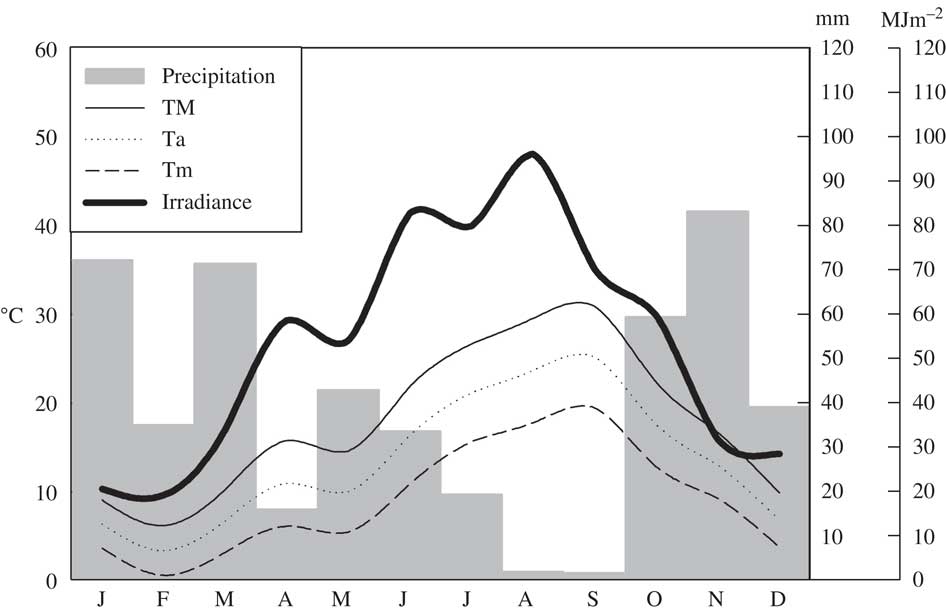
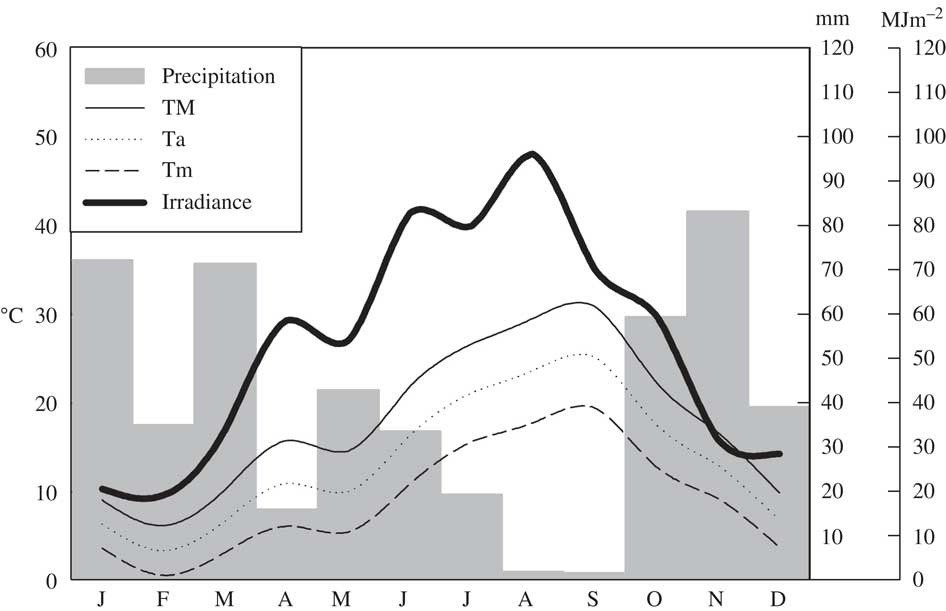
Climatic data were provided by the State Meteorological Agency (AEMET) for the sampling period from September 2008 to September 2009 with daily values for precipitation, temperature and irradiance (Fig. 1). The meteorological station is located 1 km from the study site. Due to the high continentality of the study site and the usually low ambient RH, dewfall seldom occurs, being detected on only 18 days during the study period, scattered between January and March and between November and December. Data given for any particular month are data for the previous month (i.e. data labelled as January in Fig. 1 are those gathered in December). The reason for this labelling is to keep the same month labels for all the data, since samples from January were those collected at the beginning of January, and hence exposed to the antecedent climatic conditions in December.
Climatic conditions recorded in the study area during the investigation. Monthly means of daily minimum air temperature (Tm); daily maximum air temperature (TM); mean daily air temperature (Ta); monthly summation of irradiance and precipitation. (Data from State Meteorological Agency, AEMET.)
Statistical analyses
Seasonal variation was assessed by repeated measures ANOVA after checking normality and sphericity. Differences between months were tested by pairwise comparisons with the Bonferroni correction for the P-value using the car package (Fox & Weisberg Reference Fox and Weisberg2011) in R 3.1.1 (R Core Team 2014). A paired t-test was performed to check the differences between field and laboratory acclimated values. Correlation tests were performed between F v/F m values and climatic variables measured for different durations, from 1 to 30 days, in order to assess the influence on F v/F m of the antecedent climatic conditions, as well as the period over which they were measured (Hmisc R package, Harrell et al. (Reference Harrell2014)).
Results
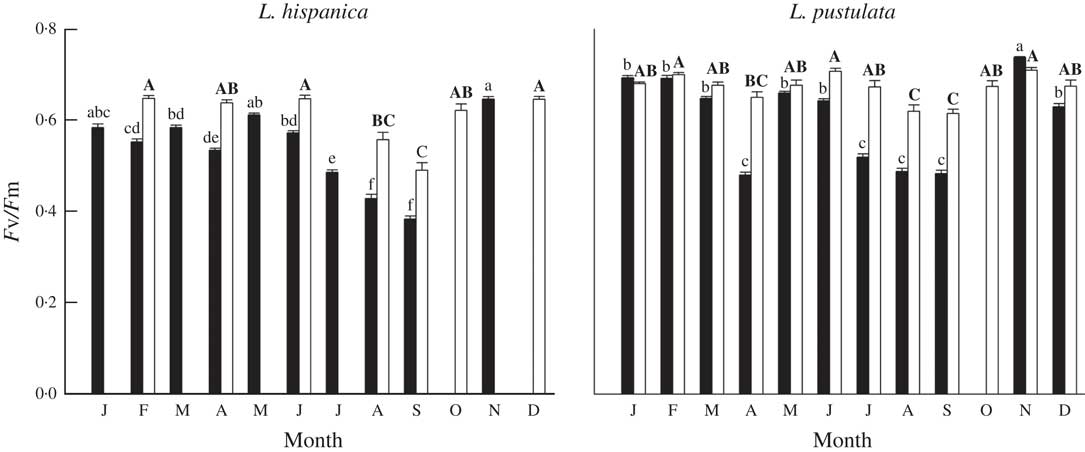
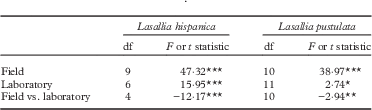
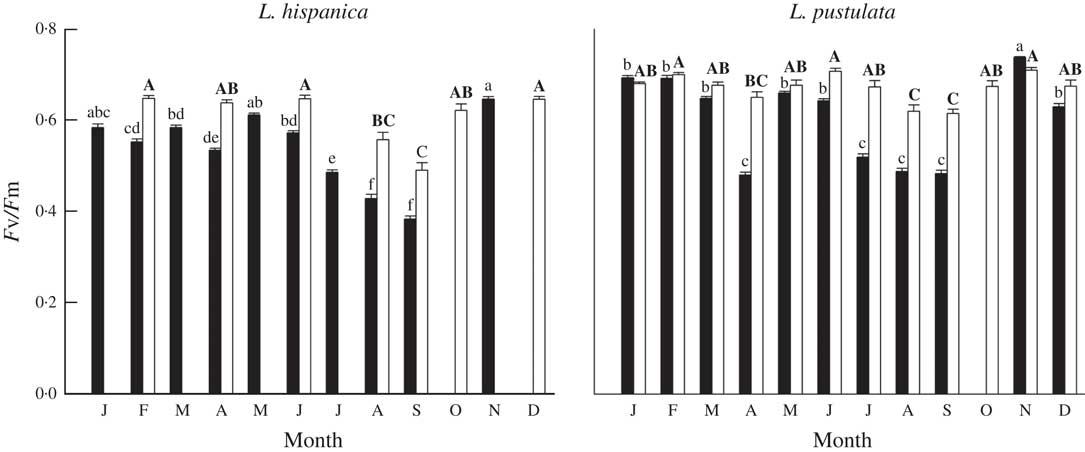
Lasallia hispanica and L. pustulata showed similar patterns regarding seasonality, with a marked depression in F v/F m during the summer months followed by a recovery at the beginning of autumn (Fig. 2). The absence of field data for L. hispanica in December is owing to frozen thalli preventing fluorescence measurements. Field data from October are missing due to a software failure. The highest F v/F m field values were recorded in November in both species (0·647 for L. hispanica and 0·733 for L. pustulata, both within the values that indicate a healthy state of PS II, according to Jensen (Reference Jensen2002)), while the lowest values were reached in September (0·384 and 0·479, respectively). Lasallia pustulata field values for April were also low (0·481). In the laboratory both L. hispanica and L. pustulata similarly had the lowest F v/F m values in September (0·494 and 0·611, respectively) while the highest values were reached in February (0·646) and November (0·705), respectively. Repeated measures ANOVA tests revealed a significant change with time in both field and laboratory measurements for both species (Table 1).
F v/F m values obtained in the laboratory (open columns) and in the field (closed columns) for Lasallia hispanica (left) and L. pustulata (right). Repeated measures ANOVAs were performed in each case and differences between months were tested by a pairwise comparison with a Bonferroni correction for the P-value. Values with the same lower case or uppercase letters are not significantly different at the P≤0·05 level. Mean values are plotted (±1SEM)
Analyses of temporal changes in Fv/Fm and of differences between field and laboratory measurements. Field and Laboratory rows: analyses of differences in Fv/Fm over a year for each species by repeated measures ANOVA tests (statistic=F). Field vs. laboratory row: analysis of differences between field and laboratory measurements by paired t test (statistic=t)

* P = <0·02; ** P = <0·01; *** P = <0·001
Higher F v/F m values were always obtained after preconditioning in the laboratory, with the exception of January and November in L. pustulata. The differences were statistically significant for both species using a paired t-test (Table 1). The disparity tended to be larger in summer in the case of L. pustulata (e.g. 26% in July vs. 0·73% in February), while it was fairly similar across the year for L. hispanica (ranging from 15% to 22%). Differences between species were also observed: F v/F m values in L. pustulata were on average 12% higher than those of L. hispanica for both field and laboratory data (Fig. 1).
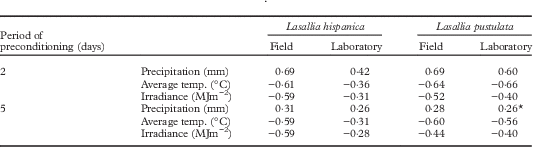
All correlations between antecedent meteorological data and F v/F m values in each species, both in the field and after laboratory preconditioning, were highly significant with positive coefficients for precipitation and negative coefficients for temperature and irradiance (Table 2). Correlations between precipitation, mean temperature and irradiance were all stronger for a 2-day than for a 5-day antecedent period. In L. hispanica the correlation coefficients between F v/F m values and climate variables were on average 73% higher for laboratory measurements while, by contrast, r values for L. pustulata were broadly similar for field and laboratory data, with those calculated for field data being only 7% higher.
Pearson’s product moment correlation coefficient (r) between Fv/Fm measurements in the field and the laboratory for Lasallia hispanica and L. pustulata and values of precipitation, average temperature and total irradiance during 2 and 5 days prior to the measurements
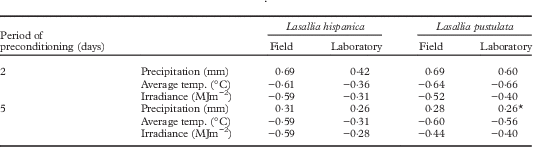
*correlation is significant at the P≤0·01 level. All other correlations are significant at the P≤0·001 level.
Discussion
The study of F v/F m by Chla fluorescence in Lasallia hispanica and L. pustulata over one year suggests that photosynthetic capacity in saxicolous lichens in a Mediterranean area might have a seasonal pattern. They displayed a marked depression of F v/F m in summer (Fig. 2) and recovered their optimum fluorescence values in autumn, as has already been reported for epiphytic lichens (Baruffo & Tretiach Reference Baruffo and Tretiach2007; Pirintsos et al. Reference Pirintsos, Paoli, Loppi and Kotzabasis2011). This pattern therefore seems to be characteristic of lichens in the Mediterranean area and does not occur in boreal regions (MacKenzie et al. Reference MacKenzie, Król, Huner and Campbell2002; Vráblíková et al. Reference Vráblíková, McEvoy, Solhaug, Barták and Gauslaa2006). Mediterranean summers are characterized by high temperatures, severe drought and high irradiance. These factors have a negative influence on the fluorescence performance of lichens (Gauslaa et al. Reference Gauslaa, Ohlson, Solhaug, Bilger and Nybakken2001; MacKenzie et al. Reference MacKenzie, Król, Huner and Campbell2002; Barták et al. Reference Barták, Vráblíková-Cempírková, Štepigová, Hájek, Váczi and Večeřová2008; Larsson et al. Reference Larsson, Večeřová, Cempírková, Solhaug and Gauslaa2009) and vascular plants (e.g. Gulías et al. Reference Gulías, Flexas, Abadía and Medrano2002; Tausz et al. Reference Tausz, González-Rodríguez, Wonisch, Peters, Grill, Morales and Jiménez2004) and this study further supports those observations (Table 2). Tretiach et al. (Reference Tretiach, Baruffo and Piccotto2012) reported a similar seasonal trend in fluorescence values for Flavoparmelia soredians, attributing most of the decrease in F v/F m to the activation of a non-photochemical quenching mechanism during desiccation; this is progressively, but not immediately, deactivated when water becomes available again. This mechanism probably influences the observed decrease in F v/F m in the present study. The effect of irradiance on F v/F m was investigated by MacKenzie et al. (Reference MacKenzie, Król, Huner and Campbell2002) who reported seasonal changes in fluorescence variables in a population of Lobaria pulmonaria growing in a deciduous forest but who did not observe such changes in the same species living in an evergreen forest with a permanently closed canopy. The considerable decrease in Lasallia pustulata F v/F m field values in summer, when the tree canopy is fully developed, points to prolonged water stress in the light being a more important factor than the direct effect of high irradiance, in accordance with the results shown by Gauslaa et al. (Reference Gauslaa, Coxson and Solhaug2012). This hypothesis is further supported by the stronger positive correlation between F v/F m and precipitation than that between F v/F m and irradiance (Table 2). In addition, the results for November, the only month where field values were higher than laboratory preconditioned values, indicate that the water regime in the field might have been more suitable than in other months. Water deprivation might also underlie the low F v/F m values measured for L. pustulata in the field in April, owing to relatively low precipitation and higher irradiance compared to values for March (Fig. 1) under a still undeveloped canopy. Tretiach et al. (Reference Tretiach, Bertuzzi, Carniel and Virgilio2013) also showed a lower physiological performance in Parmelia sulcata in the absence of a canopy.
Mediterranean lichens deal with the harsh summer conditions by entering a prolonged desiccated, metabolically inactive state. Desiccated lichens are resistant to high irradiance because desiccation reduces light transmission through the cortex (Gauslaa & Solhaug Reference Gauslaa and Solhaug2001) and stabilizes the photosynthetic apparatus by causing a functional disconnection of its components (Bilger et al. Reference Bilger, Rimke, Schreiber and Lange1989; Demmig-Adams et al. Reference Demmig-Adams, Máguas, Adams, Meyer, Kilian and Lange1990). However, during long dry periods when the weather remains too dry for the repair mechanisms to become activated, damage gradually accumulates (Gauslaa & Solhaug Reference Gauslaa and Solhaug1999). The absence of dewfall in this area adds to this problem. However, acclimation to the Mediterranean climate is evidenced by the ability of these Lasallia species to recover normal F v/F m values after the summer period, a recovery not shown by boreal species (Gauslaa et al. Reference Gauslaa, Ohlson, Solhaug, Bilger and Nybakken2001).
This ability to recover is also evidenced by the difference between field and preconditioned laboratory thalli (Fig. 2). The laboratory thalli reach maximum F v/F m in a short period, with the exception of August and September when damage might have been greater owing to harsher conditions. After protracted periods of drought, it might take longer to recover than the 48 h preconditioning period, but they finally do so and this ability is probably the reason for their survival in this climate. A boreal population of Lobaria pulmonaria affected by high irradiance and drought was found to have a much slower rate of recovery of F v/F m, reaching 50% of control thalli values after 40 days under natural conditions followed by 48 h of laboratory acclimation under low light and frequent moistening (Gauslaa & Solhaug Reference Gauslaa and Solhaug2000). On the other hand, Pellegrini et al. (Reference Pellegrini, Bertuzzi, Candotto Carniel, Lorenzini, Nali and Tretiach2014) reported damage by low light on thalli of Flavoparmelia caperata from an ash forest in Italy and then a full recovery of these thalli after two days of full hydration. The capacity for a fast response shown in this study is supported by the stronger positive correlation between F v/F m and precipitation during the preceding 2 days than that during the preceding 5 days. (Table 2). A quick physiological response in a climate such as the Mediterranean, with frequent unpredictable wet periods, could be advantageous for growth and development.
Although both species showed a similar seasonal pattern, notable differences between them were observed, probably resulting from their microhabitat preferences and their different stress tolerance. Lasallia hispanica seems to be in a suboptimal state under natural conditions as it only reached the apparent maximum F v/F m in the field in November, whereas L. pustulata maintained apparent maximum values in the field during almost the whole year (Fig. 2). The results are consistent with the increase in F v/F m in response to the 48 h preconditioning period (Fig. 2). However, the values obtained from laboratory acclimated L. hispanica were consistently higher than the respective field values, while in L. pustulata the differences between field and laboratory measurements were often small. This might indicate an efficient and fast activation of the repairing mechanisms in L. hispanica, resulting in a substantial increase in F v/F m under laboratory conditions during much of the year. This is in accordance with the preference of this species for more exposed habitats (Sancho & Crespo Reference Sancho and Crespo1989). Moreover, L. hispanica has an aero-hygrophytic strategy, taking moisture only from the air, whilst L. pustulata has a substratum-hygrophytic one, relying on the moisture in the substratum (Sancho & Kappen Reference Sancho and Kappen1989). This means that the former dries more rapidly and thus experiences desiccation more frequently, both of which enhance the production of reactive oxygen species, with the subsequent damage to DNA, proteins and lipids, amongst other deleterious effects (Minibayeva & Beckett Reference Minibayeva and Beckett2001; Kranner et al. Reference Kranner, Beckett, Hochman and Nash2008). This suggests that L. hispanica may be the more tolerant and resistant of the two species to environmental stress.
This study shows clear and similar temporal changes in the F v/F m in two co-occurring populations of Lasallia hispanica and L. pustulata growing in a typical Mediterranean ecosystem and demonstrates the close relationship between the state of PSII and climatic conditions. The response to summer drought seems to be characteristic of lichenized photobionts when exposed to typical Mediterranean summer conditions. Since both species can also be found in the north of Spain, where Mediterranean climatic features are not so pronounced, a further study with northern populations would be worth conducting in order to understand their adaptation to seasonality.
This work was funded by a predoctoral grant to MV (BES 2007-17323) and the Spanish Government projects CGL2006-12179-C02-01 and CTM2009-12838-C04-01. SPO is supported by the Spanish Ministerio de Economía y Competitividad (MINECO) through a ‘Ramón y Cajal’ contract (RYC-2014-16784). AEMET is gratefully acknowledged for the meteorological data. The comments of Dr Mauro Tretiach (Trieste), Prof. Peter Crittenden (Nottingham) and two anonymous reviewers greatly improved an early version of the manuscript.