INTRODUCTION
The reproductive pattern of most pinnipeds is characterized by annual reproduction, synchronous breeding cycles and delayed implantation. The obligate delay of embryonic implantation, also called embryonic diapause, is a period during which the onset of embryonic development is delayed. Such delayed implantation is common in pinnipeds (Enders, Reference Enders1963; Hewer, Reference Hewer1974; Boyd, Reference Boyd1991). It is generally assumed that embryonic diapause provides a mechanism that can ensure that the young are born when conditions are optimal for their survival (Bigg & Fisher, Reference Bigg and Fisher1975; Boyd, Reference Boyd1991; Temte, Reference Temte1994; Jemison & Kelly, Reference Jemison and Kelly2001; Dubé et al., Reference Dubé, Hamill and Barrette2003).
It is not fully understood how the mechanism of timing of implantation works in seals. Most studies have suggested that the annual photoperiodic cycle is the most likely mechanism of synchronizing implantation in pinnipeds (Bigg & Fisher, Reference Bigg and Fisher1975; Boulva, Reference Boulva1975; Boyd, Reference Boyd1991; Temte & Temte, Reference Temte and Temte1993; Temte, Reference Temte1994), and only grey seals (Halichoerus grypus (Fabricius, 1791)) and Australian sea lions (Neophoca cinerea (Péron, 1816)) are known not to conform to the properties of photoperiodic synchronization (Boyd, Reference Boyd1991). Renfree & Shaw (Reference Renfree and Shaw2000) in a review documented that almost 100 species of mammals in seven different mammalian orders undergo such a diapause, and showed that the characteristics differ in each family. These authors conclude that the control of reactivation of the blastocyst in seals is far from clear.
In some regions, the phenology cycle of common seals varies with latitude (Bigg, Reference Bigg1969; Temte et al., Reference Temte, Bigg and Wiig1991) and is assumed to be the effect of differences in the latitudinal photoperiod cycle (Temte et al., Reference Temte, Bigg and Wiig1991). Temte et al. (Reference Temte, Bigg and Wiig1991) found latitudinal clines for Phoca vitulina concolor (DeKay, 1842) along eastern North America and for Phoca vitulina richardsi (Gray, 1864) between Baja California and the west coast of Washington. However, they found no clines for Phoca vitulina vitulina (Linnaeus, 1758) or for other ranges of Phoca vitulina richardsi. Critical photoperiod cues may have evolved over time to adapt to specific local circumstances, which may explain why latitudinal clines are not found in some regions. According to Bigg (Reference Bigg1973), geographical variation in the seasonal availability of shrimp for the newly weaned pups may be a selective pressure which controls regional variation in reproductive timing.
The Wadden Sea is an important area for the reproduction of common seals (Phoca vitulina vitulina). Common seal pupping in the Dutch Wadden Sea occurs in May, June and July (Havinga, Reference Havinga1933; Van Haaften, Reference Haaften, Reijnders and Wolff1981; Reijnders, Reference Reijnders1990). Mating takes place in July, August and September (Havinga, Reference Havinga1933; Van Haaften, Reference Haaften, Reijnders and Wolff1981; Reijnders, Reference Reijnders1990). Implantation for Wadden Sea common seals occurs between the end of October and the third week of November according to Reijnders (Reference Reijnders1990), and in November and December according to Van Haaften (Reference Haaften, Reijnders and Wolff1981). Harrison (Reference Harrison and Enders1963) studied foetus lengths for common seals of the East Anglian coast of the United Kingdom and calculated that implantation occurs in November and December. The period of delayed implantation is 1–3 months according to Bigg (Reference Bigg1973) and 2–3 months according to Van Haaften (Reference Haaften, Reijnders and Wolff1981).
The Wadden Sea is an area which is intensively used by humans both for economic and recreational purposes. This implies the presence of various potential anthropogenic disturbance factors on seals, which in the birth season could lead to separation of mother and pup pairs. Extreme weather conditions may occasionally also lead to separation. Orphaned pups found along the coastline are brought to the Seal Rehabilitation and Research Centre (SRRC) in Pieterburen for rehabilitation. We used these rehabilitation records to investigate the timing of the pupping season over recent decades in common seals of the Dutch Wadden Sea. We also explored possible environmental causes underlying an observed change in phenology.
MATERIALS AND METHODS
The rehabilitation records of orphaned seals stranded in the Wadden Sea area were extracted from the SRRC database. The SRRC set up a stranding network soon after the start of its operations in 1971. The stranding network has been relatively stable with minimal changes in team members and in collection effort. Stranded animals on the beach are reported to the SRRC stranding network and are not actively searched for. It is assumed that the majority of the seals stranded at the Dutch coast were reported since The Netherlands has a densely inhabited coastline with a well organized stranding network. The stranding dates of the orphaned seals of our dataset are believed to be a good representation of the timing of birth of seals in the wild. Separations of recently-born seals from their mothers are usually caused by human disturbance or extreme weather conditions, and these two factors are considered to affect the seals in a random manner with respect to date. Furthermore, there are no indications that reporting effort or extreme weather conditions have advanced in time. The dataset includes only those pups which still had an umbilical stub on the day of stranding as these are the youngest pups with the shortest time lapse between birth date and stranding date. Three hundred and ten rehabilitated pups with umbilical stub were recorded in the period 1974–2008. For half of these animals (161), the date on which the umbilical stub fell off was recorded showing that ninety-eight per cent lost their umbilical stubs within the first five days of rehabilitation. This is consistent with the observations of Wipper (Reference Wipper1974) who noted that the umbilical stub falls off after three to five days. Therefore, it is likely that the stranding dates of orphaned seals with an umbilical stub do not deviate more than a few days from the true birth date of the animals.
The dataset (N = 310) includes only seals stranded in the Wadden Sea region. No data were available for the island of Texel as these seals are usually admitted to another rehabilitation centre at Texel. No seals with umbilical stubs were reported for the year 1976. The stranding dates were converted into Julian days (January 1 = 1) for each year.
All seals which enter the centre are weighed on admittance. Characteristics, such as the presence of a lanugo, are also recorded (the lanugo is an embryonic coat which common seals usually shed before birth; Oftedal et al., Reference Oftedal, Bowen, Widdowson and Boness1991). Of all the animals included in this study, 37 seals still had their lanugo on the day of stranding. Shortened pregnancies may result in lower birth weights or a higher frequency of seals born with lanugo coats. We therefore examined stranding weights and frequencies of seals with a lanugo over the research period 1974–2008.
The Netherlands has experienced a rise in temperature over the 20th Century (Van Oldenborgh & Van Ulden, Reference Oldenborgh and Ulden2003). Air temperature data were tested for a correlation with the seal stranding data. Data for the period 1974–2008 and the recording location Groningen/Eelde were extracted from the database of the Royal Netherlands Meteorological Institute available at http://www.knmi.nl/klimatologie/maandgegevens/index.html. Temperature data were extracted for the two months crucial for the timing of the reproductive cycle, namely the month November when implantation occurs (Harrison, Reference Harrison and Enders1963; Reijnders, Reference Reijnders1990) and the month May prior to parturition.
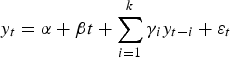
To analyse temporal changes in stranding dates, body measurements and temperature we fitted linear autoregressive (AR) models using the maximum likelihood arima procedure in R 2.12.0 (R Development Core Team, 2010). A k-th order AR model is of the form
 $$y_t=\alpha+\beta t+\sum\limits_{i=1}^k {\gamma _i y_{t - i} }+\varepsilon _t$$
Here α is the intercept, β the slope with time t (year) and the γi the linear effect of the response variable i time units ago. Significance of parameters was tested with t-tests.
Changes over time in sex-ratio and the proportion of seals with lanugo coats were fitted with logistic regression, using R's glm procedure with option family = ‘binomial'. Significance was assessed with Wald tests (Crawley Reference Crawley2007).
RESULTS
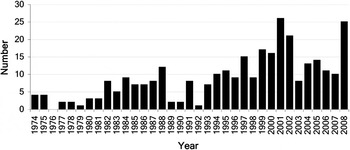
The number of orphaned seals admitted for rehabilitation has increased over the years (Figure 1), although a sharp decrease in admitted seals occurred after the two epizootics of the phocine distemper virus in 1988 and 2002 (Osterhaus & Vedder, Reference Osterhaus and Vedder1988; Jensen et al., Reference Jensen, van de Bildt, Dietz, Andersen, Hammer, Kuiken and Osterhaus2002).
The number of orphaned seal pups with an umbilical stub that stranded during the period 1974–2008 (N = 310).

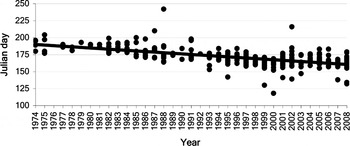
An advance of the mean annual birth dates has occurred in the period 1974–2008 with orphaned pups tending to be stranded earlier in each year (Figure 2). The relationship with time is approximately linear, although the forward shift is perhaps less apparent after the year 2000. Although the years 1976–1981, 1989, 1990 and 1992 each included a maximum of three animals, they do not appear to deviate from the general trend.
Stranding dates, presented as Julian days (January 1 = 1), of orphaned seals pups with an umbilical stub that stranded during the period 1974–2008 (N = 310). The fitted line shows a significant decline with time (see text for further details).

In 1974 the mean stranding date of rehabilitated orphaned pups with an umbilical stub was 9 July (day 190 ± SD = 7), whereas by 2008 this had shifted to 12 June (day 164 ± SD = 11), an overall advance of 26 days. Likewise, the first pup stranded in 1974 was on 29 June (day 180) whereas in 2008 this had shifted to 11 May (day 132), an advance of 48 days. The best fitting AR model was a first-order model with significant positive correlation between successive years (γ 1 = 0.375 ± SE = 0.053, P < 0.0001) and a significant decline over time (β = –0.883 ± SE = 0.098, P < 0.0001).
Out of the 310 seals with an umbilical stub, 37 animals had a lanugo. Stranding data of these seals were analysed separately, and revealed a similar gradual shift. The mean stranding date of rehabilitated orphaned pups with a lanugo had shifted from day 187 (SD = 14) in 1975 to day 154 (SD = 21) in 2008, an overall advance of 33 days. There was no significant between-year correlation (γ1 = 0.088 ± SE = 0.176, P = 0.3) and a significant decline over time (β = –1.165 ± SE = 0.244, P < 0.0001).
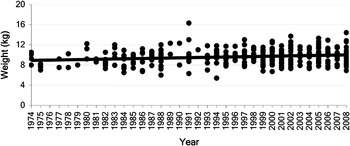
Although a decrease in weight is expected for an earlier pupping season, we found a slight increase in the weight of admitted pups over the period 1974–2008 (Figure 3). The best fitting AR model was a second-order model (γ 1 = 0.017 ± SE = 0.057, P = 0.38, γ 2 = 0.133 ± SE = 0.057, P < 0.01, β = 0.026 ± SE = 0.012, P = 0.016).
The weight (kg) of stranded orphaned seal pups with an umbilical stub that stranded during the period 1974–2008 (N = 308). The fitted line shows a significant increase with time (see text for further details).

The sex-ratio (proportion males) did not change significantly over time (z = 0.688, P = 0.49). Similarly, the frequency of a lanugo in stranded pups did not change (z = –0.301, P = 0.76).
No significant correlation was found between residual temperature (November and May) and residual birth date (Tnov: r= –0.036, P = 0.53; Tmay: r= –0.020, P = 0.72).
DISCUSSION
The number of orphaned seals admitted for rehabilitation has increased over the years corresponding to an increase in population size (TSEG, 2008). A sharp decrease in admitted seals occurred after the two epizootics of the phocine distemper virus in 1988 and 2002 (Osterhaus & Vedder, Reference Osterhaus and Vedder1988; Jensen et al., Reference Jensen, van de Bildt, Dietz, Andersen, Hammer, Kuiken and Osterhaus2002), both of which caused mass mortalities in the Wadden Sea.
Analysis of stranding dates of orphaned pups admitted for rehabilitation for the period 1974–2008 revealed a significant advance in the pupping season amounting to a total of 26 days. These results are consistent with a preliminary analysis of stranding records of orphaned seals (Osinga et al., Reference Osinga, Pen, Udo de Haes and Brakefield2009). An earlier pupping season was also found for aerial survey data of common seals in the Wadden Sea (Reijnders et al., Reference Reijnders, Brasseur and Meesters2010). For the common seals of the German Wadden Sea, a shift of comparable magnitude was observed by Abt (Reference Abt2005), who reported that the annual mean pupping dates from 1976–2004 show that phenology has advanced in a linear fashion, and was about 20 days earlier than 30 years ago.
The observed shift could solely reflect a recent change, or it could represent a return to an earlier birth season. Havinga's (1933) earliest observation of a pup in the Wadden Sea was on 14 June (day 165). The records of Havinga seem to correspond to the 1970s and 1980s when the stranding of first pups was indeed after day 165. Since the 1990s, the first pups stranded were before day 165. Thus, the present trend may have begun in the 1970s.
Different demographic factors could have had an impact on the ontogeny of birth. Until 1963, years of intensive hunting had caused the seal population in The Netherlands to dwindle (‘t Hart, Reference Hart2007). After an initial recovery of the population following the cessation of hunting, pollution began to affect the seals resulting in lower birth rates (Van Haaften, Reference Haaften1978; Reijnders, Reference Reijnders1980) and suppression of the immune system (Ross, Reference Ross1995; de Swart, Reference Swart1995). Furthermore, the two phocine distemper virus epizootics caused mass mortalities in the Wadden Sea common seal population (Osterhaus & Vedder, Reference Osterhaus and Vedder1988; Jensen et al., Reference Jensen, van de Bildt, Dietz, Andersen, Hammer, Kuiken and Osterhaus2002). The shift observed in the Dutch Wadden Sea, however, has a gradual character, showing a linear trend. This is contrary to earlier findings of Ries (Reference Ries1999) who noted that after the 1988 epizootic the birth season in the Wadden Sea shifted abruptly and remained consistently two weeks earlier. Given the rate of change in mean pupping date, the likelihood of a rather low heritability for the trait, and the long generation time, it is unlikely that the observed trend results solely from natural selection and changes in genotype frequencies due to, for example, a cessation of hunting pressure against early breeders. A growing population could lead to progressively earlier pupping due to demographic pressure. As the progression in years and the increase in population size are related in time, we cannot differentiate between an effect of years and an effect of population size. However, the estimated mortality of common seals in Dutch waters during the epidemics, 53% in 1988 and 54% in 2002 (Rijks et al. Reference Rijks, van de Bildt, Jensen, Philippa, Osterhaus and Kuiken2005), did not appear to have an impact on the Julian dates of stranding. Furthermore, demographic pressure is expected to cause a spreading out of the pupping season; that is earlier as well as later pupping. Rather, the shift in Julian dates shows an advance in pupping season and not a spread in dates.
In contrast to the advance observed in the current study, a progressive delay in mean birth date was observed for common seals (Phoca vitulina concolor) on Sable Island, Canada (Bowen et al., Reference Bowen, Ellis, Iverson and Boness2003). Analysis of the period 1987–1996, revealed a progressive delay in mean date of parturition between 1992 and 1996, resulting in an overall delay of seven days by 1996. Changes in pupping dates have also been observed for common seals (Phoca vitulina richardsi) on Tugidak Island in Alaska (Jemison & Kelly, Reference Jemison and Kelly2001). A temporal shift over the period 1976–1979 saw the onset of pupping becoming approximately 6–18 days later, and the peak pupping period becoming 9–14 days later compared to 1964 and the mid-1990s, respectively. It appears that advances as well as delays in birth season occur in common seals and that these trends can be temporary. It is interesting to note that after the year 2000, the mean stranding date of seals in the Dutch Wadden Sea has not advanced to dates earlier than day 160, perhaps indicating that the maximal forward timing of females has been reached.
The reproduction cycle can be changed in two ways, namely through changing the timing of implantation or through changes in the period of active gestation. A change in implantation may not express itself in any consequences for the pup, whereas change in the gestation period is likely to. There were no indications of a negative impact on the weight of the pups, nor was there an increase in the proportion of seals with a lanugo coat in this shift of nearly a month. These observations suggest that the most likely explanation for the change in phenology of the pupping season is a corresponding change in the timing of cessation of the period of delayed implantation. Earlier implantation could result from a shortened period of delayed implantation or from an overall shift in the reproduction cycle, including earlier mating. No data were available on the timing of mating and any changes therein. Much uncertainty remains about the specific controls of delayed implantation. It appears that there is more flexibility than expected from a photoperiod-cued mechanism. It is likely that additional factors are involved which enable a rapid response to local circumstances. Whether this response is adaptive in nature is unclear.
Food availability and temperature are generally considered to play a key role in the timing of the birth season, thus ensuring the most advantageous environmental conditions for the pups. Nutritional stress according to Bowen et al. (Reference Bowen, Ellis, Iverson and Boness2003) delayed the timing of birth at Sable Island. Jemison & Kelly (Reference Jemison and Kelly2001) found that during the period with later birth seasons in Alaska (1976–1979), there was a climatic change to warmer oceanographic and atmospheric conditions which coincided with changes in fish abundance. Duck (Reference Duck1990) found that severe climatic conditions and reduced food availability cause later female arrival at the breeding beach, and a later mean pupping date for Antarctic fur seals (Arctocephalus gazella (Peters, 1875)) on Bird Island, South Georgia. For South American sea lions (Otaria flavescens (Shaw, 1800)) in Peruvian waters, births occurred later in the season after years of low food availability, and earlier, following years of high food availability (Soto et al., Reference Soto, Trites and Arias-Schreiber2004). Unfortunately few data are available on changes in fish stocks of the Wadden Sea as well as on any changes in the diet of seals or other marine predators.
Phenology can provide particularly sensitive indicators of changes in climate. Shifting phenologies in response to a changed climate are found in several species, for instance in butterflies (Brakefield, Reference Brakefield1987; Roy & Sparks, Reference Roy and Sparks2000) and birds (Crick et al., Reference Crick, Dudley, Glue and Thomson1997). Global meta-analyses of 1700 species by Parmesan & Yohe (Reference Parmesan and Yohe2003) documented a significant mean advancement of spring events by 2.3 days per decade. Like most of the world, The Netherlands has experienced a rise in temperate over the 20th Century (Van Oldenborgh & Van Ulden, Reference Oldenborgh and Ulden2003). Although recent warming is related to natural atmospheric circulation regimes such as the North Atlantic Oscillation (NAO) (Corti et al., Reference Corti, Molteni and Palmer1999), the rise in the NAO index only partly explains the temperature rise measured in De Bilt, The Netherlands (Van Oldenborgh & Van Ulden, Reference Oldenborgh and Ulden2003). A rise in temperature is also recorded for the North Sea (Mackenzie & Schiedek, Reference Mackenzie and Schiedek2007). Although we found no direct correlation between temperature and birth date, the pupping season could be indirectly affected by temperature, namely through alterations of food availability. A response of zooplankton to a warmer Wadden Sea was recorded by Martens & Van Beusekom (Reference Martens and van Beusekom2008). An important component of the weaned seals diet is shrimp (Crangon crangon Linnaeus, 1758)) (Havinga, Reference Havinga1933; Mohr, Reference Mohr1952; Wipper, Reference Wipper1974; Muelbert & Bowen, Reference Muelbert and Bowen1993). The Wadden Sea is an important nursery area for shrimp (Kuipers & Dapper, Reference Kuipers and Dapper1984) with migration towards inshore waters in spring and an offshore migration to deeper North Sea waters in autumn (Boddeke, Reference Boddeke1976). According to Beukema (Reference Beukema1992), the settlement of a new generation of postlarvae of shrimp in the Wadden Sea started in April after mild winters, and in July after cold winters. Correspondingly, peak shrimp densities were observed in June after mild winters, and in July after cold winters. Beukema (Reference Beukema1992) also concluded that shrimps present in May on the tidal flats were significantly larger after mild, than after cold winters. A correlation between shrimp recruitment and temperature was also found by Selleslagh & Amara (Reference Selleslagh and Amara2008) for the eastern English Channel, and by Henderson et al. (Reference Henderson, Seaby and Somes2006) for the Bristol Channel.
Although no long-term effects of climate change on the seasonal abundance of shrimps in the Wadden Sea have been documented, it can be predicted that an increase in mild winters will lead to a progressive advance of shrimp abundance over the years. It is likely that such progressive changes in food availability over time will lead to a response of seals. Therefore, we propose that the common seals have changed their phenology cycle in response to altered peaks in food abundance in the Wadden Sea. These altered local conditions, ultimately may be induced by wider phenomena, such as climate change.
ACKNOWLEDGEMENTS
We are grateful to the volunteers of the stranding network (EHBZ) of the SRRC, who always are available to help stranded marine mammals. We thank Greg Hofmeyr and one anonymous referee for their helpful comments on the manuscript.