Introduction
Post-stroke dementia (PSD) has been reported in about 10% to 30% of stroke survivors (Pendlebury and Rothwell, Reference Pendlebury and Rothwell2009), and affected post-stroke functional recovery (Park et al., Reference Park2015). The early identification of high-risk groups and proper management is of overriding importance considering a time-limited window of neuroplasticity following a stroke (Murphy and Corbett, Reference Murphy and Corbett2009). However, the early identification of cognitive dysfunction after stroke is challenging in real practice. In the acute stage of ischemic stroke, most patients might not be eligible for comprehensive neuropsychological testing, which requires over one hour. Neurological deficits such as weakness of the dominant hand and visual field defect might also preclude proper neuropsychological evaluations. Even brief screening tests such as the Mini-Mental State Examination (MMSE) or the Montreal Cognitive Assessment (MoCA) require intact motor function to complete tasks such as the alternating trail-making, cube, and clock tasks. Thus, it is not applicable to a considerable portion of patients with acute stroke (Koski, Reference Koski2013). As a result, the cognitive evaluation of patients with stroke is mostly conducted at 3 months after stroke onset in practical settings. Furthermore, compared with other stroke symptoms such as hemiparesis, which have been emphasized in early rehabilitation for recovery of function as soon as possible, the cognitive sequela of stroke might miss the proper timing of intervention due to lack of screening methods.
The National Institute of Neurological Disorders and Stroke and Canadian Stroke Network (NINDS-CSN) has proposed the vascular cognitive impairment (VCI) harmonization standards neuropsychology protocol (VCIHS-NP) in 2006 (Hachinski et al., Reference Hachinski2006). It was developed primarily for the proper identification of VCI from other neurodegenerative dementia syndromes, and its feasibility was validated in multicenter prospective stroke cohort in South Korea (Yu et al., Reference Yu2013). It has three application forms consisting of 60-minute, 30-minute, and 5-mintue protocols. The NINDS-CSN 5-mintue protocol consists of only verbally conducted tests, which are subtests of the MoCA: orientation, memory, and verbal fluency tasks. It embraces both frontal and memory domains, and would be completed in a short time and can be conducted in patients with weakness of the dominant hand or visual field defect. It might be used for the early identification and screening of cognitive sequela of stroke in practical setting for a large number of patients with reasonable resource utilization. Subtests were selected based on expert opinion (Hachinski et al., Reference Hachinski2006), and the cross-sectional study have proposed reasonable discriminative power for vascular dementia (Freitas et al., Reference Freitas, Simoes, Alves and Santana2012; Kennedy et al., Reference Kennedy2014). However, its longitudinal predictive power for PSD has not been thoroughly investigated yet.
Recently, one study has shown that the MoCA was superior to the NINDS-CSN 5-mintue protocol (Dong et al., Reference Dong2016). However, they did not present any feasibility data, and the primary outcome was moderate–severe VCI rather than dementia. Considering that the MoCA has more test items, such as visuospatial construction, attention, and naming, than the NINDS-CSN 5-mintue protocol, the MoCA is certainly superior to the brief protocol. However, the MoCA usually requires over 10 or 15 min to complete as well as intact motor power and visual function. As mentioned above, the use of the MoCA might not be practical for a significant proportion of patients with acute stroke. This might lead to incorrect estimations of the actual burden of cognitive sequela after ischemic stroke. To find broad applicability in the acute stage of ischemic stroke, a screening test should be easy to adopt and be practicable to those with various neurological deficits.
Thus, we aimed to investigate the feasibility and clinical usefulness of the NINDS-CSN 5-mintue protocol in acute stage of ischemic stroke for early identification of high-risk group of clinical dementia in post-stroke survivors.
Method
Subjects
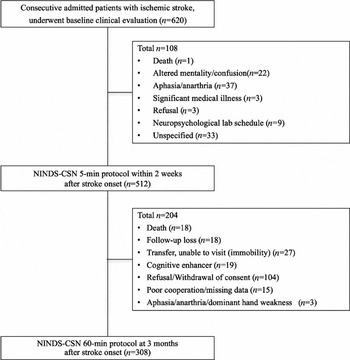
We prospectively enrolled 620 subjects with ischemic stroke within seven days of symptom onset who were consecutively admitted to 12 university hospitals in South Korea (Yu et al., Reference Yu2013). The ischemic stroke was confirmed by diffusion-weighted images. Of 620 patients, it was feasible for 512 (82.6%) to administer the NINDS-CSN 5-mintue protocol within two weeks after stroke onset (Figure 1). Patients who were excluded were significantly older (68.8 ± 10.1 vs. 65.5 ± 12.7 for those excluded vs. completed), were more likely to be women (53.7% vs. 42.0%), and had more severe stroke (initial NIHSS 9.3 ± 7.5 vs. 4.5 ± 4.4). Of these, 308 subjects had undergone the NINDS-CSN 60-minute protocol at 3 months after stroke. Excluded patients (n = 204) were significantly older (67.5 ± 11.7 vs. 64.2 ± 13.1), more likely to be women (48.5% vs. 37.7%), had more severe stroke (initial NIHSS 4.9 ± 4.3 vs. 4.1 ± 4.4), and showed lower NINDS-CSN 5-mintue protocol scores within two weeks after stroke (5.8 ± 3.2 vs. 6.9 ± 3.0).
Enrollment flow chart. NINDS-CSN (National Institute of Neurological Disease and Stroke-Canadian Stroke Network).

This study was approved by the institutional review boards of all participating hospitals, and written informed consent was obtained from all patients or their legally authorized representatives.
Cognitive evaluations
Neuropsychological assessments using the NINDS-CSN 5-mintue and 60-minute protocols were administered within two weeks and at 3 months after stroke onset, respectively.
The NINDS-CSN 5-mintue protocol consists of the MoCA subtests, including the five-word memory task (registration, recall, recognition), six-item orientation task, and one-letter phonemic fluency test (http://www.mocatest.org/) (Hachinski et al., Reference Hachinski2006). Total score of the NINDS-CSN 5-mintue protocol ranges from 0 to 12, of which lower values indicate impairment.
The NINDS-CSN 60-minute protocol was suggested to evaluate four major cognitive domains: executive/activation, language/lexical retrieval, visuospatial, and memory functions (Gorelick et al., Reference Gorelick2011). Executive/attention domain were assessed by semantic fluency (animal naming) (Kang et al., Reference Kang, Chin, Na, Lee and Park2000), Korean-controlled oral word association test (Kang et al., Reference Kang, Chin, Na, Lee and Park2000), digit symbol coding (Yum et al., Reference Yum, Park, Oh, Kim and Lee1992), Korean-trail making test-elderly's version (Yi et al., Reference Yi, Chin, Lee, Kang and Na2007), list learning strategies of Seoul verbal learning test (Kang et al., Reference Kang and Na2003). Tests for other cognitive domains were Korean-Boston naming test: short form A for language (Kang et al., Reference Kang, Kim and Na1999), Rey complex figure test copy score for visuospatial function (Kang and Na, Reference Kang and Na2003), Seoul verbal learning test for memory domain (Kang and Na, Reference Kang and Na2003). The Korean MMSE has been also conducted for the evaluation of general cognitive function (Y, Reference Kang2006). All the cognitive tests and questionnaires in the Korean-version NINDS-CSN 60-minute protocol was validated and standardized for Koreans (Yu et al., Reference Yu2013). As for the circularity issue, each item of NINDS-CSN 5-mintue protocol and 60-minute protocol did not overlap.
Primary outcome was the occurrence of PSD at 3 months after stroke onset based on the NINDS-CSN 60-minute protocol. PSD was diagnosed with reference to the American Heart Association/American Stroke Association (AHA/ASA) Scientific Statement vascular dementia criteria, which requires deficits in at least two cognitive domains regardless of memory involvement (Gorelick et al., Reference Gorelick2011). Cognitive impairment was defined when a score was below the 10th percentile for age- and education-adjusted norm (Yu et al., Reference Yu2013). Activity of daily living (ADL) impairment was defined as above 0.43 on the Korean Instrumental Activities of Daily Living (K-IADL) scale in accordance with the validation study (Kang et al., Reference Kang, Choi, Lee, Kwon, Na and Han2002). The raters were requested to evaluate the functional status independently of physical ADL. This method was the same one used in the previous studies to assess functional status of patients post-stroke (Mok et al., Reference Mok2004). We have also defined cognitive reverters as those who initially had NINDS-CSN 5-mintue protocol scores below the cut-off, but had not developed PSD at 3 months after stroke.
Demographic variables such as age, sex, level of education as well as initial stroke severity (National Institute of Health Stroke Scale, NIHSS) were evaluated as covariates. Level of education was queried as categorical variables (illiterate, not educated but literate, 0–3 years, 4–6 years, 7–9 years, 10–12 years, over 13 years), and we have dichotomized it as ⩽ 6 years vs. > 6 years (graduation of elementary school) in the final analysis considering clinical implications. NIHSS is a scale to measure the severity of stroke, which ranges from 0 (normal) to 42 (maximum severity) (Brott et al., Reference Brott1989). In addition, the Informant Questionnaire of Cognitive Decline in the Elderly (IQCODE) was assessed for the identification of premorbid cognitive decline, and it was defined as IQCODE ≥ 3.6 according to the previous study (Lee et al., Reference Lee2005).
Statistical analyses
All data were audited for outliers and implausible values before statistical analyses. For simple analyses, Student's t-tests were used for continuous variables, and χ2 tests and Fisher exact tests for categorical variables. Additionally, to evaluate the proper cut-off value of the NINDS-CSN 5-mintue protocol to predict the 90-days PSD, we conducted a receiver operating characteristic (ROC) curve analysis. In the previous cross-sectional study, a cut-off of 7/8 was proposed to delineate vascular dementia and normal cognition (Freitas et al., Reference Freitas, Simoes, Alves and Santana2012). Based on the mean differences between groups in our study and previous knowledge, we have evaluated the various cut-off values of 5/6, 6/7, 7/8, and 8/9.
To assess the independent association of the NINDS-CSN 5-mintue protocol scores with 90-days PSD, we used multivariable logistic regression models adjusted for age, sex, level of education, initial stroke severity, and premorbid cognitive decline. Covariates were selected based on the results of simple logistic regression and biologic relevance. To enable the interpretation of the relative magnitude of odds ratios (OR) across the different predictor variables, we have also calculated the standardized coefficients in the logistic regression analyses.
Due to high dropout rates, we have conducted the post-hoc subgroup analyses to investigate the effect of attrition in our cohort. In the subgroup analysis, we have examined the prognostic role of NINDS-CSN 5-minute protocol score in those who were older and had more severe stroke considering the clinical characteristics of dropout population during 3-month follow-up. We have dichotomized subjects with criteria of initial NIHSS ⩾ 3 (NIHSS mean-SD of excluded subjects, 5.8−3.2 = 2.6) and age ⩾ 56 (age mean-SD of excluded subjects, 67.5−11.7 = 55.8), which resulted in the subgroup (n = 85) comparable to those who were excluded (Table S1, available as supplementary material attached to the electronic version of this paper at www.journals.cambridge.org/jid_IPG). Within this subgroup, we have conducted the same multiple logistic regression analyses.
Statistical analyses were performed with SPSS version 21 (IBM SPSS, Chicago, IL, USA) and MedCalc for Windows, version 16.4.3 (MedCalc Software, Ostend, Belgium), and a two-sided p value <0.05 was considered as the minimum level of statistical significance.
Results
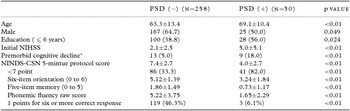
According to the AHA-ASA criteria, the frequency of PSD at 3 months was 50 (16.2%). The patients in the PSD group were significantly older, more likely to be women, had more severe stroke, and more frequently had history of premorbid cognitive decline (Table 1).
Baseline characteristics of study subjects

Number denotes mean ± SD or frequency (proportion).
* Defined as IQCODE ≥ 3.6.
National Institute of Health Stroke Scale (NIHSS), National Institute of Neurological Disease and Stroke-Canadian Stroke Network (NINDS-CSN), Informant Questionnaire of Cognitive Decline in the Elderly (IQCODE).
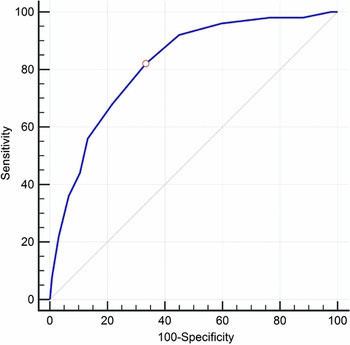
The mean score of the NINDS-CSN 5-mintue protocol was significantly different between groups (4.0 ± 2.7 for PSD, 7.4 ± 2.7 for non-PSD; range 0–12, 12 for normal cognitive function; p < 0.01). Based on the ROC curve analysis, a cut-off of 6/7 was identified as an optimal cut-off value (sensitivity 0.82, specificity 0.67, area under the curve 0.74; Table S2, Figure 2).
Baseline NINDS-CSN 5-mintue protocol ROC curve for detecting post-stroke dementia at 3 months after stroke. Circle denotes the optimal cut-off of 6/7 by ROC curve analysis. NINDS-CSN (National Institute of Neurological Disease and Stroke-Canadian Stroke Network), ROC (receiver operating characteristic).

As for the subscore of the NINDS-CSN 5-mintue protocol, all domains including orientation, memory, and phonemic fluency, showed significant differences between PSD and no dementia (Table 1). Both subscores and total score of the NINDS-CSN 5-mintue protocol within two weeks were significantly correlated with the test-specific standardized scores of the NINDS-CSN 60-minute protocol at 3 months after stroke (Table S3). Although the correlation coefficients were modest, the associations with the MMSE scores were higher than any other relationships (correlation coefficient r = 0.69).
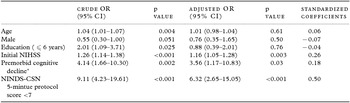
With the variable of the NINDS-CSN 5-mintue protocol score < 7 as binary dummy variable, we further conducted logistic regression analyses (Table 2). Age, initial stroke severity, and premorbid cognitive decline were all significant predictors for 3-month cognitive outcome after ischemic stroke. The NINDS-CSN 5-mintue protocol score was a significant predictor for PSD (adjusted OR 6.32, 95% CI 2.65–15.05, as a dummy variable of cut-off 6/7) after adjusting for covariates. The statistical significance was retained after excluding those with premorbid cognitive decline (n = 286, adjusted OR 5.67, 95% CI 2.25–14.28).
Logistic regression analyses for NINDS-CSN 5-mintue protocol of post-stroke dementia

* Defined as IQCODE ≥ 3.6.
National Institute of Health Stroke Scale (NIHSS), National Institute of Neurological Disease and Stroke-Canadian Stroke Network (NINDS-CSN), Informant Questionnaire of Cognitive Decline in the Elderly (IQCODE).
Among those who had initially below cut-off NINDS-CSN 5-mintue protocol score (n = 127), about 67.7% (n = 86) did not develop PSD at 90-days cognitive evaluation. When we investigated the clinical characteristics of reverters, they had less severe stroke (initial NIHSS 2.8 ± 3.4 for reverters vs. 5.6 ± 5.4 for non-reverters, p < 0.01), and showed premorbid cognitive decline less frequently compared to those who eventually developed PSD (3.5% vs. 19.5%) (Table S4). There were no significant differences in age, sex, and education. Among those who had initially above cut-off scores (n = 181), only nine patients developed PSD. They had lower NINDS-CSN 5-mintue protocol score than those who did not develop PSD (7.9 ± 1.4 vs. 9.0 ± 1.4, respectively). Age, sex, education, and initial NIHSS were not different between them.
In the subgroup analyses, the OR of NINDS-CSN 5-minutes protocol score < 7 was still significant (adjusted OR 5.90, 95% CI 1.31–26.46) in those who were older and had more severe stroke (Table S5).
Discussion
In our study, the NINDS-CSN 5-mintue protocol was easy to adopt in acute stage of ischemic stroke and had reasonable predictive power with limited number of screening tools. Our results suggest that the NINDS-CSN 5-mintue protocol is feasible and its OR for PSD is higher than those of other clinical variables, such as initial stroke severity or premorbid cognitive decline.
Strength of the NINDS-CSN 5-mintue protocol compared to the MoCA
As reported recently, the full protocol MoCA is superior to the NINDS-CSN 5-mintue protocol for predicting moderate to severe VCI at one year after stroke onset, and this is evident considering the number of items and differences in tested domains between the two exams (Dong et al., Reference Dong2016). However, the NINDS-CSN 5-mintue protocol might be a reasonable and feasible alternative to the full MoCA when a more brief and easy-to-apply measure is needed. Our study demonstrates its usefulness for patients with acute stroke, and that its predictive power is acceptable with respect to that of the full MoCA in situations where administering the full MoCA is not practical. In our results, 82.6% of eligible patients could complete the NINDS-CSN 5-mintue protocol, and most excluded patients had altered mentality, aphasia, and significant other medical illness.
Correlation between the NINDS-CSN 5-mintue protocol subscores with the NINDS-CSN 60-minute protocol
Furthermore, all subscores of the NINDS-CSN 5-mintue protocol (memory, orientation, and fluency) showed good discrimination between PSD and no dementia in our results. The correlation coefficients with 3-month cognitive tests were mostly fair, and it was the highest of 0.69 for general cognitive measure, the MMSE. It suggested that cognitive dysfunction measured with orientation, memory, and fluency tests of acute stroke stage might be associated with general cognitive decline in chronic stroke stage.
Initial stroke severity and premorbid cognitive decline as significant predictors for PSD
In our study, initial stroke severity and premorbid cognitive decline was other two significant predictors for PSD. Those are consistently reported to be predictors for PSD in the previous studies (Pendlebury and Rothwell, Reference Pendlebury and Rothwell2009). Initial stroke severity reflects lesion extent and amount of disruption of large-scale neural network, and has been reported as a significant predictor for cognitive sequelae after stroke along with other index-stroke characteristics such as location of stroke (Pendlebury and Rothwell, Reference Pendlebury and Rothwell2009; Lim et al., Reference Lim2014).
Premorbid cognitive decline might suggest that underlying pathophysiological process such as amyloid pathology, which might link to the delayed cognitive decline (Liu et al., Reference Liu2015). In our multiple logistic regression analysis, those two clinical variables were still significant along with NINDS-CSN 5-mintue protocol scores after adjusting age, sex, and education, which replicated the previous findings. In other words, the cognitive status in acute stroke stage might be important as much as initial stroke severity and premorbid cognitive decline for early identification of poor cognitive outcome after ischemic stroke.
Differences according to the diagnostic criteria
As for the diagnostic criteria, we had adopted the vascular dementia criteria of AHA/ASA scientific statement (Gorelick et al., Reference Gorelick2011). Unlike the DSM-IV criteria, it does not require impairment in memory domain to define dementia. This change was also reflected in the new DSM-V criteria for major neurocognitive disorders, which also does not require memory impairment to define dementia (Sachdev et al., Reference Sachdev2014). The prevalence of PSD at 3-months after stroke in our study was 16.2% by the AHA/ASA criteria compared to 11.0% by the DSM-IV criteria. This suggests that the AHA/ASA criteria might detect an additional 5% of the population with multi-domain impairment without memory involvement, who were not classified as having dementia according to the DSM-IV criteria. Considering the effect of executive function for functional recovery after stroke (Park et al., Reference Park2015), we should pay more attention to these patients for proper classification and intervention.
Modest predictive power
The predictive power of the NINDS-CSN 5-mintue protocol in our study was modest. In the previous study, cut-off 7/8 was proposed to discriminate vascular dementia from normal control (AUC 0.94) (Freitas et al., Reference Freitas, Simoes, Alves and Santana2012). A longitudinal study also suggested the same score as an optimal cut-off (sensitivity 0.70, specificity 0.83) (Dong et al., Reference Dong2016). Our study, where the primary outcome was dementia defined as AHA/ASA criteria at 3-months after stroke, also showed high sensitivity and negative predictive value, while specificity and positive predictive value were limited, eventually leading to moderate accuracy.
One of main reasons for low positive predictive values in our study might be cognitive reverters, who showed initially impaired cognitive function, and had recovered during follow-up. Among 127 subjects who had initially below cut-off (6/7) NINDS-CSN 5-mintue protocol score, only 32.3% had developed PSD and 67.7% were reverters. The main difference between groups was initial stroke severity. Thus, it is suggested that spontaneous cognitive recovery might occur in the 3 months after stroke in most cases of mild stroke, regardless of age and level of education. Considering that the aim of study was to identify a high-risk group in acute stroke stage for early intervention, sensitivity is more important than specificity. Proper identification of reverters and investigation of the exact mechanism for early cognitive recovery might be important for clinical application to enhance the recovery processes in the non-reverters.
Limitations
As for the limitations, we could not follow-up all patients who had undergone two-week cognitive evaluations. Only 60.2% could be followed up at 3 months post-stroke. Considering that those who were older and had more severe stroke were lost in the follow-up evaluations, this attrition bias might underestimate specificity and positive predictive value. Except well-designed small cohort study or case-control study, hospital-based registry with consecutive patients with stroke often showed limited follow-up rate. As for the 3-month follow-up completion rate, they ranged from 57.6% to 79.5% in the previous studies, which investigated the incidence of PSD (Klimkowicz et al., Reference Klimkowicz, Dziedzic, Slowik and Szczudlik2002; Nys et al., Reference Nys2005). In most studies, as we also observed, patients who were excluded were older, were more likely to be women, and had more severe stroke than did included participants. This might reflect real practice in the scope of feasibility of cognitive measurement in patients with acute ischemic stroke, and our results should be interpreted with caution considering the attrition bias. Loss to follow-up of high-risk patients is another important issue for further investigation, especially in longitudinal cognitive studies.
In addition, the predictive power of the NINDS-CSN 5-mintue protocol cut-off value was not examined in an external cohort. This should be also validated in further clinical research.
In conclusion, the NINDS-CSN 5-mintue protocol is feasible to evaluate cognitive functions within two weeks after stroke onset. It can be assessed easily at the bedside, and is a clinically useful screening method for early identification of high-risk group for PSD.
Conflict of interest
None.
Authors’ Contribution
J-S Lim, K-H Yu, and B-C Lee designed the study and supervised the data collection. J-S Lim wrote the paper. M Oh, J-H Lee, S Jung, C Kim, M Jang, S-H Lee, YJ Kim, Y Kim, J Park, Y Kang, K-H Yu, and B-C Lee collected the data. All authors assisted with writing the article through critical revision. J-S Lim was responsible for the statistical design of the study and for carrying out the statistical analysis.
Acknowledgments
Korean VCIHS study group members include Hee-Jun Bae, Jae-Kwan Cha, Ki-Hyun Cho, Soo-Jin Cho, San Jung, Yeonwook Kang, Dong-Eog Kim, Hahn-Young Kim, Oeun-Kyu Kim, Yong-Jae Kim, Im-Suck Koh, Sun-Uck Kwon, Ju-Hun Lee, Seung-Hoon Lee, Soo-Ju Lee, Mi Sun Oh, Jong-Moo Park, Joon-Hyun Shin, Kyung-Ho Yu, and Byung-Chul Lee. We appreciate Ji Sung Lee's assistance in the statistical analyses. This study was supported by a grant from the Korea Healthcare Technology R&D Project, Ministry of Health and Welfare, Republic of Korea (A102065); Hallym University Specialization Fund (HRF-S-52); Eisai Korea; and the Korea Healthcare Technology R&D project, Ministry of Health and Family Welfare, Republic of Korea (HI16C1078).
Supplementary Material
To view supplementary material for this article, please visit https://doi.org/10.1017/S1041610216002520.