Introduction
Does religious experience induce psychosis? And, if so, does it lead to isolated psychotic episodes or trigger the onset of a potentially long-standing mental disorder, such as schizophrenia or bipolar disorder? These questions are of considerable interest to the clinical psychiatrist but are very difficult to investigate in contemporary samples and require longitudinal observation. However, they can be investigated conveniently in historical samples, where populations were stable over decades in the same geographic area and where the influence of intense religious experience was relatively short-lived. Such an approach relies on the quality of historical patient records and accuracy of retrospective diagnoses, both of which have been demonstrated reliably for the records of the former North Wales Hospital in Denbigh, for which we have the complete clinical records from 1875 to 1924 (Healy et al. Reference Healy, Savage, Michael, Harris, Hirst, Carter, Cattell, McMonagle, Sohler and Susser2001; Tschinkel et al. Reference Tschinkel, Harris, Le Noury and Healy2007). The North Wales Hospital records offer the opportunity to study comparative admission incidence rates for mental illness as the population of North West Wales remained essentially constant, and the North Wales Hospital was the only provider of in-patient psychiatric care until the 1990s. The number of inhabitants hardly changed between the census of 1901 (233 149) and 1911 (233 304), with very limited population mobility. The region remained underdeveloped, so that patterns of service utilization can be more readily compared over time than elsewhere. In addition, geographical and financial constraints minimize the clinical and economic selection biases that seem to have affected other pre-community care mental illness service utilization studies (Healy et al. Reference Healy, Savage, Michael, Harris, Hirst, Carter, Cattell, McMonagle, Sohler and Susser2001).
Psychotic breakdowns linked to religious experience, the so-called Jerusalem syndrome (Bar-El et al. Reference Bar-El, Durst, Katz, Zislin, Strauss and Knobler2000), or meditation (Walsh & Roche, Reference Walsh and Roche1979; Kuijpers et al. Reference Kuijpers, van der Heijden, Tuinier and Verhoeven2007) have been described, but in single case reports or cross-sectional samples that cannot readily categorize the range of psychopathological phenomena or look at the course of any disorders. In nineteenth- and early twentieth-century Protestant countries, a series of religious revivals (RRs) centred on travelling preachers, who called the faithful to testify to being ‘chosen’ by public demonstrations of belief, generated intense experiences and enthusiasm. The most dramatic of such revivals in North Wales occurred in 1904–1905. In his annual report for 1905, the medical superintendent of the Denbigh asylum in North Wales reported that ‘early in the year an exceptional number of patients were admitted suffering from religious mania due to the Revivalists’ movements' (Michael, Reference Michael2003). Using all admissions from North West Wales, where the revival took place, to the North Wales Hospital for the years before and after 1905, we sought to establish whether the revival triggered an increase in admissions, and both the diagnostic features and lifelong course of any resulting disorders.
In our study we were mainly interested in individuals who developed short episodes of psychotic symptoms after attending one of the revival meetings. According to ICD-10, the defining characteristic of the acute and transient psychotic disorders (ATPD; ICD-10: F23) is the acute onset of psychotic symptoms (within 2 weeks). Other features are the presence of a typical psychopathology (polymorphic and schizophrenia-like, or predominantly delusional) and also a complete recovery within 1–3 months (for the schizophrenia subtype within 1 month). The group of the ATPD embraces various concepts of brief psychotic episodes, i.e. the ‘reactive psychoses’ (Stroemgren, Reference Stroemgren1987) in Scandinavia, the ‘cycloid psychoses’ (Leonhard, Reference Leonhard1999) in German psychiatry, the French ‘bouffees delirantes’ (Pichot, Reference Pichot1979) and the ‘atypical psychoses’ (Mitsuda, Reference Mitsuda1965) described in Japanese psychiatric literature.
The polymorphic type of the ATPD, which is characterized by rapidly changing symptoms, including emotional turmoil, perplexity and increased or decreased motility, shows a considerable overlap with the cycloid psychoses. According to Marneros and Pillmann (Reference Marneros and Pillmann2004), these ‘brief polymorphic psychoses’ (BPP) form the ‘core group of acute and transient psychotic disorders’ whereas the acute schizophrenia-like psychoses are more likely to belong to the schizophrenias.
Our historical database has two major advantages compared to studies looking at contemporary case-notes. First, we could retrieve the records of prior admissions back to 1865 or subsequent admissions through to 1965. Second, most contemporary studies of the natural history of psychotic disorders suffer from the problem that full remission of symptoms may be attributable to medication or other treatment and may not reflect purely the natural history of the disorder. One limitation of our admissions-based approach is that it underestimates overall incidences because not all cases would have resulted in hospital admission. However, admission criteria should not have changed rapidly over time. The present data are thus appropriate to answer our main question, whether the incidence of BPP increased as a result of the RR.
Method
Sample
The North Wales Hospital records cover all in-patient psychiatric admissions for North Wales. The admissions were, without exception, from local residents. Their home addresses and the addresses of next of kin are stated in the admissions register. Between 1902 and 1907 the patients were overwhelmingly paupers (92%) and their treatment was paid for by one of 10 Poor Law Unions. Any pauper lunatic from outside the area would have been sent to an asylum in their own locality and their treatment paid for by the Poor Law Union in which they were resident. Transfers of out-of-area patients would have been noted in the case history.
For the purposes of this study, we have taken all case-notes of patients from the North West Wales area (west of and including the Conwy Valley) admitted to the asylum between 1902 and 1907. All patients were compulsorily detained and their medical and legal certificates outlined the circumstances of detention. The case-notes record age and gender, educational, employment and marital status, family history of mental illness and prior mental or physical illness. Patients were routinely assessed for suicidality, violence, seizure-proneness, eating and sleeping habits and also alcohol intake. The notes provide a detailed assessment of mental and physical state on admission in addition to information on the course in hospital until discharge or death.
Diagnostic process
The procedures underlying retrospective diagnoses have been outlined elsewhere (Healy et al. Reference Healy, Savage, Michael, Harris, Hirst, Carter, Cattell, McMonagle, Sohler and Susser2001; Tschinkel et al. Reference Tschinkel, Harris, Le Noury and Healy2007). All diagnoses had been made before the study began but diagnoses such as F23 had been made without further specifiers.
For the purposes of this study, all F23, F20 (schizophrenia), F22 (delusional disorder), F25 (schizo-affective disorder), F31 (bipolar disorder) and F065 (catatonia) diagnoses were reviewed by S.C.L., a board-certified psychiatrist, according to ICD-10 criteria to distinguish between the different codes in the groups, in addition to reviewing cases of catatonia for inclusion. The review was based on a patient's full set of records, which give sufficient information about the onset of symptoms, the presenting mental state and the clinical course of the disorder. Although patients in this period were often kept in hospital for longer periods after recovery than would happen now, the records indicate clearly when recovery occurred.
All admissions linked to the RR and all F23 diagnoses (whether revival-related or not) and the same number of other randomly selected cases from the whole sample were reviewed by an independent consultant psychiatrist (T.R.) who was blind to the hypothesis of the study. These cases had references to the revival removed. The agreement between the two raters was 92%. To take into account the number of agreements expected by chance, we used Cohen's κ coefficient (Cohen, Reference Cohen1960), a statistical measure of inter-rater agreement for categorical items. The κ coefficient (74 cases, two raters, eight diagnostic categories) was 90% [95% confidence interval (CI) 0.818–0.976].
A key group in this sample comprised individuals who developed short episodes of psychotic symptoms after attending a revival meeting. According to ICD-10, the ATPD (F23) are characterized by the acute onset of psychotic symptoms (within 2 weeks), the presence of a typical psychopathology (polymorphic, schizophrenia-like, or predominantly delusional) and complete recovery within 1–3 months. The polymorphic type (BPP; F23.0 and F23.1) is determined by rapidly changing mood and instability of psychotic symptoms.
Data analysis
We compared all admissions during the time of the RR (1904 and 1905) to all those in the two previous (1902 and 1903) and two subsequent years (1906 and 1907). We computed incidences based on the 1901 census (Southall et al. Reference Southall, Aucott, Dorling and Ell2004). We computed age- and gender-specific incidences (separately for the age groups 15–34 and ⩾35 years) for BPP, first-episode schizophrenia, first-episode bipolar disorder and first-episode depression separately for the RR and non-RR periods. We used a Poisson regression model to determine whether these incidences depend on the year, gender, age or their two-way interactions.
Results
Between the years 1902 and 1907, there were 584 admissions to the North Wales Hospital. In 37 cases (32 in 1904–1905, three in 1902–1903 and two in 1906–1907) the hospital records link admission to the RR. Of these patients, 19 (51.4%) were diagnosed with BPP. There were also seven patients diagnosed with schizophrenia and seven patients with bipolar disorder with admissions linked to the revival.
In the case of patients diagnosed retrospectively with BPP, about a third (6/19) of those linked to the revival were admitted on the day and the others within days of the meeting. All had the polymorphic features typical for cycloid psychoses, and their conditions resolved readily.
The census data are summarized in Table 1. The average admission incidence of BPP increased from non-RR to RR years from 2.3×10⁻⁵ to 7.36×10⁻⁵. The increase was more prominent in men (from 0.65×10⁻⁵ to 9.15×10⁻⁵) than women (3.76×10⁻⁵ to 5.78×10⁻⁵). These effects were supported statistically with a Poisson regression analysis, which showed a main effect of the RR period (Wald χ2=12.664, df=1, p<0.001) and a gender by period interaction (Wald χ2=6.458, df=1, p=0.011).
Age- and gender-specific incidence rates for brief polymorphic psychoses (BPP), per annum per 100 000

RR, Religious revival.
a Taken from the 1901 census data.
The incidence of first-episode schizophrenia did not increase significantly during the RR years compared to previous and subsequent years (7.82×10⁻⁵ before/after RR, 10.13×10⁻⁵ during RR; Poisson regression: Wald χ2=2.001, df=1, p=0.157). The Poisson regression showed a main effect for age with, as expected, more first-episode schizophrenia patients in the younger age group (15–34 years; Wald χ2=14.346, p<0.001).
Similarly, patients with a first episode of bipolar disorder (diagnosed on the basis of the later course) and also patients with a first depressive episode did not present more often during the revival years compared to the years before and after the revival (Poisson regression for bipolar disorders: Wald χ2=0.514, df=1, p=0.474; depression: Wald χ2=0.716, df=1, p=0.397). There was a main effect for age in the depression group (Wald χ2=12.432, df=1, p<0.001), with more first-episode depressed patients in the older age group (⩾35 years).
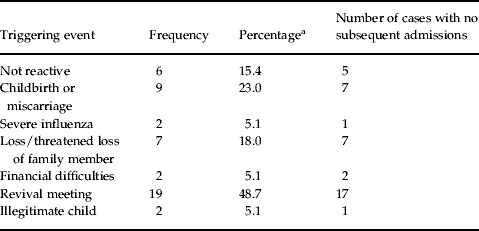
Of the 39 patients with BPP admitted between 1902 and 1907, in addition to the 19 admissions (48.7%) who developed symptoms after attending a revival meeting, a further nine admissions were linked to childbirth or miscarriages, and seven admissions to loss or threatened loss of a family member. In six cases (15.4%) no precipitating factors could be identified (Table 2). Table 2 also illustrates the favourable outcome of BPP with only a very small proportion of cases leading to readmission.
Reactivity of brief polymorphic psychoses (BPP) (n=39), covering the whole time period (1902–1907)

a Some patients had more than one triggering event.
Of the patients admitted with BPP during the index years 1902–1907, 31 of 39 (79.5%) had only one admission in their lifetime. Four patients had recurrent brief psychotic episodes, and two had one previous episode of mental problems (mentioned in the notes but not specified further). Two further patients developed subsequent problems that led to admission: one had a severe depressive episode, the other had mental problems due to physical disease.
Of the 39 BPP patients, 33 (84.6%) recovered completely from their symptoms, five (12.8%) died in hospital from physical complications (pneumonia, tuberculosis) and one patient committed suicide.
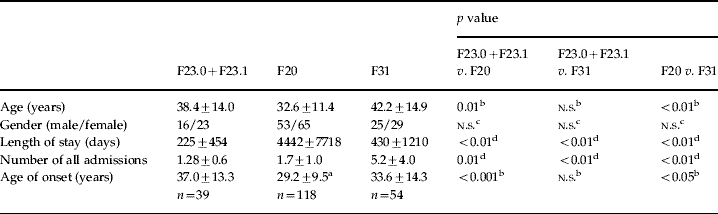
There were no differences between patients with BPP (n=39) and patients diagnosed with schizophrenia (n=118) or bipolar disorder (n=54) in terms of gender distribution. Significant differences between the groups were found regarding the length of stay in hospital. Schizophrenia patients were, on average, hospitalized for 4442 days, whereas bipolar and BPP patients were hospitalized for 430 and 225 days respectively. Over their lifetime, the group of bipolar patients had an average of 5.24 admissions, schizophrenia patients had 1.7 admissions and BPP patients had 1.28 admissions (Table 3). Schizophrenia patients had a significantly lower age of onset compared to BPP and bipolar patients.
Demographic data for brief polymorphic psychoses (BPP) and other ICD-10 diagnostic groups (values are mean ±s.d.)

n.s., Not significant.
a Only traceable for n=112.
b Independent samples t test.
c χ2 test.
d Mann–Whitney U test.
Discussion
The RR in North Wales in 1904–1905 caused a significant increase in incidence of BPP (F23.0 and F23.1), as estimated by admissions per population to the North Wales Hospital. The main wave of the North Wales revival started in the last week of November 1904 (subsiding in the summer of 1905) (Jones, Reference Jones1982) and revival-related admissions were mainly in 1905, as shown by the clear peak in the time course for admissions (Fig. 1). In 1905 the majority of BPP cases (14 out of 19) were admitted after attending an RR meeting. If the RR movement had triggered the onset of long-term psychotic illness, we might expect an increase in first-episode schizophrenia or other severe mental illness such as bipolar disorder or depression. Our data, however, show no significant increase in any of these diagnostic groups during 1904–1905.
The time course of total (–––) and brief polymorphic psychoses (BPP) admissions ( ) to the North Wales Hospital over the years around the 1904–1905 religious revival (RR), showing a peak in BPP admission in 1905 at the height of the revival.

Relationship to the Jerusalem syndrome
The phenomenology of admissions triggered by attending revival meetings was similar to the Jerusalem syndrome, as described by Bar-El et al. (Reference Bar-El, Durst, Katz, Zislin, Strauss and Knobler2000) for tourists suffering from psychotic decompensation when visiting Jerusalem. However, most of these Jerusalem-generated mental problems occurred in individuals with a previous psychiatric history. Only 42 out of 1200 patients in a 13-year period had not suffered from previous mental problems (Type III Jerusalem syndrome). These latter cases were characterized by psychomotor agitation, intense and changing mood states and also incoherent speech, a clinical picture similar to the cycloid psychoses (Leonhard, Reference Leonhard1999) and resembling the clinical presentations we observed in our study.
Diagnostic stability
Our historical database has two advantages compared to contemporary samples. First, contemporary studies cannot readily shed light on the lifetime course of any disorders. Second, studies of the natural history of psychotic disorders now suffer from the problem that any remission of symptoms may be linked to treatment rather than the spontaneous course of the disorder. Although the Jerusalem study provides a detailed clinical picture for the time of first assessment, a long-term follow-up was not possible and nothing is known about the natural history of Type III Jerusalem syndrome.
In our sample, 80% of BPP patients had only one admission during their lifetime, assuming they remained in the area, suggesting that stress-induced transient psychoses only recur in a small minority of cases and rarely lead to chronic mental illness. By contrast, Jørgensen et al. (Reference Jørgensen, Bennedsen, Christensen and Hyllested1997) followed up 51 patients with an initial diagnosis of acute and transient psychosis over 1 year and found a change of diagnosis in 48% of them, most often to schizophrenia (15%) or affective disorder (28%). Castagnini et al. (Reference Castagnini, Bertelsen and Berrios2008) followed up all Danish acute and transient cases over a 6-year period and also found a change of diagnosis on subsequent admissions, mainly to schizophrenia and affective disorders. Only 39% of acute and transient psychoses maintained their diagnosis. Neither of these studies, however, distinguished between BPP (F23.0 and F23.1) and other acute and transient psychoses. Our study may indicate that BPP, especially when reactive to stress, have a lower rate of recurrence than other acute and transient psychoses, and are less likely to convert to severe mental illness. This assumption is in accordance with the results of a study of diagnostic stability of acute polymorphic psychotic disorder without symptoms of schizophrenia (ICD-10: F23.0; Sajith et al. Reference Sajith, Chandransekaran, Sadanandabn Unni and Sahai2002). After 3 years, 73% of patients retained their index diagnosis, with the majority of the remaining cases requiring diagnostic revision to bipolar disorder.
Reactivity of BPP
Neither ICD-10 nor DSM-IV require the presence of stress prior to the onset of ATPD. In this sense, the modern concept of ATPD differs from the traditional category of reactive psychosis. This approach is in keeping with the observations of Pillmann et al. (Reference Pillmann, Haring, Balzuweit, Blöink and Marneros2002), who found that only a minority of their ATPD cases were associated with acute stress. Other authors, however, found an association between the onset of ATPD and acute stress in most of their cases (e.g. Jørgensen et al. Reference Jørgensen, Bennedsen, Chirstensen and Hyllested1996; Sajith et al. Reference Sajith, Chandransekaran, Sadanandabn Unni and Sahai2002). The problem here seems to be that different authors refer to different definitions of stressful life events and also different time frames before the onset of psychotic symptoms.
In our series of BPP, 84.6% were preceded by stressful life events, if it is agreed that the RR movement was as a stressful life event. Our data support the view that BPP triggered by life events may have a complete remittance of symptoms and diagnostic stability over time, marking them out from other psychoses and supporting the validity of a diagnosis of reactive psychosis.
Gender distribution
The pre- and post-revival years of our study are characterized by a very low rate of BPP in male patients admitted to the North Wales Hospital. The incidence of BPP in the male population increases dramatically during the revival. Although female admissions with BPP also increase during the revival years, the ‘baseline’ rate of BPP in women is much higher than in men admitted to the asylum. This observation, which was confirmed by the gender by period interaction for the BPP group in our Poisson regression analysis, can be explained in terms of the high number of postpartum cases that were also present in non-revival years (Tschinkel et al. Reference Tschinkel, Harris, Le Noury and Healy2007).
The social defeat hypothesis
Which factors propel previously mentally stable people into psychotic experiences? Are social status and standing predictors of the psychotic phenomena observed during the revival? According to the social defeat hypothesis, long-term experience of social defeat (i.e. ‘outsider’ status in a community), a lack of social support, and discrimination may increase the vulnerability for the development of psychotic symptoms (Selten & Cantor-Graae, Reference Selten and Cantor-Graae2005; Bentall & Fernyhough, Reference Bentall and Fernyhough2008). In a prospective study in The Netherlands, Janssen et al. (Reference Janssen, Hanssen, Bak, Bijl, de Graaf, Vollebergh, McKenzie and van Os2003) observed that perceived discrimination represented a risk factor for the development of psychotic symptoms. However, there is no evidence that patients who were admitted to the North Wales Hospital as a consequence of attending one of the revival meetings had an ‘outsider status’ in society. The case-notes of those patients affected by religious excitement frequently state that they were ‘very respectable’, ‘steady’ people, well integrated into the local community. The RR of 1904–1905 embraced the whole population of North West Wales. The involvement of women and young people was a special feature of the revival (Jones, Reference Jones1982). The religious experience was shared by all participants of the well-attended revival meetings.
Thus, although social defeat may very well be a risk factor for schizophrenia, the revival-induced transient psychoses do not seem to have affected the socially excluded more than other parts of the population.
Reactive psychosis and social crisis
How could so many people 100 years ago in North West Wales have developed transient psychotic symptoms within such short periods of time? Although we can speculate that personality traits, such as suggestibility or schizotypy, and biological factors may play a role, the vast majority of religious people under normal circumstances do not develop psychotic episodes. However, religious awakenings typically developed under conditions of crisis and social upheaval. The revival in North West Wales followed a 3-year failed strike (1900–1903) by quarry workers for better pay and safer working conditions and it is commonly seen as a response to this crisis (Jones, Reference Jones1982). A large proportion of the population was suffering severe economic hardship, and the future was uncertain. Such individual and collective stress has been proposed as a precipitating factor for developing psychosis (Bentall & Fernyhough, Reference Bentall and Fernyhough2008). The delusional content of the transient psychoses commonly referred to the precipitating life event, and was of a religious nature in the revival cases, which distinguishes them further from the schizophrenia cases in our sample. The delusional content seems to be understandable in the context of the situation, in line with the formulation of Jaspers (Reference Jaspers1973) in his General Psychopathology: ‘Through delusions and hallucinations the individual's fears, needs, hopes and wishes seem to become alive and real. […] Reactive psychosis serves as a defense, a refuge, an escape as well as wish fulfillment. It derives from a conflict with reality which has become intolerable.’ Our historical data confirm that transient psychoses can indeed be reactions to extraordinary life events but do not normally result in long-term mental illness. Although RRs are less likely to happen in Europe now, other social upheavals are likely to occur and could presumably lead to similar outcomes.
Acknowledgements
This study was supported by the North Wales Grants Committee and the Wales Institute of Cognitive Neuroscience (WICN). We are grateful to Dr T. Roberts, Clinical Director, Mental Health and Learning Disabilities, for cross-validation of diagnoses.
Declaration of Interest
None.