INTRODUCTION
Since 1962, when commercial no-tillage (NT) maize production was introduced in Kentucky (Phillips & Young Reference Phillips and Young1973), the NT system has been quickly adopted for grain crop production worldwide (Derpsch et al. Reference Derpsch, Friedrich, Kassam and Li2010). By 2008, 0·21 of maize (Zea mays L.) and 0·41 of soybean (Glycine max (L.) Merrill) planted acres were in NT production in the USA according to the Crop Residue Management Survey (http://www.ctic.purdue.edu/CRM/).
Burley tobacco, a major cash crop in the Southeastern USA, is problematic for conservation planning because tobacco production traditionally requires clean cultivation, for which intense rains raise erosion hazards. Tobacco producers are starting to adopt soil conservation plans for burley tobacco cultivation, especially as the tobacco industry promotes GAP (Good Agriculture Practices) for future tobacco production. No-tillage tobacco offers several advantages compared with conventional production with reduced soil erosion, shorter field preparation time, and lower fuel cost relative to mechanical tillage (Pearce & Zeleznik Reference Pearce and Zeleznik1996). Compared with bare soil, ground cover at harvest can result in cleaner cured tobacco leaf (Wood & Worsham Reference Wood and Worsham1986).
The recent development of a modified NT transplanter, together with more effective weed control options (Spartan and Command brand herbicides labelled for tobacco in the USA), have made NT tobacco production economically viable (Morrison et al. Reference Morrison, Smiley, Atkinson and Milbocker1973; Zou et al. Reference Zou, Pearce, Hu and Zeleznik2013). Although NT burley tobacco production was investigated in the early 1970s (Phillips & Zeleznik Reference Phillips and Zeleznik1989), past research provides inadequate detail comparing no-till and tilled burley tobacco production with respect to seasonal agronomic response and performance, cured leaf chemical composition and nitrogen (N) nutrition management.
Nitrogen management is an important component of tobacco production. Appropriate N management may limit excess nitrate (NO3-N) accumulation in leaves, optimize fertilizer N use efficiency, and reduce the potential for ground and surface water pollution without compromising burley tobacco leaf yield and quality (MacKown et al. Reference MacKown, Crafts-Brandner and Sutton1999). In addition to fertilizer N, N mineralization from soil organic matter (SOM) is an important N source. However, soil N mineralization may be affected by tillage method. No-tillage can have higher soil N mineralization potential than conventional tillage (CT) (El-Haris et al. Reference El-Haris, Cochran, Elliott and Bezdicek1983; Wienhold & Halvorson Reference Wienhold and Halvorson1999; Pandey et al. Reference Pandey, Chaudhari, Dagar, Singh and Singh2010), because NT tends to preserve surface soil carbon (C) and N (Six et al. Reference Six, Elliott, Paustian and Doran1998, Reference Six, Elliott and Paustian1999; Wright & Hons Reference Wright and Hons2005) and maintain higher surface soil moisture levels (Blevins et al. Reference Blevins, Cook, Phillips and Phillips1971).
Most mineralization studies have been conducted in laboratory conditions and might not reflect field conditions. One strategy to approximate field environments is to use in situ resin core incubation methods to estimate soil mineral-N dynamics during the plant growth season. Compared with laboratory incubations, the in situ approach may better predict differences in plant available nitrogen (PAN) supply due to different tillage systems during the growth season (Hubner et al. Reference Hubner, Redl and Wurst1991; Kolberg et al. Reference Kolberg, Rouppet, Westfall and Peterson1997; Khanna & Raison Reference Khanna and Raison2013).
Tobacco agronomic performance might be influenced by the effect of tillage on soil properties such as surface structure (Arshad et al. Reference Arshad, Franzluebbers and Azooz1999), moisture (De Vita et al. Reference De Vita, Di Paolo, Fecondo, Di Fonzo and Pisante2007), penetration resistance (Lampurlanés & Cantero-Martínez Reference Lampurlanés and Cantero-Martínez2003), nutrient distribution in the soil profile (Franzluebbers & Hons Reference Franzluebbers and Hons1996; Duiker & Beegle Reference Duiker and Beegle2006; Wright et al. Reference Wright, Hons, Lemon, McFarland and Nichols2007) and the rhizosphere environment (Andrade et al. Reference Andrade, Colozzi-Filho, Giller and Titi2003; Yadav & Tarafdar Reference Yadav and Tarafdar2004; Thomas et al. Reference Thomas, Dalal and Standley2007). In tobacco tillage studies, Phillips & Zeleznik (Reference Phillips and Zeleznik1989) found that the killed sod mulch on NT soil reduced evaporation, compared with tilled soil, for the first 60 days after transplanting (DAT). Tobacco growth rates were higher with NT than with CT. However, Ritchey (Reference Ritchey2010) found that penetrometer resistance in tobacco fields over the 0–10 cm depth was significantly lower with CT than NT and Zartman et al. (Reference Zartman, Phillips and Atkinson1976) reported that tobacco root density in the 0–15 cm depth increment was higher with CT than with NT.
The effects of different tillage systems on burley tobacco cured leaf yield have been mixed. When 336 kg N/ha fertilizer was applied, Phillips & Zeleznik (Reference Phillips and Zeleznik1989) reported (for a 5-year period) no significant differences in cured leaf yield and quality between CT and NT. In contrast, Zartman et al. (Reference Zartman, Phillips and Atkinson1976) reported that burley tobacco growth rates were lower with NT than CT when only 90 kg N/ha fertilizer was applied. Link (Reference Link1984), in Virginia (USA), reported that NT burley tobacco yields were equal to CT yields for 2 of the 5 years tested and significantly less in the remaining years.
With increasing health consciousness and regulation of tobacco products, the chemical constituents of the cured leaf are as important as yield. Alkaloids, including nicotine, nornicotine, anabasine and anatabine are precursors to carcinogenic nitrosamines (Andersen et al. Reference Andersen, Burton, Fleming, Hamilton-Kemp and Gay1987). Tobacco-specific nitrosamines (TSNAs) have been reported as carcinogenic compounds in tobacco for many years (MacKown et al. Reference MacKown, Eivazi, Sims and Bush1984). Since the first report documenting the presence of N-nitrosonornicotine in unburned tobacco and induced malignant tumours in mice, rats and hamsters (Hoffmann & Hecht Reference Hoffmann and Hecht1985), there have been many studies evaluating the effects of genotype (Guo et al. Reference Guo, Xia, Li, Lu, Qiu, Zhao and Yu2013), chemical applications (Li et al. Reference Li, Hempfling and Krauss2005), and the regulation of humidity and temperature during the curing process on TSNAs formation (Burton et al. Reference Burton, Bush and Djordjevic1989a ; Chamberlain & Chortyk Reference Chamberlain and Chortyk1992; Padmavathy et al. Reference Padmavathy, Rao and Rao2011; De Godoy Lusso et al. Reference De Godoy Lusso, Hayes, Lion, Davis, Hart and Morris2014). The effect of liming, N fertilizer rate, irrigation management and cultivar on reducing sugars, nicotine concentration and leaf quality have also been investigated (Karaivazoglou et al. Reference Karaivazoglou, Tsotsolis and Tsadilas2007; Çakir & Çebi Reference Çakir and Çebi2010; Rathbone et al. Reference Rathbone, Hoyt, Darroch, Wesley and Ivors2010). It is well known that tobacco alkaloid synthesis is located in the root system (Dawson & Solt Reference Dawson and Solt1959), which might be greatly affected by soil physical and chemical conditions resulting from tillage practice. However, few studies have discussed the potential impacts of tillage on tobacco leaf chemical constituents.
With increased emphasis on conservation tillage, in a context of sustainable agricultural systems, more information is needed to improve N management in relation to NT tobacco agronomic performance and leaf quality. Therefore, the objectives of the present study were to determine if the tillage method and N fertilizer rate: (i) influenced tobacco yield; (ii) affected plant available N supply during the tobacco growth season; (iii) altered cured tobacco leaf chemical composition.
MATERIALS AND METHODS
Site description and climate information
The present research was conducted at the University of Kentucky's Spindletop Research Farm, near Lexington, Kentucky, USA (38°07′368″N 84°29′264″W), approximately 298 m above sea level. The soil is a Bluegrass-Maury silt loam (fine, mixed, active, mesic Typic Paleudalf) according to the USDA-NRCS Web Soil Survey (http://websoilsurvey.sc.egov.usda.gov/App/HomePage.htm), with a 2–4% slope at the study site. The location is characterized by a wide variation in mean monthly air temperature, from 0 °C in January to 24 °C in July and August, and a relatively even distribution of mean monthly precipitation with a total average annual precipitation of 1160 mm.
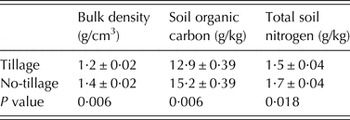
A long-term study was established in 2007 to evaluate the yield response of burley tobacco to tillage method. When the study site was established in 2007 the baseline soil pHwater (1:1, w/v) was 6·3, with Mehlich III extractable phosphorus (85 mg P/kg), potassium (178 mg K/kg), calcium (1·8 g Ca/kg), magnesium (110 mg Mg/kg) and zinc (3 mg Zn/kg). The soil texture consisted of 12% sand, 68% silt and 20% clay. By 2012, fundamental soil properties differed between CT and NT due to 6 years of differential treatment (Table 1).
The 2012 soil chemical and physical properties due to 6 years of tillage and no-tillage

Table values are the measured mean ± s.e.m., with one degree of freedom due to tillage.
Seasonal weather conditions
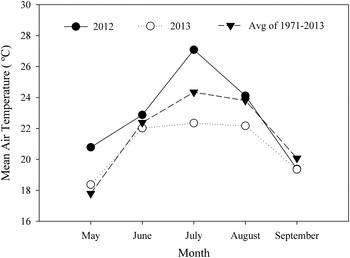
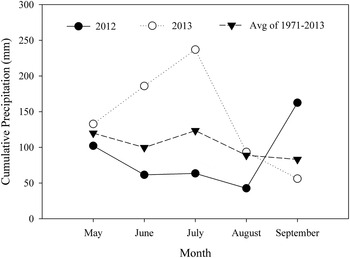
Monthly mean air temperature and cumulative precipitation for the 2012 and 2013 tobacco-growing seasons are shown in Figs 1 and 2, respectively. These two seasons had dramatically different climate, relative to the long-term mean. Total precipitation during the tobacco-growing period was 432 mm in 2012 and 706 mm in 2013, with 515 mm being the long-term mean. Average air temperature during the tobacco-growing period in 2012 was warmer than in 2013, especially in July and August when tobacco is growing rapidly. Therefore, the 2012 tobacco growth season was considered warm and dry, whereas 2013 was considered cool and wet.
Mean monthly air temperature for the 2012 and 2013 tobacco-growing seasons, and for the long-term (1971–2013) average, at the experiment site (Source: Kentucky Agricultural Weather Center, http://wwwagwx.ca.uky.edu/).

Monthly total precipitation for the 2012 and 2013 tobacco-growing seasons, and for the long-term (1971–2013) average, at the experiment site (Source: Kentucky Agricultural Weather Center, http://wwwagwx.ca.uky.edu/).

Experiment design
The tillage comparison study was established with four replications in 2007. Nitrogen fertilizer (280 kg N/ha) was applied each year to both tillage treatments. Conventional tillage consisted of mouldboard ploughing followed by disking twice and a soil finishing operation with a rototiller prior to tobacco seedling transplanting. Beginning in 2012, three N fertilizer rates (0, 140 and 280 kg N/ha) were introduced as split-plots. Tillage treatments (NT and CT) were randomly assigned to main plots (6·40 × 24·40 m2). The three N fertilizer rates were randomly assigned to split-plots (6·40 × 8·10 m2) within each main plot; phosphorus and potassium fertilizer was adjusted for each plot, based on soil test results. Fertilizer applications were broadcast by hand for both tillage methods before transplanting tobacco seedlings. The population density was 18 286 plants/ha and individual plant spacing was 0·54 × 1·07 m2. Winter wheat (Triticum aestivum L.), with no additional fertilization, was planted after tobacco harvest each season as a winter cover crop to capture residual nutrients and was chemically killed approximately 4 weeks prior to transplanting. Tobacco production practices followed recommendations of the University of Kentucky Cooperative Extension Service (Seebold & Pearce Reference Seebold and Pearce2013), except for the imposed treatments. Before 2012, only total cured tobacco leaf yield data were collected.
Variables measured
Agronomic parameters
Tobacco cured leaf yield, leaf chlorophyll and leaf tissue NO3-N and total N concentrations were determined. After harvest, tobacco was cured according to standard air-curing procedures. Tobacco leaves were manually removed and placed into ‘grades’ (flyings, lugs, leaf and tips), from the bottom to the top of the stalk, respectively (Tso Reference Tso1990). Only total cured leaf yield is reported in this paper. Leaf chlorophyll was estimated with a chlorophyll meter (Minolta SPAD-502 Konica Minolta, Osaka, Japan) at topping (removal of flowers at the top of the plant). The measurement was performed, avoiding the central vein, on the middle position of the last fully expanded leaf, commonly the fourth leaf from the apex. The same leaves were subsequently removed, oven-dried (55 °C), and ground to pass through a 1-mm sieve for NO3-N and total nitrogen (TN) determination.
In situ plant available nitrogen
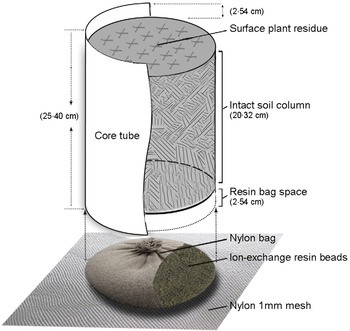
Plant available inorganic N in the 0–20 cm soil depth increment was measured by a modified in situ resin core procedure (Kolberg et al. Reference Kolberg, Rouppet, Westfall and Peterson1997). Incubation cores were prepared by driving in and then removing a soil-filled aluminium conduit (25·40 cm long with an inner diameter of 4·80 cm) from between tobacco rows before fertilizer N application. The bottom 2·54 cm depth of soil was removed from each soil core and replaced with the same volume of ion-exchange resin beads in a nylon bag. The entire assembly was returned to the original hole with a rubber washer surrounding the tube to prevent external preferential bypass flow of surface runoff water from contaminating the resin bags with inorganic N. The top of the core was open to the atmosphere to simulate field conditions. The resin bag consisted of equal amounts (35 g) of cation and anion exchange resins (Lanxess Sybron, Birmingham, NJ, USA). The design of the in situ soil resin core is in Fig. 3. Resins were incubated for 60 days in field conditions; replacement resin bags were needed for longer incubations.
Cutaway diagram of soil resin core, in which surficial plant residue, an intact soil column (0–20·32 cm), and one mixed-media ion exchange resin bag are incubated inside a core tube. A transparent example of an ion exchange resin nylon bag is shown with nylon mesh (1 mm opening) as a bottom cover.

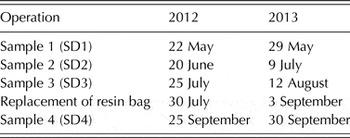
Fertilizer N (ammonium nitrate (NH4NO3)) solutions were evenly sprayed onto the inner soil surface of tubes at rates equal to 0, 140 and 280 kg N/ha. Tillage operations were performed before the first sampling date (SD1). On SD1 a 0–20 cm soil sample was removed to determine baseline inorganic N, the tubes installed and fertilizer N treatments applied. Additional sampling dates were intended to occur at 30 DAT, 60 DAT and at tobacco harvest. Actual sampling dates were adjusted due to weather and field soil moisture conditions (Table 2).
Sample dates for plant available nitrogen assays in 2012 and 2013

The gravimetric moisture content of a field moist sub-sample from a composite of three tubes at each sample date was determined. Another 10 g of field moist soil was also immediately analysed for NO3-N and ammonium (NH4-N). Each composite resin sample was mixed and weighed. Resin samples in different plots exhibited different moisture contents. A sub-sample of resin for each plot was removed to adjust to the same weight based on original product moisture and the current moisture content. The sub-sample resin bags were serially extracted in 1 m potassium chloride (KCl) by shaking bags in three separate volumes of 50 ml each for three different periods (15, 30 and 60 min). The three liquid samples were combined. The final recovered NO3-N and NH4-N concentrations were calculated by Eqns (1) and (2), respectively, derived from a previous extraction study following the standard extraction procedure described above.
 $$\eqalign{&{\rm N}{\rm O}_3 - {\rm N}\; ({\rm absorbed\; by\; resin})\cr &\quad = {\rm N}{\rm O}_3 - {\rm N}({\rm recovered\; from\; resin}) \times 1{\cdot}30 + 57{\cdot}15}$$
 $$\eqalign{&{\rm N}{\rm H}_4 - {\rm N}\; ({\rm absorbed\; by\; resin})\cr & \quad = {\rm N}{\rm H}_4 - {\rm N}({\rm recovered\; from\; resin}) \times 1{\cdot}12 + 45{\cdot}42}$$
The analysis of inorganic N from resin and soil samples used the same analytical methods. The NO3-N was determined by cadmium reduction and Greiss–Ilosvay reaction (Paratech, Lexington, KY, USA) (Crutchfield & Grove Reference Crutchfield and Grove2011). The NH4-N was determined by phenol–hypochlorite reaction (Weatherburn Reference Weatherburn1967; Ngo et al. Reference Ngo, Phan, Yam and Lenhoff1982). Each sample was analysed in duplicate and the means were used in statistical analyses. The PAN supply during the incubation period was calculated as the sum of inorganic N extracted from soil and absorbed from resin, and presented as μg inorganic N/g dry soil.
Air-cured leaf chemistry parameters
After air curing was complete, the fourth leaf from the apex of each stalk was collected and used to quantify NO3-N, alkaloid (including nicotine, nornicotine, anabasine and anatabine) and TSNA concentrations on a leaf dry matter basis. Air-dried samples were ground to pass through a 1-mm sieve and all leaf analyses were analysed in triplicate. Leaf NO3-N concentration was determined by cadmium reduction and Greiss–Ilosvay reaction (Paratech) (Crutchfield & Grove Reference Crutchfield and Grove2011). Nicotine, nornicotine, anabasine and anatabine were quantitatively determined by flame ionization gas chromatography (Perkin-Elmer Autosystem XL with Prevent, Waltham, MA, USA), according to the LC-Protocol (Jack & Bush Reference Jack and Bush2007). Alkaloids of ground tobacco samples were extracted by methyl tert-butyl alcohol (MTBE) and aqueous sodium hydroxide. The MTBE extract was injected into the gas chromatograph and alkaloids quantified by comparison with chemical standards. Samples were injected in splitless mode at 250 °C. The carrier gas was helium, and the flow rate was 20 ml/min. The flame ionization detector temperature was 250 °C. The gas chromatograph column was a DB-5 (30 m (L) × 0·53 mm (D) × 1·5 µm (FT)) (J&W Scientific, Santa Clara, CA, USA). The TSNA analyses were performed following methylene chloride extraction (Morgan et al. Reference Morgan, Reece, Risner, Bennett, Midgett, Johnson and Burton2004).
Statistical analysis
Data were analysed with the Mixed Model procedure of the SAS 9·3 computer package (SAS Institute Inc., Cary, NC, USA). Tillage treatment was the main-plot factor, whereas N fertilization rate was the sub-plot factor. Duplicate measurements on composite soil and resin samples were averaged for statistical analysis of treatment effects. Treatment effects were considered significant at the 95% level of confidence (P > F ⩽ 0·05). Mean separation was performed using the Tukey–Kramer adjustment (Kramer Reference Kramer1956) at P < 0·05. Due to high variability for the tobacco field trial, any P value between 0·05 and 0·1 in this study was considered a trend (Carmer & Walker Reference Carmer and Walker1988). All quadratic regression analyses were conducted with Sigma Plot 12·3 (Systat Software Inc., Chicago, IL, USA).
RESULTS
Long-term no-tillage tobacco yield performance
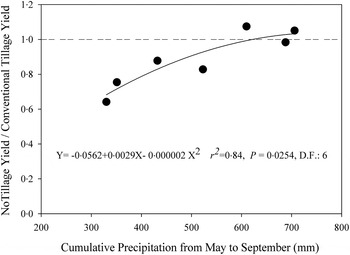
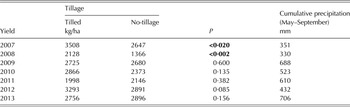
Tobacco cured yield at 280 kg N/ha for both tillage treatments, and the cumulative precipitation during growth (May–September) for 2007–2013 are shown in Table 3. Conventional tillage tobacco had significantly higher yield than NT tobacco in 2007 and 2008, and also trended higher in 2012, when cumulative precipitation was lower than the long-term average (515 mm). The relationship between the NT/CT yield ratio and cumulative precipitation was significant (r 2 = 0·84, P = 0·025, n = 7) (Fig. 4), indicating that NT tobacco productivity approached that of tilled tobacco only in wet seasons.
Relationship between the no-tillage/conventional tillage (NT/CT) yield ratio and May–September cumulative precipitation for the 2007–2013 production seasons.

Tobacco cured leaf yield at 280 kg N/ha: 2007–2013 production seasons

There was a significant interaction between year and tillage treatment. Bold values for P indicate a significant difference in tobacco yield due to tillage.
Agronomic parameters
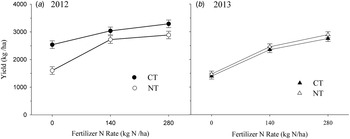
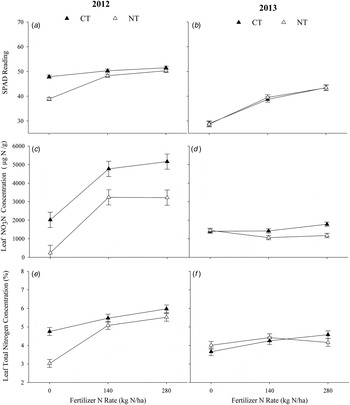
The response of tobacco cured leaf yield to tillage and N fertilization rate differed between 2012 and 2013 (Table 4). In 2012, tillage and N fertilization rate significantly affected total yield (Fig. 5(a)). There was no difference due to tillage at 140 or 280 kg N/ha, but leaf yield with tillage tended to be numerical higher than with NT at 0 kg N/ha (Interaction P value = 0·0868). Other agronomic parameters in 2012, including SPAD readings, leaf TN, and leaf NO3-N at topping, had a similar response to tillage and N fertilization rate as leaf yield (Table 4, Figs 6(a), (c), (e)).
Tobacco leaf yield response to tillage and fertilizer nitrogen rate in 2012 (a) and 2013 (b). Error bars show the standard error of the means. CT, conventional tillage; NT, no-tillage.

Response of SPAD reading, leaf total nitrogen (TN), and leaf NO3-N at topping to tillage and fertilizer nitrogen rate in 2012 (a), (c), (e) and 2013 (b, d, f), respectively. Error bars show the standard error of the means. CT, conventional tillage; NT, no-tillage.

Analysis of variance (P) for agronomic parameters, plant available nitrogen (PAN) supply and cured leaf chemistry parameters

SD, sampling date; TN, total nitrogen; TSNAs, tobacco-specific nitrosamines.
* N/A, not applicable in 2012. There was only one composite soil baseline sample for all three N fertilization rates because N treatment was not applied before that day.
However, in 2013, only N fertilization rate significantly affected leaf yield (Fig. 5(b)). There was no significant tillage effect and there was no tillage by N rate interaction. The 2013 SPAD readings showed a similar response pattern (Fig. 6(b)). The 2013 leaf TN showed no difference between no-till and tilled tobacco at any N rate (Fig. 6(f)). The 2013 leaf NO3-N for tilled tobacco was significantly higher only at 280 kg N/ha (Fig 6(d)). In general, these agronomic parameters were numerically higher in 2012 than in 2013.
Plant available nitrogen supply
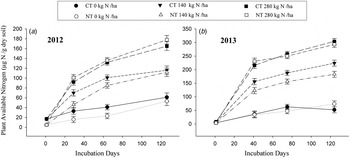
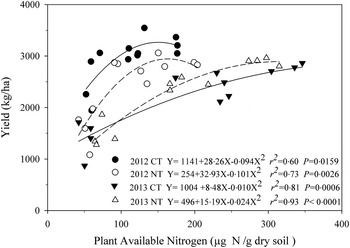
Table 4 and Fig. 7 show the response of PAN supply to tillage and N fertilizer rate. Tillage had a significant effect on PAN only at SD1 in both years. Except for SD1, PAN supply during the tobacco growth period was mostly influenced by N fertilizer rate. Figure 8 illustrates the relationships between NT and tilled tobacco yield and PAN supply in 2012 and 2013. These relationships were all well modelled by a quadratic polynomial. In general, 2012 tobacco had greater yield potential but numerically lower PAN than 2013 tobacco. Tilled tobacco exhibited generally greater yield than NT tobacco in 2012, but in 2013 there was evidence of substantial tobacco yield ‘overlap’ between the two tillage treatments (Fig. 8).
Plant available nitrogen (PAN) supply for conventional tillage (CT) and no tillage (NT) during the tobacco growth period in 2012(a) and 2013(b). Error bars show the standard error of the means. Note that the scales for PAN are different for 2012 and 2013.

Relationship between tobacco yield and plant available nitrogen (PAN) supply for no tillage (NT) and conventional tillage (CT) production in 2012 and 2013. The degree of freedom for each equation was 11.

Air-cured leaf chemistry parameters
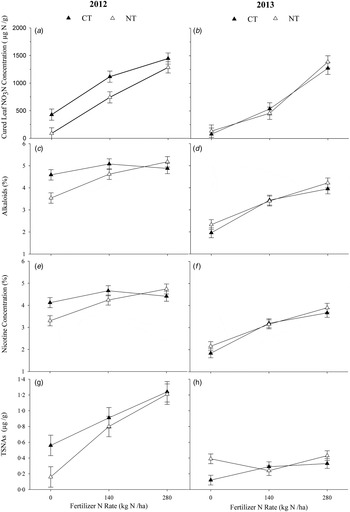
Table 4 and Fig. 9 show the responses of air-cured leaf chemical constituent concentrations to tillage method and N fertilization rate. In 2012, N fertilizer rate significantly affected air cured leaf NO3-N concentration, nicotine and TSNAs levels, and there was also a significant interaction between tillage and N rate on leaf alkaloids (P < 0·05, Table 4). Like the agronomic parameters in 2012, NT at 0 kg N/ha had the lowest values for the four cured leaf chemical parameters (Fig. 9). In 2013, there was no significant tillage effect on cured leaf NO3-N, alkaloid or nicotine concentrations (Table 4). A significant tillage by N rate interaction on TSNAs occurred in 2013 (Table 4). In general, cured leaf chemical concentrations were numerically lower in 2013 than in 2012 (Fig. 9).
Responses of cured leaf NO3-N, alkaloid, nicotine and tobacco-specific nitrosamines (TSNAs) concentration to tillage and fertilizer nitrogen rate in 2012 (a), (c), (e), (g) and 2013 (b), (d), (f), (h), respectively. Error bars show the standard error of the means. CT, conventional tillage; NT, no-tillage.

DISCUSSION
Agronomic parameters
No-tillage burley tobacco production tended to result in lower cured leaf yield in dry seasons. This result differs from that observed with NT summer annual grain production (De Vita et al. Reference De Vita, Di Paolo, Fecondo, Di Fonzo and Pisante2007). In summer annual grain production, NT tends to outperform tillage in dry seasons because NT preserves more soil moisture (Blevins et al. Reference Blevins, Cook, Phillips and Phillips1971). The same conservation of soil moisture has been reported for NT tobacco (Phillips & Zeleznik Reference Phillips and Zeleznik1989), but this benefit did not result in greater cured leaf yield. In the dry 2012 season, there was a trend for cured leaf yield to be numerically higher with tillage than with NT at the 0 kg N/ha fertilizer rate. With increasing fertilizer N rate, the yield difference due to tillage became smaller. The same response pattern was found for leaf SPAD readings, leaf NO3-N and TN concentrations at topping. Taken together, the agronomic parameters indicate that NT tobacco suffered greater N deficiency at 0 kg N/ha in the dry 2012 season compared to tilled tobacco (MacKown & Sutton Reference MacKown and Sutton1998; MacKown et al. Reference MacKown, Crafts-Brandner and Sutton1999). However, in the wet 2013 season, tillage did not affect these agronomic parameters. That the agronomic parameters in 2012 were higher than those in 2013 might also be because the cooler 2013 season was poor for tobacco growth, and excessive precipitation in 2013 could have leached N from the tobacco root zone – hence, a greater response to higher fertilizer N rates in 2013 than in 2012.
The relationship between yield and PAN supply showed that tilled tobacco had higher N use efficiency than NT tobacco in 2012. In situ incubation showed there were no significant differences in PAN supply between tillage methods in either year. Because tillage did not significantly affect N supply, there must be other reasons why greater N deficiency was observed in NT tobacco at 0 kg N/ha in 2012. One potential explanation could be that the tobacco root system was limited by higher surface soil bulk density with NT (Unger & Kaspar Reference Unger and Kaspar1994; Lampurlanés & Cantero-Martínez Reference Lampurlanés and Cantero-Martínez2003).
Unlike soybean and maize, tobacco plants have extensively branched non-symmetrical root systems, developing adventitious roots at many angles from the plant base due to transplanting (Bruner Reference Bruner1932). Zartman et al. (Reference Zartman, Phillips and Atkinson1976) found that tilled burley tobacco root density was significantly higher than that of NT tobacco, especially in the 0–15 cm depth increment. The data from roots collected during the 2014 season (not presented) support the hypothesis that greater tobacco root length and surface area occur with tillage. Most inorganic N moves to plant roots via mass flow as the plant absorbs water for transpiration (Barber Reference Barber1995). Therefore, in dry seasons, NT tobacco N uptake might be limited by the reduced root density/surface area. Greater water availability during wet seasons can make inorganic N more equally accessible to tobacco plants despite root density differences caused by tillage. This explains the increased NT/CT cured leaf yield ratio with increasing cumulative precipitation during the tobacco-growing season.
Plant available nitrogen supply
Tilled soil exhibited higher PAN than NT soil at the first sample date. This is because these baseline samples were taken immediately after tillage, which exposes SOM to mineralization. However, there was no significant difference in PAN supply due to tillage at later sampling dates. With plant species that do not produce biologically fixed N, the field PAN supply consists of fertilizer N and N mineralized from SOM. In the present study, in which the same fertilizer N rates were used in both tillage systems, the equality in PAN supplies with tillage indicates that divergent trends in mineralization–immobilization turnover in soil and fertilizer N resulted in this equivalency. This observation differs from other reports (El-Haris et al. Reference El-Haris, Cochran, Elliott and Bezdicek1983; Franzluebbers et al. Reference Franzluebbers, Hons and Zuberer1994; Wienhold & Halvorson Reference Wienhold and Halvorson1999). These reports argue that the NT SOM pool is typically higher than the pool in tilled soil, resulting in a higher NT soil N mineralization potential. However, most of these reports were from laboratory studies using disturbed/sieved samples. Sieving can accelerate SOM decomposition, resulting in higher NT soil N mineralization potential (Oorts et al. Reference Oorts, Nicolardot, Merckx, Richard and Boizard2006). The in situ resin core method better reflects field conditions, especially soil structure (Raison et al. Reference Raison, Connell and Khanna1987), preserving physical sequestration of labile SOM. Consequently, although NT soil has more SOM than tilled soil (Bernacchi et al. Reference Bernacchi, Hollinger and Meyers2005), in situ conditions might keep aggregate SOM physically protected from microorganisms and enhanced aeration. Rice & Smith (Reference Rice and Smith1984) and Rice et al. (Reference Rice, Smith and Blevins1986) reported equal N availability in NT and tilled soil by an 15N dilution method. The greater NT SOM pools do not necessarily guarantee greater soil N mineralization in field conditions, as those organic N pools may not be accessible to soil microbes.
The PAN supply was higher during the 2013 than the 2012 tobacco growth season. This difference could be due to seasonal precipitation. There were 432 and 706 mm of cumulative (May–September) precipitation in 2012 and 2013, respectively. Increasing soil moisture promotes N mineralization (Jin et al. Reference Jin, Haney, Fay and Polley2013); therefore, PAN in 2013 would be expected to be higher than in 2012. However, tobacco yield in the present study was higher in 2012 than 2013. There could be several reasons for this seasonal response pattern, including other weather factors, but the main limiting factor to tobacco yield was N nutrition. Given this, the result suggests that the in situ resin method overestimates PAN supply.
The function of a resin bag at the bottom of the soil core is to capture inorganic N leaching from the soil column. During heavy rainfall events the inorganic N captured by the resin bag would otherwise have been leached from the tobacco root zone. More inorganic N was absorbed by the resin, rather than contained in soil above the resin, in 2013 than in 2012. This was evident in tobacco yield response. In the wet season (2013), the yield in the 280 kg N/ha treatment was significantly higher than in the 140 kg N/ha treatment in no tillage. In the dry season (2012), the yields at these two N rates were not significant. More N is potentially lost from no-till soils through leaching or denitrification in wet seasons. Thus, higher N application rates are necessary. In contrast, in the dry 2012 season N loss was less and the 140 kg N/ha was sufficient to achieve high yield and higher fertilizer N use efficiency.
Air-cured leaf chemistry parameters
Cured leaf chemical composition is an important determinant of tobacco leaf use. Most tobacco alkaloids are synthetized in the root, especially in elongating root tips (Solt Reference Solt1957; Dawson & Solt Reference Dawson and Solt1959; Flores et al. Reference Flores, Vivanco and Loyola-Vargas1999). Tso (Reference Tso1990) suggested that soil conditions during root development could affect alkaloid levels. Changes in structure, moisture, penetration resistance and the rhizosphere caused by different tillage practices might affect alkaloid levels. In 2012, tillage significantly affected cured leaf NO3-N concentration and the influence of tillage on alkaloid and nicotine levels depended on N fertilizer rate. This might be the result of the low N uptake capacity caused by NT, as tillage had no significant effect on cured leaf NO3-N, alkaloid and nicotine concentrations in 2013. The N fertilizer rate significantly affected these three leaf chemical components in both years. Fertilizer N management would therefore appear to be more crucial than tillage in alkaloid synthesis, and root development differences due to tillage might not be enough to affect secondary tobacco metabolites. Tobacco TSNA levels were significantly affected by N rate in 2012, but not in 2013, probably because TSNA concentrations are relatively low compared with NO3-N, nicotine, and alkaloids. Also, TSNA formation occurs mainly during leaf curing (Burton et al. Reference Burton, Childs, Andersen and Fleming1989b ), which depends on humidity, temperature and the design of the tobacco curing barn. This makes identification of agronomic management effects on TSNAs difficult without large-scale data collection.
CONCLUSION
Unlike NT summer grain crop production, NT burley tobacco production did not derive a yield benefit from soil moisture conservation in dry seasons. Instead, low tobacco root density caused by higher soil bulk density and penetration resistance in NT appeared to limit tobacco N uptake capacity in dry seasons, subsequently resulting in tobacco N deficiency. Although tobacco cured leaf yield and chemistry were mainly affected by N fertilizer rate management, tillage affected tobacco cured leaf yield and chemistry by influencing N uptake. This effect was especially noticeable at low N fertilizer rates in a dry season. Nitrogen deficiency in NT systems could be overcome by appropriate N fertilizer intervention. Banded N close to the tobacco root system, and/or some portion of N side-dressed could be used to protect against dry season N deficiency. Irrigation could also make N easily accessible to the root system in a dry season. The effects of tillage on tobacco root development, at different N fertilization rates and under different weather conditions, should be further examined to optimize N management for NT tobacco production.
We would like to express our appreciation to Jack Zeleznik, Matthew Allen and Laura Mitchell for field management and soil sample collection during the study. We thank Tami Smith and Diane Hunter for providing us with laboratory expertise and technical assistance in soil sample analysis. We thank the analytical laboratory in the Kentucky Tobacco Research and Development Center, University of Kentucky, for tobacco leaf chemical analysis. The authors are thankful to Dr Dennis B. Egli for his valuable assistance and advice in the preparation of this paper. The information reported in this paper (No. 15-06-069) is part of a project of the Kentucky Agricultural Experiment Station.