Introduction
Microcephaly is defined as occipitofrontal circumference (OFC) more than 2SD below the mean on an applied growth standard. OFC is believed to be an anthropometric marker of brain volume and several studies have demonstrated this relationship on neuroimaging. Reference Ivanovic, Leiva and Pérez1-Reference Reiss, Abrams, Singer, Ross and Denckla4 Therefore, small OFC is recognized as an important indicator of possible neurological abnormality and a predictor of poor early childhood neurodevelopment (ND) and future developmental disability. Most studies on the causes of microcephaly have been conducted in high-income countries. While many cases are idiopathic, Reference Von der Hagen, Pivarcsi and Liebe5 perinatal and postnatal brain injury, genetic syndromes, metabolic disorders, infections, and teratogens have all been implicated as causal. Reference Abuelo6-Reference DeSilva, Munoz and Sell8
Microcephaly is a rare occurrence in high-income countries. In the United States and Europe, the reported prevalence of microcephaly ranges from 2.0 to 14.7 per 10,000 live births. Reference Graham, Fox and Talati9-Reference Morris, Rankin and Garne11 However, data from low resource settings (LRSs) suggests that the incidence rates of microcephaly may be substantially higher. Reference Rick, Domek and Cunningham12,Reference Victora, Schuler-Faccini, Matijasevich, Ribeiro, Pessoa and Barros13 In the rural southwest region of Guatemala, we documented a very high prevalence of microcephaly (1216 per 10,000 live births) in April of 2015, Reference Rick, Domek and Cunningham12 prior to the arrival of the Zika epidemic in late 2015. In Brazil, background prevalence of microcephaly was 350 per 10,000 live births in 2010, prior to the Zika epidemic. Reference Silva, Barbieri and Alves14 In India, 33% of children were reported to meet criteria for microcephaly at birth increasing to 50% by the first year of life on WHO sex-specific growth charts. Reference Sindhu, Ramamurthy and Ramanujam15 Other studies in LRSs have also shown this increasing prevalence of microcephaly over time. By age 4 years, over half of children in rural Nepal had OFC greater than 2SD below the WHO growth standards mean, implicating the cumulative adverse impacts of living in poverty on child growth. Reference Miller, Joshi and Lohani16 However, because microcephaly has been historically understudied, much is still unknown about its prevalence in LRSs.
Some researchers and global health advocates have suggested that the higher prevalence of microcephaly reported in some LRSs is potentially not representative of a “true” problem, but simply a result of an inappropriate application of a growth standard. Reference Miller, Joshi and Lohani16-Reference Daymont, Hwang, Feudtner and Rubin20 That is, small OFC may be a benign manifestation of genetics, a common occurrence in groups of people that tend to be “naturally” small in stature Reference Natale and Rajagopalan17-Reference Daymont, Hwang, Feudtner and Rubin20 and therefore, growth standards cannot be globally applied. This premise was challenged in the 2006 World Health Organization Multicentre Growth Study, in which very small differences in growth were found among children globally when nutritional and other ND risks were minimized. Reference De Onis21 The WHO concluded that deviations from its published growth standards should be considered abnormal growth. Further evidence supporting the “true” problem of microcephaly is provided by a pair of studies from Nepal that showed that children not living in poverty had OFCs that were within normal ranges when using the WHO growth standards Reference Manandhar, Manandhar and Baral22 but that microcephaly rates were as high as 50% among children living in more rural, impoverished areas. Reference Miller, Joshi and Lohani16
In order to understand whether or not microcephaly is being over-identified with global growth standards, we must explore the association between OFC and ND outcome in LRSs. While microcephaly has been repeatedly linked to poor ND outcome in high-income countries, there is a paucity of data in LRSs, and many studies that describe high background rates of microcephaly have not reported on ND outcomes. Reference Rick, Domek and Cunningham12,Reference Victora, Schuler-Faccini, Matijasevich, Ribeiro, Pessoa and Barros13,Reference Miller, Joshi and Lohani16 Of the few studies that have looked at the association between OFC and ND outcome in LRSs, the results have been equivocal. Reference Ivanovic, Leiva and Pérez1,Reference Sindhu, Ramamurthy and Ramanujam15,Reference Scharf, Rogawski and Murray-Kolb23,Reference Ivanovic, Leiva and Pérez24
In this secondary analysis of data from a prospective cohort study of postnatal Zika virus (ZIKV) infection, we report on the prevalence of microcephaly in children under 36 months of age and trends in OFC growth in the first year after birth. We compare OFC to performance-based ND testing in infants and young children in rural Guatemala. We hypothesized that children classified as meeting WHO criteria for microcephaly will perform more poorly on ND testing than children who do not meet these criteria, and that the smaller the child’s OFC, the worse the child will perform on the ND testing.
Methods
Study and setting
From June 2017 to August 2019, we conducted a prospective cohort natural history study (“The Study”) of the incidence and sequelae of postnatally-acquired ZIKV infection in infants and young children at the Center for Human Development research and clinic site in southwest Guatemala. The site is located at the intersection of the Departments of San Marcos, Quetzaltenango and Retalhuleu, encompassing 22 rural communities with approximately 30,000 residents. These communities are monolingual Spanish-speaking. The population suffers from high rates of food insecurity and child undernutrition, diarrheal disease, maternal depression, and maternal and child morbidity and mortality. Reference Olson, Lamb and Lopez25,Reference Asturias, Heinrichs and Domek26 The study was funded by the National Institutes of Health through the Baylor College of Medicine Vaccine and Treatments Evaluation Unit (see Financial Support for funding source information). The study protocol was reviewed and approved by the Institutional Review Board at Baylor College of Medicine, the Colorado Multiple Institutional Review Board, and the Ethics Review Committee of the Ministry of Public Health in Guatemala.
Procedures
Two groups of children were included in the Study: infants and young children. Infants were the largest cohort as they were the group of primary interest to the Parent Study. They were screened and enrolled from a maternal and child health program at the study site and from referrals by community health workers. They were eligible if the child was 0–2.9 months of age, the mother was >16 years of age, and the consent was signed by the mother if >18 years old or by a grandparent if the mother was 16–17 years of age (as per local ethics committee requirements). Older children were eligible if they were 1.5–5 years of age, either participated in a prior study at the site or were a sibling of an enrolled infant and consent for participation in this study was signed by one of the parents. Enrollment occurred over a 13-month period, from June 2017 to July 2018. All subjects were prospectively followed for 1 year to determine the incidence of postnatally acquired symptomatic and asymptomatic ZIKV infection. No acute ZIKV cases were confirmed during the observation period.
Developmental measures
The Mullen Scales of Early Learning (MSEL), a performance-based, comprehensive assessment of early childhood development, tests five domains: Gross and Fine Motor, Expressive and Receptive Language, and Visual Reception. An Early Learning Composite (ELC) score is created from the sum of the scores excepting Gross Motor. Reference Mullen27 . Previous publications by our group describe the translation and adaptation of the MSEL, as well as its demonstrated validity and reliability in this population. Reference Colbert, Lamb and Asturias28-Reference Connery, Berrios-Siervo and Arroyave30 Older children were administered the MSEL two times: at enrollment and 12 months later. As the primary focus of the Parent Study, infants were administered the MSEL more frequently: at enrollment, 6 and 12 months after study enrollment. Test administration was done by local psychologists trained and supervised by Study neuropsychologists from the University of Colorado.
Head circumference measurement
OFC was measured in all infants and children up to age 3 years using the Seca 211 Head Circumference Measuring Tape (12–59 cm) following standard operating procedures at all Study visits. World Health Organization (WHO) growth standards were used to calculate z scores and determine microcephaly status. 31 For the purposes of the Study, microcephaly was defined as <2SD below the mean.
Analysis
Only visits for children under 36 months for whom a valid OFC (−5 < OFC WHO z-score < 5) was measured were included in this analysis. Five records were excluded for improbable OFC measurements, per WHO sex-specific growth chart guidelines. We conducted descriptive statistics of the demographics of the analysis cohort (Table 1). We determined the prevalence of microcephaly among all children (Fig. 1). We then examined the change in OFC growth during the first year after birth (Fig. 2). (Older children were not included in this analysis due to the small sample size). For the remaining analyses, we used OFC both as a continuous exposure, and as a dichotomized exposure according to the WHO z-score cutoffs for microcephaly commonly found in ND literature: WHO z-score < −1, −1.28, −1.5, −2, and −3. We conducted three separate multivariable regression analyses to explore the association between OFC and ND in the Study cohort. First, we analyzed the association between OFC and ELC score at every visit for which both measures were collected, in order to incorporate all longitudinal data available (Table 2), using a mixed model. Because infants (enrolled ages 0–3 months) were the primary cohort for the focus of the Study, these children had more Study visits and made up more than half of all participants. Therefore, for this analysis, infants and older children study visits were analyzed separately. This analysis included all records available for each child, and accounts for within-subject correlations between multiple records from the same subject. Second, we analyzed the association between OFC and ELC scores (if child was <36 months old) by 6-month age strata, to explore the concurrent association between OFC and ND (Table 3). Third, we analyzed the association between OFC at enrollment and ELC scores at last Study visit which occurred <36 months of age (Table 4), in order to examine the association between small OFC and subsequent ND, by 6-month enrollment age strata. This analysis gives the ND effects of small OFC time to emerge. All analyses were adjusted for age and the last two analyses were stratified by age group (0–5.99, 6–11.99, 12–17.99, 18–23.99, 24–29.99, 30–35.99 months). All analyses conducted in SAS version 9.4 (Cary, NC). No statistical adjustment for multiple comparisons was performed.
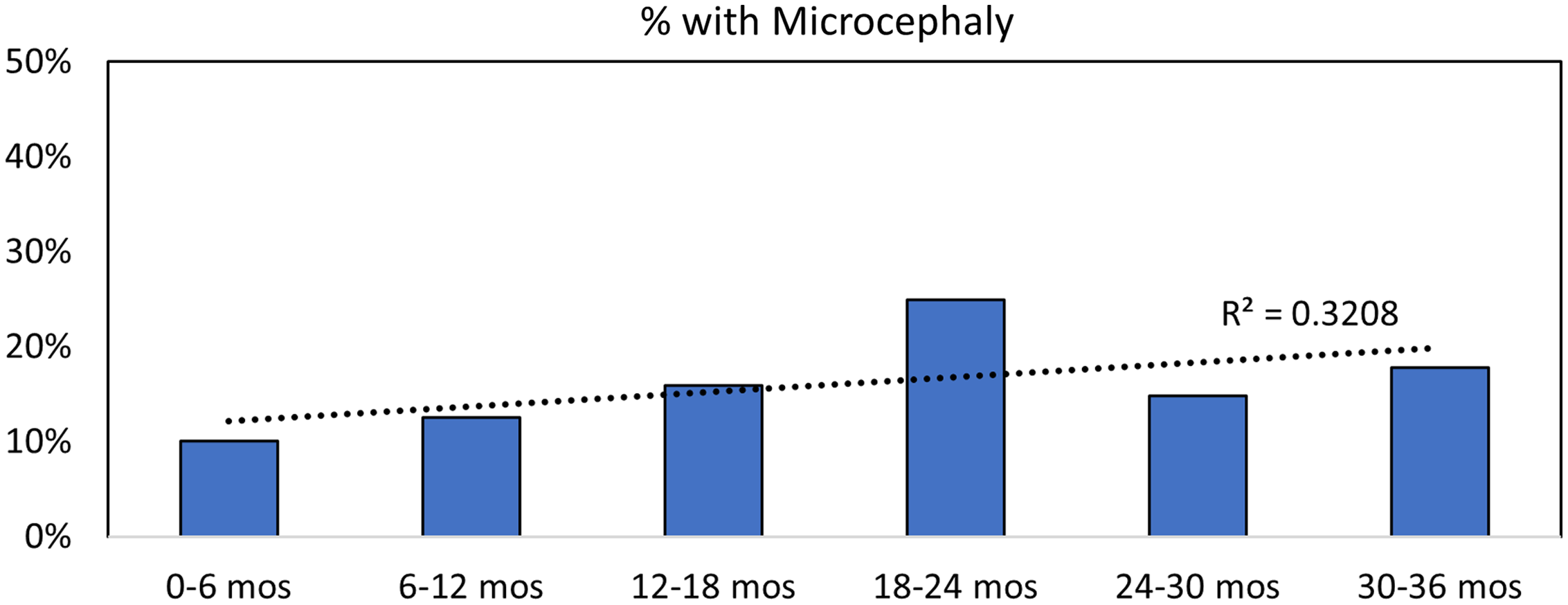
Prevalence of microcephaly (WHO OFC z-score < −2) across age groups.

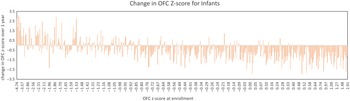
Infants change in OFC z-score over 1 year.

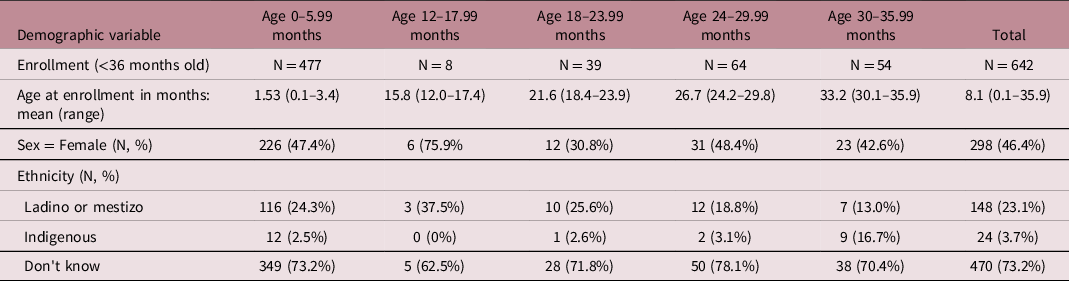
Demographics of the analysis cohort, by age at enrollment, and overall cohort

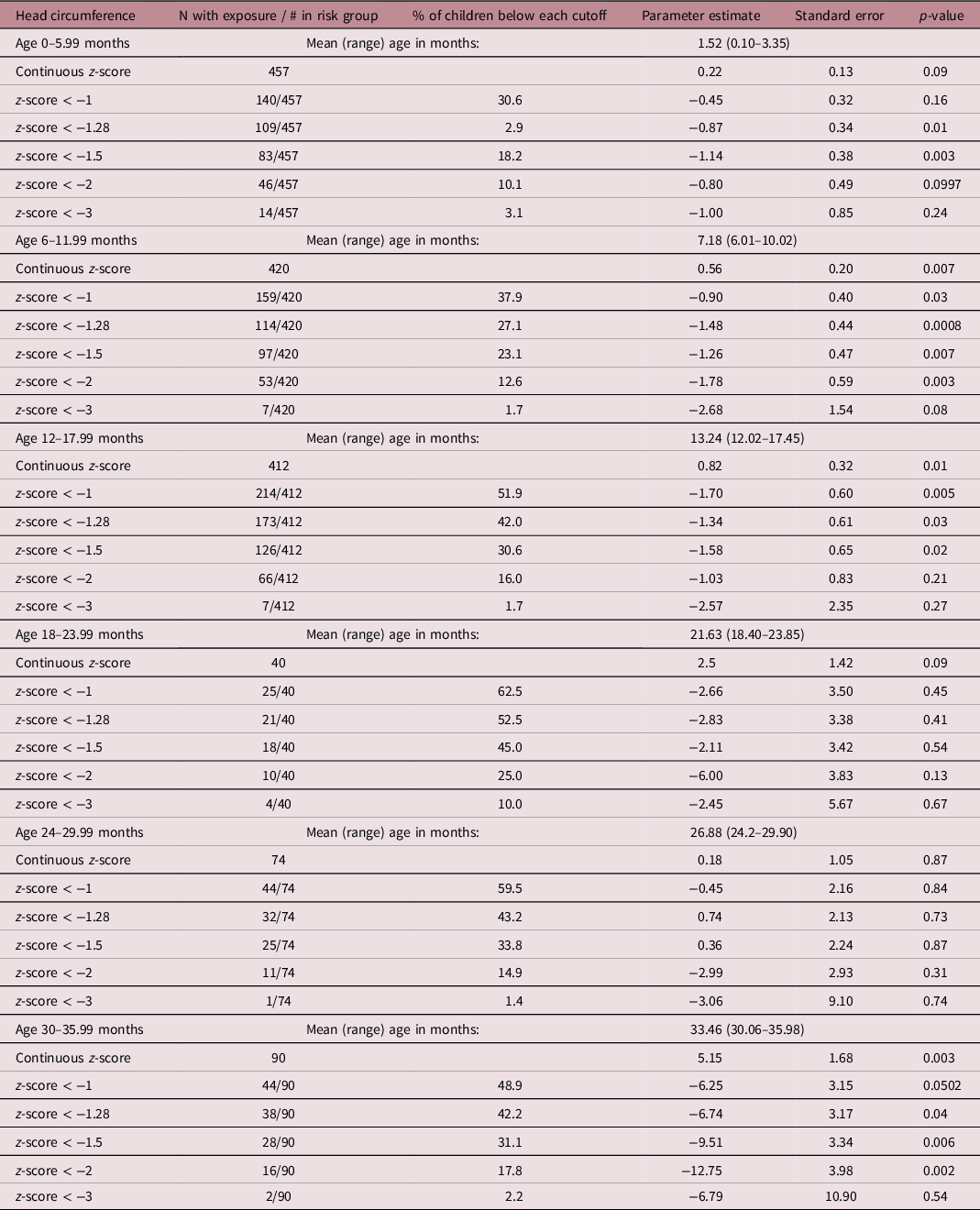
Mixed models of the association between OFC and MSEL scores, comparing data from all visits at which OFC and MSEL were collected *

* All analyses adjusted for age.

An overall analysis of head circumference was not done in this table as some children had records in multiple age groups. See Table 2 for the analysis of multiple records per child.
* Analyses only included data collected at the first visit in the age group for that child.
** All analyses adjusted for age. Reference group for analyses of z-score cutoffs is the subjects whose OFC z-score was ≥ the z-score cutoff stated in the lefthand column.
Association between OFC at enrollment and MSEL ELC at last Study visit (collected at least 11 months later)*,**

* All analyses adjusted for age. Reference group for analyses of z-score cutoffs is the subjects whose OFC z-score was ≥ the z-score cutoff stated in the lefthand column.
** No data was available for children ages 6–11.99 months and data were available for only eight children from ages 12–17.99 due to study enrollment algorithm. Therefore, these age groups were not included in the age-stratified analysis. They are included in the overall analysis at the top of Table 4.
Results
Of the 642 children included in this analysis, approximately 46% of subjects were female and most reported an ethnicity of Ladino when known (defined as combined Spanish and Indigenous ancestry) (Table 1).
Among the youngest children, ages 0–5.99 months, n = 46 (10.1%) met criteria for microcephaly. These percentages trended higher in the older age groups, with the prevalence as high as 25.0% in children 18–23.99 months (Fig. 1).
Many infants with the smallest OFC during the first months of life had positive gains in OFC growth (z-score) over the 12-month study period. Most other infants experienced declines in OFC growth measured by z-score in their first year after birth (Fig. 2).
The analysis of the association between concurrent OFC and MSEL scores that utilized all study records at which OFC and MSEL were both measured indicated a significant association between OFC and ELC in both infants (Beta estimate = 0.38, p-value = 0.01) and older children (Beta estimate = 2.63, p-value = 0.005) (Table 2).
The associations between OFC z-scores dichotomized into WHO z-score cutoffs commonly used in the literature (−1, −1.28, −1.5, −2, and −3) and lower ELC score are described in Tables 3 and 4.
Table 3 shows the association between ELC score and OFC by age strata. There was a significant positive association between continuous OFC measurement and ELC score in three groups (6–11.99, 12–17.99, and 30–35.99 months). The examination of z-score cutoffs indicated that there were significant associations between smaller OFC and lower ELC scores in those same age groups (Table 3).
Table 4 shows the association between OFC at child’s enrollment into the Study and ELC approximately 12 months later (minimum time span was 11 months). For all records, there was a significant positive association between continuous OFC measurement and ELC score measured 12 months later. There was an inconsistently significant positive association between continuous OFC by 6-month age strata and z-score cutoffs of OFC and later ELC (Table 4).
Discussion
The prevalence of microcephaly among children from this rural area of Guatemala is one of the highest reported globally. A prevalence of 10.1% was found in children in the first months of life rising to 25% in children in the second year of life. Infants with the smallest OFC in the first months of life made positive growth gains in OFC z-score during the 12-month study period, while most other infants experienced declines in OFC z-score. When OFC was measured concurrently with ND at multiple time points, smaller OFC predicted lower ND performance in both infants and children. Smaller OFC at enrollment was predictive of lower ND 1 year later. The association was inconsistent when children were analyzed by age strata of 6-month intervals and when specific cutoffs for OFC were used.
The prevalences of microcephaly reported here and that have been reported in some LRSs are much higher than those reported in higher-income countries. Therefore, there is likely different greater exposure to risk factors for children living in LRSs that are not typically present or common for children living in higher resource regions of the world. It has been theorized that higher rates of intrauterine growth restriction, congenital infections, and maternal undernutrition may at least partially explain these elevated microcephaly prevalences in LRSs. Reference DeSilva, Munoz and Sell8,Reference Grantham-McGregor, Fernald and Sethuraman32
Another plausible explanation for the increased prevalence of microcephaly and declines in OFC z-scores among children in LRSs is the high prevalence of undernutrition and enteric disease, factors causing stunting and also implicated in abnormal head growth. Reference Miller, Joshi and Lohani16 Grembi et al. Reference Grembi, Lin and Karim33 found that children who participated in a water sanitation and hygiene program and those who participated in a nutrition program demonstrated positive head growth compared to a control group. Other studies have shown that prenatal and early childhood nutritional supplementation improve the OFC growth trajectory. Reference Vaidya, Saville, Shrestha, de L Costello, Manandhar and Osrin34,Reference Surkan, Shankar and Katz35 Like stunting, rates of small OFC seem to increase as children become older, as evidenced in the current study in both cross-sectional data analysis and in individual infants tracked throughout the first year of life, which may further suggest their association. These growth patterns also clearly implicate the adverse cumulative effects of frequent infections and prolonged exposures to infection and undernutrition on all child growth. Reference Stoch and Smythe36-Reference Colombo, de la Parra and López38
Of the few studies that have looked at the association between OFC and ND outcome in LRSs, the results have been equivocal. The multicountry MAL-ED study reported no clinically significant association between OFC and ND scores in toddlers in India Reference Sindhu, Ramamurthy and Ramanujam15 but did find an association when findings from across eight countries were analyzed together. Reference Scharf, Rogawski and Murray-Kolb23 In fact, OFC was a stronger predictor of ND outcome than stunting status. Several studies from Chile have demonstrated long-term associations between OFC in infancy and later school-age ND outcome and IQ. Reference Ivanovic, Leiva and Pérez1,Reference Ivanovic, Leiva and Pérez24,Reference Ivanovic, Leiva and Perez39 These studies have found OFC to be a stronger predictor of long-term outcome than socioeconomic status.
While the association between OFC and ND was often significant and in the expected direction in our study, there are several possible reasons that help to explain some of the variability in results. Some groups, particularly the group of children with a z-score <−3, were small and potentially too underpowered to be able to detect any possible differences in ND performance. We did not have equal representation of age groups across the 36 months, which potentially complicated our ability to identify patterns in associations between ND and OFC and obscured any effects of specific age groups when analyzed together. Lastly, and likely most importantly, children in this community have many shared risk factors for ND, including high prevalence of stunting and wasting, elevated prevalence of maternal illiteracy and exposures to infectious diseases. Reference Olson, Lamb and Lopez25,Reference Asturias, Heinrichs and Domek26 This can make isolating the impact of any one factor, such as head growth, very difficult.
The relationship between ND and OFC is likely quite complex. Like that of stunting and ND, the causal pathways to each, as well as risks and protective factors are likely both shared and separate. The timing at which poor head growth begins to occur and then drops below international growth standards with the onset of ND problems is also likely complicated and currently poorly understood as is the applicability of international growth standards within specific communities. Our data show that OFC measured against an international standard can be used as a proxy for ND risk but not as a definitive predictor, especially in the youngest children. OFC may be better understood as a continuous metric rather than dichotomized and as an indicator of risk at the population level rather than at the level of the individual child.
The strengths of the current study were that we enrolled a large sample of infants and young children from an LRS for whom serial anthropometric measures and developmental assessments were available. Our developmental assessment was performance-based, the translated and adapted test has been analyzed for reliability in several previous studies Reference Colbert, Lamb and Asturias28,Reference Connery, Colbert and Lamb29 and the training and supervision of local test administrators was rigorous. Reference Connery, Berrios-Siervo and Arroyave30
Limitations of our study were that we only had OFC measurements for children up to age 3 years as we were following typical US growth monitoring standards. However, this may not have been sufficient. In their study in Nepal, Miller et al. Reference Miller, Joshi and Lohani16 noted that much of the decline seen in OFC was between the ages of 3 and 4 years. Therefore, we may have missed important data points by assuming growth pace and trajectories would be similar to children growing under more optimal conditions. Also, because of enrollment age criteria, we did not have equal representation of ages which limited our ability to look at all age groups across the spectrum of the first 36 months of life. Because we translated and adapted a US-developed test, we did not have a normative, “healthy” reference sample. Comparing children from the same community with many shared risk factors to one another potentially attenuated results and made it more difficult for us to isolate the effects of one specific metric, OFC. Also, there were likely children with diagnosable medical or developmental disorders with potential associations with microcephaly in the sample. However, due to the lack of available specialty healthcare providers in the area, any specific contributions from these is not known. Lastly, because the Parent Study was focused on postnatal Zika infection, other potential causes of small OFC and exposures were not studied.
We cannot assume generalizability of these results to other parts of Guatemala, as this study was not designed to be a representative sample of Guatemala. While our results may be generalizable to parts of the country that are also low resourced, drawing such a conclusion would require more widespread OFC growth monitoring and neurodevelopmental testing. Significance level for analysis results was not adjusted for multiple comparisons, due to our focus on an initial description of the association between OFC and ND.
We report here a high prevalence of microcephaly in infants and young children in a LRS in rural Guatemala and an association between OFC and ND. Global health research groups should continue work to understand the association between OFC and concurrent and subsequent ND, growth patterns and trajectories, and “true” prevalence of microcephaly in LRSs. Most importantly, studies of risks and causation, which could help support optimal head growth or interrupt and reverse slowed head growth, are of the utmost importance.
Acknowledgements
The authors would like to thank Walla Dempsey, Gail Tauscher, Kay Tomashek, and Wendy Keitel for their review of this manuscript and guidance in this project as DMID and VTEU project officers and investigators. We also wish to thank the families of southwest Trifinio, Guatemala, who participated in this study and the research nurses and personnel from FUNSALUD who have worked on the parent study.
Financial support
This project has been funded in whole or in part with Federal funds from the National Institute of Allergy and Infectious Diseases (NIAID). Research was supported by a NIAID DMID Vaccine and Treatment Evaluation Unit (VTEU) award to Baylor College of Medicine (Contract No. HHSN27220130015I) and EMMES (Contract No. 75N93021C00012).
Conflicts of interest
The authors do not report any conflicts of interest.
Ethical standards
The authors assert that all procedures contributing to this work comply with the ethical standards of the relevant national guidelines on human experimentation (Institutional Review Board at Baylor College of Medicine, the Colorado Multiple Institutional Review Board) and with the Helsinki Declaration of 1975, as revised in 2008, and has been approved by the institutional committees, the Institutional Review Board at Baylor College of Medicine, the Colorado Multiple Institutional Review Board, and the Ethics Review Committee of the Ministry of Public Health in Guatemala.