INTRODUCTION
In the present scenario, lasers featured by entirely flexible nanosecond pulse-shaping will be used for demonstrative experiments (NIF and LMJ) to validate central-ignition inertial fusion energy (IFE) relevant schemes.
Meanwhile, along the path of a similar challenging research, the High Power laser Energy Research (HiPER, see HiPER Report 2007–2008) project is becoming a future reference installation for demonstrative experiments on the fast ignition (FI) approach, which requires two laser pulses with different duration (ns, ps), and specialized role (compression, ignition). Relevant topics in this area are treated in several articles (Chatain et al., Reference Chatain, Perin, Bonnay, Bouleau, Chichoux, Communal, Manzagol, Viargues, Brisset, Lamaison and Paquignon2008; Eliezer et al., Reference Eliezer, Murakaml and Val2007; Hora, Reference Hora2007a, Reference Hora2007b; Imasaki & Li, Reference Imasaki and Li2007; Yu et al., Reference Yu, Yu, Xu, Tian, Chen and Wong2007; Zvorykin et al., Reference Zvorykin, Didenko, Ionin, Kholin, Konyashchenko, Krokhin, Levchenko, Mavritskii, Mesyats, Molchanov, Rogulev, Seleznev, Sinitsyn, Tenyakov, Ustinovskii and Zayarnyi2007). In this context, a range between half a ps up to one pulse duration on the order of hundred ps, wider than that now featuring the short pulse FI class drivers, could represent an important tool to test an extended class of IFE relevant approaches. Lasers with these performances could be used to generate multi-GeV heavy ions as well as X-rays or light-ion sources for direct applications to IFE.
Fast ignition by GeV heavy-ions was proposed and studied by two-dimensional numerical simulations in the framework of IFE keep-in-touch activity at Frascati EURATOM-ENEA Association from 1994–1998 (Caruso & Pais, Reference Caruso and Pais1996, Reference Caruso and Pais1998). In order to release most of the energy on the compressed fuel (at the Bragg peak), the ions had energy adequate to pass without significant losses through the corona remnants of ablative spherical implosions. The ignition threshold of compressed deuterium-tritium (DT) static half spaces and the thermonuclear performances of a spherical DT imploded fuel by a 100 ns, 1 MJ properly shaped laser pulse were studied. To get the ignition of the evolving fuel assembly, cylindrical heavy-ion beams of 50 ps duration, energy 100–375 kJ and diameters ranging between 30–150 µm were sent through the ablation remnants to reach the imploding/stagnating/expanding fuel at different compression stages. Useful synchronization windows of 600–1000 ps and values of G = 300 were found in all cases, where G = E tn/(E laser + E heavy) and E tn, E laser, and E heavy, respectively, are the energies of the thermonuclear reactions, of the laser-compressor pulse, and of the heavy-ion pulse used to start the ignition.
In spite of these encouraging results, at that time (1994–1998), both the required heavy ion beam spot diameter and pulse duration were considered by the particle accelerators community as a technological challenge.
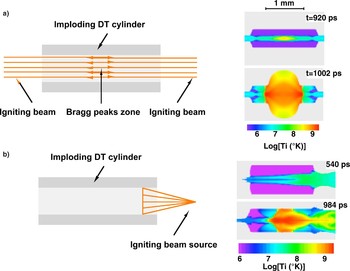
The entropy injection, as a different approach to the thermonuclear ignition that requires more relaxed driver and target features, was proposed a few years later and studied by theoretical methods and numerical simulations for different energy vectors interacting with imploding DT cylinders (X-rays, heavy, and light-ions). In this method, while a cylindrical fuel assembly is imploding along a low adiabat, additional energy beams, well before the stagnation, bring on a high adiabat on a portion of the fuel located at the symmetry center (Fig. 1a), or near one of the end faces (Fig. 1b). The work performed by the surrounding imploding fuel sets the portion at the higher isentrope to the ignition conditions and burn waves propagate along the cylinder axis (Caruso & Strangio, Reference Caruso and Strangio1999, Reference Caruso and Strangio2000, Reference Caruso and Strangio2001).
The injected entropy ignition mode. (a) Ignition of an imploding DT cylinder by a 9 GeV Bi-ions pulse (duration ≈ 300 ps, diameter ≈ 450 µm, beam energy ≈ 35 kJ). (b) Ignition of an imploding DT cylinder by a 6 MeV Deuterium ions pulse (duration ≈ 100 ps, diameter ≈ 500 µm, beam energy ≈ 20 kJ).

More recently, to explore the possibility of producing multi-MeV/Nucleon ion beams for the previously mentioned applications a scaled experiment (fast ion generation experiment (FIGEX)) was designed and proposed by ENEA. The experiment, supported by the Associazione EURATOM-ENEA sulla Fusione, was performed at the Petawatt Laser Facility of the Rutherford Appleton Laboratory (Strangio et al., Reference Strangio, Caruso, Neely, Andreoli, Anzalone, Clarke, Cristofari, Del Prete, Di Giorgio, Murphy, Ricci, Stevens and Tolley2007). Based on the controlled amount of mass mode and the causally isolated target concepts, and designed to keep negligible the fraction of escaping electrons (Strangio & Caruso, Reference Strangio and Caruso2005), two different ion-source-disks (SMALL and LARGE) were irradiated by 1 ps laser pulse (λ = 1.05 µm), respectively, at power densities 2 × 10¹⁹ and 2.8 × 10¹⁸ W/cm2. Due to the high aspect ratio (diameter/thickness ≫1) adopted for these disks, collimation effects on the produced ions were expected.
The ions produced in the experiment were collected around the target by six Thomson spectrometers. The total energy in the channels corresponding to different charge-to-mass ratios was estimated and the related distribution functions were determined. In the case of interest here (SMALL), most of the ions (≈70%) were detected in the forward direction around the normal, within a cone of ≈40° full width at half maximum. The ion energy distribution functions were found to be either Boltzmann-like or strongly peaked around low values, with a low-populated high-energy tail (up to a value of 35 MeV/nucleon, about 1 GeV for Si present in the target material).
A LASER GENERATED MULTI-GEV ION SOURCE FOR IFE APPLICATIONS
The behavior of the ion energy distribution functions and the unexpected asymmetric ion emission found in FIGEX represented a hint to explore the feasibility of ion sources of interest for thermonuclear applications (Strangio & Caruso, Reference Strangio and Caruso2008).
The qualitative behavior and duration of the ion-beam power W(t) on a surface (e.g., a thermonuclear target) placed at distance d from the ion-source-disk can be deduced by the ion velocity distribution function f as
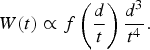
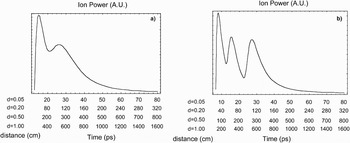
In Figure 2, ion power pulses derived from the two typical FIGEX distribution functions, scaled to multi-GeV energies, are displayed for different source distances d. The related durations correspond to possible ranges of interest for different thermonuclear applications.
Ion power pulses scaled to multi-GeV energies from the typical FIGEX distribution functions. (a) Prevalently Boltzmann-like. (b) Strongly peaked. Different source distances to the thermonuclear target result in different ion power pulse durations.

The design of the ion-source-disk for the FIGEX experiment was based on a thermally induced hydrodynamic flow model. The absorbed fraction η of the laser energy was transferred to the ions via a quasi-neutrality electrostatic field coupling electrons to ions to drive a symmetric target expansion. In general, η is expected to depend on several physical parameters like power density, light wavelength, density profile, etc., and ought to be determined by dedicated experiments. Values on the order of η ≈ 30%, conservative if compared with the experimental ones (Hatchett et al., Reference Hatchett, Brown, Cowan, Henry, Johnson, Key, Koch, Langdon, Lasinski, Lee, Mackinnon, Pennington, Perry, Phillips, Roth, Sangster, Singh, Snavely, Stoyer, Wilks and Yasuike2000), were assumed in the model due to the high-contrast of the laser pulses planned for FIGEX. Electro-dynamic effects were not included in the design.
The net forward momentum in the ion emission of the FIGEX experiment was attributed to the electro-dynamic effects (radiation pressure) induced by the laser electromagnetic field that can overcome the thermo-kinetic ones in regimes of poor absorption (≈10–15%, as estimated from the experimental results). This was the only possible interpretation since no ions with appropriate energy to balance the forward momentum emitted by the target front side were found.
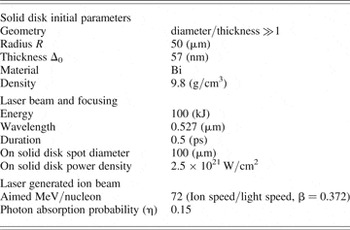
These results need to be reconsidered in the framework of a model including a relativistic treatment of foil acceleration by radiation pressure and thermal effects as a correction. In this model, a laser pulse normally impinges on a high aspect ratio solid disk (diameter/thickness ≫1) releasing the fluence Γlaser (energy/unit surface) in a time τlaser at a power density Φlaser = Γlaser/τlaser. The reference laser-matter interaction regime for a case of possible thermonuclear relevance can be framed by the numerical parameters summarized in Table 1.
A reference laser-matter interaction regime for heavy-ion sources of possible relevance for thermonuclear applications

The photons absorbed (probability η) by the target will transfer their energy (hν) and momentum (hν/c) to the electrons. The reflected photons (probability 1 − η) will transfer to the electrons a momentum that depends on the velocity of the irradiated surface, due to the Doppler shift. The thermal effects on the hydrodynamic flow due to the fast electron heating are still introduced, as a correction, through the mentioned phenomenological constant factor η (with values deduced from the experiments). The value of η is now assumed as small as the induced thermal effects must be when in a marginally relativistic regime the electro-dynamic effects prevail. Due to the quasi-neutrality requirement, the electronic and ionic particle densities (n e and n i, in the moving layer system) satisfy the condition Z in i = n e and the target thickness Δ has to be substantially greater than the Debye length λD. The electrons are heated to a temperature T h (on the order of several ten MeV) by the absorbed fraction of the laser energy and move in a collisionless regime at velocities on the order of the light speed c. The electronic round-trip through the target has a value of ≈2Δ/c, which is much smaller than the laser durations (τlaser) here considered. The light skin depth penetration length δ into the matter is on the order of λD, as deduced by δ = λDc/V th, where V th is the electronic thermal velocity (see Table 1).
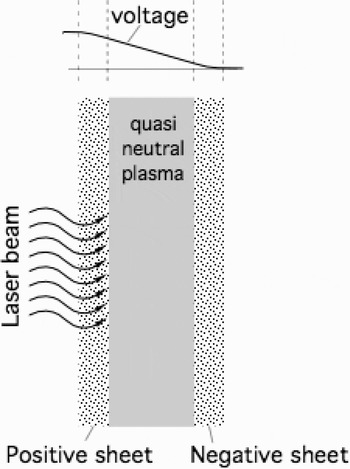
On the irradiated target side, the electrons are pushed forward by the electro-magnetic field into the ionic gas along a distance on the order of λD = δ (positive sheet) while, at the target rear side, a negative sheet (thickness about λD) arises due to the hot electronic gas restrained by a self-consistent ion electrostatic field. In the bulk of the material, ions are acted on by the electric field due to the quasi-neutral coupling (Fig. 3). This field can be estimated through the electron gas equilibrium equation, written in the system co-moving with the accelerated layer,

where E is the electric field, p e is the electronic pressure, and e is the electronic charge. From Eq. (2), it follows the estimate EΔ ≈ p eb/(eZ in i) ≈ T h/e, where p eb is the electronic pressure at the boundary illuminated by the laser light.
Plasma layer accelerated by radiation pressure: Coupling voltage distribution.

The layer equation of motion in the laboratory reference frame takes into account the effects of the radiation pressure resulting from two contributions, p abs and p refl, respectively, corresponding to the absorbed (η) and reflected (1 − η) fraction of photons:
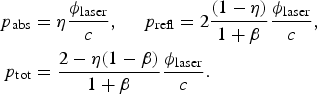
In Eq. (3), p tot = p abs + p refl and β = ν/c (ν is the moving layer velocity). The equation for a layer pushed by the radiation pressure p tot is
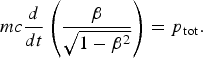
Here m is the rest mass per unit surface. Eq. (4) can be integrated to yield

where
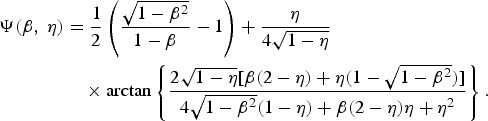
For the reference quantities of Table 1, it is Ψ(0.372, 0.15) = 0.254 and Γlaser = 1.27 GJ/cm2.
The hydrodynamic efficiency is obtained by taking the ratio of the kinetic energy K = mc 2[(1 − β2)−1/2 − 1] to Γlaser as given by Eq. (6). The result is
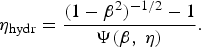
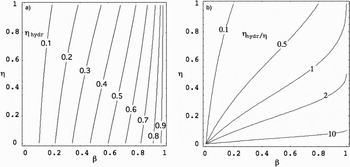
Another interesting parameter is the ratio ηhydr/η giving an estimate of the relative importance of the hydrodynamic forward directed energy flow, to the thermal one that in the layer reference system drives an intrinsically symmetric thermal expansion when the radiation pressure ends (at t = τlaser). The efficiency ηhydr and the ratio ηhydr/η are represented in Figure 4a and 4b.
Iso-levels for hydrodynamic efficiency ηhydr and for the ratio ηhydr/η.

Values of these quantities found for β = 0.372 and η = 0.15 are ηhydr = 0.304, ηhydr + η = 0.454, and ηhydr/η = 2.03. These results show that the effect due to the forward motion induced by the radiation pressure is the most important process. It has to be noted that β = 0.372 and η = 0.15 correspond to a 15 GeV Bi ion beam (72 MeV/nucleon) and to an absorption coefficient consistent with the FIGEX experimental results (see Table 1).
An equation similar to Eq. (6) can be obtained in the system where the matter is at rest (in the target reference system). In this system, using the values taken by the photon energy and momentum due to the Doppler effect, the fluence equals

Here
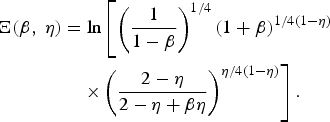
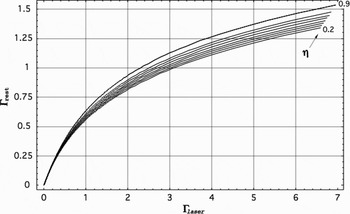
In Figure 5, Γrest is represented as a function of Γlaser for different values of η.
The laser fluence Γrest in the system co-moving with the target as a function of Γlaser, the fluence in the laboratory system.

Under the previously described conditions, it is reasonable to expect the accelerated material to be layered under the pseudo-gravitational field created in the frame of the material, by the acceleration due to the radiation pressure. In this scheme, the absorbed fraction of radiation ηΓrest goes into the electronic component of the system that remains attached to the ions since λD is much smaller than the system thickness. At the interface material-radiation, the electronic pressure  must balance with the radiation pressure evaluated in the co-moving system by
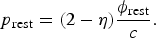
Here the quasi-neutrality condition has been used again for the electronic and ionic particle components (densities n e and n i) and ørest = ølaser/(1 + β).
The accelerated layer thickness Δ can be estimated by considering a quasi-neutral, isothermal equilibrium in the co-moving system. The quantity Δ will depend on the isothermal sound velocity 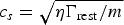 , on the applied radiation pressure, and on the initial area mass density m (a conserved quantity). The initial solid matter parameters as density ρ0 and layer thickness Δ0 are expected to enter in the combination m = ρ0Δ0 when the heated layer Δ ≫ Δ0 and ρ ≪ ρ0 (ρΔ = ρ0Δ0 = m holds). The only combination having the dimension of a length is

Clearly, Eq. (11) represents exactly the height scale of an isothermal atmosphere under the pseudo-gravity g = prest/m. At the end of the acceleration, for β = 0.372 and η = 0.15 (the reference situation of Table 1), one finds  . This model holds until the layer remains opaque to the laser radiation due to the absorption and reflection processes. A sufficient condition may be ρc < ρ = m/Δ, where the critical density ρc is calculated for the red-shifted laser radiation in the layer reference frame. For the case in Table 1, this condition is amply verified up to the time τlaser.
When the laser pulse ends at τlaser, the radiation pressure ends, and in the co-moving system, a roughly symmetric expansion starts, forward and backward. If the target radius R is greater than the value assumed by Δ at τlaser, the gas expansion results somewhat collimated around the direction perpendicular to the front and back of the cylinder surfaces with a velocity  , larger than the transverse one
 , according to the ratio
 . The corresponding half-aperture is θ ≈ arctan(Δ/2R) both in the forward and in the backward beams.
In the laboratory reference frame, the forward moving ions are projected within a half-angle
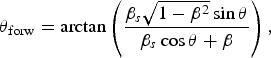
while one has for the backward beam
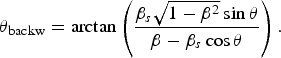
where βs = c s/c. For the reference case here considered (R = 50 µm, Δ = 14 µm), θforw = 2.3° (0.04 rad), θback = 6.4°(0.11 rad), and θback/θforw ≈ 3). The ion bulk has a speed in the interval of 0 < β = 0.510.26, corresponding to energies per nucleon E n (in MeV) ranging in 21 < E n < 155. In practice, it is to be expected a forward moving, quite collimated beam of high-energy particles surrounded by a halo filled by particles of somewhat lower energy.
It has to be noted that, after expansion, for βs < β, in the laboratory most of the ions are projected in the forward direction, so producing an ion beam with efficiency ηtot ≈ ηhdyr + η. This situation is verified for the reference case (Table 1) where ηtot ≈ 0.45.
Using as a target, a layer featured as a spherical cup of radius f, it is possible to expect at the center of curvature, a spot of radius f × θforw for the high energy group surrounded by a halo of radius f × θbackw filled by the lower energy ions. As an example, for f = 500 µm, using the value of θforw = 0.04 rad (≈ 2.3°) previously obtained, it is found that f × θforw ≈ 20 µm is a value of interest for fast ignition applications (see the Introduction in this article). Values of interest for the injected entropy approach to IFE are already obtainable for f = 0.5 cm.
CONCLUSIONS
The generation of fast heavy ions (e.g., Bi ions, tens GeV) by the irradiation of ultra-thin targets (large diameter to thickness ratio) with short laser pulses (e.g., 0.5 ps) at power densities of some 1021 W/cm2 was studied.
It has been shown by simplified hydrodynamic models that, in regimes of low power absorption (e.g., 10–15%), the radiation pressure induces the most important hydrodynamic effects, and makes possible the efficient generation (30–45%) of all-forward ejected high-energy ions (20–150 MeV/nucleon) with the highest energy part of the spectrum well collimated within a half angle as small as  (for the reference situation of Table 1). Moreover, it has been shown that using as ion source a spherical cup with radius of curvature f, a spot radius of about f × θforw can be obtained on a target set at the distance f from the source. This size is compatible with the sought applications to IFE for reasonable values of f. Also the spreads in velocity are amply compatible with the on-target pulse durations required for both the IFE applications, namely fast ignition by heavy-ions and injected entropy.