The first contemporary morphological description of hypertrophic cardiomyopathy was reported in 1958 by Teare.Reference Teare 1 In a case series of eight patients aged 14–44 years, seven of whom succumbed to sudden death, a pathological picture of asymmetric ventricular hypertrophy, disorganised arrangement of muscle bundles, and fibrosis was reported. Several decades later, the heterogeneity of the clinical spectrum of hypertrophic cardiomyopathy has been well documented, including its association with sudden cardiac death, especially with athletic activity.Reference Braunwald, Brockenbrough and Morrow 2 , Reference Maron and Maron 3
Prevalence, clinical course, and natural history
In the general population, the estimated prevalence of hypertrophic cardiomyopathy is 1:500. This would indicate that in the United States of America there are approximately 150,000 young individuals between the ages of 6 and 21 years with hypertrophic cardiomyopathy. It is an autosomal-dominant, inherited disease with variable expressivity and age-related penetrance.Reference Maron, Maron and Semsarian 4 , Reference Seidman and Seidman 5 To date, mutations in 12 genes encoding the thick and thin contractile myofilament protein components of the sarcomere or adjacent Z discs have been implicated in the development of hypertrophic cardiomyopathy. The most commonly affected genes are the myosin-binding protein C and the β myosin heavy chain, accounting for over 70% of genotyped patients. Sporadic cases due to de novo genetic mutations have also been reported.Reference Bos, Towbin and Ackerman 6 – Reference Niimura, Bachinski and Sangwatanaroj 8 Phenotypic expression of hypertrophic cardiomyopathy may first occur at all phases of life, from infancy to old age.
The clinical spectrum of hypertrophic cardiomyopathy is quite diverse, ranging from a completely asymptomatic state to symptoms related to outflow tract obstruction, diastolic dysfunction, progressive heart failure, various tachyarrhythmias, and sudden cardiac death.Reference Maron, Olivotto and Spirito 9 The hypertrophic cardiomyopathy-related mortality risk is variable, depending on reporting era as well as source. The reported annual mortality risk ranges from 4 to 6% in data from selected tertiary referral centres to 1.5% in population-based cohorts.Reference Maron, Casey, Poliac, Gohman, Almquist and Aeppli 10 – Reference McKenna and Deanfield 13
The modes of death in hypertrophic cardiomyopathy are multifactorial; however, three distinctive modes of hypertrophic cardiomyopathy-related death – heart failure, stroke, and sudden cardiac death – occurring largely during different periods of life have been reported. In a mostly unselected and longitudinally followed-up cohort of 750 patients diagnosed with hypertrophic cardiomyopathy, sudden and unexpected death occurred most often in younger patients, although without a clear predilection for any particular age group. Most heart failure-related deaths were in midlife and beyond. Death as a consequence of stroke, usually embolic and associated with atrial fibrillation, was virtually confined to much older patients.Reference Maron, Olivotto and Spirito 9
Risk factors for sudden cardiac death
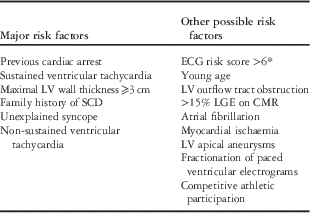
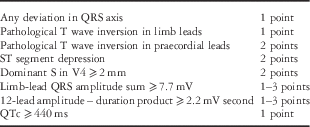
Sudden cardiac death risk in an individual child varies both with clinical features and with age. The risk of sudden death during infancy is low. Thereafter, the risk is also low between 2 and 7 years of age, but it peaks in the 8- to 16-year-old age group. Sudden death events are attributable to ventricular tachyarrhythmias – ventricular tachycardia/ventricular fibrillation – and usually occur in the presence of ⩾1 of the major risk markers. Even in the absence of conventional risk factors, hypertrophic cardiomyopathy patients have a low but non-trivial annual mortality risk of 0.6%.Reference Maron 14 – Reference Maron and Maron 17 In teenaged and adult patients, generally accepted major risk factors for sudden death are previous cardiac arrest, non-sustained ventricular tachycardia (repetitive and >120 bpm), massive left ventricular hypertrophy ⩾3 cm, unexplained syncope, blunted systolic blood pressure response to exercise, and first-degree family history of premature sudden death (Table 1). In children, massive left ventricular hypertrophy can be quantified as either maximal wall thickness >190% of upper limit for age, (z score >3.72) or a maximal wall thickness >2 cm.Reference Decker, Rossano and Smith 18 Only some of these risk factors for sudden cardiac death have been verified in paediatric hypertrophic cardiomyopathy patients.Reference Ostman-Smith, Wettrell, Keeton, Riesenfeld, Holmgren and Ergander 19 Apart from previous cardiac arrest, these risk factors individually have low predictive accuracy. A newer candidate risk assessment strategy is the electrocardiogram (ECG) risk score. This method scores amplitudes of components of the QRS complex and other morphological features of the resting ECG. A risk score of at least six points gives an odds ratio of 28.4 for sudden death/cardiac arrest (Table 2). The ECG risk score also shows promise for risk discrimination in children.Reference Ostman-Smith, Wisten and Nylander 20
Risk factors for sudden cardiac death in hypertrophic cardiomyopathy.

CMR=cardiac magnetic resonance; ECG = electrocardiogram; LGE=late gadolinium enhancement; LV=left ventricle; SCD=sudden cardiac death
* From Table 2
ECG scoring system to assess risk in hypertrophic cardiomyopathy.

Adapted from Ostman-Smith et alReference Ostman-Smith, Wisten and Nylander 20
Role of the implantable cardioverter-defibrillator in the prevention of sudden cardiac death
The implantable cardioverter-defibrillator has been shown to be an effective device to prevent sudden cardiac death in children and adults who have one or more major risk factors for sudden cardiac death. Much of the available data on implantable cardioverter-defibrillator comes from a multicentre registry of >500 hypertrophic cardiomyopathy patients, in which the rate of device interventions appropriately terminating ventricular tachycardia and/or ventricular fibrillation was 4%/year for primary prevention (cumulative, 25% over 5 years), largely in asymptomatic patients, and 11%/year for secondary prevention after cardiac arrest.Reference Maron and Maron 17 Furthermore, defibrillator intervention rates were similar in >200 children and/or adolescents with hypertrophic cardiomyopathy who underwent implantation for primary or secondary prevention at <20 years of age.Reference Maron, Spirito and Ackerman 21
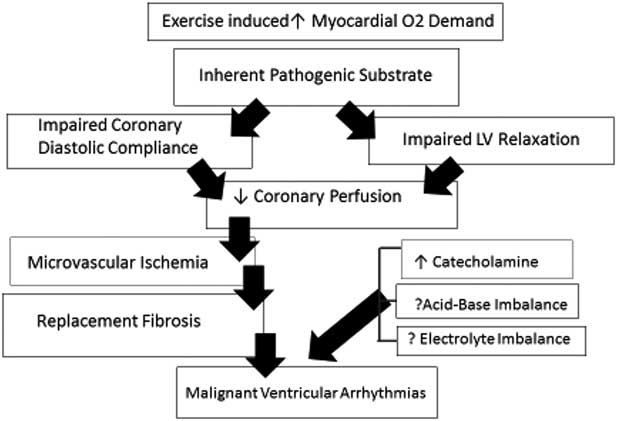
Schematic representation of potential mechanisms for malignant ventricular arrhythmias associated with exercise in hypertrophic cardiomyopathy. LV=left ventricle.

Athletic participation in hypertrophic cardiomyopathy
In the United States of America, hypertrophic cardiomyopathy is the most common cause of sudden cardiac death in the young, including competitive athletes. In one study, approximately one-third of 1866 cardiovascular deaths among United States high school and college students engaged in organised sports was attributed to hypertrophic cardiomyopathy.Reference Maron, Doerer, Haas, Tierney and Mueller 22 The majority of deaths was clustered between 3:00 p.m. and 9:00 p.m. corresponding to the peak time for participating in competitive sports. Deaths were most common between the months of August and January corresponding to competitive seasons for basketball and American football.Reference Maron, Doerer, Haas, Tierney and Mueller 22 In separate studies, hypertrophic cardiomyopathy was responsible for 6% of non-traumatic sudden deaths in young United States military recruits and for 4% of young adults suffering from sudden cardiac death during exercise in King County, Washington.Reference Eckart, Scoville and Campbell 23 , Reference Meyer, Stubbs and Fahrenbruch 24 Although the incidences are variable, there is at least some evidence, although circumstantial, that hypertrophic cardiomyopathy-related deaths occur in a portion of young athletes. In hypertrophic cardiomyopathy, participation in high-intensity sports may theoretically promote ventricular tachycardia/ventricular fibrillation by the interaction of catecholamines, metabolic acidosis, dehydration, contracted blood volume, and electrolyte abnormalities with the pathological substrates of disorganised myocyte alignment and microvascular ischaemia (Fig 1). Therefore, high-intensity sports participation may act as an independent risk factor, even in the absence of conventional risk markers intrinsic to the disease process.Reference Gersh, Maron and Bonow 16 Hypertrophic cardiomyopathy-related deaths have been reported not only in competitive athletics but also during recreational activities.Reference Gersh, Maron and Bonow 16 Akin to arrhythmogenic right ventricular cardiomyopathy, it has been proposed that vigorous sports activities may exaggerate the hypertrophic cardiomyopathy phenotype by triggering cell mechanisms leading to the myocardial hypertrophy and dysfunction with secondary arrhythmias; however, there are limited data to support this concept.Reference Pelliccia, Cianfrocca and Pristipino 25 , Reference Sakata, Ino and Fujino 26
With the hypothesis that intense physical activity could provoke sudden cardiac death in hypertrophic cardiomyopathy and, conversely, limiting such activity could mitigate that risk, sports participation has been strongly discouraged in scientific guidelines published by the American College of Cardiology in the years 1985, 2005, and 2015.Reference Mitchell, Maron and Epstein 27 – Reference Maron, Udelson and Bonow 29 According to current United States guidelines, athletes with a probable or unequivocal phenotypic expression of hypertrophic cardiomyopathy should not participate in most competitive sports, with the exception of those of low intensity (class IA sports). Participation in competitive athletics by asymptomatic, genotype-positive hypertrophic cardiomyopathy patients without evidence of left ventricular hypertrophy by two-dimensional echocardiogram or cardiac MRI is reasonable, particularly in the absence of a family history of hypertrophic cardiomyopathy-related sudden death. The European Society of Cardiology guidelines published in 2005 appear more restrictive in comparison with the American guidelines. In Europe, only those athletes with hypertrophic cardiomyopathy and a “low risk profile” for sudden cardiac death are permitted to play class 1A sports, whereas all others with clinically apparent hypertrophic cardiomyopathy are prohibited from all competitive athletics. Individuals with genotype-positive, phenotype-negative hypertrophic cardiomyopathy are allowed to participate only in recreational athletic activities and are barred from competitive athletics.Reference Pelliccia, Fagard and Bjørnstad 30 Understandably, the guidelines have not been created and based solely on evidence-based medicine but rely heavily on the consensus of experts and the self-acknowledged “art of medicine”.
After three decades of steadfast guidelines, the exercise paradox needs to be examined closely. How does one reconcile the known cardiovascular benefits of physical activity with the attributed increase in risk of sudden cardiac death? Exercise has long been accepted by the scientific community as a means of reducing cardiovascular morbidity and mortality. Equally important is the enhanced self-confidence; sense of psychological, physical, and social well-being; and the improved overall quality of life that sports participation brings to young athletes.
In contrast to hypertrophic cardiomyopathy registry studies citing an increased risk of sudden cardiac death with exercise, there are studies that demonstrate that a substantial proportion of patients with hypertrophic cardiomyopathy continue to compete at a high-intensity level, perhaps against medical advice without adverse clinical events.Reference Reineck, Rolston and Bragg-Gresham 31 , Reference Maron and Klues 32 These include athletes competing at scholastic, collegiate, professional, and Masters levels for extended periods of time in sports that include marathons, triathlons, swimming, baseball, and basketball. Animal studies also suggest that exercise may benefit the underlying pathophysiology of hypertrophic cardiomyopathy. In a mouse model of hypertrophic cardiomyopathy, routine exercise before phenotype development prevented subsequent myocyte fibrosis and disarray as well as other markers of myocardial hypertrophy. Postulated mechanisms for this beneficial effect include improved metabolic matching, alterations in apoptosis, and enhanced vagal tone. It is unclear whether these changes are replicable in humans.Reference Konhilas, Watson and Maass 33 , Reference Watson, Reusch and McCune 34
Unfortunately, there is a lack of data correlating baseline risk of sudden cardiac death to risk of sudden cardiac death with exercise, specifically with regard to the type and intensity of exercise. The specific genotype also does not typically correlate with risk stratification in hypertrophic cardiomyopathy in general and athletic participation in particular;Reference Maron and Maron 17 however, it is conceivable that a risk stratification model for sports participation could be developed on the basis of demographics, type of athletic activity, functional capacity, clinical phenotype, ECG, exercise stress testing, and echocardiogram and cardiac MRI findings that might assist in individualised risk assessment.
The implantable cardioverter-defibrillator is the most effective therapeutic strategy for minimising sudden cardiac death in hypertrophic cardiomyopathy;Reference Maron and Maron 17 , Reference Maron, Estes, Maron, Almquist, Link and Udelson 35 however, the concerns regarding athletic participation by hypertrophic cardiomyopathy patients with implantable cardioverter-defibrillators include device and lead damage, inappropriate implantable cardioverter-defibrillator discharges, intractable exercise-induced ventricular arrhythmias, and failure to recognise and treat malignant arrhythmias. Owing to these concerns, scientific society guidelines limit athletic participation in patients with implantable cardioverter-defibrillators.Reference Maron, Udelson and Bonow 29 , Reference Estes, Link and Cannom 36 In addition, prophylactic implantable cardioverter-defibrillators are not recommended in athletes with hypertrophic cardiomyopathy for the sole or primary purpose of permitting participation in high-intensity sports competition.Reference Maron, Udelson and Bonow 29 Despite these guidelines, hypertrophic cardiomyopathy patients with implantable cardioverter-defibrillators have continued to participate in athletics. In the multi-national prospective registry study on safety of sports for athletes with implantable cardioverter-defibrillators, only one of the 65 hypertrophic cardiomyopathy patients received a shock during competition or practice.Reference Lampert, Olshansky and Heidbuchel 37 The event rates of implantable cardioverter-defibrillator lead malfunction were similar between athletes and non-athletes. These data raise the controversial question as to whether or not the presence of an implantable cardioverter-defibrillator should allow a patient with hypertrophic cardiomyopathy to participate in competitive athletics. Justifiably, the scientific guidelines have also taken into account the demand for implantable cardioverter-defibrillators in hypertrophic cardiomyopathy patients desiring to engage in competitive sports, for whom the device would not be otherwise indicated, resulting in over-utilisation of implantable cardioverter-defibrillator therapy.
Other forms of hypertrophic cardiomyopathy
The comments in this article have largely related to young patients having hypertrophic cardiomyopathy caused by mutations in the genes coding for cardiomyocyte sarcomeric proteins. Although this comprises the vast majority of hypertrophic cardiomyopathy patients, the discussion would not be complete without mention of the less common forms of this disease not caused by abnormal sarcomeric proteins. On the basis of cardiac imaging studies, the phenotype may be quite similar, but the overall clinical picture may be distinguished from sarcomeric protein-related conditions on the basis of associated non-cardiac manifestations, different conduction system abnormalities, and/or different natural histories. Included in this category are some of the RASopathies such as Noonan syndrome and Costello syndrome, certain glycogen storage diseases such as Pompe disease – glycogen storage disease type II and acid maltase deficiency – PRKAG2 mutations – constitutive upregulation of the energy-sensing enzyme 5'-AMP-activated protein kinase subunit γ-2 – and Danon disease – glycogen storage disease type IIb, an lysosomal associated membrane protein 2 (LAMP2) mutation – as well as rare mitochondrial myopathies, especially those caused by mitochondrial mutations in transfer RNA glycine, the mitochondrial MT-TG gene. Together, these constitute an important minority of hypertrophic cardiomyopathy conditions.
These conditions highlight the importance of a holistic medical approach to the newly diagnosed patient with hypertrophic cardiomyopathy – for example, skeletal muscle weakness should prompt consideration of Pompe disease or mitochondrial mutation. Coexisting Wolff-Parkinson-White patterns should raise the question of a LAMP2 or PRKAG2 mutation. Characteristic facial features will direct the clinician to evaluate for Noonan or Costello syndrome. Intellectual deficiency and elevated liver enzymes suggest the diagnosis of LAMP2 mutation. Once the diagnosis is confirmed by genetic or enzymatic analysis, clinical surveillance and intervention may dramatically diverge from that typically used for sarcomeric forms of hypertrophic cardiomyopathy. The patient, generally an infant, with Pompe disease will be expeditiously started on enzyme-replacement therapy. The patient with a PRKAG2 mutation should be closely followed-up for progressive conduction system changes, including acquired pre-excitation, sinus node dysfunction, atrial fibrillation, and atrioventricular block. The youngster with Danon disease has an especially malignant course and may require early heart transplantation.
Conclusion
The current understanding of hypertrophic cardiomyopathy has evolved greatly in the past several decades. The advent of the implantable cardioverter-defibrillator and automatic external defibrillator has greatly improved survival; however, sudden cardiac death in hypertrophic cardiomyopathy cannot be completely eliminated despite risk stratification, pre-participation screening, and sports disqualification. Restriction of all patients with hypertrophic cardiomyopathy from vigorous or competitive activity may be excessive. This strategy also does not eliminate playground deaths or deaths associated with minimal exertional activity in hypertrophic cardiomyopathy.Reference Eckart, Scoville and Campbell 23 Ongoing studies in multiple areas will hopefully reduce the frequency of sudden cardiac death in hypertrophic cardiomyopathy: better understanding of the heterogeneity of the disease process; clinical data analysis through prospective registries; universal development of emergency action plans; and maximising resuscitation efforts and early defibrillation strategies.
Acknowledgements
None.
Financial Support
This research or review received no specific grant from any funding agency or from commercial or not-for-profit sectors.
Conflicts of Interest
None.
Ethical Standards
The authors assert that all referenced work contributing to this review complies with the ethical standards of biomedical or medicolegal investigation.