INTRODUCTION
Modification of the structure and phase properties of metal and alloy surface layers under superfast cooling velocities are widely used to produce superfine crystalline and amorphous structures with an application of laser pulses of different duration (Breinan et al., Reference Breinan, Kear and Banas1976; Bacci et al., Reference Bacci, Battaglin, Della Mea, Jannitti, Mazzoldi, Miotello and Servidori1980; Firsov & Golub, Reference Firsov and Golub1988; Kanavin et al., Reference Kanavin, Men'kova and Zavestovskaya2008; Kоkоrа et al., 1988). Rapid development of ultrashort lasers opens up possibilities for new applications of material precision treatment as compared to conventional lasers (Basov et al., Reference Basov, Bezotosny, Kumykov and Popov1999; Bauer et al., Reference Bauer, Chichkov, Fallnich, Koch, Korte and Ostendorf2005; Guo & Vorobyev, Reference Guo and Vorobyev2006; Kanavin et al., Reference Kanavin, Men'kova and Zavestovskaya2008). Nanostructuring of metal surface layers makes use of femtosecond laser pulses with the intensities close to the threshold ones, where one observes metal melting in a small volume without any significant ablation.
After the end of the laser pulse, the melt is rapidly crystallized due to the heat propagation into the specimen depth. Due to superfast cooling (109 K/s and higher), the size of the produced crystallites may be compared with an interatomic spacing. In this case, an amorphous layer may be formed, if the cooling velocity exceeds the freezing rate. The formation of a superfine crystalline or amorphous surface structures under the action of the laser pulses are called in the literature “laser glazing” (Bacci et al., Reference Bacci, Battaglin, Della Mea, Jannitti, Mazzoldi, Miotello and Servidori1980; Breinan et al., Reference Breinan, Kear and Banas1976; Firsov & Golub, Reference Firsov and Golub1988; Kanavin et al., Reference Kanavin, Men'kova and Zavestovskaya2008; Коkоrа et al., 1988).
The dynamics of the melt under the action of a femtosecond laser pulse on the metal has yet to be adequately studied (Bauer et al., Reference Bauer, Chichkov, Fallnich, Koch, Korte and Ostendorf2005; Guo & Vorobyev, Reference Guo and Vorobyev2006). A detailed description of surface nano-modification morphology for the use of femtosecond laser pulses is given in Guo and Vorobyev (Reference Guo and Vorobyev2006). It is shown that at laser pulse duration, ~ 65 fs, and low laser intensity, ~ 5 × 10¹² W/cm2, one can produce different structures (pores, rings, convexities) of the size ~ 40–100 nm. The morphology of nanostructures formed at the metal surface under the action of a laser pulse depends on both the laser intensity and the number of irradiating pulses, and needs further investigation.
In case of a femtosecond pulse, the material heating and melting processes take place under essentially nonlinear and non-equilibrium conditions. However, the kinetics of the melt cooling after the action of a supershort laser pulse is defined, finally, by the velocity of heat propagation into the material depth, and for the metals this velocity ranges around 1013–1015 К/s. So, the time of cooling is larger than 10−12 s. This means that one can make use of a heat model applied to a classical description of the crystallization kinetics.
The most universal approach to the description of the kinetics of the cooling process under the laser action is based on the investigation of the distribution function Z(n, t) for the numbers of the crystalline phase nuclei contained n atoms at the given time moment t (Christian, Reference Christian1978; Kanavin et al., Reference Kanavin, Men'kova and Zavestovskaya2008). The distribution function Z(n, t) being known, one can define the average size of crystallites formed under the cooling, and the relative volume of a crystalline phase.
In this paper, an analytical solution of a kinetic equation for the distribution function Z(n, t) is considered specific features of metal crystallization in the alloys under superfast cooling velocity. The problem of growth of a superfine crystal phase of micro- and nanosize under superfast cooling is analyzed analytically and numerically.
THEORETICAL MODEL
Formulation of the Problem
The thermodynamic condition of the phase transition of the first kind for crystallization process is (Christian, Reference Christian1978):

where Φs and Φl are specific free energies for solid (s) and liquid (l) phases, respectively, and T 0 is the threshold temperature of the crystallization.
The classic theory assumes that phase transition of the first kind is realized by way of thermofluctuational formation of new location of atoms (Christian, Reference Christian1978). Nuclei can only grow if there is a thermodynamic stimulus of the transformation defined by the sum of energy variations caused by the appearance of the new phase nuclei. The specific free energy change caused by the new phase nuclei generation for the cooling process can be written as follows:


where indexes υ and s denotes the volume and surface terms, respectively, Δh is the latent heat of the phase transition, σ is the phase boundary surface energy, and χ is the form-factor of the nuclei.
The nuclei distribution function Z(n, t) satisfies the normalizing condition
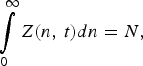
N is the complete number of the atoms in the volume. The kinetic equation for Z(n, t) takes into account both their fluctuations and the decrease or increase in the dimension of new phase nuclei determined by thermodynamics, and can be written as follows (Christian, Reference Christian1978):
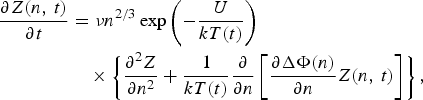
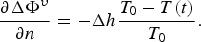
where U is an activation energy of the phase transition, i.e., the electron energy difference due to crossing of the phase boundary, ν — Debye frequency, k — Boltzmann constant. The first term on the right-hand side of Eq. (4) describes the diffusion of the initial nuclei distribution and the second one describes the migration of this distribution in the particle number space (Breinan et al., Reference Breinan, Kear and Banas1976). Both processes are of the thermofluctuational origin and are droved by the overcooling at the melt-solid boundary. Taking into account the volume term one can obtain the following relationship
As initial condition to Eq. (4) we use the system completeness, i.e., the condition of particle conservation:

The boundary conditions are as follows:

The second equation in (7) excludes from the consideration the case of very large nuclei of the new phase (boundary condition of the Bekker-Doering's theory). This statement is especially valid for short duration of the cooling taking place during the laser action where large nuclei have no time to grow.
A superfast cooling also implies that from the very beginning a sufficient amount of crystalline nuclei of the over-critical size are available, i.e., all the over-critical nuclei are automatically included into the system. Indeed, in the analysis of the crystallization, the attention is given to the volume and surface terms in Eq. (2), which determine the radius r c (or the number of particles n c) of critical nucleous corresponding to the maximum of free energy variation. In case of spherical nucleous formation.
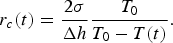
It follows from (8) that in the case of superfast cooling (taking into account that a decrease in the laser pulse duration increases the temperature change rate) subcritical nuclei become over-critical in a short period of time. Hence, the superfast cooling kinetics is determined not so much by nucleation process as by the growth of the existing nuclei.
The metallographic investigations (Kоkоrа et al., 1988) shows that crystalline nuclei produced after superfast cooling of metal melt have a nidle-dendrite form. Therefore, we consider the existence of nuclei of a plate form as primary. Then the pre-exponential factor in (4) is proportional to n, and not to the value n 2/3. The latter gives a possibility to obtain the solution to Eq. (4) in explicit form (Kanavin et al., Reference Kanavin, Men'kova and Zavestovskaya2008).
Solution to Kinetic Equation
Eq. (4) can be written after the assumptions mentioned above as follows:

Let us make a change of variables

where υ is the cooling rate. Then (9) can be presented in the form:
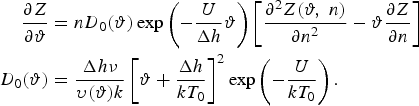
We will solve Eq. (11) using operator method applied to Schrödinger equation (Kanavin et al., Reference Kanavin, Men'kova and Zavestovskaya2008). It is necessary to find an evolution operator of the system Ŝ:

where Z in and Z f are the initial and final distribution functions. The estimation of the evolution operator is reduced to the solution to a set of differential equations relative to the parameters α и β (Kanavin et al., Reference Kanavin, Men'kova and Zavestovskaya2008):
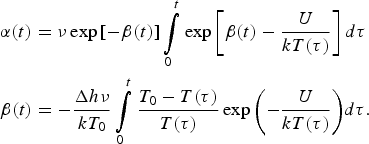
The final form of alpha and beta can be found knowing the mode of the temperature variation during cooling. It is determined by the regime of laser treatment and by the thermodynamic properties of the material.
RESULTS AND DISCUSSION
Distribution Function
To determine α(t) and β(t) we consider the most widespread time dependences of the temperature:
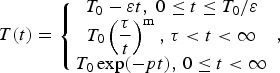
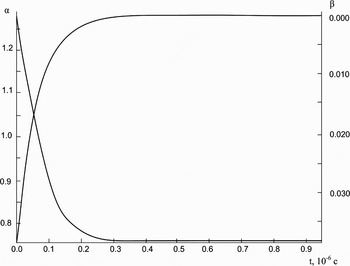
where ɛ, m, and p are the functions of the laser beam parameters. The parameters α(t) and β(t) for the linear mode of cooling are presented in Figure 1. It is clear that α and β reach their stationary values within the linear mode of cooling. The explicit form of the evolution operator allows one to analyze its action onto the initial distribution function. If we restrict to the initial designation function of the crystalline phase particle numbers can be written in the following integral form:
Time dependences of parameters α(t) and β(t) for Fe at a linear fashion of cooling (τ = 5 μs, U/kT 0 = 17.1).

I 1 is the modified Bessel function of the first kind.
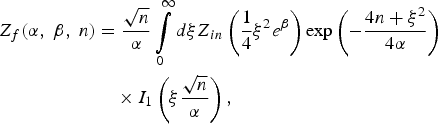
The explicit form of the initial distribution function is determined along with other factors by the cooling rate, for example, if

then for the linear and power mode of the cooling rate the following expression is valid

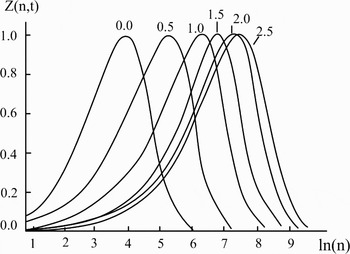
Figure 2 shows the calculation results for the time evolution of the distribution function Z(n, t). It is evident that this function drifts significantly at the initial period of cooling and does not vary practically until the end of cooling.
Dependence of the distribution function Z(n,t) on the particle number n at different instants of time (U/kT 0 = 15).

Determination of the average Number of Particles and Volume of the Crystallized Phase
Expression (15) can be shown to satisfy the conservation condition (6). As a matter of fact,
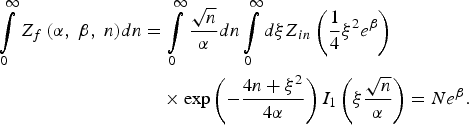
Actually, this is the number of new phase particles at t → ∞. If t → 0 parameter β → 0 and, hence, relationship (3) is valid. Then, the relative variation of the crystalline phase volume can be found explicitly:

Formula (19) corresponds to phenomenological Kolmogorov-Avraamy equation, which describes the crystallization kinetics in the approximation of the constant nucleation velocities (Christian, Reference Christian1978):
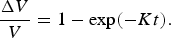
In (20), the crystalline volume fraction is developed at time t and constant temperature. K and n are suitable parameters: n is determined by the nucleation process and should be an integer from 1 to 4, K is defined by the nuclei growth and is time dependent. The explicit form of alpha and beta as functions of the thermodynamic parameters of the substance allows one to determine ΔV/V.
The average size of nuclei crystallized or average number of atoms in new formations is another important feature. Using the definition
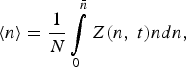
where 〈n〉 is a sufficiently large (but limited) number of particles. Taking into account that the transition in the integration limits from  to ∞ it is possible at high cooling rates to estimate the average number of particles in the crystallite in the explicit form:

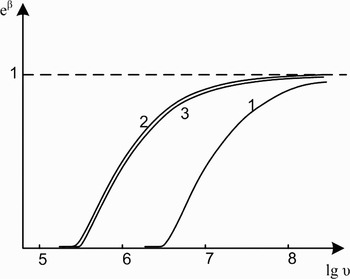
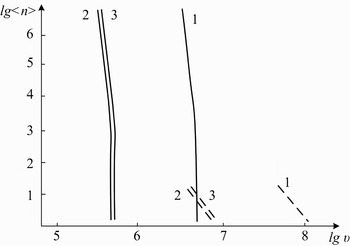
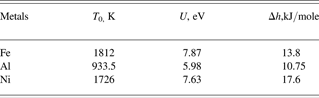
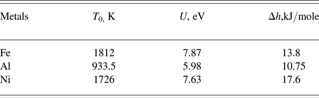
It should be noted that 〈n〉 is completely determined by the value α, i.e., by the diffusion mode of the initial distribution of the particle numbers, and ΔV/V depends on β only, i.e., on the distribution function drift in the space of particle numbers. The values of 〈n〉 and ΔV/V depend on the metal thermodynamic parameters (Eq. (13)). In Table 1, are listed important thermodynamic parameters of metals (Fe, Al, Ni). The results of calculation of the values ΔV/V and 〈n〉 for exponential fashion of cooling are presented in Figures 3 and 4. Figure 3 shows the volume e βversus the cooling rate (Kanavin et al., Reference Kanavin, Men'kova and Zavestovskaya2008). The function exp(β) → 0 and the melt crystallizes practically completely (ΔV/V → 1) at small υ. For example, it is υ ~1.8 × 10⁶ K/s for Fe, υ ~ 2.8 × 10⁵ K/s for Al, υ ~ 1.73 × 10⁵ К/s for Ni. Increase in υ leads to partial crystallization of the melt volume (exp(β) →1 at ΔV/V →0 in asymptotic limit t → ∞). In this case, we may assume that a residual fraction of the melt tends to amorphization (solidified liquid). So, in case of Fe at υ ~ 1.8 × 10⁹ К/s approximately 0.996 of the melt volume have to be amorphous. For Al and Ni, the same amorphization fraction must be reached at υ ~ 9.3 × 10⁸ K/s and υ ~ 7.3 × 10⁷ K/s, respectively.
Calculated dependence of the relative portion of the new phase volume on the cooling rate: 1 – Fe, 2 – Ni, 3 – Al.

Calculated dependence of an average number of particles 〈n〉 in new phase volume on cooling: 1 – Fe, 2 – Ni, 3 – Al. Dash curve is for amorphisation, solid curve is for crystallization.

Characteristics of metals
At the same time, 〈n〉 varies rather substantially up to two orders of magnitude at small increase of the cooling rate (Kanavin et al., Reference Kanavin, Men'kova and Zavestovskaya2008). So, 〈n〉 varies within the interval from 537 to 14 particles in Fe nucleous at the variation of υ from 4.6 × 10⁶ K/s to 4.7 × 10⁶ K/s; 〈n〉 varies from 1243 to 3 for Al at υ = (4.58–4.7) × 105 K/s; 〈n〉 varies from 462 to 2 for Ni at υ = (4.34–4.43) × 105 K/s. In rapid quenching structure for rapid cool steels has been produced by melt sputtering technique (Firsov & Golub, Reference Firsov and Golub1988). It has been shown that the mean nucleous particle number in a structure (called η-phase) was about 80 (the crystallite size about 40–100 nm). Such sizes of nanostructures were observed in Guo and Vorobyev (Reference Guo and Vorobyev2006) under the metal treatment by femtosecond laser pulses.
It should be pointed out that a detailed calculation and comparison of the results with experimental data are difficult because of the absence of the precise values of thermodynamic parameters. Moreover, under the action of the laser femtosecond pulses the cooling rate make come up to 1015 К/s, and the structure of the frozen melt, the presence and the sizes of the corresponding nanostructures will be defined by the dynamics of the processes taking place in the melt under cooling (Kanavin et al., Reference Kanavin, Men'kova and Zavestovskaya2008).
Amorphysation Criterion
A thin amorphous layer (1500 Å) on the pure Al surface has been produced by ruby laser pulse irradiation with the intensity 108 W/cm2 and pulse duration 15 ns (Bacci et al., Reference Bacci, Battaglin, Della Mea, Jannitti, Mazzoldi, Miotello and Servidori1980). The cooling rate was about 1010 К/s. In this case, the thickness of the amorphous layer is determined by the melting front velocity (about 10 m/s). A similar regime was used in Breinan et al. (Reference Breinan, Kear and Banas1976) for the Fe amorphisation. The cooling rate was about 109 К/s above the critical value for Fe (υc about 5 × 10⁶ К/s). In case where υ ~ 5 × 10⁴ К/s << υc an amorphous layer in Fe was not observed (Breinan et al., Reference Breinan, Kear and Banas1976).
In other words, there is a critical value of a cooling rate υcr for each type of metals or alloys, so that we may suppose that υ ≥ υcr is a cooling rate criterion of amorphisation.
Realization of the critical cooling rate is a kinetic condition of amorphisation. On the other hand, the rate of heat removal out of the melt into the bulk of material during the cooling is determined by the thermophysical properties of the melt, and can limit the cooling rate. In case of pulse laser action, the maximum value of the cooling rate is equal to
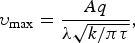
where A — is a absorbability, λ — is a heat conductivity of the material, q and τ — intensity and pulse duration of the laser radiation (Kоkоrа et al., 1988).
It was shown in Kanavin et al. (Reference Kanavin, Men'kova and Zavestovskaya2008) that :

where c 0 ≅ 0,95, U/kT 0 > 5.
The possibility of amorphisation is determined by laser beam parameters (q and τ), and by thermodynamic material ones (Δ h, U, v, T 0). If we use (23) and (24) we can determine the optimum laser amorphisation regime.
CONCLUSIONS
The crystallization kinetics of metals from the melt under superfast cooling velocities realized in the treatment of the materials by ultrashort laser pulses has been studied. An explicit solution to kinetic equation for the size distribution function of crystalline phase nuclei at the fast cooling of the melt was analyzed analytically and numerically. Use has been made of physical preconditions for the crystallization process practically realized at superfast cooling: the existence of a sufficiently large number of crystal nuclei of super-critical size and a plate-type shape of the nuclei. An average size of crystallites has been defined, as well as the volume fraction of crystallized phase. The amorphisation criterion for the melt cooling velocity is determined.
The presented expressions for the crystal nuclei size and the new phase volume have been used to describe the experiments on micro- and nanostructuring of the metal surface layers under the action of femtosecond laser pulses. A detailed comparison with the experiment assumes that one should include into consideration the processes describing the dynamics of the melt motion at the beginning of the cooling process.
ACKNOWLEDGMENTS
The work was supported by the RAS Program “Basics of fundamental research of nanotechnologies and nanomaterials,” RAS Program “Physical and technological investigation of semiconductor lasers aimed at reaching maximum parameters,” and the Russian Foundation for Basic Research, Grant 09-02-00615-a, and RF Ministry of Education and Science Grant 2009-1.1-122-052-025.