Studies of metalwork have long dominated our understanding of the British Bronze Age. Metals—malleable, multi-purpose and so clearly desirable—have been viewed on the one hand as a medium of exchange, a form of proto-currency as it were, and on the other as markers of wealth and status in a prestige goods economy. Ceramics too—valued as chronological markers and, during the late nineteenth and early twentieth centuries, as indicators of ethnic identity—have long been a focus of research interest amongst those working on the period. In contrast, objects made of other materials have often attracted less interest, partly perhaps because of their relative rarity in comparison to the many thousands of documented bronze objects. Yet materials such as amber, jet, shale and steatite occur more frequently and were used to make a wider variety of objects in the Bronze Age than in the Neolithic, while objects of faience and glass appeared for the first time. Most are small items of personal adornment, such as beads, buttons, pendants and armlets, although a few larger objects are also known, such as the Middle Bronze Age shale bowl from Caergwrle in Flintshire (Davis & Townsend Reference Davis, Townsend, Ambers, Higgitt, Harrison and Saunders2009). Such objects have tended to be framed either as ‘valuables’, symbols of status circulating in the same prestige goods networks as bronze, or as decorative trifles of limited importance. Beyond this, their cultural meanings or social significance have rarely been explored.
In recent years, a number of important studies of Early Bronze Age grave goods have attempted to redress this balance (e.g. Shepherd Reference Shepherd2009; Sheridan & Davis Reference Sheridan and Davis2002; Verkooijen Reference Verkooijen2014; Woodward Reference Woodward2002; Woodward & Hunter Reference Woodward and Hunter2015). This body of research has examined morphology, provenance, manufacturing techniques, damage and use-wear for items of amber, jet and other materials, providing insights into artefact function, craft and technology, and the life-cycles of individual objects during the Early Bronze Age. Little has been written on the use of such materials in the later part of the period, however, despite their presence at significant sites such as the Flag Fen platform and post-alignment (Coombs Reference Coombs and Pryor2001, 280; Pryor Reference Pryor2001, 322) and the extraordinarily well preserved nearby settlement at Must Farm (Knight et al. Reference Knight, Harris and Appleby2016). This paper will focus on the Late Bronze Age evidence, for during that period, the artefact inventories from excavated sites become noticeably more diverse (Brück Reference Brück, Haselgrove and Pope2007) and the deposition of non-metal ‘valuables’ forms part of that trend. The evidence will, however, be briefly contextualized relative to the much smaller number of finds of such materials of Middle Bronze Age date, for there are some interesting similarities and differences. During the Late Bronze Age, non-metal ‘valuables’ were deposited, not in graves, but in a variety of other very different contexts, and it is clear that their social role had changed.
In this paper, we will examine artefacts of amber, jet and jet-like materials; we have chosen these as they are the most common non-metal ‘valuables’ of Late Bronze Age date. The kinds of microscopic and compositional analyses that have been carried out for Early Bronze Age artefacts, notably as part of Woodward and Hunter's Leverhulme-funded project (Reference Woodward and Hunter2015), are beyond the scope of the present study; analysis of the source of the materials and the production techniques employed must therefore await future research. Instead, the main focus of this paper will be to provide a detailed discussion of the deposition of such finds, addressing in particular their contexts and associations, with patterns of breakage also examined for a sample of the artefacts. For the purposes of this study, information was predominantly obtained from published sources, although the 88 jet/jet-like artefacts from Potterne were examined first-hand for traces of deliberate destruction. A list of Late Bronze Age finds is appended to the end of the paper.
One particular issue that we hope to address is whether such artefacts can or should be viewed as ‘valuables’. The Bronze Age saw the increasing circulation of objects made from materials that derive from geographically restricted sources, notably metals. These have often been framed as ‘exotic’ objects, access to which could be limited and controlled. The acquisition and display of such artefacts, it is argued, worked to mark political power and prestige, and they were amassed as a form of wealth that was employed in strategies of competitive aggrandisement between Bronze Age chiefs. Amber, jet and jet-like materials are, as we shall see below, similarly restricted in their distribution, and they would generally have been obtained via exchange networks rather than direct from their sources. As such, it is tempting to characterize items made from these materials as prestige goods or symbols of power. This view, however, is based on a particular understanding of the relationship between people and objects in which people are conjured as active agents while objects are figured as inert and passive. Objects, then, become things that are manipulated by competitive individuals seeking social and political status—symbols marking human action, rather than agents in their own right. This anthropocentric understanding of the distinction between people and objects has been widely challenged in recent years under a variety of theoretical banners (including the new materialism, symmetrical archaeology and object-oriented ontologies) that share a common interest in the agency of objects (e.g. Fowler & Harris Reference Fowler and Harris2015; Hodder Reference Hodder2012; Olsen Reference Olsen2010; Webmoor & Witmore Reference Webmoor and Witmore2008). As we shall see in this paper, the intimate personal relationships that can be traced between people and things in the Bronze Age require us to call into question assumed categorical distinctions between subject and object (see also Brück & Fontijn Reference Brück, Fontijn, Fokkens and Harding2013). Moreover, we wish to reorient our interest away from ‘valuables’ to ‘values’, though we would challenge the modern, Western distinction between economic value and social values (Brück Reference Brück, Suchowska-Ducke, Reiter and Vandkilde2015; Graeber Reference Graeber2001), for the identification of particular objects as valuable in the economic sense is a product of the social practices and relationships in which they are implicated. It is evident that viewing amber, jet and jet-like artefacts as mere markers of wealth and status provides a limited and one-dimensional perspective on their social role. Here, then, our aim is to consider the cultural meanings and social values ascribed to such objects; as we shall see, human and object biographies were intertwined so that they were active agents in the web of human sociality.
The artefacts
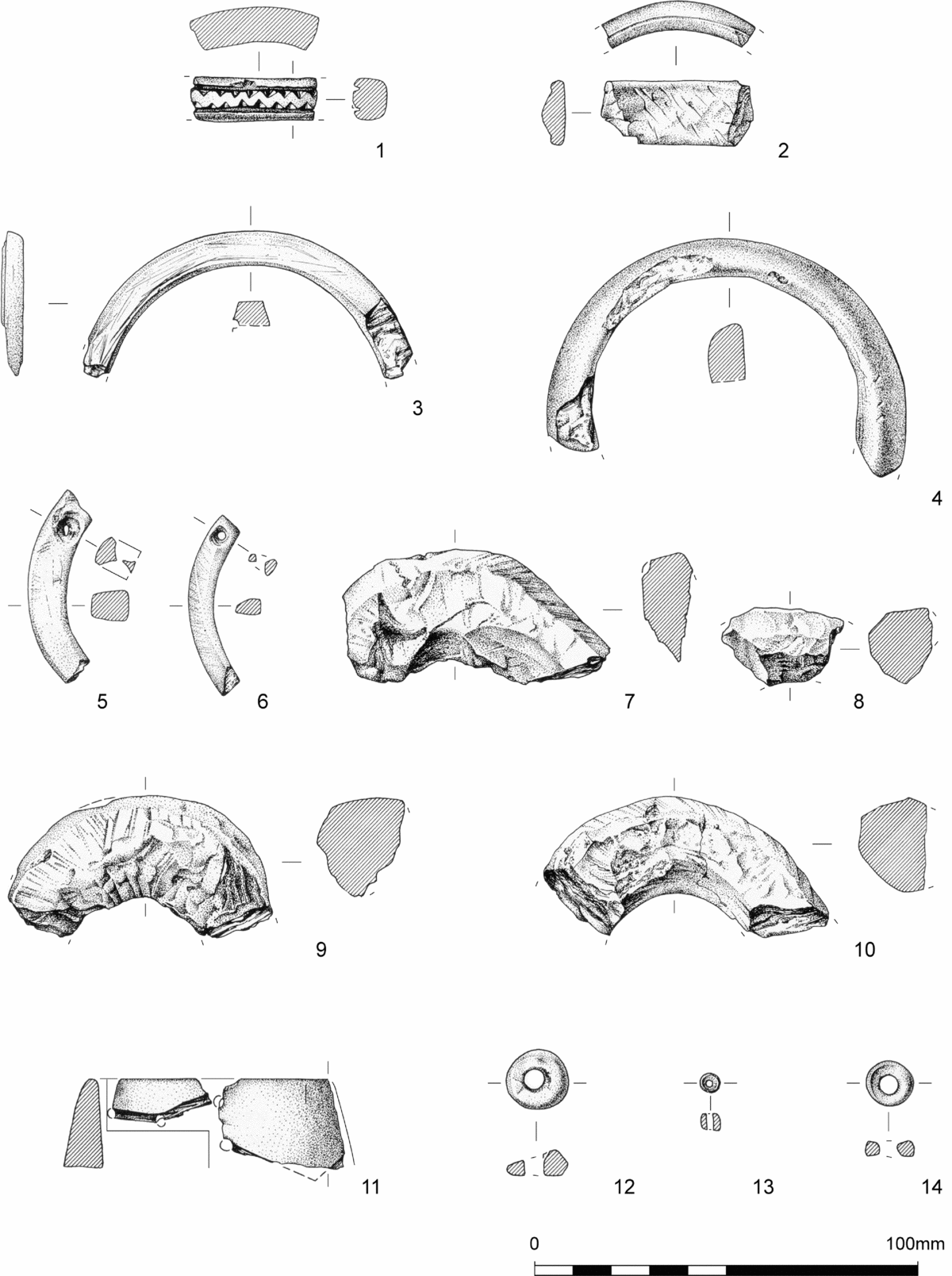
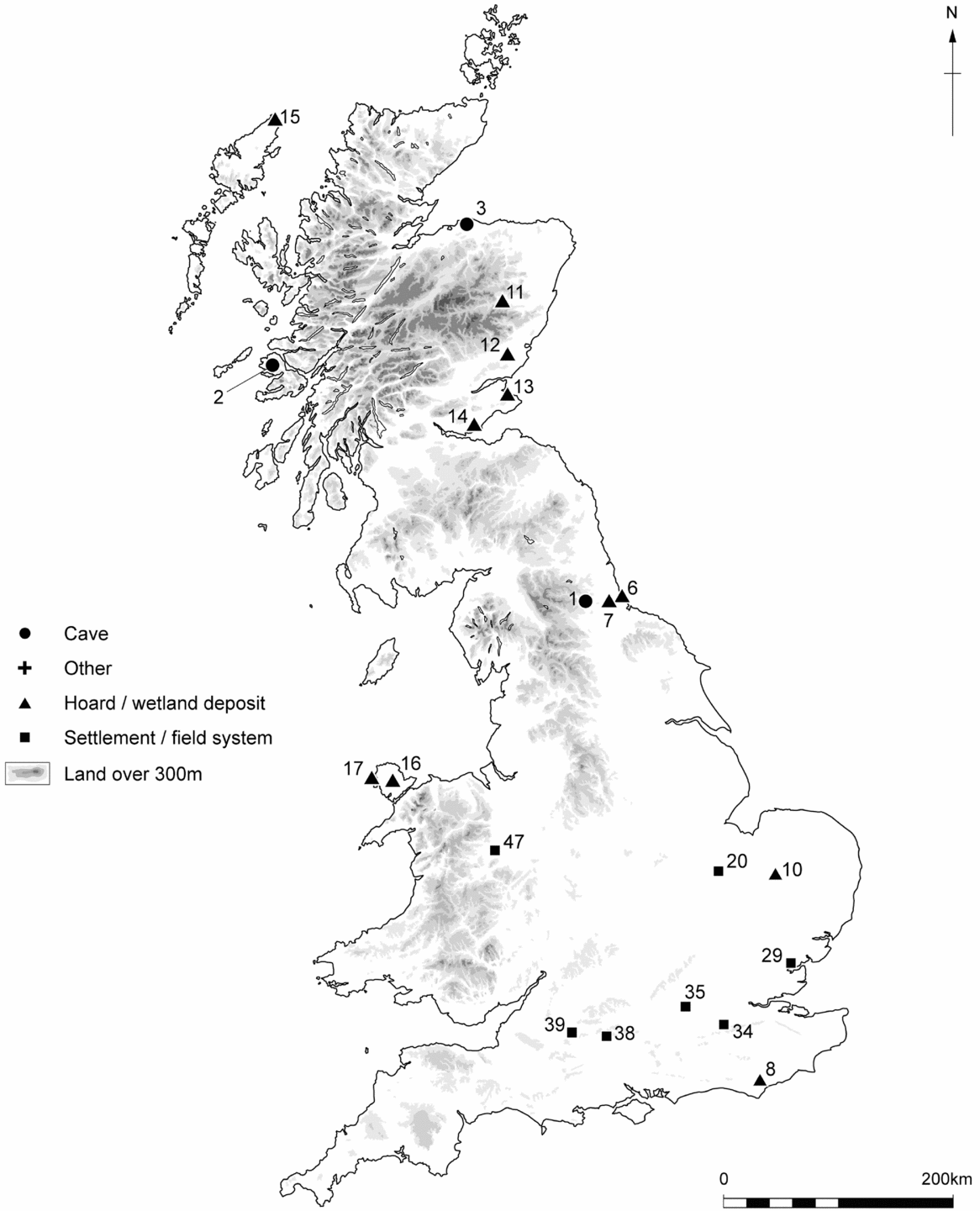
In total, a database of at least 102 amber items (exact numbers are not always given in antiquarian reports or in modern interims reports) from 21 sites was collated for this study (see Appendix). All of the amber objects were beads (Fig. 1, nos 11–13). Several new finds of Late Bronze Age date can now be added to the corpus of prehistoric amber compiled by Beck and Shennan (Reference Beck and Shennan1991), including East Chisenbury (Morris Reference Morris2010, 71), Lofts Farm (Brown Reference Brown1988, 281), Sedgefield (Needham Reference Needham2006, 34–5), High Throston (Daniels Reference Daniels2003; Reference DanielsDaniels n.d.), St Andrews (Cowie et al. Reference Cowie, O'Connor, Proudfoot, Chevillot and Coffyn1991), Shinewater (https://historicengland.org.uk/listing/the-list/list-entry/1400780) and Must Farm (Knight et al. Reference Knight, Harris and Appleby2016). In contrast to amber items of Early Bronze Age date, Late Bronze Age beads were relatively uniform in shape, predominantly circular or sub-circular and 0.8–2.0 cm in diameter, although some larger examples are known, for instance from the Balmashanner hoard (Beck & Shennan Reference Beck and Shennan1991, fig. 11.20). There is greater variety in cross-section, including flattened, biconical, rounded and wedge-shaped examples (Beck & Shennan Reference Beck and Shennan1991, 52–63). Occasionally, other types are present, such as the single fusiform bead from High Throston in County Durham which formed part of a hoard alongside other circular beads (Peter Rowe pers. comm., 2012); fusiform beads of various materials are relatively common in the Early Bronze Age, and this may in fact be a curated object of much earlier date. Beck and Shennan (Reference Beck and Shennan1991, 29–37) have employed infra-red spectroscopy to demonstrate that the amber used in prehistoric Britain was Baltic in origin; their analysis included beads of Late Bronze Age date from Balmashanner (Coles Reference Coles1960, 98–9; Schmidt & Burgess Reference Schmidt and Burgess1981, 251–2), Feltwell Fen (Smith Reference Smith1958), Llangwyllog (Lynch Reference Lynch1991, fig. 68) and Heathery Burn (Britton Reference Britton1968; Greenwell Reference Greenwell1894). Baltic amber is most likely to have been acquired via long-distance exchange networks, although it is also found in small quantities on the east coast of Britain (Beck & Shennan Reference Beck and Shennan1991, 15–27).
A selection of the amber and jet/jet-like artefacts from the midden at Potterne, Wiltshire. (1–4) jet/jet-like armlets; (5–6) jet/jet-like pendants; (7–10) jet/jet-like armlet rough-outs; (11) jet/jet-like bowl fragments; (12–14) amber beads. (After Wyles Reference Wyles and Lawson2000, fig. 81, with minor amendments by Anne Leaver.)

To date, few compositional analyses have been carried out on objects of jet and jet-like materials of Late Bronze Age date (but see Sheridan & Davis Reference Sheridan, Davis, Gibson and Simpson1998, table 12.2, for Llangwyllog). Further work of this sort is clearly desirable, but was unfortunately outside the scope of the current paper. X-ray fluorescence spectrometry has, however, been extensively employed to assess the composition of Early Bronze Age jet/jet-like artefacts (Bussell et al. Reference Bussell, Pollard and Baird1982; Sheridan & Davis Reference Sheridan, Davis, Gibson and Simpson1998; Reference Sheridan and Davis2002) and this has demonstrated that a variety of dark-coloured materials were employed to make beads and other small ornaments, including jet, shale, lignite, albertite and cannel coal. Because the identification of most Late Bronze Age artefacts cannot currently be confirmed, the term ‘jet/jet-like’ will be employed here to describe objects that may have been made of jet or similar-looking materials. It is worth noting, however, that the majority of items documented in the course of this research were identified in the original excavation reports as shale on the basis of macroscopic inspection, and it has often been assumed that most of those from south-central England derive from the Kimmeridge area, where good evidence for the large-scale production of armlets and other artefacts close to extensive sources of shale has been found at sites such as Eldon's Seat (Cunliffe & Phillipson Reference Cunliffe and Phillipson1968); we will return to this point below.
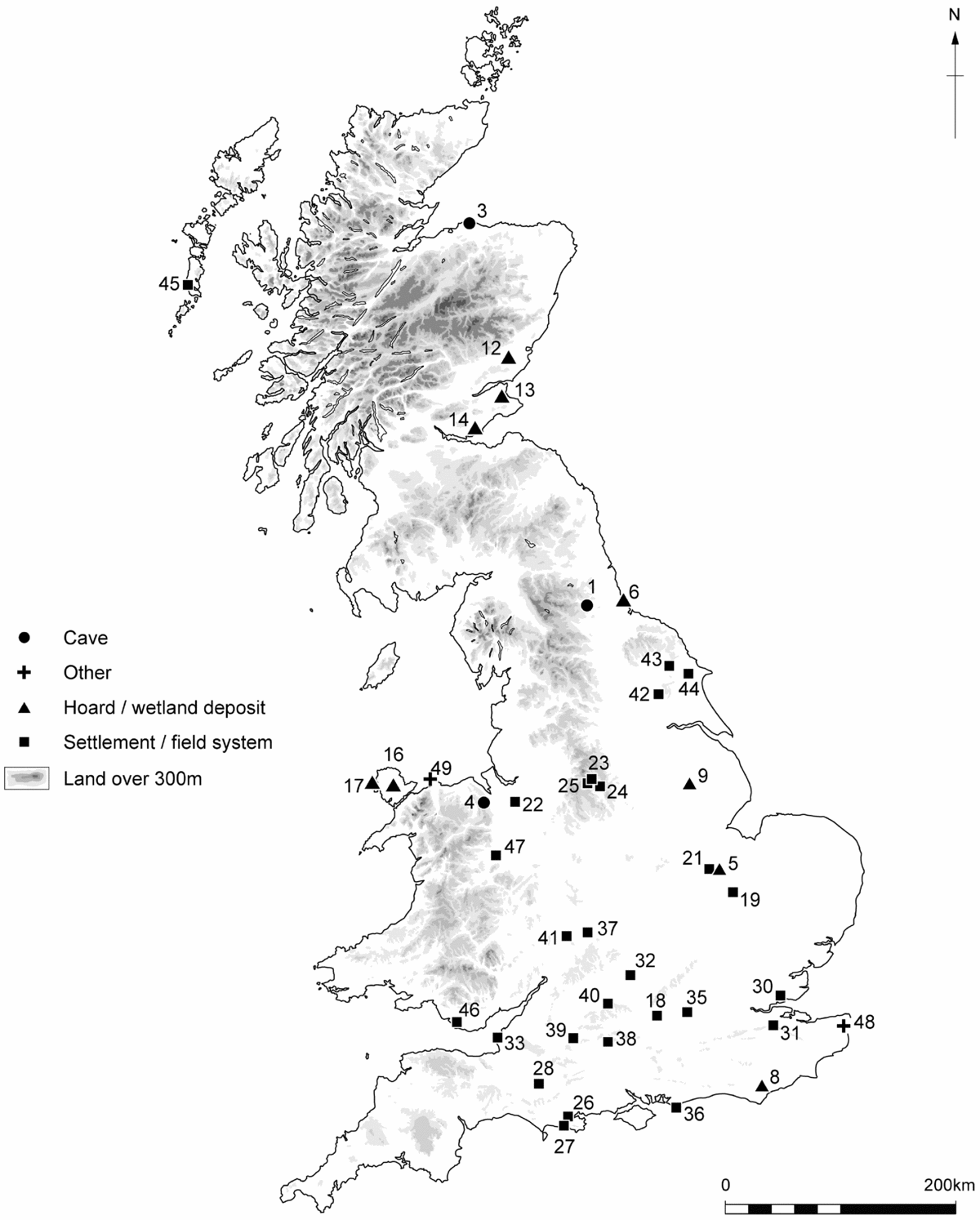
The catalogue of artefacts of jet/jet-like materials compiled for this study included at least 136 armlets or armlet fragments, 19 armlet roughouts or fragments of roughouts, 24 beads, 5 pendants, 4 finger rings, 2 vessel fragments (probably from the same artefact) and a small number of unique items from 32 sites (Fig. 1; see Appendix for details). To this total must be added the very large assemblages from Margett's Pit, Burham, Kent, which produced 7 armlets, 346 armlet roughouts and 3906 waste fragments (M. Leivers pers. comm., 2015), and from Bestwall Quarry in Dorset, which produced one armlet, one armlet roughout and a further 880 g of debris from the manufacture of these artefacts (Cox Reference Cox, Ladle and Woodward2009). The assemblage from Eldon's Seat in Dorset was not catalogued in detail in the published report (Cunliffe & Phillipson Reference Cunliffe and Phillipson1968, 225–6), but included part of a penannular bracelet, two small rings and 17 finished or roughly finished armlets alongside more than 700 fragments of waste from the production of these objects. The jet/jet-like artefacts from Thwing in Yorkshire have yet to be published, but include armlets, beads and pendants. Excluding Eldon's Seat and Thwing, a total number of 548 artefacts of jet/jet-like materials have therefore been identified (Table 1).
Numbers of jet/jet-like artefacts (excluding finds from Eldon's Seat and Thwing).

Chronology and distribution
The timeframe considered here is 1150–600 bc, covering the Wilburton (1150–1000 bc), Ewart Park (1000–800 bc) and Llyn Fawr (800–600 bc) phases of the Late Bronze Age and Earliest Iron Age. Similar categories of object were produced after 600 bc (e.g. Cunliffe Reference Cunliffe1984, 396), but are not considered here. Many of the finds can be assigned to the Ewart Park phase. No amber beads can be securely dated to the Wilburton period and only eight (from three sites) to the Llyn Fawr phase; the remainder can be assigned to the Ewart Park phase. Five of the sites that produced jet/jet-like materials date to the Wilburton phase, 18 to the Ewart Park phase and seven to the Llyn Fawr phase; the remaining sites could not be assigned to specific phases of the 1150–600 bc date range. Other types of body adornment show similar trends: a significant percentage of Late Bronze Age metal ornaments can also be dated to the Ewart Park phase, with fewer examples securely dated to the Wilburton or Llyn Fawr periods (Davies Reference Davies2012). In part, this may be a product of broader patterns in depositional practice, as deposition of hoards peaked in the Ewart Park period (Needham Reference Needham, Haselgrove and Pope2007, fig. 4). There are regional differences to these patterns, however: there are relatively few finds of jet/jet-like materials after c. 800 bc in Scotland and northern England compared to the south, where the excavation of settlements dating to 800–600 bc has resulted in a significant number of finds, notably from midden sites; again, this follows wider patterns in depositional practice, with relatively little material of Llyn Fawr date known from the north (O'Connor Reference O'Connor, Haselgrove and Pope2007). Jet/jet-like objects were made and used at Potterne, for example, right through the Late Bronze Age and Earliest Iron Age, although detailed analysis of their morphology was unable to identify any evidence for typological change, with considerable variability in cross-section both within and between different layers of the midden (Wyles Reference Wyles and Lawson2000, 213).
Although they derived from disparate sources, the overall distribution of objects made from amber and jet/jet-like materials favours the eastern regions of Britain, with relatively few or no finds in southwest England, south Wales, northwest England and western Scotland (Figs 2 & 3). This presumably reflects similarities in the social and depositional practices in which amber, jet and jet-like materials were employed in particular parts of Britain, and perhaps also networks of exchange along the east coast and up its major river systems. Some other links are also evident. The large amber beads from Balmashanner can be compared to Irish examples of Late Bronze Age date (Beck & Shennan Reference Beck and Shennan1991, 103) and it is possible that these objects were made in Ireland from Baltic amber and subsequently brought to Britain; the exchange of Irish metal for Baltic amber has been a topic of some discussion (Eogan Reference Eogan, Waddell and Shee Twohig1995, 133) and Balmashanner is situated on one possible axis of movement between these two regions. Roughouts and debris from the manufacture of jet/jet-like objects have been found at sites at a distance from the likely sources of these materials such as Potterne in Wiltshire (Wyles Reference Wyles and Lawson2000) and Brean Down in Somerset (Foster Reference Foster and Bell1990), suggesting that materials could be transported in a raw state and worked at settlements for local consumption. Wyles (Reference Wyles and Lawson2000, 210) suggests, however, that armlet roughouts rather than unworked blocks were exchanged: although 14 roughouts were found at Potterne in Wiltshire, there were no cores from creating the central hole.
Distribution of amber artefacts. (Drawing: Anne Leaver. See appendix for site names.)
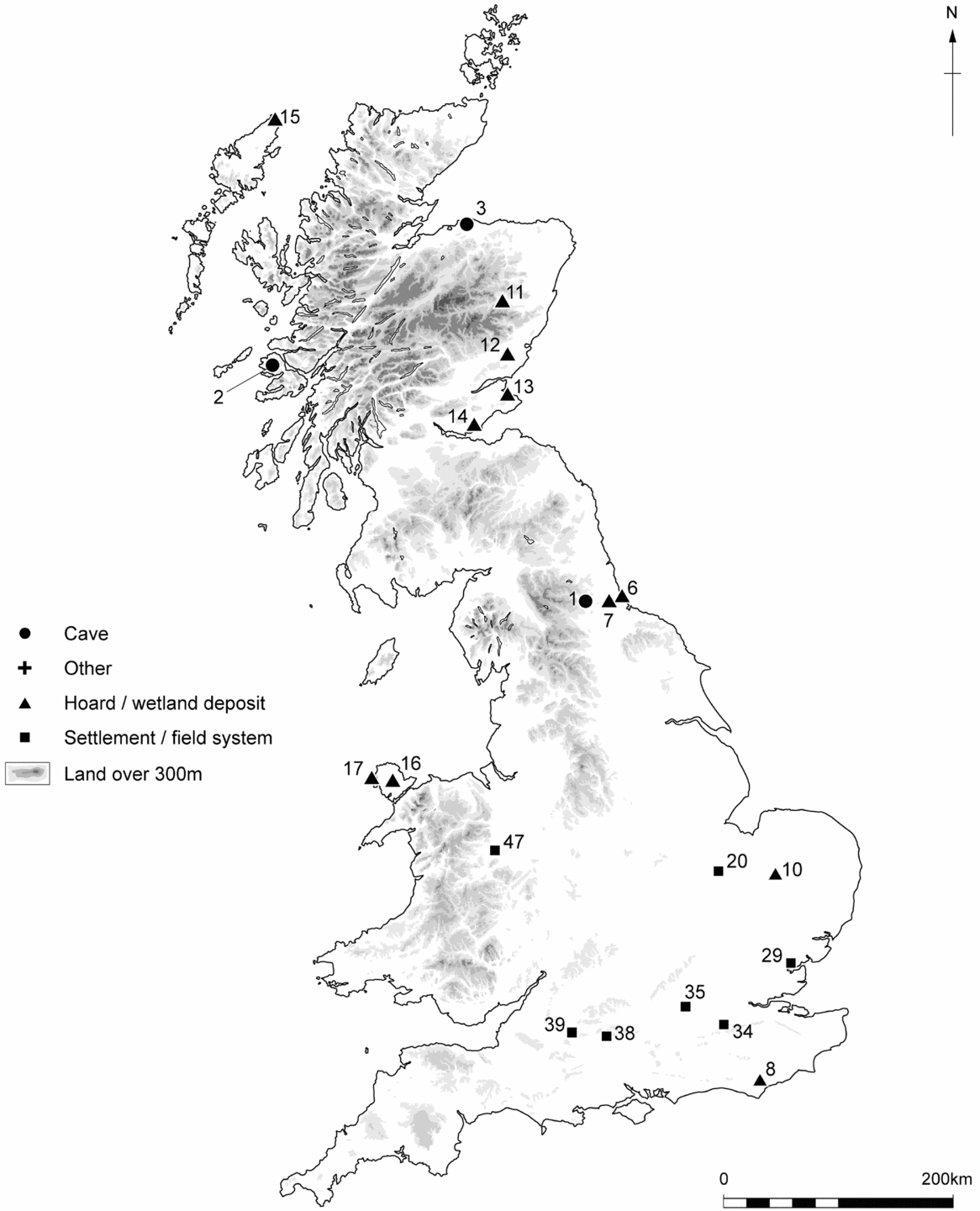
Distribution of jet/jet-like artefacts. (Drawing: Anne Leaver. See appendix for site names.)

Depositional context
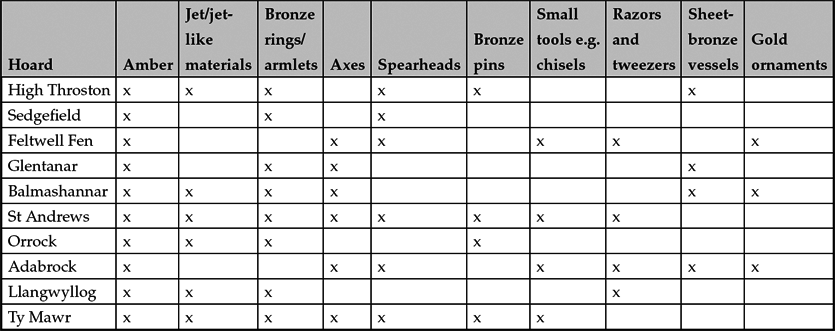
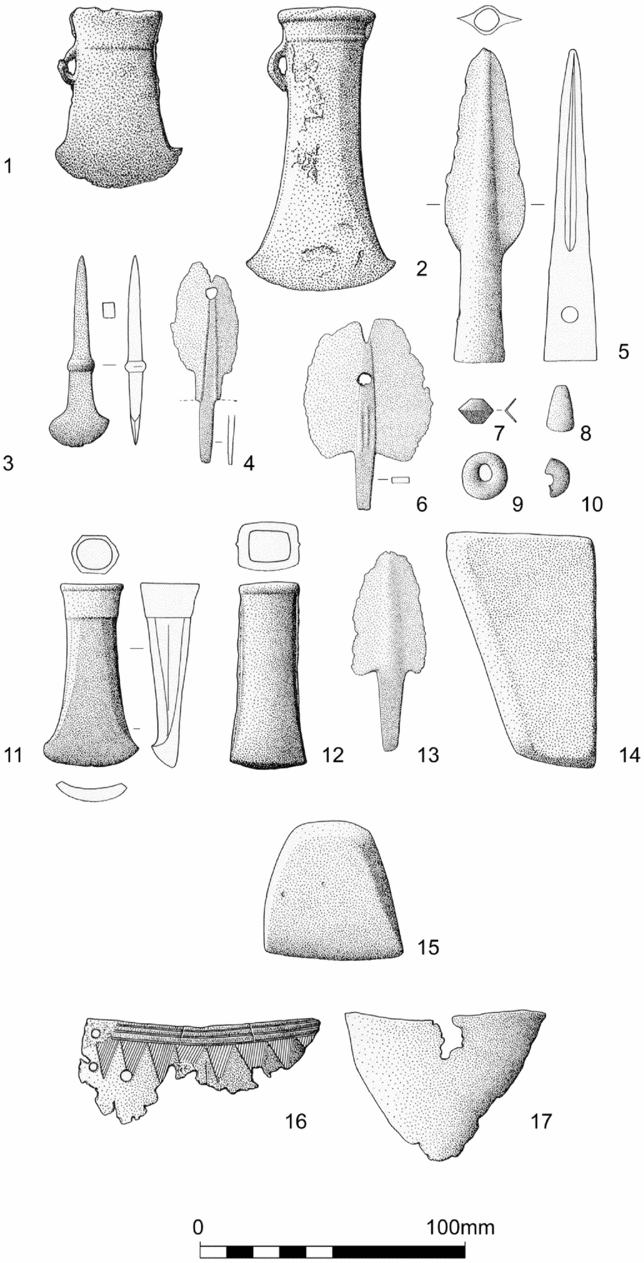
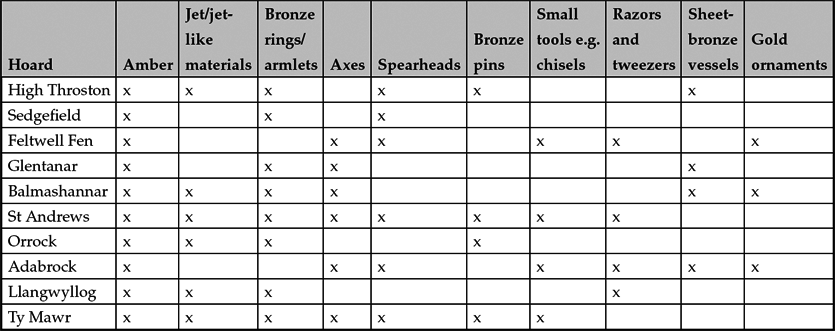
This paper is concerned primarily with the context, association and condition of artefacts of amber, jet and jet-like materials and it is to this that we turn now. Hoards are one of the main contexts in which such objects were deposited, particularly in northern England and Scotland (Table 2). It is rare for British Late Bronze Age hoards to produce materials other than bronze, so it is interesting that hoards containing amber and jet/jet-like objects (of which there are 10 known examples) often produce other ‘non-bronze’ materials. The hoard from Feltwell Fen in Cambridgeshire, for example, included an amber bead, part of a gold hair ring and two boar tusks, alongside a range of bronze objects (Smith Reference Smith1958), while the hoard from Adabrock on the Isle of Lewis produced beads of amber, gold and glass, as well as two whetstones and a selection of bronzes (Fig. 4; Schmidt & Burgess Reference Schmidt and Burgess1981, 206). There are also patterns to the kinds of bronze objects associated with amber, jet and jet-like artefacts in hoards (Table 3). Bronze penannular bracelets and rings of various sizes are most frequent, but spearheads, axes, pins and small tools such as chisels, gouges, knives and razors are also common. Beaten bronze vessels—rarely found in British Late Bronze Age hoards—were deposited in 4 of the 10 hoards, while swords seem to have been deliberately excluded.
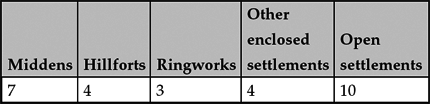
Numbers of sites of different categories that have produced amber and jet/jet-like materials.

Artefact associations in hoards showing the most common categories of object (in order of frequency) found with amber and jet/jet-like materials.
If such patterns of association and exclusion are about processes of social and material categorization, it is hardly surprising that there is evidence for careful arrangement of objects. The hoard from St Andrews in Fife contained bronze spearheads, axes and tools, alongside cannel coal or shale armlets (A. Sheridan pers. comm., 2016), amber beads and a variety of bronze ornaments, many of which appear to have been deposited in distinct groups (Cowie et al. Reference Cowie, O'Connor, Proudfoot, Chevillot and Coffyn1991); some of the objects were stacked or bound together with cord, while the presence of fragments of textile and leather hints that other groups of items may have been wrapped. Together, such composite hoards speak of the complex interconnections between aesthetics and social practice: the gleam of metal and the arresting (and perhaps symbolically significant) colours of amber and jet/jet-like materials (cf. Woodward Reference Woodward2000, 111–13) drew attention not only to the appearance of those who wore and used such artefacts, but to the practices in which they were engaged—socially significant activities such as craftwork and exchange. It is notable that many of the hoards produced large collections of amber beads, unlike finds from settlement contexts which usually comprise single beads or a small number of these items. This hints at complex processes of assembly as well as possibly lengthy histories of circulation for the artefacts from hoards, and it is possible that they were brought together by more than one person.
The hoard from Adabrock. (1–2) socketed axes; (3) chisel; (4, 6, 13) razors; (5) spearhead; (7) gold bead; (8) glass bead; (9–10) amber beads; (11) socketed gouge; (12) socketed hammer; (14–15) whetstones; (16–17) bronze bowl fragments. (After Schmidt & Burgess Reference Schmidt and Burgess1981, pl. 144, with minor amendments by Anne Leaver.)

The depositional contexts of such collections of objects are often similar to those of other British Bronze Age hoards. The hoard from Adabrock, for example, was recovered from a bog (Schmidt & Burgess Reference Schmidt and Burgess1981, 201). Other hoards are from dryland locations, but are often in prominent places with views over bodies of water. The hoard from Glentanar, Aberdeenshire (Pearce Reference Pearce1971; Reference Pearce1977), was deposited on a hillside above a tributary of the River Dee that rises in the Cairngorm mountains, while that from High Throston, Teesside, was found on the false crest of a hill overlooking Hartlepool Bay (Reference DanielsDaniels n.d.). It has been argued that these kinds of depositional contexts were deliberately chosen because of the cultural significance attributed to features such as bogs, rivers and hilltops (e.g. Bradley Reference Bradley1990; Reference Bradley2017; Bradley & Yates Reference Bradley and Yates2010); rivers, for example, were at once a source of life and channel of inter-community interaction and exchange. Similar assemblages have been found in caves. A pit in Croig Cave on the Isle of Mull contained a penannular bronze bracelet and an amber bead (Mithen & Wicks Reference Mithen and Wicks2012); the cave itself was located in a low cliff facing south across Croig Bay. The Sculptor's Cave at Covesea overlooks the Moray Firth and is difficult if not dangerous to access except at low tide (Armit et al. Reference Armit, Schulting and Knüsel2011, 251). Alongside amber and jet/jet-like beads, it has also produced bronze penannular bracelets, gold hair rings, bone points, pottery and human remains, including the skulls of juveniles that may have been displayed at the entrance (Benton Reference Benton1931; Shepherd Reference Shepherd, Burgess, Topping and Lynch2007). The deposits in this cave were highly disturbed, so they cannot be interpreted as a closed hoard; although the finds are unlikely to have been the result of a single episode of deposition, similarities with hoard finds elsewhere, and the presence of human remains, suggest that the cave was a focus for ritual activity. Objects of amber and jet/jet-like materials have also been found at timber platforms constructed in wetland and riverine contexts, such as Shinewater in East Sussex (https://historicengland.org.uk/listing/the-list/list-entry/1400780) and Washingborough in Lincolnshire (Howard-Davis Reference Howard-Davis and Allen2009); these platforms are thought to have been constructed to facilitate the votive deposition of metalwork and other artefacts into the waters.
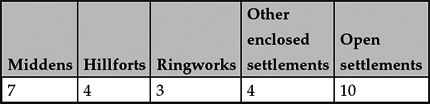
Although most Late Bronze Age amber beads are found in hoards, jet/jet-like objects were frequently deposited in other locations too, especially in southern Britain (Table 2). Jet/jet-like armlets are found in a range of settlement contexts (Table 4), including at midden sites such as Potterne (Wyles Reference Wyles and Lawson2000) and Runnymede (Longley Reference Longley1980, 31; Needham Reference Needham1991, 151), where evidence for large-scale feasting, craft-production and the deposition of ‘exotic’ materials and human remains suggest that these places played a key role in the construction of social identities, both at a local and a regional level (Waddington Reference Waddington, Davis, Sharples and Waddington2008). The 88 jet/jet-like objects from Potterne (Wyles Reference Wyles and Lawson2000) included a number of roughouts, indicating that the production of armlets took place on site, but these items were also worn and used here in contexts suggestive of social display. Three of the finished armlet fragments were decorated, two with simple grooves and the third with an incised dog-tooth pattern; this is highly unusual, for only one other decorated armlet fragment (from Flag Fen, Cambridgeshire) was identified in the course of this research. Equally remarkable are two fragments of a vessel with a series of grooves and holes that may once have held inlays of another material, perhaps a contrasting colour to the black of the vessel itself. Two of the amber beads from Potterne were associated with hearths (Healy Reference Healy and Lawson2000), suggesting that they may have been worn during the preparation or consumption of food—both activities that are closely bound up with the construction of particular forms of social identity. As such, some of these objects may have had histories that rendered them significant: two jet/jet-like pendants from the same site appear to have been made out of reused armlet fragments, their form clearly evoking the original items from which they were made (Wyles Reference Wyles and Lawson2000).
Numbers of settlements of different types that have produced amber and jet/jet-like materials.
Amber and jet/jet-like artefacts have been found at a number of other sites where large groups of people may have gathered. The armlet fragment from Cliffs End Farm in Kent (Hayward & Leivers Reference Hayward, Leivers, McKinley, Leivers, Schuster, Marshall, Barclay and Stoodley2014) was recovered from a ditched enclosure that forms part of a complex of features that were the focus of feasting activities and the deposition of human remains (McKinley et al. Reference McKinley, Leivers, Schuster, Marshall, Barclay and Stoodley2014). Items of amber and jet/jet-like materials have been found at four hillforts: current interpretations of such sites sees them as community aggregation sites rather than the apex of a settlement hierarchy (Sharples Reference Sharples2010, 116–24). The amber bead and possible jet/jet-like pendant fragment from the body of the rampart at the Breiddin in Powys (Musson Reference Musson1991, 160) may represent the residues of an earlier phase of unenclosed occupation, but the armlet fragment from the rampart at Beeston Castle (Bliss Reference Bliss and Ellis1993) may have been deliberately incorporated into this context. Two complete socketed bronze axes were also recovered from this feature: one of these was unfinished, the flashing around the edge of the casting still present. Such items, which could easily have been recycled, are hard to explain as casual losses.
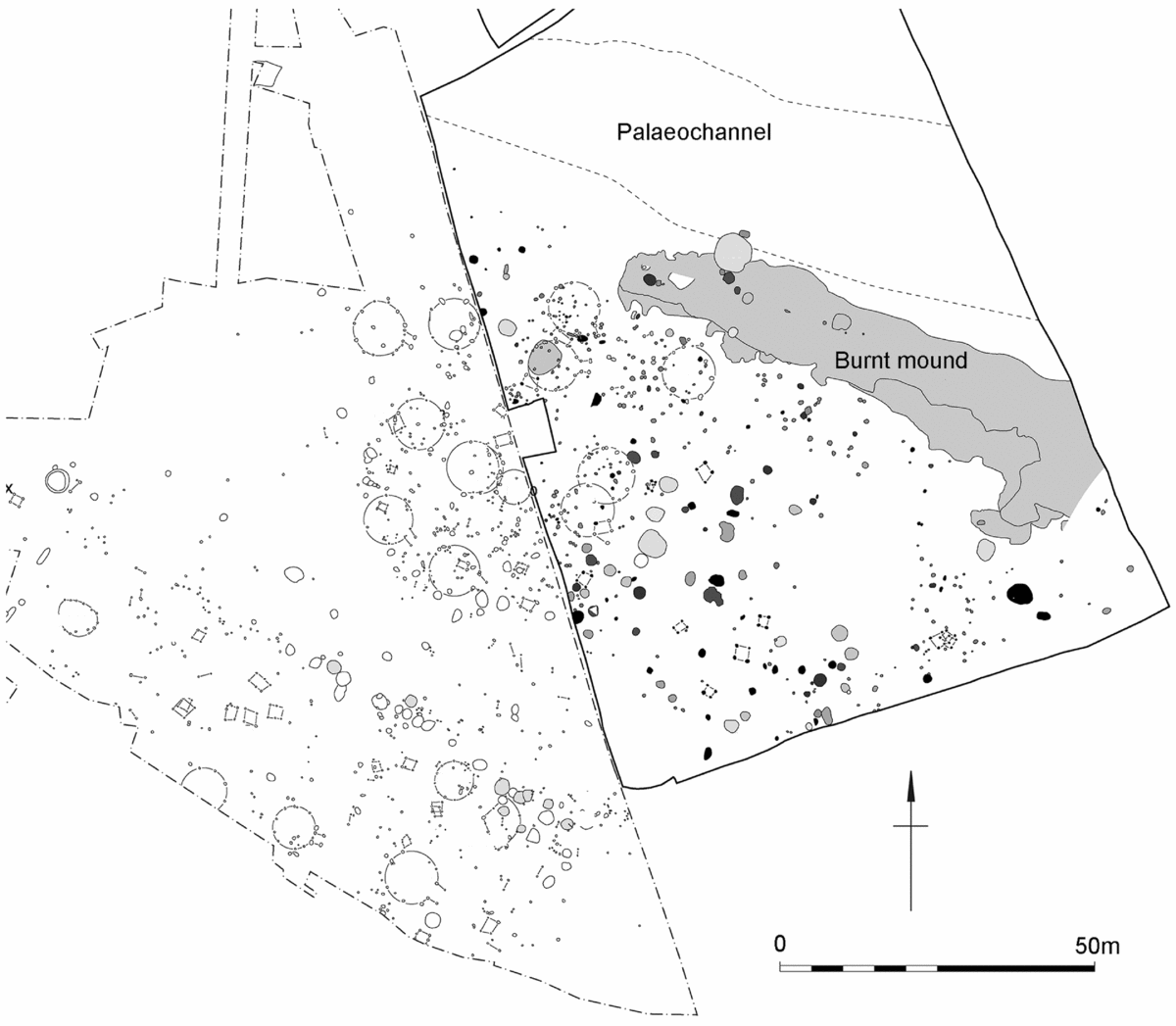
Amber, jet and jet-like objects are found on other kinds of settlements including 3 ringworks (substantial enclosed settlements), 4 other enclosed settlements and 10 open settlements (Table 4)—the latter, at least, would not usually be interpreted as high-status sites. Details of their context suggest that sometimes these were deliberately deposited. A burnt deposit from the upper fill of a ditch surrounding a Late Bronze Age settlement at Eynsham Abbey in Oxfordshire produced a single fragment of jet/jet-like armlet and a large portion of a plainware jar alongside the partial burials of a dog and neonatal pig (Boyle Reference Boyle, Barclay, Boyle and Keevill2001). Indeed, similar items have been found in boundary contexts at other sites. A fragment of jet/jet-like armlet was deposited in the fill of the post-hole marking the right-hand side of the porched entrance to roundhouse 17 at Tinney's Lane in Sherborne, Dorset (Best et al. Reference Best, Woodward and Tyler2014), while a complete, finely-polished jet/jet-like bead and part of an armlet were recovered from the phase 1 palisade trench surrounding the settlement at Staple Howe, East Yorkshire (Brewster Reference Brewster1963, 121); the latter was found just to the left of one of the entrances to the site. Similar finds occur elsewhere in the landscape too, for example the armlet fragment from the final cut of a ditched field boundary at Padholme Road in Cambridgeshire (Pryor Reference Pryor1980, 5, 21–2). At Green Park in Berkshire, an armlet fragment was recovered from a burnt mound that lay along the edge of a palaeochannel defining the northeastern periphery of the settlement (Fig. 5; Boyle Reference Boyle, Brossler, Early and Allen2004). Although the purpose of burnt mounds continues to be debated, they appear to have been the product of a range of heat-mediated transformative technologies (Hodder & Barfield Reference Hodder and Barfield1991). The mound at Green Park produced sheep bone and loom weight fragments, and the excavators suggest that fulling, cleansing, dyeing or felting of wool (all processes that require hot water) may have been carried out here (Brossler & Allen Reference Brossler, Allen, Brossler, Early and Allen2004, 128–9); the use of wool is widely attested in the European Bronze Age (Bender Jørgensen Reference Bender Jørgensen1992; Harris Reference Harris2012) and we might note here how visually striking an object made of a black, lustrous material would have looked if worn against the matt white of wool. Whatever the case, here too a fragment of jet/jet-like armlet was deposited in what may have been considered a liminal zone associated with transformative activities of some sort. It is possible to argue that at least some of these finds were deliberately incorporated into boundary contexts as a means of drawing attention to the social significance of such liminal spaces. We do not know what made jet/jet-like materials suitable for this purpose, although it is possible that their colour, origin or role in signifying particular aspects of social identity may have been important.
A jet/jet-like armlet fragment was found in the burnt mound that ran along one edge of the settlement at Green Park. (After Brossler et al. Reference Brossler, Early and Allen2004, fig. 3.7, with minor amendments by Anne Leaver, courtesy of Oxford Archaeology.)

Sometimes, it is evident that the deposition of amber, jet and jet-like objects was closely connected with important points in the life-cycle of a site. At Lofts Farm in Essex, part of an amber bead was associated with a large dump of fineware ceramics in the upper fill of the enclosure ditch (Brown Reference Brown1988, 281)—interpreted by the excavator as representing the remains of a feasting event to mark the abandonment of the site. Late Bronze Age waterholes often appear to have been deliberately decommissioned at the end of their lives—sealed by artefact-rich deposits containing special objects and human remains. At Huntsman's Quarry in Worcestershire, the upper fill of a waterhole produced part of a jet/jet-like armlet, a complete cylindrical loomweight, several mould fragments for the casting of bronze objects and part of the upper thoracic vertebra of an adult (Jackson Reference Jackson and Jackson2015). The portion of armlet had two carefully made depressions at one end that may have been drilled in order to repair or re-use an old object and as such this item can perhaps be considered an heirloom. The presence of mould fragments is interesting too, for jet/jet-like objects are associated with evidence for metal working at several other sites. At Pentrwyn in Conwy, part of a jet-like armlet was found next to a pit that produced copper-smelting debris (Smith Reference Smith2015). This is the only known Bronze Age smelting site in Britain. It is located on a natural terrace part-way down a series of sea cliffs on the Great Orme, a dramatic limestone headland jutting into the Irish Sea; the choice of such a liminal location for the transformative activity of smelting may be no coincidence. However, it was not only fragments of finished artefacts—objects at the end of their life—that were deposited in such interesting contexts. Roughouts also form components of such deposits and we can suggest that these too were deliberately selected for the particular associations they evoked. The well at East Beach, Selsey, West Sussex (Seager Thomas Reference Seager Thomas2001), for example, produced two armlet roughout fragments, drawing together concepts of production, productivity and the foreign with the regenerative potential of water in a place that was located on the interface between the land and the sea.
Patterns of fragmentation
We will turn now to consider patterns of breakage in items of amber, jet and jet-like materials of Late Bronze Age date. However, the condition of the bronze objects in hoards containing such objects also deserves comment. The bronzes from such deposits are sometimes broken. The hoard from High Throston on Teeside contained pin shanks and ring fragments as well as complete pins and rings (Reference O'Connor and DanielsO'Connor n.d.). The socket of a spearhead from the same hoard had been broken off in antiquity, although both parts were present. The bronze bowl from the Balmashanner hoard, Angus, had been miscast: the metal had failed to fill the mould so that part of one side of the bowl was missing, and the rough casting seam that had formed where the two halves of the mould had met had not been removed (Anderson Reference Anderson1892, 188). In other contexts, such items might be interpreted as scrap awaiting recycling, but the presence of objects such as amber beads and boar tusks in such hoards calls this interpretation into question. Indeed, the ‘decomissioning’ of some of the bronze objects is hard to explain in purely functional terms: one of the complete pins from High Throston, for example, had been bent into a C-shape (Reference O'Connor and DanielsO'Connor n.d.). These hoards, then, brought together and ordered a range of significant materials in ways that contrasted the complete and the fragmentary, the old and the new—objects with lengthy life-histories alongside others whose social potential remained unrealized. In either case, these were powerful objects that marked special places in the landscape.
Like the bronze objects they were associated with, amber, jet and jet-like items from hoards are sometimes complete and sometimes broken. The three shale or cannel-coal rings from St Andrews, for example, were complete (Cowie et al. Reference Cowie, O'Connor, Proudfoot, Chevillot and Coffyn1991, 50), while the hoard from Glentanar contained three amber beads that had been broken in half (Pearce Reference Pearce1977); in only one case was both halves present. Caution is required when interpreting such objects without first-hand examination, however, as these materials are fragile and it is not always clear whether the breaks are ancient or modern, particularly for antiquarian finds such as at Glentanar. The artefacts from settlement contexts are frequently fragmentary, but this of course does not mean that they should be treated as inconsequential ‘refuse’: the deliberate destruction of objects has been linked with rituals of abandonment in other British Bronze Age contexts (Brück Reference Brück2006; Nowakowski Reference Nowakowski1991). Jet/jet-like armlets, in particular, are virtually never complete, and in general only a small portion (often 10–20 per cent) of the original object is present. These items do not usually seem to have been broken in situ, as in most cases only single fragments of individual objects have been found. The materials from which such artefacts were made were friable, and it is likely that many armlets broke in use. There are some possible hints at deliberate destruction, however. The single fragment of armlet from the Flag Fen post alignment was deposited alongside many broken bronze objects (Coombs Reference Coombs and Pryor2001)—objects that are commonly accepted to have been ritually destroyed. This is clearly a special object, as it was incised with a zigzag design that was inlaid with lead or tin; only one other possible instance of the use of inlay on a jet/jet-like artefact was identified during the course of this research (the bowl from Potterne mentioned above), although occasional examples are known from Early Bronze Age and Middle Bronze Age contexts (Baker et al. Reference Baker, Sheridan and Cowie2003; Davis & Townsend Reference Davis, Townsend, Ambers, Higgitt, Harrison and Saunders2009). Nearby, a rare example of two conjoining armlet fragments from the lowest level of the Flag Fen platform has been interpreted by the excavator as indicating deliberate ritual destruction (Pryor Reference Pryor2001, 322) and it is possible that these formed part of a foundation deposit, perhaps marking the ending of one stage in the life-cycle of this special place and its occupants prior to the start of a new and different phase of use.
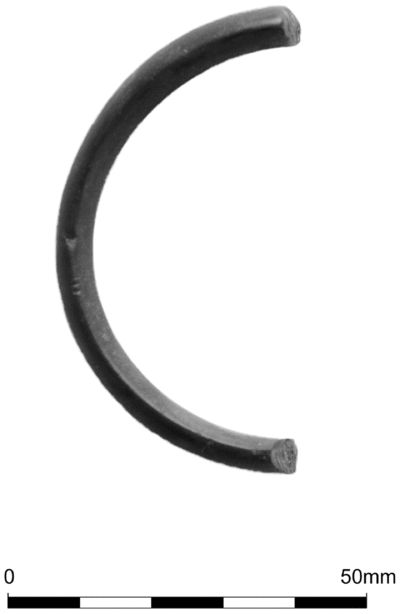
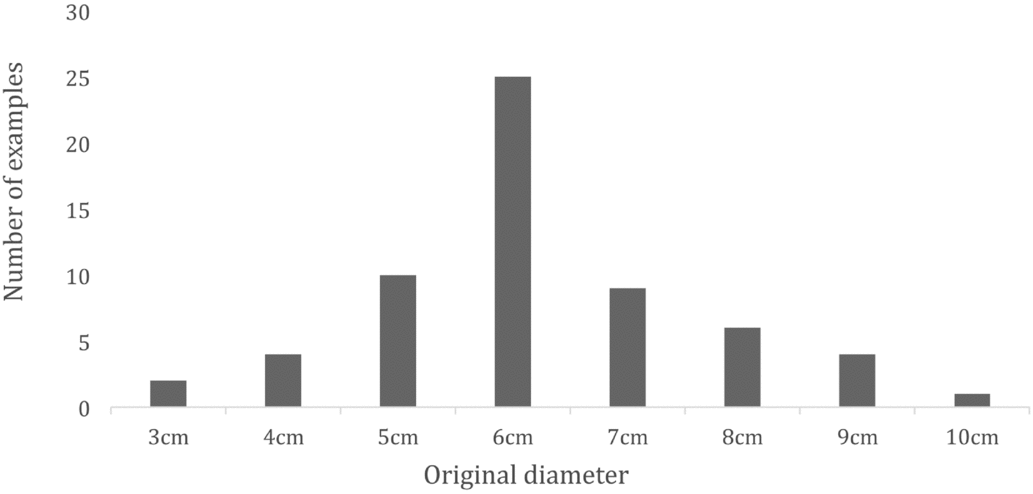
As a more detailed pilot study into patterns of fragmentation, the 88 fragments of jet/jet-like artefacts from the midden at Potterne in Wiltshire (Wyles Reference Wyles and Lawson2000) were examined. Seventy-nine of these were armlet fragments, of which 71 were parts of finished objects and 8 were roughouts in the early stages of production. Just 5 armlet fragments had marks on or near the breaks that might be interpreted as possible chisel marks relating to acts of deliberate destruction. Most of the armlets were less than 1 cm thick, however, and they would therefore snap relatively easily without the use of tools. There were some interesting patterns in breakage nonetheless. Most comprised small sections of the original object (<15 per cent), but there were 4 armlets that had clearly been snapped in half (Fig. 6) and another 20 that had been broken into quarters. The breaks were fresh, suggesting that this had occurred not long before they were deposited in the midden. Perhaps most intriguingly, the original internal diameters of the objects were also relatively standardized. Of the 61 armlet fragments for which this could be estimated, 44 (72 per cent) lay in the region of 5–7 cm in internal diameter, with the largest number (25 objects or 41 per cent) having an internal diameter of 6 cm (Fig. 7). A 6 cm armlet will fit over the hand of a modern 8- to 10-year-old child of slim build, but would not fit that of an adult, or even an older child. This standardization in diameter is interesting, for it does not appear to be purely the result of the production process: there was marked variation in the thickness of the bands of individual armlets. Instead, we can suggest that armlets of standardized diameter were produced because they may have been given to mark particular life-cycle rites—perhaps in mid–late childhood. It is significant that so many of these objects were found at Potterne, which, on the basis of other evidence, has been interpreted as a ceremonial site at which large groups of people came together for feasting and other ritual activities (Lawson Reference Lawson2000): age grade ceremonies and initiation rites may have been included amongst these. The patterning in the fragmentation of the objects may therefore be important, hinting at deliberate destruction to mark the end of one stage in the life-course. Snapping objects in half or into quarters is surely a meaningful act, for it produces fragments that can easily be shared amongst people, giving material form to significant personal relationships (Chapman & Gaydarska Reference Chapman and Gaydarska2007). A small number of armlets of other sizes were also present: interestingly the largest of these (10 cm in diameter) was also the most highly decorated example in the assemblage.
This jet/jet-like armlet from Potterne had been snapped in half prior to deposition (courtesy of Wiltshire Museum.)

Projected original internal diameter of jet/jet-like armlets from Potterne.

Amber items may have been fragmented in ways that did not require the breaking of individual beads. It is noticeable that some of the sites listed here, notably hoards such as Balmashanner (Coles Reference Coles1960, 98–9; Schmidt & Burgess Reference Schmidt and Burgess1981, 251–2) and Llangwyllog (Lynch Reference Lynch1991, fig. 68), have produced substantial numbers of beads of different sizes, and Beck and Shennan (Reference Beck and Shennan1991, 103) suggest that these originally formed large graduated necklaces. Other hoards, such as Adabrock (Schmidt & Burgess Reference Schmidt and Burgess1981, 206), produced smaller numbers, while finds from settlement contexts usually comprise just one or two beads. It is possible that this indicates regional variation in dress, but it may also suggest that these items were deposited at different points in the life-cycles of composite objects and their owners. The disassembly of Early Bronze Age necklaces and the curation of individual beads has been a topic of some attention (Woodward Reference Woodward2002; Woodward et al. Reference Woodward, Hunter, Sheridan, Woodward and Hunter2015), and it is possible that similar practices continued into the later part of the period: the single amber beads from sites such as Lofts Farm in Essex may have been retained and circulated over a considerable period of time. The histories of collections (or ‘necklaces’) of amber beads has been explored for the Early Bronze Age (Woodward et al. Reference Woodward, Hunter, Sheridan, Woodward and Hunter2015) and it would be interesting to apply similar approaches to Late Bronze Age assemblages such as the groups of beads from Tŷ Mawr (Lynch Reference Lynch1991, 246–51) or Balmashanner (Coles Reference Coles1960, 98–9; Schmidt & Burgess Reference Schmidt and Burgess1981, 251–2). For example, the presence of a transverse perforation on one of the five beads from Glentanar suggests that this collection originally formed part of a larger multi-stranded necklace (Pearce Reference Pearce1977, 126); the dual perforation on this item would have allowed it to be used as a spacer bead. As already mentioned above, it is possible that the amber beads from some hoards may have originated in Ireland. The dual-perforated example from Glentanar is unusually large at approximately 30 mm in diameter. Large amber beads are more common in Ireland than in Britain (Cahill Reference Cahill, Roche, Grogan, Bradley, Coles and Raftery2004) and it is possible that the Glentanar beads may originally have formed part of a larger Irish Late Bronze Age necklace (Beck & Shennan Reference Beck and Shennan1991, 103; Pearce Reference Pearce1977, 126). If so, the circulation of such items over considerable distances may have underpinned significant social and political relationships.
Magical materials
The details of depositional context, associations and condition therefore suggest that ornaments of amber, jet and jet-like materials were not purely decorative, but played important social roles that shaped how they were treated at the end of their lives. Their particular meanings and material properties meant that they were powerful objects. Sheridan (Sheridan & Davis Reference Sheridan and Davis2002, 824; Sheridan & Shortland Reference Sheridan and Shortland2004) and Woodward (Reference Woodward2000, 109–10) have discussed the special qualities of jet and amber in Early Bronze Age burials, noting that, unlike other materials of geological origin, they can float and be burnt, and they have electrostatic properties. They are sourced from the shoreline, a liminal zone between land and sea, and their colour and lustre give them a particular sensory attraction. Although it is now widely accepted that jet and amber beads in Early Bronze Age contexts are likely to have been attributed magical and amuletic powers, objects made from the same materials in later prehistory are defined primarily in economic terms—their value in exchange transactions deriving from their relative rarity and exotic origin (Cunliffe Reference Cunliffe2005, 506–9). This is, of course, in part because the British Late Bronze Age has traditionally been rendered as a period shaped by practical rather than ritual concerns (Brück Reference Brück2000)—its archaeological record dominated by settlements and territorial boundaries rather than burials—although this dichotomy has been challenged in recent years. We would suggest, therefore, that the unusual properties of such materials may have been of equal interest and importance in the Late Bronze Age.
Surprisingly, shale has rarely been considered in similar terms (but see Calkin Reference Calkin1970; Denford Reference Denford1995). Although little compositional analysis has to date been carried out, the jet-like artefacts from sites in central southern England have often been identified as shale on the basis of macroscopic inspection, and many of these are thought to originate from a single area—the Kimmeridge coast in Dorset. Indeed, there is evidence for the large-scale production of artefacts such as armlets at Late Bronze Age sites in this area, notably Eldon's Seat (Cunliffe & Phillipson Reference Cunliffe and Phillipson1968). The oil shale from which such objects were made is known to ignite spontaneously (Denford Reference Denford1995; Melville & Freshney Reference Melville and Freshney1982, 40), and there are several locations along this coast known as Burning Cliff and Burning Beach. In the recent past, these natural cliff fires, which occur around three times a century in each location, elicited great public interest, and it seems likely that this phenomenon would have been a source of wonder, if not fear, in prehistory. As such, shale too may have been considered a magical material from a known and special place in the landscape. Its unusual properties may have made it a suitable means of symbolizing ideas of transformation, purification and otherworldly power, and it is perhaps no surprise that it was considered an appropriate material for marking particular phases in the human life-course and for deposition in watery places and other liminal contexts.
Conclusion: the social agency of objects
This paper has sought to explore the social role of amber, jet and jet-like objects in Late Bronze Age Britain. Beads, armlets and pendants made from these materials were valued for more than their exchange value and their decorative role. They were incorporated into composite hoards deposited in significant places in the landscape; these collections of objects mobilized the aesthetics of colour and brilliance to draw attention to particular people and practices. Their arresting sensory attributes, including their visual appeal, meant that they were particularly effective in illuminating key aspects of social identity, including life-stages that may have been considered especially vulnerable. Amber, jet and jet-like materials were deposited in other contexts also, notably Late Bronze Age settlements. There, they were employed in significant social transactions—both small-scale moments of local importance such as the closing of a disused waterhole, and events of regional significance where communities congregated to mark special occasions such as age-grade ceremonies. Such transactions involved the circulation, display and deposition of objects old and new, complete and fragmentary, each with its own particular history. It is likely that these items were employed to mark particular forms of gendered identity too, but as they were not deposited in graves during this period, it is not possible to infer specific gendered associations.
We began by noting that items such as amber beads and shale armlets tend to be viewed either as markers of status and prestige for wealthy individuals, or as decorative trifles of limited social significance; in either case, they are conjured as inert objects appropriated and manipulated by human agents in the pursuit of particular social and political ends. The preceding discussion indicates that, on the contrary, objects of amber, jet and jet-like materials can be considered powerful social agents. Deposited in fragments in Late Bronze Age pits, ditches and waterholes alongside finds such as potsherds and animal bone, it is difficult to see them as ‘valuable’ in the modern, Western sense, and in parts of southern England at least, they may have been relatively common components of dress. Certainly, there is little to suggest that they can be viewed as commodities, for they appear to have formed an essential component of the self. Yet they clearly enacted significant social and cultural values. Worn on the human body, perhaps during certain stages of the human life-course, they made particular categories of person. Artefacts such as armlets drew attention to actions, gestures and ways of holding the body that are likely to have formed key elements of particular social identities; indeed, as children grew, it may have been impossible to remove such objects from their arms without breaking them. The deposition of large numbers of armlet roughouts (Table 1) suggests that the process of production was itself symbolically significant: such objects may reference the making of the person.
So, too, broken artefacts may have spoken of the dissolution of identities: they are often found in contexts that can be viewed as liminal (such as boundary ditches, caves and wetlands) where their display, manipulation and deposition may have facilitated transformation from one social category to another, while elsewhere they were deposited at significant points in the life-cycles of settlements and their occupants. This transformative power may have been underpinned by the particular qualities of the materials themselves: the ability of oil shale spontaneously to combust, or of amber's golden colour to reference the sun (Verkooijen Reference Verkooijen2014), for fire in its various forms is an elemental source of death and rebirth, and the deposition of such artefacts in association with other items that may have evoked concepts of transformation, such as clay mould fragments and pieces of human bone, is perhaps no surprise. We can suggest that objects of amber, jet and jet-like materials were not viewed as inert, but as magical materials with powerful properties—properties that empowered and protected those who wore and used them. The origin of these materials in the interface of land and sea, and the powers ascribed to them, made them a suitable means of marking important locations, and of symbolizing processes of transformation.
Although items of amber, jet and jet-like materials are found on ‘ordinary’ settlements, they are particularly frequent at sites that can be interpreted as community gathering-places, such as middens, timber platforms and hillforts. Here, they may have played key roles in rites of passage and other communal ceremonies that served not to define personal status, but to sustain socially accepted forms of identity. Such identities were relational rather than individual. The fragmentation and deposition of objects of amber, jet and jet-like materials worked to generate, transform and memorialize enchained relationships: the deliberate snapping of armlets into halves and quarters at Potterne, for example, or the curation of single amber beads that might once have formed part of complete necklaces, facilitated the circulation of objects between people bound together by significant social and familial ties. As such, these items were not simply markers of wealth and status, but were objects with personal histories that gave meaning to both people and places. Even when they were old and broken, they had not lost their meaning: in some cases their age and history gave them value, for example when armlet fragments were re-used as pendants, and the very act of destruction created fragments that gave enchained relationships (Chapman & Gaydarska Reference Chapman and Gaydarska2007) material form. The role of these artefacts in generating relational forms of identity is indicated also by their incorporation into complex assemblages in contexts varying from closing deposits in waterholes to composite hoards. Such assemblages ordered the world of materials and objects in highly structured ways: differences in colour, form, texture and source facilitated processes of categorization, juxtaposition and exclusion that gave meaning and value to people and to the activities and landscapes with which they were associated.
The social practices in which amber, jet and jet-like objects were employed during this period need to be contextualized more generally. To begin with, they contrast dramatically with the evidence from earlier periods. As noted above, objects of amber and jet/jet-like materials are found almost exclusively in burials during the Early Bronze Age (Beck & Shennan Reference Beck and Shennan1991; Shepherd Reference Shepherd2009; Woodward & Hunter Reference Woodward and Hunter2015), and there are significantly larger numbers of such finds than in the Late Bronze Age: Beck and Shennan record the presence of amber beads at over 85 Early Bronze Age mortuary sites, for example. The number of amber and jet/jet-like finds of Middle Bronze Age date is, in contrast, very small. Beck and Shennan identify amber objects from just five sites: these include finds from two hoards and a cave, perhaps prefiguring the depositional practices characteristic of the Late Bronze Age. Nonetheless, the rarity of amber and jet/jet-like artefacts in Middle Bronze Age hoards is interesting, given the large number of metal ornaments from these assemblages (Roberts Reference Roberts2007). A recent detailed analysis of more than 3000 Middle Bronze Age burials (Caswell & Roberts in press) indicates that only the amber beads from a cremation burial at Rhee Lakeside near Earith in Cambridgeshire (Robinson Reference Robinson2007, table 4.3) can confidently be assigned to this period (Edward Caswell pers. comm., 2017); no instances of jet/jet-like artefacts were noted. PhD research carried out by one of the authors (Brück Reference Brück1997) on Middle Bronze Age settlements in southern England identified jet-like objects at only four out of 65 sites, and no amber objects at all. These derived from contexts similar to some Late Bronze Age settlements: at Shearplace Hill in Dorset, for example, a post-hole that formed part of the main post-ring of roundhouse A produced an armlet core, while an armlet fragment was found just to the rear of this building in slip from the bank surrounding the settlement (Rahtz & ApSimon Reference Rahtz and ApSimon1962, 323). In comparison to this small dataset, there is a significantly increased quantity of material from the Late Bronze Age.
In contrast to the Early and Middle Bronze Age, there is little evidence of formal burial during the Late Bronze Age, and the few known examples are usually unaccompanied by grave goods (Brück Reference Brück1995). Instead, objects that spoke of aspects of social identity—such as bronze swords, gold lock-rings or amber beads—were deposited in ways that detached them from the human body. The scattered fragments of human bone found in Late Bronze Age settlements (Brück Reference Brück1995) are largely divorced from any context that speaks of the lives of particular individuals, and this suggests that these identities related to particular stages in the life-cycle and may not have continued after death. Transformations from one social category to another were controlled by the community (at various scales) and hedged by ritual and ceremony (Van Gennep Reference Van Gennep1960); this hints that there may have been less autonomy and room for individualistic competitive gain than we often think.
Yet at the same time, it is evident that the ways in which social categories were constructed were changing. The proliferation of personal ornaments including items of amber, jet and jet-like materials during the Late Bronze Age, and particularly the Ewart Park period (Davies Reference Davies2012), is part of a more general diversification of material culture categories (Brück Reference Brück, Haselgrove and Pope2007): a much wider variety of specialized tools of bronze, bone and other materials were produced in the Late Bronze Age than in previous periods, for example, suggesting that specific tasks and those who performed them were increasingly differentiated. This speaks of the emergence of more complex systems of social classification, or, perhaps, increasing concern regarding the definition of social identity. It seems, however, that these were socially accepted forms of identity defined and controlled by the community, and there is little to suggest that the diversification of material culture indicates an increase in social competition between wealthy, high-status individuals. Not all such developments are precisely contemporary, however: although the use of personal ornaments is particularly characteristic of the Ewart Park period, decorated ceramics are predominantly a feature of the subsequent Llyn Fawr phase (Barrett Reference Barrett1980). It seems likely that these trends relate to broader changes in patterns of inter-community interaction, for it is during the Late Bronze Age that we see the emergence of new types of communal gathering-place, such as the middens of southern Britain (Madgwick & Mulville Reference Madgwick and Mulville2015), timber platforms and the early hill-top enclosures of the north and west. Doubtless, such gatherings formed the context in which new ways of constructing social identity were required that communicated beyond the confines of the household group or immediate kin. Yet, as our discussion of the depositional context of amber, jet and jet-like objects indicates, it would be simplistic to assume that this involved no more than the signalling of status through the display of ‘prestige’ goods. Instead, the way in which materials such as gold, bone, amber, jet and clay were brought together, used and deposited at such sites indicates that these formed part of complex cosmographies in which objects were not reduced solely to their economic value (Waddington Reference Waddington, Davis, Sharples and Waddington2008).
It is evident, of course, that there is more to be done with the body of material examined in this paper. In particular, compositional analysis is required to distinguish jet and similar dark materials from Late Bronze Age contexts, and to identify their sources. The pilot study of patterns of breakage in the assemblage from Potterne could be extended to other sites. Indeed, this did not include analysis of more general patterns of wear (such as the use-wear documented on Early Bronze Age ornaments: Woodward & Hunter Reference Woodward and Hunter2015), an examination of which would help to identify objects that were in circulation for protracted periods of time. The publication of the recently excavated large assemblage of manufacturing debris from Margett's Pit in Kent will add to our understanding of the working and circulation of jet-like materials outside of the Kimmeridge area. Patterns of production and exchange are central to the construction of social identities, and detailed analysis of the chaînes opératoires employed to make such objects at sites where the material was worked on a large scale may help to elucidate the social organization of production. To date, there has been no detailed analysis of the spatial or depositional context of debris from sites, such as Eldon's Seat, where production appears to have occurred on a fairly large scale; such research could allow us to examine whether the meaning and value of these materials varied according to distance from source. We hope, nonetheless, that this preliminary study of amber, jet and jet-like objects from Late Bronze Age contexts goes some way towards illuminating the potential archaeological and cultural value of such small and decorative items.
Acknowledgements
We are grateful to Peter Rowe, Matt Leivers, Adam Gwilt and Jody Deacon for unpublished information on High Throston, Margett's Pit and Llanmaes, to Anne Leaver for producing Figures 2 and 3, to Wiltshire Museum for facilitating access to the Potterne material and to our referees for thought-provoking and constructive criticism.
Appendix: List of sites (by types, country and county/region)
Note
With a small number of important exceptions (identified in the list below), multi-phase sites that were used during the Late Bronze Age, but where the objects recovered could not be securely assigned to that phase, were excluded from this study.
Caves
England
1. Heathery Burn, Durham
This cave produced an amber bead and five jet/jet-like armlets, alongside bronze tools, weapons and ceremonial objects, gold ornaments, a variety of bone and antler objects, pottery and human and animal bone (Britton Reference Britton1968; Greenwell Reference Greenwell1894). The finds were made in the nineteenth century, however, so their precise stratigraphic relationships are unknown.
Scotland
2. Croig Cave, Mull, Argyll and Bute
An amber bead and penannular copper-alloy bracelet were deposited in a pit in this cave (Mithen & Wicks Reference Mithen and Wicks2012).
3. Sculptor's Cave, Covesea, Moray
The finds from this cave include bronze and gold ornaments, bone tools and fragments of human bone dating to the Late Bronze Age, alongside seven amber beads and four beads of possible jet/jet-like materials (Benton Reference Benton1931; Shepherd Reference Shepherd, Burgess, Topping and Lynch2007). However, the jet/jet-like and amber items were not securely stratified and there are large numbers of finds from the Iron Age and Romano-British periods also (Armit et al. Reference Armit, Schulting and Knüsel2011; Benton Reference Benton1931).
Wales
4. Lynx Cave, Bryn Alyn, Denbighshire
A fragment of armlet of a jet/jet-like material was found in Late Bronze Age layers blocking the entrance to this cave (Blore Reference Blore2012, 45). Human remains (predominantly long bones) were found inside the cave. A second fragment of armlet was recovered from a disturbed layer which also produced finds of Romano-British date (Blore Reference Blore2012, 28–9).
Hoards and deposits in wetland contexts
England
5. Flag Fen, Cambridgeshire
Five jet/jet-like armlet fragments (two of which conjoin) were found in the lowest level of this timber platform in the fen. Pryor (Reference Pryor2001, 322) notes that the fit between the two conjoining fragments is very precise, indicating that this object was broken in situ. At the nearby Power Station site, a fragment of armlet decorated with an incised zigzag design inlaid with tin or lead was found alongside large quantities of metalwork (Coombs Reference Coombs and Pryor2001, 280) associated with a timber trackway linking the platform to the dryland to its east.
6. High Throston, Durham
The High Throston hoard was deposited in a pit and comprised a large number of bronze objects including a spearhead, nail-headed pins and pin shanks, bronze rings, a bugle-shaped object and c. 20 fragments of two sheet-bronze vessels (Daniels n.d.). In addition, there were a large number of amber beads (more than 20); five jet/jet-like beads, a large ‘D’ sectioned jet/jet-like ring 109 mm in diameter, and one jet/jet-like spacer-plate; a tin-alloy bead and a tin rouelle, or miniature spoked wheel of French type. Some of these objects had originally been deposited in a pottery vessel.
7. Sedgefield, Durham
A hoard found while metal-detecting comprised part of the blade of a spearhead, a bugle-shaped fitting, two bronze annular rings, three amber beads and some fragments of animal bone (Needham Reference Needham2006).
8. Shinewater, East Sussex
Four amber beads and part of a jet/jet-like armlet were recovered from a timber platform in the Willingdon Levels (https://historicengland.org.uk/listing/the-list/list-entry/1400780)
9. Washingborough, Lincolnshire
Fragments from two armlets and part of a small rectilinear block, all of jet/jet-like materials, were found in peat deposits adjacent to a timber platform at the edge of the River Witham at Washingborough (Howard-Davis Reference Howard-Davis and Allen2009). Two of these finds were from a context that also produced a bronze pin and bar, mould and crucible fragments, worked bone and antler, and human bone.
10. Feltwell Fen, Norfolk
This hoard was deposited on the Fen edge and comprised two spearheads, a socketed chisel, five socketed axes/axe fragments, a socketed gouge fragment, two socketed knife fragments, a razor, tweezers, part of a gold lock-ring, an amber bead, a bone toggle, two fragments of boar tusks and part of a plano-convex ingot (Smith Reference Smith1958).
Scotland
11. Glentanar, Aberdeenshire
A hoard found under a stone on a hillside included at least five amber beads, a large number of bronze axes and armrings, and more unusual items such as two sets of triple-rings and two bronze cups (Pearce Reference Pearce1971; Reference Pearce1977).
12. Balmashanner, Angus
A hoard unearthed during ploughing in 1892 comprised one broken socketed axe, 11 penannular armlets, 10 bronze rings, one iron ring, three penannular bronze rings wrapped with gold foil, four beaten gold penannular ornaments of triangular section, one cast bronze bowl (damaged in casting), 26 amber beads, five jet/jet-like beads and pottery sherds (Coles Reference Coles1960, 98–9; Schmidt & Burgess Reference Schmidt and Burgess1981, 251–2).
13. St Andrews, Fife
A hoard found in the course of building work may originally have comprised some 200 items (Cowie et al. Reference Cowie, O'Connor, Proudfoot, Chevillot and Coffyn1991). The bronze objects included axes, knives, a chisel, a razor, a gouge, two tweezers, several spearheads, a chape, a sword fragment, a number of sunflower-headed pins, penannular bracelets, annular rings, lock-rings, finger rings and concave discs. There were also 7 amber beads and 3 jet/jet-like armlets. The contents appeared to have been deposited in groups, with the spearheads at the top, the axes below them and the bronze ornaments and tools at the base of the deposit. Some of the bronze annular rings had been stacked and bound into groups with cord. The presence of fragments of textile and leather suggests that some groups of objects were wrapped.
14. Orrock, Fife
Found in the eighteenth century, this hoard was originally described as recovered from a cairn, although a site visit in the 1950s failed to identify any feature of that sort (Canmore ID 52783). The contents of the hoard include an amber bead, a sunflower-headed pin, four rings and three penannular armlets of bronze and a single jet/jet-like armlet (Piggott Reference Piggott1948).
15. Adabrock, Ness, Lewis, Western Isles
The hoard from Adabrock was found in a bog and comprised two socketed axes, a leaf-shaped spearhead, a socketed gouge, a socketed hammer, a tanged chisel, three razors, a portion of a beaten bronze bowl, a gold bead, two amber beads, a glass bead and two whetstones (Schmidt & Burgess Reference Schmidt and Burgess1981, 206). There is some evidence of careful arrangement: the smaller items are described as lying above the larger objects. The hoard may originally have been contained within the bronze bowl.
Wales
16. Llangwyllog, Anglesey
Described as found ‘in a little stream’ (Way Reference Way1866, 97), the hoard from Llangwyllog comprised a razor, tweezers, looped corrugated bronze button (possibly an item of horse-gear), looped wire bracelet, several bronze rings, 16 amber beads, three jet-like beads and two jet-like beads/rings (Lynch Reference Lynch1991, fig. 68). Analysis by Sheridan and Davis (Reference Sheridan, Davis, Gibson and Simpson1998, table 12.2) demonstrated that the jet-like items were in fact made from a variety of materials, including jet, cannel coal, shale/canneloid shale and possibly bitumen.
17. Tŷ Mawr, Anglesey
This group of objects was found on the southwest flank of Holyhead Mountain, itself a striking landmark. Comprising a socketed axe, knife, tanged chisel, disc-headed pin, several bronze rings, a penannular armlet, two spearheads, a jet/jet-like armlet and five amber beads (Lynch Reference Lynch1991, 246–51), the hoard was described as found ‘under some large stones’ (Way Reference Way1867, 253). The same early description recounts how ‘in removing one of the hut circles, the relics here figured were exposed to view’ (Way Reference Way1867, 253). There are Late Bronze Age radiocarbon dates from more recent excavations at some of the hut circles on the mountain, suggesting the hoard may originally have been deposited in a settlement context. However, other hut circles were occupied during the Iron Age and later periods (Smith Reference Smith1987).
Settlements and field systems
England
18. Green Park, Reading, Berkshire
A fragment of jet/jet-like armlet was recovered from a burnt mound that lay along one side of a palaeochannel at the northern edge of the settlement (Boyle Reference Boyle, Brossler, Early and Allen2004).
19. Colne Fen, Cambridgeshire
The upper fills of a well that formed part of a dispersed settlement produced large quantities of pottery and animal bone and a fragment of jet/jet-like armlet (Evans Reference Evans2013, 134).
20. Must Farm, Cambridgeshire
This waterlogged settlement has produced at least one amber bead (Knight et al. Reference Knight, Harris and Appleby2016).
21. Padholme Road, Peterborough, Cambridgeshire
Around 2/3 of a jet/jet-like armlet was deposited in the final cut of a field boundary ditch (Pryor Reference Pryor1980, 5, 21–2).
22. Beeston Castle, Cheshire
A jet/jet-like armlet fragment was found in the body of the Late Bronze Age rampart (Bliss Reference Bliss and Ellis1993; Ellis Reference Ellis1993, 22). A second was deposited in a charcoal-rich layer associated with post-holes and stake-holes just behind the rampart.
23. Back Tor, Derbyshire
A variety of surface finds were found in an around this tor, which is located on the same ridge as Mam Tor (c. 2 km to the northwest; see below). The finds include a jet/jet-like armlet fragment, Late Bronze Age ceramics, flint, burnt stone, a socketed knife and several grinding stones (Makepeace Reference Makepeace1994).
24. Gardom's Edge, Derbyshire
Finds from a series of stone-built roundhouses scattered across a field system include three fragments of jet/jet-like armlet (probably from the same artefact) from house 1; 32 pieces of waste, fragments of two finished armlets and fragments of three partly-finished armlets from inside and around house 2; 13 pieces of waste from house 3; and two armlet fragments, one armlet fragment that may have been reworked as a pendant, and six pieces of waste from in and around various field boundaries and clearance cairns (Beswick Reference Beswick, Barnatt, Bevan and Edmonds2017).
25. Mam Tor, Derbyshire
Three fragments of jet/jet-like armlet were recovered from hut platform 3. Two of these may have been from the same armlet, although they were not conjoining (Coombs & Thompson Reference Coombs and Thompson1979).
26. Bestwall Quarry, Dorset
A jet/jet-like spindle whorl was deposited in a large pit just outside roundhouse 9 (Ladle & Woodward Reference Ladle and Woodward2009, 118), while a pit in house 13 produced a jet/jet-like armlet and large portions of a single ceramic vessel. It is not clear if the armlet was complete or fragmentary, though interestingly the pot was identified as a waster (Ladle & Woodward Reference Ladle and Woodward2009, 124). Another spindle whorl, an armlet roughout and 888 g of unworked waste fragments were also recovered (Cox Reference Cox, Ladle and Woodward2009, 275–6)
27. Eldon's Seat, Dorset
Although the main phase of occupation at Eldon's Seat can be dated to the Late Bronze Age (Cunliffe & Phillipson Reference Cunliffe and Phillipson1968; Needham Reference Needham, Haselgrove and Pope2007, 43), there was also evidence for Iron Age and Roman activity. However, most if not all of the 739 fragments of shale appear to have been found in to the Late Bronze Age occupation layers, indicating large-scale production at this site. Finds include armlet roughouts, cores, roughly finished armlets, polished armlets and small rings, alongside large numbers of flint flakes that the excavators suggest were employed to work the shale by hand.
28. Tinney's Lane, Sherborne, Dorset
Six armlet fragments were found in occupation layers, pits and (in one case) a post-hole that formed part of the porch of a roundhouse (Best et al. Reference Best, Woodward and Tyler2014). Most were associated with waste from pottery production.
29. Lofts Farm, Essex
Part of a small cylindrical amber bead was recovered from the upper fill of the outer enclosure ditch on the northern side of the settlement (Brown Reference Brown1988, 281). It may originally have formed part of a large deposit of domestic debris including fineware ceramics in the top of the ditch.
30. Mucking South Ring, Essex
Two fragments of jet/jet-like armlet were found in the upper fill of the outer ditch of this ringwork. A pit inside the ringwork produced another fragment (Evans et al. Reference Evans, Appleby and Lucy2015, 194–5).
31. Margett's Pit, Burham, Kent
There were two distinct working areas for jet/jet-like materials at this site. In places, these comprised 30 cm thick deposits of debris and struck flint, alongside pottery, animal bones and burnt flint (Milward Reference Milward2009; M. Leivers pers. comm., 2015). The finds of jet/jet-like objects include 346 unfinished armlets in various stages of manufacture, 7 finished but broken examples, and 3906 pieces of debris including very small chips. Despite the presence of postholes, no clear structures could be discerned. A number of Late Bronze Age cremation and inhumation burials were also found.
32. Eynsham Abbey, Oxfordshire
A fragment of jet/jet-like armlet, the remains of a plain jar, a partial dog burial and a neonatal partial pig burial were found in a deposit of burnt material in a ditch (Boyle Reference Boyle, Barclay, Boyle and Keevill2001).
33. Brean Down, Somerset
Two jet/jet-like armlet fragments and two roughouts for armlets were found in the midden layer at this site (Foster Reference Foster and Bell1990, 160).
34. Queen Mary's Hospital, Carshalton, Surrey
Part of an amber bead (c. 75 per cent) was found at this Late Bronze Age ringwork, probably from the fill of the enclosure ditch (Adkins & Needham Reference Adkins and Needham1985, 41).
35. Runnymede, Surrey
Four amber beads, several bead fragments and three jet/jet-like armlet fragments were recovered from the midden and related flood-reworked deposits (Longley Reference Longley1980, 33; Needham & Spence Reference Needham and Spence1996, fig. 101).
36. East Beach, Selsey, West Sussex
Two fragments of jet/jet-like armlet roughout were deposited in the lower fills of a well along with pottery, flint and an object of baked clay (Seager Thomas Reference Seager Thomas2001).
37. Whitchurch, Warwickshire
Two jet/jet-like armlet fragments were recovered from midden contexts at this site (Waddington & Sharples Reference Waddington and Sharples2011, 52).
38. East Chisenbury, Wiltshire
A fragment of jet/jet-like armlet and the blade end of a socketed axe were found together at the base of the midden in trench A (McOmish et al. Reference McOmish, Field and Brown2010; Morris Reference Morris2010, 72). Half of an amber bead was found on the old land surface in trench B; two fragments of human bone were also recovered from this context, although it is not clear if these were associated with the bead.
39. Potterne, Wiltshire
Five complete amber beads and two minute fragments were found in the midden at Potterne (Healy Reference Healy and Lawson2000). One of the amber beads was recovered from the upper surface of hearth 472 and a second from beside heath 258. Eighty-eight jet/jet-like objects were also found (Wyles Reference Wyles and Lawson2000). These comprised 67 armlet fragments, two beads, two pendants probably made out of reused armlet fragments, two vessel fragments (probably from the same object), 14 roughouts and various other worked fragments. Three of the armlet fragments and both of the vessel fragments were decorated with incised lines and simple geometric motifs. The depth of the grooves and holes on the vessel fragments suggests they may originally have been made to receive an inlay.
40. Weathercock Hill, Wiltshire
Test-pits excavated in an artefact scatter produced a single jet/jet-like armlet, plainware ceramics and various fragments of bronze objects (Bowden et al. Reference Bowden, Ford and Gaffney1993).
41. Huntsman's Quarry, Worcestershire
Two jet/jet-like armlet fragments were found in closing deposits in the upper fills of two waterholes in this extensive open settlement and field system (Jackson Reference Jackson and Jackson2015, 75–6). They were associated with metalworking debris, fragments of loom weights, part of a bone pin and a fragment of human bone.
42. Grimthorpe, East Yorkshire
Two jet/jet-like armlet fragments were found in the ditch of this hillfort in association with plainware ceramics (Stead Reference Stead1968, 166). A third fragment was unstratified.
43. Staple Howe, East Yorkshire
This enclosed settlement produced various jet/jet-like items, including three armlet fragments, four finger rings, three beads, two pendants, a cruciform-sectioned object and a number of partly-worked pieces (Brewster Reference Brewster1963, 121–2), as well as a single crescent-shaped artefact. Several of these items (including two armlet fragments, two beads, two rings and the cruciform-sectioned object) were deposited in the palisade trenches surrounding the site. A finely polished pendant was found on the floor of hut II.
44. Thwing, East Yorkshire
This ringwork has produced ‘many lathe turned bracelets in jet and black shale . . . with a small number of beads and pendants’ (Manby Reference Manby, Barrett and Bradley1980, 322). The site has not been fully published, however, so their context is unclear.
Scotland
45. Cladh Hallan, South Uist
A fragment of jet/jet-like armlet was found in the occupation deposits in house 401 (Marshall et al. Reference Marshall, Mulville, Parker Pearson and Gidlow1998).
Wales
46. Llanmaes, Glanmorganshire
A jet/jet-like disc was found in a layer dating to the Late Bronze Age. This was sealed by a metalled surface from which a jet/jet-like armlet fragment was recovered. A number of further armlet fragments were found in the midden itself, although Roman material was intermixed with the Late Bronze Age deposits, so the date of these items is currently unclear (A. Gwilt & J. Deacon pers. comm., 2016).
47. Breiddin, Powys
An amber bead and a curved length of jet/jet-like material that may originally have formed part of a pendant were found in the body of the Late Bronze Age rampart (Musson Reference Musson1991, 160). Another fragment of amber bead was found in the occupation layers behind the rampart.
Other
England
48. Cliffs End Farm, Kent
A fragment of part-finished jet/jet-like armlet was found in the ditch surrounding an enclosure that was part of a complex of features that formed a focus for feasting and mortuary activities (Hayward & Leivers Reference Hayward, Leivers, McKinley, Leivers, Schuster, Marshall, Barclay and Stoodley2014).
Wales
49. Pentrwyn, Conwy
A fragment of jet/jet-like armlet was found adjacent to a small cluster of pits, one of which produced copper smelting slag (Smith Reference Smith2015).