Over the last few decades, grassland ecologists and conservationists in Australia and South Africa have raised the alarm about a variety of introduced fodder plants that today pose a significant threat to the health of native grassland communities. These include white clover, lucerne, rye grass, and sainfoin—all fodders that formed, figuratively and literally, the bread and butter of the Agricultural Revolution in Britain in the long eighteenth century. Reports of these concerns adhere to a common narrative: introduction was “incidental,” and sometimes “accidental,” until the late-nineteenth century, when Australian and South African colonial and postcolonial states staged technocratic interventions in deteriorating pastoral grasslands.Footnote 1 It is, of course, unfair to demand in-depth historical analysis from ecologists; however, the notion that those European grasses and legumes were introduced and spread more or less heedlessly before the emergence of “scientific” colonial agriculture in the second half of the nineteenth century is equally pervasive in historical scholarship on environmental change in the British Empire.
This study demonstrates how and why European fodder crops traveled to two fledgling British colonies, New South Wales and the Cape of Good Hope. It questions the suitability of the paradigms that historians have used to analyze imperial plant transfers between the decline of Britain's first Atlantic empire in the 1780s and the ascent of its global empire in the 1840s, a period C. A. Bayly calls the “imperial meridian.” Early plant transfers to these two colonies were highly orchestrated, with specific agrarian and political objectives in mind, but, unlike in later periods, they occurred largely without the benefit of institutionalized agricultural science or a long-armed colonial state. In this study, I strip these plants of much of the agency that Alfred Crosby's enduring thesis of “ecological imperialism” bestows upon them. At the same time, I push back against scholarship that considers only attempts to transform colonial landscapes by modern, technocratic states. I argue against an uninterrogated division in the literature on ecological imperialism between a chaotic, unscientific, and apolitical ecological imperialism in the early modern period and a methodical, scientific, politicized ecological imperialism in the modern period.Footnote 2
Crosby argues that the conquest of the Neo-Europes (colonies of settlement in temperate regions) was made possible only by the largely independent establishment and spread of Europe's portmanteau biota. In other words, European plants, animals, and germs did much of the work of colonization, resulting in early ecological transformations of colonial landscapes into settler-friendly forms. In Crosby's articulation, however, the process of ecological imperialism occurred beyond official oversight, without much scientific or political intent on the part of the men and women who carried biota, often unwittingly, from Europe to the colonies. For Crosby, ecological imperialism, even at the moment of contact, was unplanned, ungoverned, and in many ways inexorable.Footnote 3 Crosby's model is most appropriate in the Atlantic New Worlds of the sixteenth, seventeenth, and early eighteenth centuries, where this kind of haphazard biological expansion, particularly of germs, animals, and weeds, indeed dominated.Footnote 4 It is much less applicable in the late eighteenth century as British colonial planners and officials began to problematize extractive and myopic agrarian development in the American colonies and to turn instead to the Enlightenment's primary compulsion: improvement. Ecological imperialism in this period cannot be considered a chaotic, unwitting, or stateless phenomenon.
This is not the first study to suggest that Crosby's seductively simple thesis fails to adequately acknowledge scientific and state management of plant and animal transfers. Supported by foundational texts in the history of British imperial science, Crosby's critics have fashioned a different paradigm over the last three decades: the heavy-handed governance and technocratic transformation of colonial “nature.” In this alternate model, ecological imperialism is the post-contact fruit of the consecrated union of scientific knowledge and state power. This form is distinctly modern, if not, to borrow James Scott's term, high modernist. Scholarship in this vein, particularly studies of plant and animal transfers in colonial and postcolonial Australia and South Africa, has focused with few exceptions on the late nineteenth and the early twentieth centuries; technocratic states, aided by both metropolitan and colonial scientific institutions, by then actively superintended such projects.Footnote 5 By the end of the nineteenth century, nearly every British-settler colony had an active botanical garden as part of its civil administration, as well as a range of state-funded agricultural, horticultural, acclimatization, and/or pastoral societies. Additionally, by the beginning of the twentieth century, these colonies had formal, if fledgling, agricultural departments, which directed and documented biological encounters and agricultural development by way of seed importation, crop experimentation, weed and pest eradication, erosion control, irrigation schemes, loan programs, and agricultural education. But the period between 1780 and 1830 fits just as uneasily within this paradigm as it does in Crosby's thesis. At the turn of the nineteenth century, science—or, less anachronistically, natural history—had just started to be incorporated directly into British political institutions. Moreover, the British imperial state and the colonial states in New South Wales and the Cape of Good Hope—or, rather, the legal and institutional mechanisms, regulatory practices, and cultural constructs that would come to define them—were still embryonic.Footnote 6
Although they were small and remote, these two post-Enlightenment colonies were nevertheless critical to Britain following the loss of its Atlantic seaboard colonies. Accordingly, ecological imperialism, even without the support of a modern colonial state or institutionalized science, was painstakingly choreographed, biologically and politically. Transfers of plants and, to a lesser degree, animals to these colonies were carefully considered and coordinated by the leaders of agrarian improvement in Britain. Specifically, the fleets sent from Britain to New South Wales in 1788 and to the Cape of Good Hope in 1800 were fleets of fodder. Fodder plants were at the heart of the “improved” mixed husbandry (the careful cycling of soil nutrients through the roots of plants and the guts of animals) that had revolutionized the agrarian economy of Britain during the Enlightenment; they were, therefore, also at the heart of the attempted transfer of Enlightenment-era mixed husbandry from Britain to these newly acquired colonies. Grass, which I use here as a shorthand for a variety of fodder crops in the poaceae (true grass), fabaceae (legume), and brassicaceae (crucifers) families, rarely journeyed on its own. Although tracing the exact ecological trajectory of these European fodder plants throughout Australia and South Africa over the course of the nineteenth and twentieth centuries is extremely difficult, there was nothing accidental about their introduction and early utilization.Footnote 7
The initial spread of European fodder crops in these two colonies was not a haphazard march of stowaways carried along by contaminated cereal seed or poorly attended stock, but neither was it the product of a highly organized, scientific governance of nature at the hands of a powerful state. Between the rogue seeds and feral livestock of the early modern Atlantic empire and the large-scale, state-funded transplantation and acclimatization projects across Britain's global empire in the late nineteenth and early twentieth centuries, Britain attempted to remake the landscapes of these two distant colonies in its own newly improved agrarian image. Agricultural improvement was, as Bayly argues, “the dominant discourse” of the British Empire between 1780 and 1830. It was the improving farmer's duty, whether in Buckinghamshire or Botany Bay, to sustain, if not increase, the productivity of the soil and stock in his care and to wield a knowledge of natural history to wrest abundance from wastes. It was the imperialist's duty to do the same on a grander scale. In this period, ecological imperialism was forged not by independent biological processes or a powerful technocratic state, but by this ideology of improvement.
At the end of the eighteenth century, chagrin toward the agrarian profligacy of the American colonies, coupled with concerns about the agrarian development of a new penal colony in New South Wales and the recently acquired colony at the Cape of Good Hope, led the British government to call upon a host of agricultural experts to assemble shipments of seeds, plants, and animals to these new colonies. In New South Wales, this was a preemptive effort to ensure both immediate and long-term food security in a uniquely remote settlement. In the Cape of Good Hope, the larder of the East Indian trade route, this project was a direct intervention into faltering Dutch agrarian systems. In both cases, fodder crop seeds were intended to deliver a specific form of agrarian improvement: mixed husbandry, which was actively transforming the productive power of land across the British Isles at the end of the century. Considered critical to long-term agricultural viability in these colonies, mixed husbandry was condensed to its most corporeal and mobile form: grass.
Grass, Dung, America, and the Antipodes
What was the role of grass in the “portmanteau biota,” as Crosby calls it, arriving with early British settlers to New South Wales and the Cape of Good Hope? How does grass help us to connect these two small, distant settlements to each other and to imperial ambitions at the end of the eighteenth century? Less than twelve years apart, a wide array of grasses, pasture legumes, and other fodder crop seeds was sent with the First Fleet to Australia in 1787–88 and with William Duckitt's “Department of Agriculture” to the Cape of Good Hope in 1799–1800. Historians have often taken for granted a rigid dichotomy between land-extensive, prodigal colonial agriculture and labor-intensive, conservative metropolitan agriculture. But the carefully curated shipment of fodder crops to New South Wales and the Cape of Good Hope links these two colonies—both of which have been associated almost exclusively with land-extensive pastoralism—to the intensive soil husbandry undertaken across much of Britain during the Agricultural Revolution.Footnote 8 The ecology and political economy of what became known as “New Husbandry” in Britain, as well as critical appraisals of American husbandry, shaped the biological transfers to New South Wales and the Cape of Good Hope.
At the end of the eighteenth century, British improvers linked political and social stability to the enhanced productivity of intensive soil husbandry, which was achieved primarily by increased use of sown fodder crops.Footnote 9 Beginning in the mid-eighteenth century, critiques of New World husbandry—that American farmers mined the soil of its nutrients, left their livestock (and their manure) to roam unchecked on wastelands, and abandoned spent soils to lands beyond practicable social or political control—coalesced with critiques of colonial American waywardness more broadly. Intensive mixed husbandry at home was the antithesis of colonial production in North America, and it shaped agrarian aspirations and expectations in Britain's post–American Independence colonies in the Southern Hemisphere. This kind of improved husbandry was deemed by colonial planners and officials in New South Wales and the Cape of Good Hope to be readily transferable to any colony boasting a temperate climate. At the end of the eighteenth century, British agrarian patriots had the opportunity to transfer this system of husbandry and its associated biota to these new settlements, seeking to propel these colonies toward a very different future than that of the American colonies.Footnote 10
The doubling of output in the grain-producing regions of Britain in the long eighteenth century owed more to the intensification of fodder-centric systems of mixed husbandry than to agricultural mechanization, wasteland reclamation, or even Parliamentary enclosure. In its most sophisticated articulation, the Norfolk four-course rotation, mixed husbandry was a closed nutritive system. In the place of fallows, farmers instead relied on manure inputs from stock fed with sown fodders and on nitrogen-fixing legume rotations such as clover to restore nutrients to the soil.Footnote 11 The ecological unification of stock-rearing and arable cultivation was made possible by the use of these sown fodders and by improved manure collection techniques by farmers who strove to “usher nutrients through the seasons and weave them through plants, digestive systems, and soils.”Footnote 12 Critiques of New World husbandry, on the other hand, fixated on colonial farmers’ failure to recycle soil nutrients: they had been made indolent and careless by the natural fertility of virgin soils and, in many cases, by the exploitation of slave labor. Colonial agriculture had degenerated into medieval forms of cultivation relying on long fallows. Worse still, colonial farmers abandoned their lands once they became exhausted from over-cropping. American colonists, as agricultural writer Walter Harte claimed in 1764, habitually failed to cultivate in a manner befitting the “true spirit of industrious civilization.”Footnote 13 For Harte, industriousness meant attention to grass and dung.
The Swedish naturalist Pehr Kalm, recognized as an authority on American agriculture after the English publication of his Travels in North America (1770), argued that the underuse of sown grasses in North America was evidence of both sloppy husbandry and indifferent governance. American farmers did not typically grow dedicated fodder crops like clover or turnips, neither did they manage those natural pastures upon which their stock relied. Most native grasses in New England and the Mid-Atlantic were annuals, reproducing from seed. When livestock were allowed to consume these annual grasses before they went to seed, the plants failed to reproduce, and forage had to be found elsewhere. Perennials, conversely, depend on vegetative reproduction (that is, from a shoot of the original plant) and recover even when consumed or trodden down. “Careful oeconomists” procured such grasses from England and sowed them liberally for their stock, but such farmers, Kalm lamented, were shockingly few and far between in America.Footnote 14
For the anonymous author of the much-cited American Husbandry (1775), neglect of grass led directly to the neglect of manure. Not only did American livestock overgraze and destroy natural pastures, but the manure that they produced remained where it fell, contributing nothing to the maintenance of arable soils. From New England to Georgia, American farms suffered from “want of dung.” For one critic, the logic of mixed husbandry was infallible and universal: “Dung” was “in all parts of the world, whatever may be the climate, the only means of getting good arable crops … as all good farmers in England have well known these last hundred years.” Failing fertility led to land abandonment, and outside observers often criticized the “landbreaking” colonial Americans for their disregard of the social and economic value of permanence; yet these observers failed to grasp, or discounted altogether, the logic of shifting cultivation and the substitution of quality for quantity.Footnote 15
Agricultural prodigality was linked to social and political prodigality. America was indeed “the best poor man's country” in terms of initial agricultural productivity, but it lacked the hierarchical social structures that ordered agrarian life in Britain. To outside observers, the American farmer was a freeholder. He owned everything that his labor produced, and his liberty was absolute. This was in stark contrast with a British countryside driven by rent, obligations, and deference. To some, the potential for rapid economic and social independence was a source of excitement, wonder, and envy. But for others, particularly agrarian elites in Britain and those in charge of governing the colonies (often the same individuals), the American yeomanry was a source of great political anxiety.Footnote 16 From the core seventeenth-century settlements on the American eastern seaboard, several westward-moving frontiers had merged by the mid-eighteenth century to create an enormous and continually shifting agricultural frontier stretching from present-day Maine to east Florida. This expansion had produced conflicts with the French and the Spanish and with Indian nations, leading to a long and expensive war on multiple fronts. As settlements moved west, they became more difficult to oversee and govern from the coastal seats of commerce and power.Footnote 17
The British government sought to avoid this dynamic in its new colonies by focusing on agrarian improvement, which became by the 1780s the “national moral crusade” and “dominant faith of the [British] elite.”Footnote 18 Initially, agrarian patriotism—the British cult of agrarian improvement modeled on Cameralist and Physiocratic thought in continental Europe—was concerned primarily with national autarky.Footnote 19 Agrarian patriots like the Duke of Bedford, Earl Sheffield, Walter Harte, Arthur Young, Sir John Sinclair, and King George III strove to reinforce the power of the landed classes and the monarchy after a humiliating defeat in America or to offer, as Linda Colley has argued, an alternate form of supremacy to an extensive empire.Footnote 20 But it is a mistake to define agrarian patriotism so narrowly. It was, after all, through the lens of agrarian patriotism that such an unflattering view of North American agriculture had taken form, particularly with regard to grass- and manure-based soil husbandry. Agrarian patriotism solidified the alliance between agrarian progress and natural history and between agricultural practice and political ideology. This, in turn, paved the way for colonial planners and officials, even those committed to protecting landed interests in Britain, to call agricultural improvement efforts in colonies “patriotic.”Footnote 21 Early institutions associated with agrarian patriotism—specifically Sir Joseph Banks's Royal Botanic Garden at Kew (with George III as its active patron) and the first British Board of Agriculture (1793–1822)—played a large role in the agrarian futures of New South Wales and the Cape of Good Hope despite lacking the technocratic teeth of later agricultural and scientific institutions. Their involvement revolved around the transfer of European fodder crops. If the poor husbandry that had led, directly or indirectly, to the loss of the American colonies could be reduced to the neglect of grass and manure, then careful attention to grass and manure in these two new colonies would perhaps be the best assurance for social, political, and economic security in the Antipodes.
New South Wales and the Cape of Good Hope were small, distant settlements rarely considered critical to the health of the British Empire. After 1783, Britain still controlled lucrative colonies in the Americas and South Asia; however, the relative security of this empire should not be overstated. In the 1780s and 1790s, colonial prosperity in the Caribbean was made fragile by renewed hostilities in Europe, by the constant threat of slave uprisings, and by an increasingly vocal abolitionist movement in Britain. The East India Company was plagued by political scandal and financial woes and was in danger of losing its Royal Charter. Prospects for the Canadian colonies were dim as a result of rapid depletion of fur, fish, whale oil, and timber.Footnote 22 New South Wales and the Cape of Good Hope might not have been envisioned as imperial moneymakers, but they served critical needs at the end of the century—New South Wales as a receptacle for convicts and the Cape of Good Hope as a filling station on East Indian trade routes. The success of both colonies was dependent on the productivity of the land.
At first glance, the early histories of New South Wales and the Cape of Good Hope are quite dissimilar in terms of economic and political conceptualization and administration, only converging in the Victorian period when both colonies developed economies based on large-scale pastoral and mineral production.Footnote 23 The Cape of Good Hope, unlike Australia, was not “terra incognita.” At the time of the British takeover in 1795, the Dutch Vereenigde Oostindische Compagnie had been in the Cape of Good Hope for 150 years, linking the region to global markets throughout the early modern period. Aboriginal Australia, on the other hand, had developed in almost complete isolation for nearly 12,000 years. The convict settlement of New South Wales was the product of some ten years of inquiry, debate, and planning. The Cape of Good Hope fell unexpectedly into British hands during the French Revolutionary Wars. Settler society had to be built from scratch in New South Wales, whereas in the Cape of Good Hope the British inherited colonists, agrarian landscapes, markets, and institutions from the Dutch.Footnote 24 Yet in terms of their agrarian development, these two upstart colonies were not dissimilar. Both colonies were located in temperate climate zones, with relatively high but uneven annual rainfall, where farmers were susceptible to unpredictable cycles of drought and flooding. The majority of the soils in both colonies were nutritionally and/or structurally unsuitable for grain cultivation, particularly as even rudimentary irrigation techniques (that is, drainage and ditch irrigation) were largely unfeasible in this early period.Footnote 25 Despite dealing with very different demographic configurations, British administrations in both colonies would come to rely on racial and social hierarchies to alienate non-whites from land, resources, and political representation and to justify authoritarian control over land and labor distribution.Footnote 26
More than anything else, however, New South Wales and the Cape of Good Hope were connected to each other through an Enlightenment project of agrarian improvement. Early colonial settlement in New South Wales is often portrayed as a somewhat shortsighted “Grand Experiment,” and historians have frequently argued that the British had few long-term goals for the Cape of Good Hope and were therefore reluctant to tamper with the political or agrarian status quo.Footnote 27 In fact, the hybrid War and Colonial Office, with the aid of some of Britain's greatest political and scientific minds, expended a great deal of time, energy, and resources to articulate and realize a zealous, if sometimes inchoate and contradictory, vision for the agrarian future of both colonies. They would be self-sufficient in food staples, able to export surplus agricultural produce, eager to consume British luxury goods and manufactures at high prices, and able, some hoped, to receive some of Britain and Ireland's “redundant” population. Most importantly, at a time when war was continually draining state coffers, these colonies were supposed to pay for themselves.Footnote 28 To this end, the British government invested pointedly in the agrarian development of both colonies, an investment that would rest primarily on the promise of sown fodders and mixed husbandry.
Agrarian Ambitions and the Fodder Fix
The perceived perils of land-extensive, soil-depleting agriculture in the American colonies shaped the approach of colonial planners and officials to these two new colonies. But those anxieties were not simply transferred to New South Wales and the Cape of Good Hope without adjustments in response to climate, soils, and, in the case of the Cape of Good Hope, the agrarian structures that were already in place. The Home Office, responsible for the new penal colony in the Pacific, and the hybrid War and Colonial Office, in charge of the wartime occupation of the Cape of Good Hope, did not enter into these agrarian projects blindly. Both offices deliberated for several years on how best to exact agricultural bounty from these two environments, one unproven and the other lackluster. In both cases, some twelve years apart, officials turned to the mainstay of Enlightenment mixed husbandry: fodder crops.
The colonization of Australia was not a hurried excretion of British undesirables. It was a meticulously planned settlement grounded in the multifaceted Enlightenment doctrine of improvement: improvement of self, society, and, perhaps most importantly for the mastermind of the settlement, Sir Joseph Banks, the natural world. The European desire to unlock the riches of the fabled terra australi s stretches back to the fifteenth century, but it was Banks who represented Australia as a wasteland ready to be enclosed—figuratively, if not literally—and rendered productive by a comprehensive transfer of British seed and stock.Footnote 29
Banks rose to prominence during what Bayly calls the “knowledge panics” of the late-eighteenth century, when, in the face of real or perceived crises, government officials eagerly sought out the advice of experts to guide policy decisions.Footnote 30 From 1778 to his death in 1820, Banks in his capacity as president of the Royal Society advised the government on scientific and colonial affairs. Like his Swedish mentor, Linnaeus, Banks believed that humankind possessed “an infinite larder” in the natural world. But Linnaeus had orchestrated a “gathering in of Creation” in his Uppsala gardens in order to bring the agricultural bounty of the world to Sweden without the financial burdens of an overseas empire; Banks, on the other hand, viewed plant transfers and acclimatization at Kew Gardens as a two-way street in a kingdom boasting an established commercial tradition and an extensive empire. Viewing natural history as an imperial science, Banks appreciated the parallels between the patriotic landlord's role in improving his estates with an eye to long-term profitability and government's role in ordering, rationalizing, and utilizing colonial territories.Footnote 31
The seeding of New South Wales was by far Banks's most ambitious plant transfer scheme. Banks saw potential in New South Wales well before the British government considered using it as a convict colony. Botany Bay soils were “extremely fertile,” the indigenous inhabitants “artless” and untroubled by the European visitors, and the climate ideal for grain, grass, and stock.Footnote 32 Once the American colonies became unavailable for British prisoners sentenced to transportation, the latter languished in overcrowded prison hulks on the Thames. In 1779, Prime Minister Lord North summoned Banks to Parliament to give his views on establishing a penal colony at Botany Bay. Even at this early stage, Banks envisioned this “blank slate” settlement as an agricultural microcosm of England, arguing that the ships must be furnished with English cattle, sheep, hogs, and poultry as well as the best grain, fodder, and garden seeds that could be had in England.Footnote 33 Mired in a war, Parliament declined to move forward on Banks's ambitious proposal, but when the war ended and less-ambitious convict settlement schemes in West Africa failed to thrive, Lord Beauchamp's 1785 Parliamentary Committee on Transportation resuscitated Banks's Botany Bay scheme.
Banks, in coordination with the Admiralty and the Home Office, put his support behind two complementary proposals for a Botany Bay settlement by an American loyalist, James Matra, and a naval officer with ties to the East India Company and the Royal Society, Sir George Young. Operating under an Aristotelian meteorological order based on latitudinal symmetry, these proposals claimed that the eastern coast of Australia was perfectly suited to every vegetable cultivated in the corresponding northern and southern latitudinal zones in Europe, Africa, the Americas, and Asia. This “territory so happily situated” would become an agricultural paradise and a commercial emporium “far superior to all others.” The plan was saturated in the language of improvement directed toward those politicians still licking the wounds of war:
To what end are all the discoveries of our great forefathers, and lately, those of the wonderful Cook? Shall so wide, so noble a field for the exercise of enterprising spirits be relinquished …? Shall we rest contented with the loss of America, and tamely circumscribe ourselves to our present discontented colonies?Footnote 34
Banks testified on the environmental suitability of Botany Bay to support European agriculture, if cultivated “in the Ordinary Modes used in England” and if settlers were provided the resources to pursue those “Ordinary Modes.”Footnote 35 This brand of boosterism formed by notions of colonial cornucopia and New World “Edens” was not new to imperial politics, and even though it had often proved disastrous, the British government, under the direction of the new home secretary, Lord Sydney (Thomas Townshend), moved decisively to undertake this project.Footnote 36
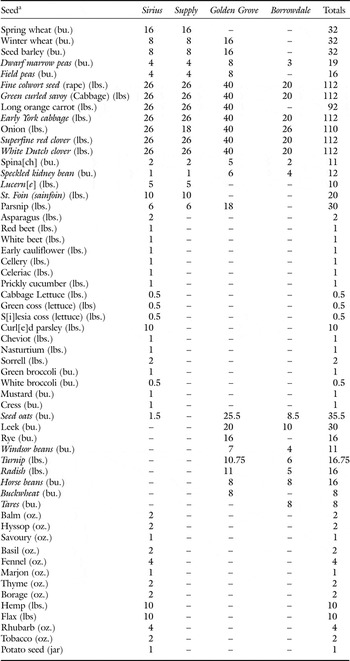
In coordination with the Home Office, the Navy Board, and his Kew Gardens seedsman, Hugh Ronalds, Banks compiled a shipment of plants and seeds that he deemed necessary for success in a colony with a climate “similar to that of the South of France.” Banks split the seed order between the four supply ships—the HMS Sirius, Supply, Golden Grove, and Borrowdale—to protect against the loss of one or more ships on the journey. The seed lists for each vessel were comprehensive. They included young trees, plant cuttings, and a long list of agricultural seeds calculated for mixed farming: human consumables (such as grains and vegetables) and, more notably, a wide variety of stock fodders (table 1).Footnote 37 George Worgan, the surgeon charged with the care of the seeds, plants, and animals on the flagship Sirius, attested to the biblical magnitude of their project: “Thus equipped,” he wrote in his diary, “each Ship like another Noah's Ark, away we steered for Botany Bay.”Footnote 38 In consultation with Banks, Lord Sydney directed Captain Arthur Phillip, an erstwhile Hampshire farmer, to clear land and plant the English seed as quickly as possible.Footnote 39
List of Seeds Sent to New South Wales on the First Fleet, 1787–88

Source: TNA, T1/639, [October 1786], fols. 253–55.
aPlants commonly used for stock fodder in italics.
Banks was taking a long view of agricultural settlement. Unlike in North America, this was not to be a roving settlement where grain was cultivated without rotation on virgin soils while stock wandered the wilderness, depositing manure miles from the farmyard. In addition to staple grains (spring and winter wheat, barley, and oats), all four supply ships were packed with a wide variety of fodder crop seeds that included a large amount of red and white clover, rape/colwort, lucerne, sainfoin, oats, turnips, tares, beans, peas, and the most common varieties of fodder cabbage. The sheer amount of clover, the most tried and trusted of all the leguminous fodders on the First Fleet, indicates the agricultural practices the planners anticipated in New South Wales. Even though Banks had assured the committee of plentiful natural forage, he made provision for a variety of artificial fodders, from the ubiquitous clover to more experimental and costly fodders, like sainfoin and lucerne, associated with Mediterranean climates.Footnote 40 Although 112 pounds of white clover might seem to be insufficient for an entire settlement, it was enough to broadcast on seven to nine acres. Even after two or three cuttings for hay, the original amount should have been able to produce thirty-five to fifty-five bushels of seed in the first year by modest European standards.Footnote 41
With these fodders, the cattle, sheep, goats, hogs, and poultry could be fed close to the settlement, their dung collected and used to replenish nutrients in spent grain fields. Governor Phillip was given orders to “proceed without delay” to the cultivation of the lands with both staple grains and stock fodders. No imported animals would be slaughtered, and, until fences could be built, Marines (not convicts) were to be charged with keeping livestock from escaping and going feral, as had so often happened in new settlements in America. While large government-run grain plantations were to build up a secure food supply quickly, the longer-term goal was to turn convicts, corrupted in England by idleness and urban vice, into small-scale mixed farmers.Footnote 42 The first step in this direction was taken less than two years after the First Fleet landed: an experimental settler farm was established under the care of James Ruse—a young Cornish convict with an agricultural upbringing—in order to find out how quickly one man with an initial loan of seed, stock, and implements could cultivate a thirty-acre grant and become self-sufficient in both grain and stock.Footnote 43 This support for closely settled mixed farming would extend to Governor John Hunter's administration as emancipated convicts were settled on small farms along the Hawkesbury.Footnote 44
Banks continued throughout the next ten years to take an active role in supporting the colony, even after it became clear that his initial assessments of the land had been flawed.Footnote 45 Banks claimed that the chief issue was a lack of financial support for continued experimentation, exploration, enclosure, and seed and stock transfers. “I am a bird of peace,” he wrote to a discouraged Governor Hunter in 1797, “my business as an encourager of the transport of plants from one country to another is suspended during war.” Nevertheless, he continued to take the long view that in the end England might “revive in New South Wales when it has sunk in Europe.”Footnote 46 Over the next twenty years, Banks would send resupplies of plants and seeds from Kew's accounts with trusted collectors, surgeons, and a series of Australia-bound governors, including shipments of the best quality fodder seeds available at the Ronalds firm.Footnote 47 While the First Fleet had sailed primarily with leguminous fodders, Banks followed up with many true grasses for sown pastures, including ryegrass, timothy grass, meadow grass (poa), and guinea grass. By the end of the 1790s, colonial officials began raising concerns about the pull of extensive pastoralism in the interior grasslands of New South Wales; Banks's solution was to encourage the sowing of English pastures closer to the main areas of settlement.Footnote 48
Yet despite the floundering of British mixed husbandry in New South Wales, a mere twelve years later many of the same figures who were directly and indirectly involved in the agricultural planning of the First Fleet settlement—including Sir Joseph Banks, Henry Dundas, Sir George Yonge, Evan Nepean, and Lord Hawkesbury (Liverpool)—would undertake a strikingly similar agricultural project at the southernmost reaches of the empire. In 1800, another veritable ark of fodder seeds departed England and headed south to the newly acquired Cape of Good Hope, accompanied by a semiofficial agricultural department charged with overhauling the underperforming agrarian systems of the Dutch Boers.
Britain's planning and planting of New South Wales had occurred during a time of relative peace, but the Cape of Good Hope, strategic to British interests in the Indian and Pacific Oceans, was colonized in 1795 in an act of war. The project of agrarian improvement in the Cape of Good Hope was reformative rather than purely creative and was therefore more politically charged. For two years, an improvised and underfunded military government had two primary tasks: keeping the increasingly disgruntled Dutch Boers in the northeastern districts of the Cape of Good Hope from outright rebellion and preventing the colony from falling to the French or into the equally eager hands of the East India Company.Footnote 49 In setting up the formal administration and civil establishment under a proper governor in 1797, Secretary of State for War and the Colonies Henry Dundas emphasized that Britain could only justify its continued rule over the Dutch and prevent the colony from burdening the already overstretched Treasury by improving it: by establishing a new, enlightened agrarian order over what had been characterized as an increasingly disordered agrarian society. For Dundas and his new governor, Lord John Macartney, a little improvement in agriculture and infrastructure (that is, access to markets) would go a long way in winning over Dutch subjects and augmenting the economic productivity of the colony.Footnote 50
The historiography of the Cape Colony is silent on the attempted reawakening of fodder-centric mixed farming in the first decades of British rule at the Cape of Good Hope that began with the expedition of William Duckitt's agricultural department in 1799. For most historians, the death knell of this kind of intensive cultivation rang in the late seventeenth century after the fruitless efforts of Jan van Riebeeck, first commander of the Vereenigde Oostindische Compagnie, to transfer the best agricultural practices of the Dutch Low Countries to the Cape of Good Hope; a seemingly inevitable rise of land-extensive plantation agriculture and commercial pastoralism in the colony then followed.Footnote 51 But during the chaotic days of the initial occupation, British officials began to question the dependability of both the plantation and the veld. Wealthier and established Dutch colonists, the free burghers, exploited slave labor from Madagascar and Mozambique to grow thin cereal crops on large plantations where the majority of land was left in long fallows due to chronic soil exhaustion. They supplemented their incomes by investing in cattle and sheep, which they sent out to cheap, unenclosed, circular six-thousand-acre government loan “farms” on the velds. Additionally, by 1797 there were more than ten thousand trekboers, Dutch-speaking transhumant pastoralists, grazing herds of fat-tailed sheep, largely unchecked, across hundreds of thousands of square miles of grassland. They were difficult to govern, contributed little to the colony's economy, agitated already precarious relations with Khoikhoi pastoralists and Xhosa agro-pastoralists on ill-defined frontiers in the east, and had become (according to one observer) “full as Savage as the Natives.”Footnote 52
The occupation required grain, fodder, and meat to be extracted from Dutch and African producers for the permanent British garrisons and their mounts, for East India Company vessels, for other British (or allied or neutral) ships bound for New South Wales or Asia, and for the residents of Cape Town. Yet for the first five years, the administration relied on regular shipments of expensive provisions from Bengal.Footnote 53 Even when the British reluctantly offered a high enough price for grain to entice the free burghers to expand production, soil exhaustion and labor shortages prevented these farmers from meeting the demand. Nor could colonizers rely on Khoikhoi or Xhosa populations in the east to make up the deficits.Footnote 54 Both before and after the takeover, Dundas's correspondence frequently reveals a desire to permanently extract the Cape of Good Hope from the Dutch in order to turn it into a colony more agriculturally productive and friendlier to British (that is, East India Company) interests. The Dutch had considered the settlement “in no other light but as subservient to their Indian trade,” which had led to “grievous” management of the colony's resources. Production of grain, Dundas asserted, would rise only “in proportion to the encouragement given to it.” To that end, only a combination of careful husbandry of exhausted Cape soils and free commercial intercourse could counteract the “stagnation of all industry in the agriculture of this fertile country.”Footnote 55
Dundas was not alone in this assessment. His first appointed governor, Lord Macartney, advocated vehemently for a heavy-handed intervention into Cape agriculture. During his governorship from 1797 to 1799, Macartney instructed his private secretary, John Barrow, an amateur naturalist, to compile several reports for Dundas: reports on the resources and inhabitants of the Cape of Good Hope and, more important, reports about how they had been squandered by the Dutch. Like Banks's Endeavor journals for New South Wales, these reports became the principal reference for the Colonial Office's evaluation of the agrarian potential of the Cape of Good Hope, and they give a much clearer picture of why Duckitt's fleets of fodder were needed to begin with.Footnote 56 Barrow optimistically claimed that the land in the valleys between the Hottentots-Holland, Hawequas, and Mastroosberg ranges was “uncommonly fertile” and supplied with plentiful rains.Footnote 57 Upon breaking up new land, good farmers could expect fifteen to twenty bushels of wheat and thirty to forty of barley per bushel of seed sown, nearly the return expected in the best wheat-producing regions of England. Yet according to Barrow's analysis of records kept by the Burgher Senate, the average wheat yield for Dutch planters was a mere nine and a half bushels of wheat and twenty-one bushels of barley per bushel of seed sown.Footnote 58 For Barrow, the beauty and fertility of the Cape of Good Hope deserved “the spirit of commerce and adventurous industry,” spirit and industry that the Boers had failed to muster.Footnote 59 “No part of the world has had its natural advantages so abused as the Cape of Good Hope,” he wrote, indicating that with a little expertise in natural history the vitality of the soil could be unleashed and made to support the agricultural bounty of Europe.Footnote 60
Neglect of improvement, Barrow claimed, led to moral degeneration and commercial antagonism, excusable in an African but unpardonable in a European. Barrow wrote in the tradition of the Linnaean naturalists sent to the Cape of Good Hope in the 1770s, Carl von Thunberg and Anders Sparrman. They saw at least some Africans as having reached the maximum level of advancement possible by a “barbaric” people and considered the Boers as having degenerated to the lowest level of European civilization, particularly in terms of agricultural industriousness.Footnote 61 These naturalists promoted an expertly managed environment and disapproved of colonial governments that left farmers to their own devices. Rather than invoking the sedate if patronizing tone used to describe African producers, they sternly admonished wealthy Dutch planters, who ostensibly should have known better, emphasizing in particular their imprudent disregard for the conservation of soil nutrients. Dutch use of manure was “ill-preformed, or else entirely neglected,” with the result that any arable land or pasturage—even on good-quality, wet soils—could only be cultivated for a few years before they had to be abandoned.Footnote 62 “The Boer,” Barrow wrote, echoing Sparrman, “bestows no kind of labor on the ground but that of throwing in the seed; the rest is left to chance and the effects of an excellent climate.” Even in the best lands in the Cape Country districts, the farms of the burghers, with their slaves and legions of draft oxen, “afford[ed] nothing that in England would be considered a crop.”Footnote 63
Barrow was adamant that the soil was not the problem. As proof, he pointed to a few examples of well-executed mixed farming, particularly in the densely settled agricultural communities at Stellenbosch and Franschhoek, now the Cape Winelands. Barrow, like Pehr Kalm in North America, was particularly attentive to the cultivation of fodder crops, which could be cut twice or three times for winter feed, grazed by cattle for several months, and then plowed under in the winter as green manure. This, for Barrow, was the only way that the exhausted soils of the Cape of Good Hope's arable lands could be returned to good heart, a sentiment echoed in other official reports.Footnote 64 By 1799, his correspondents on the ground in the colony had convinced Secretary Dundas that an intervention into Cape agriculture was absolutely necessary and that the starting point of that intervention had to be fodder. These reports insinuated the corrigibility of both land and farmer, but the land needed a redeemer bearing redemptive plants.
The plan to establish an agricultural department to encourage British-style improved husbandry at the Cape of Good Hope depended on finding a willing and able superintendent. Dundas and the incoming governor to the Cape of Good Hope, Sir George Yonge, reached out in 1799 to the newly chartered Board of Agriculture (1793–1822) to find a suitable man—a surrogate for this elite set of agrarian improvers. William Duckitt, the youngest son of a well-regarded yeoman farmer and ploughwright of the same name, was an ideal candidate for this venture: he had practical farming experience, he was well versed in both the ideological and technical literature of improved farming, he was well connected through his father and brothers to Britain's ultimate authorities on agricultural improvement, and he was, unlike his patrons on the board, of an expendable social class.Footnote 65 Lord Somerville, president of the Board of Agriculture, enthusiastically put forward Duckitt's name and even insisted on accompanying Duckitt and Yonge to Dundas's home in Wimbledon to propose both the terms of Duckitt's engagement and the functions of the new department. In addition to the salary, pensions, and promises of land to Duckitt and the twelve husbandmen and mechanics accompanying him, Duckitt was given carte blanche to purchase on government account all the seeds, implements, and stock needed to begin his operations.Footnote 66
Dundas sent Duckitt to Sir Joseph Banks, who in addition to his ongoing experience in facilitating the migration of plants was also a founding member of the Board of Agriculture. Banks gave guidance on the care of plants, seeds, and stock on the journey and on how to select the best spot for Duckitt's first experimental farm.Footnote 67 Robert Gibbs, official seedsman to the Board of Agriculture, was called in to advise Dundas and Duckitt on the best seeds to take out to the new colony. After some negotiating, the final bill for seeds came in at a staggering £419 (£36,000 today), but Dundas acquiesced to the expense nevertheless.Footnote 68 The fact that the Gibbs firm was chosen over other cheaper seed firms is significant. Robert Gibbs and his son Thomas specialized in forage crop seed. They were often hired as consultants by improving landlords to design fodder regimes tailored to the particular soils of newly enclosed farms. They imported rare and expensive fodder seed (for example, marl grass and birdsfoot trefoil) from continental Europe and Asia, and they offered “in house” grass mixtures to farmers wishing to lay down permanent pasture over tired arable land. The Gibbs firm had supplied seeds for board members Francis and John Russell, fifth and sixth Dukes of Bedford, for the experimental farm at Woburn Abbey under the direction of Duckitt's elder brother, John. Thomas Gibbs would later collaborate with the horticulturist George Sinclair and chemist Sir Humphry Davy in the decade-long grass trials at Woburn Abbey, which resulted in the publication of Hortus gramineus Woburnensis (1816), the definitive nineteenth-century text on English fodder crops.Footnote 69
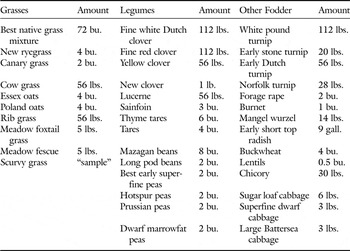
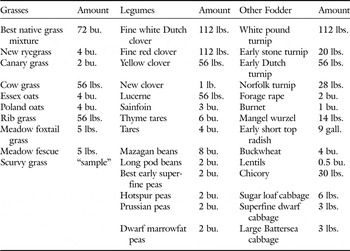
The best fodders needed to be consumed by the best stock. With his connections to the Board of Agriculture, Duckitt was able to procure Spanish sheep from George III's flock at Hampton Court, Devonshire bulls and cows from the Duke of Bedford's prize herd at Woburn Abbey, and “Bakewell Blacks” from Robert Bakewell's stud farm in Leicestershire.Footnote 70 By the end of April of 1800, Dundas had advanced the sum of £1,928 (£172,000) on Duckitt's venture, not including the cost of freight and passage on the merchant ship Wellesley, with assurances that the funding of his operations would continue via Yonge upon his arrival in the Cape of Good Hope.Footnote 71 As with the First Fleet to New South Wales, the Wellesley was a microcosm of an improved British farm (table 2).Footnote 72 In addition to the impeccably pedigreed livestock, it held twelve tons of agricultural equipment and £419 worth of seeds, three-fourths of which were grasses, legumes, and other fodder crops.Footnote 73
Fodder Seeds Sent to the Cape of Good Hope on HMS Wellesley, 1800
Source: “Bill of Seeds,” 3 April 1800, British Library Add. MS 38763, fol. 1.
The Wellesley contained more clover in its hold than the entire First Fleet had carried. Notably, true grasses played a much more prominent role in the Wellesley than they did on its First Fleet counterpart, with eight different grass varieties and fifty-six bushels of Gibbs's best native grass mixture for sown pasture. The grass bias on the Wellesley reflected the evolution of agricultural improvement in Britain under the influence of the Board of Agriculture. By the end of the century, improving farmers across the country began to rely on increasingly sophisticated sown fodder regimens to boost the productivity of their land.Footnote 74 Duckitt did not transport wheat, barley, rye, or maize seeds; sluggish grain production was not brought about by poor seed quality or quantity. Echoing Kalm's diagnosis of American husbandry, the problem was caused by settlers permitting cattle (and their manure) to roam far away from the arable crops on overcrowded natural pastures instead of sowing rotations of leguminous fodders or laying down permanent pastures. “What Folly,” he wrote, “that a Farmer shoud [sic] have want of grass in a country without Winter!” Although no records survive from any of Duckitt's properties, he intended to sow a wide variety of such plants and distribute them to “such Enterprising Farmers” as he could find.Footnote 75
Duckitt left England in May of 1800, fully equipped “for the purpose of procuring for the Settlement at the Cape of Good Hope the opportunity of improving the agriculture of that colony by the aid of his experience and information in husbandry.”Footnote 76 The project was not without its critics. One of Dundas's regular correspondents, Lady Anne Barnard, the sharp-tongued wife of the colonial secretary, dismissed Duckitt's impending emigration as a naïve overreach by the colonial government. In her view, Boers on the whole did the best they could in an inhospitable climate and terrain. Barnard was quick to point out the environmental impropriety of Duckitt's department, coming as he was “to shew Africa what good farming is … and how fertile all sorts of soils are to be made by skill” and to “convert sandy plains into fertile fields & set all the rocks a-sprouting with Corn.”Footnote 77 Barnard's reaction foreshadowed the challenges and disappointments that would plague Duckitt's department in the following years.
However, at least in the planning and early execution of the project from 1799 to Governor Yonge's recall in 1801, the objectives of the department were clear if overconfident. The British government did not have resources to conduct a complete overhaul of the agrarian life of the colony, so they sent an emissary and a ship full of fodder seeds instead. It was a relatively inexpensive, simple, and wildly optimistic solution to an extremely complex problem. Duckitt would set an example for the underproductive Dutch freeholders and trekboers. He would show them how much richer they would be—economically, socially, and morally—if they embraced intensive mixed husbandry in the green, well-watered lowlands within easy distance of Cape Town; recalled their stock from the interior; and fed them instead on fields of English clovers, grasses, and root vegetables, plants securely packed in his ark.
Conclusion: The Staying Power of Grass
A full account of what happened to these transoceanic deployments of fodder crops is beyond the scope of this article, in part because the execution of this agricultural project was far more challenging than its initiation. In the three or four decades following the landing of these fleets of fodder in New South Wales and the Cape of Good Hope, the transplanted fodder crops (such as clover, ryegrass, lucerne, and meadow grass) were slowly but steadily decoupled from the very system of husbandry that they were intended to support. In other words, for a variety of reasons, mixed husbandry had less staying power in these colonies than did the grasses themselves. The formation of a distinctly British agrarian landscape grounded in Enlightenment-era mixed husbandry in these antipodean colonies was foiled by a variety of environmental, political, and economic impediments on the ground.
The ecological orchestration of these colonies’ agrarian futures was thorough and meticulous, weighted as it was with the imperial anxieties of the late eighteenth century, but it was nevertheless only the beginning of the story of traveling grass in Australia and South Africa. Crosby writes that, in North America, pioneers crossed the Appalachian mountains and “found white clover and bluegrass [poa pratensis or English meadow grass] waiting for them,” crediting the plants’ “aggressive natures” for the feat.Footnote 78 In New South Wales and the Cape of Good Hope, however, clover and grass were frog-marched at great cost and with great intentionality across the ocean and across the more forgiving parts of mostly unforgiving landscapes. Clover and other fodder seeds packed in the holds of the Sirius, Supply, Golden Grove, and Borrowdale in 1787 and the Wellesley in 1800 made tangible the vision for a new and improved settler empire grounded in Enlightenment thought and practice, but upon arrival the prescriptions for their dissemination often failed. Understanding natural history and scientific agriculture and identifying the agricultural practices and accompanying biota that would theoretically support the most agreeable settler society were important steps, but they did not actually make the grain and grass grow.
The agricultural practices and agrarian systems that had truly revolutionized food production in much of Britain at the beginning of the nineteenth century could not be imposed on colonial landscapes and people without significant recalibration. Environments in both colonies were often resistant to British seeds and husbandry. Soils that so easily sustained rich indigenous botanical kingdoms did not often support the biota of Britain. Fundamental misreadings of native ecologies in New South Wales and the Cape of Good Hope by the likes of Banks and Barrow led to early disappointments. Settlers did not often have the technology or the labor power to combat the alternating overabundance and dearth of water on their farms; they also lacked the resources to properly contain their stock or to redistribute manure. Colonial governments lacked the authority, organization, and funds to enforce improvement over large territories and dispersed populations. Despite the potency of improvement ideology and the proven productive power of careful soil husbandry; despite the influx of agricultural experts, natural historians, and keen new settlers; and despite policies intended to discourage extensive land use, British officials, both in London and in the colonies, struggled to invoke the ecological logic or impose the economic, social, and political relationships of the British countryside in these new lands.Footnote 79
While arable production was critical to the development of these colonies in the first half-century of British settlement, it was overshadowed by the development of robust pastoral industries in the early nineteenth century.Footnote 80 This industry was based on the appropriation of massive tracts of native grassland and the distant and wide dispersal of British (and Boer, in the case of the Cape of Good Hope) stock rangers—the very situation that early colonial planners had been keen to avoid in the wake of American independence. Yet the failure of a particular form of agricultural improvement, fodder-centric mixed husbandry, did not preclude incorporating introduced grasses into pastoral improvement projects. Traces of grass in the archival records of both New South Wales and the Cape of Good Hope are few and faint, but it is clear that sown or “artificial” European grasses (including legumes) were often much more successful in the hands of pastoralists than in those of farmers. While there is some evidence that wealthier farmers in both colonies used sown-fodder rotations and produced hay from sown pastures, most grasses were sown in response to pasture exhaustion, initially in the districts around Sydney and Cape Town and along overland routes used to drive stock to markets, but later in their respective interiors.Footnote 81
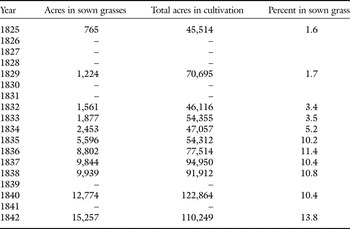
After import duties were lowered on colonial wool in 1823, both colonies began to rely more on large pastoral operations, and the ensuing merino boom put unprecedented pressure on the native grasslands of both colonies. In New South Wales, the nutritive kangaroo grass diminished and was replaced by hardier but less palatable grasses like wiregrass or speargrass. In the Cape of Good Hope, overstocking led to discernable desertification of the once “luxuriant” velds of the Great Karoo. Highly disturbed grassland communities were also susceptible to invasion by introduced species. English pasture grasses like clover, ryegrass, meadow grass, fescue, or couch grass were of course welcome, but harmful and unpalatable plants like Scotch thistle, white horehound, and blackberry nightshade were not. In both New South Wales and the Cape of Good Hope, exotic weeds thrived on river or stream frontage where the ground was most heavily trampled. In the Cape of Good Hope, these issues were compounded by the seasonality of native grasses; in the dry months of August and September, settlers often had to relocate their entire herds to wetter areas around rivers or other water sources on volatile frontiers in order to find good grass. The default form of improvement for this problem was to lay down perennial grasses and legumes to prevent or correct pasture exhaustion caused by “surcharge” stock populations, and indications of this can be found in the historical record.Footnote 82 Official accounts of acreage in sown grass are not available for the Cape of Good Hope, but in New South Wales between 1825 and 1840, records indicate a twentyfold increase in sown grass cultivation (from 765 acres to 15,257) compared to only a two-and-a-half-fold increase in total arable cultivation (45,515 to 110,249) (table 3).Footnote 83 This, of course, does not account for the artificial grasses that infiltrated native pasturage, introduced either intentionally by graziers or unintentionally via stock, stock manure, bird droppings, wind, and flood.
Acreage in Sown Grasses in New South Wales, 1825–1842

Source: Returns of the Colony of New South Wales (Blue Books), 1822–1857, CY 4/251-290, Mitchell Library (State Library of New South Wales).
Early colonial improvers in New South Wales and the Cape of Good Hope may have lacked the institutionalized coalition of agriculture, politics, and science—improvement with teeth, if you will—that characterized later periods, but there was nothing accidental about the journey of fodder into and across these territories. Fodder crops, which would become inextricably ascribed to the commodity chains of the British Empire, were not brought to these colonies on the bootlaces or burlap sacks of soldiers and settlers. Many of these pasture plants indeed colonized, or as Crosby puts it, “spread aggressively” on native grasslands, but they did so with the direct aid of ambitious colonial planners, improvement-minded naturalists, and enterprising farmers and graziers. The transfer of pasture grasses and fodder crops to these colonies was part of a politically charged attempt to replicate improved British husbandry—at once progressive and conservative, productive and picturesque—in these auspicious, yet alien territories. The carefully outfitted project of agrarian improvement had to be recalibrated to the environmental, economic, and political realities of colonial life. On the whole, enlightenment-era mixed husbandry failed to thrive in these new landscapes. Nevertheless, the grass, the material embodiment of mixed husbandry, had a very real future in these antipodean lands. It was a future grounded in moments of encounter and transition—the moments when botanists left and Marines arrived, when seedlings shriveled in the afternoon heat or washed away in the flood, when spades struck rock, when the farmer abandoned the toil of tillage for the grazing range, when cowpats decomposed a hundred miles from the nearest field, when clover started to creep.