1. Introduction
The Argentine Precordillera is interpreted as an extensive fold-and-thrust orogenic belt located to the east of the main Andes in the northwestern region of Argentina (Astini, Reference Astini, Pankhurst and Rapela1998). This geological region is situated in the La Rioja, San Juan and Mendoza provinces with an extension of 450 km north–south and 110 km east–west (Furque & Cuerda, Reference Furque and Cuerda1979). Based on its stratigraphical and structural characteristics, the Precordillera has been divided into three morphostructural units: the Eastern (Ortiz & Zambrano, Reference Ortiz and Zambrano1981), Central (Baldis & Chebli, Reference Baldis and Chebli1969) and Western Precordillera (Baldis et al. Reference Baldis, Beresi, Bordonaro and Vaca1982). The Eastern and Central Precordillera are represented by a Lower Palaeozoic carbonate succession unique in South America, which was deposited in diverse platform environments ranging from shallow intertidal to marginal shelf or deep distal ramp settings (Cañas, Reference Cañas, Ramos and Keppie1999; Bordonaro, Reference Bordonaro2002).
The marine deposition in the Precordillera underwent a dramatic change from limestone to black shale during early Darriwilian time (Carrera & Astini, Reference Carrera and Astini1998). This event is interpreted to be due to a rapid sea-level rise that led to the drowning of the platform to the east, hindering carbonate production (e.g. Los Azules and Gualcamayo formations); however, in some areas the carbonate sedimentation continued until late Darriwilian time (e.g. Las Aguaditas and Las Chacritas formations; Keller, Eberlein & Lehnert, Reference Keller, Eberlein and Lehnert1993; Carrera & Astini, Reference Carrera and Astini1998). These unevenly distributed transitional environments prove the diachronic nature of the Precordilleran carbonate sedimentation (Carrera & Astini, Reference Carrera and Astini1998).
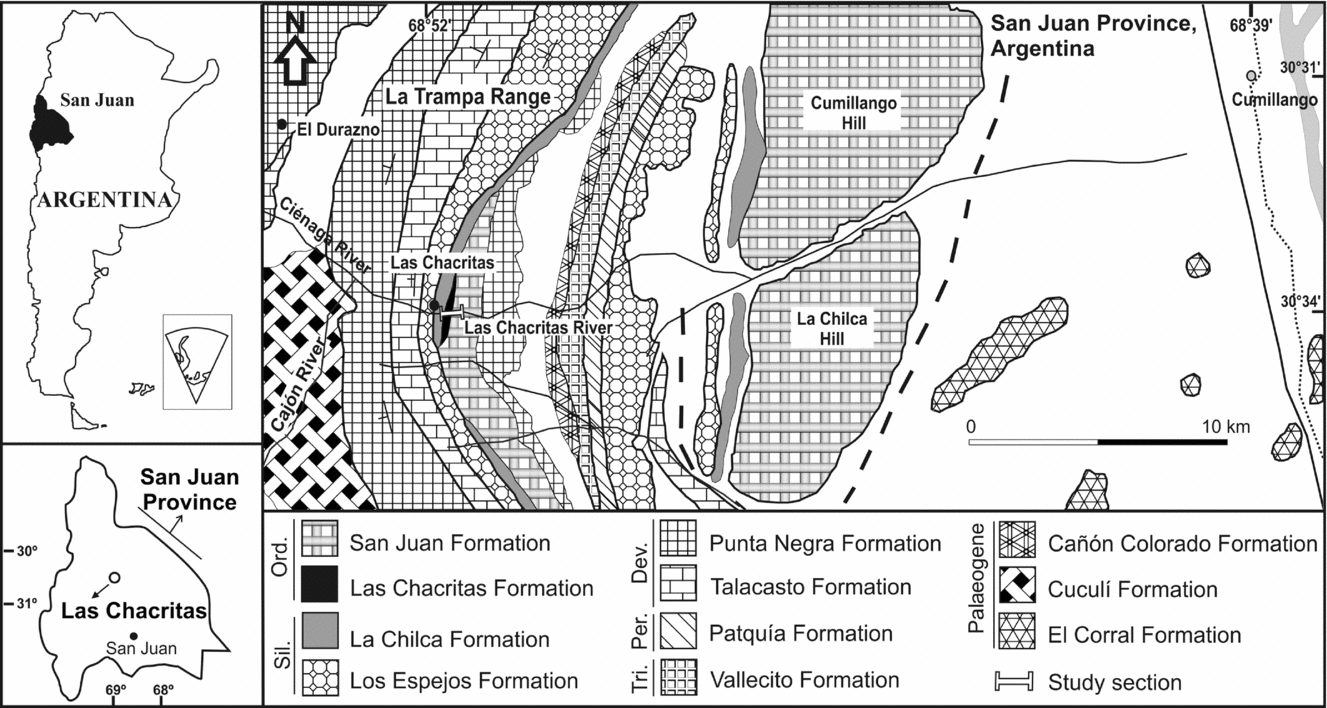
The La Trampa Range is part of the Central Precordillera in the San Juan Province (Fig. 1) where an important Middle Ordovician section is represented by a richness in micro and macrofossils. Upper Lower – lower Middle Ordovician rocks of the San Juan Formation conformably overlain by the Las Chacritas Formation of middle Darriwilian age are exposed here. The latter unit is paraconformably overlain by the lower Sandbian Las Aguaditas Formation at the Las Chacritas River section (Carrera & Astini, Reference Carrera and Astini1998), where part of the middle and upper Darriwilian section are missing. At other localities however, it is unconformably overlain by the La Chilca Formation which is a latest Ordovician – Silurian siliciclastic unit.
Location and geological map of the Las Chacritas River section in the La Trampa Range, Precordillera of San Juan, Argentina.

The conodont zones of the Argentine Precordillera are based on assemblages of species characteristic of the North American Midcontinent Province during Early Ordovician time, with an increase in Atlantic Province representatives of Middle Ordovician age (Bagnoli & Stouge, Reference Bagnoli and Stouge1991). In the Middle Ordovician section there is a mixture of faunas in transitional environments, while characteristic cold-water forms dominate the late part of the period (Lehnert, Reference Lehnert1995; Albanesi, Hünicken & Barnes, Reference Albanesi, Hünicken and Barnes1998; Lehnert et al. Reference Lehnert, Bergström, Keller and Bordonaro1999). Traditionally, the Baltoscandian zone system has been considered as a reference for the Middle Ordovician conodont biostratigraphy of the Precordillera (Albanesi & Ortega, Reference Albanesi, Ortega and Aceñolaza2002). In previous Precordilleran studies the ranges of the index species Lenodus variabilis (Sergeeva), Yangtzeplacognathus crassus (Chen & Zhang), Eoplacognathus pseudoplanus (Viira), Eoplacognathus suecicus Bergström and Pygodus serra (Hadding), and the lower range of Pygodus anserinus Lamont & Lindström, have been recognized in the middle–upper Darriwilian (Heredia, Reference Heredia1982, Reference Heredia1998; Sarmiento, Reference Sarmiento1985; Hünicken & Ortega, Reference Hünicken, Ortega and Austin1987; Albanesi, Benedetto & Gagnier, Reference Albanesi, Benedetto and Gagnier1995; Ortega, Albanesi & Hünicken, Reference Ortega, Albanesi and Hünicken1995; Albanesi, Hünicken & Barnes, Reference Albanesi, Hünicken and Barnes1998; Ottone et al. Reference Ottone, Albanesi, Ortega and Holfeltz1999; Albanesi et al. Reference Albanesi, Bergström, Schmitz, Serra, Feltes, Voldman and Ortega2013; Feltes, Albanesi & Bergström, Reference Feltes, Albanesi, Bergström, Albanesi and Ortega2013; Mestre & Heredia, Reference Mestre and Heredia2013 a; Serra, Albanesi & Bergström, Reference Serra, Albanesi, Bergström, Albanesi and Ortega2013). The upper range of Pygodus anserinus and the range of Amorphognthus tvaerensis Bergström in the Sandbian Stage have been established in several sections of the Precordillera (Heredia, Reference Heredia1982; Lehnert, Reference Lehnert1995, Albanesi & Ortega, Reference Albanesi and Ortega1998; Ottone et al. Reference Ottone, Albanesi, Ortega and Holfeltz1999).
The first graptolite record in Argentina was a didymograptid specimen from the Ordovician Portezuelo Formation of Salta (Brackebush, Reference Brackebush1883); since then, graptolite contributions have greatly increased, providing significant information for regional and global correlation and palaeobiogeographic studies. Floian – early Dapingian graptolite faunas from NW Argentina show Atlantic provincial affinity (Maletz & Ortega, Reference Maletz, Ortega, Cooper, Droser and Finney1995) and some particular associations include Pacific, Baltic and Chinese faunas (Toro, Reference Toro1999). According to recent analysis, Floian graptolites from NW Argentina show strong similarity to graptolite faunas from Baltica, less affinity with Great Britain and weaker affinities with Laurentia and SW China (Vento, Toro & Maletz, Reference Vento, Toro and Maletz2012). Graptolite assemblages of the Precordillera are recorded from upper Tremadocian (Ortega et al. Reference Ortega, Banchig, Voldman, Albanesi, Alonso, Festa and Cardo2014) to Hirnantian rocks (Albanesi & Ortega, Reference Albanesi, Ortega and Aceñolaza2002). Important graptolite assemblages of Darriwilian and Sandbian age were identified in the Precordillera. The Levisograptus austrodentatus (Da1), Levisograptus dentatus (Da2), Holmograptus lentus (Da3), Pterograptus elegans (Da4a), Hustedograptus teretiusculus (Da4b) (Webby et al. Reference Webby, Cooper, Bergström, Paris, Webby, Paris, Droser and Percival2004), Nemagraptus gracilis and Climacograptus bicornis (Sandbian) zones have been recognized (Albanesi & Ortega, Reference Albanesi, Ortega and Aceñolaza2002; Brussa, Toro & Benedetto, Reference Brussa, Toro, Benedetto and Benedetto2003, p. 76; Toro & Brussa, Reference Toro, Brussa and Benedetto2003, p. 452; Ortega, Albanesi & Frigerio, Reference Ortega, Albanesi and Frigerio2007).
Despite the many studies of conodonts in the Precordillera, their published records in the Las Chacritas River section at the La Trampa Range are contradictory. Moreover, the knowledge of graptolites from these units is poor, only a few specimens having been documented from the Las Aguaditas Formation by Peralta & Baldis (Reference Peralta and Baldis1995). The present contribution reports new data on the conodont biostratigraphy of the San Juan, Las Chacritas and Las Aguaditas formations and reports graptolites from the Las Chacritas and Las Aguaditas formations. The local and regional chronostratigraphic relationships are revised, providing a more accurate and detailed biostratigraphic scheme for the Middle and Upper Ordovician of the Argentine Precordillera. Based on the analysed collections, new information on the composition of conodont and graptolite associations through the stratigraphic column is presented, including the first records of graptolites from the Las Chacritas Formation.
2. Las Chacritas Formation
The mostly calcareous Las Chacritas Formation crops out in the northern La Trampa Range. This unit was first described by Espisúa (Reference Espisúa1968), and was then subject of many studies such as those by Astini (Reference Astini1994), Peralta & Baldis (Reference Peralta and Baldis1995), Carrera & Astini (Reference Carrera and Astini1998), Heredia, Beresi & Peralta (Reference Heredia, Beresi and Peralta2005, Reference Heredia, Beresi and Peralta2011), Mestre & Heredia (Reference Mestre and Heredia2012), Albanesi et al. (Reference Albanesi, Bergström, Schmitz, Serra, Feltes, Voldman and Ortega2013), Heredia et al. (Reference Heredia, Carlorosi, Mestre and Soria2013), Serra & Albanesi (Reference Serra, Albanesi, Albanesi and Ortega2013) and Serra, Albanesi & Bergström, (Reference Serra, Albanesi, Bergström, Albanesi and Ortega2013).
Peralta, Heredia & Beresi (Reference Peralta, Heredia, Beresi, Raft and Atka1999) defined the Las Chacritas Formation as a 55-m-thick sequence made up of fine-grained siliciclastic and carbonate sediments deposited in a continental shelf setting (Carrera, Reference Carrera1997). The former authors described two members. The lower member is a 38-m-thick succession with a layer of K-bentonite at the contact with the San Juan Formation, composed of tabular, thin- to medium-bedded fossiliferous dark mudstones, nodular wackestone and packstones. Synsedimentarily deformed beds occur in the middle and upper part of the unit, indicating a deepening slope transport towards the north. The upper member is 17 m thick, and consists of thin-bedded wackestone, bioclastic grainstone, mudstone and spiculitic mudstone. It is very fossiliferous with increasing bioclastic content towards the top of the unit (Carrera & Astini, Reference Carrera and Astini1998; Peralta, Heredia & Beresi, Reference Peralta, Heredia, Beresi, Raft and Atka1999).
A deeper-water limestone sequence overlies the Las Chacritas Formation, and is referred to the Las Aguaditas Formation by Peralta, Heredia & Beresi (Reference Peralta, Heredia, Beresi, Raft and Atka1999). The Las Aguaditas Formation was formally defined by Baldis et al. (Reference Baldis, Beresi, Bordonaro and Vaca1982) at its type section, Las Aguaditas Creek in the Los Blanquitos Range. It consists of platy limestone intercalating slumped horizons and breccias (Baldis et al. Reference Baldis, Beresi, Bordonaro and Vaca1982) which, according to Keller, Eberlein & Lehnert (Reference Keller, Eberlein and Lehnert1993) were developed during times of a rapidly falling sea level. Astini (Reference Astini1995, Reference Astini1997) suggested that it was deposited on structural hights (horsts) within the basin, which served as a reservoir of carbonate remnants.
3. Previous biostratigraphic studies
Graptolites have been poorly studied previously in this outcrop, probably because of the lack of records in the calcareous sequence. Peralta & Baldis (Reference Peralta and Baldis1995) have documented a graptolite and trilobite fauna from the Las Aguaditas Formation in the Las Chacritas Creek outcrop, including the following taxa: Dicellograptus divaricatus var. salopiensis Elles & Wood, Hustedograptus aff. H. teretiusculus (Hisinger), Glossograptus aff. G. hincksii (Hopkinson), Climacograptus cf. antiquus Lapworth and Amplexograptus sp. These authors suggested a Darriwilian age for the unit based on the presence of Hustedograptus aff. H. teretiusculus, and correlated this unit with the Las Aguaditas Formation in the Los Blanquitos Creek section on the basis of its lithostratigraphic and palaeontologic composition (Peralta & Baldis, Reference Peralta and Baldis1995).
The Las Chacritas Creek section has also been the subject of several studies involving the conodont fauna. In the lower strata of the Las Chacritas Formation the L. variabilis Zone was first mentioned by Peralta, Heredia & Beresi (Reference Peralta, Heredia, Beresi, Raft and Atka1999) and later verified by Albanesi & Ortega (Reference Albanesi, Ortega and Aceñolaza2002). Albanesi & Astini (Reference Albanesi and Astini2000) recorded the E. pseudoplanus Zone based on the appearance of Eoplacognathus pseudoplanus in the middle part of this unit, and the presence of species of Microzarkodina enabled these authors to divide the zone into the M. hagetiana and M. ozarkodella subzones following the Baltoscandian and Chinese conodont zonal schemes. Heredia, Beresi & Peralta (Reference Heredia, Beresi and Peralta2011) recognized the E. pseudoplanus Zone spanning the upper metre of the San Juan Formation and the basal part of the Las Chacritas Formation and the E. suecicus Zone in the middle part of the latter formation, suggesting a hiatus between these zones based on the absence of early or intermediate forms of E. suecicus in their collections. Recent studies by Mestre & Heredia Reference Mestre and Heredia(2013b) have recognized the Y. crassus Zone near the top of the San Juan Formation below the E. pseudoplanus Zone. These zones were also described in the study unit by Albanesi et al. (Reference Albanesi, Bergström, Schmitz, Serra, Feltes, Voldman and Ortega2013) and Serra, Albanesi & Bergström (Reference Serra, Albanesi, Bergström, Albanesi and Ortega2013). The E. pseudoplanus Zone in the Las Chacritas Formation correlates with the lower Sierra de La Invernada Formation (Albanesi, Bejerman & Astini, Reference Albanesi, Bejerman and Astini2009), the upper Lower Member of the Los Azules Formation (Ortega, Albanesi & Frigerio, Reference Ortega, Albanesi and Frigerio2007) and the upper Lower Member of the Las Aguaditas Formation (Feltes, Albanesi & Bergström, Reference Feltes, Albanesi, Bergström, Albanesi and Ortega2013).
4. Materials and methods
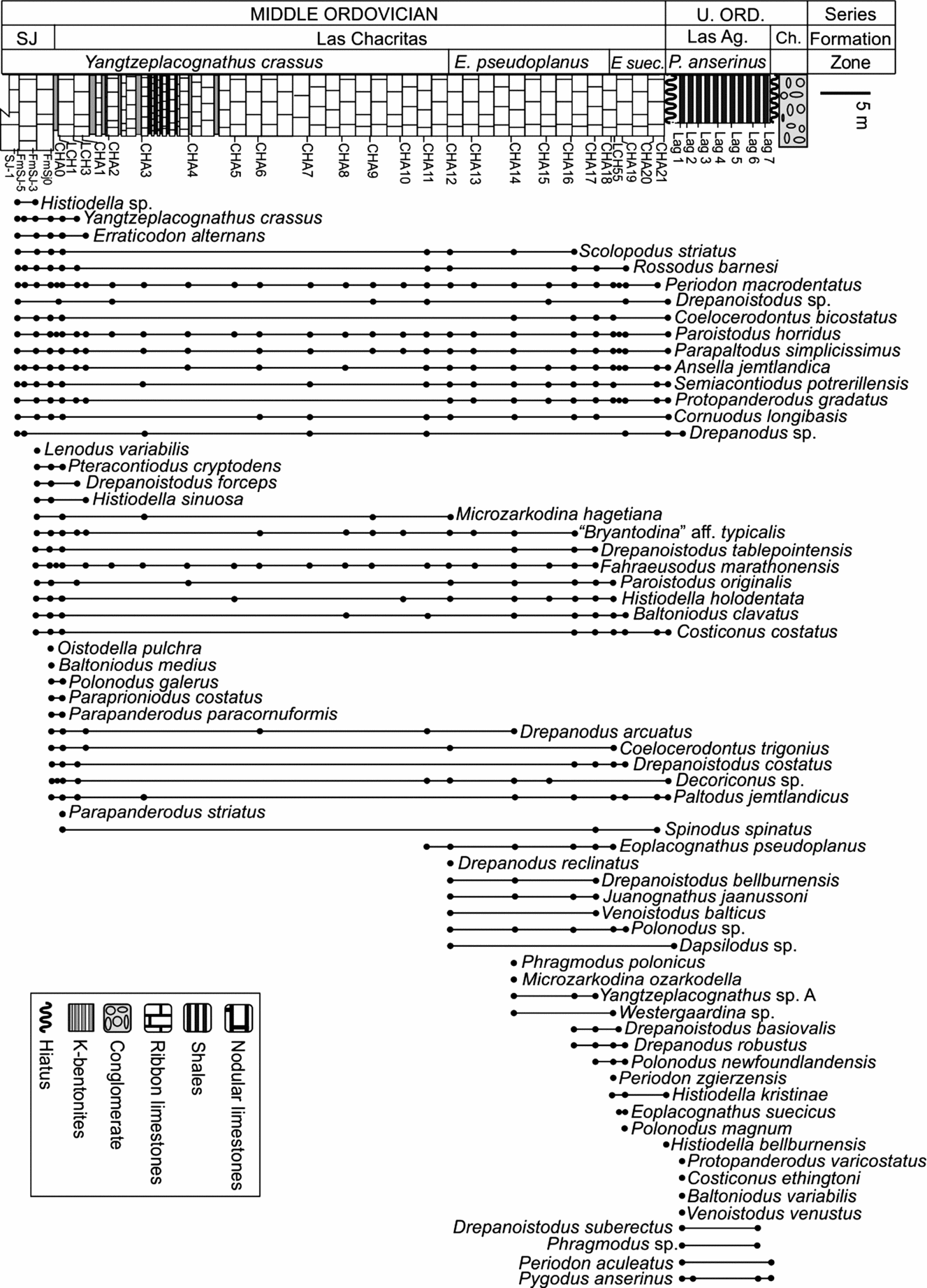
Our study is based on completely new conodont records throughout the Las Chacritas section, which allow us to revise previous interpretations. Thirty-eight carbonate samples were collected along the section from the top of the San Juan through Las Chacritas and Las Aguaditas formations. Four samples collected from the Las Aguaditas Formation were barren of conodonts and excluded from Table S1 (in the online Supplementary Material available at http://journals.cambridge.org/geo). Samples of 2 kg were processed and produced a total of 7287 identifiable conodont elements (Table S1, available at http://journals.cambridge.org/geo). These specimens are well preserved with a colour alteration index (CAI) of 2.5, indicating overburden palaeotemperatures ranging from 90ºC to 110ºC (Epstein, Epstein & Harris, Reference Epstein, Epstein and Harris1977). Conodont elements recorded from the uppermost San Juan Formation, the upper strata of the Las Chacritas Formation and the basal part of the Las Aguaditas Formation are abundant and taxonomically diverse, whereas the specimens recovered from the basal and middle parts of the Las Chacritas Formation, as well as from the middle and upper intervals of the Las Aguaditas Formation, are scarce (Fig. 2).
Stratigraphic column showing conodont species ranges and zones. Abbreviations: U. ORD. – Upper Ordovician; Las Ag. – Las Aguaditas; Ch. – La Chilca; SJ – San Juan; E. suec. – E. suecicus.

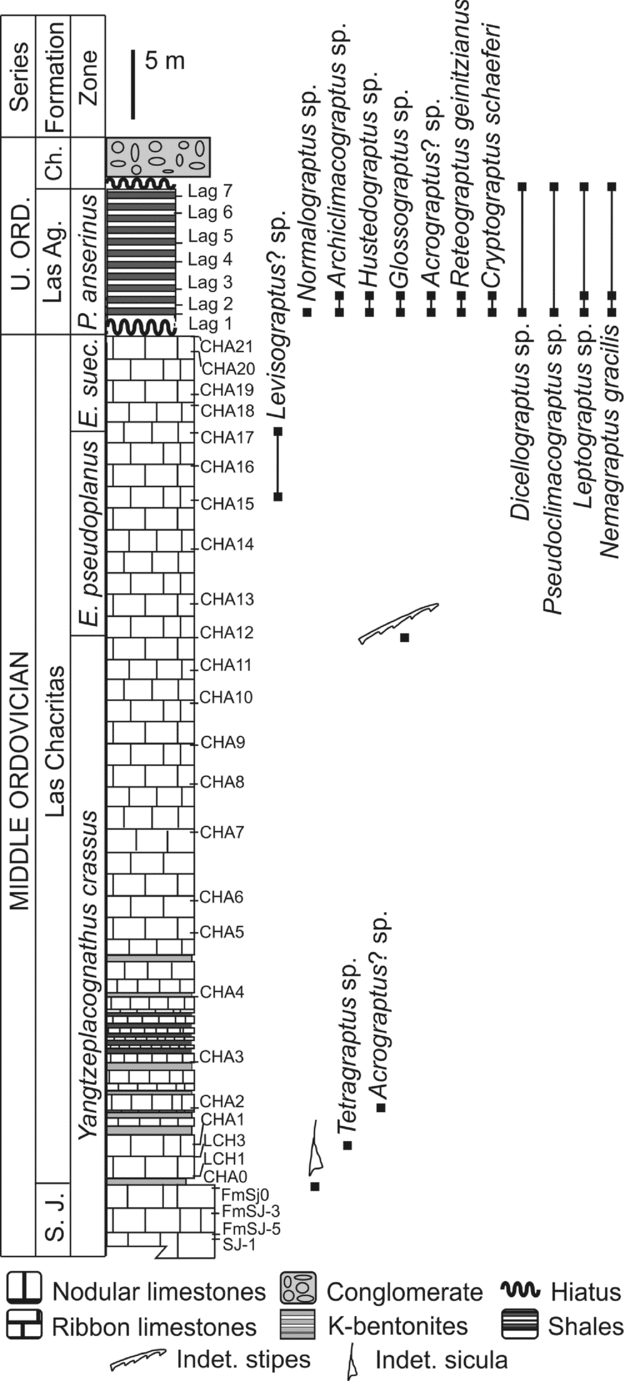
A thorough sampling for graptolites was accomplished in the Las Chacritas and the Las Aguaditas formations. The taxa recorded in the former formation are few and the preservation of the tubarium is rather poor, while in the latter formation graptolites are more abundant and better preserved (Fig. 3).
Stratigraphic column showing graptolite species ranges and conodont zones. Abbreviations as for Figure 2.

The fossil collection is housed in the Museo de Paleontología, Facultad de Ciencias Exactas, Físicas y Naturales, Universidad Nacional de Córdoba, under the repository codes CORD-MP (conodonts) and CORD-PZ (graptolites).
5. Conodont biostratigraphy and correlation
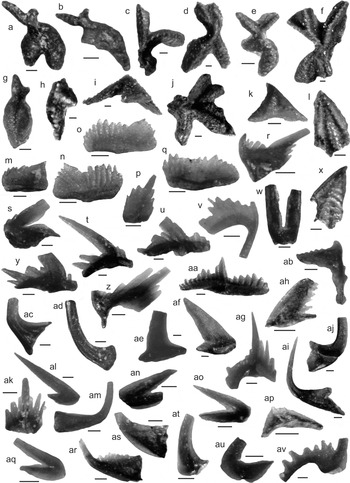
Conodont species recorded in the study section represent the Yangtzeplacognathus crassus, Eoplacognathus pseudoplanus with its M. hagetiana and M. ozarkodella subzones, Eoplacognathus suecicus and Pygodus anserinus zones (Fig. 4). In the entire thickness of the Las Aguaditas Formation, specimens of P. anserinus were recorded as isolated elements as well as on bedding plane surfaces of calcareous shales where they are associated with the index graptolite species Nemagraptus gracilis (Hall).
Darriwilian and Sandbian conodont elements from the Las Chacritas River section. Scale: 0.1 mm. (a–c) Yangtzeplacognathus crassus (Chen & Zhang), San Juan Formation; (a, b) Pa elements, oral view; (a) sample FmSJ-3, ×50, CORD-MP 18218; (b) sample SJ-1, ×80, CORD- MP 29332. (c) Pb element, sample SJ-1, ×50, CORD- MP 29333. (d, i) Polonodus magnus Albanesi, Las Chacritas Formation, sample CHA19, ×40, CORD-MP 29334; (d) oral view; (i) lateral view. (e) Late forms of Eoplacognathus pseudoplanus (Viira), Las Chacritas Formation, Pa element, oral view, sample CHA18, ×80, CORD-MP 29337. (f) Eoplacognathus pseudoplanus (Viira), Las Chacritas Formation, Pa element, oral view, sample CHA14, ×30, CORD-MP 29335. (g) Yangtzeplacognathus sp. A Stouge, Las Chacritas Formation, oral view, sample CHA16, ×60, CORD-MP 29336. (h) Eoplacognathus suecicus Bergström, Las Chacritas Formation, Pa element, oral view, sample LCH55, ×50, CORD-MP 18216. (j) Polonodus newfoundlandensis (Stouge), Las Chacritas Formation, Pa element, oral view, sample CHA19, ×40, CORD-MP 29338. (k) Polonodus sp. Las Chacritas Formation, lateral view, sample CHA12, ×100, CORD-MP 29348. (l, x) Pygodus anserinus Lamont & Lindström, Las Aguaditas Formation, Pa elements, oral view, sample Lag6, ×80, CORD-MP 29339, 29340. (m) Histiodella sinuosa (Graves & Ellison), San Juan Formation, Pa element, lateral view, sample FmSJ0, ×100, CORD-MP 18278. (n, p) Histiodella holodentata Ethington & Clark, Las Chacritas Formation; (n) Pa element, lateral view, sample CHA17, ×100, CORD-MP 29342; (p) Sc element, lateral view, sample CHA16, ×100, CORD-MP 29355. (o) Histiodella kristinae Stouge, Las Chacritas Formation, Pa element, lateral view, sample CHA18, ×100, CORD-MP 29341. (q) Histiodella bellburnensis Stouge, Las Chacritas Formation, Pa element, lateral view, sample QN3, ×90, CORD-MP 18327. (r) Phragmodus sp., Las Aguaditas Formation, lateral view, sample Lag1, ×60, CORD-MP 56. (s, y) Periodon aculeatus Hadding, Las Aguaditas Formation, sample Lag1; (s) M element, lateral view, ×80, CORD-MP 29344; (y) Pa element, lateral view, ×80, CORD-MP 29345. (t, z) Periodon macrodentatus (Graves & Ellison), Las Chacritas Formation; (t) Pa element, lateral view, sample CHA12, ×50, CORD-MP 29347; (z) Sd element, sample CHA17, ×60, CORD-MP 29357. (u) Periodon zgierzensis Dzik, Las Chacritas Formation, Pa element, lateral view, sample CHA18, ×80, CORD-MP 29346. (v) Fahraeusodus marathonensis Bradshaw, Las Chacritas Formation, lateral view, sample CHA16, ×60, CORD-MP 29358. (w) Westergaardodina sp., Las Chacritas Formation, lateral view, sample CHA18, ×100, CORD-MP 29343. (aa) ‘Bryantodina’ aff. typicalis Stauffer, Las Chacritas Formation, P element, lateral view, sample CHA14, ×50, CORD-MP 29353. (ab) Baltoniodus clavatus Stouge & Bagnoli, Las Chacritas Formation, Pa element, lateral view, sample CHA17, ×60, CORD-MP 29359. (ac) Costiconus costatus Dzik, Las Chacritas Formation, lateral view, sample CHA19, ×30, CORD-MP 29360. (ad) Scolopodus striatus Pander, Las Chacritas Formation, lateral view, sample CHA14, ×35, CORD-MP 29365. (ae, af) Drepanoistodus bellburnensis Stouge, Las Chacritas Formation, lateral view; (ae) Sa element, sample CHA14, ×40, CORD-MP 29363; (af) M element, sample CHA17, ×50, CORD-MP 29364. (ag) Microzarkodina hagetiana Stouge & Bagnoli, Las Chacritas Formation, Sa element, anterior view, sample CHA14, CORD-MP 29372. (ah) Oistodella pulchra Bradshaw, San Juan Formation, M element, lateral view, sample FmSJ0, ×50, CORD-MP 19464. (ai, aj) Protopanderodus gradatus Serpagli, Las Chacritas Formation, lateral view; (ai) sample CHA14, ×25, CORD-MP 29352; (aj) sample CHA14, ×40, CORD-MP 29351. (ak) Microzarkodina ozarkodella Lindström, Las Chacritas Formation, Sa element, posterior view, sample CHA14, ×45, CORD-MP 29350. (al) Drepanoistodus tablepointensis Stouge, Las Chacritas Formation, M element, lateral view, sample CHA14, ×40, CORD-MP 29361. (am) Cornuodus longibasis (Lindström), Las Chacritas Formation, lateral view, sample CHA16, ×60, CORD-MP 29362. (an, at) Drepanoistodus costatus Abaimova, Las Chacritas Formation, lateral view, sample CHA17, ×100; (an) M element, CORD-MP 29366; (at) P element, CORD-MP 29367. (ao) Venoistodus balticus Löfgren, Las Chacritas Formation, M element, lateral view, sample CHA15, ×100, CORD-MP 29368. (ap) Gen nov. sp. nov. A, Las Chacritas Formation, P element, lateral view, sample QN2, ×50, CORD-MP 19462. (aq) Venoistodus venustus (Stauffer), Las Aguaditas Formation, lateral view, sample Lag1, ×80, CORD-MP 29373. (ar, as) Ansella jemtlandica Löfgren, Las Chacritas Formation, lateral view, sample CHA 14, ×80; (ar) Sa element, CORD-MP 29369; (as) P element, CORD-MP 29370. (au) Paroistodus originalis (Sergeeva), Las Chacritas Formation, lateral view, sample CHA16, ×100, CORD-MP 29371. (av) Paroistodus horridus (Barnes & Poplawski), Las Chacritas Formation, lateral view, sample CHA17, ×60, CORD-MP 29354.

5.a. Yangtzeplacognathus crassus Zone
The recognition of the lower limit of the Y. crassus Zone is based on the first occurrence of the eponymous species at 3.75 m from the top on the uppermost San Juan Formation, and the upper limit of the zone is defined by the first appearance datum (FAD) of Eoplacognathus pseudoplanus in the Las Chacritas Formation at 36 m above the base. This zone occupies the upper part of the Paroistodus horridus Subzone of the Lenodus variabilis Zone proposed by Albanesi & Ortega (Reference Albanesi, Ortega and Aceñolaza2002) for the biostratigraphic scheme of the Precordillera.
In this study, the first appearance of Y. crassus is contemporaneous with the occurrences (although not first appearances) of L. variabilis, P. horridus, Histiodella sinuosa (Graves & Ellison) and H. holodentata Ethington & Clark. The ranges of these species straddling the contact between the San Juan and the Las Chacritas formations support the recognition of the Y. crassus Zone through the interval that spans a significant change of lithofacies.
The occurrence of Yangtzeplacognathus crassus in this section is significant for intercontinental correlation, because it is used as an index species for the zonal schemes in China and Baltoscandia (Zhang, Reference Zhang1998a , Reference Zhang b ; Löfgren, Reference Löfgren2003; Löfgren & Zhang, Reference Löfgren and Zhang2003; Stouge & Nielsen, Reference Stouge and Nielsen2003). Stouge (Reference Stouge2012) indicates that the P. macrodentatus Zone (H. sinuosa, H. holodentata and H. cf. holodentata subzones) as defined in western Newfoundland corresponds to the upper part of the Y. crassus Zone. Bradshaw (Reference Bradshaw1969) documented the presence of Histiodella sinuosa in association with Oistodella pulchra Bradshaw in the lower and middle members of the Fort Peña Formation exposed in the Marathon Basin in Texas. In the Las Chacritas River section, both species were also found in the top strata of the San Juan Formation allowing a correlation with that part of the Fort Peña Formation. In Baltoscandia and south-central China the Y. crassus Zone is defined by the stratigraphic range of the eponymous species (Reference ZhangZhang, 1998a , Reference Zhang b ). Löfgren & Zhang (Reference Zhang2003) reported that Y. crassus first appears in association with L. variabilis, similar to our records, and disappears in the basal part of the interval bearing few specimens of E. pseudoplanus.
The associated conodont fauna of this zone includes Ansella jemtlandica (Löfgren), Baltoniodus medius (Dzik), Baltoniodus clavatus Stouge & Bagnoli, ‘Bryantodina’ aff. typicalis (Stauffer), Coelocerodontus bicostatus, C. trigonius, Cornuodus longibasis (Lindström), Decoriconus sp., Drepanoistodus tablepointensis Stouge, Drepanoistodus forceps (Lindström), Drepanodus arcuatus Pander, Erraticodon alternans (Hadding), Fahraeusodus marathonensis (Bradshaw), Histiodella sinuosa, H. holodentata, Juanognathus jaanussoni Serpagli, Lenodus variabilis, Microzarkodina hagetiana, Parapaltodus simplicissimus Stouge, Paroistodus horridus, P. originalis (Sergeeva), Paltodus jemtlandicus Löfgren, Periodon macrodentatus (Graves & Ellison), Protopanderodus gradatus Serpagli, Rossodus barnesi Albanesi, Scolopodus striatus (Lindström) and Semiacontiodus potrerillensis Albanesi.
5.b. Eoplacognathus pseudoplanus Zone
In the Las Chacritas Formation samples CHA11 to CHA18 yielded abundant Pa and Pb elements of E. pseudoplanus allowing the recognition of the eponymous zone. The E. pseudoplanus Zone ranges from 36 m above the base of the Las Chacritas Formation up to the first appearance of E. suecicus at 58 m from the base of the unit.
This interval also includes the following species: A. jemtlandica, C. bicostatus, C. trigonius, Costiconus costatus Dzik, C. longibasis, Decoriconus sp., Drepanoistodus basiovalis (Sergeeva), D. tablepointensis, F. marathonensis, H. holodentata, H. kristinae Stouge, M. hagetiana, M. ozarkodella Lindström, P. simplicissimus, P. horridus, P. macrodentatus, Polonodus newfoundlandensis Stouge, Polonodus sp., P. gradatus, S. potrerillensis and Westergaardodina sp.
In the studied section, stratigraphically late forms of E. pseudoplanus were recorded at 53.5 m above the base of the Las Chacritas Formation (sample CHA17) and E. pseudoplanus and E. suecicus coexist in the same sample (CHA18) at 55.6 m from the base, where late forms of E. pseudoplanus exhibit great similarity to early forms of E. suecicus. A direct evolutionary relationship between these species was suggested by Zhang (Reference Zhang1999) based on similar records in her collections.
The first appearance of Microzarkodina ozarkodella defines the base of the upper subzone of the E. pseudoplanus Zone (Reference ZhangZhang, 1998b ; Löfgren, Reference Zhang2004). The occurrence of this species in the Las Chacritas Formation supports a correlation with the E. pseudoplanus Zone as defined in Baltoscandia. A number of typical taxa of this zone, such as Ansella jemtlandica, Costiconus costatus, Drepanodus arcuatus, Drepanoistodus spp., Histiodella holodentata, Parapaltodus simplicissimus, Protopanderodus gradatus and Semiacontiodus potrerillensis, frequently occur in this interval, which is a similar conodont association of the correlative interval in Baltoscandia as described by Löfgren (Reference Löfgren2004).
At Las Chacritas, H. kristinae first appears at the top part of the E. pseudoplanus Zone. This is in agreement with Zhang Reference Zhang(1998a) who documents the replacement of H. holodentata by H. kristinae in her study area. Löfgren (Reference Löfgren2004) recorded H. holodentata and H. kristinae as co-occurring in the upper part of the E. pseudoplanus Zone in Sweden as well. These data allow for a correlation not only with China and Baltoscandia but also with the uppermost part of the Table Point Formation of the Table Head Group in western Newfoundland, where Stouge (Reference Stouge1984) demonstrated the same evolutionary succession in this interval. Based on Stouge (Reference Stouge2012) data, the first appearance of P. macrodentatus, H. holodentata and then H. kristinae in successively younger strata are useful for a precise correlation with the succession in Newfoundland.
5.c. Eoplacognathus suecicus Zone
The base of this zone is located in the upper Las Chacritas Formation, at 55.6 m above the base in the study section (Sample CHA19) where early forms of this species are associated with late forms of E. pseudoplanus. Reference Zhang and SzaniawskiZhang (1998c) subdivided the E. suecicus Zone into the Pygodus lunnensis and P. anitae subzones; the record of Polonodus magnus Albanesi, Reference Albanesi1998 (senior synonym of Pygodus lunnensis Reference Zhang and SzaniawskiZhang 1998c ) allows the identification of the lower E. suecicus subzone for the interval in our section. The E. suecicus Zone was initially recognized in the Argentine Precordillera by Hünicken & Ortega (Reference Hünicken, Ortega and Austin1987) in the Los Azules Formation at Cerro Viejo of Huaco.
The key species E. suecicus and H. kristinae recorded here allow for correlation with the E. suecicus Zone from Baltoscandia, and with the H. kristinae Zone as defined by Stouge (Reference Stouge1984) for western Newfoundland. The presence of H. bellburnensis Stouge in the top strata of the Las Chacritas Formation supports correlation with the Periodon zgierzensis Zone of the Table Point Group in western Newfoundland, as this zone was recently defined by Stouge (Reference Stouge2012).
The index species E. suecicus has been shown to be biostratigraphically useful since its first description by Bergström (Reference Bergström, Sweet and Bergström1971). It displays a wide geographic distribution having been documented in Baltoscandia (Viira, Reference Viira1967, Reference Viira1974; Bergström, Reference Bergström, Sweet and Bergström1971; Löfgren, Reference Löfgren1978), North America (Harris et al. Reference Harris, Bergström, Ethington and Ross1979), and north China (An & Zheng, Reference An and Zheng1990). The species taxonomy was thoroughly reviewed by Zhang (Reference Zhang1999).
This zone has also been identified in diverse strata of the Precordillera, such as the Gualcamayo Formation in the Villicum Range (Sarmiento, Reference Sarmiento1991) and the Cerro Potrerillo (Albanesi, Hünicken & Barnes, Reference Albanesi, Hünicken and Barnes1998), the lower part of the Sierra de La Invernada Formation (Ortega et al. Reference Ortega, Albanesi, Banchig and Peralta2008), and the Yerba Loca Formation (Albanesi, Benedetto & Gagnier, Reference Albanesi, Benedetto and Gagnier1995). Although E.D. Brussa (unpub. thesis, Universidad Nacional de Córdoba, 1994) reported the E. suecicus Zone from the Las Aguaditas Formation, recent studies by Albanesi et al. (Reference Albanesi, Bergström, Schmitz, Serra, Feltes, Voldman and Ortega2013) and Feltes, Albanesi & Bergström (Reference Feltes, Albanesi, Bergström, Albanesi and Ortega2013) indicate the presence of a hiatus that probably covers the interval from the top part of the E. pseudoplanus through the E. suecicus and the Pygodus serra zones up to the lower P. anserinus Zone in the Las Aguaditas Formation as its type locality.
In our study collections, the E. suecicus Zone yields a conodont association including A. jemtlandica, B. clavatus, C. longibasis, Drepanoistodus basiovalis, D. costatus, F. marathonensis, H. kristinae, H. bellburnensis, P. simplicissimus, P. horridus, P. originalis, P. macrodentatus, P. zgierzensis, P. gradatus, Polonodus sp., P. magnus and Gen. nov. sp. nov. A.
5.d. Pygodus anserinus Zone
The P. anserinus Zone is identified in the Las Aguaditas Formation at the Las Chacritas River section by the record of the homonymous species and associated forms. The lowest productive sample is from the base of the formation, where elements of P. anserinus were found on bedding plane surfaces of shales associated with Nemagraptus gracilis, and isolated elements were recovered from all samples of this zone. The uppermost sample was taken 10 m above the base, just at the top of the Las Aguaditas Formation, where the specimens were found either isolated from mudstone or on bedding planes. The occurrence of P. anserinus and N. gracilis clearly demonstrates that these strata correspond to the upper part of the P. anserinus Zone of early Sandbian age. The associated conodont fauna includes Baltoniodus variabilis (Bergström), Costiconus ethingtoni (Fåhraeus), Drepanoistodus suberectus (Branson & Mehl), Drepanodus sp., Phragmodus sp., Protopanderodus varicostatus (Sweet & Bergström), Periodon aculeatus Hadding and Venoistodus venustus (Stauffer).
P. anserinus has been documented from several localities of the Argentine Precordillera; for example, Heredia (Reference Heredia1982) published the first report of this species form the San Rafael Block, where the lower boundary of the zone was determined by Lehnert et al. (Reference Lehnert, Bergström, Keller and Bordonaro1999). The upper boundary was recorded in the Las Aguaditas Formation, Precordillera of San Juan, by the FAD of Amorphognathus tvaerensis (Lehnert, Reference Lehnert1995; Albanesi & Ortega, Reference Albanesi and Ortega1998). In the latter formation, the P. anserinus Zone was recently described by Albanesi et al. (Reference Albanesi, Bergström, Schmitz, Serra, Feltes, Voldman and Ortega2013) and Feltes, Albanesi & Bergström (Reference Feltes, Albanesi, Bergström, Albanesi and Ortega2013) at the Las Aguaditas section.
5.e. Comments on previous conodont studies
Previous conodont studies of the San Juan and Las Chacritas formations have shown that these units are middle Darriwilian in age. In our study area, Albanesi & Astini (Reference Albanesi and Astini2000) recorded the E. pseudoplanus Zone in the uppermost part of the San Juan Formation up to 49.5 m above the base of the Las Chacritas Formation. Subsequently, Heredia (Reference Heredia2012) found the basal part of the Las Chacritas Formation to be barren and recovered the first conodont specimens 2 m above the base, including the index species E. pseudoplanus. The E. pseudoplanus Zone (Heredia, Reference Heredia2012) and the E. pseudoplanus/D. tablepointensis Zone (Heredia, Beresi & Peralta, Reference Heredia, Beresi and Peralta2005) were recorded at the contact between the San Juan and Las Chacritas formations, and alternative schemes for this section were published (Heredia, Beresi & Peralta, Reference Heredia, Beresi and Peralta2005, Reference Heredia, Beresi and Peralta2011).
Based on this new data, the contact between the San Juan and Las Chacritas formations corresponds to the Y. crassus Zone. This species is well documented from the upper part of the San Juan Formation, but it decreases in abundance and disappears in the basal part of the Las Chacritas Formation. We also recorded a diverse conodont fauna from the lower part of the formation. Supporting our findings, the brief report by Feltes et al. (Reference Feltes, Serra, Albanesi and Voldman2014) verifies the occurrence of Y. crassus as documented by various authors from the upper San Juan Formation and overlying strata at diverse localities of the Central Precordillera including La Chilca, Las Chacritas, Las Aguaditas, Oculta creek and the Viejo de Huaco Mountain.
Heredia (Reference Heredia2012) documented the appearance of late forms of E. suecicus at 7 m above the base of the Las Chacritas Formation and suggested a possible hiatus in the first metres of the formation due to the absence of early or intermediate forms of E. suecicus. In our study, the E. pseudoplanus Zone with the M. hagetiana and M. ozarkodella subzones are defined in the middle part of the Las Chacritas Formation, followed by the E. suecicus Zone at the top strata of the formation. According to our analysis, in the transition between the E. pseudoplanus and E. suecicus zones early forms of E. suecicus are recorded; any lithological discontinuity is not verified to support the hiatus suggested by Heredia (Reference Heredia2012) and Heredia, Beresi & Peralta (Reference Heredia, Beresi and Peralta2011).
6. Graptolite biostratigraphy and correlation
The sampled interval for graptolites included the Las Chacritas and the Las Aguaditas formations spanning the upper Darriwilian – lower Sandbian stages. The ranges of species recorded through these units are shown in Figure 3.
The base of the Nemagraptus gracilis Zone is recognized by the appearance of the N. gracilis fauna including the eponymous species, which marks the beginning of the Sandbian Stage. Index graptolite species from the topmost Darriwilian strata were not found; nevertheless, a Darriwilian biostratigraphy could be established by conodont studies. The graptolites from the Las Chacritas Formation are rare and the preservation of the tubaria is poor; however, they provide significant palaeontological data for this group in outer ramp deposits of this formation. Conversely, in the Las Aguaditas Formation the graptolites are abundant, diverse and useful fossils for biostratigraphy.
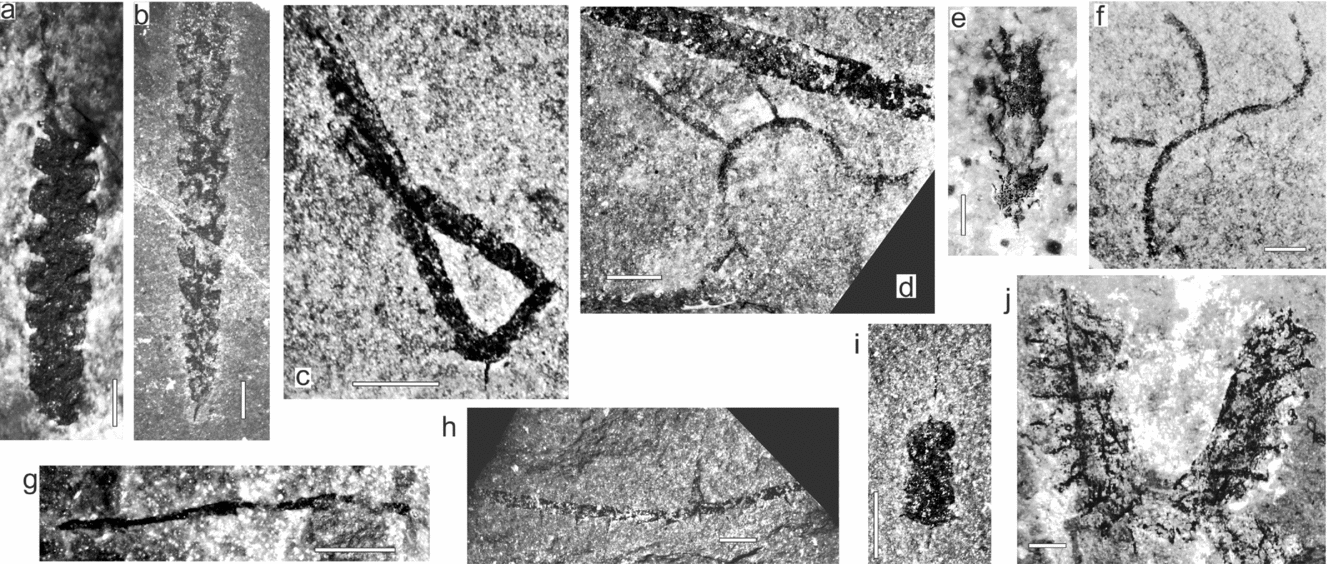
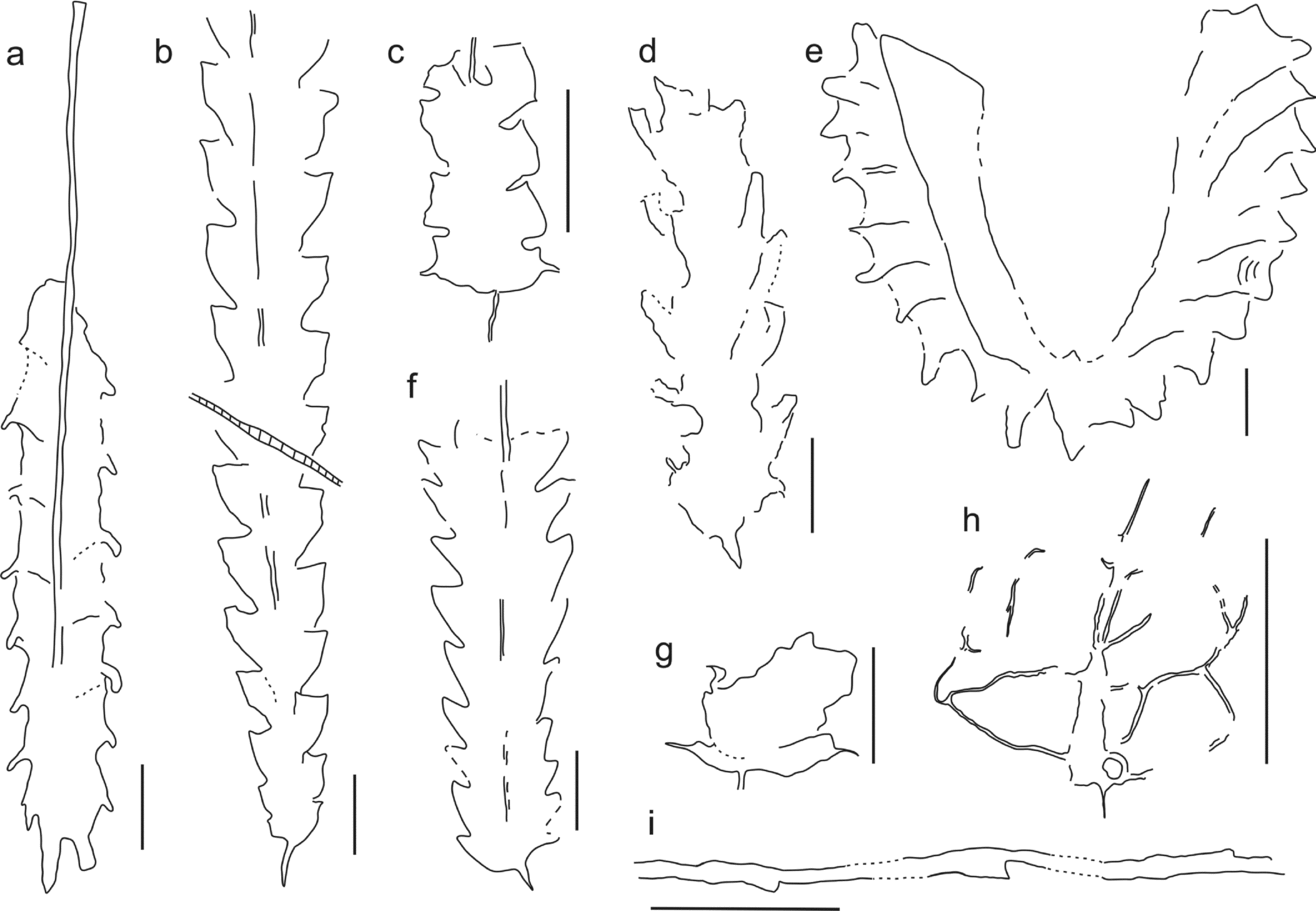
Fragments of stipes and siculas were recovered from K-bentonite layers at the base of the Las Chacritas Formation (Y. crassus Zone). Specimens of Tetragraptus sp. are present in the lower and middle parts of the unit (Figs 5j, 6e), although only mature colonies were recovered. Poorly preserved stipes that do not show much detail were found a few metres above, some of which could be identified as Acrograptus? sp., but no proximal ends were found to permit identification at the species level (Figs 5g, 6i). In the middle and upper part of this formation scandent tubaria of Levisograptus? sp. were recorded (Figs 5e, 6d, g). Although the graptolite fauna is scarce, the association of this species with E. pseudoplanus suggests an age equivalent to the Holmograptus lentus Zone of the Argentine Precordillera (Ortega, Albanesi & Frigerio, Reference Ortega, Albanesi and Frigerio2007).
Darriwilian and Sandbian graptolites from the Las Chacritas River section. Scale: 1 mm. (a) Pseudoclimacograptus sp., Las Aguaditas Formation, sample Lag7, CORD-PZ 33552. (b) Normalograptus sp., Las Aguaditas Formation, sample Lag1, CORD-PZ 33580. (c) Dicellograptus sp., Las Aguaditas Formation, sample Lag1, CORD-PZ 33563. (d, f) Nemagraptus gracilis Hall, Las Aguaditas Formation; (d) sample Lag1, CORD-PZ 33581; (f) sample Lag2, CORD-PZ 33550. (e) Levisograptus? sp., Las Chacritas Formation, sample CHA17, CORD-PZ 33576. (g) Acrograptus? sp., Las Chacritas Formation, sample CHA2, CORD-PZ 33575. (h) Leptograptus sp., Las Aguaditas Formation, sample Lag1, CORD-PZ 33582. (i) Archiclimacograptus? sp., Las Aguaditas Formation, sample Lag1, CORD-PZ 33569. (j) Tetragraptus sp., Las Chacritas Formation, sample LCH4, CORD-PZ 33574.

Camera lucida drawings of Darriwilian and Sandbian graptolites from the Las Chacritas River section. (a) Cryptograptus schaeferi Lapworth, Las Aguaditas Formation, sample Lag2, CORD-PZ 33561. (b) Normalograptus sp., Las Aguaditas Formation, sample Lag1, CORD-PZ 33580. (c) Archiclimacograptus? sp., Las Aguaditas Formation, sample Lag1, CORD-PZ 33569. (d) Levisograptus? sp., Las Chacritas Formation, sample CHA17, CORD-PZ 33576. (e) Tetragraptus sp., Las Chacritas Formation, sample LCH4, CORD-PZ 33574. (f) Hustedograptus sp., Las Aguaditas Formation, sample Lag1, CORD-PZ 33544. (g) Levisograptus? sp., Las Chacritas Formation, sample CHA15, CORD-PZ 33583. (h) Reteograptus geinitzianus Hall, Las Aguaditas Formation, sample Lag1, CORD-PZ 33511. (i) Acrograptus? sp. Las Chacritas Formation, sample CHA2, CORD-PZ 33575.

6.a. Nemagraptus gracilis Zone
Specimens of N. gracilis (Fig. 5d, f) were recorded in the basal and top strata of the Las Aguaditas Formation. The graptolite fauna that accompanies this species consists of Glossograptus ciliatus Emmons, Cryptograptus schaeferi Lapworth (Fig. 6a), Pseudoclimacograptus sp. (Fig. 5a), Normalograptus sp. (Figs 5b, 6b), Dicellograptus sp. (Fig. 5c), Leptograptus sp. (Fig. 5h), Archiclimacograptus? sp. (Figs 5i, 6c), Reteograptus geinitzianus Hall (Fig. 6h) and Hustedograptus sp. (Fig. 6f). This association indicates the N. gracilis Zone, and the common presence of P. anserinus enables us to conclude that these strata belong to the basal part of the zone which is early Sandbian in age.
This zone is reported from several localities in the Argentine Precordillera. In Central Precordillera it is identified in the Los Blanquitos section (Las Aguaditas Formation; Brussa, Reference Brussa1996), Sierra de la Invernada (Sierra de la Invernada Formation; Ortega et al. Reference Ortega, Albanesi, Banchig and Peralta2008), Cerro La Chilca (Los Azules Formation; Blasco & Ramos, Reference Blasco and Ramos1976) and El Tontal Range (Portezuelo del Tontal Formation; Cuerda, Reference Cuerda1986; Peralta et al. Reference Peralta, Pöthe de Baldis, León, Pereyra, Ortega and Aceñolaza2003). It was also documented in the Western Precordillera in the Yerba Loca Formation, in the Jáchal River section (Blasco & Ramos, Reference Blasco and Ramos1976) and in the Eastern Precordillera in the La Cantera Formation, Villicum Range (Peralta, Reference Peralta1993).
This graptolite fauna has a worldwide distribution (Baltic region, Great Britain, North America, Australasia, China, South America) (Finney, Reference Finney1986; Finney & Bergström, Reference Finney, Bergström, Hughes and Rickards1986). Its presence in the Argentine Precordillera was discussed by Ortega & Brussa (Reference Ortega and Brussa1990) and Ortega & Albanesi (Reference Ortega and Albanesi1998). New information about the N. gracilis Zone in Peru, Bolivia and Venezuela extends its record to other parts of South America (Brussa et al. Reference Brussa, Maletz, Mitchel and Goldman2007; Gutiérrez-Marco et al. Reference Gutiérrez-Marco, Mansilla Plaza, Rábano and García-Bellido2011).
7. Conodont palaeoecology
Conodonts are abundant and of high diversity through the contact interval between the San Juan and the Las Chacritas formations, as is the case for the middle–upper part of the Las Chacritas Formation. A decline in the relative abundance of most taxa is observed near the base of the Las Chacritas Formation and the presence of some prominent forms, such as Paroistodus horridus, Periodon macrodentatus, Ansella jemtlandica and Fahraeusodus marathonensis, indicates a change in the environmental conditions. The major part of the carbonate sequence is dominated by P. macrodentatus and P. horridus.
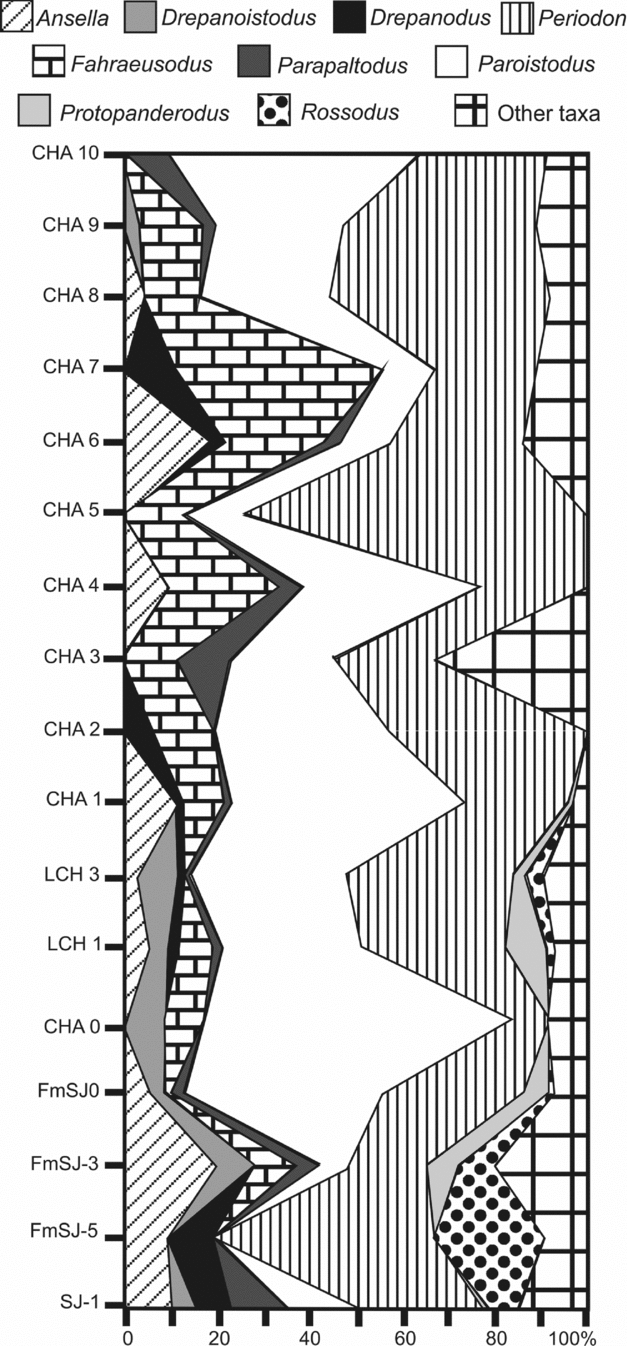
A total of 2179 conodont elements were counted from the Y. crassus Zone. The proportion of Y. crassus ranges between 0.32 and 2.80% per sample, with a maximum in the upper 1 m of the San Juan Formation and the first 2 m of the Las Chacritas Formation. Periodon macrodentatus and Paroistodus horridus are by far the most abundant taxa in the Y. crassus Zone, at 37.90% and 37.67% respectively. At the top of the San Juan Formation, the species P. horridus is more abundant (40%) than P. macrodentatus (29%); in the lower 30 m of the Las Chacritas Formation however, the latter species contributes the highest percentage (30–67%) in all samples. Other taxa, such as A. jemtlandica (7.57%), P. gradatus (6.96%) and F. marathonensis (6.35%), are less common but appear in all the samples of this zone (Fig. 7). Periodon and Paroistodus are both considered indicators of high sea levels or cold-water environments (Rasmussen & Stouge, Reference Rasmussen, Stouge, Cooper, Droser and Finney1995). The presence of Ansella and Protopanderodus further supports an outer shelf-slope setting, which characterizes the deep-water Protopanderodus–Periodon Biofacies as defined by Rasmussen & Stouge (Reference Rasmussen, Stouge, Cooper, Droser and Finney1995).
Sampled levels and relative abundance of conodont taxa in the Y. crassus Zone.

From the conodont collection with 4092 specimens recorded in the E. pseudoplanus Zone, Paroistodus horridus and Periodon macrodentatus are the most abundant species representing 40% and 23%, respectively (Fig. 8). The next most abundant taxa are Protopanderodus gradatus (10%), Parapaltodus simplicissimus (4.40%), Drepanoistodus spp. (4%), Ansella jemtlandica (3%) and Polonodus sp.(0.9%) that are common in western Newfoundland (Stouge, Reference Stouge1984) and in south-central China Reference Zhang(Zhang, 1998a ) from deeper sea environments. The presence of Histiodella spp. (2.80% in abundance) reflects North American affinities, suggesting similar environmental conditions. According to Löfgren (Reference Löfgren2004), the occurrence of Histiodella is related to transgressions; this is in accordance with the associated conodonts of our E. pseudoplanus Zone, which can be interpreted as indicative of deep-water environments.
Sampled levels and relative abundance of conodont taxa in the E. pseudoplanus Zone.

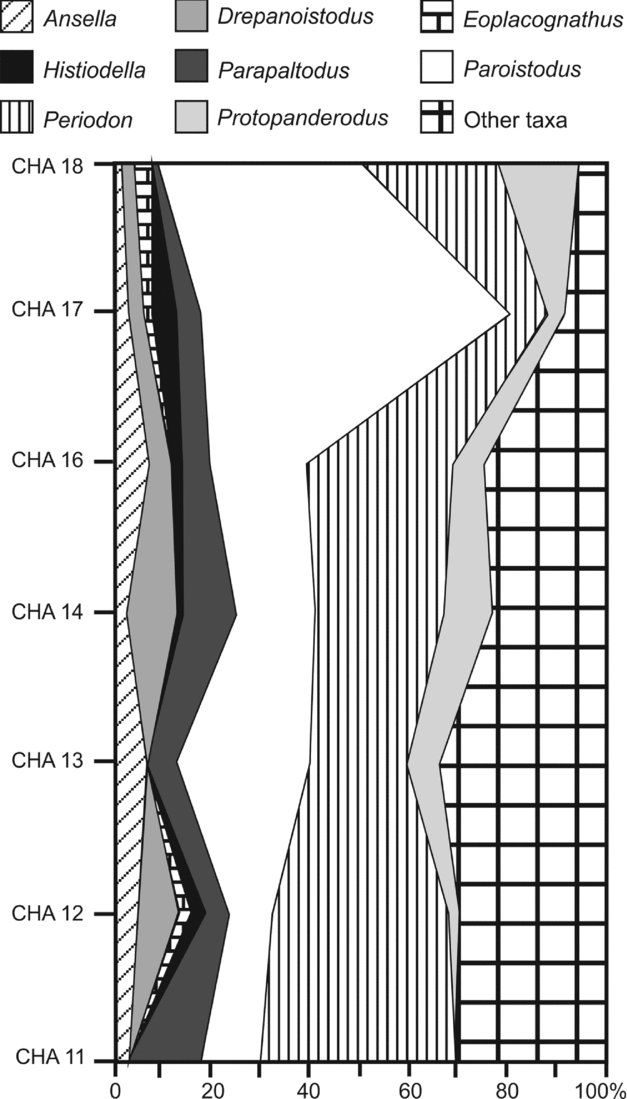
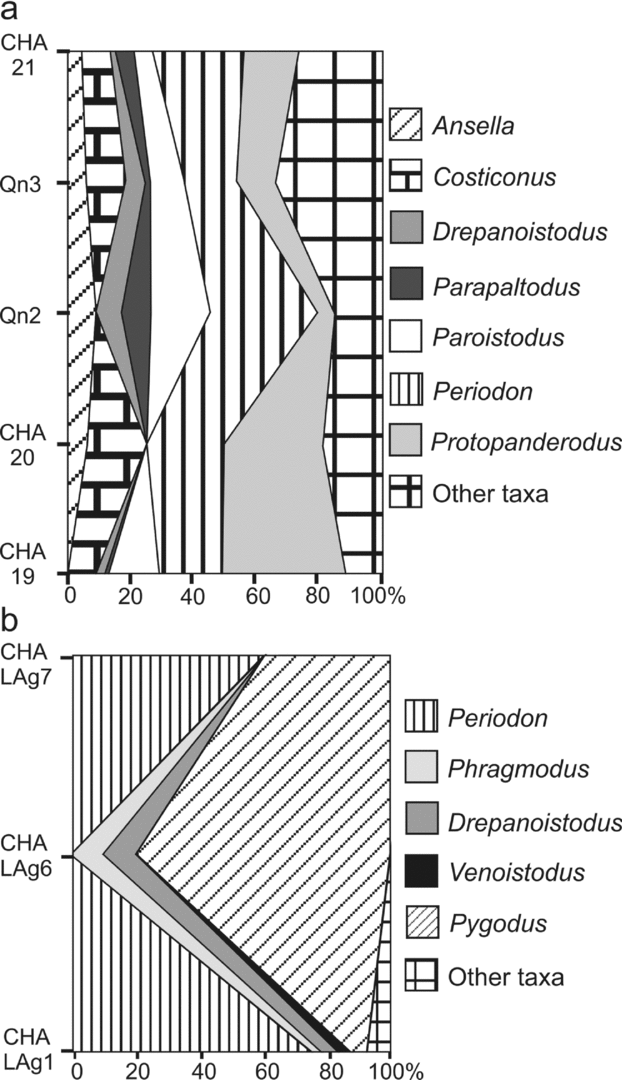
Among the 837 conodont elements recovered from the E. suecicus Zone the most abundant species is Protopanderodus gradatus, which represents the 24.4% of the total taxa. P. macrodentatus (21.9%), P. horridus (13.6%) and Costiconus costatus (6.9%) follow in abundance (Fig. 9a). The presence of these taxa is related to transgressive events (Pohler, Reference Pohler1994), and they were recognized by Stouge (Reference Stouge1984) as characteristic taxa of the Periodon–Cordylodus (=Paroistodus) Biofacies which represents shelf edge to slope environments.
Sampled levels and relative abundance of conodont taxa: (a) E. suecicus Zone; (b) P. anserinus Zone.

A collection of 179 conodont specimens was recovered from the P. anserinus Zone. The most abundant species is Periodon aculeatus, which represents 70.4% of the total conodont fauna. P. anserinus (10.06%), D. suberectus (5.03%) and V. venustus (3.91%) follow in abundance (Fig. 9b). In comparison to the previous zones, the conodont fauna of the P. anserinus Zone is less diverse and abundant and graptolites become the dominant fossils. The lithology consists of grainstones–packstones interbedded with mudstones and black shales. These facts suggest a significant environmental change caused by different water depth conditions, being a deeper facies compared to that of the Las Chacritas Formation.
7.a. Relative abundance of principal genera
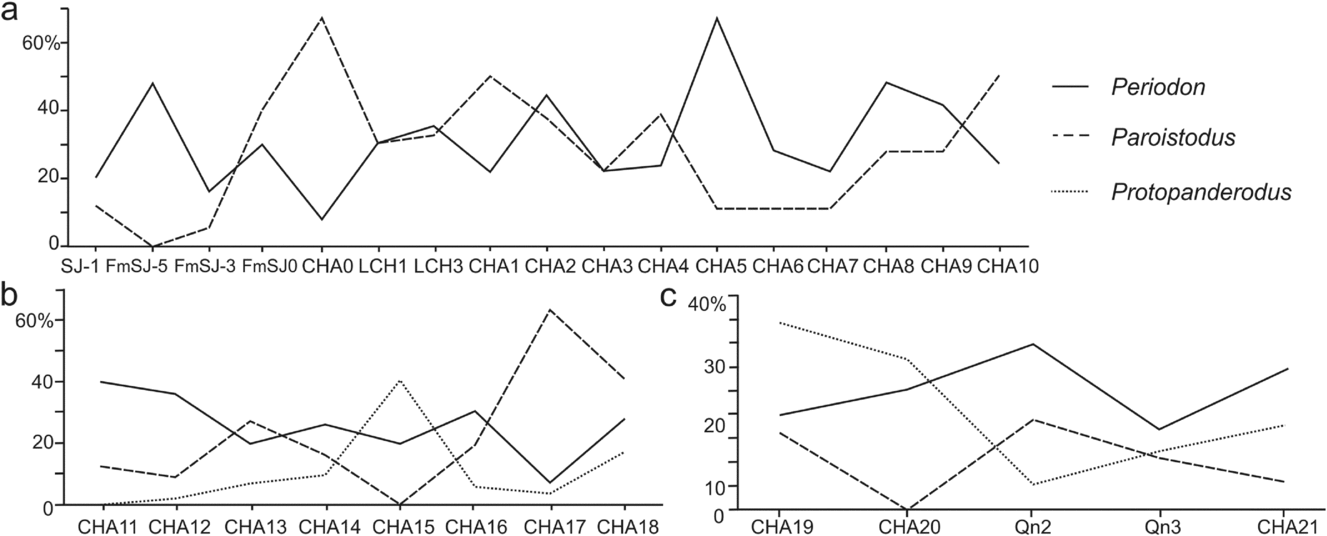
The relative abundance logs displayed here are based on the relative abundance of the major conodont genera for each zone. In the Y. crassus Zone, Periodon shows four major peaks while Paroistodus shows up to three; in both cases these are spread over several samples (Fig. 10a). Periodon represents the most abundant taxon in the uppermost strata of the San Juan Formation (samples SJ-1, FmSJ-5 and FmSJ-3) and in the middle and top parts of this zone (samples CHA2 and CHA5–CHA9). However, this trend changes upwards in the succession where Paroistodus becomes more abundant at the base of the Las Chacritas Formation (samples LCH3-CHA1 and CHA4) and at the top of the first zone (sample CHA10). An antithetical relationship is determined by the increase of one species and the concomitant decrease of the other although both taxa are typical of deep, proximal to distal slope environments. Paroistodus represents a biotope constrained to lower temperatures or deeper conditions compared to Periodon, which indicates pulses of depth change to deeper environments. The lithofacies in these strata are made up of nodular limestones in the upper San Juan Formation and ribbon limestone interbedded with black shales in the basal part of the Las Chacritas Formation, indicating a change of environments that is interpreted as a transition to deeper-water facies.
Relative abundance logs based on the relative abundance of the major conodont genera in each zone, Periodon, Paroistodus and Protopanderodus, from the Y. crassus, E. pseudoplanus and E. suecicus zones.

Periodon is the dominant genus through most of the E. pseudoplanus Zone, although Paroistodus becomes more common than Periodon in abundance and remains the dominant taxon (Fig. 10b) at the top of the zone (sample CHA17). Protopanderodus is the next most common taxon and shows a main increase phase in the middle part of the zone (sample CHA15). At this level Periodon decreases, whereas Paroistodus disappears for the only time in the zone. These genera are representative of deep facies, although the lithology indicates a shallower setting compared to that of the previous zone.
At the base of the E. suecicus Zone the Paroistodus–Periodon association is replaced by Protopanderodus as the most abundant (Fig. 10c). This relation is reversed in sample Qn2 where Periodon and Paroistodus reappear with peaks of high abundance, the former being the highest. Samples Qn3 and CHA 21 were taken from the top part of the Las Chacritas Formation in different outcrops of the formation. The lithology and conodont fauna composition of this zone are similar to that of the E. pseudoplanus Zone, suggesting similar environmental conditions.
8. Conclusions
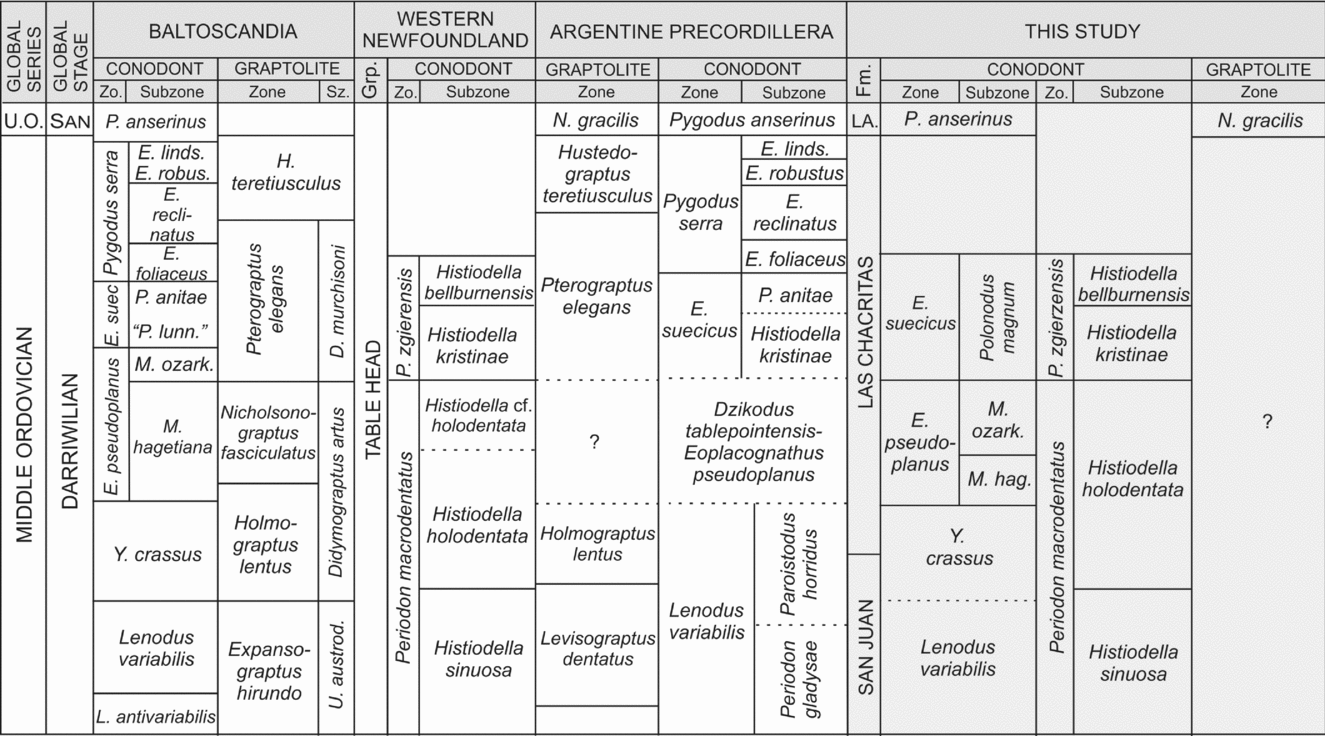
Based on this study a new conodont–graptolite biostratrigraphic scheme is compiled for the Middle–Late Ordovician Las Chacritas River section in the Central Precordillera (Fig. 11).
Stratigraphic chart of the Middle Ordovician section showing correlations between the main graptolite and conodont zonal schemes. After Zhang (1998c), Löfgren & Zhang (Reference Löfgren and Zhang2003) and Stouge (Reference Stouge1984, Reference Stouge2012) for reference zonations, Albanesi & Ortega (Reference Albanesi, Ortega and Aceñolaza2002), Heredia et al. (Reference Heredia, Beresi and Peralta2005) and present work for the Argentine Precordillera. Abbreviations: LA – Las Aguaditas; UO – Upper Ordovician; SAN – Sandbian; Zo. – Zone; Sz. – Subzone; Grp – Group; Fm. – Formation.

The four Middle–Upper Ordovician conodont zones identified in the study area are (in ascending order): the Yangtzeplacognathus crassus, Eoplacognathus pseudoplanus, Eoplacognathus suecicus and Pygodus anserinus zones. A detailed conodont biostratigraphic scheme is based on the records of not only the index species but also other significant chronostratigraphic markers such as Microzarkodina hagetiana, M. ozarkodella, P. magnus, P. newfoundlandensis, Histiodella sinuosa, H. holodentata, H. kristinae, H. bellburnensis, Periodon macrodentatus, P. zgierensis and P. aculeatus.
The conodont fauna from the Las Chacritas River section shows both Baltic and Laurentian provincial affinity. Yangtzeplacognathus and Eoplacognathus species are less frequently represented in the studied units, while the Histiodella and Periodon evolutionary stages proved to be additional aids for correlation. Yangtzeplacognathus sp. A, identified by Stouge (Reference Stouge2012) from the Cow Head Group, was found in association with H. holodentata and P. macrodentatus in the Las Chacritas Formation. The faunal similarity between the Las Chacritas River section and the Cow Head Group further suggests that the Periodon zones and their Histiodella subzones defined by Stouge (Reference Stouge2012) may offer potential for intercontinental biostratigraphic correlation, and should be considered for conodont biostratigraphy and palaeobiogeographic analysis of the Middle Ordovician Precordillera.
The Nemagraptus gracilis Zone is identified through the Las Aguaditas Formation in the Las Chacritas River section. According to our records, this formation is Sandbian in age and correlates with the middle member of the Las Aguaditas Formation in its type section at the Las Aguaditas Creek in the Los Blanquitos Range.
Based on the conodont and graptolite faunas, the interval from the top part of the San Juan Formation and through the Las Chacritas Formation corresponds to the Darriwilian Stage. The Las Aguaditas Formation in the Las Chacritas River section belongs to the Sandbian Stage. The new biozonation allows for a precise global correlation with other regions, for example China, Baltoscandia, North America, Great Britain, Southern Australia and New Zealand. Moreover, the presence of a hiatus between the Las Chacritas and the Las Aguaditas formations, spanning the upper Darriwilian interval (involving the P. serra conodont Zone and the P. elegans and H. teretiusculus graptolite zones), is indicated by the records of E. suecicus at the top part of the Las Chacritas Formation and of P. anserinus and N. gracilis at the base of the Las Aguaditas Formation.
Environmental depositional settings are interpreted based on analysis of the lithology and relative abundance logs of conodont genera for each zone. Periodon, Paroistodus and Protopanderodus are the major components of the faunas from the San Juan and Las Chacritas formations, whereas Periodon and Paroistodus maintain an antithetical relationship throughout most of the unit. The main taxa indicate deep-water settings for all of the zones. The lithofacies in the top part of the San Juan Formation is of nodular limestones, whereas ribbon limestone interbedded with black shales are characteristic of the basal part of the Las Chacritas Formation, suggesting a change in environmental conditions to deeper-water facies. Black-shale deposits are absent in the middle and upper portions of this formation, which represent a slightly less deep environment. We document graptolite taxa for the first time from the shallow, outer ramp deposits of the Las Chacritas Formation. Conodont elements from the Las Aguaditas Formation are less frequent with Periodon aculeatus as the most abundant species, while graptolites tend to be abundant in the whole unit with Dicellograptus, Leptograptus and Nemagraptus as the dominant genera. Carbonate siltstones with a high percentage of organic matter, graptolitic facies and the presence of Periodon in high abundance suggest a further deepening of the basin after the hiatus that separates the upper part from the underlying sequence.
Acknowledgements
This study is part of the doctoral thesis of the senior author; we acknowledge the support from the CICTERRA (CONICET-UNC), Museo de Paleontología and CIGEA (FCEFyN-UNC). The research was funded by grants of the SECYT-UNC. We wish to acknowledge the valuable help given by biologist Nicolás A. Feltes. Comments and corrections by the reviewers, Svend Stouge and an anonymous reviewer, significantly improved our manuscript and are greatly appreciated.
Supplementary material
To view supplementary material for this article, please visit http://dx.doi.org/10.1017/S0016756814000752