Introduction
Japan and Taiwan face an unprecedented situation regarding their rapidly growing elderly populations. In 2013, Japanese elderly (65 years old and older) had reached 25% of total population and could be found in approximately one in the four people (Statistic Bureau, Ministry of Internal Affairs and Communications of Japan, 2013). It is estimated that 38.8% of the Japanese population will be 65 years of age or older in 2050. Similarly, Taiwan is encountering a dramatic increase in the proportion of the elderly. In 2011, Taiwanese elderly accounted for 11% of the population, and were estimated to exceed 14% in 2017 and reach 20% by 2019 (Council for Economic Planning and Development of Taiwan, 2008). Although the proportion of the elderly in Taiwan is not greater than that seen in Japan, the elderly population in Taiwan is the fastest growing, and Taiwan is predicted to be one of the most aged societies by 2050 (approximately 40%). Along with the growth of the middle aged and elderly populations, it is predicted that the incidence of age-related diseases will increase. Therefore, it will be more important than ever to address the geriatric diseases in both countries.
Of the geriatric diseases, dementia is one of the diseases which bring a severe burden to caregivers and to society. Notably, AD is the most common cause of degenerative and progressive cognitive impairment in both Japan and Taiwan (Liu et al., Reference Liu1995, Reference Liu, Lin, Chen, Tai, Yen and Howng1996; Reference Liu, Lai, Tai, Lin, Yen and Howng1998; Lin et al., Reference Lin, Lai, Tai, Liu, Yen and Howng1998; Asada, Reference Asada2012). AD is characterized by the impairment of memory and temporal and/or spatial disorientations such as a difficulty in remembering dates and getting lost (Pai and Jacobs, Reference Pai and Jacobs2004; Pai, Reference Pai2006; Pai et al., Reference Pai2012). Since the symptoms involved with dementia interfere with the self-supporting life and everyday activities, individual with dementia requires long-term home care, usually by the spouse or relatives; and often induces CB as a consequence.
CB has been defined as “the physical, psychological or emotional, social, and financial problems that can be experienced by family members caring for impaired older adults”, and is possibly influenced by ethnical, cultural, and social contexts (George and Gwyther, Reference George and Gwyther1998; Salguero et al., Reference Salguero, Kohn, Salguero and Marotta1998). A cross-cultural study that examined the cultural differences in CB of AD between Guatemalans and Americans found that Guatemalan caregivers had less institutional service (e.g. institutional respite care) and more informal support by relatives than Americans (Salguero et al., Reference Salguero, Kohn, Salguero and Marotta1998). Consequently, it is suggested that there is a higher level of CB in Guatemala (Salguero et al., Reference Salguero, Kohn, Salguero and Marotta1998). In Taiwan, Huang and co-workers (Reference Huang, Shyu, Chang, Weng and Lee2009) reported that 89% of caregivers had never used respite care, and 65% of the caregivers did not know about respite care (Huang et al., Reference Huang, Shyu, Chang, Weng and Lee2009). In Japan, Ono and colleagues (Reference Ono, Tamai, Takeuchi and Tamai2014) reported that 76% of the patients with dementia applied for long-term care service during participating study (Ono et al., Reference Ono, Tamai, Takeuchi and Tamai2014). The publicity of service for people with dementia in Taiwan seems to be relatively lower than that in Japan according to these studies. Because there is a difference in the social situations between Japan and Taiwan, the way of feeling the CB of the people with dementia might differ across two countries.
Research on how to manage the CB is essential to ensure the quality of life of patients and their caregivers because no curative treatment of AD is presently available. Regardless of the importance of international comparative research regarding CB, to our knowledge, little is known about the cross-national study of CB. Therefore, we conducted the survey and assessed the CB of the people with AD in Japan and Taiwan. We, then, performed the exploratory and confirmatory factor analyses and examined the measurement invariance across two countries. Lastly, we compared the CB between Japanese and Taiwanese caregivers.
Methods
Procedure
We obtained written informed consent from all patients and caregivers before registering as participants in the study. Participants were 343 outpatients with AD and their caregivers. Of these participants, Japanese subjects were 230 outpatients with AD and their caregivers who visited the Memory Clinic of Kumamoto University Hospital between April 2007 and June 2014. Taiwanese patients and their caregivers (n = 113) were recruited through the Alzheimer's Dementia Research Center at National Cheng Kung University Hospital between November 2013 and February 2014. All patients were diagnosed by the senior psychiatrists and neurologists, and met the diagnostic criteria of the National Institute for Aging-Alzheimer Association (McKhann et al., Reference McKhann2011).
This international collaborative study was conducted in Kumamoto Prefecture (Kumamoto, Japan) and Tainan City (Tainan, Taiwan). Kumamoto Prefecture had a population of 1,794,927 people as of June 2014. The number of people in Tainan City was 1,883,251 in January 2014. In Kumamoto Prefecture, 25.7% of the population is elderly, at least 65 years old. The proportion of the elderly in Tainan City is 12.1%. The proportion of aged people in each region is nearly in accordance with two country's respective population aging rate.
The ethics and research committees of Kumamoto University and of National Cheng Kung University Hospital approved the study protocol.
Measurements
CB for dementia was assessed by the ZBI, which is one of the most widely used measurements. To assess CB in the Japanese population, we used the Japanese version of the ZBI (Arai et al., Reference Arai, Kudo, Hosokawa, Washio, Miura and Hisamichi1997). The reliability and validity of the Japanese version of the ZBI were confirmed by Arai and colleagues (Reference Arai, Kudo, Hosokawa, Washio, Miura and Hisamichi1997). For Taiwanese population, we used the Chinese version of the ZBI (Ko et al., Reference Ko, Yip, Liu and Huang2008). The reliability and validity of the Chinese version of the ZBI have been well established in previous studies by Ko and co-workers (Reference Ko, Yip, Liu and Huang2008). The ZBI consists of 22 items which are assessed on a 5-point Likert scale, ranging from 0 = “never” to 4 = “nearly always”. The total score in this scale ranges from 0 to 88 points, with higher scores indicating increased CB.
The Mini-Mental State Examination (MMSE) is the most frequently used assessment methods for the estimation of cognitive function, and it has been shown to have adequate reliability and validity (Folstein et al., Reference Folstein, Folstein and McHugh1975). The MMSE, which has a maximum score of 30 points, consists of 10 cognitive function domains. A higher score on the MMSE reflects better cognitive function.
Statistical analysis
The characteristics and outcomes were compared using the t test or χ 2 test with Fisher's exact test between Japanese and Taiwanese caregivers. Effect size for difference between groups was given as Hedges’ g formula. Hedges’ g is generally classified as: small (0.2–0.49), medium (0.5–0.79), and large (0.8 and over) effects. Effect size for the strength of the relationship was tested using Cramer's φ. Cramer's φ of 0.1 is considered a small effect, 0.3 a medium effect and 0.5 a large effect.
Analysis procedure consists of three phases. The first phase examined the factor structures of Japanese and Chinese version of ZBI by the exploratory and confirmatory factor analyses, respectively. In the second phase, we tested the measurement invariance of ZBI using MG-SEM across two countries. In the final phase, the latent factor means on ZBI were compared between Japan and Taiwan.
Exploratory and confirmatory factor analyses were conducted using the likelihood-ratio test with promax rotation to determine the factor structures of the ZBI that best fitted in the Japanese and Taiwanese datasets. The number of factors was determined by the scree plot procedure. The items with a factor loading of less than 0.35 or cross-loadings items (variable loads on multiple factors) were removed from confirmatory factor analysis.
To evaluate model fit in this study, we reported the likelihood-ratio χ 2, degree of freedom (df), Akaike information criterion (AIC), CFI, RMSEA. If the Likelihood-ratio χ 2 is not significant, the model is regarded as acceptable. However, it is revealed that the χ 2 will be inflated as statistically significant if the sample size exceeds 200 because χ 2 is sensitive to sample size (Schumacker and Lomax, Reference Schumacker and Lomax2004). The value of χ 2 thus might conclude erroneously that model is a poor model fit. Therefore, the χ 2 statics were not further discussed in detail in present study. The lower value of AIC was regarded as better model fit. We considered the structural equation modeling with CFI value which was equal to or higher than 0.90 as acceptable. Less than 0.10 of The RMSEA value was considered as well fit.
We tested the configural, metric, and scalar invariances using the indexes of AIC, CFI, and RMSEA. Configural invariance means the same factorial structures across two countries. Metric invariances means the factor loadings are the same across two countries in addition to the configural invariance. Scalar invariance means the item intercepts are the same across two countries in addition to the configural and metric invariances. We examined the partial measurement invariance if full measurement invariance such as configural, metric, and scalar invariances was not satisfied by the criterion of AIC, CFI, and RMSEA. Lastly, latent factor mean differences across two countries were compared if the full/partial scalar measurement invariance was ascertained.
Statistical analyses were performed using SPSS (version 20 for Windows, 2011, SPSS Institute, IBM, Tokyo, Japan) and AMOS statistics package (version 20 for Windows, 2011, SPSS Institute, IBM, Tokyo, Japan). A 2-tailed p value of less than 0.05 was considered as significant.
Results
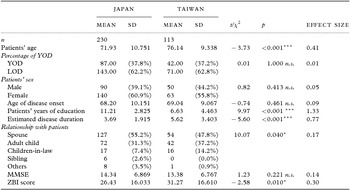
Three hundred and forty three patient and caregiver dyads were eligible for the statistical analysis. We summarized the characteristics of the patients and their caregivers on the Table 1. The t test and χ 2 test with Fisher's exact test revealed that there were significant differences in patients’ age (t = −3.73, P < 0.001; Hedges’ g = 0.41), patients’ years of education (t = 9.97, p < 0.001; Hedges’ g = 1.33), the estimated disease duration (t = −5.60, p < 0.001; Hedges’ g = 0.77), relationship with the patients (χ 2 = 10.07, p = 0.040; Cramer's φ = 0.17), and ZBI score (t = 2.58, p = 0.010; Hedges’ g = 0.30) between Japanese and Taiwanese caregivers.
Crude comparison of the characteristics and caregiver burden for the patients with Alzheimer's disease between Japan and Taiwan

LOD, late onset dementia; YOD, young onset dementia; SD, standard deviation; n, number; MMSE, Mini-Mental State Examination; NPI, Neuropsychiatric Inventory; ZBI, Zarit Burden Interview.
***p < 0.001.
*P < 0.05, n.s.; not significant.
Model fir for ZBI
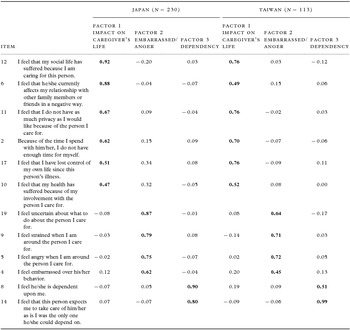
Exploratory factor analysis with promax rotation extracted 3 factors on all 22 items of the ZBI. At this point, item 22, which asks “Overall, how burdened do you feel in caring for this person”, was removed because this item loaded highly on multiple factors. The factor loadings of item 1, 7, 18, 20, 21 were less than 0.35. Second factor analysis showed that item 3, 13, 16 had high factor loading on multiple factors, and item 15 indicated poor factor loading (less than 0.35).
Finally, after excluding the 10 items and again conducting the confirmatory factor analysis, the 12 items of the ZBI with a 3-factor structure remained in both sample (Table 2). The χ 2 value of were 58.59 (df = 33, p = 0.004) in Japanese and 46.39 (df = 33, p = 0.061) in Taiwanese samples. In these models, about 61.4% of the variance in Japanese and 50.6% of the variance in Taiwanese samples were explained by 3-factor model. The first factor consisted of 6 items. We labeled this factor “Impact on caregiver's life”. Second factor contained 4 items that refers to the feelings of anger and strain experienced by caregiver. This factor was named as “Embarrassed/anger”. Third factor included 2 items which relate to the feelings that the other person is dependent on the caregiver, so we named this factor as “Dependency”.
Results of the confirmatory factor analysis on the items of Zarit Caregiver Burden Interview in Japanese and Taiwanese caregivers

The highest loading of each item across the factors is highlighted in bold.
Measurement Invariance
Configural invariance
First, to test the configural invariance, we considered whether the ZBI (12-item) was well described by a 3-factor structure across two countries. Multiple group analysis was used to examine the measurement invariance, and showed that the configural invariance fitted the data moderately, AIC = 348.662, CFI = 0.949, and RMSEA = 0.051. Every factor loading was significant (p < 0.001). These reference indexes showed that the 3-factor model demonstrated the configural invariance across two countries.
Metric invariance
Second, following the achieving the configural invariance, we examined the metric invariance. To certify the metric invariance, we restrained the factor loadings to be equal between two groups, and set the item intercepts and residual variances as freely estimated. This metric invariance model indicated an acceptable model fit, AIC = 360.655, CFI = 0.938, and RMSEA = 0.054. These results suggested that factor loadings were invariant between Japanese and Taiwanese samples (Table 3).
Goodness-of-fit indices for models tested in the Japanese and Taiwanese sample

df, Degree of Freedom; AIC, Akaike Information Criterion; CFI, Comparative Fit Index; RMSEA, Root Mean Square Error of Approximation; CI, Confidential Interval.
Scalar invariance
Third, the scalar invariance was tested in 3-factor model with 12-item of ZBI, in which the item intercepts and factor loadings were set to be equal across two countries. Although the RMSEA was below 1.00 (RMSEA = 0.078), model fit was considered as poor because the CFI value was not above 0.90 (CFI = 0.861).
Lastly, to refine the structural models, we examined the partial scalar invariance. After we searched and left 2 items that were not invariant across countries, we established the partial scalar invariance (AIC = 301.749, CFI = 0.901, and RMSEA = 0.066). Two items which left from the equality constraints were the item 11 and 9.
Comparing of caregiver burden
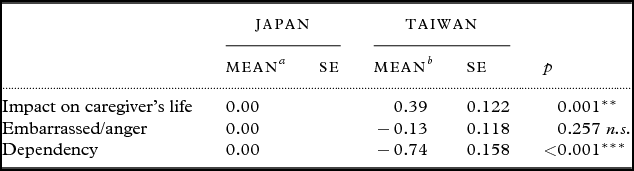
Based on the result of partial scalar invariance, it is thought that comparing of latent factor means of ZBI between Japan and Taiwan were possible. The latent factor means of the Japanese caregivers were set to zero for identification of the model, to estimate latent mean differences for Taiwanese group. As a result, latent factor mean of “Impact on caregiver's life” and “Dependency” were significantly different from zero. With regarding to “Impact on caregiver's life”, latent factor mean in Taiwan was significantly higher than that in Japan (p = 0.001). The latent factor means of “Dependency” in Taiwan was significantly lower than that in Japan (p < 0.001) (Table 4).
Latent mean differences of each factor across Japan and Taiwan

a Latent factor means in the Japanese group were fixed to zero.
b Latent factor means in the Taiwanese group were freely estimated from the Japanese sample.
***p < 0.001.
**p < 0.01, n.s.; not significant.
Discussion
To the best of our knowledge, this is the first study that compared the CB for dementia between Japan and Taiwan. Our results suggested that Taiwanese caregivers had higher CB about “Impact on caregiver's life”. On the other hand, the score of “Dependency” in Japan was higher than that in Taiwan. These results perhaps propose that the different type of support is needed to reduce the CB in each country. In Japan, long-term care insurance has been launched since 2000. Japanese caregivers might have less resistance to place their parents or relatives in a day-care center or a nursing home than those in Taiwan, because these services are well known by Japanese as a part of long-term insurance system. On the other hand, in Taiwan, paid-helpers who come from Philippines, Indonesia, and Vietnam are commonly available to care for a family member with dementia in their home because caregivers who admit family members into a nursing home are potentially regarded as “ungrateful child” (Huang, Reference Huang2004). The cultural difference in attitude for caring and traditional filial piety might be deeply associated with the CB. It is thought that the “Dependency” also might be related with social and family structures in both countries. The proliferation of nuclear family (two-generation family) in Japan might make a shortage of human resources for caring among relatives. The decreased number of the family members will make the caring difficult at home. Although it is impossible to reveal the specific cause of the differences about CB between Japan and Taiwan in this study, we think that this issue deserves further research.
Primary purpose was to compare the CB across two countries. To this end, we have extracted the 3 factors out of 12 items of ZBI, and confirmed the partial scalar invariance of ZBI. The wide varieties of factor solutions of ZBI have been reported, and factor structure has been found to be inconclusive (Whitlatch et al., Reference Whitlatch, Zarit and von Eye1991; Hébert et al., Reference Héberta, Bravo and Préville2000; Bédard et al., Reference Bédard, Molloy, Squire, Dubois, Lever and O'Donnell2001; O'Rourke and Tuokko, Reference O'Rourke and Tuokko2003; Ankri et al., Reference Ankri, Andrieu, Beaufils, Grand and Henrard2005; Flynn Longmire and Knight, Reference Flynn Longmire and Knight2011). Though the number of factors proposed in the literature for the ZBI has ranged from 1 to 5 (Hébert et al., Reference Héberta, Bravo and Préville2000), short version of the ZBI has mostly 2 or 3-factor (O'Rourke and Tuokko, Reference O'Rourke and Tuokko2003). In a previous study of ZBI from 152 dyads of community-dwelling people with AD, Ankri and colleagues (Reference Ankri, Andrieu, Beaufils, Grand and Henrard2005) conducted the factor analysis and produced a 3-factor model of ZBI. Three factors of the ZBI proposed by Ankri and colleagues (Reference Ankri, Andrieu, Beaufils, Grand and Henrard2005) were named as follows: social consequences for the caregiver, psychological burden, and the feeling of guilt. The factor of social consequences for the caregiver consists of item 6, 10, 11, 12, 13, 17. This factor is quite similar to the factor of “Impact of caregiver's life” in present study. With regard to psychological burden, the factor of “Embarrassed/anger” in this study is similar in composition to the structure of psychological burden. Regarding the factor of “Dependency”, Flynn Longmire and Knight (Reference Flynn Longmire and Knight2011) proposed the factor named “Patient's dependency”. Although the factor of “Dependency” in our study is composed of only 2 items (item 8 and 14), the factor of “patient's dependency” can be partially explained by this factor of “Dependency” in this study. We excluded 10 items from factor analysis and used only 12 items. Though latent factor means might depend on the selected items for the structure of each factor, non-invariant does not have an impact sufficiently. Therefore, although the factor structure of ZBI in this study was somewhat different from previous studies, we thought that non-invariant item should be removed from factor analysis, and considered the comparison as meaningful.
The strength of this study was that we identify common factorial structure of CB across two countries. Then, we compared the latent factor means between Japan and Taiwan after establishing the partial measurement invariance. However, there are several limitations in this study. First, we could not control the effect of the differences on participants’ characteristics when we compared the latent factor means of ZBI. Socio-economic factor including ethnicity and culture of origin may also play a significant role in the caregiving stress and coping model (Aranda and Knight, Reference Aranda and Knight1997; Knight et al., Reference Knight, Silverstein, McCallum and Fox2000; Reference Knight, Robinson, Longmire, Chun, Nakao and Kim2002). These factors should have been taken into consideration. Second, the reader should keep in mind that the generalization of this study might be limited because the participants were from only two university hospitals. Because both hospitals are located in provincial capital of these areas, our results may not be applicable to patients and caregivers who live in rural or metropolitan areas. Lastly, this is the first step to assess the difference in CB between two countries. Follow-up data for CB would strengthen the results of this study. In future direction, a longitudinal study, which aims to know how the caregivers in each country feel the caregiving burden, would characterize the country-specific uniqueness of CB.
Notwithstanding these limitations, this study is thought to be an informative report because this is the first study to reveal the differences of CB between Japan and Taiwan. In conclusion, the results of this study emphasize the importance of further research for the cultural difference on CB of dementia across two countries. Since the number of patients with dementia, especially AD, is expected to grow rapidly in both Japan and Taiwan, the concern with CB of dementia will be growing in both societies. We suggest that further research with longitudinal design will be needed to clarify the important determinants on CB in each country.
Conflict of interest
None
Description of authors’ roles
Ming-Chyi Pai and Manabu Ikeda designed the study. Masateru Matsushita, Cai-Ying Jhou, and Asuka Koyama conducted the study and analyzed the data. Masateru Matsushita wrote the first draft of manuscript. All authors revised critically and approved the final version of the manuscript.
Acknowledgments
We would like to express our sincere gratitude to Ken Kikuchi, Associate Professor (Medical Quality Management Center, Kumamoto University Hospital) for helping comments on an earlier draft of this paper. This study was supported by Promotional Programs for Research on Dementia of Health and Labour Sciences Research Grants.