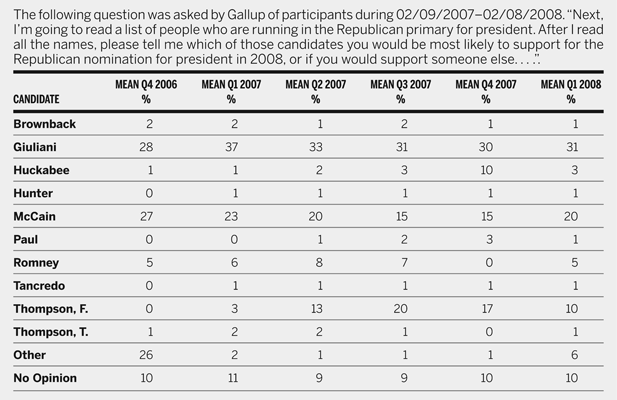
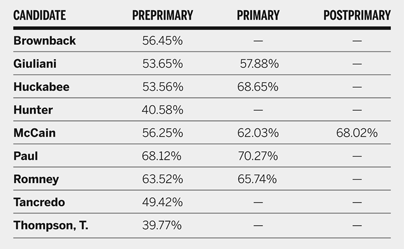
The contenders for the 2008 presidential nominations raised an unprecedented amount of money, more than $1.7 billion throughout the nomination and general election stages. Compared to the $500 million raised during the 2000 election, this staggering increase reflects the highly competitive nature of an open race in both political parties.Footnote 1 More than $700 million of these donations came from individual contributors who presumably were motivated by the prospect of an open race.Footnote 2 Most of this donation activity occurred before the formal primary and caucus contests began (Federal Election Commission 2011). Because of the impact this “early money” has on determining the outcome of the contest, the nature of these contributions must be explored. In the past, the candidate with the greatest fundraising prowess prior to the Iowa contest tended to win the nomination for their respective party (Adkins and Dowdle Reference Adkins and Dowdle2002). However, the 2008 Republican presidential nomination contest belied expectations. As can be seen in table 1, former New York City mayor Rudy Giuliani was the sole frontrunner during the preprimary period. By the time the first primary votes were cast, Giuliani's frontrunner status had greatly diminished, and he ended his candidacy in January 2008. Based on this and other financial patterns, the outcome of the 2008 Republican nomination contest indicates that the role of money seemed to be less decisive than in recent races.
Average Quarterly Polling Results for the Republican Presidential Nomination Candidates during the Preprimary and Primary

Real Clear Politics 2012
In the past, early money was not only a necessary means to obtain the resources needed for a successful campaign but also a barometer of viability. On this basis, the lack of money may be the biggest factor that determines if a potential candidate steps into the official political ring. In fact, the money factor has dissuaded well-known candidates from running, as demonstrated in 1999 when Texas governor George W. Bush's lead in early fundraising and in the polls convinced Tennessee senator Lamar Alexander, Republican activist Patrick Buchanan, North Carolina senator Elizabeth Dole, and former vice president Dan Quayle to drop out of the race for the Republican nomination months before the Iowa Caucus (Adkins and Dowdle Reference Adkins and Dowdle2004, 1–27). A major reason for the necessity of raising large sums of money in the early stages of the contest is because of the escalating costs of competing in a frontloaded primary system. Here, states vie for influence over the electoral process and its outcomes by attempting to hold their contests early in the nomination cycle.
A frontloaded system precludes the slow building of momentum, instead requiring an enormous amount of money to project a national identity and to ward off attacks from opponents and outside interest groups. Thus, campaign money is essential to shape public and media perceptions about a candidate's viability; in turn, this attracts more media attention that allows candidates to raise even more money in a self-perpetuating cycle (Busch and Mayer Reference Busch and Mayer2003; Taylor Reference Taylor2010).
Likewise, Adkins and Dowdle (Reference Adkins and Dowdle2002, 256–75) find that investing money in fundraising during the early stages of the preprimary is correlated with later success in collecting contributions. Because candidates have finite time and money, they make choices about where to focus their early fundraising endeavors. A case study of fundraising during the 1988 nomination contests suggests that early money comes from areas and constituencies in which candidates already have ties (e.g., Michael Dukakis has success raising money in his home state and from Greek Americans) and in disproportionate amounts from the densely populated states in the country where the wealthier contributors live (Brown, Powell, and Wilcox Reference Brown, Powell and Wilcox1995).
This latter point concerning donor concentration is alarming because these states have the potential to disproportionately influence candidate selection when compared with the rest of the nation. As Taylor (Reference Taylor2010) concludes, states that have unbalanced influence over the presidential selection process can have this same impact on public policy in certain situations.
THE POLITICAL GEOGRAPHY OF CAMPAIGN CONTRIBUTIONS
The frontloading of the electoral system further compounds the likely biased skew of donations to well-known candidates and away from the “long-shot” candidates and the issues they represent, despite these candidates potentially representing the interests of the general public. Specifically, long-shot candidates must often develop sources of funding far afield of their home state well in advance of popular recognition. Gimpel, Lee, and Pearson-Merkowitz (Reference Gimpel, Lee and Pearson-Merkowitz2008) find that even congressional candidates increasingly rely on financial support from outside of their home state. As much as two-thirds of individual donations may come from nonresident contributions that are “partisan and strategic in nature” (373). These donations may occur because of partisan ties that prompt nonresidents to become monetary surrogates for candidates and causes outside of their states, especially in competitive districts (Gimpel, Lee, and Pearson-Merkowitz Reference Gimpel, Lee and Pearson-Merkowitz2008). Therefore, the well-known candidates would be able to raise more contributions than their lesser-known competitors outside of their home states before the nomination contests begin.
Further exacerbating the emerging nonhome state bias in campaign donations is the finding that most presidential contenders appear to be receiving the bulk of their campaign money from the same pool of cash (Gimpel, Lee, and Kaminski Reference Gimpel, Lee and Kaminski2006). By mapping the geographic proximity of donations made by individual contributors, parties, and political action committee to presidential candidates during general elections from 1992 to 2004, Gimpel, Lee and Kaminski (Reference Gimpel, Lee and Kaminski2006) found a “geographic pattern to the giving independent of wealth, age, occupation, and other individual characteristics” (Reference Gimpel, Lee and Kaminski2006, 625). The patterns indicate that the heaviest giving is located in the “urban areas on the coasts, particularly the Philadelphia-New York-Boston corridor, Southern California, and the major Great Lakes cities of Chicago and Detroit,” (626).
Although Gimpel, Lee, and Kaminski (Reference Gimpel, Lee and Kaminski2006) extract a “Red State/Blue State” divide from their data as Republican candidates “exhibit a broader geographical base than Democratic candidates in the Upper Midwest, the Plains, and the Mountain states, many of the same places appear on both maps in the highest contributor categories” (628).Footnote 3 Interestingly, Gimpel, Lee and Kaminski discover that both Democratic and Republican contenders can raise large sums of money in the same areas, even if they are not successful electorally in these regions.Footnote 4
A major concern with candidates raising a large portion of their funds from a few densely populated areas is that it potentially leads to some states being more influential than others (Busch and Mayer Reference Busch and Mayer2003; Taylor Reference Taylor2010). Specifically, if the bulk of the contributors live in densely populated areas, then it is not surprising that the presidential candidates and their campaigns focus their fundraising efforts and policy platforms on the areas where contributors live. Others believe that unlike electoral competition, financial competition is not a zero-sum game (Gimpel, Lee, and Kaminski Reference Gimpel, Lee and Kaminski2006). With financial competition, states that are not electorally influential because of their late primary contest, such as New York, can still be politically influential because candidates pay attention to them regardless of their electoral worth. Namely, the states of California and New York, which have historically been major sources of presidential contributions (Brown, Powell, and Wilcox Reference Brown, Powell and Wilcox1995), and more recently, Texas, which has increased in population and economic clout, can be expected to dominate presidential fundraising.
Therefore, we expect contenders for the presidential nomination, when compared to the lesser-known candidates, should not only have early fundraising success in the “big three” states of California, New York, and Texas but also in their home states (an effect that should be further accentuated in candidates who call one of the big three states home). These successful contenders should also expand their reach to the rest of the United States as the primary season progresses (Hinckley and Green Reference Hinckley and Green1996, 693).
RESEARCH METHODS
As previously discussed, frontloading the primaries has made the early stages of the presidential campaign, specifically the preprimary period, an increasingly significant fundraising period. Therefore, this article evaluates fundraising for the 2008 Republican nomination contest by exploring both when and where candidates accumulate their campaign cash. To do this, the geographic location and timing of campaign contributions to the Republican presidential nomination aspirants are investigated. In this study, we use FEC reports on individual contributions to nine Republican candidates competing for the 2008 presidential nomination.
We expect that the 2008 Republican nomination aspirants will have raised the bulk of their money in the preprimary period, supporting the arguments made by Adkins and Dowdle (Reference Adkins and Dowdle2002) and Mayer (Reference Mayer1996) regarding early fundraising. Additionally, we expect that this money came from the big three, densely populated states of New York, California, and Texas, supporting the claims of Gimpel, Lee, and Kaminski (Reference Gimpel, Lee and Kaminski2006). Finally, we expect that the candidates who are perceived as frontrunners will have an easier time raising money from outside their home states supporting the claims of Hinckley and Green (Reference Hinckley and Green1996) and Brown, Powell, and Wilcox (Reference Brown, Powell and Wilcox1995).
To test these expectations, this study uses FEC reports on individual contributions to nine Republican candidates during the 2007–08 presidential nomination contests.Footnote 5 The reports for each candidate were sorted into three periods during the presidential primary contests: the preprimary period (January–December 2007), the primary period (January–March 2008), and the post primary period (April–August 2008). To differentiate the impact of candidate status on campaign contributions we provide poll standings in the USA Today/Gallup poll results for the corresponding time period (as the results in table 1 show).
To differentiate the financial bases of support from individual donors, the geographical origins of the contributions were divided into three categories: a candidate's home-state, the three most populated statesFootnote 6 as identified by US Census and ACS Census reports as California, New York, and Texas, and rest of the country (i.e., all other states combined). These three categories were not mutually exclusive in the instances when the home state of a candidate was one of the top three populated states. Although this overlap complicates the analysis, it does not detract from the original question raised by Brown, Powell, and Wilcox (Reference Brown, Powell and Wilcox1996): How much money came from the expected areas of high fundraising contribution (the most populated states and a candidate's home-state) as opposed to the rest of the country?
Based on this arrangement of the data, we expect to determine whether any common timing or geographical fundraising patterns exist among different types (frontrunners, competitive, or lesser-known) of presidential nomination candidates. The first stage of this study considers whether candidates sustained their fundraising from the preprimary to the primary period. The ability (or lack thereof) of a candidate to sustain contributions during the primary period is indicative of campaign support and provides context for the analyses that follow. The next stage of this study considers whether candidates broadened their base of financial support past their initial bases of support.
FINDINGS
Despite the notion that frontrunners tend to remain in the lead throughout the nomination process (Brown, Powell, and Wilcox Reference Brown, Powell and Wilcox1995), the 2008 presidential nomination contest belied expectations. As previously mentioned, Giuliani was the sole frontrunner during the preprimary period (as shown in table 1). Leading in most polls, Giuliani's status as a frontrunner diminished when entering into the primary season proper before he ended his candidacy in January 2008. In contrast, Arizona senator John McCain and Massachusetts governor Mitt Romney established themselves as competitors in the polls early in the primary season. Both Romney and McCain remained competitive with each other throughout the preprimary and primary season, with McCain ultimately emerging victorious. Most interesting is the experience of Arkansas governor Mike Huckabee, who only topped 5% in the public opinion polls during the last two months of the preprimary period. Huckabee, however, can be considered a victor of sorts due to his transcending from his position as a lesser-known candidate to becoming a nationally recognized candidate, partly due to his caucus win in Iowa. Ron Paul, a member of Congress from Texas, was the only other presidential candidate remaining in the race, maintained his dark-horse candidacy throughout the primary season despite his status in the polls. In contrast, Brownback, Hunter, Tancredo, and both Thompsons (Tommy and Fred) followed Giuliani's course and dropped out before the end of January.
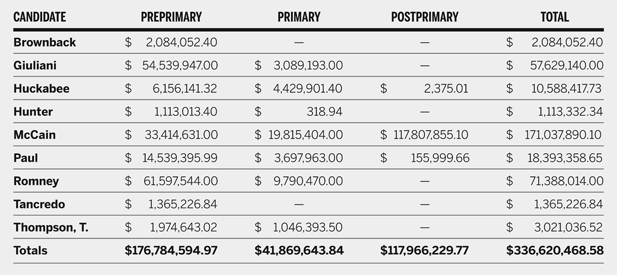
As expected, Republicans raised the bulk of their money in the preprimary season (almost $177 million), accounting for more than half of the total individual contributions leading up to the Republican national convention and more than four times the fundraising that occurred during the publicly visible primary season (as the results in table 2 show).
FEC Individual Contributions by Primary Period

Although the three contenders (Giuliani, McCain, and Romney) had the advantage in the money race, the fundraising heavyweights Giuliani and Romney were winnowed out of the race by February of 2008. Romney's advantage was his self-worth; he personally contributed almost $50 million to his own campaign (Center for Responsive Politics 2008). Giuliani's advantage stemmed from his home-state being one of the big three politically active, densely populated states. The only dark-horse candidate to raise a sizable amount was Paul at $15 million whose raised money throughout the entire primary season and reached a unique niche within the party. The other dark-horse candidates (Sam Brownback, Duncan Hunter, Tommy Thompson, and Tom Tancredo) were quickly winnowed out, leaving the only other candidate, Mike Huckabee, the ability to raise a substantial amount of money during the primary season.
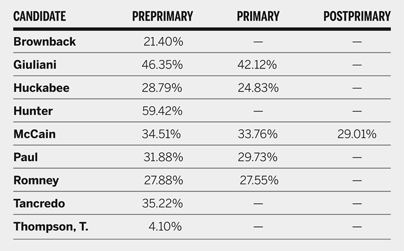
To allow for comparison between candidates with substantial funds and those candidates with lesser amounts of cash, we use percentages in the following analysis of the timing and geography of fundraising. Table 3 illustrates the proportion of a candidate's money that came from the big three states of California, New York, and Texas. Consideration of the preprimary period suggests that these three states dominate in the percentage of giving to the great majority of candidates, signifying these states' influence over the electoral process. The pattern derived from analyzing change from preprimary to primary fundraising in table 3 is that most of the candidates' support from these three states wanes by the primary season. McCain is the candidate most consistently relying on these states for financial support (preprimary = 35%/primary = 34%) followed by Romney (preprimary =32%/primary = 30%). Two of the three candidates who held elective office in one of the large states raised the greatest proportion of their money from these states (Giuliani from New York at preprimary = 46%/primary = 42% and Hunter from California at preprimary = 59%). However, the third candidate to hail from one of the big three, Ron Paul from Texas, raised one of the lower proportions of money throughout the entire campaign from the big three (preprimary = 32%/primary = 30%).
Big States

As discussed previously, there is some overlap for Giuliani, Hunter, and Paul, candidates whose home state is also operationalized as one of the big three states (as the results in table 4 show). However, when compared to Paul (preprimary =13%/primary = 11%), Hunter and Giuliani relied more on their home states for financial support. Likewise, those other candidates defined as symbolic (Brownback, Huckabee, Tancredo, and Thompson) saw their home states serve as their primary bases of support. All of these symbolic candidates, with the exception of Huckabee, are winnowed out by the primary indicating these candidates were unable to build a national base of support, especially when compared with contending candidates.
Home States

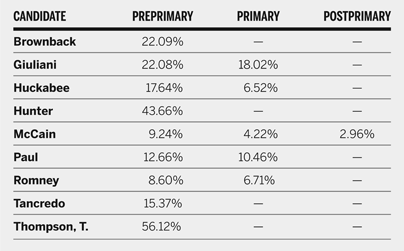
Table 5 illustrates the proportion of a candidate's money that came from the states noninclusive of their home state and the big three states. Overall, the Republican candidates successfully raised money from around the nation, with preprimary fundraising of 58%, primary fundraising of 61%, and postprimary fundraising of 68% coming from these “other” states. The pattern of change to ever increasing percentages of money coming from outside the big three and candidate homes states indicates that the Republican candidates' money comes from a more dispersed area over time. Although all candidates were not winnowed out at the start of the primary season exhibit a wider scope of fundraising, the most notable candidate with a dispersed contributor base was Paul. In comparison, Huckabee and McCain showed substantial increases in the proportion of funds raised from outside traditional bases of support, with an increase of +15% and nearly +6% respectively. Giuliani (+4%) and Romney (+2%) demonstrated a level of stasis from preprimary to primary period that might be indicative of their inability to extend their reach to a broader audience.
Rest of the Country

DISCUSSION
These findings, while limited to a single nomination cycle, provide some insight into the geographic fundraising patterns of Republicans during the 2008 presidential nomination contest. First, the 2008 Republican presidential nomination aspirants raised the bulk of their money in the preprimary period, which supports Mayer (Reference Mayer1996) and Adkins and Dowdle's (Reference Adkins and Dowdle2002) assertions concerning the timing of campaign contributions. Furthermore, we find confirmations for the findings by Hinckley and Green that a large proportion of a campaign's money originates from the candidate's home state (Hinckley and Green Reference Hinckley and Green1996, 693). Although we confirm Gimpel, Lee, and Kaminski's (Reference Gimpel, Lee and Kaminski2006) findings concerning concentrated centers of giving, we also find that some candidates also can raise significant amounts of money outside of their home states and the “Big Three.” This study finds that an even more geographically dispersed support network exists than previously thought with almost 60% of Republican money consistently coming from states other than the big three of California, New York, and Texas and the candidate's home state.
In conclusion, the preprimary period is an increasingly important time for fundraising. Although the primary period is perhaps most interesting in terms of who is winnowed out of the field of candidates, money alone may not determine the winner of electoral contests—without financing a candidate will not survive long. In fact, a candidate's ability to build a dispersed base of financial support earlier in the electoral process may be the missing element. Lesser-known candidates who successfully tap into regions of the country that are not their home state or the big three may raise their profile as a viable candidate in the next electoral cycle. This pattern certainly appears to be true for Huckabee and Paul, who were both symbolic candidates when the 2008 presidential contest began in 2007. Therefore, despite the increasing role early money plays in the nomination process, with the states of California, New York, and Texas disproportionately exerting influence, the process for the Republicans may allow smaller states to play an influential role, albeit in an indirect manner.
This article raises two future research questions. First, how representative is the 2008 Republican nomination contest of other presidential elections? Our research addressing presidential contests in the new millennia is in its preliminary stages. However, our results will mirror these findings just as our results mirrored the findings of Brown, Powell, and Wilcox (Reference Brown, Powell and Wilcox1995) concerning the 1988 contests. Second, what impact does this have on the policy of concentrated fundraising? This concentration is alarming because these regions have the potential to unduly influence candidate selection when compared with the rest of the nation (Gimpel, Lee, and Kaminski Reference Gimpel, Lee and Kaminski2006). Busch and Mayer (Reference Busch and Mayer2003) demonstrate that frontloading has led some states to have a disproportionate influence on the presidential nomination process, whereas Taylor (Reference Taylor2010) suggests that in certain conditions these states gain disproportionate public policy awards. This is corroborated by Berry, Burden, and Howell's (Reference Berry, Burden and Howell2010) finding that the president shapes the geographic distribution of federal spending. Future research should help determine whether the concentrated nature of early money also is rewarded with disproportionate influence.