The risk of sudden cardiac death associated with Wolff–Parkinson–White syndrome is between 0.15 and 0.39%/year according to follow-up studies.Reference Munger, Packer and Hammill 1 , Reference Blomstrom-Lundqvist, Scheinman and Aliot 2 The mechanism of death is thought to be secondary to atrial fibrillation rapidly conducted via the accessory pathway to the ventricle and subsequent deterioration into ventricular fibrillation. Historical teaching suggests that patients with intermittent pre-excitation would be at lower risk for these events and further risk stratification is not routinely recommended.Reference Blomstrom-Lundqvist, Scheinman and Aliot 2 , Reference Klein and Gulamhusein 3
Case report
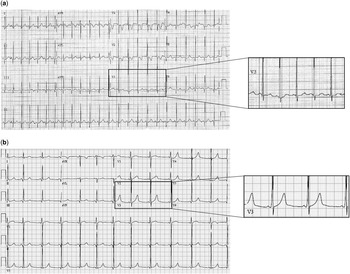
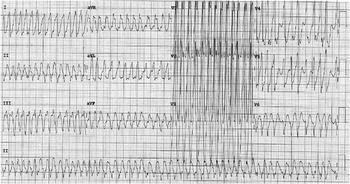
The patient was a 10-year-old male with a history of supraventricular tachycardia as a neonate with normal cardiac anatomy. Serial electrocardiograms showed no or minimal evidence of pre-excitation (Fig 1). Over the last year, he had frequent palpitations without syncope and was not on antiarrhythmic medications. He presented to the emergency room for a prolonged episode associated with dizziness. The electrocardiogram showed an irregular wide complex tachycardia with a ventricular rate between 170 and 400 bpm suggestive of atrial fibrillation with rapid conduction via an accessory pathway (Fig 2). The tachycardia terminated spontaneously. A subsequent electrophysiology study revealed 1:1 conduction with rapid atrial pacing at a cycle length of 190 ms while under anaesthesia via a left lateral accessory pathway. He had inducible orthodromic re-entrant tachycardia; however, atrial fibrillation was not induced during the study. A radiofrequency catheter ablation via a transseptal approach was successfully performed.
( a ) Baseline electrocardiogram (ECG) showing sinus rhythm without pre-excitation. There is a short PR interval (100 ms); however, no Δ waves are seen. ( b ) ECG showing subtle pre-excitation.

Electrocardiogram showing wide complex tachycardia with a right bundle branch block morphology and superior axis at a rate as fast as 400 bpm.

Discussion
Multiple studies have aimed to better define risk factors for sudden cardiac death in Wolff–Parkinson–White syndrome patients. Owing to the small event rate, there have been few factors identified with reliable positive predictive value or robust sensitivity and specificity. Having a short accessory pathway effective refractory period, shortest pre-excited RR interval ⩽250 ms, multiple pathways, or inducible atrioventricular re-entrant tachycardia, which triggers atrial fibrillation, appear to be associated with higher risk of malignant arrhythmias.Reference Blomstrom-Lundqvist, Scheinman and Aliot 2 , Reference Cohen, Triedman and Cannon 4 , Reference Pappone, Vicedomini and Manguso 5 There is ongoing controversy as to whether or not loss of pre-excitation during exercise indicates lower risk of sudden cardiac death.Reference Dalili, Vahidshahi, Aarabi-Moghaddam, Rao and Brugada 6
Intermittent pre-excitation has been thought to reflect a relatively longer refractory period conferring a lower risk for sudden cardiac death;Reference Klein and Gulamhusein 3 however, electrophysiology studies of patients with intermittent pre-excitation suggest that they may have a similar incidence of high-risk antegrade conduction via an accessory pathway making risk stratification more complex.Reference Mah, Sherwin and Alexander 7 There have been at least two previous case reports of asymptomatic adults with intermittent pre-excitation developing rapid conduction in the presence of atrial fibrillation.Reference Gemma, Steinberg, Prystowsky and Padanilam 8 Loss of pre-excitation could be secondary to improved atrioventricular node conduction in the setting of a left-sided accessory pathway, particularly in children where the atrioventricular node has better conduction characteristics than in older patients.Reference Li, Hu and Lin 9 Unless clear beat-to-beat loss of pre-excitation is seen, determination of the risk of rapid conduction cannot be made in a left-sided accessory pathway.Reference Spar, Silver, Hordof and Liberman 10
Despite having intermittent pre-excitation, this patient presented with atrial fibrillation with rapid conduction via an accessory pathway and rapid antegrade conduction during an electrophysiology study with atrial pacing. This case underscores that in a symptomatic child intermittent pre-excitation does not rule out the presence of a potentially dangerous accessory pathway, particularly if left-sided, and an electrophysiology study and ablation are warranted.
Acknowledgements
The authors would like to acknowledge Dr. Eric Silver for his support and input.
Financial Support
This research received no specific grant from any funding agency, commercial, or not-for-profit sectors.
Conflicts of Interest
None.