In this article we take steps toward solving an empirical puzzle in the liberal institutional research program by developing a theory of interactions among democracy, international organizations, and peace. The puzzle is this: the research program has produced generally robust results on the role of democracy in reducing the risk of international violence.1
For this conclusion, see Bennett and Stam 2004, chap. 5; Chernoff 2004; and Reuveny and Li 2003; for a contrary view, see Rosato 2003; but then Kinsella 2005.
Bennett and Stam 2004, chap. 5, confirm robustness; for varied views, see Schneider, Barbieri, and Gleditsch 2003; and Mansfield and Pollins 2003.
Oneal and Russett's work is illustrative. An IGO effect was significant among politically relevant dyads: Russett, Oneal, and Davis 1998; and Russett and Oneal 2001; but not all dyads: Oneal and Russett 1999. The IGO-peace link appears using one kind of statistical correction for duration dependence, GEE: see Russett and Oneal 2001, chap. 5; but not with peace years in Oneal and Russett 1999 as specified by Beck, Katz, and Tucker 1998. The link appears among all dyads with peace years correction when the dependent variable is wars, but not for lower-level militarized disputes: see Oneal and Russett 2004; and Kinsella and Russett 2002. IGOs may be formed by states that already have peaceful relations with each other: Oneal and Russett 2001, chap. 6, find causal arrows in feedback loops running in both directions. Oneal, Russett, and Berbaum 2003 resolve some of these issues in a distributed lag analysis to address both duration dependence and reciprocal causation. Even among all dyads they find a strong conflict-reducing effect for IGOs on all militarized disputes and on fatal MIDs (militarized interstate disputes resulting in at least one fatality).
Other interpretations
First, however, we review three theoretical reasons that might account for conflicting empirical results to date, and to which we shall return in our theoretical perspective and analyses:
- Liberal theory is simply wrong, and the realists are
right—international organizations are mere reflections of relative
state power, ineffectual and at best operating only at the margins. Any
effective restraint on the use of force in an anarchic world requires
coercion or deterrence, and international organizations must depend on
decisions by their member states, not on the organization per se, to
provide the capability and will to coerce and deter.4This position dismisses all the noncoercive functions that institutions can provide to reduce conflict among their members (for example, mediation, reducing uncertainty by conveying information, changing interests, norms, and mutual identification). Nevertheless, it makes a powerful argument and defines a null hypothesis that cannot be dismissed without persuasive theory and robust evidence.
Mearsheimer 1994–95.
- Any peace-inducing effects of IGOs are obscured by the possibility
that they may reflect existing conflicts or even stimulate new ones among
their members. Kinsella and Russett propose this interpretation when they
find joint IGO membership to be positively related to conflict. They
suggest that not only are many (nonglobal) international organizations
formed among states that are already salient for one another because of
existing diplomatic and commercial ties, but that IGOs are likely to make
those ties more salient and hence increase the likelihood that disputes
will arise. Only at high frequencies of shared IGO membership, in the
context of well-developed institutional capacity, would a net
conflict-reducing effect emerge.5
Kinsella and Russett 2002.
Relatedly, Boehmer, Gartzke, and Nordstrom maintain that not all IGOs should be expected to reduce conflict, and that only well-institutionalized organizations may have the mediating capacity to reduce conflicts among their members.6
Boehmer, Gartzke, and Nordstrom 2004. For another attempt to differentiate IGOs theoretically, see Haftel and Thompson 2006.
- Only certain types of IGOs, defined by function and by the global/regional distinction, may have significant conflict-reducing effects. For example, global organizations with nearly universal membership may have no discernible effect, but others which, though global, have more restricted membership [for example, the General Agreement on Tariffs and Trade (GATT), World Trade Organization (WTO), World Bank, and International Monetary Fund] may exclude states already in highly conflictual relationships with one or more of their members, and so, may more effectively inhibit violent conflict among those who are members.
Furthermore, both global and regional IGOs may be distinguished as those addressed primarily to military, political, economic, or social functions. Leskiw, for example, looks at participation in international rivalries and their severity levels.7
Leskiw 2002.
Mansfield and Pevehouse 2002 and 2003.
Theory: Densely Democratic IGOs
The efforts to identify a consistent effective role for joint IGO memberships, whether by measuring overall network density (number of shared IGOs) or by distinguishing among capabilities or functions, have met with only moderate success. Here we develop a theoretical position that looks more closely at particular kinds of IGOs: those identified not as regional or global or by function, but by the kinds of states that compose them. Specifically, we analyze IGOs by the political systems of their members, focusing on densely democratic IGOs. That is, we hypothesize a kind of interaction between IGOs and democracy, and that IGOs comprised mostly of democratic states will be more effective in reducing the risks of militarized interstate conflict among their members than will other kinds of IGOs. Dyads in these densely democratic IGOs will also have a lower risk of violence compared to dyads that share few or no joint IGO memberships. This proposition better reflects Kant's basic insight about the conditions of peace, which applied not to all states and organizations, nor to a centralized amalgamation, but to a voluntary “pacific federation” [confederation] of republics. “[W]herever in the world there is a threat of war breaking out, they will try to prevent it by mediation… .”9
Several mechanisms have been hypothesized in linking IGOs to peace, but here we focus on three that are likely to be more influential when most of the member states of the organization are democracies. Nearly all IGOs contain some autocratic or only marginally democratic states. Therefore it is important to ask whether these violence-reducing influences apply only to the democratic members, or to both democratic and nondemocratic member states. Recall that while violent conflicts short of war between democratic states are unusual, they are not rare enough to be ignored. For example, Oneal and Russett report that when both states in a dyad are at the 90th percentile on the democracy scale, they are 43 percent less likely to have a fatal militarized interstate dispute (MID) than are two states at the median on the democracy scale.10
Oneal and Russett 2002.
Credible Commitments
If it is true that a major reason for state conflict is the inability to make binding commitments to fulfill bargains,11
then IGOs can help alleviate this credibility gap. Members of IGOs who could potentially come into conflict have a ready mechanism to engender credible commitments. Because they can turn to a mutual institution to help monitor commitments, they will be more likely to overcome the commitment problem and refrain from fighting.IGOs may provide institutional mechanisms to monitor members' commitments, substituting for or supplementing member states' capabilities, and helping to insure that the commitments will be reinforced at the institutional level. Indeed, states will often turn to external agents when creating credible commitments is difficult. Governmental leaders—especially democratic ones—face potential audience costs for not following through on their international obligations or for reneging on these commitments; this increases the likelihood of fulfilling these promises.12
Of course, it is important that the commitment of the IGO to monitor and enforce agreements is credible. Thus, IGOs populated by democratic governments, which are more likely to uphold their commitments, enhance confidence that the institution's commitment is credible as well.While this argument suggests why IGOs populated by democracies might have commitment advantages, what about democratic states within democratic IGOs? What is the value added in terms of credible commitment in these cases? While it is true that democracies may make more credible commitments than autocracies, ceteris paribus, IGOs may still help democratic states confront what could be labeled the “turnover problem.” Because officials in democratically elected governments change, there is a possibility that a new government could undo the commitments of the previous government. In particular, they would not necessarily face the same level of audience costs because they did not enter the commitment in the first place.
Many agreements, including those between democracies, provide mechanisms of commitment. For example, trade agreements are particularly effective in serving as a promise for democracies not to renege on their commitment to liberalize trade.13
A similar argument has been applied to monetary integration as well.14Martin and Simmons 1998, 748.
A sizable literature—for example, Cowhey 1993; Gaubatz 1996; Martin 2000; and Lipson 2003— shows that ratification requirements allow democracies to commit more credibly to international agreements. This suggests that densely democratic IGOs should be well suited to enforce commitments. While one might argue that this means IGOs are not needed for democratic states to engender credible commitments, in every empirical investigation of this topic the ratification-commitment linkage involves IGOs or international regimes, suggesting there is some value added to signing international commitments versus relying only on the potential bilateral “promising advantages” of democracies.
A related but distinct “turnover problem” is confronted by new democracies attempting to make credible commitments. Often, new regimes have difficulties making reliable commitments because others fear the potential collapse of the new government. Here again, densely democratic IGOs can assist in preventing autocratic backsliding, making these democratizers' commitment to democracy (and the agreements they sign) more ironclad. For example, densely democratic IGOs can and do make entry or continuation in the IGO conditional on being democratic and have been shown to further the consolidation of nascent democracies.16
Pevehouse 2005.
In particular, highly democratic regional IGOs often punish members who appear to backslide into autocracy. The European Union (EU) from its foundation had a commitment to democracy, bundling national democratic institutions and European institutions in a mutually supporting manner to solidify peace.17
Eilstrup-Sangiovanni and Verdier 2005 contend that the EU institutions were carefully designed as a means of committing a temporarily weakened West Germany not to use its future power to pursue military ends in Europe.
The Organization of American States (OAS) also has the power to levy severe economic and political sanctions (such as suspension of membership, approval of military intervention by member states) after a seizure of power.19
See Donno 2005, for an analytical typology of various IGO action options against democratic backsliders.
Washington Post, 30 April 1996, A13.
Thus, even for states that are already democratic and may have an easier time overcoming the commitment problem, IGOs may enhance credible commitments by addressing the turnover problem. They may also enhance the credibility of commitments for new democracies by assisting in their consolidation. For all types of states, IGOs can be important external anchors for solving commitment problems, which can be key to preventing conflict.
Dispute Settlement
Many IGOs have standing dispute settlement and mediation mechanisms to prevent political or economic differences from spiraling into military conflicts. As noted above, Kant expected that his republics would be more likely to use mediation to resolve their conflicts. Indeed, the success of his federation depended on states being accustomed to the rule of law at home, and an extension of that behavior to settling disputes with similarly lawful states.
Democracies tend to promote institutions of conflict resolution in international relations. In particular, they are more likely to employ third-party conflict management techniques such as adjudication and arbitration. In their study of legalization and dispute settlement mechanisms, for example, Keohane, Moravscik, and Slaughter contend that liberal democracies are more likely than nondemocracies to submit to transnational dispute resolution mechanisms (independent judicial bodies), rather than interstate dispute resolution mechanisms such as bilateral talks.21
Keohane, Moravscik, and Slaughter 2000, 478–79.
Mitchell 2002, 753.
Indeed, the general rise in legalism in world politics finds an impetus in the increase in democratization. Kahler contends that democracy gives power to prolegalization interests who either prefer legal frameworks for normative-legal reasoning (for example, human rights organizations) or for contractual-economic reasons (for example, business organizations): “[A]mong the industrialized democracies, law occupies a central institutional place, and these pro-legalization normative lobbies are powerful.”23
Kahler 2000, 671. It is true that Kahler then argues that because of turnover in democracies, they may have an interest in not legalizing their relations with other states. While this is possible, our discussion in the previous section suggests it is equally likely that states will legalize their relations with one another so as to bind future governments.
These dispute settlement mechanisms within IGOs populated by democracies are also more likely to succeed in ending threats of violence. Successful mediation involves promoting the exchange of concessions, encouraging the use of contracts, and reducing the cost of enforcing them.24
Stone Sweet and Brunell 1998.
Martin and Simmons 1998.
IGOs populated predominantly by democracies are thus more likely to engender respect for the institutional mechanisms to reduce and eliminate conflict, and to provide more legalistic mechanisms as part of their institutional package. This is certainly a strong reason to expect densely democratic IGOs to settle disputes among members. In fact, democratic IGOs may require their members to resolve acrimonious border disputes with their neighbors (for example, the EU's requirements for Eastern European membership candidates), thus reducing a common cause of international conflict.28
Bunce 1997.
But again, what value added are IGOs to democracies that would already be likely to engage in conflict resolution? For two reasons, we still expect strong dispute settlement advantages for IGOs even among democratic states. First, several scholars argue that transitional regimes of liberalizing states often can and do make overt attempts to spur nationalist sentiment regarding ethnic identity.29
Mansfield and Snyder 2002 and 2005 find that states liberalizing from autocracy to somewhere in the anocratic range of Polity scores (not into the democratic range) evidence increased conflict. Even so, Oneal, Russett, and Berbaum 2003 report that a full democratic transition from autocracy to democracy brings the risk of conflict with a democracy down to that between two well-established democracies. Also see Rousseau 2005, chap. 6.
For instance, in the aftermath of the 1989 revolutions in Eastern Europe, some observers feared that nationalism would be a rallying point for leaders in the region's democratizing states. One such concern was Hungarian nationalism and the fate of Magyars living in neighboring states. In the first years after the break from the Soviet orbit occurred in Hungary, the transitional Joszef Antall regime could easily have tried to legitimate itself by arousing nationalist sentiment in Hungary over the Magyar issue. In fact, Antall himself made an early statement that he desired to be the “Prime Minister of 15 million Hungarians.” (There are only 10 million Hungarians in Hungary.) That statement was taken by Hungary's neighbors as “a revival of traditional Hungarian revisionist nationalism.”30
Kozhemiakin 1998. According to Batt 1994, 183, the question was not “whether nationalism will play a role in Hungarian politics, but whether it will be nationalism of a more moderate variety which can coexist and support the transition to democracy.”
As Kozhemiakin argues, however, Hungarian political elites have not tried to base their legitimacy and popularity on nationalist issues. Rather, “when other sources of political legitimacy are not too difficult to find, nationalist sentiments in Hungary can be contained.” IGO memberships, such as the Council of Europe or the Association Agreements with the European Union, served as a substitute for appeals to nationalism. Kozhemiakin continues, “Hungarians value their internationally recognized democratic status too much to allow their unqualified desire to protect Magyar minorities to hurt it and, by implication, impede Hungary's efforts to integrate itself fully into the West.”31
Kozhemiakin 1998, 82–83.
Indeed, when pressed by the EU, the North Atlantic Treaty Organization (NATO), and the Organization for Security and Cooperation in Europe (OSCE), Hungary signed friendship treaties with both Romania and Slovakia, spurring one commentator to note, “With both treaties in force, potentially explosive tensions in the heart of Europe will have been calmed.”32
New York Times, 26 March 1995, D4.
Second, as we previously emphasized, democracies do have disputes—conflicts still arise between democracies, even if they do not escalate into war. Indeed, we contend that one explanation for nonescalation is the network of IGOs in general, and densely democratic IGOs specifically. Dispute settlement mechanisms within IGOs are important even for pairs of democracies. Recent history provides a case where such a situation arose.
In 1986, Colombia and Honduras signed a maritime treaty effectively excluding Nicaragua from access to a large portion of the Atlantic Ocean. Although Nicaragua protested at the time, its relations remained cordial because Honduras never ratified the treaty. Then on 30 November 1999, the Honduran legislature ratified the treaty, bringing an immediate response of trade tariffs from Nicaragua. Days later, Honduran troops opened fire across the border, while Nicaragua mobilized its forces near the border. In the words of one observer, “Over the past week, relations between Honduras and Nicaragua have become so tense that some observers feared an actual shooting war could erupt. Nicaragua prepared to impose trade sanctions on Honduras and broke commercial relations. Honduran officials issued statements indicating that the nation's armed forces were ready to ‘defend the fatherland.’”33
Flakus 1999. On the likelihood of war between Nicaragua and Honduras, see Christian Science Monitor, 27 December 2001, 5; and Miami Herald, 22 February 2000, A1. On this case generally, see Pratt 2001.
After these violent acts, both parties asked the OAS to mediate the dispute. By 30 December 1999, an agreement was signed in Miami to reduce tensions, but in February 2000, Nicaraguan and Honduran boats exchanged fire in a dispute over the possession of an uninhabited island. Again the OAS stepped up mediation efforts and began the process of monitoring and verification of the agreements, which were still in place as of 2005.
Several facets of this case are important for our argument. First, at the time of the dispute, both Honduras and Nicaragua were democracies. Second, the OAS was populated almost entirely by democracies. Third, Honduras and Nicaragua initially took their dispute to the International Court of Justice (ICJ) but eventually decided the OAS was their preferred forum due to the long decision time scheduled by the ICJ. Thus, despite all the factors that should have kept two democracies out of a bilateral militarized dispute, it took the dispute settlement mechanisms of a highly democratic IGO to de-escalate the violence once it began.
Socialization
In addition to an institutional commitment to mediation and law, IGOs may socialize member states to particular types of behavior.34
By influencing what states define as acceptable behavior, IGOs may redefine what are appropriate ways to deal with potential interstate conflicts. Socialization and norm change have long been central to perspectives on international integration, notably in Deutsch's interest in the creation of a pluralistic security community,35Deutsch et al. 1957.
But Deutsch was not much interested in institutions. They do not appear among his fourteen essential or helpful conditions for pluralistic security communities save under the larger heading of a wide range of mutual transactions, “together with the institutions to carry them out.” There his discussion of institutions is limited to a page and a half with a few proper nouns, some counts, and no mention of processes.37
Deutsch et al. 1957, 146–47.
Wendt 1994.
Adler and Barnett—among the most important revivers of Deutschian ideas in the last decade—do, however, regard institutions as important. The more expectations of nonviolent conflict resolution “are institutionalized in both domestic and supranational settings, the more war in the region becomes improbable…. The institutional context for the exercise of power changes; the right to use force shifts from the units to the collectivity of sovereign states and becomes legitimate only against external threats or against community members that defect from the core norms of the community.”39
Adler and Barnett 1998, 55–56. Dembinski, Hasenclever, and Wagner 2004 fear that mutual identity, especially as fostered by a democratic alliance, may create greater willingness to use force against autocracies outside the alliance. Such a phenomenon may be consistent with a “clash of civilizations” thesis—see Huntington 1996—but does not appear for Western civilizations versus others outside of the Cold War context. Russett and Oneal 2001, 258–60.
In his study of the OSCE, Adler notes that though it is neither fully a security community nor fully democratic, it has been successful in spreading norms and trust-building practices. MERCOSUR was formed in large part to provide means for new democratically elected presidents to control their militaries. Through shared economic institutions they were able to open up each other's markets and reduce the size of their military establishments under conditions of peaceful international relations. New security-producing practices grew out of a shared Latin American identity and common democratic practices.40
Finnemore and Sikkink discuss how IGOs may perform as norm entrepreneurs through phases of imitation, socialization, and internalization; densely democratic IGOs may make it possible to pass the “tipping point” to a security community earlier than would otherwise be possible. They may create new identities, and norms, unintentionally as well as deliberately.41Indeed, Mitchell shows empirically how through a process of socialization by IGOs, nondemocracies become socialized to practice peaceful dispute settlement, especially regarding territorial claims.42
Mitchell 2002.
Starr and Lindborg 2003.
Thus, we argue that one is more likely to find peaceful norms evolving through a process of identity transformation in IGOs that are more homogenously democratic. Risse-Kappen makes such an argument with regard to collective identity and the emergence of cooperation: “Democratic features of liberal democracies enable the community in the first place. But the institutionalization of the community exerts independent effects on the interactions. In the final analysis, then, democratic domestic structures and international institutions do the explanatory work together.”45
Taken together, these three groups of causal mechanisms cover a range of phenomena encompassing structural, institutional, and normative explanations, sometimes competing but often complementary46
in ways reminiscent of similar interpretations of the democratic peace itself. We lack the fine-grained and micro-level information to distinguish between them in our quantitative analysis below. Nevertheless, they all suggest one common observable implication: IGOs composed largely of democracies should be marked by less violence among their members. We now turn to an empirical test of this proposition.Analysis
To test these hypotheses we need to move beyond simple counts of joint dyadic memberships in IGOs. We thus create a measure of IGOs for how densely democratic they are, weighting each IGO by the mean level of democracy (Polity IV) among its members.47
All references to “democraticness” of an institution refer to the level of democracy among member states. We do not address issues of whether the rules or procedures of particular organizations are judged as democratic—an issue beyond our scope here.
The IGO data are from Pevehouse, Nordstrom, and Warnke 2004. From 1965 forward, all data are annual observations. For 1885–1965, where the original COW IGO data measures membership in five-year periods, membership data are filled in for as many organizations as possible. Where this was not possible, membership was interpolated based on the five-year observations bracketing the year in question.

Our sample is the period 1885–2000, a longer period with more observations than in most previous analyses. We examine all dyads for which data are available. The dependent variable in this analysis (fatal mid) is the onset of a MID between states i and j in which at least one fatality occurs in year t+1.49
We use Maoz's adjustment of the MID data set that corrects for the absence of fighting between sides in multilateral disputes.50Maoz 2002.
See Oneal, Russett, and Berbaum 2003, 376; and Fordham and Sarver 2001. Despite examples such as Senese 1997, we are not satisfied that the whole MID scale is truly ordinal; that is, a threat to use military force or demonstration of force (such as a threat to use nuclear weapons, or visibly putting them on alert) is necessarily less serious than some uses of force without violence (such as seizing a fishing boat). Escalating a use of force to where it results in a fatality, however, seems a more defensible indication of a step-level jump.
The first variable, democratic igos, is a count of a subset of all IGOs of which states i and j are members; namely the number of such IGOs whose average level of democracy is at or above 7 on the Polity IV scale (which runs from −10 to 10).52
See Marshall 2004.

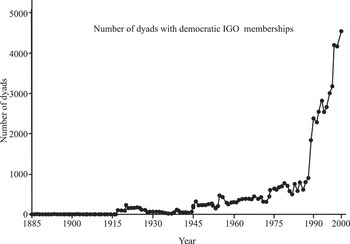
Trends in democratic IGO membership over time
Other variables tap Kantian processes that may correlate with both the onset of fatal MIDs and the nature of IGOs joined by states. democracys represents the Polity IV scores of each state, sorted by whichever state is the less democratic state in the pair, since more emphasis is placed on the less constrained actor. When testing our hypothesis it is essential to ensure that any effect of democratic IGOs is not simply a proxy for the peaceful effect of democracy alone. By including this variable we control for the general influence of states' democracy at the dyadic level, so that the estimate for democratic igos taps only the effect of the degree to which members of the IGOs are democratic.
We capture the effects of economic interdependence by introducing dependences. This measures each country's imports and exports with its partner, divided by each state's gross domestic product (GDP). The lower of these ratios identifies the dependence of the less constrained state.53
We use an extended version of the data from Oneal, Russett, and Berbaum 2003, who rely on multiple sources of trade data including Gleditsch 2002.
We include both distance and contiguity since some states may share a border yet have distant capitals (Russia and China), while others may be in close proximity but have no common border (Gambia and Guinea-Bissau).
Gleditsch 2003.
One other theory-driven variable for the analysis stems from the fact that a small minority of dyads account for the great majority of disputes in the global system.56
It is thus likely that past dispute behavior influences current dispute behavior57 and also depresses the number of IGOs shared by disputatious dyads. Conversely, states may join IGOs (or democratic states join densely democratic IGOs) primarily with those states with whom they already have a predominantly peaceful relationship. We thus calculate a running sum of militarized disputes between states i and j for the entire period, and label this variable cumulative mids.To ensure that any relationship between our weighted IGO variables is not simply a reflection of pairs of states that are members of many IGOs, we use joint igos, the number of IGOs of all varieties in which both members of the dyad share membership.
As is now customary, to control for the possibility of temporal dependence in the onset of fatal MIDs we create a counter of the years between each onset and use this measure as the base of a cubic spline function with two knots.58
Beck, Katz, and Tucker 1998.
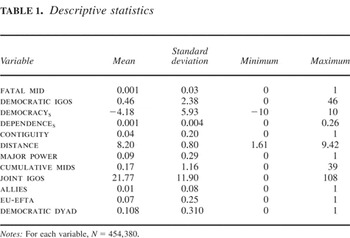
Descriptive statistics

Results: Democratic IGOs Matter
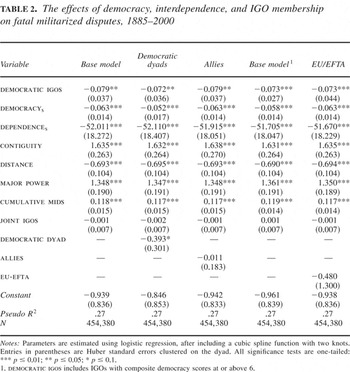
The first column of Table 2 shows the estimates of our base model with only the core variables. Our key variable, democratic igos, is negative and highly statistically significant. Thus, the more joint memberships in IGOs composed of democracies, the less likely it is that the states in a dyad will engage in fatal MIDs. It is important to note that this effect is independent of and in addition to the effect of democracy in the dyad. Consistent with past research and the weak-link hypothesis, democracys is also negative and statistically significant, suggesting that the higher the level of democracy for the less democratic state in the dyad, the less likely is a fatal dispute. Taken together, these findings provide strong support for a Kantian interpretation of interstate relations—democracy and international institutions building a more peaceful international system together.
The effects of democracy, interdependence, and IGO membership on fatal militarized disputes, 1885–2000

This relationship between democratic IGOs and conflict is not only statistically significant, but substantively significant as well. As the number of joint democratic IGOs for the pair of states rises from the mean to a one standard deviation increase, the probability of a dispute drops by about 21 percent. Clearly, IGOs composed of predominantly democratic members lessen the probability of conflict. This is true while controlling for a host of factors that have traditionally explained interstate peace, several of which are correlated with membership in democratic IGOs.
The remaining variables have the expected signs. Higher levels of economic interdependence reduce the propensity of states to engage in violent interstate disputes. Contiguous dyads and dyads containing a major power are more likely to engage in fatal disputes, and dyads of states some distance from each other are less likely to do so. Each of these is consistent with previous work on the Kantian peace.59
We also estimate a model substituting a variable controlling for the average number of democratic great powers in IGOs shared by states i and j. The estimate of this variable does not achieve statistical significance, suggesting it is not large, democratic powers exerting a peace-enhancing effect.
Two other estimates are worthy of note. One is that joint igos has no effect in any of these models; that is, when controlling for how democratic the members of the IGO are, the institutional density between the states does not matter. This suggests that the political character of its member states strongly affects what the institution is able and willing to do by way of reducing conflict among its members.
This should not, however, be read as implying that nondensely democratic IGOs make no contribution to preventing militarized disputes. Many such IGOs are quasi-universal organizations that include nearly all states and so cannot be densely democratic. With so few dyads outside these organizations, we cannot establish a reliable baseline level of conflict in the absence of any IGO membership. Also, we will show below that membership in all kinds of IGOs does contribute to preventing the escalation of lower-level MIDs to fatal ones.60
One simple test is to compute the rate of fatal disputes for dyads who share zero, one, and two IGO memberships in any given year. Those states that share no IGO membership are more likely to engage in fatal MIDs than those dyads who have at least one or two joint memberships. This difference is statistically significant.
The other estimate of interest is that dyads with greater experience of violent conflict (cumulative mids) show a much higher risk of a fatal MID. Conversely, the absence of previous violent conflict lowers the risk that a fatal MID will occur. Yet that independent effect of prior history supplements but does not erase the independent effect of democracy or the independent effect of densely democratic IGOs in reducing conflict. Jointly democratic IGOs reduce conflict not merely because they may have a prior history of peace.
In sum, these initial results suggest that IGOs do play an important role in mediating conflict between member states, but this effect emerges systematically only in IGOs composed largely of democracies. If it were only democracy and not the institutions leading to peace, only the state-level measure of democracy would be statistically significant. So democratic IGOs serve as instruments to enhance the effects of democracy.
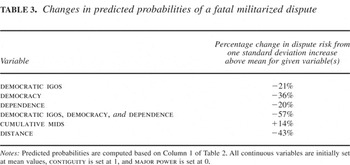
Table 3 compares the marginal effects for variations in several variables in the model. Note that while the effect of the democratic igos variable is quite strong, other Kantian variables are just as influential. Indeed, raising the democratic igos, democracy, and dependence variables by one standard deviation simultaneously yields a 57 percent decline in the probability of a fatal MID. Non-Kantian variables are important too, such as a history of conflict between states. Raising the number of past MIDs within the dyad by one standard deviation from the mean yields a 14 percent increase in the probability of a fatal dispute. Still, higher levels of democratic IGO membership, trade, and democracy can account for a significant reduction in serious violence between states.
Changes in predicted probabilities of a fatal militarized dispute

Robustness Checks
We want to ensure that our finding is neither the result of model underspecification nor a statistical artifact. To this end, we conduct several robustness checks. First, some might object to our attempt to hold democracy constant in the previous model since we directly control for the regime type of only the less democratic in the dyad. That is, despite our theory suggesting the contrary, it could be that for pairs of democracies, IGOs provide little value added when it comes to peace. To control for this possibility, we reestimate our model including an indicator variable coded as a 1 if both states in the dyad are democracies. Again, if democracy is leading to peace and there is little value added to the process by IGOs, we expect this new variable to reduce any conflict-mediating effect of democratic IGOs. But as seen in the second column of Table 2, this is not the case. While this new variable is negative and statistically significant, democratic igos is still statistically significant.
In addition, limiting our estimation sample to only dyads in which both states are autocracies yields similar results—the estimate of democratic igos is negative and statistically significant. These findings strongly suggest that democratically dense institutions help all states keep peaceful relations. Our finding is not simply an outgrowth of democracy itself, but that international institutions of democracies do matter for peace.61
We do not show these later estimates but they are available from our Web site: 〈http://www.polisci.wisc.edu/pevehouse〉. We also re-estimate our original model on only a sample of democratic pairs. democratic igos remains negative and highly statistically significant.
For example, Farber and Gowa 1997.
We regard similarity of preferences, including alliance when conceived as a preference measure, to be a mediating variable rather than a direct influence on conflict, and thus not appropriate in a parsimonious model.64
We do, however, add it as a robustness check on our findings. To this end, we add a measure of alliances (allies)65Gibler and Sarkees 2003.
We also ran a robustness check on similarity of preferences as measured by UN voting agreement, applying the Signorino and Ritter 1999 similarity measure of S to UN voting patterns (data concern only the post–World War II era). The estimate of S is negative but not statistically significant, with no systematic relationship to the probability that states engage in a fatal MID. Moreover, the democratic igos variable remains statistically significant at the p < .1 level. While Signorino and Ritter show S to be a more useful measure than the traditional Tau-B measure, we generated similar estimates using Tau-B. It does attenuate the influence of democratic igos somewhat, but not for the results presented in the next section. Since joint democracy is one of the principal influences on UN voting patterns—see Russett and Oneal 2001, 228–37—it is preferable to use it as a direct influence on conflict. We also added a variable for the balance of military capabilities, but it has no effect on our independent variable of interest.
We also want to ensure that our findings are not the result of measurement decisions. Thus, in the fourth column of Table 2, we re-estimate our initial model but relax our definition of democratic IGOs for our models using the democratic igos variable. While our previous threshold was 7 to be counted as a democratic IGO, we move this threshold to 6 to ensure our definition alone is not responsible for our findings. The result is entirely consistent with our earlier estimates.67
To conserve space we show only the threshold 6 estimates, but changing the threshold to 5 yields similar results.
One concern when discussing the influence of IGOs is that the results may really depend on the impact of just one or two large and democratic IGOs, notably the European Union and the European Free Trade Area (EFTA). The final column of Table 2 introduces a dummy variable for IGOs composed of European dyads, specifically dyads containing states in either the EC/EU or EFTA. Since all those states are also democracies, and in the region with the greatest number of democracies, we need to insure that the apparent effect of densely democratic IGOs is not merely a European phenomenon. It is not. The eu-efta variable has no effect, while the strong effect of democratic igos is unchanged.68
This result stays consistent if only the EU is counted in the indicator variable. In addition, defining our democratic igos variable as including only regional organizations generates similar findings—the recomputed variable remains negative and statistically significant. We define regional organizations as IGOs whose members are in the same geographic region, thus excluding universal organizations such as the UN.
Next, because fatal MIDs are rare events, to avoid bias in our statistical models we utilize King and Zeng's rare events logit,69
King and Zeng 2001.
Similar checks show unchanged results in Table 4. Results for all the robustness tests discussed but not shown here will be available on the Web site.
We are also wary of the possibility that our findings are time-bound. We want to insure that our findings are not an artifact of the recent post–Cold War rise in democratic states and organizations during a time of relative peace. Moreover, Kant himself hypothesized that the effect of federations of republics would not be constant over time, but increase in a process that suggested positive feedback. To this end, we estimate our initial model on three subsamples of our time period: 1885–1945; 1945–2000; and 1945–89. Interestingly, although we do not find strong support for Kant's supposition, it is because the influence of democratic IGOs appears strong in each of these subsamples.
Indeed, in the 1885–1945 subsample, there are no fatal disputes between states with at least one membership in a democratic organization.71
Farber and Gowa 1997 claim little evidence of peace among democracies before the Cold War, which led them to conclude that the democratic peace was an artifact of structural/realist variables. Our results dispute their contention that Kantian variables had little influence before World War II.
Finally, and perhaps most importantly, we examine a possibility raised earlier: that democratic IGOs are really endogenous to conflict. One competing explanation of our findings, for example, would be that states that are on good terms and/or unlikely to fight (especially because they are democracies) are members of democratic IGOs. To guard against this possibility, we led the dependent variable in each model. In addition, we conduct an additional test for reverse causality. We estimate a negative binomial count model, where democratic igos (in year t+1) is the dependent variable, and fatal mid becomes an independent variable along with the remaining control variables from the base model.72
Our model of IGO membership is similar to Russett, Oneal, and Davis 1998, 461; Russett and Oneal 2001, chap. 6; and Mansfield and Pevehouse 2006. It includes all the control variables in column 3 of Table 2, in addition to a measure of international hegemony and an indicator for the post–Cold War years. On the addition of these later variables, see Mansfield and Pevehouse 2006.
Democratic IGOs and Escalation?
Given our choice of the dependent variable (fatal mid), there is a possibility that some selection bias is occurring. That is, we have shown a consistent and robust relationship between democratic IGOs and a lack of fatal disputes, but could this be because members of democratic IGOs have fewer tensions generally? Before entering into disputes that create fatalities, surely states begin their differences with less intense levels of hostility, later escalating to fatal MIDs. It is important to control for this possibility since, for example, if states in democratic IGOs are generally less likely to fight (in nonfatal MIDs), then we are mistakenly inferring a relationship that does not exist—we have an upward bias in our estimate of democratic igos.
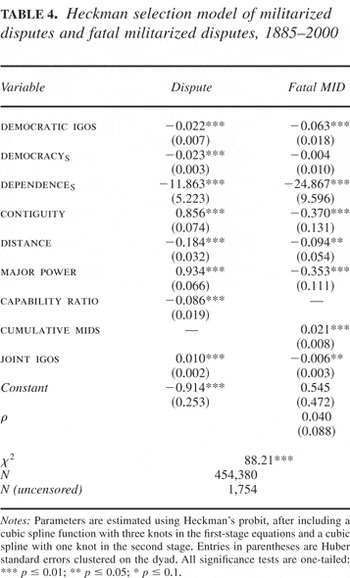
To understand the influence of democratic IGOs more fully, we ask whether violent MIDs can be prevented by these institutions, when a MID already exists in the dyad, while controlling for the possibility that IGOs lessen the possibility of a MID generally. To this end, we estimate a Heckman selection model, where the first stage tests for the influence of democratic IGOs in preventing the onset of any MID, and the second stage examines whether MIDs that do occur become violent with at least one death. The two equations are:

Again, for the second equation, fatal mid is observed only if dispute equals 1. By simultaneously estimating both stages, we ensure that any correlation between the onset of a dispute and its escalation to a fatal dispute (correlation between ε1 and ε2) is modeled. As previously noted, if the two processes are correlated, failure to account for this relationship can lead to biased inferences.73
As shown by Reed 2000.
For identification purposes, we add capability ratio to the dispute model since past studies have linked the balance of forces in a dyad to the onset of militarized disputes, yet a great disproportion may more inhibit the initiation of a militarized dispute than its escalation to a fatal dispute under the uncertainties of crisis decision making.74
We rely on the COW Capabilities data for the ratio of material capabilities. Each state's political-military capacity is measured by averaging its share of the international system's total population, urban population, military expenditures, military personnel, iron and steel production, and energy consumption. capability ratio is the ratio of the capabilities of the larger state to those of the smaller state: see Singer 1987; and Singer and Small 1993.
Table 4 presents the estimates of this new model.75
To estimate these models, we use the “heckprob” routine in STATA 8.0.
Heckman selection model of militarized disputes and fatal militarized disputes, 1885–2000

A few of the remaining estimates are worth noting. Regime type appears to strongly influence the onset of disputes, but not their escalation—a finding that parallels Reed.76
Reed 2000.
Interestingly, the joint igos variable is positive and statistically significant in the first stage. Again recall that democratic composition of IGOs is controlled for, thus this variable is likely capturing the influence of the institution itself. Perhaps pairs of states with a high level of interaction join some IGOs to manage many conflicts of interest with the potential of escalating to a serious MID. This interpretation is consistent with the strong positive impact of all IGOs on the onset of any MID, but the strong negative impact of all IGOs on fatal MIDs. Thus, when examining IGOs in an undifferentiated manner, they may appear to promote conflict generally, but to inhibit more violent disputes—a finding consistent with past empirical work.77
On the former finding, see Kinsella and Russett 2002; on the latter, Oneal, Russett, and Berbaum 2003.
The error correlation term (ρ) for this model is positive but not statistically significant, suggesting that the two processes of onset and escalation are independent, and that adding the selection portion to the model of fatal MIDs adds little information to the model.78
This is counter to the findings of Reed 2000, but there are important differences in model specification. In particular, Reed examines escalation to wars, not fatal disputes.
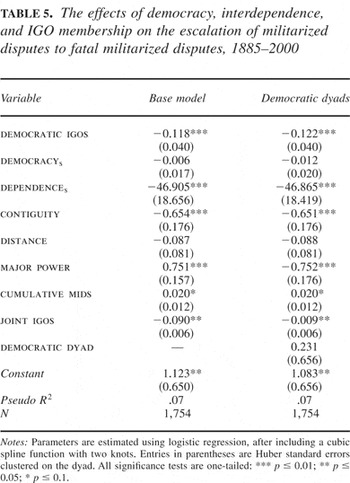
Since there appears to be no statistical reason for a selection model for the onset of disputes and their escalation to fatal disputes, we re-estimate the second equation, for the onset of fatal disputes, using only those cases where a MID onset has occurred. Thus, we can see whether, conditional on the existence of some conflict, hostilities escalate to the point of creating fatalities. Recall that one of our hypothesized causal mechanisms dealt with dispute settlement mechanisms, many of which are designed with this explicit purpose in mind. Evidence that democratic institutions inhibit severe disputes once tensions are already high would provide strong support for that particular causal path linking IGOs to peace.
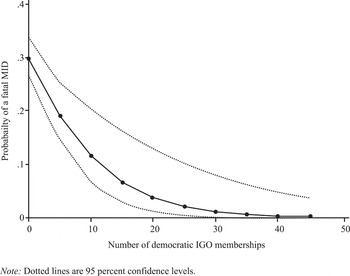
Table 5 shows the estimates of these models, which consistently support the idea that democratic IGOs engender peace. In all the models, democratic igos is negative and highly significant statistically. Again, this is true when controlling for joint democracies, as shown in column 2.79
We also reran earlier robustness checks on the presence of military alliances, the presence of EU-EFTA states, and adjusting the democracy threshold to 6 and above. All results are consistent with our initial findings.
Simulations are based on 3000 simulations of parameter estimates using CLARIFY. See King, Tomz, and Wittenberg 2000.
The effects of democracy, interdependence, and IGO membership on the escalation of militarized disputes to fatal militarized disputes, 1885–2000


Predicted probabilities of escalation to fatal MIDs
Consistent with the estimates of the second stage of the Heckman model (in Table 4), democracy alone has little influence in preventing the escalation of lower-level MIDS to fatal disputes. Rather, democracy seems to work through the instruments provided to democratic states by international organizations. Economic interdependence, however, continues to play a strong and independent role in suppressing violence between states during times of crises. Again the effect of joint igos is negative and usually statistically significant at the p < .05 level, suggesting that even when controlling for the nature of the IGOs in the dyad, the sheer number of joint memberships influences the prospects for conflict escalation.
Finally, it is worth noting that higher numbers of previous MIDs increase the likelihood of escalation to fatal MIDs, as does the presence of a major power in the dyad. In addition, Table 5 shows that directly contiguous states are actually less likely to escalate the violence after they have become involved in a dispute. The shift of this variable from strongly positive in past studies of all MIDs to strongly negative here, when moving to the escalation framework, suggests that while neighbors may be far more likely to engage in conflict, they may be more careful about which conflicts escalate.
Conclusions
We are now more confident in rejecting the realist hypothesis that IGOs are fundamentally irrelevant to reducing violent international conflict. Rather than focusing on all IGOs in the world system, attention to a particular theoretically informed subset proves productive. To paraphrase a previous U.S. president: “It's democratic IGOs, stupid!”
We found consistent evidence to support our hypothesis that a particular kind of IGO is conflict reducing, and that those IGOs produce their effect in conjunction with the regime characteristics of their member states. IGOs comprised principally of states with democratic governments are strongly and consistently associated with a lower risk of fatal militarized disputes among their constituent states. Peace among democracies depends in part on their ability to use conflict-reducing mechanisms associated with those IGOs populated mostly by democratic states. The effect of densely democratic IGOs is in addition to any separate effect either of joint democracy or of joint IGO membership, and it operates on both democratic and nondemocratic dyads. This result holds up well under a variety of robustness tests for different measurements or different specifications of the equations. Densely democratic IGOs help to lower both the risk that MIDs of any sort will arise, and that lower-level MIDs will escalate to fatal ones. Notably, it is unlikely that low frequencies of previous disputes lead to the formation of densely democratic IGOs and thus reverse the causal relationship of our hypothesis.
Since densely democratic IGOs reduce both the frequency of MIDs and their escalation, the direct Kantian causal arrow from a particular kind of IGO to peace seems clear, operating both on democratic and nondemocratic members. Other research points strongly to a positive role for democratic IGOs in promoting and consolidating democracy.81
Pevehouse 2005.
These strong statistical results of course cannot tell us exactly how democratic IGOs work to prevent conflict among their members, nor can they sort out the effect of the different causal processes we suggested as operating. We lack the kind of case study process tracing that would illuminate the conditions under which these statistical results might occur. We do not have the kind of rich, detailed measures of IGOs by function or institutional structure that might provide useful explanations. We require good micro-level evidence of the ways in which institutions work, and such micro-theories of behavior as the principal-agent rational models that have illuminated the democratic peace and even the liberal peace of economic interdependence. We need to know precisely how democracy matters, in different contexts.82
A complementary enterprise would unpack the variable democracy. For example, Minnich 2005 finds that certain kinds of democracies (notably parliamentary systems with incentives for multiparty representation) are more likely to join IGOs.
A focus on densely democratic IGOs may allow other methods and models to dispel some important remaining shadows within the still-unfolding Kantian peace research program. It is likely that densely democratic IGOs contribute in various ways to the uneven learning process by which Kant expected his confederation of republics to form, deepen, and expand.83