INTRODUCTION
In response to increased public awareness and concern about sport-related concussion over the past decade, many sports organizations nation-wide have attempted to improve athlete safety by requiring concussion management protocols. At the collegiate level, concussion management protocols typically require athletes to undergo a battery of assessments that serve as a measure of baseline status representing pre-injury function. A baseline assessment often includes measures of concussion-related symptoms, balance, and neurocognitive abilities. In the event of a concussion, sports medicine clinicians assess for deficits and track recovery by administering the same battery of tests and assessing change.
Accurate interpretation of neurocognitive scores is often difficult due to the number of factors associated with poorer performance at baseline. Male gender (Covassin et al., Reference Covassin, Swanik, Sachs, Kendrick, Schatz, Zillmer and Kaminaris2006), previous concussion (Collins et al., Reference Collins, Grindel, Lovell, Dede, Moser, Phalin and McKeag1999), history of learning disability (LD), and attention deficit–hyperactivity disorder (ADHD) (Collins et al., Reference Collins, Grindel, Lovell, Dede, Moser, Phalin and McKeag1999; Elbin et al., Reference Elbin, Kontos, Kegel, Johnson, Burkhart and Schatz2013), psychological distress such as anxiety and depression (Bailey, Samples, Broshek, Freeman, & Barth, Reference Bailey, Samples, Broshek, Freeman and Barth2010), as well as education level and language (Jones et al., Reference Jones, Walter, Caplinger, Wright, Raasch and Young2014) have all been associated with lower baseline neurocognitive performance. However, a large amount of neurobiopsychosocial variance, which is the combination of neurological, biological, and psychosocial factors, in baseline neurocognitive functioning has yet to be explained. Early exposure to contact sports has recently been associated with cognitive deficits in later life (Stamm et al., Reference Stamm, Bourlas, Baugh, Fritts, Daneshvar, Martin and Stern2015); however, the effects of contact sport exposure have not been assessed in the context of baseline neurocognitive performance.
The effects of various socioeconomic status (SES) factors considered influential in other applications of neuropsychological assessment are yet to be investigated in the context of baseline neurocognitive assessment. SES factors potentially influence biological and psychosocial determinants of baseline performance and, thus, may be critical for interpreting deviant but valid baseline results, particularly when being compared to post-injury results in the evaluation and management of patients with concussion (McCrea, Broshek, & Barth, Reference McCrea, Broshek and Barth2015). The current study takes a first step in filling this gap in the concussion literature.
The influence of SES on cognition has been widely studied in the educational field. Children from disadvantaged SES backgrounds perform worse on intellectual testing than do children from higher SES backgrounds (Andersson, Sommerfelt, Sonnander, & Ahlsten, Reference Andersson, Sommerfelt, Sonnander and Ahlsten1996; Duncan, Brooks-Gunn, & Klebanov, Reference Duncan, Brooks-Gunn and Klebanov1994). Children from lower-SES families have less access to recreational and learning materials from infancy to adolescence, which likely mediates the association between SES and cognitive development (Bradley, Convyn, Burchinal, McAdoo, & Coll, Reference Bradley, Convyn, Burchinal, McAdoo and Coll2001). Further supporting the influence of resource access, cognitive stimulation in the home environment explained one third to one half of the variance in verbal abilities and math skills in economically disadvantaged children (Korenman, Miller, & Sjaastad, Reference Korenman, Miller and Sjaastad1995).
The negative effects of disadvantaged SES backgrounds during childhood that are associated with impoverished learning environments lead to poorer cognitive performance in adulthood (Kaplan et al., Reference Kaplan, Turrell, Lynch, Everson, Helkala and Salonen2001). This suggests that children’s developmental environment heavily influences their cognitive ability and warrants consideration when interpreting neurocognitive performance across their lifespan. This is particularly necessary when interpreting baseline scores of those at increased risk of sustaining a head injury, in which premorbid deficits are often interpreted as brain injury effects (Larrabee, Binder, Rohling, & Ploetz, Reference Larrabee, Binder, Rohling and Ploetz2013).
Exposure to contact sports, such as American football, during key neurodevelopmental periods has recently been described as being associated with cognitive deficits later in life (Stamm et al., Reference Stamm, Bourlas, Baugh, Fritts, Daneshvar, Martin and Stern2015). While the repetitive concussive and sub-concussive impacts sustained throughout one’s career may moderate long-term cognition in this population, other factors, such as developmental environment, have yet to be considered. American football players come from a wide range of socioeconomic backgrounds. In 2014, 52.9% of American football players at Division 1 Football Bowl Subdivision (FBS) level were African-American, a larger percentage than all other sports except men’s basketball (“NCAA College Sport Racial and Gender Report Card,” 2015).
Previous research indicates that African American children have a significantly increased likelihood of being exposed to persistently low SES backgrounds that have influential effects on childhood cognitive abilities (Duncan et al., Reference Duncan, Brooks-Gunn and Klebanov1994). This suggests a large percentage of collegiate football players are at an increased risk of being exposed to low SES backgrounds that result in being cognitively disadvantaged. This could lead to lower cognitive reserve at the time of concussive/subconcussive exposure and throughout their lifetime. Athletes with lower cognitive reserve may be at an increased risk of prolonged recovery at the time of concussive injury or of long-term cognitive deficits following repetitive concussive and sub-concussive impacts. However, no studies to date have assessed the role of SES in conjunction with previously studied variables in collegiate football players.
Developmental environment and SES have been inconsistently defined from a methodological perspective but the most commonly used measures of SES are income, education, and occupation, either individually or in some combination (Braveman et al., Reference Braveman, Cubbin, Egerter, Chideya, Marchi, Metzler and Posner2005; Duncan & Magnuson, Reference Duncan and Magnuson2003; Krieger, Williams, & Moss, Reference Krieger, Williams and Moss1997). The Hollingshead Four Factor Index (Hollingshead, Reference Hollingshead1975), which was used to represent parental SES in the current study, describes SES as a composite of educational and occupational variables and is considered a reliable indicator of SES (Gottfried, Reference Gottfried1985).
The purpose of this study was to assess the contribution of SES along with neurodevelopmental/demographic factors and exposure to sport as predictors of baseline neurocognitive functioning in collegiate athletes. We hypothesized that SES factors would significantly predict baseline neurocognitive performance above and beyond previously studied variables, such as race (Kontos, Elbin, Covassin, & Larson, Reference Kontos, Elbin, Covassin and Larson2010), gender, previous concussion history, years playing primary sport, neurodevelopmental and psychological history. Understanding the relative importance of these factors on baseline neurocognitive performance may aid in the interpretation of deviant, or lower than expected, scores as well as identifying athletes at risk for poor outcomes after brain trauma.
In a separate analysis, we aimed to assess the contribution of multivariate predictors on baseline neurocognitive functioning in collegiate football players. We hypothesized that SES would be a better predictor of baseline neurocognitive performance than years exposed to football, which is an indirect measure of the cumulative exposure to repetitive brain trauma, and previous concussion history. Understanding the contribution of SES on baseline neurocognitive functioning in collegiate football players may aid in the interpretation of neurocognitive scores. Additionally, understanding the contribution of SES may be a first step in identifying a risk factor for student-athletes that may be at an increased susceptibility to acute and long-term cognitive deficits associated with repetitive brain trauma.
METHODS
Data were obtained from the National Collegiate Athletic Association (NCAA) and Department of Defense Concussion Assessment, Research and Education (CARE) Consortium for secondary analysis by a participating institution. The CARE Consortium, initiated in 2014, collects concussion-related assessment data, including baseline and post-injury concussion test results for student-athletes at multiple NCAA institutions. Before the start of their respective seasons, student athletes at each participating CARE institution annually undergo a battery of assessments that serve as a baseline measure of performance. The battery includes, at a minimum, measurements of concussion-related symptoms, balance, and neurocognitive abilities.
In addition to these assessments, all participating student-athletes complete a Clinical Reporting Form (CRF), which provides comprehensive background information on sport participation history, academic history, self- and family-medical history, parental education and occupation, and family income. A more detailed description of the CARE consortium methodology is described elsewhere (Broglio et al., Reference Broglio, McCrea, McAllister, Harezlak, Katz and Hack2017). For the purpose of this initial investigation, we limited analyses to University of Florida student-athlete data only. The University of Florida Institutional Review Board (IRB-01) approved the reception of the data from CARE and the analysis of the data.
Participants
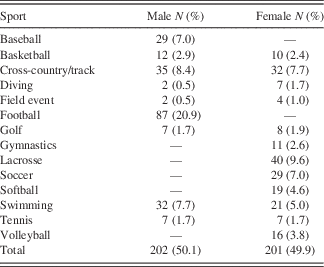
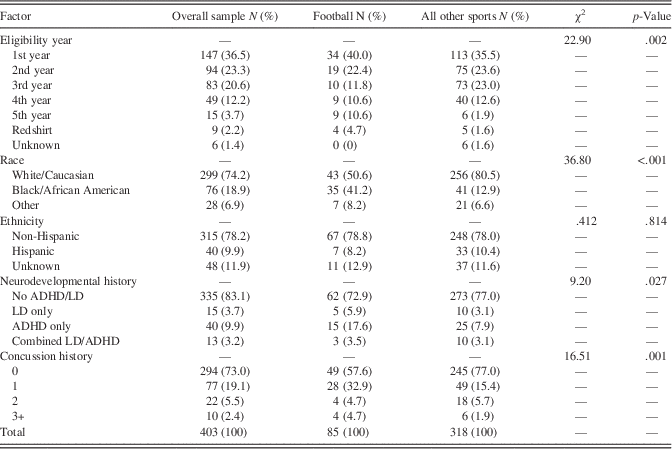
The dataset obtained from the CARE Consortium contained baseline assessments for 494 University of Florida student-athletes from the 2014–2015 and 2015–2016 seasons. After exclusion of student-athletes due to insufficient SES data (N=64), incomplete sport participation variables (N=6), incomplete race data (N=14), and invalid ImPACT data (N=7), 403 student-athletes were included in the final analyses. Student-athletes from 9 male and 12 female sports were included in the sample, as depicted in Table 1. Student-athletes’ year of athletic eligibility ranged from the first year to the fifth year, as depicted in Table 2.
Sample Distribution of Student-Athletes’ Primary Sport

Sample Distribution of Student-Athlete’s Year of Athletic Eligibility, Race, Ethnicity, Neurodevelopmental Disorder History, and Concussion History

Note. Chi-square analysis assessing group differences between football and all other sports combined.
Predictor Variables
Demographic
Self-reported age and gender for the 403 participants [mean age=19.67, standard deviation (SD)=±1.3 years; range, 18–23 years old; male, n=202] were included in the analysis. Race, which is one commonly used proxy of SES, was included in the analysis due to the unreliable nature of self-reported SES. Race was self-reported by the student-athletes and defined as White/Caucasian, Black/African American, or Other. The “other” category included Asian, Indian-Alaskan, and student-athletes of multiple races, which, due to small numbers, were combined. Fourteen student-athletes were excluded due to incomplete race data. Race variables were dummy-coded before entry into the regression model. Ethnicity was defined as Hispanic/Latino, Not Hispanic/Latino, or Unknown. Table 2 shows the sample distribution of student-athletes’ race and ethnicity.
Neurodevelopmental History and Psychological Distress
Self-reported neurodevelopmental disorders and psychological distress were collected as part of the baseline assessments. Self-reported history of diagnosed attention deficit-hyperactivity disorder (ADHD) and LD, as well as current depressive, anxiety, and somatic symptoms, were included in the regression models. Neurodevelopmental history was obtained from the medical history portion of the CRF. Data were not available on the stimulant usage of ADHD diagnosed participants. Psychological distress was assessed with the Brief Symptom Inventory-18 (BSI-18; Derogatis, Reference Derogatis2000), an 18-item questionnaire that assesses general feelings of anxiety (mean=0.72; SD=±1.49), depression (mean=0.69; SD=±1.68), and somatization (mean=1.09; SD=±1.90) representative of the preceding 7 days.
The BSI-18 includes six questions for each of the three domains assessed on a 5-point Likert scale, where “0” indicates that the symptom has not been present, “1” indicates that the symptom has been present “A Little Bit,” “2” indicates that the symptom has been “Moderately” present, “3” indicates that the symptom has been present “Quite A Bit,” and “4” indicates that the symptom has been “Extremely” present, for a possible score of 0–24 on each domain. Table 2 shows the sample distribution of student-athlete’s neurodevelopmental history.
Concussion History and Years Participating in Sport
Self-reported concussion history, diagnosed and suspected, was obtained from the medical history portion of the CRF. Number of years participating in primary sport (mean=11.1; SD=±3.7 years) was defined as the number of years in which the athlete participated in an organized sports league. In the secondary analysis, number of years participating in football (mean=10.2; SD=±4.0 years) was defined as the number of years in which the athlete participated in an organized football league. Athletes were excluded if the age at which they reportedly began competing in an organized sports league was below the age of 3 (n=6). The sample distribution of the student-athlete’s concussion history is shown in Table 2.
SES
The Hollingshead Four Factor Index of Social Status (Hollingshead, Reference Hollingshead1975) characterizes parental SES. The Hollingshead Index assigns numeric values to parental education and occupation to estimate SES such that higher education and occupation receive higher scores. Values assigned to education (1–7) and occupation (1–9) are multiplied by 3 and 5, respectively, and summed for a composite score (range=8–66) representing SES level. Athletes who reported their parents’ education as “unknown” were excluded; however, athletes who reported their parents’ occupation as “unknown/unemployed” were included to ensure the current sample accounted for parents who were coded as unemployed.
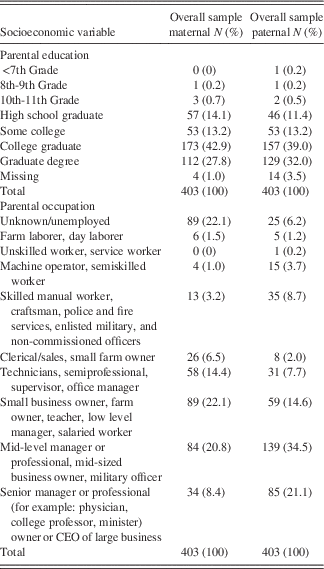
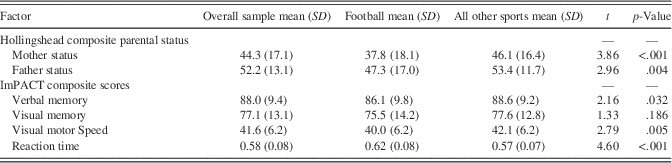
Therefore, the range for occupation (0–9) and parental SES composite score range (3–66) in the current sample differed from the approach recommended by the Hollingshead index. To account for this deviation and an inability to determine who lived in single parent households, composite scores were obtained and included separately for student-athletes’ mothers and fathers. Athletes were included only if complete data were available for at least one parent. Sixty-four athletes were excluded due to incomplete socioeconomic data. Table 3 shows parental education and occupation. Table 4 shows sample distribution of the Hollingshead Index composite scores.
Sample Distribution of Parental Education and Occupation

Sample Distribution of Hollingshead Index Composite Scores and ImPACT Composite Scores

Note. Independent samples t-test assessing differences between football and all other sports combined.
Outcome Variables
Immediate Post-Concussion Assessment and Cognitive Testing (ImPACT) is a computerized neurocognitive assessment tool comprised of six subtests, components of which provide the underlying data for four composite scores: Verbal Memory, Visual Memory, Visual Motor Speed, and Reaction Time (Lovell, Collins, Podell, Powell, & Maroon, Reference Lovell, Collins, Podell, Powell and Maroon2000). ImPACT validity indicators provided by the program were unavailable for analyses. Therefore, in an effort to eliminate invalid evaluations, ImPACT composite scores were standardized, and a cutoff score of 3 SDs or more below the mean was used for verbal memory (n=3), visual memory (n=0), and visual motor speed (n=0), and a cutoff score of 3 SDs or more above the mean was used for reaction time (n=4).
The four ImPACT composite scores were reduced to a two-factor structure based on recent research (Gerrard et al., Reference Gerrard, Iverson, Atkins, Maxwell, Zafonte, Schatz and Berkner2017; Maerlender et al., Reference Maerlender, Flashman, Kessler, Kumbhani, Greenwald, Tosteson and McAllister2013) indicating that “Speed” (Visual Motor Speed and Reaction Time) and “Memory” (Verbal and Visual Memory) constructs best characterize the six underlying subtests. Reaction Time was inversed so that higher scores for each composite indicated better performance. Visual Motor Speed and Reaction time were then transformed to Z-scores relative to the overall sample distribution so that scores were on the same metric. The overall speed outcome represented an average of the Visual Motor Speed and Reaction Time Z-scores. The overall memory outcome represented an average of the Verbal Memory and Visual Memory Z-scores. Each ImPACT assessment was completed on a desktop computer either individually or in a small group setting (maximum four athletes per group). Descriptive statistics of raw ImPACT composite scores can be seen in Table 4.
Analysis
Data Normalization
Each ImPACT test measure distribution was evaluated for normality. Overall memory (Kolmogorov-Smirnov=.056; p=.004) and overall speed (Kolmogorov-Smirnov=.047; p=.033) were significantly negatively skewed, so the scores were normalized by applying Blom transformations (Blom, Reference Blom1958), which is a formula-based approximation of the expected value of normal order statistics. White/Caucasian race (r=.331; p<.001) was moderately, positively correlated with paternal SES and Black/African American race (r=.338; p<.001) was moderately, negatively correlated with paternal SES; therefore, for each sample, the unstandardized residual of SES after accounting for race was calculated using a regression model so that race and SES were separable in the prediction of neurocognitive performance.
Factors Affecting Baseline Scores
Hierarchical regression analyses on each of the neurocognitive outcome measures (overall memory and overall speed) were used to assess the relative contributions of multivariate predictors on baseline neurocognitive performance in the overall sample of collegiate athletes (N=403).
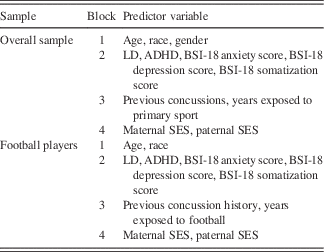
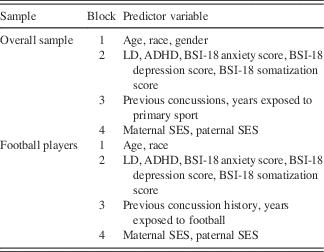
In a separate analysis using only football players (N=85), hierarchical regression analyses on each of the neurocognitive outcome measures were used to assess the relative contribution of years exposed to football, previous concussions, SES, as well as other previously mentioned multivariate predictors, on baseline neurocognitive performance. Data were excluded list-wise to reduce the impact of missing data. Variables for all models were retained only if found to be statistically significant to improve the model’s prediction performance by reducing the variance caused by estimating non-significant variables. Statistical significance was defined using p<.05 criterion. Table 5 shows predictor variables by block for each analysis.
Predictor Variables by Block for Each Sample Assessed.
RESULTS
Factors Affecting Baseline Neurocognitive Scores
Memory
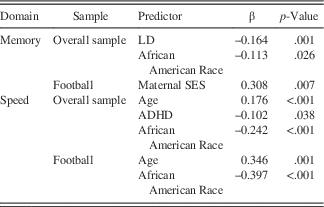
Table 6 shows hierarchical linear regression statistics for ImPACT memory and speed scores. When evaluating the overall sample, the variables retained in the model explained 3.7% of the variance in memory performance (R2=.037; F(2,382)=7.438; p=.001). Specifically, the presence of an LD (β=−0.164; p=.001) and Black/African American race (β=−0.113; p=.026) were associated with lower overall memory scores.
Hierarchical Linear Regression Statistics for Memory and Speed Composites

Among football players, maternal SES was the only variable retained in the model and explained 9.5% of the variance in memory performance (R2=0.095; F(1,74)=7.749; p=.007). Specifically, higher maternal SES (β=0.308; p=.007) was associated with better overall memory performance. Consistent with our hypothesis, years playing football (p=.372) and previous concussion history (p=.854) were not associated with baseline memory performance in football players. All other variables included in Table 5 were not associated with baseline memory performance in the overall and football samples.
Speed
When evaluating the overall sample, the variables retained in the model explained 9.9% of the variance in speed performance (R2=.099; F(3,381)=13.984; p<.001). Specifically, Black/African American race (β=−.242; p<.001) and the presence of ADHD (β=−0.102; p=.038) were significantly associated with worse overall speed performance. Older age at the time of testing (β=.176; p<.001) was significantly associated with better overall speed performance.
Among football players only, the variables retained in the model explained 23.9% of the variance in speed performance (R2=.239; F(2,73)=12.770; p<.001). Specifically, older age at the time of testing (β=0.346; p=.001) was associated with better overall speed performance. Black/African American race (β=−0.397; p<.001) was associated with worse speed performance. Consistent with our hypothesis, years playing football (p=.575) and previous concussion history (p=.170) were not associated with baseline speed performance in football players. All other variables included in Table 5 were not associated with baseline speed performance in the overall and football samples.
DISCUSSION
We investigated the effects of SES factors on baseline neurocognitive performance in collegiate student-athletes, as well as the influence of previously described influential demographic and medical history variables. Results indicated age, race, and neurodevelopmental diagnoses of LD or ADHD are predictors of baseline neurocognitive performance in the overall sample. In a secondary analysis of football players, we investigated the effects of SES, years exposed to football, and concussion history on baseline neurocognitive performance, as well as the influence of age, race, and medical history variables, in an attempt to elucidate whether factors related to brain trauma or premorbid influences were more strongly related to neurocognitive scores. We found age, race, and SES factors predicted neurocognitive performance. Exposure to head impacts as represented by years of football play and concussion history did not predict baseline neurocognitive performance. Additionally, contrary to previous research (Covassin et al., Reference Covassin, Swanik, Sachs, Kendrick, Schatz, Zillmer and Kaminaris2006), gender was non-significant after controlling for demographic, neurodevelopmental, sport participation, and SES.
Maternal SES, accounting for 10% of the variance, significantly predicted only memory performance in football players. This finding supports previous research that both maternal SES and maternal IQ are the strongest predictors of their children’s intelligence (Andersson et al., Reference Andersson, Sommerfelt, Sonnander and Ahlsten1996). Additionally, findings revealed football players, specifically, had significantly lower maternal SES (p<.001) and paternal SES (p=.004) when compared to all other sports combined. Furthermore, years exposed to football (p=.372) and previous concussion history (p=.854) were not associated with memory performance.
These results suggest poorer neurocognitive performance at baseline in collegiate football players is attributable to the effects of disadvantaged socioeconomic backgrounds during childhood as opposed to being exposed to football. Researchers and clinicians should weigh the environmental and demographic factors associated with low SES when interpreting poor baseline performance. Poor performance on a student-athlete’s initial baseline test (e.g., Freshman year) could be due to environmental factors associated with low SES. Additionally, as seen in the current study, there is a higher rate of neurodevelopmental disorders in children from low SES backgrounds (Pastor, Reference Pastor2009).
Current data, however, suggest the effects of low SES are more predictive of neurocognitive performance than neurodevelopmental disorders in football players. The complex interaction of these factors influencing neurocognitive performance emphasizes the role of trained neuropsychologists in the interpretation of cognitive test results in athletes, which has been recommended by the Concussion in Sport Group (McCrory et al., Reference McCrory, Meeuwisse, Dvorak, Aubry, Bailes, Broglio and Castellani2017).
Poor neurocognitive scores in the context of low SES backgrounds may serve as a risk factor for more quickly diminished cognitive reserve leading to both acute and long-term cognitive deficits in football players at risk for multiple concussion and extensive exposure to repetitive subclinical brain trauma. Cognitive reserve, of which SES is one commonly used proxy, describes the concept that there are individual differences that allow some to cope with brain-related changes better than others (Stern, Reference Stern2009). Lower cognitive scores seen in relatively young, retired NFL players have been attributed to early exposure to repetitive brain trauma (Stamm et al., Reference Stamm, Bourlas, Baugh, Fritts, Daneshvar, Martin and Stern2015). However, current data suggest that lower baseline cognitive test scores in college football players may be due more so to environmental and demographic factors associated with low SES. It could be the case that cognitive changes reported by retired football players or their family members have synergistic effects with brain trauma; premorbidly low cognitive reserve heightens risk for earlier manifestation of clinical impairment following repetitive concussive and subclinical impacts.
Black/African American race was consistently associated with worse speed performance at baseline. This finding contradicts previous research finding no racial/ethnic differences in baseline neurocognitive performance on ImPACT (Kontos et al., Reference Kontos, Elbin, Covassin and Larson2010). However, the previously mentioned study included both high school and collegiate athletes, used the four-factor ImPACT structure, and failed to control for other influential covariates.
While concussion-related research has yet to adequately study race differences in neurocognitive functioning, it has long been suggested that race be considered when interpreting neurocognitive scores (Williams, Reference Williams1997). Research exists demonstrating that low SES and minority students have unequal educational quality compared to Whites (Darling-Hammond, Reference Darling-Hammond2004). Furthermore, quality of education, as measured by reading level, consistently accounts for significant variability in in neurocognitive performance between racial groups (Dotson, Kitner-Triolo, Evans, & Zonderman, Reference Dotson, Kitner-Triolo, Evans and Zonderman2008, Reference Dotson, Kitner-Triolo, Evans and Zonderman2009; Manly, Byrd, Touradji, & Stern, Reference Manly, Byrd, Touradji and Stern2004; Manly, Jacobs, Touradji, Small, & Stern, Reference Manly, Jacobs, Touradji, Small and Stern2002).
Shuttleworth-Edwards and colleagues previously assessed the effect of level and quality of education on performance of the Wechsler Adult Intelligence Scale III in a South African population and found that verbal and performance indices, including processing speed, were depressed by lower quality of education (Shuttleworth-Edwards et al., Reference Shuttleworth-Edwards, Kemp, Rust, Muirhead, Hartman and Radloff2004). SES, which in the current sample was higher among White/Caucasian student-athletes (p<.001), is associated with quality of education (Darling-Hammond, Reference Darling-Hammond2004). Thus, the results of worse speed performance in Blacks/African Americans could be attributable to quality of education differences during key neurodevelopmental periods. Educational quality also influences neurocognitive performance in Whites/Caucasians (Dotson et al., Reference Dotson, Kitner-Triolo, Evans and Zonderman2009).
Additionally, there is significant variability in access to quality education within racial groups, which emphasizes the importance of obtaining family/social history when interpreting neurocognitive scores. Future studies should assess the differential effects of race and quality of education on baseline neurocognitive performance.
In the overall sample, the presence of an LD was associated with worse memory performance, while the presence of an ADHD diagnosis was associated with slower speed performance. This finding is consistent with previous research indicating that the presence of a neurodevelopmental disorder is associated with worse neurocognitive scores on ImPACT (Collins et al., Reference Collins, Grindel, Lovell, Dede, Moser, Phalin and McKeag1999; Elbin et al., Reference Elbin, Kontos, Kegel, Johnson, Burkhart and Schatz2013). While previous research (Collins et al., Reference Collins, Grindel, Lovell, Dede, Moser, Phalin and McKeag1999; Elbin et al., Reference Elbin, Kontos, Kegel, Johnson, Burkhart and Schatz2013) indicated that athletes with an LD performed worse on both speed and memory measures, our findings are more selective and suggest that LD is associated with poorer memory, while ADHD is associated with lower speed scores.
Interestingly, SES was a stronger predictor of overall memory performance in football players than was the presence of a neurodevelopmental disorder. This finding highlights the importance of accounting for neurodevelopmental history and SES in brain injury research, as premorbid impairments can often be misinterpreted as brain injury effects (Larrabee et al., Reference Larrabee, Binder, Rohling and Ploetz2013). It should be noted that data were unavailable on medication status at the time of testing for the ADHD sub-sample. Recent research revealed that non-medicated, adolescent athletes with ADHD performed worse on all ImPACT composites at baseline when compared to medicated athletes, with the largest effect on the visual motor speed composite (Cook et al., Reference Cook, Huang, Silverberg, Brooks, Maxwell, Zafonte and Iverson2017).
Similarly, in a sample of college athletes, non-medicated athletes with ADHD performed worse on a psychomotor speed task when compared to controls (Littleton et al., Reference Littleton, Schmidt, Register-Mihalik, Gioia, Waicus, Mihalik and Guskiewicz2015). The percentage of student-athletes with self-reported ADHD in the overall sample of the current study (9.9%) was similar to a previous study (10.1%) (Alosco, Fedor, & Gunstad, Reference Alosco, Fedor and Gunstad2014). These findings reflect the importance of accounting for medication status when interpreting neurocognitive performance.
Across groups, older age was significantly associated with better baseline speed performance. As baselines are currently administered annually at our institution, student-athletes past their first year of eligibility, 63.5% of the overall sample and 60% of football players, may be more subject to practice effects and knowledge about the nature of testing, which could contribute to better performance than athletes in their first year of eligibility and unfamiliar with task instructions. This may also suggest that ImPACT processing speed and reaction time assessments may be more susceptible to practice effects compared to the verbal and visual memory assessments, which did not significantly improve with age.
Although these findings are significant, the effect sizes within the overall sample are small, which could attenuate the clinical meaningfulness. However, when assessing football alone, effect sizes were larger. This suggests that sport-specific differences in the proportional representation of various demographic variables (e.g., SES and race) may also be an important consideration within the broader biopsychosocial attributional model. Future research should further explore race and SES differences as it relates to baseline neurocognitive performance, as the current data suggest these factors explain sport-specific differences in performance.
The results of the current study emphasize the importance of adopting a neurobiopsychosocial approach to interpreting cognitive test scores in athletes. At baseline, low SES and race could influence neurocognitive performance. Similar to previous research, neurodevelopmental disorders, such as ADHD or LD, influence baseline speed and memory neurocognitive performance, but SES was a stronger predictor in football players than these aforementioned variables. As recommended by the Concussion in Sport Group, a trained neuropsychologist should be consulted when incorporating the several influential factors affecting cognitive test scores (McCrory et al., Reference McCrory, Meeuwisse, Dvorak, Aubry, Bailes, Broglio and Castellani2017). Neuropsychologists may also help determine situations in which more comprehensive neuropsychological testing is warranted.
LIMITATIONS AND FUTURE RESEARCH
The current study has several limitations. First, all demographic/background information contained in the CRF was based on athlete self-report. Second, ImPACT is a brief neurocognitive measure, which may be insensitive to subtler cognitive differences potentially elicited from a more comprehensive neuropsychological test battery. Additionally, recent research has identified poor test–retest reliability on several computerized neurocognitive tests, including ImPACT (Nelson et al., Reference Nelson, LaRoche, Pfaller, Lerner, Hammeke, Randolph and McCrea2016). This suggests that the poor reliability of computerized neurocognitive tests increases measurement error and, in general, complicates the interpretation of results.
It is also difficult to control athlete effort while completing baseline neurocognitive assessments. However, the study findings are relevant to the thousands of clinicians who use ImPACT and other computerized neurocognitive tests in athletic settings. We also attempted to include only valid ImPACT data, which presumably eliminate instances of grossly poor effort. Other general limitations include the exclusive use of collegiate athletes, limiting generalizability to other participation levels, and the inclusion of student-athletes from only one institution, which may not be representative of other universities in different geographic locations with variable demographic makeups.
Future research should aim to, if possible, collect parental SES factors directly from parents as opposed to reliance on their child’s understanding of education and occupation level. The degree to which these influences at baseline translate in a post-injury setting should also be investigated. Lastly, given the previous research on the effects of childhood development factors on cognition across the lifespan, in addition to our findings of their effects on baseline neurocognitive testing in collegiate athletes, research of retired athletes should examine cognitive functioning within a broader neurobiopsychosocial framework that incorporates influences beyond history of concussion and exposure to collision sports (Asken et al., Reference Asken, Sullan, Snyder, Houck, Bryant, Hizel and Bauer2016).
ACKNOWLEDGMENTS
This publication was made possible, in part, with support from the Grand Alliance Concussion Assessment, Research, and Education (CARE) Consortium, funded, in part by the National Collegiate Athletic Association (NCAA) and the Department of Defense. The U.S. Army Medical Research Acquisition Activity, 820 Chandler Street, Ford Detrick MD 21702-5014 is the awarding and administering acquisition office. This work was supported by the Office of the Assistant Secretary of Defense for Health Affairs through the Psychological Health and Traumatic Brain Injury Program under Award NO W81XWH-14-2-0151. Opinions, interpretations, conclusions, and recommendations are those of the author and are not necessarily endorsed by the Department of Defense (DHP funds). No conflict of interest exists among authors.