Traumatic experiences during childhood, including not only neglect, but emotional, physical, or sexual abuse, have been consistently associated with increased risk for developing stress-related neuropsychiatric disorders, such as depression, anxiety, posttraumatic stress disorder, and substance abuse disorders (De Bellis, Reference De Bellis2005). Childhood neglect and maltreatment are considered to involve chronic or repeated stress exposures, sufficient to activate the hypothalamic–pituitary–adrenal (HPA) axis, and chronic stress experiences early in life have been shown to modify stress reactivity and subsequently vulnerability to stress (Caspi et al., Reference Caspi, McClay, Moffitt, Mill, Martin and Craig2002; De Bellis, Reference De Bellis2005; Gordon, Reference Gordon2002). The serotonin system is considered to play a pivotal role in modulating risk for developing mood and anxiety disorders, and several widely used antidepressants have as site of actions the serotonin (5-hydroxytryptamine [5-HT]) system, with selective serotonin reuptake inhibitors (SSRIs) being one of the most common treatments (Berton & Nestler, Reference Berton and Nestler2006; Gross & Hen, Reference Gross and Hen2004). In addition, a number of studies have shown there to be reciprocal influences between the serotonergic system and the HPA axis (Feldman & Weidenfeld, Reference Feldman and Weidenfeld1998; Lowry, Reference Lowry2002) and, furthermore, that both are altered by early-life stress (Thadani, Reference Thadani2002; Vazquez, Eskandari, Zimmer, Levine, & Lopez, Reference Vazquez, Eskandari, Zimmer, Levine and Lopez2002).
Together with an environmental component, various studies in humans suggest a strong link between specific genetic predisposition and stress-related disorders later in life. Interactions between genetic predisposition and life events are likely to account for interindividual differences in psychopathology, because some individuals are very sensitive to stressors, whereas others seem to be more resilient to stress. Studies investigating the influence of candidate genes in susceptibility to anxiety and depression in humans have suggested an association with a functional variant in the promoter of the serotonin transporter (5-HTT) gene, termed the serotonin transporter linked promoter region (5-HTTLPR; Gross & Hen, Reference Gross and Hen2004; Levinson, Reference Levinson2006).
Although other functional variants have been identified, the short (s) 5-HTTLPR allele has been demonstrated to diminish in vitro transcription of 5-HTT relative to that from the long (l) allele. This results in the existence of two functionally distinct alleles, imparting either high (l/l) or low (l/s and s/s) transcriptional activity (Lesch et al., Reference Lesch, Bengel, Heils, Sabol, Greenberg and Petri1996), and therefore, serotonin transporter levels (Heinz et al., Reference Heinz, Jones, Mazzanti, Goldman, Ragan and Hommer2000). To date, several studies have shown associations between the s allele and an increased risk for anxiety and mood disorders (Hamet & Tremblay, Reference Hamet and Tremblay2005; Levinson, Reference Levinson2006). In a prospective longitudinal study, Caspi et al. showed that 5-HTTLPR s allele carriers were more likely to develop depression, but only as a function of chronic or repeated stress exposures (Caspi et al., Reference Caspi, Sugden, Moffitt, Taylor, Craig and Harrington2003). Overall these findings suggest that stressful life experience and 5-HTTLPR interact to produce mood and anxiety disorders in individuals with the s allele.
Because their environments can be controlled, nonhuman primates provide a valid model for understanding the origins of interactions between adverse early-life experience and functional genetic variants in the development of stress-related disorders (Barr, Newman, Shannon, et al., 2003; Barr, Schwandt, Newman, & Higley, Reference Barr, Schwandt, Newman and Higley2004). In silico analyses of the regulatory region for the serotonin transporter gene demonstrate this region to be both highly conserved and, in some cases, polymorphic, in simian but not other mammalian species (Barr & Goldman, Reference Barr and Goldman2006). In rhesus macaques (Macaca mulatta), a 21 base pair (bp) insertion/deletion polymorphism orthologous to the recombinant human 5-HTTLPR variant (rh5-HTTLPR) has been shown to alter transcriptional efficiency (Bennett et al., Reference Bennett, Lesch, Heils, Long, Lorenz and Shoaf2002).
Several paradigms have been used in nonhuman primates to study the short- and long-term consequences of stress exposures that occur early in development. Peer reering is a condition under which infant macaques are separated from their mothers at birth and housed in a nursery with three age-matched peers. This is an established model of early adversity, which has been consistently shown to induce high levels of anxiety in rhesus monkeys (Suomi, Reference Suomi1991). Regardless of early environmental conditions, social separation in nonhuman primates is considered a highly stressful event. It has been shown to activate the HPA axis and to induce behavioral and physiological stress responses. The initial response, referred to as the “protest phase,” is characterized behaviorally by increased locomotion, excessive vocalization, and distress and, physiologically, by high levels of ACTH and cortisol. When the separation event persists over several days, the acute reaction to separation is followed by a “despair phase,” characterized by very low levels of exploration activity and an increase in both behavioral withdrawal and self-directed behaviors. Physiologically, ACTH has been shown to drop below baseline levels even if cortisol levels remain elevated (Barr, Newman, Shannon, et al., Reference Barr, Newman, Lindell, Shannon, Champoux and Lesch2004; Higley et al., Reference Higley, Mehlman, Taub, Higley, Suomi and Vickers1992; Mineka & Suomi, Reference Mineka and Suomi1978).
Previous studies have demonstrated that PR monkeys exhibit more severe responses to social separation stress and an increased risk for despair during a social separation (Mineka & Suomi, Reference Mineka and Suomi1978; Suomi, Reference Suomi1997). A Gene × Environment interaction (G × E) between the polymorphism in the serotonin transporter gene regulatory region and rearing history on serotonin functioning has been reported in adult rhesus monkeys (Barr, Newman, Becker, Champoux et al., Reference Barr, Newman, Becker, Champoux, Lesch and Suomi2003; Barr, Newman, Lindell, et al., Reference Barr, Newman, Becker, Parker, Champoux and Lesch2004; Bennett et al., Reference Bennett, Lesch, Heils, Long, Lorenz and Shoaf2002). Later reports demonstrated that PR infants that were also carriers of the rh5-HTTLPR s allele exhibited higher levels of stress axis responding during the acute, protest phase of social separation. In addition, independent of rearing condition, monkeys carrying the s allele had higher plasma levels of ACTH levels during the chronic, “despair” phase of social separation (Barr, Newman, Becker, Parker et al., Reference Barr, Newman, Shannon, Parker, Dvoskin and Becker2004).
In this study, we investigate the association of the rh5-HTTLPR s allele with the behavioral responses to this social separation stress. Based on the studies cited above, we test the hypothesis that, in the context of early rearing history, length variation in the rh5-HTTLPR gene regulatory region is associated with differential behavior responding to acute and chronic social separation, and that the s allele may differentially influence in the behavioral responses of mother-reared (MR) and PR monkeys.
Methods
Subjects and care
Protocols for the care and use of experimental animals were approved by the Institutional Animal Care and Use Committee of the National Institute on Alcohol Abuse and Alcoholism and the National Institute of Child Health and Human Development, National Institutes of Health. Rhesus macaques (n = 189, representing 10 birth cohorts) were born and housed at the National Institutes of Health Animal Center in Poolesville, MD. At birth, all subjects were divided into two groups with different social and rearing experiences early in life. MR monkeys (n = 130) were reared for the first 6 months of life with their biological or cross-fostered mothers and fathers in social groups comprising 8–12 adult females (about half of whom had same-aged infants) and 2 adult males.
PR monkeys (n = 59) were separated from their mothers and housed in an incubator for the first 14 days of life. From day 14 until day 37, they were placed alone in a nursery cage and provided a blanket and a terry cloth covered, rocking surrogate. At 37 days of age, they were placed in a cage with three other age mates to whom they had continuous access. PR group rearing deprives animals of parental input and the opportunity to learn appropriate social behaviors and context during early development and is a model for early-life stress. The rearing conditions have been described in detail elsewhere (Shannon, Champoux, & Suomi, Reference Shannon, Champoux and Suomi1998).
Separation procedures
When the animals reached the age of 6–7 months, they were subjected to four sequential, 4-day separations with 3 days of reunion in between (Higley, Suomi, & Linnoila, Reference Higley, Suomi and Linnoila1991). Subjects in the peer group were separated into individual sections of the home cage using partitions, which prevented the infants from seeing or making contact with one another. However, the infants could hear each other. MR infants were separated from their mothers by removing the mother from the social group leaving the infant in the home cage with other adult females, males, and infants (no maternal siblings or older juveniles were present). In a small number of subjects (n = 33), both mothers and infants were removed from the home cage. Because preliminary analyses indicated that there were no interactive effects of genotype with separation conditions, data collected under both conditions were included in the analyses. Day 1 (Monday) of each separation week was designated as the acute phase of separation. Days 2–4 (Tuesday–Thursday) of each separation week were designated as the chronic phase of separation. Following each separation week, subjects were reunited with their mothers or peers early on Friday morning and separated again at noon on Monday.
Behavioral observations
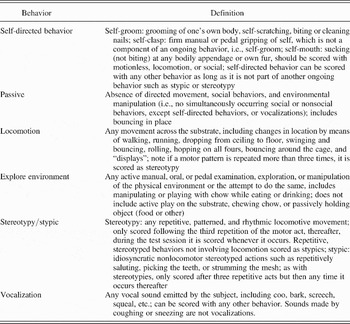
During each separation week, a total of nine observations were made, according to the following schedule. Three observations were made on Day 1: two immediately following separation and one at Hour 1. Two observations were made each day for Days 2–4. Each observation period was 300 s in duration. All behaviors were recorded as durations in seconds, except vocalizations that were recorded as frequencies. Behavioral data were collected by multiple observers with at least 85% interobserver reliability (Table 1).
Definitions of behaviors scored during social separation

Genotyping
Using standard extraction methods, DNA was isolated from whole blood and collected from the femoral vein after the animals had been given ketamine anesthesia (15 mg/kg, intramuscular). The rh5-HTTLPR region was amplified from 25 ng of genomic DNA with flanking oligonucleotide primers (stpr5, 5′-GGCGTTGCCGCTCTGAATGC; intl, 5′-CAGGGGAGATCCTGGGAGGG), in 15-µl reactions using Platinum Taq and the PCRX Enhancer System kit (Invitrogen, Carlsbad, CA), according to the manufacturer's protocol. Amplifications were performed on a thermocycler (9700; Perkin–Elmer, Fremont, CA) with 1 cycle at 96°C for 5 min followed by 30 cycles at 94°C for 15 s, 60°C for 15 s, and 72°C for 30 s, and a final 3-min extension at 72°C. Amplicons were separated by electrophoresis on a 10% polyacrylamide gel, and the short (s; 398-bp) and long (l; 419-bp) alleles of rh5-HTTLPR were identified by direct visualization following ethidium bromide staining. One hundred eighty-nine infants were genotyped (130 MR animals: l/l = 85, l/s = 45; 59 PR animals: l/l = 44, l/s = 15).
Statistical analyses
StatView 5.0.1 (SAS Institute, Inc., Cary, NC) was used for all statistical analyses. Behavioral data were summarized as mean scores across the 4 weeks of separation, with separate means calculated for the acute and chronic separation phases. Factor analysis with principle components extraction and varimax rotation was used to reduce the complexity of the behavioral data to identify underlying behavioral dimensions for association analysis. Two separate factor analyses were performed for the acute and chronic separation phases to investigate potential changes in the behavioral response to social separation between these two phases. For the extracted factors, factor scores were calculated for each subject and used in subsequent analyses. To assess the effects of serotonin transporter genotype and rearing condition on behaviors during social separation stress, a two-way analysis of variance (ANOVA) was conducted with separation condition (MR or PR) and serotonin transporter genotype (l/l or l/s) as independent variables. The effects of these variables on acute and chronic behaviors over the course of the separation paradigm were determined. Post hoc comparisons were performed using Tukey–Kramer tests (p < .05).
Results
Behavioral factors
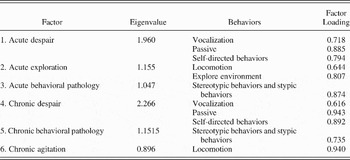
Factor analysis performed on behaviors collected during the acute phase of separation produced three factors that together explained 69.3% of the variance. Similarly, factor analysis performed using behaviors collected during the chronic phase of social separation produced also three factors that together explained 78% of the variance (Table 2). Factor 1 showed high positive loadings with vocalizations, self-directed behavior, and behavioral withdrawal (passive). Passive and self-directed behaviors have been identified as those associated with the despair phase of social separation originally described by Bowlby (Mineka & Suomi, Reference Mineka and Suomi1978), and, consequently, this factor was designated as acute despair. Factor 2 was labeled as acute exploration because of a high positive loading with the explore environment and locomotion. Factor 3 showed high positive loadings with stereotypy/stypic and locomotion, behaviors indicative of agitation or anxiety (Mineka & Suomi, Reference Mineka and Suomi1978; Suomi, Reference Suomi1991). Thus, this factor was labeled as acute behavioral pathology.
Results of factor analyses

Factor 1 showed high positive loadings with vocalizations, self-directed behavior, and behavioral withdrawal (passive) and, thus, was designated as chronic despair. Factor 2 showed a high positive loading with stereotypy/stypic and high negative loading with explore environment and was labeled chronic behavioral pathology. Factor 3 showed high positive loadings with locomotion and was labeled chronic agitation.
Acute separation
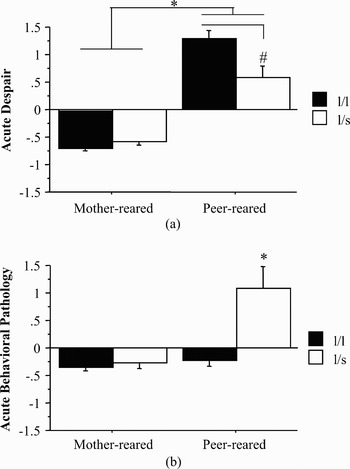
The ANOVA performed with acute despair as a dependent variable yielded a significant main effect of rearing, F (1, 185) = 217.5, p < .0001, and a main effect of rh5-HTTLPR genotype, F (1, 185) = 7.6, p < .007, in addition to a Rearing × rh5-HTTLPR interaction, F (1, 185) = 15.7, p = .0001. In general, PR monkeys showed higher levels of acute despair compared to MR monkeys. Post hoc comparisons revealed that PR monkeys with the l/l genotype demonstrated a higher level of acute despair compared to PR l/s monkeys (Figure 1a).
The differences between mother-reared and peer-only reared monkeys during the acute behavioral response to the separation for (a) acute despair and (b) acute behavioral pathology. Black bars indicate l/l and white bars indicate animals heterozygous for the 5-HTTLPR s allele of 5-HTTLPR. Error bars indicate the standard error of the mean; #p < .05, *p < .001.

There were significant main effects of rearing condition, F (1, 185) = 34.7, p < 0.0001, and rh5-HTTLPR, F (1, 185) = 31, p < .0001, and a significant Rearing Condition × rh5-HTTLPR interaction, F (1, 185) = 23.4, p < .0001, for acute behavioral pathology. Post hoc comparisons revealed that PR monkeys that were carriers of the s allele had a much higher level of behavioral pathology compared to all MR monkeys and to PR monkeys with the l/l genotype (Figure 1b). There were no effects of rearing condition or rh5-HTTLPR on acute exploration.
Chronic separation
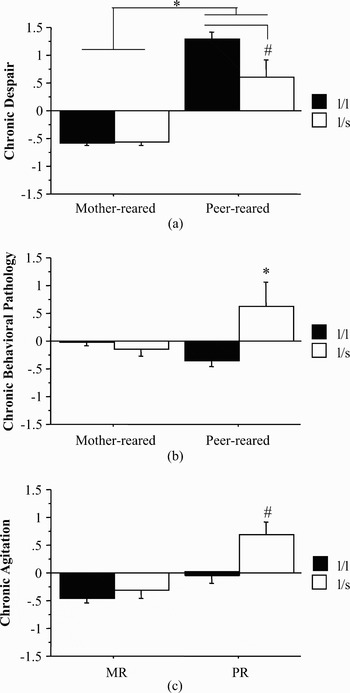
In looking at associations and possible interactive effects of rh5-HTTLPR with chronic despair, results were similar to those obtained in examining despair responses exhibited during the acute phase of separation. There were significant main effects of rearing condition, F (1, 185) = 191, p < .0001, and rh5-HTTLPR, F (1, 185) = 9, p = .004, on chronic despair and a significant Rearing × rh5-HTTLPR interaction, F (1, 185) = 10, p = .002. Post hoc comparisons revealed that PR infants show a higher level of despair during chronic separation compared to those reared with their mothers. Furthermore, PR l/l infants demonstrate a higher despair response compared to PR l/s infants (Figure 2a).
Differences between mother-reared and peer-only reared monkeys during the chronic behavioral response to the separation for (a) chronic despair, (b) chronic behavioral pathology, and (c) chronic agitation. Black bars indicate animals homozygous and white bars animals heterozygous for the l allele of 5-HTTLPR. Error bars indicate the standard error of the mean; #p < .05, *p < .001.

The ANOVA examining rearing and genotype effects on chronic behavioral pathology yielded a significant main effect of rh5-HTTLPR, F (1, 185) = 7.7, p < .0001, and a significant Rearing × rh5-HTTLPR interaction, F (1, 185) = 13.8, p = .0003. Post hoc comparisons revealed that PR monkeys with the l/s genotype exhibited higher levels of behavioral pathology compared to all MR monkeys and to PR monkeys homozygous for the l allele (Figure 2b).
The ANOVA for chronic agitation yielded significant main effects of rearing condition, F (1, 185) = 20.3, p = .0001, and rh5-HTTLPR genotype, F (1, 185) = 8.5, p = .004, in addition to a significant Rearing × rh5-HTTLPR interaction, F (1, 185) = 4, p = .05. Post hoc comparisons revealed that PR monkeys with the l/s genotype exhibited higher levels of agitation during chronic social separation compared to both MR (l/l or l/s) and PR l/l infants (Figure 2c).
Discussion
Our results show that early life experience influences the behavioral responses of rhesus macaques to stressful events, such as social separation, and that these behavioral responses are strongly modulated by a functional genetic variant in the serotonin transporter linked polymorphic region. Compared to MR monkeys, those reared in peer-only groups show higher levels of despair (which include self-directed behaviors, passive and vocalization) during both the acute and chronic phases of a separation. But whereas PR monkeys with l/l genotype display higher level of despair compared to PR l/s monkeys, those that were carriers of the s allele were more likely to develop pathological behaviors as a result of this stress exposure. These results were observed for data collected during both the acute and chronic stress exposures. Overall, these findings suggest that rh5-HTTLPR polymorphism influences behavioral responses to stress, but only as a function of a history of adversity. Moreover, it is clear that PR l/s monkeys are among those that are more likely to develop behavioral pathology as a result of stress exposures.
There is a large body of literature showing that, when exposed to social separation, infant rhesus monkeys exhibit a biphasic protest–despair response, similar to what is reported in human children when separated from their mothers. The initial “protest” phase, characterized by high levels of vocalization and activity, is followed by a “despair” response of intense self-directed behaviors and low activity levels. In the present study, higher levels of both sustained arousal and vocalization are reported during among PR infants.
Our study, therefore, confirms previous findings indicating that the biphasic behavioral response is influenced by the early life environment (Mineka & Suomi, Reference Mineka and Suomi1978). PR animals live in an environment in which their opportunity for social interactions is somewhat limited and in which the only source of social attachment is three other same-aged peers. In addition, because they are not housed in a large run, as are MR infants, their space is relatively restricted. As a result, they may be more likely to develop self-directed behaviors. Moreover, because they do not have the opportunity to interact with other group members, they may be more likely to exhibit passivity or behavioral withdrawal. In both humans and primates, the despair response to separation is characterized by a reduced level of activity and an increase in self-directed behaviors. This response is proposed to result from a perception of helplessness, because the infant has no control over the environment (Mineka & Suomi, Reference Mineka and Suomi1978). Based on this hypothesis, PR monkeys have been proposed to “give up” or exhibit a helpless phenotype, earlier in their protest response and to reach state of despair more quickly than MR monkeys. Our data support these previously published studies.
Peer rearing is considered to be a model for both stressful and impoverished early environments and, as such, is likely to affect nervous system development. Previous data in our laboratory have demonstrated that this rearing condition interacts with the rh5-HTTLPR s allele to reduce cerebrospinal levels of the main serotonin metabolite, 5-hydroxyindoleacetic acid. This suggests the serotonergic system to be particularly affected in PR l/s monkeys (Bennett et al., Reference Bennett, Lesch, Heils, Long, Lorenz and Shoaf2002). Moreover, in addition to exhibiting developmental deficits compared to MR and PR l/l monkeys from the first months of life (Champoux et al., Reference Champoux, Bennett, Shannon, Higley, Lesch and Suomi2002), PR l/s animals also show higher levels of ACTH in response to stress (Barr, Newman, Shannon, et al., Reference Barr, Newman, Shannon, Parker, Dvoskin and Becker2004).
In terms of the effects of rh5-HTTLPR genotype on behavioral responses to stress, we found that PR l/l monkeys demonstrated higher levels of despair compared to PR l/s monkeys, indicating that the rh5-HTTLPR polymorphism influences the level to which an animal exhibits this well-documented despair response to separation. This contradicts human studies that have demonstrated that the s allele increases vulnerability to depression. However, it has been noted that this despair response is the normative response among rhesus macaque infants, particularly among those that have been peer reared. Moreover, the self-directed behaviors that are documented to occur as part of the despair response to separation have been suggested to be a behavioral strategy that could potentially aid in coping with the uncontrollable stress of separation and, as a result, may have an active function in reducing anxiety.
Unlike either MR infants or PR l/l infants, PR infants that were carriers of an s allele were not only more likely to exhibit signs of anxiety and agitation, even during the chronic/adaptation phase of social separation, but they were more vulnerable to developing stress-related behavioral pathology (i.e., stereotypy). Previous findings in our laboratory have demonstrated that during both the acute and the chronic phases of separation, PR l/s monkeys exhibit higher endocrine responses to separation stress (Barr, Newman, Shannon et al., Reference Barr, Newman, Shannon, Parker, Dvoskin and Becker2004). This is to some extent true in humans, for which a strong link between the rh5-HTTLPR s allele and increased risk for anxiety and mood disorders has been demonstrated. As stated above, PR l/s animals also rate lower on the despair response dimension, which had high positive loadings for self-directed behaviors, thought to act to ameliorate stress. This could, in theory, further contribute to the increased levels of agitation and anxious responding that are observed among this group during social separation.
One obvious advantage of performing behavioral genetics studies using a macaque model is that such studies afford us the opportunity to examine behavioral effects of genetic variants that are orthologous to those present in humans. The mechanisms that mediate stereotypical behavior in animals and anxiety symptoms in humans have been suggested to be similar (Hugo et al., Reference Hugo, Seier, Mdhluli, Daniels, Harvey and Du Toit2003). At least two lines of evidence seem to support this hypothesis. First, in a variety of animal species, stereotypical behaviors are reported to be associated with exposures to highly arousing and stressful environments (Garner, Reference Garner2005). Analysis of behavioral data prior to separation (data not shown) demonstrate that stereotypic behaviors are rarely observed in infant monkeys, regardless of rearing condition and the rh5-HTTLPR polymorphism. This is consistent with prior studies and suggests stereotypical behaviors to be induced by repeated stress exposures, particularly among animals with early histories of adversity that are also carriers of the rh5-HTTLPR s allele. Second, several studies in monkeys have shown that serotonergic treatments, which increase serotonin levels, are efficacious in reducing stereotypies (Fontenot et al., Reference Fontenot, Padgett, Dupuy, Lynch, De Petrillo and Higley2005; Hugo et al., Reference Hugo, Seier, Mdhluli, Daniels, Harvey and Du Toit2003; Weld et al., Reference Weld, Mench, Woodward, Bolesta, Suomi and Higley1998). In particular, the SSRI fluoxetine has been shown to reduce repetitive motoric patterns in vervet monkeys (Hugo et al., Reference Hugo, Seier, Mdhluli, Daniels, Harvey and Du Toit2003). Because SSRIs have been widely used as treatment for depression and anxiety-related disorders (Gross & Hen, Reference Gross and Hen2004; Nemeroff & Owens, Reference Nemeroff and Owens2002), this supports the notion that the high level of behavioral pathology reported in PR l/s infants may be related to the high levels of arousal or stress reactivity among this group.
In this study, we demonstrated that a history of adversity increased behavioral responses to stress and that these behavioral responses were further influenced by the rh5-HTTLPR genotype. It has been proposed that, provided that alternative behavioral reactivity phenotypes (and, by extension, the genetic factors that contribute to them) confer equivalent or similar degrees of fitness, they will be maintained (Clark & Ehlinger, Reference Clark and Ehlinger1987). We demonstrated that PR l/l monkeys exhibit an increased despair response (vocalization, passivity, and self-directed behavior) to social separation, whereas PR l/s infants are more likely to become agitated in response to stress and to develop behavioral pathology with chronic stress exposure. Our social separation experiment was performed at a developmental time point at which rhesus infants are normally weaned from their mothers (in both captive and wild populations), resulting in increased frequency and more prolonged periods of mother–infant separation. The behavioral response exhibited by infants homozygous for the l allele could be highly adaptive in this context. As stated earlier, during periods of separation from the attachment source, these infants exhibit a despair response, which includes distress cries or vocalizations. These cries, which increase drastically during periods of separation, are important in signaling an infant's location, so that the caregiver can locate and then retrieve it. On the other hand, increased vigilance and stress reactivity would have obvious selective advantages in terms of both infant survival and, in adulthood, protection of both self and offspring. The fact that carriers of the s allele may ultimately develop a maladaptive behavioral pathology (stereotypy), when exposed to chronic, persistent stress, may be balanced by the fact that they are also more harm avoidant and/or vigilant.
Alternatively, it may be that neither the l nor the s rh5-HTTLPR allele is necessarily protective against stress exposures. However, it is likely that different outcomes will be observed depending on the life history (i.e., PR macaques), developmental stage, HTT haplotype, or genetic background. Recent studies in humans support this view, and association between the l/l genotype and stress-related pathologies such as obsessive–compulsive disorder and attention-deficit/hyperactivity disorder have also been demonstrated (Hu et al., Reference Hu, Lipsky, Zhu, Akhtar, Taubman and Greenberg2006; Manor et al., Reference Manor, Eisenberg, Tyano, Sever, Cohen and Ebstein2001; McDougle, Epperson, Price, & Gelernter, Reference McDougle, Epperson, Price and Gelernter1998). One major limitation of the present study is that the haplotype structure at this locus has not yet been defined. Such studies are in progress and are of interest, given the newly characterized functional haplotypes in humans, whose frequencies are known to differ vastly among different human populations (Hu et al., Reference Hu, Lipsky, Zhu, Akhtar, Taubman and Greenberg2006).
The fact that a variety of distinct behavioral responses to stress are observed within a given population suggests that there has been, at some point in evolutionary history, selection at both the individual and population levels for the existence of a broad range of behavioral phenotypes and/or strategies. The identification of functionally equivalent 5-HTTLPR variants that are observed at relatively high frequencies in both rhesus and humans may, moreover, suggest that these loci are maintained by balancing selection. Our studies in macaques demonstrate that the rh5-HTTLPR polymorphism influences behavioral adaptation to stress, despite the fact that it also confers increased risk for behavioral pathology. It may be that similar selective pressures have maintained the 5-HTTLPR, and other functional 5-HTT polymorphisms, in human populations.