1 Introduction
Contemporary asylum laws challenge the narratives of migrants and legal professionals. The dilemma arises in expectations for the asylum seeker to tell the right story in legal proceedings, while, at the same time, continuing to make sense of their own personal experience as they deal with new conditions of life in the host country. Such sense-making is a major function of narrative, in large part to understand what is going on in the world and how one fits (Nelson, Reference Nelson, Fivush and Haden2003). In daily life with friends, family and familiar collectives, people are, moreover, drawn to narrate what is confusing, troubling and potentially empowering (Daiute and Nelson, Reference Daiute and Nelson1997). For that reason, achieving the right story to satisfy public norms is a process that understandably requires interaction with relevant other persons and institutions (Barsky, Reference Barsky1994; Daiute, Reference Daiute2008). Tensions between everyday narrating and narrating in institutional settings with much at stake are especially acute for individuals, such as minority groups and asylum seekers, subjected to discrimination, exclusion and traumatic events. To cope, people embarking on the asylum process or stuck in the midst are, after all, still making sense of life-threatening experiences that separated them from family, friends, familiar cultural practices and predictable life trajectories. Having to tell a certain kind of story at border crossings, in refugee camps and in reception centres, to lawyers, social workers and judges who will decide their futures, interrupts and confounds the narrative sense-making process (Daiute and Di Donato, Reference Daiute and Di Donato2022). Pressures on people who have not had access to public institutions like mainstream education likewise face the dilemma of being asked to share a personal story in an impersonal way that skews heavily towards expectations of unfamiliar and sometimes hostile others. Professionals helping people on such life-altering journeys must offer careful guidance on how to use narrating to cross institutional borders into courtrooms and classrooms. Lack of clarity about the forms and functions of narrative can cause misunderstandings, inefficiencies and harms in contexts where narrating is a crucial process towards social justice, including the cases presented herein.
This paper presents dynamic storytelling methodology as applied successfully with a Roma community seeking legally mandated inclusion in public education and as used to interpret two asylum cases. We begin with an example of client-sensitive narrating in a social inclusion policy setting where education advocates applied dynamic storytelling with a politically vulnerable group – Roma Pedagogical Assistants – who succeeded in continuing their experimental programme linking schools and settlements via their skilled use of everyday and policy-oriented narrating. Anchoring our examples in the norms of credibility and coherence – the parameters for granting international protection – we then illustrate two different examples of legal narrating, one in Italy that faltered in part because the legal team forced a narrative and another in the Netherlands that faltered because the client was left on his own to figure out the audience and its expectations. Across these cases, the focus is on how advocates understand and guide the narrative process to bridge norms of personal and institutional narrating systematically and successfully (or not). We conclude by proposing a socio-legal framework for collaborative lawyering in clinical legal training that highlights the sense-making and institutional functions of narrating.
Our guiding research questions are: ‘How does dynamic storytelling methodology provide a bridge (and/or indicate lack of a bridge) between everyday and professional narrating mediated by advocates (educators and legal teams) and adults in politically vulnerable positions?’ and ‘How can advocates apply dynamic storytelling methodology within a socio-legal framework for clinical legal research and training?’
The methodology addressing those aims is dynamic storytelling. We explain that this process occurs when participants are afforded the opportunity to share their experiences for different purposes with different audiences and to examine diverse narratives collaboratively for communicative success. From that perspective, we understand the concepts of credibility and coherence as useful analytic tools for bridging between people and institutions, as well as legal norms.
The issue to illuminate is that the pathway to successful legal stories (or policy stories such as for the Roma) is through persons’ sharing their experiences while making sense of experiences for and with different audiences. This is possible when legal teams mediate legal inclusion using narrative tools to demystify rules for vulnerable clients. Our relatively unique collaboration across social science and legal studies offers a method for guiding the inclusion of laypeople in educational and legal projects (Daiute and Di Donato, Reference Daiute and Di Donato2022; Di Donato, Reference Di2021).
2 Narrating is a social and political process
Legal teams and other advocates, such as educators, can begin the process of guiding narratives that achieve social inclusion goals, such as asylum, by understanding that narrating is a social and political process. That narrating is an emotional, cognitive and aesthetic activity that forms, maintains and changes society has been acknowledged in legal studies as well as in the social sciences and humanities (Amsterdam and Bruner, Reference Amsterdam and Bruner2000; Bakhtin, Reference Bakhtin, Emerson and Holquist1986; Daiute, Reference Daiute2013; Di Donato, Reference Di2021; Sherwin and Wagner, Reference Sherwin and Wagner2012). Not merely arranging words, narrative authors – those who speak, write or perform accounts of their experience – interact in their environments and those interactions change depending on the speaker/writer purpose and audiences (actual or imagined) at the time of sharing.
Dynamic storytelling theory and methodology builds on defining each narrative in terms of the author/speaker purpose for/with an audience at and across specific times of sharing (Daiute, Reference Daiute2013). Along with universal qualities like the use of stories to depict lifelike characters, events, dilemmas and morals (Bruner, Reference Bruner2003), diverse cultural groups create some unique storytelling aesthetics and purposes (Lee, Reference Lee2003). For example, some cultural practices emphasise diverse meanings with nuances of familiar linguistic dialects or metaphors, whereas others state meanings explicitly with moral-of-the-story statements. Storytelling sets the cultural scene for human development, within familiar early-life routines and language forms (Nelson, Reference Nelson, Fivush and Haden2003). As a person increasingly interacts with diverse institutions, such as school, civic events, religion organisations and foreign cultures via travel and communication technologies, they learn to apply narrative strategies to diverse contexts (Daiute and Nelson, Reference Daiute and Nelson1997).
A major premise of dynamic storytelling is that there is no single true story and that different versions evolve over time and interaction setting (Daiute, Reference Daiute2013). That said, legal teams and clients can arrive at an admittedly normative story collaboratively. Based on dynamic storytelling theory, we posit that arriving at an acceptable story may be easier and ethical when the legal team acknowledges and works through the client's familiar sense of credibility and coherence as shared in their spontaneous narrative problem-solving. Unfamiliar settings with much at stake can render even the most astute everyday storyteller confused, mute, apparently manipulative or overly strategic. Supportive advocates, such as legal teams, must orient clients who have experienced injury, abuse and injustices to tell their story successfully, without causing clients additional harm. Based on research and practice, we explore how legal teams and clients can work directly from everyday narrating to legal narrating.
As we authors integrate our social science and legal projects, we propose premises of clinical lawyering. Dynamic storytelling acknowledges that the audience of any and all narratives is an implicit and sometimes an explicit influence to open the box of legal reasoning. Clinical lawyers promote a vision exhorting lawyers to involve clients directly in individual and collective efforts to speak and act against their own oppression (Piomelli, Reference Piomelli2016). Legal scholars have argued that lawyers, clients and other community members should work together in a non-hierarchical relationship to challenge the existing system of power, taking the local, sociocultural context of the lawyering process into account (López, Reference López2005). Going further to implicate lawyers, scholars have acknowledged lawyers’ ‘attitude to silence clients’ voices’ and representations, in spite of the potential that clients’ stories have as a means of social change (Alfieri, Reference Alfieri1990–1991). After all, clients possess skills and knowledge that enable them to recount ‘alternative stories’, resisting the dominant elites’ views in society (Alfieri, Reference Alfieri1990–1991; Reference Alfieri2016). A goal of clinical lawyering is thus to ensure that lawyers as well as clients extend themselves playing central roles in legal decision-making, as well as their goal and offering details of their experiences (Zulack, Reference Zulack1994–1995). Towards that end, we consider some key narrative norms, applied somewhat differently in daily life and legal cases.
2.1 Credibility and coherence are processes
The UNHCR has established the importance of asylum seekers’ oral testimony as evidence. Whereas norms of everyday storytelling generate from the narrator's purpose and, typically known interlocutors, legal norms of credibility and coherence orient the successful asylum narrative:
‘A refugee, according to the Geneva Convention, is someone who is unable or unwilling to return to their country of origin owing to a well-founded fear of being persecuted for reasons of race, religion, nationality, membership of a particular social group, or political opinion.’ (https://www.unhcr.org/en-us/1951-refugee-convention)
The oral testimony takes on special weight because people escaping violence do not tend to have time to gather identity documents or material evidence of their persecution (such as cell phone photos or statements by witnesses). In Italy, for example, the ‘narrative’ is generated from a ‘personal interview’ (Art. 12 Legislative Decree No. 25, 2008),Footnote 1 which takes place in the presence of a member of the Committee ‘paying due attention to the personal or general context in which the application arises, including the applicant's cultural origin or vulnerability’ (Art. 15 Legislative Decree No. 25, 2008). According to Article 13 of the same decree, ‘the applicant is guaranteed the possibility to express in an exhaustive manner the elements employed as a foundation for the application’. Another group of external gatekeepers enters even in terms of the claimant's home cultural knowledge. Fact-finders working in country-of-origin information (COI) units provide decision-makers – case-workers and judges – with the necessary information related to the countries of origin of asylum seekers. Given this peculiarity of international protection law, an evaluation of the credibility of claimants’ narratives is a problematic issue (Coffey, Reference Coffey2003). In terms of our goal to link storytelling for personal purposes in everyday life and legal purposes of saving one's life, the personal story becomes a legal story, in part as it includes country-of-origin details. Given the weight of these legal norms, one of our goals is to figure out how to balance a bit more towards the personal story so internal and external consistency might be in harmony. Each person, of course, knows her/his/their experience and has some control over how to share it.
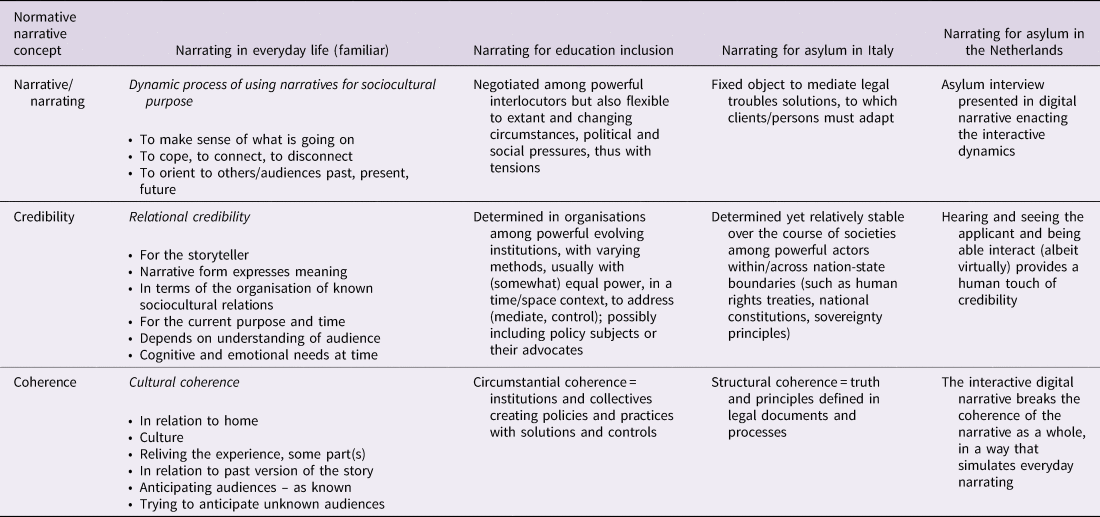
Table 1 summarises some of the major differences between norms of credibility and coherence in familiar daily life and in contexts where subjects of official policies and laws must orient to those audiences if their claims of inclusion are to be successful.
Narrating differs across everyday and institutional contexts

Having presented some of the official criteria for legal norms, we now illustrate how storytelling differs in a setting where subjects of social inclusion policies worked with educators to generate a range of personal and public stories. This example of dynamic storytelling with Roma adults seeking roles for themselves and their community inside mainstream education will then become a model we expand to collaborative lawyering.
2.2 Narrating beyond vulnerability for inclusion in education
Narrative has been at the centre of a social inclusion process involving the Roma people, in part so Roma voices may formally enter public life in ways that command respect. Roma populations have been living across Eurasia for 1,000 years since the first ones migrated from the Indian subcontinent. Unlike many migrants who eventually integrate into societies, the 1,000-year history of the Roma has been one of exclusion, discrimination, persistent stereotypical myths and injustices. Exclusion has been so great that legal mandates for Roma inclusion in education, housing and health care have been instituted across Eurasian countries, especially where their rights to inclusion continue to be violated. Countries like Serbia, seeking entry into the EU, have paid special attention to their Roma communities. Such EU requirements emanate from human rights norms embodied in a regional Treaty for Roma Inclusion by twelve countries with large Roma populations across Eurasia.
An excerpt of the treaty illustrates how central narrative is to social justice projects. In this case, participants writing the treaty narrated the setting, characters and desired trajectory:
‘we pledge that our governments will work toward eliminating discrimination and closing the unacceptable gaps between Roma and the rest of society …. We declare the years 2005–2015 to be the Decade of Roma Inclusion and we commit to support the full participation and involvement of national Roma communities in achieving the Decade's objectives …. We invite other states to join our effort.’ (Sofia, 2 February 2005)
Building on this treaty and previous work with Roma communities in the former Yugoslavia and in the post-1990s Balkan war period, Serbia instituted the Roma Pedagogical Assistant (RPA) Program, with commitments and activities across the state and local governing and education practice entities. Although often living in settlements with no official address or access to basic services like electricity or plumbing, Roma people can be embedded in systems of justice, such as the requirement that they attend public schools. Education is a gatekeeper for access to such services, and the RPA programme aimed to expand beyond the 4–6 per cent of the community who enter secondary education. The ultimate goal of the project was to increase Roma participation in the mainstream society by supporting the participation of community members in education, as liaisons between schools and Roma families as well as with children in schools. This role of the RPA was legislated, funded and implemented with formal training across the country. The programme recruited among the very few Roma adults who had completed secondary school.
The RPAs were the frontline mediators of this process in education via their participation as teaching assistants working in school buildings with everyone, as well as specifically by helping Roma children and families navigate their participation. Acknowledging the numerous obstacles to this endeavour as well as to practical obstacles to Roma attending school, a goal embedded in the programme was for the RPAs to have a voice at all levels of policy implementation. To support the RPA participants’ bridging of their personal and public voices, a Dynamic Storytelling Workshop occurred with 174 RPAs during a pause in the regular training sessions (Daiute and Kovacs-Cerovic, Reference Daiute and Kovacs-Cerovic2017). We wish to clarify that supporting Roma communities’ narratives that bridge their experiences of exclusion in generational cycles of poverty and their participation as educators in public schools is a less rigidly scripted task than asylum seekers’ needing to present a successful credible fear interview. Highlighting that distinction, we discuss how the RPAs demonstrated extreme care with every sentence of every narrative to avoid conforming to the explicit and persistent stereotypes about their people. Although one problematic detail in their interaction with a colleague or student would not have sent them on a plane back to India, many local officials and parents proved ready to end the RPA project even with scant evidence that the Roma children were not clean enough, healthy enough, etc. to sit alongside mainstream children (Daiute and Kovacs-Cerovic, Reference Daiute and Kovacs-Cerovic2017). We now discuss how dynamic narrating in the RPA programme served as a bridge between community and public expectations.
Based on principles of dynamic storytelling, the two-day workshop was convened with educators and community leaders they knew, as well as with researchers (including one of the authors of this paper). In addition to one another, some of the non-Roma interlocutors were more and less familiar. The RPAs participated individually and collectively to narrate their experiences and reflect on others’ narrations, including those of the policy-makers and journalists reporting on the Roma inclusion practices. Narrative activities in this professional development context thus invited the participants to share their experience and knowledge for diverse purposes and audiences. Among other activities like commenting on the treaty presented above, the RPAs wrote two narratives and a letter to make sense of their experience relevant to the social inclusion treaty, their role in it and their evaluation of how the programme should move forward.
The narrative prompt ‘Write about your journey to becoming a PA’ was designed, as human rights interviews are, to elicit the first-person perspective – that is, with the author the main character or assumed main character:
‘It started with my acknowledgement that the Roma population belongs to the lowest class in education, and that in my street, there live many who are uneducated and very poor. I had a desire to do something for my people, to help them. I applied for the vacancy for PA, together with my best friend, who also wanted to do something for our people. We collected necessary documentation and submitted it to the committee. We were accepted! [Smiley face icon]
‘Today I work as a PA in a preschool institution. I primarily help children and their parents persuading them that education is essential. Also, I related to the NGOs and the local institutions. I use all possible ways to help my people. I use all institutions for which I know. I created a circle of people around me who are willing to help.’
As with any personal narrative, this one exposed the authors as they wanted to be perceived for that purpose and audience. The author of this personal journey narrative, like most others, emphasised three values in particular, including collaborating with all Roma and the majority community (27 per cent of sentences across all journey narratives), the importance of education (23 per cent) and considering the RPA role (16 per cent) (Daiute and Kovacs-Cerovic, Reference Daiute and Kovacs-Cerovic2017). These three values accounted for a majority of the personal journey narratives, indicating that the PAs perceived their activities in terms of the collective rather than as an individual struggle against odds. For that reason, social and cognitive dimensions of their personal journeys prevailed over potentially emotional dimensions wrought with their experience in institutions that had historically excluded them.
Another narrative activity during the workshop was meant to broaden the participants’ opportunity to share complexities of their experiences. That invitation was ‘Write a story about a Roma child in education’. Such a hypothetical, even possibly fictional, story allowed the author to craft a stance as an observer, with a focus on third-person characters, and thus to be more off-centre-stage. Notice the very different emphasis the author of the journey story expressed when shifting gaze to a Roma child, the major beneficiary of the RPA work:
‘One day a father appeared at the door of the institution, with his daughter in torn dress and slippers.
‘“Good morning,” he said to me.
‘“Good morning,” I answered. “How can I help?”
‘Her father said: “I want to register my daughter for kindergarten; I could not bring her earlier. You know how it is. I work collecting metal the whole day, and there is nobody else to bring her.”
‘“Super!” said the assistant-pedagogue. “Please, sit down. Of course, you can register her; it is good that you took her here because she can learn a lot, and there are many children here to befriend with her. What do you think, Marija?”
‘“Well, super! I'd like to come here every day!” Marija happily responded.
‘Father: “But, you know, I have no money to buy her shoes or books; all I earn goes for food.”
‘PA: “Don't worry. I will provide all that. I only ask that she regularly comes to school”.’
Shifting his perspective with the affordances of this narrative prompt, the author of the Roma child story used the stance of omniscient narrator and literary devices to emphasise obstacles in Roma living circumstances, humanity of Roma characters and a potential role for the RPA. Roma child stories by this same group of PA participants emphasised the importance of acknowledging and addressing obstacles (26 per cent of all sentences in the Roma child stories), collaboration (24 per cent) and human qualities (14 per cent) (Daiute and Kovacs-Cerovic, Reference Daiute and Kovacs-Cerovic2017). These findings show how a slight shift in an invitation to narrate became extremely useful for a policy subject under scrutiny. In the first narrative, for example, this author demonstrated his community orientation, whereas in the second unpleasant details and dependencies of Roma life. It is this kind of narrating as observer of one's own plight that brings critical knowledge to light, thereby increasing the complexity, humanity and, we think, success of narrating for social inclusion. This can, we argue, apply as well to collaborative lawyering with asylum seekers and others.
The third of the individual writing activities was to ‘Write a letter to a future Roma Pedagogical Assistant’, thereby explicitly involving the authors in their roles as experts:
‘Dear colleague, the job of the assistant-pedagogue is not easy but is interesting. You are going to work in preschool institution and your task is as follows. As you know yourself, PA is a link between the institution you work in, the parents and the other institutions as NGOs, for example. Essential is to establish a good cooperation with them all because their support will be important for your future work. Since the Roma children are in educational institution for the first time, very important is to keep them there and make their stay there easier; they will then attend regularly. These first steps are important for their further schooling and for formation of their habits.
‘If this is not clear enough, please, call me. Good luck! (PA 100 per cent sure).’ (Daiute and Kovacs-Cerovic, Reference Daiute and Kovacs-Cerovic2017)
The letter by the same author of the two narratives above uses the direct communication to a like-minded recipient to emphasise the importance of PA role activities (54 per cent of all sentences in the letters) as well as the value of collaboration (16 per cent) and acknowledging and addressing obstacles (14 per cent). As in the letter above, those values came to life in mentions of the details, psychological expressions and policy strategies of RPA actors.
For purposes of this paper, several points about the design and findings of the RPA workshop are most relevant. First, the workshop design acknowledged that narratives are interactions with actual and imagined audiences and purposes. The RPAs were able to present their experience and knowledge in diverse strategic ways, as they were not expected to tell only one single story about their experience in life and in the RPA programme. Because there was much at stake for each Roma participant and for their community more generally, their self-expressions would obviously be subject to scrutiny, for their worth and veracity.
In terms of norms, the personal journey narrative and the letter allowed the credibility of the PAs as their first in their role in mainstream education. The story of the Roma child expressed another kind of credibility – that of the history and circumstances of exclusion the community had and would face were there no increased inclusion efforts. In this way, research and practice inviting complex narrating – the use of diverse expressive stances with diverse implied author stances, audiences and features – have shown that credibility is an interactive and complex process. Given those narrative experiences as reflective interpretation of their official role, the RPAs were subsequently able to offer suggestions for Roma integration policies moving forward.
With the facts and logics across their narratives, the RPAs were, in brief, making a case for continuation of their funded role in education, for their capacity to collaborate with non-Roma educators and to provide valuable resources to all children. The education and research advocacy team worked collaboratively with several of the RPAs to examine the diverse narrative examples to generate a plan for the group's self-advocacy. In addition to skilfully interpreting the experience and knowledge shared across the diverse genres, this collaborative group created a statement and argument for the future of the programme (Daiute and Kovacs-Cerovic, Reference Daiute and Kovacs-Cerovic2017).
In the next section, we discuss the norms of credibility and coherence in asylum law, where they have primarily been applied. The aim is to highlight, with examples, the disequilibrium that may exist between a person's need to tell their story in a spontaneous way and the need of legal professionals to force their account into scripts or embedded institutional story in order to make them credible. From Margaret's case (Di Donato, Reference Di2020a), we move to a case where little guidance was offered.
3 Narrating asylum
As we explained above, leading clinical scholars have sought to identify how narrative theory can yield narrative practices that help lawyers develop an understanding of their clients’ lives and their clients’ desires in seeking help through lawyers (Alfieri, Reference Alfieri1990–1991; Reference Alfieri2016). In their view, telling the story is also the ‘cure’ for silenced or powerless voices to be heard.
Clients’ stories are considered as means of social change and clinicians who have advocated for a revolutionary approach to legal practice report that clients possess skills and knowledge that enable them to recount alternative stories, resisting the dominant elites’ views in society. As such, they urge that attorneys should not simply work for clients, but with clients as lay allies (López, Reference López1992).
According to this approach, lawyering is construed as the human art of problem-solving wherein stories shape the understanding, the knowledge and the management of a problem. A concept consistent with our argument is ‘“lay lawyering” – the things one person does when he helps another solve a problem’ (López, Reference López1984, p. 55). On that view, storytelling would be a critical device to understand and analyse the work of (lay) lawyers, who have specific knowledge of their relevant experiences, because solving a particular problem always demands specific knowledge; training people to adapt their culturally specific problem-solving knowledge to unfamiliar audiences and stories requires, at a minimum, that they be exposed to a new set of potential audiences and stories, and assisted in identifying and crafting those stories the audience will find most persuasive (Di Donato, Reference Di2020b). In more general terms, this proposal is to use alternative stories vs. stock stories to challenge elitist and fixed versions in society. Yet, what those alternative stories might be and how legal teams can support them have yet to be defined, as they were in the Roma PA workshop, which provided different possible positionings drawing on experiences and knowledge in ways that connected with participants’ past, present and future. As we explained above, asylum seekers must construct narratives that meet several narrow external expectations. An advance in the clinical legal field would be to develop a process that avoids the irrelevant story or the stock story while cultivating a personally and culturally relevant successful story for asylum norms.
We now examine a case where the legal team could have benefited from greater humanistic roots of law and the possibility of the legal clinic to find in narration a potential tool for linking diverse disciplinary perspectives and those of laypeople in juridical discourse. The case presentation emerged in an ongoing research project at an Italian law school with the aim of empowering asylum seekers’ performances in institutional settings. It will be developed in collaboration with local courts and legal offices (Di Donato, Reference Di2022).
3.1 Narrating for asylum in Italian law
Consistently with international law (as noted above), Italian law specifies the following: in Italy, the applicant's story must comply with two sets of parameters: it must be consistent in itself, and it must correspond to what is known as the COI. Norms of coherence and credibility must be evident within the applicant's story and in relation to known circumstances in the country of origin. The applicant must tell the story indicating that a return to the country of origin would threaten their life. This threat must be credible in terms of details in the story and confirmed by the COI. Fact-finders draw on information confirmed by official decision-makers to establish the COI, which then affirms external validity of dangers reported in the personal story: ‘Do the place, the event and the traditions that the asylum seeker mentions truly exist and do they fit the given description?’
Absent evidence in the strict sense of the term, the applicant's statements are thus considered to be truthful if they are found to be ‘consistent and plausible’ and ‘do not contradict’ both the general information – that is, the COI – and the specific information about his case:
‘Should any of the elements or aspects of the declarations made by the applicant for international protection fail to be supported by evidence, they shall be considered truthful if the authority competent for deciding on the application believes that the applicant has made every reasonable effort to describe the application in detail; b) all the relevant elements in his possession have been produced and a suitable reason for the absence of any other significant elements has been furnished; c) the declarations made by the applicant are considered consistent and plausible and do not contradict the general and specific information relevant to his case as available; …; e) from the checks pursued, the applicant has been found to be generally reliable.’Footnote 2
In other words, should facts as narrated by the client fail to coincide with the COI, the COI is likely to take precedence over the story told by applicants, who are not always in a position to prove truth as required by the court. In practice, this gap may often require verifying the information – a burden of proof that in Italy is not borne by the asylum seeker alone, but also by the examiner. This examiner is a person conducting the investigation at the level of the territorial committee or of the judicial authority. In the case of judicial proceedings, steps to prove details in question can be shared by the asylum seeker, such as to fill in gaps. The legal team would, of course, also, in their preparation of the client seek to achieve a story that might not require such additional examination. The asylum narrative does not thus stand on its own, as a plurality of people are called into account to define the credibility of the asylum seeker's story (lawyers, social workers, judges, members of territorial committees). This is one way that the asylum narrative is embedded in problem-solving and a resulting collaborative narrative (D'Halluin, Reference D'Halluin2016). That said, the ultimate determination is that this narrative within itself conforms to norms established by the legal context. As we see below, the pressure to achieve one true story may involve a painful process for the client and legal team.
In the section below, we present a dynamic reading of an asylum narrative, building towards a rationale for practice that can examine the potential benefit of a more process-oriented collaborative lawyering development of a story that achieves asylum for the client.
3.2 Forcing the right narrative: Margaret's case
We briefly present the case of Margaret, who came to Italy from Nigeria, at first to escape from a forced marriage and then to break free from forms of sexual exploitation (Di Donato, Reference Di2020a). Margaret's story unfolded over a series of interviews with legal staff of a social co-operative based in Naples – an organisation with staff of lawyers and mediators to conduct asylum interviews. As is common practice, the interviews are recorded in written notes by one of the parties present, rather than being audio- or video-recorded. For this reason, we report excerpts, as they are critically important to the legal shaping of Margaret's story (Di Donato, Reference Di2020a).
Based on one of the author's practice, we present some passages of this process undertaken by an anti-trafficking organism based in Naples, in order to show the story process construction and the lawyer's lack of correct training about the fact-finding method and elicitation of the client's story. In addition to the lawyer, a non-lawyer (a cultural mediator) who understands issues of human-trafficking victims assists in the case. This analysis explores how these diverse collaborations interrupt or support, from their diverse perspectives, the construction of a successful case via the client's narrative.
The process of identifying Margaret undertaken by Dedalus (a social work co-operative working with the Territorial Commission to identify victims of trafficking) took the form of a series of interviews that one of the authors was able to attend in the co-operative's offices between February and April 2018. What now follows is a brief description of the three phases of these interviews with Margaret, based on the notes taken during the meetings and subsequently edited.
During the first meeting, the lawyer, Evelyne, explained to Margaret how it would proceed, emphasising the function and significance of the path they were about to embark on together: that of piecing her story together and orienting it for the purposes of the interview she would have with the committee, which was due to meet Margaret several months later. Evelyne also underlined the importance of building a story that would give her a better chance of obtaining the status of international protection, explaining that recognition of asylum is based on the premise that that there are good reasons for believing that the applicant would be running a serious risk if she were to return to her country of origin:
‘We have to be very accurate in reconstructing your story from when you were still in Nigeria. We shan't get it all done today: it's a complicated job. If we make a good job of it, we have a better chance of constructing a story that will lead to a happy ending.’
Barbara (the cultural mediator), speaking partly in English and partly in the applicant's language, added: ‘you must convince them about the risks you are going to face, you must show solid reasons. It's not a problem if you don't remember: feel free and relax.’
Evelyne then asked for more details about the various stages of the journey: ‘Shall we go on a little part of this journey? Let's say we are leaving Benin City.’ Margaret took up her story again, specifying that, after several hours of travelling, the person who was responsible for them had left them somewhere, giving each of them a number: they were to stay in this unidentified place until they were called for on the basis of this number. Since there were some gaps in the story, after about two hours of interviewing, Evelyne suggested stopping and taking it up again another time, commenting like this: ‘The journey is a very important stage for piecing the story together. So we'll stop now and continue next time.’ Margaret showed signs of impatience and asked how long she would have to wait before the committee would summon her for the hearing: she had lodged her application in November of the previous year and three months had already gone by. Evelyne answered that the waiting time was generally up to one year from the beginning of the procedure and that the aim was not to rush things, but to do a good job.
During the second meeting, Barbara guided Margaret by highlighting gaps (‘points we miss’): ‘they are direct, you must be specific.’ ‘From Nigeria to Libya, how many days did it take? How long you did stay in Libya? Where? How did you survive? Did they give you clothes?’ Considering Margaret's reticence, the mediator tried to encourage her further, suggesting she think seriously about the consequences of being sent back home, asking ‘What happens if you go back?’ Margaret answered: ‘My life would be worse, nobody could care for my children.’ Barbara explained to her that the questions she would be asked during the committee hearing would be something like ‘Why did you leave your country?’, reminding her that the committee would have to decide whether she would be allowed to stay in Italy:
‘They will ask you whether you were capable of defending yourself in Nigeria by going to the police. The committee has information about Nigeria, they combine information. You should be more aware about your country. You must be able to give an account. There are a lot of gaps we need to fill.’
In the third meeting, which took place after another two weeks, Barbara once again pointed out the need to achieve greater clarity about some of the stages of the journey, explaining the meaning of the questions better and asking her to be more precise and concise in her answers. Barbara started showing signs of impatience, because she and the lawyer had not compiled enough material to piece the story together: ‘I am not understanding anything, so what do we do? You don't forget the truth because it is your truth, truth is inside you, so you answer quickly.’
Barbara then burst out impatiently in Italian, asking ‘ma che stiamo facendo?’ (‘What are we doing here?’), then also in English:
‘We are doing everything we can. I am not responsible because I tried. It is time! Who was that man? I want the name! What happened between the two of you? Is he the father of your baby? How long did you stay at that house? Who was he?’
Margaret then began speaking in her own language, without stopping, alternating her story with bursts of tears. Barbara added the occasional comment in Italian that enabled the note taker to understand the gist of the story: ‘She [the madam] brings in seven men every day and takes money for just three weeks.’
The short excerpts from these conversations show how questions evolved from one meeting to the next, becoming more pressing and directive as the meetings grew ever more intense. In addition, this verbal behaviour was accompanied by Barbara's increasing impatience, as she tried to encourage Margaret to tell her story, saying that she had done everything possible to help and support her in the path she would tread towards the hearing before the committee. The steps taken by Evelyne, the lawyer, who was only present in the first of these meetings, were more incisive and restricted to defining the operative and legal framework.
Regarding the interaction between Margaret and the two operators, there appears to be an apparent lack of understanding and respect for daily, sociocultural storytelling when the mediator says that the ‘truth is inside you’. Margaret seems to have little opportunity to tell her stories in a spontaneous way, such as how people she met during the trip treated her/spoke with her and how she came to an awareness of what she was involved in. As has been shown in other cases, the fact that a story is spontaneous and transparent is not enough on its own to make it worthy of legal recognition and protection. This may perhaps explain the artificiality of the situation described above and the apparent forcible reshaping of the story by the cultural mediator.
At various points, the stories are scrutinised and recorded by note takers, rather than audio or video-recordings (Di Donato, Reference Di2021), thereby further abstracting from the client's experiences.
The exact expression of narratives, whether in careful note-taking or available via recordings, is important for capturing full personal and social meaning, as well as for revisiting by the client and team. As the legal considerations of granting asylum increase, the refugee's journey story is important for certain truth norms, but the process used may be at odds with identifying non- stereotypical truths (i.e. specific experiences rather than stock stories or scripts). The process of perceiving and interpreting emotional nuances occurs implicitly in everyday storytelling but also in storytelling for official purposes, especially when narrated experiences have been life-threatening and traumatic. When listening first for norms, we are likely to shape what we hear in terms of requirements, such as for credibility and coherence. The role of the story as a process for the refugee's interactions with others and reflections to cope with his circumstances may remain unattended. Note-taking is less labour-intensive than recording, transcribing and analysing detailed clients’ stories as told, but professionals may bake norms into their notes, as writing every word verbatim is extremely challenging. This analysis proceeds to explore whether and how norm-based storytelling and listening might make a difference in the fairness of the asylum process and perhaps even eventually in efficiency.
In this way, a story of personal experience becomes a legal story. Storytelling always occurs in relation to audiences, actual and imagined, and when the audience has enormous power over one's life, clarity of expectations is helpful. The COI report may, of course, be subject to the very circumstances causing flight (such as myths that a country does not encourage people to flee) and the severity of judgment may be influenced by circumstances in the country of asylum (such as a major influx of refugees during periods of mass displacements). In terms of internal consistency, stories conforming too rigidly to a script defined by escapes from extreme violence and moral threats if one returns might seem inauthentic. What may fall through the cracks of fairness is that, from the perspective of the applicant, an account of events that is credible and coherent in her more familiar circumstances, such as recounting the journey to family or friends, may by necessity include contradictions.
Coherence and credibility are, after all, both subjective concepts as well as legal concepts crafted in diverse disciplinary contexts – law and psychology. While the successful asylum narrative requires the raconteur's direction to legal norms and values, their living narrative involves complex positioning around the migration journey, which is by definition a psychosocial process (relational, conflicted, changing, etc.) and, thus, in the interactive lawyer–client development of the case. Because narrative competences and familiarity with social and legal norms evolve together, our interest is to highlight what happens when lawyers understand the asylum seeker as a collaborator with experience that is foundational to the knowledge-building process of the case. Next, we offer an example of an asylum interview that is interactive yet provides as little guidance as Margaret's situation provided too much.
3.3 Ambivalent interaction with Middle Eastern refugees: Rifat's case
As in Italy, the Netherlands also requires norms of credibility and coherence in asylum story appeals. Available with Rifat's consent (Lighthouse Reports, 2016), the interactive digital narrative (IDN) enacts the potential complexity and variability of an asylum narrative, as well as the pressure to get the right version. Interlocutors with an iterative version of a story could appreciate the reality of sharing one's story of displacement many times and the apparent lack of response beyond the selection of the next steps. ‘The story’ changes over time with the storyteller's different vantage points in time, space and social milieu. The story is dynamic in its development, and it is also static in that the life may be squeezed out of if over-told to conform to rigid requirements.
This story by Rifat, a twenty-one-year-old refugee from Syria, was elicited for a video documentary with asylum seekers by journalist advocates for refugee rights. An interviewer with official experience asked Rifat, and other refugees, typical questions. The IDN designers made questions and responses interactively searchable for scholars, practitioners (as we are) and others who want to become ‘aware of the complexity of accepting or rejecting someone … [and] to experience the tension between a human story and the policy rules’ (Lighthouse Reports, 2016). In addition to reflecting on his/her perception of the narrative quality for asylum purposes, the player can select tags to hear/see additional information about various characters or events, such as about parents or the army. The authenticity, interactivity and flexibility of this process offers insights for considering differences between everyday and legal storytelling. Whereas variability is prominent, so is the guessing-game nature of how to share one's traumatic experiences in ways that are emotionally authentic yet also give the right story.
The video is a close-up on Rifat's face and the audio unfolds in segments of three or four sentences. The narrative begins as follows:
‘I am from Al-Rastan. Back then it was partly controlled by the regime and partly controlled by the opposition. I don't want anything to do with either. I don't like violence. My father died on April 1st, 2014. Shortly after that, I left the country. We went to Turkey first, me, my stepmother, my brother, my two brothers and a sister, my wife and my child. Then we took a boat to Greece. Yes, it was a dangerous journey. But luckily we are here now. No, I was never approached to fight. I was downstairs; my father and my brother were upstairs. Then the top floor of the house was hit. I went upstairs to drag my father and my brother out of the debris. They were buried the same day in Al-Rastan. The bomb was released from a tank. That means it came from the regime because it was the only party who owns tanks. The regime also bombs residential areas. A lot of children died that day.
‘When I think about Syria, I get very sad. It was very painful to see my father and my brother lying under the debris. Shortly after that I left the country.
‘There is a dam in Al-Rastan. The regime controlled the area above it. We used to live in the area below. A part of Al-Rastan was under control of the opposition. But the regime could easily drop bombs anywhere from above.’
As we played it, the temporal narrative line rambled associatively, in part as Rifat produced it, also because he responds to the off-screen interviewer's questions. Such explicit interactions add to those evoked in Rifat's mind as he recalled events, experiences with different family members, antagonists in the regime, etc. Those past interlocutors, like the interviewer(s), are always more or less part of a narrative, potentially interrupting coherence or challenging credibility. In an asylum narrative, the present audience who will determine the author's life course is primary, but those other characters from the past and possibility projected into the future (such as those one would like to join in another country) emerge not only as static words in the text, but also as real impacts on the narrative via the narrator. Interacting with such diverse others in and around an official story is something we can consider as relevant to an astute listening and interpreting process. Adding to the tone of the questioner as indicated in question framing is the judgment of the player who is completely outside the story yet also engaging with it, perhaps like a judge.
Segments of the interview appear as the IDN player requests to hear/see more related to the tags. Family, for example, is an element of an asylum story and that tag was available for queuing more of Rifat's story:
‘My family lives in Germany now. That's alright, I like Holland better. And it will give me a reason to discover Germany in the future.
‘Yes, my relatives, they are well known throughout Syria because the former foreign minister of the El-Assad regime, he's a relative of mine. Yes, they are well known in Syria because of him. But he's not like a cousin or uncle for me. He's just someone who belongs to the same tribe. Yes, but I don't know him well.
‘I went to school until sixth grade. I don't remember what year was that. Yes, believe me, I don't know how old I was when I left school. I'm very forgetful person. My anniversary, I don't remember the date. My wife always complains about that. After I turned 18, I was drafted to military service and decided to leave Syria. I got the conscription letter in 2014.’
Nuances such as which characters emerge when in the story may interact or even interfere with the ultimate goals of explaining very clearly why being returned to the original country would be deadly. But those details are coherent within memory search organised at least in part by emotions raised by recounting the story itself, as well as by the fact that someone is asking about it and listening.
Trying to maintain coherence, Rifat self-corrected:
‘No wait, it wasn't a letter, it was an announcement. They told me in person.
‘Yes, but I could still pass the check points without any trouble after that. I don't know if it's customary, but in my case, this is how it went.
‘Yes, it was painful … but I never considered joining any of the opposition parties. I hate bloodshed. No, I was never approached by any groups to fight for them. They call themselves the Free Syrian Army. Yes, the Free Syrian Army, that's what they call themselves. That's all I know.’
Although not linear in any strict chronological line, Rifat has been sharing what appears to be a credible and coherent narrative of someone hoping to remain in Europe, if not in the Netherlands, and certainly to avoid being returned to a problematic place for him. The jumbled chronology, within sections, as well as the arrangement of sections by the IDN player raises questions relevant to norms for judging this story. Coherence is achieved in part by successfully retrieving and organising many events, characters, dilemmas and temporary assessments from memory into a narrative form, which may not be how they are stored. That the story itself must read as coherent in terms of facts as true, false, compete or incomplete draws on a dimension outside of personal experience, as we observed with interactions to collaboratively create Margaret's story.
At one point, a cellphone appears in the video frame, presumably from the interviewer, and Rifat accepts it. After a long pause looking at it, Rifat says: ‘You found my picture on Facebook.’ Seeming to tear up, he adds: ‘Yes, this is a gun in my hand.’ As if offering an explanation, after several seconds of a visibly emotional pause, he says: ‘There's so much injustice. I really hate the regime.’ He then puts his face in his hands and turns away from the camera, seeming to be on the verge of tears and says: ‘I lied.’ After another pause of several seconds, Rifat says: ‘I lied because they told me I shouldn't tell the truth. After he deserted from the military, my brother formed a battalion. This battalion was part of the Free Syrian Army. Yes, we were there too. I also was part of it.’
The last line of the story was: ‘I am glad that I was able to tell my story. I feel relieved.’
This statement underscores Rifat's claiming of his story, imperfect as it is and as he is aware it is. Upon examination, the asylum investigation committee found evidence that pointed to an association with the Free Syrian Army, meaning that the asylum seeker might have been involved with war crimes. Nevertheless, obviously also aware that applicant could be at risk, the decision was postponed until further research that, at the time of the report in 2016, was still ongoing.
Our reason for our sharing this account is to demonstrate just some of the functions of storytelling as a dynamic relational process and to consider the kinds of interactivity to build into proposals for collaborative lawyering as well as what to avoid. Interacting with unfamiliar yet helpful others as in the Roma case and over time in Margaret's case may not pose a threat to authenticity of the client's story but brings an interlocutor into view, ideally for a knowledge-sharing conversation that evolves well over time. We do not know whether subsequent steps in Rifat's process achieved success, but we can observe from the digitally interactive asylum story some of the tensions between coherence and credibility of an everyday story for personal and social purposes compared to a story that would be scripted to pass the legal test.
4 Towards a framework for socio-legal narrating for asylum justice
We have shown how sensitivity to diverse meanings of credibility and coherence could honour the interactive complexity for clients and advocates by being explicit that the right story is not ‘inside of you’, but is instead a negotiation between credibility and coherence in life and storytelling contexts. Everyday credibility and coherence have intra-personal validity (as Rifat seems to have found), interpersonal validity (as the Roma PAs employed with the different narrative and letter genres) and systematic validity (as Margaret eventually achieved through an elaborate and apparently painful process for her and her supporters). Table 2 presents these different meanings across official settings.
Credibility and coherence across three narrating for social justice settings

As presented in Table 2, credibility occurs with different relational configurations. In professional development workshops, Roma adults with high-school education behind them (a fact quite rare among the Roma) are sharing stories with their Roma peers and with educators, social workers and other professionals offering training on the rules and requirements in their new professional role as assistants in mainstream education. Given the two narratives and one letter, credibility emerges clearly as in relation to the genre, purpose and audience. As we saw above, the first-person stories of how one became a PA includes the credibility of community support during recruitment to the PA role, commitment to the mission of improving education and ability to engage in the mainstream discourse. Credibility in the letter to a future PA is imbricated with honesty for that audience who may expect this will not be an easy job and who might appreciate some guidance. In contrast, credibility in the Italian asylum institutional context comes in a more abstract way in relation to the specific criterion of threat.
With this framework, we move to ideas for how preparation for asylum cases might incorporate a dynamic narrative process, with credible interactions among the legal team, including the client, working together towards a successful story. In that process, the credibility and coherence in the everyday storytelling process would not be deemed wrong, but would instead form credible scaffolding for the eventual constructed successful legal story.
5 Increasing collaboration of legal teams for collaborative lawyering
Prior law and narrative approaches paved the way for collaborative lawyering (López, Reference López2017) with legal–clinical tools to help legally vulnerable people engage in problem-solving, supporting their participation in legal settings. Empirical study of a systematic interactive design can extend the theory and practice of collaborative lawyering (Di Donato, Reference Di2021). The Roma inclusion study offers support that accessing this diverse range of knowledge, including with implications of policy and legal actions, can occur and can provide material for the clients themselves to use for advocacy purposes. In that example, we observed officials working with lay actors not only for them, as legal scholars urge.
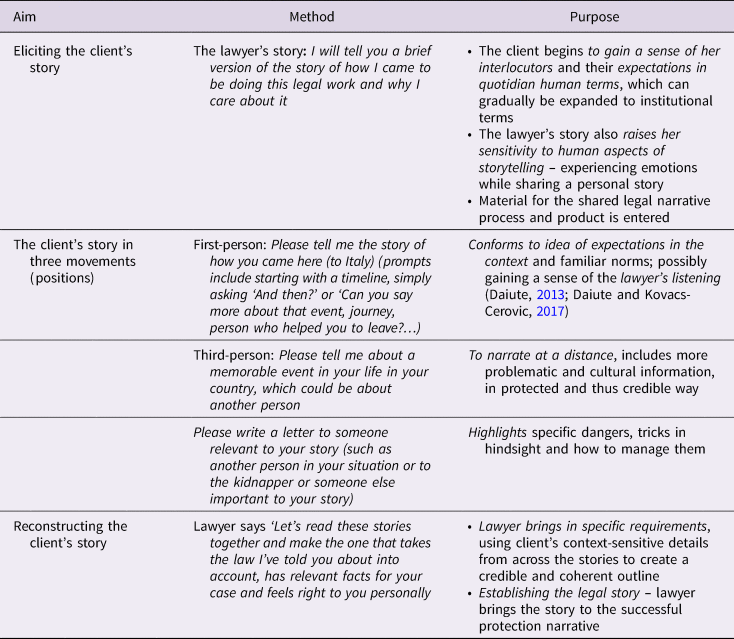
Thus, our contribution seeks to explore new forms of collaborative lawyering (Galowitz, Reference Galowitz2012; López, Reference López2017) with principles of dynamic storytelling, paving the way for an appraisal of the possibility of developing legal–clinical tools to support vulnerable subjects’ problem-solving in legal settings. The possible development of a socio-legal–clinical model of research and action, based on a collective narrative approach (Daiute, Reference Daiute2013), may furnish lay actors – especially asylum seekers – with an opportunity to familiarise themselves with the norms, procedures and expectations of the institutions of their host countries, providing them with tools – such as narrative devices – for mediating their positions in society. Table 3 presents an outline of a collaborative approach.
Framework for socio-legal storytelling workshop

Such a collaborative approach would allow clients to understand how the legal system works, what the formal and informal rules are, and the practices with which they are expected to deal. This could reduce more general conditions of ‘legal vulnerability’ for specific categories of clients (asylum seekers) who risk getting lost in translation when unaware of the rules of the games and their role within those rules. In fact, vulnerability, despite its ambiguous definition, is understood here to be a relational and situated concept rather than a general characteristic belonging to specific categories of individuals. It is the geographical, political, economic and institutional conditions, in a broad sense, that make people dependent and without appropriate skills (Fineman, Reference Fineman2008–2009).
5.1 Framework of legal storytelling workshop
In order to achieve social justice goals (Block, Reference Block2011), we propose creating socio-legal spaces to raise different voices democratically and realise effective forms of collaborative lawyering, with the active participation of lay and expert actors (lawyers, volunteer associations), in order to address the multidimensional problems faced by the client and to elaborate a common understanding of socio-legal problems, thereby increasing laypeople's consciousness and narrative mechanisms in institutional settings. We invite lawyers as well as researchers to experiment with interactive narrating to support clients’ comfortable expression in order to allow the legal team to hear more of the contextual and personal details that may be implicit and in order to help the client understand how the legal system works (Nelken, Reference Nelken2012), what the formal and informal rules are (Fuller, Reference Fuller1969) and what practices they are expected to incorporate into their stories.
Shifting to a collaborative lawyering process would involve enacting the dynamic quality of narrating for all major participants, the legal team as well as the clients. Zooming back from the pressure to elicit the singular right story, the process would involve the lawyer beginning by saying: ‘I will tell you a story of how I came to be doing this legal work and why I care about it.’ This would be for the lawyer to open to his/her own sociocultural quotidian narrating experience and for the client to gain a sense of the socio-legal audience and expectations (implicitly rather than by direct questioning towards the goal, which can interrupt important information). The lawyer and client could together evaluate the story in terms of credibility and coherence. Understandings of those norms in the context of mutual informal experience sharing introduces professional and lay actors via their narratives, which become increasingly useful and available for collective examination when creating the public story.
The client, who is normally in the hot seat to share experience, would next share her story in three movements (as in the Roma PA workshop). The lawyer could prompt these movements or the movements could be described for the client to share as she feels most comfortable or relevant. The prompt could be ‘Please tell me the story of how you came here’ (to Italy) (prompts include starting with a timeline, simply asking ‘And then?’ or ‘Can you say more about that event, person …?’). Because the first-person story is the one most under scrutiny for specific legal expectations, it could be shared after the other two, and it could be shared several times for different audiences. The reason for this flexibility is that the first-person story must eventually conform to specific expectations, but the client should have the opportunity to begin with personal purposes such as to release any tension related to the events, to continue making sense of the events, to remember, to cope or other reasons. In that process, the lawyer can remember and refer to her own implicit purposes when sharing her personal story.
Another prompt would be ‘Please tell me about a memorable event in your life as a child in our country, as though you were watching, making a film’. The purpose of this story is to invite the client to ventriloquate – that is, to present as though for someone else like her, to include culturally sensitive, problematic, upsetting, conflicting details in a protected and emotionally credible way.
A third prompt invites yet another stance, like the one we presented in the Roma case – a stance that is rarely considered: the person who is a subject of the law or policy presents the defining conditions, issues, strategies for a like-minded audience or for an authority. The prompt would be ‘Please write a letter to someone like you back home who may be considering or beginning a similar journey’. This discourse stance reveals specific danger and strategies for managing them.
The collaborative process would then involve gathering details from across the client's narratives and letter in a co-construction process by the professional and lay team. This would acknowledge that there is no single story. This would also acknowledge that fact construction is a process and that the client has control of the process. In addition to creating a uniquely believable and nuanced account, such a co-construction process grounded in the client's uninterrupted original story would also include context details that may be obvious to the client yet not apparent to the legal team. Such a developmental process might also avoid any additional harms arising from unintentional premature changing of a client's story and eventually a healthier outcome for the claimant, the team and the process.
Towards that end, the lawyer could say:
‘Let's read/listen together to the stories you have shared over time. We can work together to make one that includes the facts for this case. Those required will be to highlight how the story uniquely demonstrates danger, how the story hangs together in ways that make sense in the current context and back home.’
The purpose is to collect relevant details from across the stories to create a credible and coherent outline in terms of the legal requirements, acknowledging that these are not the only dimensions of credibility and/or coherence. Discussing the previous steps, the lawyer and client rewrite the client's asylum narrative together, acknowledging that it is a legal embedding of the everyday personal story but not replacing it emotionally or culturally. The lawyer can add that having shared her personal story, she has become even more sensitive to listening to the client's story.
6 Conclusion
Adhering to norms in formal settings like education and law can build in a discovery process whereby advocates as well as applicants share their stories, consider those diverse stories together and find ways to manage credibility and coherence as processes. In the Roma PA programme, this occurred in several ways, including generating a range of narratives in different stances by the PAs in relation to the policy documents. In the Italian asylum case, the pressuring of the legal team is revealed and replaced with one that – though without the best narrative approach – also involves them in their own everyday storytelling. The IDN presentation of the case in the Netherlands presents a different kind of dynamic.
With somewhat different ultimate standards of judgment, credibility and coherence emerge as negotiated across the different examples. Credibility and coherence emerge as dynamic interactions among personal experience, purpose and interlocutors, involved in mutual understanding of a story as constructed over time. In social justice cases, the collaborative process must be managed in increasingly deliberate ways by the application with support of the professionals (social workers and lawyers trained in narrative).
Inviting the personal as well as professional stances of the legal teams humanises their understanding that one's story is a dynamic and vulnerable process. This may open their perspectives to the clients’ experience, knowledge and possibly resistance, thereby changing the system with shared storytelling processes. How this works is the subject of our ongoing inquiry. Any increase of clients’ legal awareness requires the development of conceptual as well as practical skills for clinical lawyering.
This educational goal requires clinical teaching to be extended towards some crucial topics, such as (1) making legal scholars aware that clients are human beings and that facts must be connected not only to legal elements, but also to broader stories, to multicultural issues, including gender, race and inequality; (2) creating settings for listening adequately to the client's story; (3) framing the lawyer–client relationship in terms of reciprocity rather than in terms of asymmetries, thereby involving clients as channels in the case theory as well as in the solution of the case.
Hence our invitation to clinicians to learn how narration can be employed technically, not only to support their professional goals, but also to support their clients’ ‘performance’, thereby mediating between their personal positions and society. Drawing on the cases of Margaret and Rifat, our final argument is to propose designing new socio-legal tools to achieve substantive justice (Block, Reference Block2011). Specifically, in order to achieve this goal, we propose conceiving of legal clinics as socio-legal spaces with the active participation of lay and expert actors (lawyers, volunteer associations), in order to address the multidimensional problems faced by the client and to elaborate a common understanding of socio-legal problems. This could increase laypersons’ consciousness and agency in legal settings. Such a space would allow clients to understand how the legal system works, what the formal and informal rules are, and the practices with which they are expected to deal. In fact, as lawyering generally demands specific knowledge regarding the relevant audiences, stories and storytelling practices, our proposal is to train laypeople to adapt their specific problem-solving knowledge to unfamiliar audiences.
We have argued for a process progressing from remembering with an initial raw story to make sense of and, in some ways, cope with one's experience, such as believing a trafficker at the time, then offering advice to others journeying along the same path. If the legal assistant becomes more knowable to the client, this might make a difference in which facts are elicited (such as when sexual abuse is relevant). Finally, with these narratives oriented to the past and used for recall and sense-making in different purposes, the client can participate in culling the version for the ultimate goal. Such a process could then enlist the client as the judge reflecting on versions of their own narratives in terms of their new knowledge about the legal expectations and the humility of the legal team respecting experience. These narrative moves make audiences, including judges, more human, less abstract and, thus, also vulnerable and in need of certain facts to do their jobs. In this way, credibility and coherence become processes situated in the different relational structures of narrating – narrator stance–purpose–audience–time – ideally also successful legal claims and insights to break down barriers to belonging.
Acknowledgements
None
Conflicts of Interest
None