Wine: This ruffler may be troublesome, we were best admit him to our society, he is a dry companion, and you may observe, how he hath insinuated already with the greatest.
So advises ‘Wine’ at the end of Wine, beere, ale, and tobacco. Contending for superiority, a humorous pamphlet sold by John Grove in London in 1630.Footnote 1 The ‘ruffler’ in question is Tobacco: Contending consists of a dialogue between ‘Wine, A Gentleman’, ‘Sugar, His Page’, ‘Beer, A Citizen’, ‘Nutmeg, His Prentice’, ‘Ale, A Country-man’, ‘Toast, One of his rural Servants’, ‘Water, A Parson’, and ‘Tobacco, A Swaggering Gentleman’. Personified as social types, these drinks and their accoutrements move in and out of each other's ‘society’ and ‘company' – as they term it – discussing their relative social standing and superiority over each other.Footnote 2
The subtitle, Contending for superiority, consequently refers both to the intoxicants, vying for position in the symbolic and market economy, and the social types with whom they are associated, who jockey with each other for prestige and status. The conceit enables humorous commentary on the cultural and social connotations of intoxicants and the politics of taste surrounding their consumption. In the 1630 edition, Tobacco arrives late on the scene, just as Water is convincing the other beverages that contention should give way to reconciliation. Wine's intervention on behalf of Tobacco successfully appeals to the self-interest of the other drinks. All the intoxicants accordingly agree to ‘live and love together’.Footnote 3
Contending introduces the three concerns of this article: the dynamism of the English market for alcohol and tobacco c. 1629; certain kinds of social context in which these commodities were consumed; and some of the cultural influences shaping their consumption. What follows suggests that the publication of Grove's pamphlet coincided with a marked increase in the consumption of intoxicants, particularly tobacco and wine. This was concurrent with a development that has largely gone unnoticed by historians, the assimilation of the term ‘society’ into the English vernacular, a word which, along with its synonym ‘company’, was increasingly used to describe various kinds of voluntary and purposeful association from the 1570s. One feature of these economic and social developments was that, for many educated and relatively affluent men, drinking and smoking were normative and stylized aspects of their social identity by the time John Grove published his dialogue. This identity was derived primarily from the lessons of Renaissance humanism. In particular, it was associated with the increasingly complex set of social skills and attributes known as ‘wit’.
Contending illuminates, in effect, the burgeoning nexus between intoxicants, society, and wit in the early seventeenth century – a nexus which raises obvious problems for the early modern narrative in which intoxicants are usually implicated. The story goes that traditional communities, and the rituals and obligations that characterized them, were saturated with alcohol.Footnote 4 This was as true for English urban and rural neighbourhoods as it was for the clan system in Ireland and Scotland.Footnote 5 From the later sixteenth century, however, drunkenness began to attract much moral criticism and governmental regulation.Footnote 6 Potential sites of excessive consumption, like alehouses, as well as customary settings, like parish ‘ales’, became identified with ‘plebeian’, ‘barbarous’, or ‘merry’ behaviour that was at odds with the demands of what Norbert Elias styled the ‘civilizing process’ and which Max Weber termed ‘the spirit of capitalism’.Footnote 7 Although this moralizing was by no means unprecedented, its intensity marked a qualitative and definitive shift that had two cultural sources: Renaissance humanism and evangelical Christianity. As Keith Thomas has argued, the ‘revival’ of ‘classical doctrine’ facilitated a wide social ‘movement to develop new standards of bodily control and social decorum’ that ‘covered a wide range of behaviour’. This ‘cult of decorum led to a profound divergence between the streams of polite humour and folk humour’; by the end of the seventeenth century ‘it was only the vulgar who could go on laughing without constraint’.Footnote 8 Accounts of the social impact of the ‘reformation of manners’ likewise emphasize that, locally and nationally, social elites increasingly drew on biblical and classical learning to refine their manners and to segregate and punish inferiors’ behaviour.Footnote 9 Alehouses and drunkenness were especial targets in these campaigns, providing the means for the ‘better’ sorts to define their respectability.Footnote 10 The publication of Contending coincided with one peak in this campaign for reformation and civility in England.
Three points follow from this. The first is that Renaissance humanism was a monolithic ideology of order, sobriety, virtue, and aggressive humourlessness: one which inculcated powerful notions of civic duty, virtue, and participation; and which after 1530 combined seamlessly with the evangelical desire for social and personal discipline.Footnote 11 Secondly, these qualities were class-specific. Keith Wrightson suggests that in the century after 1580 ‘a deep social cleavage … opened up in English society’, ‘not simply between wealth and poverty, but between respectable and plebeian cultures’.Footnote 12 As Alexandra Shepard also states, ‘alternative codes of manhood, rooted in values ranging across prodigality, excess, bravado, brawn, transience, and collectivism, were positively claimed by, and became increasingly associated (often negatively) with, the “meaner sorts of men”’.Footnote 13 This resonates with the more nebulous assumption that the consumption of alcohol, tobacco, and other kinds of intoxicant, especially to excess, was primarily a source of solace and escape from material deprivations. David Courtwright has argued, for example, that the initial allure and success of ‘psychoactive substances’ in early modern Europe was ‘dire utility' – they helped ‘peasants and workers cope with lives lived on the verge of the unliveable’. Courtwright suggests that it is ‘no coincidence that the rapid growth of European distilling, and the explosive growth of tobacco imports, took place during “the general crisis of the seventeenth century”’: for a whole host of reasons ‘these were people who could use a smoke and a drink’.Footnote 14
The flipside was that a modern diet of milder intoxicants, derived from colonial expansion and global trade, was integral to what has been styled the new ‘culture of respectability’.Footnote 15 In the century after 1650, coffee became synonymous with public ratiocination and discourse; tea became the focal point for the rituals of domestic sociability; and tobacco was repackaged as snuff, a hallmark of politeness.Footnote 16 Indeed, Jan de Vries has placed these ‘colonial groceries’ at the heart of Europe's ‘industrious revolution’, whereby the proliferation of consumable goods encouraged ‘a growing number of households’ to ‘reallocate their productive resources (which are chiefly the time of their members) in ways that increased both the supply of market-orientated, money earning activities and the demand for goods offered in the marketplace’.Footnote 17 Householders opted to work in ways requisite of modern capitalism. However, they did so not simply through economic or spiritual compulsion – pace Karl Marx and Max Weber – but as a direct response to the allure of what Jordan Goodman describes as Enlightenment ‘excitantia’.Footnote 18
Contending highlights, in contrast, a close link between alcohol, tobacco, and consumerism in the decades before Europe ‘took to soft drugs’. It suggests that, no matter the force of the ‘reformation of manners’, the ‘civilizing process’, or ‘state formation’, the consumption of alcohol remained quite as integral to elite identities and their ‘society’ as it was to other social groups; that indeed drinking – including excessive drinking – may well have increased in social and political significance even as moralists called for further reformation. It also demonstrates what literary historians have long known: that Renaissance humanism could be used to valorize drunkenness and wit as well as to idealize moderation and civility. In this respect, the ‘new learning’ was deeply ambivalent in terms of the manners and social skills it taught. Certainly, commentators at the beginning of the eighteenth century had no doubts that the English had been well schooled in the lessons of intoxication taught over the previous 150 years.
I
The word ‘intoxication’ carried two meanings in early modern England. It denoted ‘poisoning, or envenoming’ and ‘tuddling or making drunk’.Footnote 19 In each instance, the term could be used metaphorically and invoke a heightened spiritual or emotional consciousness; it was also linked to the consumption of certain substances. These included ‘drugs’, a generic term for ingredients in pharmacy, chemistry, distilling, dyeing, or manufacturing which by the seventeenth century were understood as having physiological effects on a living organism. As Paul Rycaut noted in 1668, it was common for Ottomans ‘to be drunk or intoxicate themselves with Aqua vitae, opium, or any stupefying drugs’.Footnote 20 From the perspective of modern pharmacology, intoxicants also include those caffeine- and cocoa-based products assimilated into the European diet after 1650: coffee, tea, and chocolate. For contemporaries, however, intoxication in the sense of drunkenness would have most obviously implied the central protagonists of Contending: the alcoholic beverages already well established in the English diet; and tobacco, one of the first colonial groceries to be trafficked from the ‘New World’, and which was imbibed as a ‘drink’ for much of the seventeenth century.
It was not the innate properties of alcohol and tobacco that were perceived to intoxicate, nor was intoxication their primary social function. Just as the noun ‘intoxicant’ was only coined in the nineteenth century, so the characters in Contending were proud of their normative status as sources of health and nourishment.Footnote 21 William Vaughan was entirely typical, for example, in listing each of them in 1600 among ‘Natural and artificial directions for health derived from the best philosophers, as well modern, as ancient.’ Drawing on classical and vernacular commonplaces, the Welsh humanist prescribed wine ‘when moderately drunk’ to ‘refresh the heart and spirits, temper the humours, engender good blood, break phlegm, conserve nature, and make it merry’. Beer ‘nourish[es] the body’ and ‘cause[s] a good colour’. So could ale, though ‘nowadays few brewers do brew it as they ought for they add slimy and heavy baggage unto it, thinking thereby to please tosspots’. Tobacco when ‘well dried, and taken in a silver pipe … cures the migraine, the toothache, obstructions proceeding of cold, and helps the fits of the choler’.Footnote 22
As far as contemporaries were concerned, what made alcohol and tobacco intoxicative was the manner, quantity, and context in which they were consumed and the person's intellectual, emotional, and physical condition at the moment of consumption. Thomas Hobbes opined in the middle of the seventeenth century that ‘the variety of behaviour in men that have drunk too much, is the same with that of Mad-men: some of them Raging, others Loving, others Laughing, all extravagantly, but according to their several domineering Passions’.Footnote 23 Likewise, the only use of the term by William Shakespeare finds Fluellen in Henry V observing that Alexander the Great ‘in his rages and his furies, and his wraths, and his cholers, and his moods, and his displeasures, and his indignations, and also being a little intoxicated in his brains, did, in his ales and his anger, look you, kill his best friend, Cleitus’.Footnote 24 For both writers, alcohol was a catalyst rather than cause of drunkenness, whereby the passions and humours were allowed free rein. This was consistent with the more general conviction that drunkenness was a social and physiological condition: early modern moralists did not seek to criminalize alcohol so much as reform the manner and contexts of its drinking. By the time Contending was published, tobacco, despite being vilified during its introduction to Europe, was treated in much the same way.
Historians have, by and large, treated wine, beer, ale, and tobacco as separate commodities with distinct histories and social ramifications rather than appreciating the full ‘repertoire of behaviour-altering substances’ available at any given moment.Footnote 25 Even comparative studies have tended to impose a chronology of consumption whereby one substance supersedes another as the symbol, as it were, of the zeitgeist.Footnote 26 By grouping together four beverages with similar medicinal, dietary, and intoxicative qualities, Grove was suggesting an alternative perspective which resonated with early modern readers – that there was an economy and culture of intoxicants embedded in the everyday lives and experiences of different sorts of people; that the consumption of one commodity, like tobacco, could encourage the consumption of others, like wine, beer, or ale; and that the spectre or possibility of intoxication extended across the social spectrum as a result. As intriguingly, the timing of Grove's dialogue raises the possibility that this economy was especially conspicuous in the 1620s and 1630s.
This was certainly the case with tobacco. The ‘holy herb’ attracted significant attention in Europe from the 1570s and by the early 1600s had become a subject over which humanists and physicians flexed their rhetorical muscle, not least because James I and VI entered the fray in 1604.Footnote 27 The prominence of tobacco in print and on stage does not mean that its popularity was instantaneous.Footnote 28 Rather, these representations of smoking preceded its emergence as an intoxicant of mass consumption: until the 1620s, most people talked and heard about smoking before they could afford to do it.Footnote 29 It was only between 1622 and 1638 that the successful establishment of American plantations and the protection of their monopoly over cultivation and traffic meant that imports rose from about 60,000 to 2,000,000 lb per annum.Footnote 30 Prices declined accordingly. In the 1610s, Matthew Markland valued his stock in Wigan, Lancashire, at 9 s per lb; Thomas Middleton indicated it cost 6d for a pipe's-worth in London (the equivalent of three oranges); and the most expensive crops could fetch up to 40 s per lb. Yet by 1632, Thomas Harris's stock in the Cotswold town of Charlbury was valued at 1 s 8d per lb; the plantation price dropped to 1d per lb in 1640; and in 1671, Thomas Robinson purchased five pipes of the finest tobacco in York for only 10d.Footnote 31 John Grove's responsiveness to these developments can be seen in the differences between the first and second editions of Contending. The 1629 text (which was probably written in 1625) mentions tobacco in passing – it is an affectation of ‘Wine’, with whom the substance is closely linked, rather than a speaking character.Footnote 32 By 1630, however, ‘Tobacco, A Swaggering Gentleman’ is central to the dialogue's denouement, talking his way into the ‘society’ of drinks and gaining acceptance as an equal by the established beverages.
The assimilation of tobacco into the English diet provides one context for reading Contending. Another was the latest phase in the on-going commercialization of the brewing industry. Ale was the beverage indigenous to England.Footnote 33 Traditionally brewed in small qualities for local consumption, it was an important source of daily nourishment and important make-shift of household economies lower down the social spectrum.Footnote 34 Beer, in contrast, was introduced into England from Germany and the Low Countries from the fifteenth century.Footnote 35 The key difference between ale and beer was that the addition of hops to the latter made for a more durable product, not only cheaper to brew but also transportable. This encouraged capital investment in equipment and other costs, not least of which was fuel: developments in English beer-brewing and coal-mining were closely connected.Footnote 36 The result was fewer, larger operations at the expense of both the ‘alien’ tradesmen whose families introduced beer-brewing into London and female ‘brewsters’ who dominated ale-brewing before the commercialization of beer.Footnote 37 From the 1570s, beer eclipsed ale as the metropolitan staple of choice.Footnote 38 Its popularity coincided with a general rise in consumption linked to the increase in population, which almost doubled from 2·7 million to 5 million people in the hundred years after 1541.Footnote 39 In London alone, it is estimated that 51 million litres of beer were drunk weekly in 1574; 106 million litres by 1585; 146 million litres by 1600.Footnote 40 The proliferation of provincial alehouses – licensed and unlicensed – likewise suggests an almost limitless thirst.Footnote 41 In the hundred years after 1540 York innkeepers accordingly enjoyed a significant rise in numbers and wealth and by 1600, the Brewers’ Company in London had emerged as a major force in civic and parliamentary politics. By 1665, no less than four of its members were wealthy enough to serve as London aldermen.Footnote 42
Thomas Brennan has established a similar scenario for the French wine trade, which after the fifteenth-century depression was in the vanguard of shaping ‘a coherent national market’, ‘stimulating the commercial development of French society’. As with English beer, it was Dutch merchants who were crucial to commercialization – not in this instance by providing the requisite production skills so much as offering ‘an enormous market, both for consumption and re-export’.Footnote 43 The impact of these developments on English diet has been noted by W. B. Stephens. While wine (with textiles, timber, and groceries) remained ‘one of the four chief commodities imported into England throughout the early modern period’, Stephens shows that the ‘early seventeenth century was a period when the volume of wine imports was particularly large compared with preceding and succeeding periods’.Footnote 44 In the early sixteenth century, the annual national imports ranged between 9,403 and 9,820 tuns. By 1623, it had risen to 20,708 tuns and by 1638, to 49,446 tuns, dropping to 29,363 tuns by 1641. Stephens suggests that after 1660, ‘imports sometimes topped 20,000 tuns but was often well below that total’. Aside from the later 1680s, when imports reached 38,700 tuns per annum, the average was almost half that of the 1630s.
If the commercialization of early modern brewing can be regarded, in part, as an index of the rapid increase in population, then the rise in wine and tobacco imports was altogether sharper and more contingent. Converted into modern measurements, Stephens's figures suggest that the national consumption of wine increased from 3·8 litres per capita in 1623 to 8·6 litres per capita in 1638.Footnote 45 Although much more research is needed, the early signs are that locally the rise could be even more marked. In 1609, for example, York merchants trading through Kingston-upon-Hull imported wine amounting to 5·6 litres per capita of the population of York. By 1639, that figure had risen to 118·3 litres per capita.Footnote 46 National tobacco consumption rose from 0·012 lb per capita to 0·39 lb per capita between 1623 and 1638 – not because of tobacco's function as a medical panacea but because it was bought and consumed alongside wine, beer, and ale. Certainly in York the licensed retail of tobacco was almost entirely conducted through the drinks trade.Footnote 47 In the same decades, concern among national and local governors over the proliferation of unlicensed alehouses reached a new intensity.Footnote 48 The point is that this undoubted reformatory energy coincided with the highest levels of wine consumption in the whole of the early modern era. Although tobacco imports continued to rise throughout the seventeenth century, the increasing value of the re-export trade may also mean that, in terms of domestic consumption, the 1620s and 1630s was something of a peak.
The vibrancy of the market for intoxicants in the 1620s and 1630s is consistent with two related developments. The first of these is the frequency with which drunkenness appears as a term of insult in defamation cases heard before the church courts. In York, for example, nine defamation suits were recorded for the 1590s. In not a single case were individuals defamed for their drinking habits; rather (as might be expected) sex was the predominant idiom. This contrasts with fourteen defamation cases recorded for the 1630s, six of which involved insults invoking excessive drinking or explicitly drunken misdemeanours. Thus when Katherine Brooke verbally assaulted Elizabeth Wetton in 1595 she used a variety of insults relating to sexual and verbal incontinence and economic dependency: Brooke told Wetton she was a ‘whore, arrand whore, scurvy whore, Queane, scold, common scold, drabbe, filthy drabbe … God's wound thou art a whore and an arrand whore.’Footnote 49 When Marjory Wilson did something similar to Elizabeth Simpson in 1637, drunkenness was very much part of the lexicon of pejorative stereotypes. Simpson was ‘scurvy Queane and scurvy drunken Queane and drunken companion’, Wilson ‘intimating [Simpson was] a dishonest woman of her body, or a lewd and naughty woman and that [she] had been drunken and was a common drunkard’.Footnote 50 The same decade, John Cowper was not merely a ‘common liar’ and ‘lying fellow’ but also ‘a drunkard’ and Anne Chayter called Mary Simpson ‘a stinking liar get out of my shop, are you mad now, you are a liar’ after Simpson accused Anne of ‘making her child drunk’.Footnote 51 Likewise, Francis Williams was reported by a number of witnesses of haranguing John Fountain with the taunt ‘that he [Francis Williams] was never such a Beast as he the said John Fountain was to be drunk whilst another man occupies his wife’.Footnote 52
This shift in defamatory language clearly requires further research. What can be said for now is that, in York at least, accusations of drunkenness coincided with demonstrable increases in both the retail of wine and tobacco and the number of unlicensed alehouses fined by the civic magistracy: the accentuated concern among moralists with drinking may well have been a response to real changes in social practice.Footnote 53 The profits to be gained from the traffic and retail of intoxicants by the late 1620s help explain, secondly, the concerted and politically incendiary attempts by the cash-strapped Caroline regime to establish or extend monopolies over the retail of both wine and tobacco.Footnote 54 Resented by producers and consumers alike, the restructuring of these trades was vigorously debated in parliament and print in the months preceding the Civil War.Footnote 55 The pressures of civil war meant that the crown's fiscal experiments merely preceded the parliamentary excise introduced in 1643 – an innovation which saw intoxicants account for a staggering 60 per cent of state revenues by 1788.Footnote 56 The early Stuarts were more conscious than historians have been of the fiscal possibilities of intoxicants; their problem was finding the means to exploit them legitimately. The ‘society’ of Wine, Tobacco, Beer, and Ale was nothing if not profitable.
II
If Contending suggests a moment of rapid expansion in the market for intoxicants then it also illuminates by whom and in what contexts these commodities were consumed. According to Contending, the culprits were not the ‘peasants and workers’ assumed by Courtwright, so much as the social groups identified both by contemporary commentators and subsequent historians as the main beneficiaries of the economic changes known to have characterized the period: rural and urban gentry; merchants, tradesmen, and artisans; prosperous husbandmen and commercial farmers. This is hardly surprising. Alcohol consumption is recognized by modern observers as ‘a sensitive indicator of rising real incomes’; and it is now well established that, for these sections of the populace at least, the hundred years after 1550 were unusually prosperous. Given that wine and tobacco, like recreational beer- and ale-drinking, required disposable income, it follows that the relatively affluent were most responsible for market growth.Footnote 57
This was certainly the assumption of Water – the ‘Parson' – as he looked to reconcile the bickering drinks by demonstrating what he termed their ‘singularity’. Water decreed that Wine ‘shall be in most request among Courtiers, Gallants, Poetical Wits, Qui melior is luti hominess, being of a refined mould, shall choose a more nimble and active watering, to make their brains fruitful … to exhilarate their spirits, and acuate [sic] their inventions’. Beer was ‘in most grace with the Citizens, as being a more staid Liquor, fit for them that purpose retirement and gravity, that with the Snail caries the cares of a house and family with them, tied to the attendance of an illiberal profession’; beer may also ‘be in credit with Gentlemen's Cellars’. The ‘remit’ of Ale was ‘the Country as more fit to live where you were bred: your credit shall not be inferior, for people of all sorts shall desire your acquaintance, especially in the morning, though may be allowed all the day after’. Even ‘the Parson shall account you one of his best Parishioners, & the Church wardens shall pay for your company … and if you come into the City, you may be drunk with pleasure, but never come into fashion’.Footnote 58
This conception of the social order was inherited from Elizabethan commentators, the most influential (and certainly most printed) of which was Sir Thomas Smith's Commonwealth of England, which bore close similarities to William Harrison's Description of England.Footnote 59 Written in the 1560s and first published in 1583, Commonwealth went through numerous editions and in 1629 – the year Grove first published his dialogue – was famous enough to be invoked eponymously as ‘Smith's Commonweal’.Footnote 60 Smith was a leading humanist who envisaged England as a participatory polity in which four ‘sorts’ of men took on public roles and responsibilities according to their status, ability, and wealth. These included the nobility and gentry; urban citizens and burgesses; yeomen; and the fourth sort of artisans, mechanics, and husbandmen who in theory ‘do not rule’ but who in reality served as local governors.Footnote 61 That the ‘singularities’ of Wine, Beer, and Ale correspond to Smith's classification is hardly surprising given the ubiquity of his text and its especial resonance for the lawyers, university graduates, and gentlemen who, as we will see, were the likely readers of Contending. Three features of his typology are worth emphasizing here. First, Smith depicted a social order in flux, medieval assumptions about rigid ‘estates’ and noble lineage giving way to more socially porous categories.Footnote 62 Gentility was no longer a birth-right, for example, but was rather re-described as bought (with money), learned (with a liberal education), and earned (through public service).Footnote 63 Secondly, Smith articulated more clearly than most the cause of flux: ‘the widespread reality of self-interested economic behaviour’.Footnote 64 Rather than perceiving ‘profit’ as covetous and socially damaging he demonstrated in Ciceronian fashion that the regulated and responsible pursuit of gain was not merely compatible but necessary to the commonwealth.Footnote 65 The result in terms of political culture was, thirdly, a ‘monarchical republic’ in which subjects who could afford it were encouraged to act as ‘citizens’ in their respective spheres of influence, be it court and country, cities and boroughs, or rural parishes.Footnote 66 In this way, power and status were not monopolized by a single class or institution, such as the aristocracy or the court, so much as distributed across the commonwealth.Footnote 67
One conceit of Contending was that these relatively affluent and powerful groups were drinkers as well as citizens. Another was that the collective consciousness of each ‘sort’ did not make for a functional and harmonious commonwealth in the way envisaged by humanist theorists. Indeed, until the intervention of Water the tenor of social relations in Contending is much more akin to another product of Renaissance humanism: those city comedies in which stereotypical gentlemen, gallants, citizens, and countrymen – and the wives, amours, and dependants of each – relentlessly contend for status, wealth, and power in a kind of endemic social warfare.Footnote 68 It is out of this more recent literary genre that Tobacco, ‘the Swaggering Gentleman’, steps. Already beloved by ‘princes’, ‘poets’, ‘physicians’, and ‘soldiers’, and socially assured in his ‘eloquence’ and ‘wit’, Tobacco threatens to carry all before him in the manner of Ben Johnson's Quarlous in Bartholomew Fair or Thomas Middleton's Witgood in Trick to catch the old one.Footnote 69 The alcoholic beverages accordingly decide to include him in their society as an act of self-preservation. As Ale concedes: ‘I better consider ‘twere safest to use him [Tobacco] kindly, least by degrees he overthrow us, and set upon our privileges, for I heard a gentleman ‘tother day affirm, he had fasted three or four days, only with Tobacco.’Footnote 70
The social stereotypes and rivalries which Contending nicely observes are familiar enough to historians; the specific interactive moments in which contention and reconciliation occur much less so.Footnote 71 This is ironic given that one of the meta-terms of social historiography – ‘society’ – was used by Wine to describe just such moments. He was not alone in this. In the seventy years before Contending was published, the word ‘society’, as a translation of the Latin societas, had been promulgated by humanists as a new way to denote the kind of sociability described in the vernacular by the Romance word ‘company’ and Anglo-Saxon term ‘fellowship’.Footnote 72 In this respect, it is entirely appropriate that Wine, as the beverage in Contending which symbolizes classical culture and the ‘new learning’, should be the only character to say ‘society’ in the dialogue. All the other commodities talk of ‘company’ instead. The words denoted, however, the same kind of activity – voluntary and purposeful association.
This quite concrete and institutional sense of society is at odds with the term's modern and more abstract depiction of the ‘distinct system of social relations’ in which people live.Footnote 73 Yet it was the sense familiar to people at the time. The seventeenth-century lexicographer Edward Phillips was entirely typical, for example, in defining ‘Sociality’ as ‘(Lat.) fellowship, company’ and ‘Society’ as
An assembly of several People in one Place, on purpose to assist each other in business … a particular tie between some Persons, either for interest, out of friendship, or to live a Regular life … a Company of them joined together in the study of some Art or Science.Footnote 74
Into the next century, Samuel Johnson noted that society meant ‘1. Union of many in one general interest. 2. Numbers united in one interest; community. 3. Company, converse. 4. Partnership; union on equal terms.’ Company in turn involved ‘persons assembled together’ for ‘the entertainment of each other’, ‘for conversation and mutual entertainment’, ‘fellowship’, and ‘the execution or performance of anything’. Examples included ‘a joint trade or partnership’; ‘some particular rank or profession, united by some charter; a body corporate, a corporation’; ‘a subdivision of a regiment; so many as are under one captain’.Footnote 75 No matter the increasing variety of companies and societies, the concept enshrined by the words remained voluntary and purposeful association.Footnote 76 All that changed in the meantime was the volume and range of sociability styled and practised in these terms.
The trend can be crudely measured simply by counting appearances of ‘company’ and ‘society’ on printed title-pages.Footnote 77 They first appear regularly in the 1570s (‘company’ appears intermittently from 1511, ‘society’ is first used on a title-page by the humanist John Barston in 1576).Footnote 78 In the 1590s, they appeared on less than 1 per cent of title-pages; this rapidly increased to over 2.5 per cent of title-pages by the 1610s. There was a significant dip in appearances during the 1640s but by the end of the 1650s the words enjoyed pre-war visibility levels and by the 1690s they appear on more than 3·5 per cent of title-pages. This compares to 0·5 per cent of title-pages carrying ‘household’ or ‘family’ and 3 per cent of texts inscribed with the word ‘state’. It was between 1610 and 1640 that ‘society’ became properly embedded in the printed vernacular consciousness, the word appearing on more title-pages than ‘company’ for the first time. It is likewise significant that these three decades were the only period before the 1690s when ‘company’ and ‘society’ appeared on printed title-pages more often than ‘state’.
The types of company and society so invoked reflected the burgeoning range of associational practices intimated by Samuel Johnson. They included in the first instance fully fledged corporations such as city councils and guilds, global trading companies, the Inns of Court (which styled themselves ‘societies’), and the Society of Jesus. Secondly, they encompassed institutions like acting companies, militia companies, separatist churches, clubs, and societies, and by the end of the seventeenth century voluntary associations like Societies for the Reformation of Manners and friendly societies. Company and society denoted in the third instance more amorphous networks like the companies of vagabonds, thieves, and highwaymen which haunted the early modern popular consciousness. And, most pertinent to the current discussion, the words described those more ephemeral moments of sociability around which everyday life was structured: in the market, the alehouse, the tavern, at the dinner-table.Footnote 79
The contemporary conflation of drink and society was nicely demonstrated by William Prynne in 1628. Prynne's Healthes: sickness was an excoriating critique of the modern ‘Art of Drinking’, which displayed, among other things, a sharp sensitivity to the politics of sociability. Prynne observed that just as ‘Drunkenness is now shrouded (nay countenanced, justified, and applauded) under the popular and lovely Titles of Hospitality, Good-Fellowship, Courtesy, Entertainment, Joviality, Mirth … Friendship, Love, Kindness, good Neighbourhood, Company-keeping’, so ‘Drunkards are likewise magnified, and extolled, under the amiable, reverenced, and applauded terms of Good-Fellows, wits; Poets; Courteous; Sociable, Merry, Jovial, and Boon-Companions.’ This amounted to the enclosure of sociability, whereby those ‘reclaimed from his Ebrious company, and Drunken courses … is forthwith hated, and branded for a Puritan, a Hypocrite, a Precisian … even by such who deemed him an honest man, a sociable, boon and good companion heretofore’. That is, to not drink as fashion demanded was not merely to be sober but to be unsociable. Yet even as the drunken ‘sociable’ monopolized sociability, so he precluded the kind of association that really mattered. As Prynne warned, intoxication ‘excludes and shuts out men from heaven, from the society and company of God's saints on earth’.Footnote 80
Given the inextricability of drinking and sociability it is hardly surprising that Contending was likewise saturated with the language of society and company. Not only does the dialogue conclude with Wine inviting Tobacco to join the ‘society’ of alcoholic beverages. The protagonists use the word ‘company’ no less than thirteen times over the previous fourteen pages. The drama begins with Sugar complaining that his master, Wine, only allows him ‘in his company … for fashion sake’ and ‘I do not love this Toast's company.’Footnote 81 Wine observes in turn that Sugar ‘keeps women's company too much’.Footnote 82 Beer chides Wine that ‘men pay dear for your company, and repent it’ and, upon meeting Tobacco for the first time, asks ‘Why comes he into our company?’Footnote 83 And so on. It is in the querulous society of the first half of the dialogue that rivalries and jealousies are articulated, mainly through waspish wit. Company is avoided; when it occurs, the purpose is contention. After Water's intervention, however, the word ‘friend’ is used five times in quick succession along with ‘brothers’ and ‘fellows’.Footnote 84 With the ‘companions’ reconciled to their singularities, and also accepting the interloper Tobacco, they partake in what the humanist John Barston eulogized as a ‘society of friends’, displaying ‘that familiar trust, which by virtuous conditions and similitude of honest manners make men to be all one, and one to delight and love in the other, for that is true friendship indeed’.Footnote 85 Or as John Grove put it in his preface to Contending: ‘Gentlemen; for in your Drink, you will be no less.’Footnote 86
It should be stressed that the close connection drawn between intoxicants and society was not peculiar to certain strands of Renaissance literary culture. The fecundity of early modern corporate and institutional life is obvious enough, although its cumulative social impact has not been appreciated because different kinds of organization – whether trading companies, theatre companies, debating clubs, or the Royal Society – have been studied separately rather than as variations of the same associational process.Footnote 87 As in other eras (not least the medieval), alcohol was integral to the maintenance of early modern corporate attachments and identities. More to the point, appearances of ‘company’ in more prosaic sources suggest exactly the same concept used in Contending. To take just three examples from the defamation cases recorded in York. Edward Clynt testified that on 21 July 1598 ‘about noon’ he was in the alehouse of William Bonas and ‘diverse honest persons did go into the said house with him, and there tarried, and remained the time and space of his being and remaining there in his company’.Footnote 88 In 1600, Christopher Colson was accused of spreading the ‘common fame and voice’ that Elizabeth Parton ‘used suspicious and unlawful company with Thomas Watson’ at an inn during Beverley Fair.Footnote 89 And Richard Atkinson recalled that on 16 March 1640 he was ‘in the company of Mr Christopher Brearey … and some others drinking a pint of wine in the house [tavern] of Mrs Mary Secker widow’. They were disturbed when ‘Richard Knight having (as it seemed) been in some other company came into the room where this examinant and his said company were and behaved himself very uncivilly in words to divers of the company’.Footnote 90
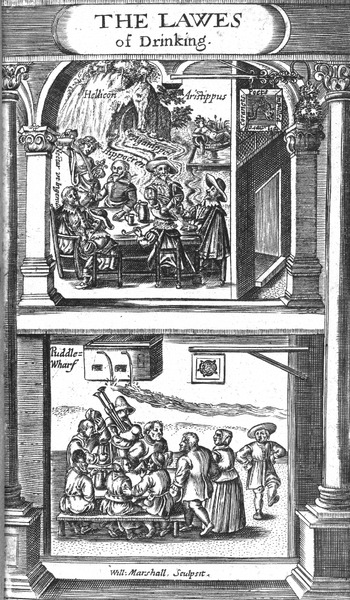
In each instance, ‘company’ clearly demarcated the formation of voluntary and purposeful associations within the larger setting of a drinking establishment. While obviously less formalized than, for example, the East India Company or the Society of Merchant Adventurers, each of these interactive moments was characterized by its own structure and boundaries and conformed to tacit conventions and rules. The same impression is conveyed by visual representations of drinking from the period (see Figure 1). For example, the famous frontispiece of Richard Braithwaite's A solemn jovial disputation (1617), which juxtaposed tavern and alehouse drinking, has been shown to illustrate the ‘spatial’ expression of more general cultural and social distinctions – between the classically minded wine drinkers and the more mechanical alehouse tipplers.Footnote 91 Equally striking is that the two groups of drinkers formed cohesive societies and companies within the settings of tavern and alehouse – these were particular instances of association, each with their own ‘laws’, conventions, patois, and ethos. The print captures, in effect, exactly the kind of discursive and social developments which so worried commentators like Prynne.
Frontispiece, Richard Braithwaite (?), A solemn jovial disputation (1617). By permission of the British Library c. 40. b. 20.

III
There was a correlation between the expanding market in intoxicants and the proliferation of voluntary and purposeful association. Although the practice of household hospitality is thought to have declined in the later sixteenth and seventeenth centuries, the enhanced possibility of company and society offered alternative modes of consumption that were neither inevitably tied to the household-family nor necessarily a function of neighbourly or paternalistic relations.Footnote 92 Whether these societies took the form of a corporation, an institution, or more ephemeral interactions like that described by Richard Atkinson and represented by Richard Braithwaite, intoxication was often a consequence of this sociability and, on occasion, its primary purpose.
A nice example of what might be styled inadvertent intoxication is the attempt by Edward Guy and John Hacker to resolve their differing religious opinions in Fincham, Nottinghamshire, in 1672. Guy, the parish minister, and Hacker, a local gentleman, joined others ‘in company’ in Henry Drury's alehouse to ‘have words about their former familiarities and also some discourse about their former differences and quarrels’. Unfortunately, Guy ‘began to … admonish [Hacker] to refrain conventicles and meeting houses’ and ‘told him that as he [Guy] was the minister of the parish it was his duty to admonish him of these things’. For ‘further persuasion’ Hacker was reminded by Guy that he had been ‘ingeniously educated at the university and Inns of Court and that therefore not only he but the most gentlemen thereabouts extremely wondered that a person of his quality and education should run to such places to hear weavers and cobblers or such like fellows’ and that ‘it was a disgrace to him so to do’. In response, Hacker very angrily replied ‘Hold you babbling your sirrah you are drunk’ and called him ‘drunken fellow and drunken priest’. Guy replied that ‘he [was] never so drunk as to lose his horse’, at which ‘Hacker very passionately by and with great fury smote him upon the belly with his double fist and then violently pressed his hands under Mr Guy's chin and took hold of his collar and violently pulled him to the ground.’Footnote 93
In the case of Hacker and Guy, the effects of alcohol waylaid what seems to have been a genuine attempt at ‘civil conversation’. Rather than engaging in rational and courteous discussion, the men allowed their passions, and their mutual animosity, full rein. The more purposeful pursuit of intoxication was described in York in 1629, the same year Contending was published. Thomas Martin explained to the Consistory Court that Anthony Carthorne ‘was and is such a person as is termed a good fellow, and such as one as will keep company and spend his money with his friends’. Although
he endeavours to refrain as much, as he can, but that he is drawn away some time by his friends, and wits and is such as one as uses to go to alehouses and to drink hard sometimes, in so much that … he has been so overtaken with drink, as that he was not fit to keep company any longer.
On one notorious occasion Carthorne was in a York alehouse ‘with some company at which time a wager was laid’. Carthorne won and ‘demanded the wager, whereupon some quarrel crossed betwixt him and some of the said company which was with him’. The fight spilled out onto the street and Carthorne and ‘the rest of the company’ ended in the stocks in Thursday Market.Footnote 94
In certain respects, the drinking experiences of Hacker and Carthorne are unremarkable: male drunkenness is hardly peculiar to seventeenth-century England. However, as a quintessentially social act drinking is always contingent: who drinks; what they drink; how, when, and why they drink – all these factors are culturally specific. It so happens that ‘civil conversation’ and ‘good fellowship’ were forms of company widely propagated in vernacular print in the seventeenth century.Footnote 95 More significant is that both incidents pose problems for the familiar narrative of early modern social change. According to the orthodoxy, dynamic processes like the assimilation of civility, reformation of manners, monarchical republicanism, and the dissociation of elite and popular culture made drinking and drunkenness the condition and consolation of traditional and/or plebeian culture – of social groups left behind by the new money and new learning. The companies in Fincham and York suggest, in contrast, that just as affluence contributed to an expansive market in alcohol and tobacco so humanism valorized types of company and society committed to the consumption and enjoyment of intoxicants. Guy was university educated, after all, and Hacker trained at the Inns of Court: they attended two of the institutions at the heart of the English Renaissance. Carthorne, as a ‘good fellow’ and ‘hard drinker’, was a minor official of the Council of the North: his companions may well have modelled their social personas on drinking ballads like Ben Jonson's popular The mad merry prankes of Robbin-Good-fellow, published in 1625. Jonson was, of course, a notorious classicist, drinker, clubber, and wit.Footnote 96 Like Carthorne and Hacker, he was someone for whom Contending could have been written.
That the Inns of Court and universities were home to companies of hard drinkers is well known, the drunkenness of early modern students facilitating male bonding, camaraderie, and serving as important rites of passage.Footnote 97 This quasi-sanctioned intoxication is also a reminder that, even as the educated elites preached godliness and civility, many of them were also inured to a culture that placed a high premium on the concept of ‘wit’. The most perceptive elaboration of this concept was by Thomas Hobbes, who in Leviathan took ‘wit’ to be synonymous with what he termed ‘virtues intellectual’, or ‘abilities of the mind’.Footnote 98 Hobbes divided these virtues into acquired wit, by which he meant the capacity for reason ‘acquired by method and instruction' – i.e. ‘science' – and natural wit, ‘which is gotten by Use only, and Experience’.Footnote 99 One crucial insight of Hobbes was that natural wit divided into fancy and discretion. The former involved quickness of thought, imagination, the capacity to observe similitude between phenomena; the latter required ‘Distinguishing, and Discerning, and Judging between thing and thing … particularly in matter of conversation and business; wherein times, places, and persons are to be discerned’. A second insight was that ‘Celerity of Imagining' – upon which ‘Good Fancy’ was based – was dictated by ‘men's passions’: at any given moment ‘the secret thoughts of a man run over all things, holy, prophane, clean, obscene, grave, and light, without shame or blame’. It was discretion that enabled people to judge which thoughts should be articulated when, to whom, and in what form. As Hobbes put it: while an ‘Anatomist’ may ‘speak or write his judgment of unclean things’ for ‘another man to write his extravagant, and pleasant fancies of the same, is as if a man, being tumbled into the dirt, should come and present himself before good company’. In such circumstances, ‘where Wit is wanting, it is not Fancy that is wanting, but Discretion. Judgment therefore without Fancy is Wit, but Fancy without Judgment not.’Footnote 100
Most contemporary writers understood ‘discretion’ and ‘judgment’ to be core attributes of ‘civility’. In this sense their re-description by Hobbes as ‘wit’ was idiosyncratic. The semantic manoeuvre nevertheless enabled Hobbes to depict wit – and so the cultural impact of humanism more generally – as dialectical. It involved a constant negotiation between fancy and the passions on the one hand and judgement and discretion on the other, with individuals perpetually poised between their thoughts, feelings, and imaginings and their understanding of the civil proprieties of any given society. In so doing, Hobbes gave a distinctive gloss on the previous 100 years of cultural development. He implied that not only had the English become fully acquainted with the social demands and power of ‘civility’ (‘discretion’ and ‘judgment’). They had also learned to value ‘fancy’ and the power of the passions. More to the point, he alluded to two kinds of situation in which ‘discretion’ became subordinate to ‘fancy’. First, ‘in professed remissness of mind, and familiar company, a man may play with the sounds, and equivocal significations of words; and that many times with encounters of extraordinary Fancy’.Footnote 101 Secondly, ‘the effect of the wine, does but remove Dissimulation [i.e. civility]; and take from [people] the sight of the deformity of their Passions’. He explained that ‘the most sober men, when they walk alone without care and employment of mind, would be unwilling the vanity and Extravagance of their thoughts at that time should be publically seen’. Drunkenness, like religious ‘Inspiration’, removed the inhibitions of civility.Footnote 102
Thanks mainly to the efforts of literary historians, it has become increasingly apparent that the social milieu in which Contending was published placed an extremely high value on ‘fancy’; that it was in the vanguard of forming ‘familiar companies’ of ‘friends’; that within this environment ‘wit’ was a coveted and contested epithet; and that the capacity for ‘extraordinary fancy’ and ‘hard drinking’ went hand-in-hand.Footnote 103 The institutional centres of this culture were the universities, the Inns of Court, and the burgeoning London ‘town’. James Holly Hanford long ago argued, for example, that Contending should be read as a contribution to the genre of ‘farcical interludes’ written for performance at Cambridge University in the 1610s and 1620s – that it derived from the social network of Thomas Randolph, the most talented writer and ferocious drinker of this generation of self-styled ‘university wits’.Footnote 104 However, there is strong circumstantial evidence that Contending was the work of the professional playwright James Shirley.Footnote 105 Shirley was a star in the firmament of London's ‘town’ and was also admitted to the society of Gray's Inn in 1632, preparing a series of masques and interludes which shared many of the conceits of Contending.Footnote 106
The precise identity of the authors is less important than the dialogue's provenance in the midst of this interconnected associational world: there was significant mobility between the universities, the law, and ‘the town’, each of which were hallmarks of English gentility by the 1620s. What is clear is that the shop of John Grove in Furnivall Inn Gate served an audience of practising legal professionals and apprentice innsmen who lived, worked, and played in Holborn and its environs. Since the 1590s, the neighbourhood had witnessed the formation of new tavern-based societies which supplemented the communality of the Inns themselves. These ‘companies had well-defined rituals based on cultures of revelling at the universities and the Inns of Court and the humanist revival of classical convivial traditions’. Typical was the ‘Sireniacs’, who ‘looked back to the Greek symposium and Roman convivium, as well as placing themselves in the company of the drinking societies of contemporary Europe’.Footnote 107
Like the generation before them the epithet these educated groups claimed for themselves was ‘wit’. Their stylized conversations ranged from ‘flyting, a type of verbal duelling associated with communities of honour that aggressively defined the in-group’, to ‘classically low and ludic genres, such as burlesque and mock-encomium’, to ‘making merry’, ‘drunken singing’, intensive toasting, and other forms of stylized debauchery. This ‘highly diversified and sophisticated culture’ of ‘convivial societies’ became more diverse in the 1620s.Footnote 108 Timothy Raylor notes that a new spate of London fraternities had their antecedents not merely in the humanist nexus of grammar school, university, and Inns of Court but also the ‘military companies’ which had performed so lamentably in the Thirty Years War.Footnote 109 Emulating less the ancient Greek symposium and convivium and more the hetaireia and komos – notorious for their ‘ritualized degenerate behaviour' – such association further complicated an already ‘complex habitus in which young men could learn and practice ways of speaking, dressing and modes of behaviour that distinguished them within a wider society of gentlemen’.Footnote 110 Or, as a founder member of the Order of the Bugle noted more prosaically in 1623, ‘their Company … made no other association but only to be merry, and drink wine and take Tobacco’.Footnote 111
It was not for nothing, therefore, that Contending contains numerous jokes about the Low Countries and ‘military postures’.Footnote 112 Indeed, the dialogue nicely reflects the concatenation of societies in which it was produced and consumed. Predicated on the fanciful conceit of talking drinks it is packed with jokes, puns, and satire, including an allusion to the literary pretensions of James I (Tobacco noting that ‘I am confident it is easier for a poet not born to sovereignty to aspire to a kingdom, then for a king not born with fancy to be made a poet’).Footnote 113 It involves a song between Wine, Beer and Ale (chorus: ‘Then let us be merry, wash sorrow away/Wine, Beer and Ale shall be drunk today’) and Ale's diverting impersonation of a soldier (who demonstrates the twenty-four stages required to light a tobacco pipe).Footnote 114 And it climaxes with a dance in which Sugar, Nutmeg, and Toast are ritually re-subordinated to their masters Wine, Beer, and Ale. Such vignettes echo the annual revels staged at the Inns and universities and ‘entertainments’ enacted by the clubs and fraternities meeting in adjacent taverns.
Contending was, in short, a quintessential work of Renaissance wit. It contributed to a more general culture of fancy, merriment, and intoxication that invested deeply both in the formation of society and the consumption of alcohol and tobacco. Like other features of a university and legal education, this burgeoning fetishism for intoxicants, company, and wit carried implications far beyond London. In 1584, for example, about half the active JPs in Somerset and Northamptonshire had attended a university, Inn or both. By 1636 it was 86 per cent and 82 per cent respectively.Footnote 115 The wider purchase and meaning of ‘wit’ is likewise suggested simply by other ‘witty’ texts published in the final years of the 1620s. Between 1628 and 1630 no printed books carried the language of ‘civility’ on their title-pages. This compares with at least ten works emblazoned with ‘wit’ and its variants (this is excluding ‘wit’ in the sense of ‘to wit’ and ‘with’); together they offer a useful cross-section of the genres and writers which helped define this culture of early seventeenth-century wit.
Two texts were new editions of Elizabethan classics. In Greene's groatsworth of wit (1628; first published 1592) the infamous Elizabethan wit Robert Greene – ‘England's second Cicero' – offered repentant advice and Romantic fables ‘To Wittie Poets, or Poetical Wits’.Footnote 116 The phenomenally successful Politeuphia, wit's commonwealth (1628 and 1630; first published 1598) was one of the original miscellanies of quotations and epigrams designed for readers to peruse and remember in preparation for ‘company’.Footnote 117 The genre was closely linked to the cultivation of wit: Politeuphia could have been purchased along with other miscellanies like Nicholas Bereton's Wit's private wealth (1629; first published 1607); William Basse's A help to memory and discourse with table-talk as musicke to a banquet of wine: being a compendium of wittie and useful propositions (published in 1628, 1629, and twice in 1630); and Robert Hayman's Quodibets … epigrams and other small parcels, both morall and divine (1628).Footnote 118 Hayman further induced the reader with ‘two epistles of that excellently wittie doctor Francis Rabelais’ (1628). Rabelais is, of course, an important figure in the history of wit. Previously invoked to illustrate the growing separation between ‘polite’ and ‘carnival’ humour, the ‘witty doctor’ is now appreciated as the humanist humorist par excellence – a vernacular writer who deliberately and copiously mixed classical quotations with scatological jokes; who combined erudition and vulgarity; who revelled in fancy, the body, drunkenness, and the passions as well as rhetoric and ratiocination; and who exemplified at once ‘the frequently earthy quality of much humanist wit’ and ‘the coexistence of wit with serious intent’.Footnote 119
The same could be said (albeit in less lofty tones) of John Taylor, whose Wit and mirth (1628) echoed most clearly the intersection of intoxicants, society, and wit found in Contending.Footnote 120 Taylor promised potential readers that his miscellany of witty stories had been ‘Chargeably collected out of Taverns, Ordinaries, Innes, Bowling Greenes, and Allyes, Alehouses, Tobacco shops, Highwaies, and Water-passages’. These had been ‘Made up, and fashioned into Clinches, Bulls, Quirkes, Yerkes, Quips, and Jerkes’. The jest-book was a popular genre with a long and distinguished history and Taylor warned readers that some of his ‘beggarly wardrobe of witty jests … may be in print in some other Authors’.Footnote 121 That they were designed to be recited in company made repetition all the more likely. Taylor's jests were accordingly conventional, combining puns, satire, scatology, innuendo, witty ripostes, and gormless behaviour.Footnote 122 For all their generic qualities, however, there are a number of anecdotes I have not yet found in jest-books published prior to Wit and mirth, not least those concerning current drinking habits. This suggests, perhaps, that the excessive drinking of the 1620s had itself become a topical subject for wit.
To take three jests involving beer, tobacco, and wine. When ‘certain Justices of the Peace being informed of the odious abuses daily committed by drunkenness’ spent two days ‘hearing informations and working reformations’, they concluded that ‘smaller [weaker] drink should be brewed whereby these unruly people might sometimes go to bed sober’. On hearing the decision ‘one mad tosspot fellow … without fear or wit came to the Justices’ and asked whether it had taken them two days to come up with their ruling. They replied ‘yes’. ‘Why then quoth the drunkard, I pray you sit three days more to know who shall drink it, for I will none of it.’ When a Scottish Gentleman with ‘sore eyes’ was ‘counselled by his Physicians to forbear drinking of wine’ he replied it was ‘the lesser evil, to shut up the windows of his body, than to suffer the house to fall down, through want of reparations’.Footnote 123 And when a ‘Gentleman that was of a very hasty disposition … and withal was a great Tobacco taker … one time beat and kick'd his man, the fellow ran from him’. The man subsequently ‘told one of his fellows that he thought his master was transformed into Brawn, for he was all Choler, and that he thought the reason for his kicking was because he drank Coltsfoot' – a leaf imbibed to remedy coughs – ‘among his Tobacco’.Footnote 124 This was wit for readers fully versed in the pleasures and dependencies of intoxicants.
IV
John Chartres has observed that eighteenth-century England ‘seems to have prized drinking’; indeed ‘consumers’ spending on drink exceeded the value … of the whole of British overseas trade’.Footnote 125 As this suggests, alcohol and affluence went hand-in-glove, Daniel Defoe noting that when it came to drinking ‘The Gentry lead and the Clergy drive’; indeed, ‘English drunkards gods and men outdo/Drink their estates away, and senses too.’Footnote 126 It is tempting, perhaps, to regard these drunken propensities as perennial: an embedded feature of the English or British national psyche.Footnote 127 Like any social activity, however, intoxication must be learnt from one generation to the next. It involves skills and conventions, requires material and institutional resources, and is modified and altered over time. This article has suggested that, insofar as the drinking cultures of English elites were concerned, the early seventeenth century was an especially significant moment in this learning process. It is also worth reiterating that by ‘elite’ is meant not simply the narrow crust of aristocratic or courtly culture, as James Nicholls has misleadingly assumed, but rather the various communal, professional, and governing groups identified by contemporary commentators.Footnote 128 Certainly, William Prynne was clear that ‘every jovial courtier’, ‘every Corporation, Court or Country Officer’, ‘every riotous Gentleman’, ‘Trencher-Chaplain’, ‘Pot-Learned Scholar’, ‘Soldier’, ‘serving man’, ‘mechanic, clown, and country-peasant’ desired ‘to be intoxicated’.Footnote 129 More to the point, ‘this gangrene and leprosy of drunkenness’ emanated not from below but was rather spread by the ‘ill-example of some great men, Gentlemen, Clergymen, and others’.Footnote 130
Although historians have tended to infer that the reformation of manners was the dominant cultural force in England after 1540, the powerful concoction of new money, commodities, societies, and learning inculcated habits of intoxication which were quite as pervasive as the drive for regulation. Indeed, if the genealogy of the modern regulative state can be traced to here (as it surely should) then so, too, can the classicized valorization of ‘familiar company’ and the aesthetics of intoxication.Footnote 131
This early modern dialectic between prodigality and reformation, fancy and discretion, intoxication and industriousness remains a defining feature of the modern condition. So, too, does the tendency to blame the poor rather than the rich for uncivil consumption. Defoe made the point rather more subtly than Prynne. A proponent of the Societies for the Reformation of Manners, this shrewd social observer nevertheless pamphleteered against the London Society in 1700 and quit the Edinburgh branch in 1709. He did so because, while the targets of reforming campaigns were invariably ‘the Commons’, ‘the labouring Poor’, and ‘the Plebs’, the main culprits of drunkenness were ‘the Gentry’. He suggested that ‘would the Gentry of England deny the Modishness of Vice by their own practice; would … that he shall swear and be drunk, shall be counted a Rake, and not fit for Gentlemen's Company’, only then could they look ‘to reform the Nation’.Footnote 132 Josiah Woodward likewise railed against the ‘Sons of Wine’ and ‘Libertines’ who were ‘indefatigable in raking out of all the Heathen Authors, and our Modern plays, all expressions that may seem to favour his Licentiousness’.Footnote 133
Both Defoe and Woodward traced England's chronic drunkenness to the Restoration. Tracts like Grove's Contending and Prynne's Healthe, not to mention the expansion in the market for intoxicants, suggest these habits had longer and more complex antecedents: that they emanated from the same Renaissance culture that encouraged the call for civility in the first place. The consequences – in terms of the sort of people punished by the Societies for the Reformation of Manners – were not only hypocritical but iniquitous. Defoe observed that ‘Tis hard, Gentlemen, to be punished for a crime, by a man as guilty as ourselves’; that ‘this is really punishing men for being poor, which is no crime at all’.Footnote 134 It is an observation that still resonates today.