Sexual coercion is among the subtlest manifestations of gender-based violence (Smith et al., Reference Smith, Chen, Basile, Gilbert, Merrick, Patel, Walling and Jain2017). It consists of unwanted sexual activity resulting from pressure, in absence of the perpetrator’s use of physical force (Pugh & Becher, Reference Pugh and Becker2018), either through verbal pressure, manipulation, or blackmail (negative verbal coercion; Smith et al., Reference Smith, Zhang, Basile, Merrick, Wang, Kresnow and Chen2018), or via seduction and sweet-talking (positive verbal coercion or coaxing; Camilleri et al., Reference Camilleri, Quinsey and Tapscott2009).
Among the different types of sexual violence that occur within relationships, sexual coercion is more common than generally thought and tends to be normalized by victims, going unnoticed (Katz & Tirone, Reference Katz and Tirone2010; Salwen & O’Leary, Reference Salwen and O’Leary2013). In fact, according to Smith et al. (Reference Smith, Chen, Basile, Gilbert, Merrick, Patel, Walling and Jain2017), three out of four women who reported one or more incidents of nonphysical sexual coercion at some point in their lifetime (a total of 13.5% of the sample) had experienced this sexual coercion by their current or former intimate partner.
Despite the multiple negative consequences that sexual coercion produces in victims (e.g., Brown et al., Reference Brown, Testa and Messman-Moore2009), little is known about the relationship between sexual coercion experience and the perception of risky situations, especially when occurring within a couple’s relationship. Therefore, the current study focused on analyzing women’s perceptions and responses to sexual coercion (risk perception, perceptions of the perpetrator’s behavior, and probability of leaving the relationship), based on three important factors: The type of sexual coercion tactic used by the perpetrator, the women’s previous IPSC experience, and their degree of acceptance of sexual aggression myths (e.g., Arriaga et al., Reference Arriaga, Capezza and Daly2016; Garrido-Macías, Valor-Segura, & Expósito, Reference Garrido-Macías, Valor-Segura and Expósito2020a, 2020b; Garrido-Macías & Arriaga, Reference Garrido-Macías and Arriaga2020; Hetzel-Riggin et al., Reference Hetzel-Riggin, James, Roby and Buczek2021; Katz et al., Reference Katz, Moore and Tkachuk2007).
Factors Influencing Women’s Perceptions and Responses to IPSC
Several factors can stop women from adequately perceiving and responding to situations of intimate partner sexual violence, such as: The type of coercive tactic used by the perpetrator; their previous experience of sexual coercion; and the extent to which they accept sexual aggression myths.
Type of Coercive Tactic
The perpetrator’s sexual coercion tactic may influence how sexual violence situations are perceived. Usually, the harsher the sexual coercion tactic, the more negative the perception of sexual violence (e.g., Garrido-Macías, Valor-Segura, & Expósito, Reference Garrido-Macías, Valor-Segura and Expósito2020a; Garrido-Macías & Arriaga, Reference Garrido-Macías and Arriaga2020; Katz et al., Reference Katz, Moore and Tkachuk2007). Specifically, the severity of the perpetrator’s tactic conditions women’s response to situations of sexual risk. Indeed, research indicates that the use of more severe strategies is related to women’s faster responses to risk and earlier decisions to leave the sexual violence situation (Garrido-Macías, Valor-Segura, & Expósito, Reference Garrido-Macías, Valor-Segura and Expósito2020b; Yeater et al., Reference Yeater, McFall and Viken2011). For instance, Yeater et al., (Reference Yeater, McFall and Viken2011) found that women’s responses became increasingly effective as the risk of sexual assault became more violent in the described scenarios.
In the same vein, research has demonstrated that the perpetrator’s tactic may also influence perceptions of the perpetrator’s behavior (e.g., Brown et al., Reference Brown, Testa and Messman-Moore2009; Edwards et al., Reference Edwards, Kearns, Gidycz and Calhoun2012; Garrido-Macías & Arriaga, Reference Garrido-Macías and Arriaga2020). Generally, perpetrators are perceived more negatively when they use physical force tactics than when they use verbal tactics (Brown et al., Reference Brown, Testa and Messman-Moore2009; Garrido-Macías, Valor-Segura, & Expósito, Reference Garrido-Macías, Valor-Segura and Expósito2020a; Katz et al., Reference Katz, Moore and Tkachuk2007). For example, based on written scenarios of sexual coercion, Garrido-Macías and Arriaga (Reference Garrido-Macías and Arriaga2020) found that women perceived the perpetrator’s behavior as less acceptable and excusable when the coercion tactic was physical than when it was verbal. The authors did not, however, find any differences in perceptions between positive and negative verbal coercion conditions.
Finally, the persuasion coercive strategies used by the perpetrator generate emotional confusion, distortion of thoughts, and paralysis in women, which make it difficult to leave the relationship (Escudero Nafs et al., Reference Escudero Nafs, Polo Usaola, López Gironés and Aguilar Redo2005). Thus, the perpetrator’s tactic plays a key role in the women’s decision to leave a relationship in which sexual violence is taking place. In this way, the probability of women remaining in an abusive relationship is lower when they have experienced physical sexual coercion than when they have suffered verbal coercion (Edwards et al., Reference Edwards, Kearns, Gidycz and Calhoun2012; Garrido-Macías & Arriaga, Reference Garrido-Macías and Arriaga2020; Katz et al., Reference Katz, Moore and Tkachuk2007). Based on written scenarios of verbal sexual coercion, Garrido-Macías and colleagues (Reference Garrido-Macías, Valor-Segura and Expósito2020a) found that women in the positive verbal coercion scenario were less likely to leave the relationship than women in the negative verbal coercion scenario. For their part, Garrido-Macías and Arriaga (Reference Garrido-Macías and Arriaga2020) did not find any differences between the two verbal conditions.
Previous Experience of Sexual Coercion
One relatively unexplored factor relating to women’s perceptions and responses to IPSC is previous experience of sexual violence victimization. This latter factor can uniquely influence response to risk (Garrido-Macías, Valor-Segura, & Expósito, Reference Garrido-Macías, Valor-Segura and Expósito2020b; Messman-Moore & Brown, Reference Messman-Moore and Brown2006). For instance, using sexual assault scenarios interspersed with sentences that increased sexual victimization risk, Messman-Moore and Brown (Reference Messman-Moore and Brown2006) demonstrated that victims of sexual violence obtained similar risk recognition scores than nonvictims, but their responses to danger were delayed, i.e., they took more time in deciding to leave the situation described in the scenario. Similar results were found by Garrido-Macías, Valor-Segura, and Expósito (Reference Garrido-Macías, Valor-Segura and Expósito2020b), in their study on IPSC victims. Concretely, female university students watched a video showing an increasing risk of sexual violence (ending with unwanted sex with the partner) and answered questions regarding risk recognition and risk response. No differences were found either between victims and nonvictims with respect to risk recognition, but sexual coercion victims took longer to hypothetically leave the situation than nonvictims.
Few studies have examined the potential impact of prior sexual victimization experience on perceptions of perpetrator behavior. Nevertheless, it seems reasonable to assume that victims of intimate partner violence would try to adjust their perceptions of their partner so as to avoid the decision to leave them (see Goodfriend & Arriaga, Reference Goodfriend and Arriaga2018). This idea is based on cognitive consistency theories, according to which people align their beliefs to maintain consistency between their experiences and perceptions, trying to avoid the decision of whether or not to end the relationship (Arriaga & Capezza, Reference Arriaga, Capezza, Mikulincer and Shaver2011). A small body of research has suggested that a victim’s experience of intimate partner violence predicts a less negative perception of perpetrators. For example, women are more tolerant toward the perpetrator when the aggression occurs within their own relationship than in a stranger’s relationship (Arriaga et al., Reference Arriaga, Capezza and Daly2016). In a recent study, women having experienced IPSC perceived the perpetrator’s behavior in a sexual coercion scenario as more acceptable than women without such experience (Garrido-Macías & Arriaga, Reference Garrido-Macías and Arriaga2020).
Lastly, previous sexual coercion experiences may also affect the decision to leave the relationship, due to delayed risk responses and lower negative perceptions of the perpetrator’s behavior. Deciding to leave an abusive relationship implies a greater degree of conscious reflection than deciding to leave a situation (Garrido-Macías, Valor-Segura, Krahé, et al., Reference Garrido-Macías, Valor-Segura, Krahé and Expósito2020). Indeed, according to several studies, many women decide not to leave the relationship after a sexual violence experience (e.g., Edwards et al., Reference Edwards, Gidycz and Murphy2011; Katz et al., Reference Katz, Kuffel and Brown2006). For instance, the scarce literature that does exist using hypothetical written IPSC scenarios has shown that victims are less likely to leave the relationship than nonvictims (e.g., Arriaga et al., Reference Arriaga, Capezza and Daly2016; Garrido-Macías & Arriaga, Reference Garrido-Macías and Arriaga2020). These findings support the results of studies based on visual sexual coercion scenarios which found that prior IPSC experience predicted a lower probability of leaving the relationship (e.g., Garrido-Macías, Valor-Segura, Krahé et al., Reference Garrido-Macías, Valor-Segura, Krahé and Expósito2020; Garrido-Macías, Valor-Segura, & Expósito, Reference Garrido-Macías, Valor-Segura and Expósito2020b).
Sexual Aggression Myths
Finally, acceptance of sexual aggression myths is an individual factor that has been widely studied in perceivers of situations of sexual violence. Yet little is known regarding its effect on the victims’ perceptions of such situations. Sexual aggression myths are defined as “descriptive or prescriptive beliefs about sexual aggression (i.e., about its scope, causes, context, and consequences) that serve to deny, downplay, or justify sexually aggressive behavior that men commit against women” (p. 425; Gerger et al., Reference Gerger, Kley, Bohner and Siebler2007). Hence, sexual aggression myths serve as a general cognitive schema to interpret information in cases of sexual violence (Bohner et al., Reference Bohner, Eyssel, Pina, Siebler, Viki, Horvath and Brown2009). They can influence risk perception, perceptions of the perpetrator’s behavior, and the probability of leaving the abusive relationship.
Regarding the impact of sexual aggression myths on risk perception, these myths are undeniably still embedded in our culture today and may affect risk perceptions due to current social realities (Hetzel-Riggin et al., Reference Hetzel-Riggin, James, Roby and Buczek2021). Thus, the victims’ risk perceptions in a given situation may differ due to factors such as their degree of acceptance of myths. This assumption was demonstrated by Loiselle and Fuqua (Reference Loiselle and Fuqua2007) who verified that women showing higher (vs lower) levels of rape myth acceptance presented longer response latencies when asked to indicate when a man had gone too far in an audiotaped date rape vignette. In line with the above, in a study based on scenarios in which risk of sexual victimization increased, Yeater et al. (Reference Yeater, Treat, Viken and McFall2010) showed that the participant’s greater myth acceptance predicted lower sensitivity to risk information. Recently, Hetzel-Riggin et al. (Reference Hetzel-Riggin, James, Roby and Buczek2021) found similar results using sexual assault vignettes and the evaluation of the participants’ risk perception and rape myths acceptance. Specifically, women with higher levels of rape myth acceptance were more likely to leave the scenario later and showed delayed behavioral responses compared to women with lower levels of rape myth acceptance.
Research has also showed that sexual aggression myth acceptance is associated with how a perpetrator is perceived. Specifically, at the cognitive level, high acceptance of sexual aggression myths has been found to be related to less negative perceptions (e.g., Bohner et al., Reference Bohner, Eyssel, Pina, Siebler, Viki, Horvath and Brown2009; Klement et al., Reference Klement, Sagarin and Skowronski2019). For example, after observing a date rape scenario, participants with higher levels of rape myths acceptance (vs. participants with lower levels) attributed less responsibility and guilt to the perpetrator (Hammond et al., Reference Hammond, Berry and Rodriguez2011; Klement et al., Reference Klement, Sagarin and Skowronski2019), minimized the seriousness of the situation (Newcombe et al., Reference Newcombe, van Den Eynde, Hafner and Jolly2008), and exonerated the perpetrator (Bohner et al., Reference Bohner, Eyssel, Pina, Siebler, Viki, Horvath and Brown2009).
Finally, to the best of our knowledge, no study has hitherto evaluated whether myth acceptance influences the probability of leaving the relationship. However, a positive association between sexual violence experiences and sexual aggression myth acceptance has been demonstrated (e.g., Fernández-Fuertes et al., Reference Fernández-Fuertes, Fernández-Rouco, Lázaro-Visa and Gómez-Pérez2020). Sexual coercion victims show more difficulties to perceive risk, they perceive the perpetrator’s behavior less negatively, and they are less likely to leave the relationship than nonvictims (e.g., Garrido-Macías, Valor-Segura, & Expósito, Reference Garrido-Macías, Valor-Segura and Expósito2020b; Messman-Moore & Brown, Reference Messman-Moore and Brown2006). Therefore, acceptance of myths about sexual assault can be expected to have a similar impact: Reducing women’s ability to respond to the risk; to adequately perceive the perpetrator’s behavior; and making it less likely, therefore, that the victim will leave the abusive relationship.
Current Research
Given the contrasting results found hitherto regarding women’s perceptions of positive and negative VSC (e.g., Garrido-Macías, Valor-Segura, & Expósito, Reference Garrido-Macías, Valor-Segura and Expósito2020a; Garrido-Macías & Arriaga, Reference Garrido-Macías and Arriaga2020), the present study analyzed how the type of VSC tactic used by the perpetrator influences: IPSC risk perception; perceptions of the perpetrator’s behavior; and the probability of leaving the relationship. Furthermore, previous research has analyzed the relationship between myth acceptance and responses to sexual violence (e.g., Hetzel-Riggin et al., Reference Hetzel-Riggin, James, Roby and Buczek2021; Klement et al., Reference Klement, Sagarin and Skowronski2019). Yet little is known about myth acceptance and its effects on responses to IPSC, the specific focus of the current study. In fact, no previous studies have examined the victim’s degree of myth acceptance and how this relates to her perceptions of the perpetrator’s behavior and probability of leaving the abusive relationship. Thus, integrating findings from the literature summarized above, this work analyses the effects of previous IPSC experience and women’s acceptance of sexual aggression myths on women’s perceptions and responses to sexual coercion.
Based on the above, we expected to find the following: An absence of differences between positive VSC and negative VSC in risk recognition (Hypothesis 1a); that a positive VSC (vs a negative VSC) condition would lead, however, to a greater delay in risk response (Hypothesis 1b); and a greater delay in behavioral responses (Hypothesis 1c). Furthermore, we hypothesized that participants exposed to positive (vs negative) VSC would perceive the perpetrator’s behavior as more acceptable (Hypothesis 2a) and more excusable (Hypothesis 2b), and were less likely to leave their partner (Hypothesis 3). Moreover, it was expected that higher levels of myths acceptance and IPSC experience would be associated with a greater delay in risk response as well as perceiving perpetrator behavior as more excusable and acceptable and, hence, to a lower probability of leaving the relationship (Hypothesis 4). The final hypothesis was that this association would occur especially in cases of a subtler VSC tactic (positive VSC, Hypothesis 5).
Method
Participants and Design
Participants were 427 heterosexual women from the Spanish general population and aged 18 to 38 years (M = 24.09, SD = 4.49). At the time of the study, all women were in a relationship of, with an average duration of 45.87 months (SD = 44.16). Furthermore, 40.98% of women reported having experienced some form of intimate partner sexual coercion over the last year, according to their responses to the Sexual Coercion in Intimate Relationships Scale (SCIRS; Shackelford & Goetz, Reference Shackelford and Goetz2004).
The study was a between-subjects experiment in which the tactics used by the partner to obtain sex were manipulated through hypothetical scenarios. Women were randomly assigned to one of two conditions (positive VSC or negative VSC), and they responded to some dependent variables that assessed their perceptions of the scenario: Their IPSC risk perception (risk recognition, risk response, and delayed behavioral response); their perceptions about the perpetrator (acceptable behavior and excusable behavior); and the probability of their leaving the relationship. Previous IPSC experience and sexual aggression myths were measured as predictor variables.
Procedure and Materials
The sample was recruited via a non-probabilistic incidental sampling procedure in April 2021. A research assistant distributed announcements about the study on social networks (e.g., Facebook) requesting women’s collaboration online, inviting them to participate in a study about decision-making within intimate relationships. The research assistant also provided information regarding the guarantee of confidentiality and anonymity of their responses, as well as the study’s estimated duration (approximately 20 min). After giving their consent, participants completed all the measures via Qualtrics. This web host randomly assigned each participant to one of the two scenario conditions (positive VSC vs negative VSC) and instructed participants to imagine being the protagonist of the scenario. After reading it, women had to indicate when they would feel uncomfortable (risk recognition score), and when they would leave that scenario (risk response score). Subsequently, participants completed manipulation checks and rated whether the male partner’s behavior was acceptable and excusable, and the probability that they would leave the relationship. All women then completed predictor variables measures regarding their IPSC experiences in the last year and their acceptance of sexual aggression myths. Finally, they completed demographic measures and were debriefed. All measures and procedures were approved by the research ethics committee of the first author’s university.
Measures
Manipulation: The type of VSC (positive vs negative) was manipulated according to two different scenarios created by Garrido-Macías and Arriaga (Reference Garrido-Macías and Arriaga2020). In both scenarios, the participant invites her male partner to her house after a night of laughs, talk and flirts together. The partner then makes sexual advances, the participant resists, and finally they have sex. Both scenarios described common features of sexually coercive tactics (Bagwell-Gray et al., Reference Bagwell-Gray, Messing and Baldwin-White2015; Basile et al., Reference Basile, Black, Breiding, Chen, Merrick, Smith, Stevens and Walters2011; Camilleri et al., Reference Camilleri, Quinsey and Tapscott2009; Tamborra et al., Reference Tamborra, Dutton and Terry2014). In the positive VSC condition, the partner attempts to legitimize sex as reflecting love and closeness, verbally invoking relationship-oriented reasons to justify his sexual advances (e.g., “your partner smiled, gently whispered that you were so very special to him, and affirmed strong feelings toward you…” or “your partner expressed wanting to be intimate with you to demonstrate his feelings”). However, in the negative VSC condition, the partner verbally invoked a self-oriented motive (e.g., “your partner frowned and said to you that you were leading him on and he felt physically aroused toward you in that moment…” or “your partner replied that you owed it to him to meet his physical needs”), reflecting a sense of entitlement.
Risk perception of IPSC: The two scenarios created by Garrido-Macías and Arriaga (Reference Garrido-Macías and Arriaga2020) were adapted to follow the Risk Perception Survey developed by Messman-Moore and Brown (Reference Messman-Moore and Brown2006). The RPS is a written scenario depicting a heterosexual encounter with a series of statements that increase the risk of sexual assault. The participants’ task is to identify when (in which statement) they start to feel uncomfortable (risk recognition score), and when they would leave the situation described in the scenario (risk response score). Furthermore, the delayed behavioral response captures the time lag between the moment participants first feel discomfort and when they would leave the scenario, calculating the difference between the risk recognition score and the risk response score. In contrast with Messman-Moore and Brown’s vignettes, those in the present study reflected a situation of sexual coercion (described in the previous section), but they were also broken into a series of chronological statements (17 sentences) that reflected an increasing risk of sexual coercion victimization, including sexual comments, verbal persuasion, manipulation, and pressure. Participants had to imagine themselves interacting with the man in the scenario. Responses were scored according to the statement number signaled by participants and which corresponded to when they felt uncomfortable and when they would leave the situation. Higher numbers indicated later statements in the scenario (indicating a greater risk of sexual coercion).
Following the procedure applied by Messman-Moore and Brown (Reference Messman-Moore and Brown2006), to support the assumption that the risk of sexual coercion increased as the scenario progressed, some data was obtained via expert ratings. These experts assessed the level of risk at several points in both vignettes and identified risk factors within each statement. Two items also asked them (using a 5-point Likert scale ranging from strongly disagree to strongly agree): (a) Whether the sexual coercion risk increased as activities in the vignette progressed; and (b), if the hypothetical situation was real, would the sexual coercion risk increase the longer the woman remained in the situation. Results indicated that experts strongly agreed that sexual coercion risk increased as statements in the vignette progressed in both the positive VSC condition (M = 4.70; SD = 0.48; Cualitative Variate Index (CVI) = .70; k = .66) and the negative VSC condition (M = 4.90; SD = 0.32; CVI = .90; k = .89), and the longer the participant remained in the situation (positive VSC, M = 4.80; SD = 0.42; CVI = .80; k = .79; negative VSC, M = 5; SD = 0; CVI = 1; k = 1).
Manipulation checks: Two questions used by Garrido-Macías and Arriaga (Reference Garrido-Macías and Arriaga2020) assessed whether the manipulation had the intended effect of invoking positive (vs. negative) verbal coercion: “My partner’s intentions were positive” and “my partner believed that he is being caring or loving”. A third question assessed the extent to which women were immersed in the experimental task: “How realistic do you consider the scenario you just read to be?” All participants’ responses were based on a 7-point response scale ranging from 1 (not at all) to 7 (very), higher scores reflecting a greater endorsement of each item.
Perceptions of the perpetrator´s behavior: Two items previously used by Garrido-Macías and Arriaga (Reference Garrido-Macías and Arriaga2020) assessed the perceptions of the partner’s behavior. The first asked participants whether the partner’s behavior was acceptable (“my partner’s behavior was acceptable”), and the second whether the partner’s behavior was excusable (“my partner’s behavior was excusable”). Women responded using a 7-point response scale from 1 (not at all) to 7 (very), higher scores indicating a greater endorsement of each item.
Probability of leaving the relationship: One item taken from Garrido-Macías, Valor-Segura and Expósito (Reference Garrido-Macías, Valor-Segura and Expósito2020b) assessed the probability that participants would leave the relationship (“to what extent would you be willing to leave the relationship if the situation happened to you?”). Women answered on a 7-point scale ranging from 1 (I would definitely not leave the relationship) to 7 (I would definitely leave the relationship).
Previous IPSC experience: An abbreviated version of the Sexual Coercion in Intimate Relationship Scale (SCIRS; Shackelford & Goetz, Reference Shackelford and Goetz2004), used by Garrido-Macías and Arriaga (Reference Garrido-Macías and Arriaga2020), assessed sexually coercive experiences with an intimate partner. Women indicated how frequently they had experienced any of 19 specific acts of sexual coercion in the last year. The latter included: Manipulations (e.g., “my partner hinted that if I loved him, I would have sex with him”); threats (e.g., “my partner hinted that he would have sex with another woman if I did not have sex with him”); and use of violence and physical force (e.g., “my partner threatened to use violence against me if I did not have sex with him”). Participants answered using a 6-point response scale: 0 (has never occurred), 1 (has occurred once in the last year), 2 (has occurred twice in the last year), 3 (has occurred between three and five times in the last year), 4 (has occurred between six and 10 times in the last year), and 5 (has occurred more than 11 times in the last year). All scores were added, higher numbers indicating greater sexual coercion victimization by an intimate partner (α = .84).
Sexual aggression myths: The Spanish validation of the Acceptance of Modern Myths about Sexual Aggression Scale (AMMSA; López-Megías et al., Reference López-Megías, Romero-Sánchez, Durán, Moya and Bohner2011) was used to assess sexual aggression myths. Participants responded to 30 items (e.g., “Once a man and a woman have started ‘making out,’ a woman’s misgivings against sex will automatically disappear”, “If a woman invites a man to her home for a cup of coffee after a night out this means that she wants to have sex”) using a 7-point response scale from 1 (totally disagree) to 7 (totally agree). Responses were averaged in such a way that higher numbers indicated greater acceptance of sexual aggression myths (α = .91).
Demographic Characteristics: Self-identified gender, relationship status, and current relationship duration were assessed via standard demographic questions.
Results
Manipulation Checks, Descriptive Statistics and Correlations
Initial analyses examined whether the manipulation of the VSC tactic had the intended effect, by means of a between-subjects MANCOVA (using relationship duration and age as covariates). As expected, the results revealed a significant multivariate effect of condition, Wilks’λ = .94, F(2, 422) = 14.59, p < .001, η p 2 = .07. Specifically, the positive VSC condition was more likely to be judged as involving a partner whose intentions were positive, M = 2.42, SD = 1.45, relative to the negative VSC condition, M = 1.79, SD = 1.24, F(1, 423) = 24.83, p < .001, η p 2 = .06. The positive VSC condition was also more likely to be judged as involving a partner who believed he was being caring or loving, M = 3.03, SD = 1.76, relative to the negative VSC condition, M = 2.23, SD = 1.54, F(1, 423) = 23.17, p < .001, η p 2 = .05. These effects remained significant when controlling for relationship duration and age.
Regarding ecological validity, an ANCOVA was conducted to examine the perceived realism of the described scenario (controlling for relationship duration and age). Participants reported that the portrayed interaction was quite realistic, M = 6.12, SD = 1.41, and no differences were found between the conditions in terms of realism, F(1, 423) = 1.10, p = .295, η p 2 = .00 (positive VSC, M = 6.12, SD = 1.40; negative VSC, M = 6.12, SD = 1.41).
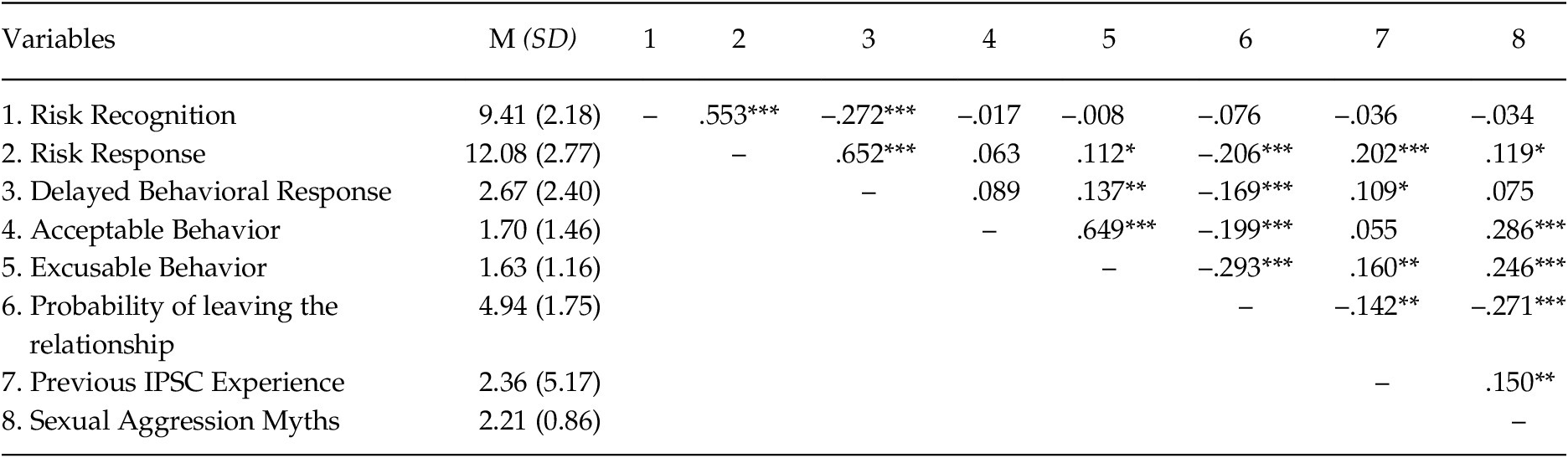
The means, standard deviations, and correlations for all dependent variables are shown in Table 1. The three risk perception measures correlated with each other, but risk recognition did not correlate with any of the other variables. Risk response correlated positively with the perception of the perpetrator’s behavior as excusable, previous IPSC experience, and sexual aggression myths acceptance, and correlated negatively with the probability of leaving the relationship. For its part, perpetrator behavior perceptions correlated positively with previous IPSC experience and sexual aggression myths acceptance, and negatively with the probability of leaving the relationship. Finally, previous IPSC experience was positively associated with sexual aggression myths acceptance.
Means, Standard Deviations, and Correlations between the Dependent Variables

Note. *** p < .001. ** p < .01.* p < .05.
Influence of the Partner’s Coercive Tactics on Perceptions
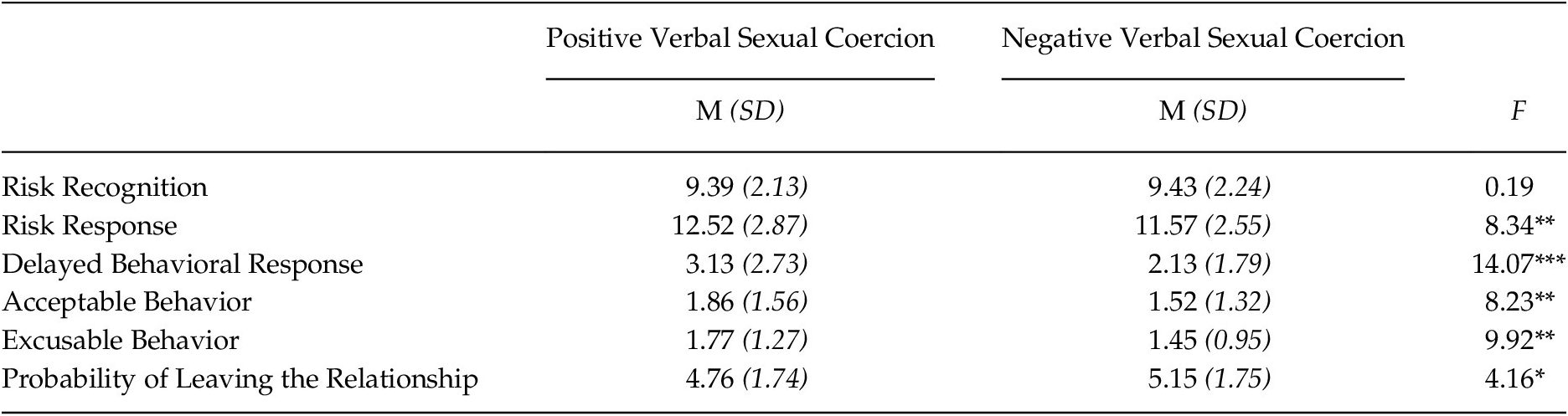
To examine the influence of the partner’s coercive tactics on perceptions, a between-subjects MANCOVA was first conducted. It allowed to analyze the hypothesized relationship (Hypothesis 1) between the type of sexual coercion tactic (positive VSC vs. negative VSC; independent variable) and IPSC risk perception (risk recognition, risk response, and delayed behavioral response; dependent variables) (see Table 2). Age and relationship duration were introduced as covariatesFootnote 1. The results indicated a significant multivariate effect of the type of tactic on IPSC risk perception, Wilks’λ = .97, F(2, 422) = 7.23, p = .001, η p 2 = .03. Consistent with Hypothesis 1a, no differences were found between positive and negative VSC regarding the moment in which women first felt uncomfortable (risk recognition), F(1, 423) = 0.19, p = .660, η p 2 = .00. However, women differed with respect to the moment in which they would leave the situation (risk response), F(1, 423) = 8.34, p = .004, η p 2 = .02, so that positive VSC condition participants decided to leave the scenario when the sexual violence situation was more advanced than negative VSC condition participants, supporting Hypothesis 1b (see Table 2). Finally, according to Hypothesis 1c, the type of tactic had a significant effect on the time lag between risk recognition and risk response (delayed behavioral response), F(1, 423) = 14.08, p < .001, η p 2 = .03, being greater in the positive VSC condition than in the negative VSC condition (see Table 2).
Means, Standard Deviations, and Hypothesized Contrasts

Note. Table values are means and standard deviations (in parenthesis, italicized) presented to reflect hypothesized contrasts (Hypothesis 1a, 1b, and 1c).
***p < .001. ** p < .01. *p < .05.
Secondly, to evaluate the effect of the type of tactic on perceptions of the perpetrator’s behavior (Hypothesis 2), another between-subjects MANCOVA was conducted, with the type of tactic (positive VSC vs. negative VSC) as independent variable and perceptions of the perpetrator’s behavior as acceptable and excusable as dependent variables. Again, both age and relationship duration were introduced as covariatesFootnote 2. Regarding Hypothesis 2, results indicated a significant multivariate effect of the type of tactic on the perceptions of the perpetrator’s behavior, Wilks’λ = .97, F(2, 421) = 5.55, p = .004, η p 2 = .03, with differences between positive and negative VSC on both perceptions of acceptable behavior, F (1, 422) = 8.23, p = .004, η p 2 = .02, and excusable behavior, F(1, 422) = 9.92, p = .002, η p 2 = .02. Specifically, as shown in Table 2, women in the positive VSC condition (vs. women in the negative VSC condition) perceived the perpetrator’s behavior as more acceptable (Hypothesis 2a) and excusable (Hypothesis 2b).
Finally, a between-subjects ANCOVA analyzed the relationship between the type of tactic and the probability of leaving the relationship (Hypothesis 3). Again, relationship duration and age were introduced as covariates.Footnote 3 Results revealed an influence of the type of tactic on the probability of leaving, F(1, 423) = 4.16, p = .042, η p 2 = .01, so that women in the positive VSC condition reflected lower probability of leaving the relationship than women in the negative VSC condition (see Table 2).
Indirect Effect of Sexual Aggression Myths and Previous IPSC Experience on the Probability of Leaving the Relationship based on Response to Risk and Perceptions of the Perpetrator’s Behavior
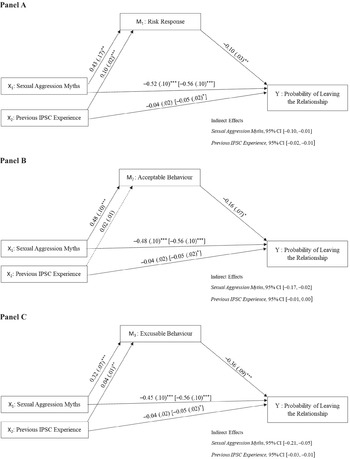
To examine Hypothesis 4, six mediation analyses were run using PROCESS (Model 4; Hayes, Reference Hayes2018; Igartua & Hayes, Reference Igartua and Hayes2021), testing through linear models using ordinary least squares (OLS) regressions whether sexual aggression myths acceptance (X1) and previous IPSC experience (X2) predicted probability of leaving the relationship (Y) via risk response (M1) and perceptions of the perpetrator’s behavior (i.e., acceptable behavior [M2] and excusable behavior [M3]). Relationship duration and age were included as covariates. As shown in Figure 1 (Panel A), sexual aggression myths and previous IPSC experience were related to delayed risk response, which also decreased the probability of leaving the relationship. Results indicated that the indirect effect of sexual aggression myths, b = –0.04, SE = .02, 95% CI [–0.10, –0.01], and previous IPSC experience, b = –0.01, SE = .01, 95% CI [–0.02, –0.01], on the probability of leaving the relationship was driven by delayed risk response. This finding suggests, in accordance with Hypothesis 4, that higher levels of myths acceptance and previous IPSC experience lead to a later response to risk, which, consequently, decreases the probability of leaving the relationship.
Mediation model displaying the indirect effects of sexual aggression myths and previous IPSC experience on probability of leaving the relationship via risk response (Panel A), acceptable behavior (Panel B), and excusable behavior (PANEL C). All responses value are unstandardized estimates (b values), with their SE reported between parenthesis. Total effects appear within brackets
*** p < .001. ** p < .01. * p < .05.

Conversely, Figure 1 (Panel B) reveals a significant association between sexual aggression myths and perceptions of perpetrator’s behavior as acceptable, but the association between previous IPSC experience and acceptable behavior perception was not significant. For its part, acceptable behavior perception was related to the probability of leaving the relationship. Therefore, results showed that sexual coercion myths acceptance, b = –0.08, SE = .04, 95% CI [–0.17, –0.02], but no previous IPSC experience, b = –0.01, SE = .00, 95% CI [–0.01, 0.00], was indirectly linked to the probability of leaving the relationship via its effect on acceptable behavior perception. Specifically, greater myths acceptance was associated with perceptions of the perpetrator’s behavior as more acceptable, which, in turn, was associated with a lower probability of leaving the relationship. This pattern, however, was not found in the case of previous IPSC experience, partially supporting Hypothesis 4.
Furthermore, Figure 1 (Panel C) indicates that sexual aggression myths and previous IPSC experience were also related to perceptions of the perpetrator’s behavior as more excusable, which decreased the probability of leaving the relationship. Concretely, results revealed that the indirect effect of sexual aggression myths acceptance, b = –0.12, SE = .04, 95% CI [–0.21, –0.05], and previous IPSC experience, b = –0.02, SE = .01, 95% CI [–0.03, –0.01], on the probability of leaving the relationship was driven by perceptions of more excusable behavior. Therefore, in accordance with Hypothesis 4, higher levels of myths acceptance and higher previous IPSC experience led to perceptions of the perpetrator’s behavior as more excusable, which resulted in decreasing the probability of leaving the relationship.
Finally, six moderated mediation analyses were run to examine Hypothesis 5, that is, whether the type of tactic (W) moderated the indirect effect of sexual aggression myths acceptance (X1) and previous IPSC experience (X2) on the probability of leaving the relationship (Y), based on risk response (M1) and perpetrator behavior perceptions (M2 and M3) using PROCESS (Model 7; Hayes, Reference Hayes2018). Results did not yield a moderating type of tactic effect in any of the mediation models. Specifically, the interaction between sexual aggression myths and type of tactic on risk response, b = –0.49, SE = .34, 95% CI [–1.16, 0.18]; acceptable behavior, b = –0.28, SE = .19, 95% CI [–0.64, 0.09]; and excusable behavior, b = –0.19, SE = .13, 95% CI [–0.44, 0.05]; were not significant. Similarly, the interaction effects of previous IPSC experience and type of tactic on risk response, b = 0.05, SE = .04, 95% CI [–0.02, 0.12]; acceptable behavior, b = –0.03, SE = .02, 95% CI [–0.07, 0.00]; and excusable behavior, b = –0.02, SE = .03, 95% CI [–0.07, 0.03]; were not significant either. These results did not support Hypothesis 5, and suggest that sexual aggression myths and previous IPSC experience decrease the probability of leaving the relationship via delayed risk response and perceptions of the perpetrator’s behavior as more acceptable and more excusable, regardless of the perpetrator’s type of verbal sexual coercion tactic.
Discussion
The goal of the present study was to assess women’s perceptions and responses regarding a scenario involving sexual coercion by a hypothetical intimate partner. Different factors that could potentially affect their interpretations were examined: (a) The type of coercive tactic used by the perpetrator; (b) previous IPSC experience; and (c), their acceptance of sexual aggression myths.
The first aim of this study was to analyze the influence of the perpetrator’s type of tactic (positive VSC vs. negative VSC) on women’s risk perception, their perceptions of the perpetrator’s behavior, and the probability of their leaving the relationship. To do this, the RPS (Messman-Moore & Brown, Reference Messman-Moore and Brown2006) was adapted to examine women’s risk recognition, risk response, and delayed behavioral response in a hypothetical written scenario that reflected an increasing risk of sexual coercion. As expected, in accordance with Hypothesis 1a, the results did not show differences between positive and negative VSC regarding the delay it took for women to feel uncomfortable (risk recognition). Although no previous studies have analyzed how the type of tactic influences risk recognition, this finding is consistent with past research that found an absence of differences regarding the moment in which women recognized the risk of sexual violence as a situation’s circumstances varied (e.g., Garrido-Macías, Valor-Segura, & Expósito, Reference Garrido-Macías, Valor-Segura and Expósito2020b; Messman-Moore & Brown, Reference Messman-Moore and Brown2006). For its part, the results obtained for risk response supported Hypothesis 1b by demonstrating that women in the positive VSC scenario responded later to risk than women in the negative VSC scenario, deciding to leave the scenario when the situation of sexual coercion was more advanced. In addition, in line with the above and in agreement with Hypothesis 1c, women in the positive VSC condition (vs. negative VSC condition) had higher delayed behavior, spending more time between the moment they recognized the risk and decided to leave the abusive situation. These findings support previous studies showing that women may have less negative reactions to sexual coercion when the abusive partner uses softer coercion tactics (e.g., Garrido-Macías, Valor-Segura, & Expósito, Reference Garrido-Macías, Valor-Segura and Expósito2020a). Therefore, the results of this study are consistent with the findings in the literature regarding risk perception and demonstrates that the perpetrator’s use of less severe strategies (in this study, positive VSC vs. negative VSC) is associated with women’s delayed decisions to leave the situation of sexual violence as well as delayed behavioral responses (Garrido-Macías, Valor-Segura, & Expósito, Reference Garrido-Macías, Valor-Segura and Expósito2020b; Messman-Moore & Brown, Reference Messman-Moore and Brown2006; Yeater et al., Reference Yeater, McFall and Viken2011).
Regarding perceptions of the perpetrator’s behavior, results indicated, consistent with Hypothesis 2, that women in the positive VSC scenario perceived the perpetrator’s behavior as more acceptable (Hypothesis 2a) and excusable (Hypothesis 2b) than women in the negative VSC scenario. This is consistent with the existing literature that has found that the use of softer sexual coercion tactics (verbal vs. physical) is associated with less negative perceptions of the perpetrator (e.g., Brown et al., Reference Brown, Testa and Messman-Moore2009; Garrido-Macías & Arriaga, Reference Garrido-Macías and Arriaga2020; Katz et al., Reference Katz, Moore and Tkachuk2007). However, while this study found less negative perpetrator perceptions in positive (vs. negative) VSC tactics, the only previous study to have analyzed how the types of verbal coercion tactics influence perpetrator perceptions found no differences between the positive and negative variants (Garrido-Macías & Arriaga, Reference Garrido-Macías and Arriaga2020). One possible explanation is the different procedure used in the scenarios. In the study by Garrido-Macías and Arriaga (Reference Garrido-Macías and Arriaga2020), the participants had to read the entire scenario and then respond to the measures of perception of the aggressor’s behavior. In the present study, the fact that women had to decide at what point in the scenario they would leave the situation may have highlighted the positive or negative type of verbal coercion, making the participants more aware of the differences between both and thus obtaining the expected results of Hypothesis 2.
Focusing on the probability of leaving the relationship, results indicated that women in the positive VSC condition would be less likely to leave the relationship after the situation compared to women in the negative VSC condition. This finding supports Hypothesis 3 and previous research that has shown that the probability of remaining in the relationship is greater in the case of women having experienced softer sexual coercion (Edwards et al., Reference Edwards, Kearns, Gidycz and Calhoun2012; Katz et al., Reference Katz, Moore and Tkachuk2007) and when the perpetrator uses positive verbal coercion tactics (Garrido-Macías, Valor-Segura, & Expósito, Reference Garrido-Macías, Valor-Segura and Expósito2020a).
The second main objective of this study was to analyze the role of previous IPSC experience and myths acceptance on risk perception, perceptions of the perpetrator’s behavior, and the probability of leaving the relationship. Results partially supported Hypothesis 4 by reflecting that both variables (previous IPSC experience and sexual aggression myths) captured a motivation to continue the relationship based on risk response and perceptions of the perpetrator’s behavior. Specifically, previous IPSC experiences and higher sexual aggression myths acceptance led women to delay their decision to leave the situation (later risk response) and to perceive the perpetrator’s behavior as more acceptable (only significant for sexual aggression myths acceptance) and more excusable, and, hence, to a lower probability of leaving the relationship. These results agree with past research that has demonstrated that both, previous experience of sexual violence and myths acceptance predict later risk response (e.g., Garrido-Macías, Valor-Segura, & Expósito, Reference Garrido-Macías, Valor-Segura and Expósito2020b; Hetzel-Riggin et al., Reference Hetzel-Riggin, James, Roby and Buczek2021; Messman-Moore & Brown, Reference Messman-Moore and Brown2006), less negative perceptions of the perpetrator’s behavior (e.g., Bohner et al., Reference Bohner, Eyssel, Pina, Siebler, Viki, Horvath and Brown2009; Garrido-Macías & Arriaga, Reference Garrido-Macías and Arriaga2020; Klement et al., Reference Klement, Sagarin and Skowronski2019), and a lower probability of leaving the relationship (e.g., Arriaga et al., Reference Arriaga, Capezza and Daly2016; Garrido-Macías & Arriaga, Reference Garrido-Macías and Arriaga2020; Garrido-Macías, Valor-Segura, & Expósito, Reference Garrido-Macías, Valor-Segura and Expósito2020b). The latter corroborates the detrimental effect of previous experience and myths acceptance on women’s reactions to sexual violence.
Finally, contrary to what we expected in Hypothesis 5, the perpetrator’s type of tactic did not moderate the relationship between previous IPSC experience/myths acceptance and risk response/perpetrator behavior perceptions. Hence, the mediating effect of risk response and perceptions of the perpetrator’s behavior between previous IPSC experience and myths acceptance and probability of leaving the relationship occurred regardless of the perpetrator’s type of tactic. This result could be congruent with some previous research that found an absence of differences in the way in which women perceive positive and negative verbal coercion (e.g., Garrido-Macías & Arriaga, Reference Garrido-Macías and Arriaga2020). Both forms of coercion include verbal strategies without the use of physical force. Therefore, it could be possible that, in the context of our study, the fact of having suffered sexual coercion or accepting myths may have a greater weight on women’s perceptions of the situation and perpetrator, and on their decision to be more tolerant and to remain in their abusive relationship. It is very important to further explore and determine the key factors underlying women’s assessments of sexual violence risk situations and their responses to them.
The present study contributes to our understanding of the factors that prevent women from adequately perceiving sexual coercion in a relationship. Nevertheless, the study presented some limitations which must be taken into account when interpreting its results. First, it is important to acknowledge that women responded to a hypothetical scenario of intimate partner sexual coercion. In other words, the study’s results are based on women’s perceptions and intentions and the latter may not match their responses in equivalent real-life situations. Thus, we cannot say that the women’s decisions regarding when they would leave the situation or relationship would predict their actual behavior in real life.
Second, women were instructed to heighten their attention to threat-related stimulus in order to decide which sentence of the scenario made them feel uncomfortable and when they would leave the situation. Therefore, they knew in advance that something negative was going to happen, an advantage they would not have in real life and that may also have influenced their responses. Future research should replicate the present research exposing them to these types of situations in different ways in order to achieve more realistic representations (e.g., video or audio clips) and favoring responses that would be as faithful as possible to real life.
Third, the present study assessed previous experiences of intimate partner sexual coercion over the last year, but it was not known whether women suffered these experiences with their current partner or in a previous relationship. This distinction should be considered in future studies. Indeed, past research has shown that there are differences in the way victims perceive and respond to situations of sexual violence depending on whether coercion was experienced in a previous relationship or with the current partner (e.g., Garrido-Macías, Valor-Segura, & Expósito, Reference Garrido-Macías, Valor-Segura and Expósito2020b; Garrido-Macías & Arriaga, Reference Garrido-Macías and Arriaga2020). Along the same lines, other forms of victimization were not assessed either: neither outside intimate relationships, nor outside the domain of sexuality. Therefore, differences among participants beyond their previous IPSC experience may have been related to our study’s dependent variables in ways that we were unable to control. Future longitudinal designs are necessary in order to achieve a more adjusted analysis of variables that may be influencing sexual coercion perceptions and responses.
The current study contributes new knowledge regarding how women interpret an intimate partner’s sexually coercive behavior based on specific features of the situation, their own previous experiences, and their individual characteristics. Specifically, subtle verbal coercion tactics predict less negative perceptions of the situation and of the perpetrator, which could lead women to minimize harmful behavior and remain in their abusive relationship. Furthermore, the results indicate that previous IPSC experience and sexual aggression myths acceptance contribute to greater acceptance of sexual coercion. These factors are therefore part of the key issues that need to be addressed in order to prevent sexual violence and to help victims adequately perceive sexual violence situations. The findings presented here highlight the broad impact that certain variables (perpetrator’s type of tactic, previous sexual coercion experience, and myth acceptance) have on women’s reactions toward sexual coercion and their consequent risk of revictimization. Further research is thus necessary in order to examine these factors more in depth and to prevent future sexual coercion experiences. Along the same lines, the results suggest some avenues to enhance the effectiveness of sexual violence prevention programs. They could include egalitarian sex education, helping women to understand the limits beyond which a healthy sexual relationship may turn into sexual violence. Indeed, verbal sexual coercion is frequent in intimate relationships, yet it is harder to identify, interpret and respond appropriately. It is also more difficult to seek help. Thus, it is important to provide an adequate adaptive and healthy frame of reference, guiding couples towards correct assumptions as well as healthy and egalitarian behaviors.