Introduction
Wheat is a major staple food because of the wheat plant's agronomic adaptability, ease of grain storage and ease of converting grain into flour for making staple food products. Wheat is the major source of carbohydrates in the diet of people in many countries, including Australia, most of Europe, Northern Asia and Northern Africa (Khalid et al., Reference Khalid, Khan, Arif, Altawaha, Adnan, Fahad and Parmar2019). Wheat is an important source of food for the inhabitants of the whole world and plays an important role in the economy of many countries including Pakistan. Being a staple diet in Pakistan, it occupies a central position in agriculture (Bibi et al., Reference Bibi, Majid, Ulfat, Khatoon, Munir and Javed2017). Around 80% of the farmers are growing wheat at an area of 9 million hectares during the Rabi (winter) season. This crop alone has contributed about 10% of value addition in agriculture and 2.1% of the country's gross domestic product during 2015. In Pakistan, grain yield of wheat crop never exceeded 2.5 tons per hectare, whereas managing methodologies permit farmers of the world to produce10 tons per hectare. The reasons for low yield in Pakistan include poor planning and land preparation, use of low yielding wheat varieties, low-quality seed, inappropriate use of fertilizers, water logging, salinity, insect infestation and poor wheat management (Khatoon et al., Reference Khatoon, Majid, Bibi, Javed and Ulfat2016). In Pakistan, the total wheat production was 25.7 million metric tons reported in 2017. The demand for wheat is globally increasing at the rate of 2% annually, due to an increase in global population. That is why the quality of wheat should be such that can meet these challenges and support the economy by trade (Parveen et al., Reference Parveen, Masood, Khalid, Hameed, Mushtaq and Suleman2019). Various strategies have been used over time for the improvement of wheat yield, and seed priming with various chemicals and hormones is one of them. Seed priming is a presoaking treatment in which seeds are soaked for a certain period of time before sowing and then dried back to restore the optimum moisture contents. Seed germination and seedling emergence have been found more vigorous and faster as compared to dry/unprimed seeds. In seeds, numerous biochemical changes are stimulated by priming which are important to start the germination process and for the improvement of certain physiological characteristics. Seed priming promotes quick and uniform seed germination and crops growth. It also plays a crucial role in seed germination of various crops even under adverse conditions and mostly enhances the yield. Seed priming promotes more branches and a high number of tillers in wheat (Mustafa et al., Reference Mustafa, Mahmood, Ullah, Sharif, Bhatti, Muhammad Nadeem and Ali2017) which ultimately leads to increased biological yield. There has been much research in recent years about the potential of nitric oxide (NO) for yield improvement. It has gained an important position in plant sciences, and has a multifunctional role in the growth and development of plant besides regulating the cellular mechanism (Bibi et al., Reference Bibi, Majid, Ulfat, Khatoon, Munir and Javed2017). In several studies (Neill et al., Reference Neill, Desikan and Hancock2003, Reference Neill, Barros, Bright, Desikan, Hancock, Harrison, Morris, Ribeiro and Wilson2008), exogenous NO was applied on various crops in order to study its role for yield improvement. However, the well-defined role of NO priming on wheat physiology is still lacking. Therefore, the current project was carried out to evaluate the performance of NO as a plant growth enhancer for improving the wheat growth, physiology and productivity in different wheat varieties.
Materials and methods
The experiments were conducted during 2013 and 2014 in the field area of District Muzaffarabad Azad Jammu and Kashmir, Pakistan and then further analysis was carried out in the research laboratory of Department of Botany University at Azad Jammu & Kashmir. Seeds of seven rainfed wheat (Triticum aestivum L.) genotypes, viz. Lasani-2008 (gt1), Faisalabad-2008 (gt2), AAS-2011 (gt3), Punjab-2011 (gt4), Uqab-2002 (gt5), Chakwal-50 (gt6) and NARC-2011 (gt7) commonly cultivated in the study area were treated with 10−4 and 10−5 M NO for priming along with control and were sown in the field. Wheat varieties were assigned to the main plots and NO concentrations to the sub plots using randomized complete block design with three replicates. Fully developed flag leaves were harvested after 5 months of sowing at booting stage to study physiological variations induced by priming. Germination speed was measured based on the method of Magour et al. (Reference Magour, Coper and Fahndrich1974) by using the equation of Rajabi and Poustini (Reference Rajabi and Poustini2005). Chlorophyll contents were measured by spectrophotometer using the method of Sims and Gamon (Reference Sims and Gamon2002). Leaf moisture content and leaf dry matter content were determined by using the procedure of Saura-Mas and Lloret (Reference Saura-Mas and Lloret2007), relative water content by Weatherley (Reference Weatherley1950) and leaf water loss (LWL) by Xing et al. (Reference Xing, Tan, An, Zhao, Wang and Zhang2004). Relative injury and cell membrane thermostability were determined by the method of Yildirim et al. (Reference Yildirim, Bahar, Koc and Barutcular2009). All the obtained data were statistically analysed in computer package MSTAT-C. Level of significance for the variations of means was tested using analysis of variance. Duncan's Multiple Range Test (DMRT) was used to compare the difference amongst the means of treatments (Steel et al., Reference Steel, Torrie and Dickey1997).
Results
Germination speed
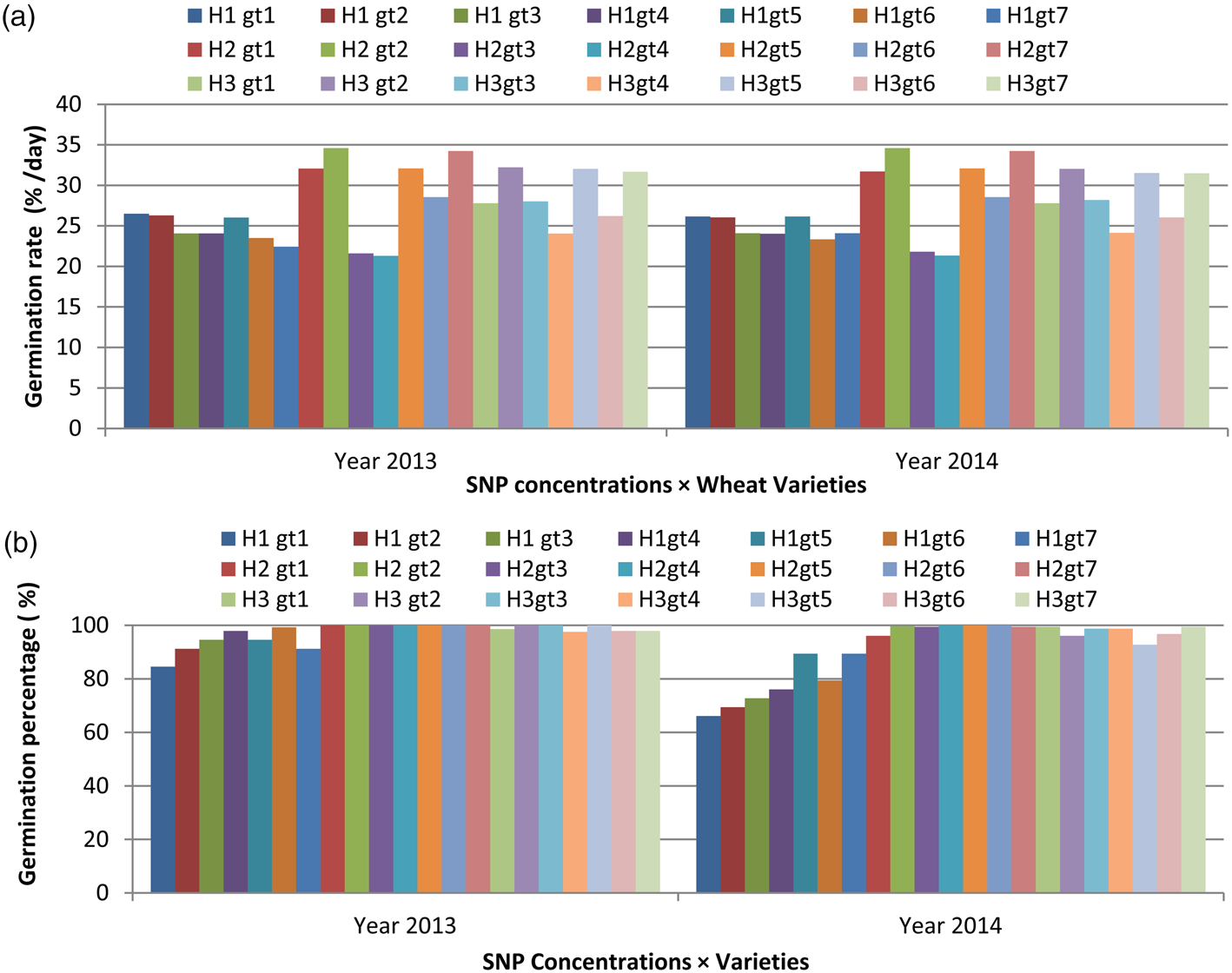
Significant variation (P ⩽ 0.05) in germination rate (GS) was observed by NO priming for both the years. During both the study years, i.e. 2013 and 2014, gt2 (Genotype 2) primed with 10−4 M sodium nitroprusside (SNP) showed the highest germination speed as presented in Fig. 1a. Unprimed varieties showed lower germination speed compared to SNP primed samples from almost all the studied genotypes of wheat.
Colour online. (a) Fluctuations in nitric oxide-induced germination speed in wheat genotypes. (H1, H2, H3 represent 0 M SNP, 10−4 M SNP, 10−5 M SNP, respectively. While gt1, gt2,…gt7 are wheat genotypes as mentioned in ‘Materials and methods’ section.) (b) Fluctuations in nitric oxide-induced germination percentage in wheat genotypes.

Germination percentage
Significant variation (P ⩽ 0.05) in germination speed (GS) was observed by NO priming for both the years (Fig. 1b). During 2013, gt2, gt3, gt5, gt6, gt7 primed with 10−4 M SNP and gt2, gt3 and gt5 showed the highest germination percentage. Whereas 10−5 M SNP primed gt4, gt5 and gt6 during 2014 showed the same highest germination percentage. Unprimed samples showed lower germination speed compared to SNP primed samples from almost all the studied genotypes of wheat during both the study years.
Chlorophyll a
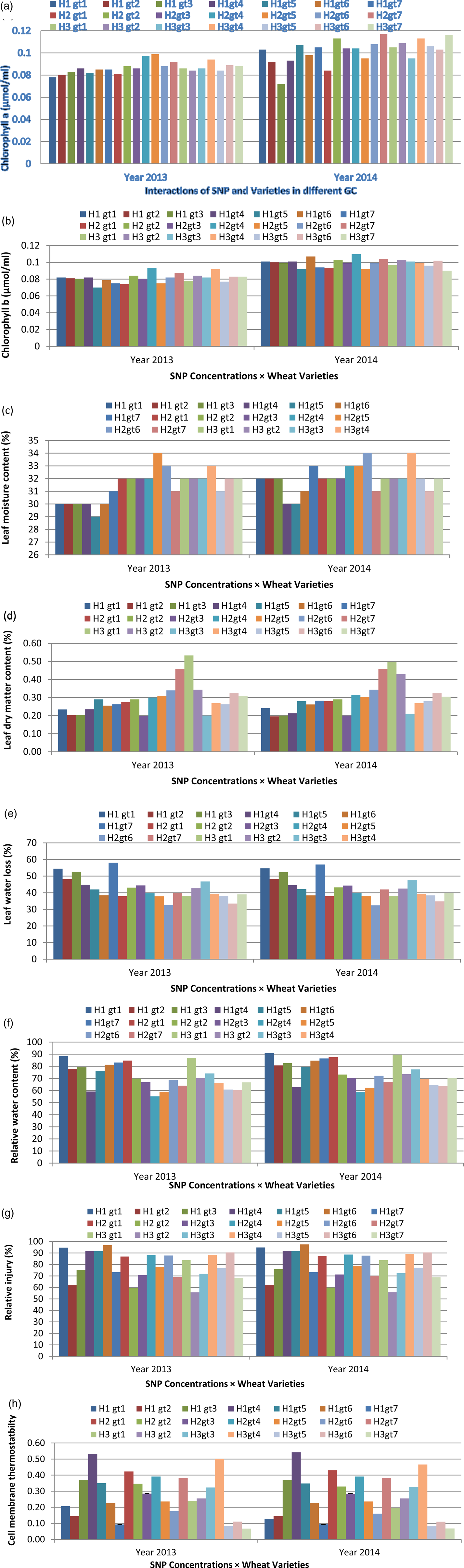
Significant variation (P ⩽ 0.05) in chlorophyll a was observed by NO priming for both the years. During 2013, gt5 primed with 10−4 M SNP showed the highest chlorophyll a, whereas during 2014, the highest chlorophyll a was revealed by10−5 M SNP primed gt7 (Fig. 2a). As is clear in the figure, chlorophyll contents were found to be lower in unprimed varieties compared to SNP primed wheat varieties.
Colour online. (a) Fluctuations in nitric oxide-induced chlorophyll a in wheat genotypes. (b) Fluctuations in nitric oxide-induced chlorophyll b in wheat genotypes. (c) Fluctuations in nitric oxide-induced leaf moisture content in wheat genotypes. (d) Fluctuations in nitric oxide-induced leaf dry matter content in wheat genotypes. (e) Fluctuations in nitric oxide-induced leaf water loss in wheat genotypes. (f) Fluctuations in nitric oxide-induced relative water content in wheat genotypes. (g) Fluctuations in nitric oxide-induced relative injury in wheat genotypes. (h) Fluctuations in nitric oxide-induced cell membrane thermostability in wheat genotypes.

Chlorophyll b
During both years, the lowest chlorophyll b was estimated in non-primed samples (Fig. 2b). However, during 2013, the highest chlorophyll b was measured in gt4, primed with 10−5 and 10−4 M SNP. Likewise, gt4 showed the highest chlorophyll b during 2014 at 10−4 M SNP.
Leaf moisture content
Leaf moisture content of plants is often used to explain the internal water status. However, analysis of variance showed a slight variation in leaf moisture contents during 2013 and 2014 (Fig. 2c). In 2013, the highest leaf moisture content was measured in gt5 at 10−4 M SNP priming, while the lowest value was estimated from unprimed gt6. During 2014, gt4 primed with 10−4 M SNP and gt6 primed with 10−5 M showed the highest leaf moisture content. The lowest leaf moisture content was observed in unprimed genotypes. The present findings revealed more moisture contents in primed genotypes as compared to control.
Leaf dry matter content
Leaf dry matter content revealed non-significant variations (P ⩽ 0.05) between 2013 and 2014 (Fig. 2d). During these 2 years, the highest leaf dry matter content was found from gt1 primed with 10−5 M SNP, while the lowest in gt3 with and without priming during 2013 and 2014.
Leaf water loss
The present study exhibited the significant (P ⩽ 0.05) effect of NO priming on LWL during 2013 and 2014 separately; however, non-significant differences were found between these 2 years (Fig. 2e). The highest bar for LWL was observed within non-primed gt7 and the lowest in gt6 primed at 10−4 M SNP during both the years.
Relative water content
In the present study, non-significant (P ⩽ 0.05) variations in relative water content were observed among primed and non-primed genotypes during both the years (Fig. 2f). Surprisingly, the highest relative water content was recorded in non-primed gt1. In contrast, the lowest relative water content was revealed at 10−4 M SNP within gt2 during both the years.
Relative injury and cell membrane stability
Relative injury coupled with the membrane stability can be used as a complementary tool for the screening of potential wheat genotypes. In the current study, significant variations (P ⩽ 0.05) for relative injury were revealed among different wheat genotypes with or without priming; however, the results were non-significant and more stable during both the years (Fig. 2g). The highest relative injury was recorded in gt6 during both the study years and the lowest in gt2 primed with 10−4 M SNP.
Analysis of variance for cell membrane thermostability revealed the significant variations (P ⩽ 0.05) in cell membrane thermostability by priming in all wheat genotypes. The highest cell membrane thermostability was revealed by unprimed gt4 followed by the same genotypes at 10−5 M SNP concentration during both the years (Fig. 2h). The lowest cell membrane thermostability was found in gt7 at 10−5 M SNP during 2013 and 2014. Other genotypes exhibited intermediate stability for the cell membrane.
Grain yield
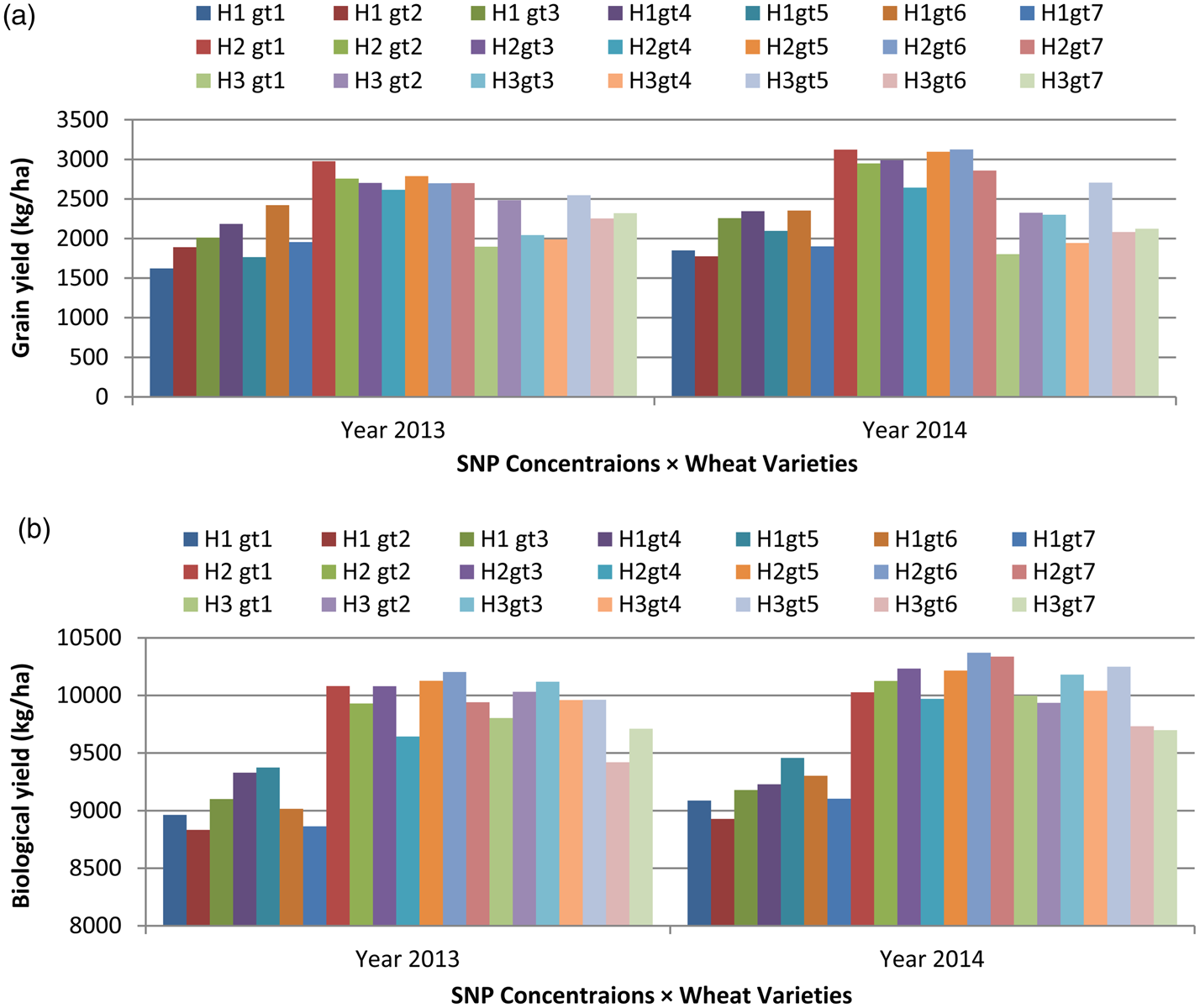
In the present study, significant (P ⩽ 0.05) variations in grain yield were observed among primed and non-primed genotypes during both the years (Fig. 2a). The highest grain yield was recorded in 10−4 M SNP primed gt1 during 2013 and gt2 during 2014. In contrast, the lowest grain yield was revealed from unprimed samples during both the study years.
Biological yield
The present study exhibited the significant (P ⩽ 0.05) effect of NO priming on biological yield during 2013 and 2014 (Fig. 3b). The highest bar for biological yield was observed from 10−4 M SNP primed gt3 during both the study years and the lowest in unprimed gt2 during both the years.
Colour online. (a) Fluctuations in nitric oxide-induced grain yield in wheat genotypes. (b) Fluctuations in nitric oxide-induced biological yield in wheat genotypes.

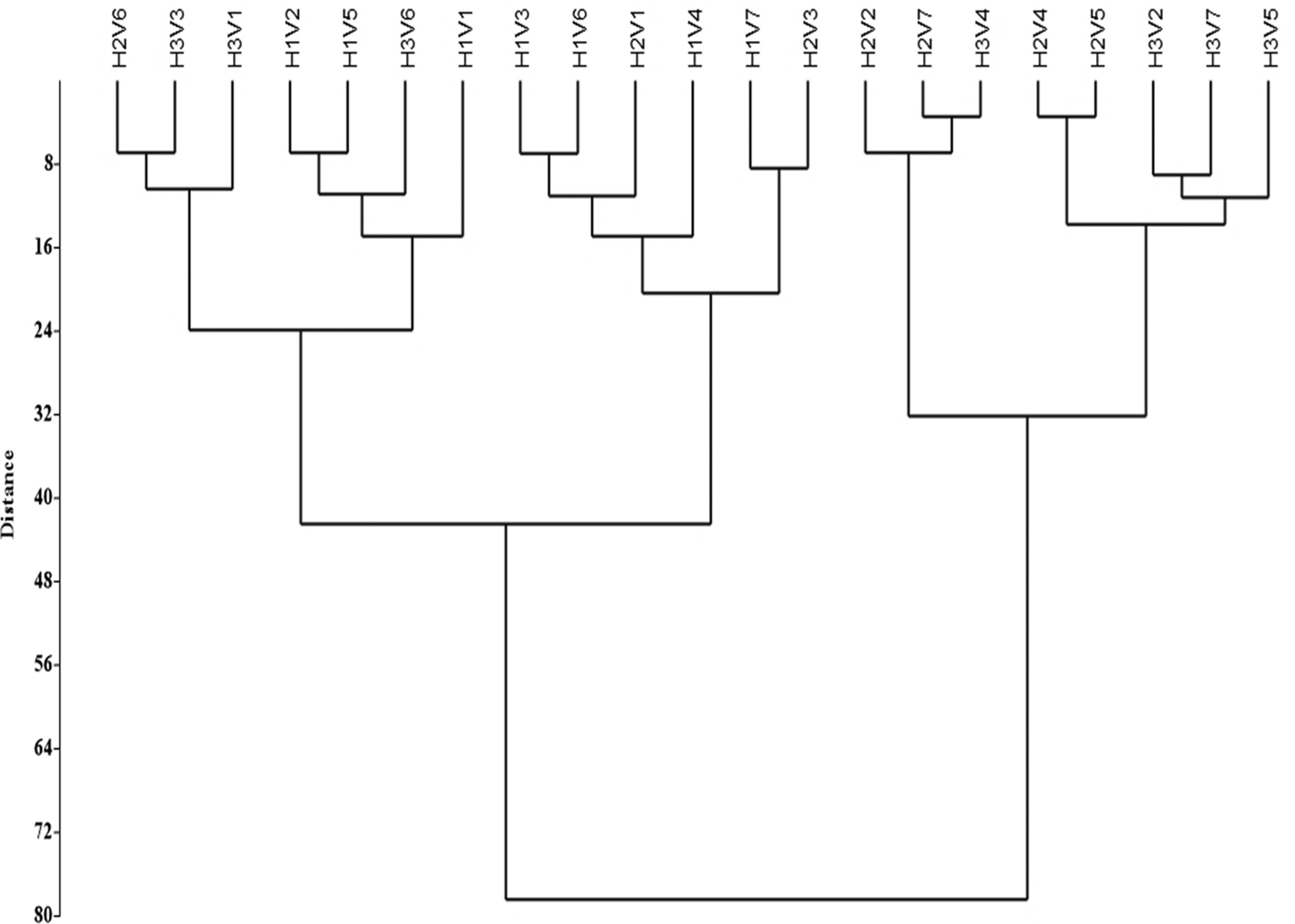
Combined cluster analysis for physiological attributes of wheat by NO priming.

Discussion
Germination rate is the reciprocal of the time taken for the process of germination to complete starting from the time of sowing. Hormonal treatment showed increased GS with an increased level of SNP treatment by improving the metabolic activities (tricarboxylic acid cycle, amino acid, sugar and respiratory substrate metabolism) in the seed. Similar results were reported by Sharafizad et al. (Reference Sharafizad, Naderi, Siadat, Sakinejad and Lak2012) who reported increased GS by an increased level of stress as well as of hormone. The highest germination rate was seen in wheat variety gt2 primed with 10−4 M SNP. Differences in germination rates between varieties are due to variations in their performance as well as tolerance levels. Such variability in germination indices was also reported by Anbumalarmathi and Mehta (Reference Anbumalarmathi and Mehta2013). In the present work, seed priming in stressed GC showed highest GS values which is consistent with the findings of Zare et al. (Reference Zare, Tavili and Darini2011) who reported GS of primed seeds more in stressed GC as compared to unstressed one.
Final germination percentage was observed to be higher from both the studied years in SNP primed seeds. Seed priming stimulates various biochemical changes in the seed which are essential to commence germination process, for example, activation of a certain enzyme, breaking of dormancy, water imbibition, etc. (Ajouri et al., Reference Ajouri, Asgedom and Becker2004). Numerous processes stimulating germination can be activated by seed priming and endure following redesiccation of seeds (Asgedom and Becker, Reference Asgedom and Becker2001). The highest GP values, seen in gt2 and gt5, are due to genetic differences that correspond to differences in redesiccation tolerance level between varieties. Variations in different parameters between varieties grown under the same conditions and treatments were also reported by Murthy et al. (Reference Murthy, Ranganayakulu, Vidhu and Rao2013).
NO has been supposed to possess dual roles, either protective or toxic, depending upon its environments. It plays a crucial role in the varied physiological functions of plants (Zhao et al., Reference Zhao, Chen, Zhang and Zhang2009). However, little information is published about its role in germination, growth, physiology and yield of cereals. NO was reported to increase the chlorophyll contents in leaves as it reduces oxidative injury to photosynthetic apparatus besides scavenging of ROS (Hsu and Kao, Reference Hsu and Kao2007). The present findings confirm the previous reports that hormonal application significantly increases the chlorophyll contents in leaves of various crop species by reducing chlorophyll degradation in leaves (Ulfat et al., Reference Ulfat, Majid, Bibi and Khanum2017). Ulfat et al. (Reference Ulfat, Majid, Bibi and Khanum2017) reported an increase in chlorophyll contents from primed seeds compared to control within spring wheat. Hsu and Kao (Reference Hsu and Kao2007) explained that a decrease in reactive oxygen species and less oxidative damage to photosynthetic apparatus are the possible reasons for this value of chlorophyll (Hsu and Kao, Reference Hsu and Kao2007). Different wheat varieties showed significant variations in photosynthetic pigments because of varied seed vigour as well as genetic make-up. Hayatu and Mukhtar (Reference Hayatu and Mukhtar2010) also observed variations in chlorophyll values between different varieties of the same species.
The present results are in accordance with the findings of Hosseinzadeh-Mahootchi et al. (Reference Hosseinzadeh-Mahootchi, Ghassemi-Golezani, Zehtab-Salmasi and Tourchi2013) and Abdolahpour and Lotfi (Reference Abdolahpour and Lotfi2014) that priming increases the moisture contents. In the current results, it was revealed that priming modifies photosynthetic efficiency and this can be a major cause of high dry matter production. Increased dry matter production positively correlates with the grain yield which is the indication of increased economic yield along with the biological yield. Likewise, deviations in leaf dry matter content due to priming were observed by Zaman et al. (Reference Zaman, Ali, Mahmood, Arshadullah, Shahzad and Khan2010). Seed priming provides oxygen to plants and consequently plants experience a less systematic resistance that eventually leads to more dry matter production from primed samples compared to control (Bibi et al., Reference Bibi, Majid, Ulfat, Khatoon, Munir and Javed2017).
The present results revealed a decrease in water loss due to priming. A similar decrease in LWL was reported by Tan et al. (Reference Tan, Zhao, Hong, Han, Li and Zhao2008) and Bibi et al. (Reference Bibi, Majid, Ulfat, Khatoon, Munir and Javed2017) by NO priming. Priming helps the plants to reduce water loss by developing thick cuticles, closing their stomata or by possessing leaf hairs to enhance boundary layer. Stomata quickly respond to environmental signals in order to protect the plant from losing excessive water; however, it allows carbon dioxide to pass through to drive photosynthesis. Bibi et al. (Reference Bibi, Majid, Ulfat, Khatoon, Munir and Javed2017) and Lugojan and Ciulca (Reference Lugojan and Ciulca2011) worked on crops with hormonal application and reported an increase in relative water content by SNP priming. This is because SNP priming helps the plants in maintaining relative water content by changing cell wall stretchiness and by osmotic adjustment. LWL was found to vary significantly between different wheat varieties during both experiments in the present work. Such variations in LWL from different varieties were also previously reported by Lugojan and Ciulca (Reference Lugojan and Ciulca2011), who suggested that the degree of variation between genotypes was sufficient to offer the scope for the selection of traits in order to improve drought tolerance in wheat genotypes.
A decrease in relative injury by priming as compared to control was also supported by the work of Yildirim et al. (Reference Yildirim, Bahar, Koc and Barutcular2009) and they reported a decrease in relative injury due to priming even under stress conditions. Cell membranes are the most vulnerable plant organelles to any type of abiotic stress. These stresses damage cell membrane and reduce cell membrane stability by loosening chemical bonds present in their molecules. It ultimately changes the tertiary and quaternary structures of the membrane proteins. Such modifications in the membrane boost membrane permeability (Savchenko et al., Reference Savchenko, Klyuchareva, Abramchik and Serdyuchenko2002). These variations in membrane stability by various genotypes and priming have also been reported by Bibi et al. (Reference Bibi, Majid, Ulfat, Khatoon, Munir and Javed2017); Haque et al. (Reference Haque, Ilias and Molla2009) and Zaman et al. (Reference Zaman, Ali, Mahmood, Arshadullah, Shahzad and Khan2010).
Kulshrestha et al. (Reference Kulshrestha, Sharma and Seth2013) reported that primed seed in hormones increased yield, early floral initiation, greater flowers and pods. In the current work, wheat variety gt2 showed the highest yield during 2014 due to its greater suitability for the study area compared to other varieties in the study. Similarly, Harris et al. (Reference Harris, Breese and Rao2005) stated that primed seed vegetation had been capable of producing better yields than unprimed. Salicylic acid accelerated wheat yield (Shakirova et al., Reference Shakirova, Sakhabutdinova, Bezrukova, Fatkhutdinova and Fatkhutdinova2003) and it impacts the physiological and biochemical responses at some point of vegetative degree and lively assimilation translocation from source to sink that boom in kernel yield and yield components (Dawood et al., Reference Dawood, Sadak and M2012).
Conclusion
The present study revealed that seed priming with NO increased the pigments of chlorophyll a and b markedly. Similarly, a positive effect of SNP priming was observed in wheat genotypes. The priming concentration of 10−4 M SNP was found to be suitable to improve most physiological parameters of wheat. Decreases in injury and increases in membrane stability and yield attributes in wheat varieties were observed following priming. Moreover, wheat varieties gt2 and gt4 were found to be more suitable for the study area with SNP priming compared to other varieties (Fig. 4). Hence, application of 10−4 M SNP to crop plants before sowing is recommended in order to improve plant physiology and lead ultimately to high growth and yield.
Financial support
This research received no specific grant from any funding agency, commercial or not-for-profit sectors.
Conflict of interest
The authors declare there are no conflicts of interest.
Ethical standards
Not applicable.