It is well known that the early modern period witnessed great advances in English antiquarian and topographical scholarship focused on different regions and localities. From the Elizabethan period onwards there was a progressive growth in the histories of counties, towns, and eventually parishes across the country as part of a process that W. G. Hoskins dubbed ‘the rediscovery of England’.Footnote 1 During the seventeenth and eighteenth centuries this development was also becoming more evident across Wales, Scotland, and Ireland as a growing number of shires, urban centres, and rural communities were subjected to surveys and accounts.Footnote 2 The emergence of new forms of inquiry in the era of the ‘scientific revolution’ augmented both the methods and the concerns of this research as a greater interest in both the natural history and present state of particular territories and places infused its traditional focus on antiquities and genealogies. The holistic approach of the ‘scientific antiquarianism’ that first became evident in the 1640s remained a significant strand in regional studies across the British Isles into the modern period.Footnote 3
An important part of this scholarly endeavour was its collaborative and communal dimension. One manifestation of this was the way in which printed questionnaires were deployed to solicit information among broad constituencies of people around the different parts of the British Isles. While the use of such published interrogatories by some contemporary scholars has been noted, the extent to which it became a standard fact-finding strategy or research methodology among antiquaries and natural scientists of the late Stuart and Georgian period has yet to receive sustained attention.Footnote 4 This article seeks to examine the origins and development of this practice in Great Britain and Ireland and to demonstrate its ubiquity as a mode of academic inquiry during the late seventeenth and eighteenth centuries. Despite the faith that was clearly invested in the circulation of printed ‘queries’, their yields of information remained relatively modest for much of this period. The following discussion will offer some explanations for the fitful early progress of what has since become one of the basic techniques of data collection in modern academic research.
I
The utilization of the printed questionnaire as a means of gathering information had a well-established history before it was adopted for the purposes of scholarly research in Great Britain and Ireland. Administrators of both church and state across Europe had long deployed ‘enquiries’ as an effective way of amassing knowledge about the people and places within their jurisdictions and by the sixteenth century some of these were taking printed form.Footnote 5 It was during the seventeenth century that the circular list of interrogatories also came to be adopted as a research method in more strictly academic inquiry. In the British context the inspiration for this, as for so many of the other intellectual developments of the period, came from Francis Bacon. It was under the influence of Baconian natural philosophy that the formulation of ‘heads’, or ‘articles of inquiry’, became a common means of identifying issues for investigation and structuring empirical research among scholars who sought to collect useful knowledge. Bacon compiled a series of ‘topics’, or ‘directions of invention and inquiry’, in pursuit of the comprehensive ‘civil’ and ‘natural histories’ upon which he began working in the early 1620s. His ideas set the agenda for much research into ‘natural knowledge’ over the next two centuries, one characterized by the mixing of antiquities and natural history into an integrated account of phenomena past and present. His was a method based on first-hand experience in the field rather than reliance on the accounts of others, and one that implied focus on a particular geographical area in the interests of accuracy and detail. Moreover, his stress on the benefits of collaborative research pointed to the value of distributing such ‘heads’ among would-be accomplices. Since systematic interrogation of the material world by observation and experiment was inevitably beyond the scope of any one individual, it could only be accomplished by the ‘united labours of many, though not by any one apart’.Footnote 6
Accordingly, those virtuosi who, over the succeeding generations, sought to realize the programme set out by Bacon, frequently drew up and disseminated sets of queries as a framework for their investigations and an invitation to collective endeavour. Thus the pioneering inquiry into the state of Ireland undertaken by the group of progressive thinkers and social reformers that gathered around Samuel Hartlib in the 1640s and 1650s was classically Baconian in this respect, as in others. In 1645 Gerard Boate began working on a comprehensive natural history of the country with the aid of information supplied by his brother Arnold. When Gerard died early in 1650 only the first part of the work had been completed and Arnold edited the text for publication two years later. At the same time he issued an alphabetical list of queries, An interrogatory relating more particularly to the husbandry and naturall history of Ireland, soliciting material for the three remaining parts of the project, printed as an appendix to the second edition of Hartlib's Legacie in 1652, but which was also designed for detachment and separate circulation. This appears to give Arnold Boate the honour of being ‘the first author in England to publish such a questionnaire’.Footnote 7
With Arnold Boate's death late in 1653, Hartlib handed responsibility for the Irelands naturall history project to Robert Boyle and Robert Child. Copies of Boate's Interrogatory were sent to Boyle and within a few months ‘divers’ replies had come in. After Child's demise, Robert Wood took a lead in distributing the questionnaire and sheets of answers were sent back to Hartlib and circulated to Boyle's sister, Lady Ranelagh. In the end, nothing came of the ambition to complete a scientific and holistic natural history of Ireland, although immediate legacies of the project were the ‘Gross’ and ‘Civil’ surveys of the country directed by Benjamin Worsley, and the great ‘Down’ survey undertaken by William Petty. The latter was a model of scientific measurement and observation on the ground, and in its employment of hundreds of common soldiers to carry out the work, an exemplary exercise in collective and ‘democratic’ investigation.Footnote 8
After the Restoration the Baconian methods pioneered by the Hartlib circle in Ireland were to have a significant influence on research strategies adopted by the new science and its nascent philosophical societies across the British Isles. Robert Boyle probably drew upon his Irish experience when devising various sets of interrogatories for the fledgling Royal Society in the early 1660s. His highly influential ‘General heads for a natural history of a countrey, great or small’, together with his ‘Other inquiries concerning the sea’, and ‘Articles of inquiries touching mines’, were printed in some of the first numbers of the Society's newly instituted Philosophical Transactions.Footnote 9 Meanwhile Petty's writings were full of such ‘queries’, reflecting his evolving interests in the history of trades, political arithmetic, and social reform.Footnote 10 In the early 1680s he drew up in manuscript ‘The method of enquiring into ye state of any country’.Footnote 11 He also printed a sheet of queries further to what would have been the first secular census of population in England.Footnote 12
In February 1661 both Boyle and Petty were appointed to the Society's Committee on Foreign Plantations that would be responsible for generating a whole series of inquiries aimed at acquiring information from specific parts of the globe.Footnote 13 Another notable example of this methodology in action was in the field of agriculture. At the first meeting of the Society's Georgical Committee in June 1664 it was decided that in order ‘to compose as perfect a history of agriculture and gardening as might be’, appropriate ‘heads of inquiries’ should be drawn up out of ‘georgical authors’ and dispatched to ‘experienced husbandmen in all the shires and counties of England, Scotland, and Ireland’.Footnote 14
An equally important figure in this aspect of the Society's mode of operation was its experimental scientist, Robert Hooke. Hooke produced comprehensive ‘tables or heads of inquiry’ with respect to both ‘natural’ and ‘artificial’ knowledge as the intellectual framework for its co-operative research.Footnote 15 Hooke's geographical interests took a new turn in the late 1660s when he developed a close professional relationship with the publisher John Ogilby over the surveying of property boundaries in London after the Great Fire. In November 1669 Ogilby obtained a licence to produce a new atlas of the world that he proposed in four volumes dealing with each of Africa, America, Asia, and Europe. By June 1670 he had decided to add a fifth volume on ‘Britannia’ that was to consist of three parts: a road book of England and Wales, a collection of twenty-five city plans, and series of county surveys. Hooke was an enthusiastic sponsor of this project and may well have been instrumental in persuading the ageing Ogilby to seek the aid of a printed questionnaire as part of a collaborative research strategy.Footnote 16
It was at this point that the printed questionnaire was first deployed as a method of researching the history and topography of Britain. A group composed of Ogilby and Hooke, together with the surveyor Gregory King, the lawyer Sir John Hoskins, the architect Christopher Wren, and the antiquary John Aubrey, were responsible for formulating two versions of Queries in order to the description of Britannia in 1673. In addition to the concern with administrative structures and antiquities, these queries bore witness to Hooke's interest in natural history, topography, and economic activity, as well as to Aubrey's additional enthusiasm for ‘peculiar customs and manners’. These single folio sheets were clearly intended for distribution in the localities as a vehicle for soliciting information from qualified sources. One consisted of nineteen questions upon which it was said, ‘Information is desir'd in writing; either upon certain knowledge, or other good authority, directing each remark to the number relating to it, and annexing thereto the county and hundred wherein the remark falls.’ The other, of twenty-two questions, was addressed to ‘the nobility and gentry, and all other ingenious persons’, who were to return ‘such remarques of the county or place of their residence, or what they may be acquainted with’, to Ogilby at his house in the White Friars.Footnote 17
In May 1673 Ogilby, as newly appointed cosmographer royal, granted Aubrey a licence to survey Surrey, as a result of which he undertook his perambulation of the county between July and October and had plans, never realized, to do the same in Sussex, Berkshire, and Oxfordshire. His Surrey notes contain a copy of both sets of the Britannia Queries and they clearly provided a framework for his characteristically Baconian investigations, ‘mixing antiquities and naturall things together’. They may also have been the basis for the ‘Naturall Queres’ which formed part of Aubrey's researches in his home county, and to which he received ‘considerable remarques’ in response. Several of their questions would become verbatim chapter headings in the Natural history of Wiltshire, which he had largely completed by the end of 1675.Footnote 18
Among Hooke's other coffee house companions was the natural historian from Oxford, Robert Plot, and he too was to deploy a set of general questions more specifically at the county level.Footnote 19 In 1673 Plot announced his own intention ‘to journey through England and Wales, for the promotion of learning and trade’, and in so doing ‘to make strict inquiry after all curiosities both of art and nature’ under ten ‘heads’ with ‘interrogatories for every head’ to be dispersed among ‘the most ingenious part of the nation’. The result was Quar's to be propounded to the most ingenious of each county in my travels through England, a total of twenty-two questions on which he collaborated with Hooke and which were printed in 1674.Footnote 20 Despite plundering Aubrey's notes on several counties, Plot must have suspended any ambition to cover the whole of England, confining his focus instead to his county of residence. He had a manuscript of the Natural history of Oxfordshire completed for circulation among the company at Garaway's by November 1675 and it was printed in May 1677.Footnote 21 On 14 February 1679 Plot issued another more detailed set of Enquiries in print, again purporting to be directed at the entirety of England and Wales, but in practice this contained the research questions behind what would become another county study, the Natural history of Stafford-shire, published in 1686.Footnote 22
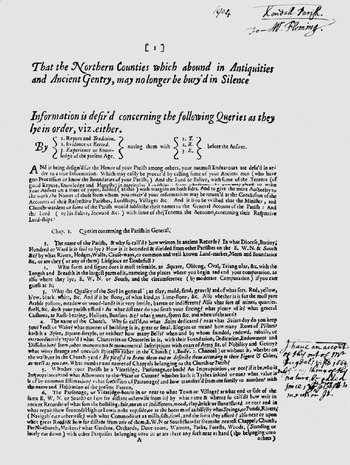
By this time, however, sets of ‘queries’ that announced their intention in the title to cover a specific region or locality were appearing. The seminal contribution here is one that has gone largely ignored by historians of English antiquarian scholarship. On 1 January 1677 Thomas Machell, a young Oxford scholar inspired by Ogilby's Queries, had printed the first questionnaire specifically intended to inform a county study and directed at the unit of the parish. That the northern counties which abound in antiquities and ancient gentry, may no longer be bury'd in silence information is desir'd concerning the following queries as they lye in order, contained in four quarto pages detailed questions on natural history and antiquities together with almost all aspects of current economic, social, and cultural life. It was distinguished not only by its focus on the most local level, but also by its concern to elicit information from inhabitants beyond simply the learned elite. No less significant was its interest in the types of sources from which information derived, as an indication of their reliability. He asked informants to write a ‘T’, an ‘R’, or an ‘E’, before each answer in designating its derivation respectively from ‘report and tradition’, ‘evidence or record’, or ‘experience or knowledge of the present age’.Footnote 23
Questionnaire of Thomas Machell, 1677. This image is reproduced with the kind permission of the Cumbria Record Office, Kendal.

One of only two surviving copies of Machell's questionnaire is that which he sent to the antiquary and JP for Westmorland, Sir Daniel Fleming. On 26 March 1677 Machell wrote to Fleming at Rydal Hall, near Grasmere, explaining that he had
enlarg'd Mr Oglebyes Queries, that I may be both able to satisfy them, and myne own curiosity. The end of which is to haue in readiness a local account how things stand at this day in each parish & lordship; to which I may refer (as a comon-place) all those collections I haue in readiness; and what euer else shall hereafter occur, either in historyes or ancient records.
He confessed his hope that gentlemen and clergy would help him, but showed a Baconian faith in the possibility of deriving wisdom from humble people of experience in insisting that the queries were also
contriv'd for ordnary capacityes, that the vulgar (possibly of slow apprhensions) who must be consulted in this vndertakeing, by giueing their answers to severall queries in different terms tho to the same purpose, may luckily hit of som little circumstance fully discovering all that is sought for in 2 or 3 questions.
He referred to receiving help from Mr Stuartson the schoolmaster of Kendal and having ‘dispatch'd papers som time agoe to my dear friend & brother Mr Blennerhassat; wch (I make no question) he has dispersed among the ministers’.Footnote 24 On 15 August 1677 Machell was himself instituted as rector of Kirkby Thore near Appleby and for the next twenty years, until his death in 1698, he rode around Cumberland and Westmorland, sketching, mapping, note-taking, and interviewing, in pursuit of the programme he had set out.Footnote 25
Thereafter, the printed questionnaire devised by antiquaries and natural historians of particular counties became a normal research method. At the beginning of 1683 the physician, antiquary, and political theorist, Nathaniel Johnston, published a set of twenty-four Enquiries for information towards the illustrating and compleating the antiquities and natural history of York-shire by which he sought ‘the assistance of the reverend clergy in each parish’ in the completion of a county history for which he had been collecting material, wapentake by wapentake, since the 1660s.Footnote 26 Meanwhile, John Aubrey was doing his best to encourage the Baconian blend of natural and civil history in other counties by disseminating Plot's queries as a model. In February 1681 Edward Tyson informed Plot that ‘Mr Aubray, who gives you his service, desir'd me to acquaint you that there are some friends of his that are curious and intelligent in nat: hist:, and if they had your queres, might possibly be able to serve you; wherefore desires that he may have 6 copys of them sent him.’ Footnote 27 One of these friends was John Beaumont to whom Tyson referred in November 1683 when he told Plot that Aubrey ‘desired of me some of your queres for a gentleman in Somersetshire who is desirous of imitating you in the nat[ural] hist[ory] of that county. But to it he will add likewise the civil and ecclesiastic[al] hist[ory].’ Beaumont was another of those who had been persuaded by his friend Robert Hooke to undertake such a project and to whom Aubrey had also lent his notes on Surrey. In 1685 he printed a three-and-a-half page pamphlet under nine headings entitled A draught of a design for writing the history of nature and arts of the county of Somerset, ‘extracted for the greatest part from certain heads of enquiries’ published by Plot, whose Oxfordshire and Staffordshire volumes he intended to imitate. He sent a copy of his design to the recently formed Oxford Philosophical Society for which Plot was the director of experiments and an instrumental figure.Footnote 28
The English counties were not the only parts of the British Isles to become the focus of investigation by means of printed inquiries formulated and distributed via networks of virtuosi. The set of sixteen questions further to a description of Ireland issued in July 1682 by William Molyneux may well have owed something to the influence of each of Hooke, Aubrey, and Petty. These ‘Quaeries’ were printed as part of an information gathering exercise intended to furnish material for an account of Ireland to be published as part of the New English atlas proposed by the London bookseller Moses Pitt, a project for which Hooke had been a galvanizing force. Their seventh question, ‘What peculiar customs, manners, or dispositions the inhabitants of each county, or town have among them?’ was characteristically Aubrey. He preserved a copy of Molyneux's questionnaire, which closely resembled the shorter version of Ogilby's Queries, among his Surrey notes. Question 8, ‘How each county is inhabited, thickly or thinly?’ bore the stamp of Petty and he was to become the first president of the Dublin Philosophical Society founded by Molyneux the following year. This single sheet seems to have circulated among the English gentry in Ireland with a remit to provide descriptions on a county basis, but in the event Moses Pitt went to prison for bankruptcy and the Atlas was never realized.Footnote 29
In the same year Sir Robert Sibbald was appointed geographer royal for Scotland and set to work gathering material for his Scottia illustrata that would appear in 1684. Sibbald was familiar with ‘The honourable Mr Boyle his wishes for wrytting of a natural history’ and sometime in 1682 he published an Advertisement containing a dozen ‘general queries, to which answers are desired’, followed by particular questions aimed at each of the nobility, clergy, and gentry, the royal burghs and the universities. He followed this up later the same year with some more detailed printed instructions, In order to an exact description, intended to help prospective respondents record accurate results. Copies of these ‘were sent all over the kingdome; and from severall shyres and Isles … full informationes were sent to me by severall learned men’.Footnote 30
During the following decade the Celtic scholar Edward Lhwyd embarked on a similar enterprise in Wales. In the early 1690s Lhwyd was persuaded by William Nicolson to write the Welsh ‘Additions’ for the revised version of Camden's Britannia being edited by Edmund Gibson.Footnote 31 Lhwyd, who had been a close associate of Plot in the Oxford Philosophical Society and had succeeded him as keeper of the Ashmolean, adopted the research methodology of his mentor and others of that generation. His papers include a copy of the first set of Ogilby's queries, both of Plot's, plus those of Machell and Molyneux, and these no doubt influenced the written queries that he sent to the gentry and clergy of Denbeigh, Merioneth, and Montgomery before embarking on a tour through Wales later in 1693.Footnote 32 Thereafter Lhwyd would make a significant advance in both the form and the distribution of the printed questionnaire in pursuing his own great work, the Archaeologia Britannia, a comprehensive comparative study of the language, history, literature, and culture of the Celtic inhabitants of the British Isles. His Parochial queries in order to a geographical dictionary, a natural history, &c. of Wales (1696) consisted of four folio pages containing thirty-one questions on the geography and antiquities, natural history, and customs of the country. Its originality lay in the space that it provided underneath each query in which to write an answer, thus inviting responses on the printed sheet itself. The scale of Lhywd's ambition was also unprecedented. Four thousand copies were circulated in all parishes of the principality and his extensive correspondence makes it possible to chart the efforts made to disperse them.Footnote 33
The 1690s yielded a number of other such initiatives that emerged similarly from the scholarly networks and publishing projects of the day. It was Plot's invitation to provide the ‘Additions’ to Kent and Middlesex in the new edition of Camden that resulted in his list of manuscript queries relating to Kentish husbandryFootnote 34 and a comprehensive set of Enquiries to be propounded to the most sincere and intelligent in the cities of London and Westminster, printed as a broadsheet in August 1694.Footnote 35 Meanwhile information on Gloucestershire for the new edition of Britannia was being supplied by Richard Parsons, chancellor of the diocese, who had been amassing antiquarian and other material during his annual parochial visitations. He printed Queries in order to a survey of the county of Gloucester to aid these inquiries, requesting returns on twenty articles under headings of ‘The church’, ‘The parish’, and ‘The parishioners’ in their past and present state.Footnote 36 At the same time it was Edward Lhywd who persuaded John Morton to issue Certain heads intended to be treated, of in a natural history of Northamptonshire in 1700 which would lead to the well-known work completed twelve years later.Footnote 37 And in 1694 the Scottish cartographer, John Adair, who had drawn maps for Hooke and Pitt's New English atlas project and written accounts in response to Sibbald's queries in the 1680s, produced his own broadsheet of fourteen Queries, in order to a true description; and an account of the natural curiositys, and antiquities. This was preparatory to the topographical Description of the sea coasts and islands of Scotland that he went on to publish in 1703 and the ‘Short account of the kingdome of Scotland’ completed four years later though never printed.Footnote 38
II
By the end of the seventeenth century, therefore, the programme of research intent on exploring the regions and localities of the British Isles, that characteristically combined ‘civil’ and ‘natural’ history and involved the printed questionnaire devised and disseminated among coteries of the learned, was a well-established phenomenon. The extent to which this method continued to inform and structure the pursuit of natural knowledge and the writing of county surveys in Georgian Britain has yet to be sufficiently recognized or discussed. Its endurance and development as a research method owed something to a variety of different influences. Among them was the parochial visitation of the church, the remit of which came increasingly to overlap with other forms of survey at the local level.Footnote 39 Another stimulus was the expansion of learned societies during the eighteenth century that served to augment the institutional framework that had facilitated collaborative networks so profitably in London, Oxford, and Dublin after the Restoration.Footnote 40 At the same time, the proliferation of periodical magazines and learned journals provided an ever-greater number of outlets for the publication and dissemination of questionnaires.Footnote 41 And the revival, especially from the 1760s, of the interest in ‘political arithmetic’ that had been such a feature of the later seventeenth century gave renewed impetus to the gathering of useful economic and social data, both past and present, in communities across the British Isles.Footnote 42
Richard Parsons's Queries in Gloucestershire demonstrate the obvious overlap between the ecclesiastical visitation and inquiry after other kinds of parochial information. The development of printed visitation articles in the early eighteenth century owed much to another of Nicolson's circle at Queen's College Oxford, William Wake. Wake was already a distinguished historian of the medieval English church when in 1705, as bishop of Lincoln, he came to preside over the largest see in the country, an area encompassing more than 1,300 parishes. In his visitation articles of 1706, and those later issued on his translation to the archdiocese of Canterbury in 1716, he pioneered the direction of questions not to the churchwardens but to the clergy themselves. He also included requests for information on both the present state and history of their livings, and provided spaces on the printed sheets for them to write their answers. Wake digested the returns in a speculum that was to act as a handbook thereafter in the aid of diocesan management. This practice was continued by his successor at Lincoln, Edmund Gibson, who in turn took it to the bishopric of London in 1723, and it rapidly became established as the model for episcopal visitations across England and Wales during the eighteenth century.Footnote 43
This reciprocal connection between the clerical and lay inquiry was further advanced through Wake's relationship while at Lincoln with the antiquary Browne Willis of Whaddon Hall, near Fenny Stratford in Buckinghamshire.Footnote 44 Willis had been gathering material on the antiquities of his county for several years when in April 1712 he printed a set of a dozen Queries on four folio pages addressed to local ‘gentlemen and clergymen’, providing, as Lhywd and Wake had done, room underneath each one for written answers. In the course of his pastoral duties, Wake ‘dispersed these queries all over the county’ of Buckinghamshire on Willis's behalf.Footnote 45
Willis was also a founding fellow of the Society of Antiquaries, reconstituted in 1707, and he appears to have been a pivotal figure in inculcating the method of research by printed questionnaire throughout this network of gentleman scholars during its early years. Among Willis's correspondents was the young antiquary and future non-juring bishop of the Church of England, Richard Rawlinson. In 1714 Willis sent Rawlinson four copies of the answers to his Queries, those for Hardwick, Farnham, and East Claydon written on the printed sheets themselves, and another from Fulmer forming a separate account, all of which the latter kept as a reference. The two men may have discussed the matter when Rawlinson visited Whaddon Hall two years later.Footnote 46 Thus it was very much in imitation of Willis's example that when Rawlinson set out on a tour of almost every Oxfordshire parish in the company of the publisher Edmund Curll in 1718, he carried with him his own printed inquiries addressed To the reverend the clergy and gentlemen of the county of Oxford.Footnote 47
Willis's questionnaire also provided the basis for the ‘printed queries’ consisting of ‘tenn articles or heads’ that John Bridges began circulating among the parochial clergy of Northamptonshire from 1718 further to his intended history of the county. Perhaps the idea had been transmitted to him via his research assistant, William Slyford, whom Willis had employed for the same purposes in 1713, or otherwise through contact with the Society of Antiquaries of which he became a fellow in 1718 and vice president in 1723–4.Footnote 48 By this time Willis's research assistant was the young Francis Peck and when in 1729 Peck published a sheet of queries soliciting information on the natural history and antiquities of Leicestershire and Rutland, he was following his mentor's practice in this as in other respects.Footnote 49 It may well have been from his friend Francis Peck that the rector of Fersfield, Francis Blomefield, had the idea of issuing a similar questionnaire in pursuit of An essay towards a topographical history of Norfolk that he first proposed to write in June 1733. This set of twenty inquiries was printed and distributed to about 240 clergymen across the county early in 1735 and the first part of the history rolled from his private press in March the following year.Footnote 50
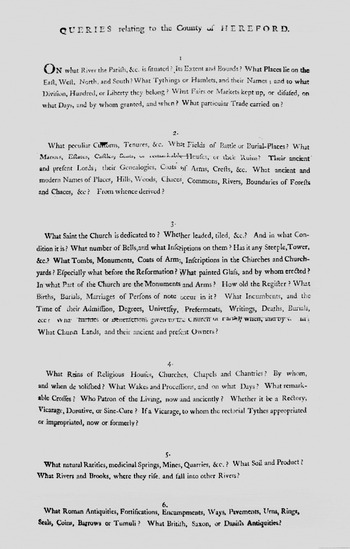
Meanwhile Browne Willis's influence, at one remove or another, can be detected on a number of other antiquaries of this generation. In February 1720 he responded to an inquiry from William Holman in Essex by sending him another old copy of his Buckinghamshire queries, this time the one which had been returned from the parish of Cheddington. ‘All I can say in the matter’, he advised him, ‘is that if you think any p[ar]t of it for your purpose you may extract it and print such like queries’, although Holman seems content to have pursued his own researches by personal letter rather than printed questionnaire.Footnote 51 Willis had a more positive influence on the historian of Dorset, John Hutchins. Since becoming curate of Milton Abbas in 1723, Hutchins had begun work on local antiquities and when Willis, himself a native of neighbouring Blandford, visited the area in 1736, he persuaded Hutchins to undertake a full-scale account of the county. To this end Willis drew up and had printed at his own expense a set of Queries relating to the county of Dorset under six headings that, together with a circular letter, were ready for Hutchins to distribute in April 1739.Footnote 52 The practice of one of these men must also have had some influence on the antiquary of Longworth in Herefordshire, Richard Walwyn. The Queries relating to the county of Hereford that Walwyn printed as a broadside in November 1749 was, although unacknowledged, almost completely identical in content to that which Willis had constructed for Hutchins.Footnote 53
R. Walwyn, Queries relating to the county of Hereford (1749). This image is reproduced with the kind permission of the Herefordshire Archive Service.

The use of printed questionnaires as a research method continued to be a standard procedure for those in the milieu of the Society of Antiquaries up until the death of Willis in 1760 and beyond. In 1741 the Scottish historian and topographer, William Maitland, a fellow of the Antiquaries and of the Royal Society, compiled ‘a large set of queries, with a general letter, and transmitted both to every clergyman in Scotland’ and the General Assembly of the kirk urged its members to assist him in the project ‘by drawing up, and sending him, answers to his printed queries concerning their respective parishes’.Footnote 54 Jeremiah Milles, who became a fellow of both these learned societies at just that time, would adopt the method in the course of his researches while prebendary of Exeter Cathedral. His Queries for the county of Devon was distributed among the clergy of the diocese in 1753.Footnote 55 A member of the council of the Society of Antiquaries in this period was Edward Rowe Mores. Two printed versions of his ‘Parochial queries for the county of Berkshire’, one dated 17 May 1759, were sent out to the county's parish clergy over the summer of that year.Footnote 56
During the 1750s the leading light in the Antiquaries was its vice president James Theobald. He proposed that the organization as a whole adopt its own questionnaire relating to matters of civil and natural history, ‘whereby such gentlemen of learning and industry as should be disposed to promote usefull and entertaining researches of those kinds, might be directed in their choice of materials, and the Society reap the fruits of their labours and knowledge’. The result was his octavo pamphlet, Queries proposed to gentlemen in the several parts of Great Britain, in hope of obtaining, from their answers, a better knowledge of its antiquities and natural history, circulated to fellows in 1754.Footnote 57 These attempts by Theobald, together with Henry Baker, to galvanize their colleagues into studying the regions was paralleled by their promotion of the county surveys instigated in 1759 by the newly founded Society of Arts, of which both were also members.Footnote 58
In 1771 Richard Gough was appointed director of the Society of Antiquaries and he became a dominant figure in this circle during the last quarter of the eighteenth century. Gough's insistence on the highest standards of empirical scholarship and desire to promote publication made him an instrumental figure in both the facilitation of antiquarian research and the dissemination of its fruits. He became a close friend and collaborator of the Society's publisher John Nichols and the two men helped to see through the press John Hutchins's History and antiquities of the county of Dorset (1774) and Edward Rowe Mores's Collections toward a parochial history of Berkshire (1783).Footnote 59 Meanwhile Foote Gower, another of Gough's correspondents and a fellow of the Antiquaries from 1768, published An address to the public, relative to the proposed history of Cheshire (1772). It included a list of the eight ‘heads of arrangement’ under which the projected work would be structured and his stated intention ‘to disperse in every parish’ a ‘series of printed enquiries’ soliciting information from the ‘learned and ingenious’.Footnote 60 Two years later George Allan, a lawyer and antiquary from Darlington was elected to the Society and acknowledged Gower as one of the inspirations for the ‘Queries proposed to the clergy and gentry’ of Durham that he printed for circulation further to a ‘civil and ecclesiastical history of the antient and present state’ of the county palatine.Footnote 61
Gough also persuaded Nichols to edit the monumental Bibliotheca topographica Britannica, consisting of comprehensive antiquarian accounts arranged by county, which would appear in fifty-two parts in the decade after 1780. Nichols prefaced the first number with a short survey of the printed questionnaire during the eighty years between Edward Lhwyd's activities in Wales and George Allan's in Durham. He followed this with his own consolidated list of fifty-six questions relating to the topography, antiquities, and present state of a parish, together with a further fifty-five concerning its natural history, ‘intended to comprehend all that have before been circulated, somewhat differently modified and enlarged’. Nichols's work amounted to a summation of this research methodology to date and the Bibliotheca project epitomized the empirical fieldwork and publication to which the Society of Antiquaries was committed under Gough's directorship. The same could be said of the great History and antiquities of the county of Leicester that Nichols published in four volumes between 1795 and 1815, which was anticipated in the 1780s by his circulation of seventy-four of these questions in Queries proposed to the nobility, gentry, and clergy, of Leicestershire.Footnote 62
Throughout the rest of the British Isles other learned societies of the eighteenth century were to serve a similar function in promoting research activities, sharing ideas, and communicating results. Each of them adopted its own printed questionnaire as part of a co-ordinated strategy to gather antiquarian information, natural knowledge, or useful data, and these articles of inquiry served as intellectual agenda expressing the interests and purposes of their institutions. Thus after its foundation in 1744 the Physico-Historical Society of Dublin reissued a set of ‘Queries’ first drawn up for local correspondents by Walter Harris in 1740 and, in addition, dispatched paid ‘inquirers’ around the country with a view to collecting material for published topographical surveys of all the Irish counties.Footnote 63 In 1772 the Dublin Society, an organization founded in 1731 and dedicated to social improvement, formed a select committee for antiquities. Its joint secretary, Charles Vallancey, oversaw the circulation of 4,000 parochial questionnaires across Ireland in search of similar matter.Footnote 64 When the Society of Antiquaries of Scotland was formed in November 1780 one of its earliest acts was to distribute a circular letter to members requesting that each should provide a report on his own parish. The queries, devised either by its founder David Steuart Erskine, the 11th earl of Buchan, or the scholar-bookseller William Smellie, were arranged under seven heads covering geography, agriculture, and population, communications, minerals, and fossils, trade and manufactures, antiquities, and other miscellaneous matters.Footnote 65
The foundation of antiquarian societies for individual counties of Britain would have to wait until the nineteenth century but in the 1750s John Burton was already arguing for the institution of a body in Yorkshire on the model of the Physico-Historical Society of Dublin, ‘to consider proper methods of acquiring and propagating a competent knowledge of this county’. At the end of his Monasticon Eboracense: and the ecclesiastical history of Yorkshire (1758), he reproduced the Physico-Historical Society's inquiries together with a copy of his own ‘Queries in order to shew the geography, history and antiquities, of the county of York: published several years ago by J.B. M.D.’ He included his own study of Hemingbrough parish as an example of what might be done.Footnote 66 As late as February 1769 he was still writing to the archbishop of York, seeking the support of the church for an organization in emulation of ‘the good example set us by ye nobility and gentry in Ireland’. He recalled that
some years ago I printed a set of necessary queries to be sent to each parish, towards furnishing materials for other parts of ye History of Yorkshire, as ye enclosed will show. To such of ye clergy as I was acquainted with I did send one each, and have had returns, but they are very few. But if ye society be once formed, and at ye visitations a person distributes a copy to each parish, desiring an answer to ‘em, ye work will be soon prepared.Footnote 67
Another strategy for both reaching and creating networks of informed individuals in the parishes, who might be able and willing to answer sets of queries, was the magazine or journal. The growth of serial publication during the eighteenth century presented the opportunity to build upon the example set by the Royal Society's use of the Philosophical Transactions after the Restoration. As a relatively economical and well-targeted means of connecting with those in the learned and literary circles who might most profitably offer assistance, inserting queries in a gazette could be an expedient strategy. As one correspondent suggested to Browne Willis, any such inquiry that he undertook in the future might best be served by ‘publick notice in a gazette, or your letter to certain places’. So it was in the third number of the aptly named Republic of Letters that Anthony Hammond published a short ‘Inquisitio parochialis’ in 1731. Richard Polwhele clearly thought it worthwhile publishing his interrogatories for a ‘History of Devonshire’ in the Gentleman's Magazine for December 1790 since, as he told the editor, ‘many gentlemen in this county attend to your valuable publication, and will be much pleased to find my Queries there’.Footnote 68
It was presumably for this reason that James Theobald reprinted his interrogatories for the Society of Antiquaries in the Gentleman's Magazine for April 1755. Theobald's work was given another circulation by Peter Muilman who adopted it for the queries further to a history of Essex that he advertised in the Morning Post on 7 November 1769. The same questionnaire was reproduced again for a similar kind of audience in North Britain when it appeared in the Scot's Magazine for January 1772.Footnote 69
As the method of disseminating queries was extended over time, so too was their content. The revival of interest in the scale and nature of the nation's resources that is evident from the middle of the eighteenth century was also reflected to some extent in the purview of these questionnaires. The principal concern with antiquities, topography, and natural history that such exercises had come to reflect began to be supplemented again with the kind of interest in economic activity, productive capacity, and population size that had been characteristic of the ‘improvers’ and ‘political arithmeticians’ of earlier generations. Theobald's influential and much reprinted Queries for the Society of Antiquaries was of real significance here. His inclusion of interrogatories relating to numbers of houses and inhabitants, vital statistics from parish registers, data on prices and wages, and information on manufactures and the numbers employed, represented notable additions to what had become the predominant focus of researches into ‘civil and natural history’. Theobald's work provided something of a model for inquiries of this sort in the second half of the century and for their routine inclusion of requests for current economic and social information. George Allan acknowledged the reprint of this Antiquaries questionnaire in the Gentleman's Magazine as the source for the questions on demography and economy that he reproduced from it almost verbatim. With the incorporation of Theobald's questions into the large consolidated list produced by John Nichols as the research agenda for the Bibliotheca topographica Britannica in 1780, concern with the present condition and resources of the parish was confirmed as a significant and valuable part of such studies. ‘Those to whom the first part of these Queries may seem uninteresting’, he suggested, ‘will, it is hoped, make a proper use of the second, to improve our commerce and manufactures from the sources which nature has placed among ourselves, and within every man's reach.’Footnote 70
This agenda made its way north of the border when Thomas Pennant adopted Theobald's questionnaire for the ‘Queries, addressed to the gentlemen and clergy of North-Britain, respecting the antiquities and natural history of their respective parishes’, which he circulated in 1769 prior to setting out on his tour through Scotland in June that year.Footnote 71 When Sir John Sinclair launched his famous Statistical account of Scotland in May 1790 with a set of Queries intended to elucidate ‘the Natural History and Political State’ of the country, he also acknowledged Theobald's list, redeployed by Pennant, as one of the two sources for the 160 questions that he sent to the minister in every Scottish parish. To these, however, ‘many alterations and additions were judged necessary, to adapt them to the state of this country, and objects of the author’, and, with Sinclair, a focus upon the present and an interest in the natural resources, economic activity and social condition of localities came to predominate.Footnote 72
By the end of the century the overlap between the study of parochial antiquities and natural history, and the inquiries into population and wealth that also tended to be conducted at the local level, was quite extensive. On the one hand, county histories such as Samuel Rudder's New history of Gloucestershire (1779), James Pilkington's Present state of Derbyshire (1789), and John Collinson's County of Somerset (1791) included population data derived from visitation returns, while Edward Hasted's Kent (1797–1801) contained detailed accounts of expenditure on poor relief. On the other hand, economic and social inquiries such as Sir Frederick Morton Eden's monumental account of The state of the poor in England and Wales (1797) acknowledged Sir John Cullum's History of Hawsted as an exemplary case and was greatly influenced by the parish-by-parish approach of Sinclair's Statistical account.Footnote 73 In the 1790s, therefore, the comprehensive approach to parochial study first envisaged by the Baconian initiatives of the mid-seventeenth century, combining both the ‘curious’ and the ‘useful’ and concerned as much with the present as with the past, finally began to realize some of its true potential.
III
The printed inquiry after information, often fostered by the learned societies of the later seventeenth and eighteenth centuries, played an important role in forging links between antiquaries, natural historians, or ‘statistical’ inquirers and the wider community of the ‘learned and ingenious’ across the parishes and regions of the British Isles. It was an instrument through which the educated gentry and clergy, in particular, could be enlisted in the process of scholarly research and it engaged that same constituency who would, it was hoped, eventually become subscribers to the published results. For most of this period, however, the success of this fact-finding methodology was only ever partial. The scant survival of these printed queries, often in copies of no more than one or two, is itself testimony to how few were returned to source or otherwise preserved.
There is, for example, no evidence that Ogilby or Plot, Johnston or Beaumont, ever received any written replies to their questionnaires. Thomas Machell appears to have had just one, a short description of the parish of Melmerby sent to him by the rector, Mr Singleton, in June 1677.Footnote 74 Richard Rawlinson elicited replies from Thomas Fletcher, the minister of Bloxham, and from Daniel Ayshford of Swyncombe, both annotated on the questionnaire itself, as well as separate descriptions of Nettlebed and Pishill from Robert Horn, and of Watlington by Thomas Toovey, but apparently no other formal returns. It was only from their extensive field trip and own observation that Rawlinson and Curll managed to amass a considerable body of antiquarian notes on Oxfordshire parishes.Footnote 75 James Theobald received ‘Some account of the parish of Hapton, in the county of Norfolk’ by Robert Chaplin, and a very full account of Sherborne in Dorset by Peter Smith, but these seem to be the sum of the replies to his queries.Footnote 76
Despite its employment of travelling specialists to gather information, the Physico-Historical Society succeeded in publishing descriptions of only three Irish counties before it was dissolved in 1752, and just two more appeared over the following decade.Footnote 77 Of the 4,000 questionnaires sent out by the Dublin Society in the next generation, responses to just forty were received and many of these were said to be ‘perfectly trifling’. Only an account of the parish and adjoining district of Kilronan in Roscommon, written by the eminent antiquary Charles O'Conor in August 1773, was reported to be of any value, and the Society's antiquities committee was disbanded the following year.Footnote 78 The Society of Antiquaries of Scotland had no more than eight parochial accounts of one sort or another communicated to it in the decade following the publication of its questionnaire, four of which were printed in 1792 in the first volume of the Society's journal Archaeologia Scotica.Footnote 79
In other cases the response rate was a little better and may have been some tangible benefit to research and writing. Browne Willis received a total of thirty replies to his Buckinghamshire queries, a significant if modest return on all his efforts: ‘by my fate you must [not] depend on much’, he had warned William Holman who was considering the same exercise.Footnote 80 To his request for material in Berkshire, James Rowe Mores amassed a collection of eighteen responses.Footnote 81 Francis Blomefield kept a ‘book of memoranda’ between 1733 and 1736, to track the fortunes of the questionnaires he had distributed, listing the names of those to whom he had sent a copy and noting ‘returned’ or ‘answered’ against some. Only fifteen of these replies survive in his papers, although the actual response may have been more substantial as in November that year he could write to one of his assistants, Antony Norris, of ‘what great helps have come in by my queries, sometimes having 20 or 30 sheets besides books, letters, records and papers, for a single hundred’.Footnote 82
In certain instances the yield was clearly substantial enough to be of real value, some contributions representing quite considerable narrative accounts in their own right. Thus in the 1680s William Molyneux received communications on twenty Irish counties from fourteen identifiable individuals, many of them amounting to extensive and minutely observed descriptions of people and places, although ones rendered from a distinctly Protestant and Anglo-centric perspective. He and his younger brother Thomas had most of them neatly transcribed in two manuscript folios, and other returns survive in scattered sources.Footnote 83 Among Robert Sibbald's papers are materials forwarded by at least fifty-nine people drawn from all regions of the country. This large network of contacts established with the aristocracy and gentry, ministry and officialdom, throughout the kingdom clearly played a role in forging something like a diffused intellectual community in late seventeenth-century Scotland. Like Molyneux, Sibbald brought within his ambit people from disparate localities, encouraging them to contribute information that may never otherwise have been committed to paper, and in so doing providing detailed observations on the Scottish regions in the 1680s.Footnote 84
Edward Lhwyd may be said to have achieved the same in Wales. One of his correspondents, John Wynn, was wise to caution him in January 1697 that ‘You must not expect the sheets to be sent you back with observation under proper heads’, since fewer than thirty copies of the Parochial queries with answers duly filled in the spaces are extant among his papers. In total, however, returns in one form or another exist from at least 170 parishes across Wales, making this easily one of the most successful exercises of its kind.Footnote 85 In early Georgian Northamptonshire John Bridges had a healthy response to his ‘enquiries’, not only from many of the local clergy, but also from the efforts of William Taylor, the schoolmaster of Heyford, who travelled around the county on his behalf and sent back answers from some thirty-two parishes.Footnote 86 More fulsome still were the 263 replies that Jeremiah Milles received for his Devonshire queries in 1753, representing fully two-thirds of parishes in that county. They were bound up in five folio volumes where they remained on his death in 1784.Footnote 87
The paucity of answers to so many other questionnaires, however, may be explicable by a number of factors. The propensity to ignore a ‘circular’ requesting information is likely to have been as common in this period as it is today. What is surprising, perhaps, is not that the returns to such inquiries were so poor, but that researchers continued to be optimistic about their value for so long. The lack of response that greeted most of them suggests a general apathy or indifference among the educated classes, both clergy and gentry alike, that is hardly surprising. Most were apparently unable or unwilling to expend effort on exercises in which they could see neither private advantage nor common good. What Edward Thomas reported to Edward Lhwyd from Monmouthshire in 1697 had a universal applicability:
I beg leave to tell you my sentiments of my countrymen in general, as well clergy as laity, that they never care to be concerned over much in any business that has not (att least) some appearance either of present pleasure or future profit: so that, in short, I doubt you'l find but little labour saved by vertue of these papers.Footnote 88
Many of those clergymen who bothered to reply at all did so in a minimal and taciturn way that suggests a lack either of the ability or the necessary application to answer the often detailed questions posed. Others, who were willing enough, clearly failed to see any value in the kind of mundane local knowledge so often sought. ‘I received your Queres’, the rector of Hawridge told Browne Willis in the summer of 1712, ‘but when I began to look into them I soon perceived that the two parishes to which I belong would not afford many answers to them, and therefore accord to your desire’. ‘I deffer'd giving any answer to you queries, hoping by enquiry to have got some account of my parish worth reading’, wrote Thomas Dawson to Willis from Wexham, ‘but after all, it appears so very barren, that I believe you will hardly think it deserves any notice.’Footnote 89 Some may have had genuine and reasoned misgivings about the purpose and appropriateness of such intimate inquiry. In August 1735 Joseph Lane, the rector of Saxlingham in Norfolk, wrote to Dr Henry Briggs, rector of Holt, who was helping Francis Blomefield with his researches.
I have according to your request returned the Queries, but without such an answer as you I presume might expect from me; my reasons for which are these. First of all, that I find nothing in either of my parishes (the monument excepted) worthy to be communicated to the publick. Secondly that should there be anything relating to the manors, or customs thereof, worthy to be taken notice of, I should by no means presume to do it: not thinking it either civil or gratefull, to expose the private properties of a friend, and a gentleman, without his leave, to the publick observation of mankind. Thirdly that so particular and exact an account, of every minute circumstance, mentioned in the Queries, would (in my opinion) render the whole work too voluminous, and by no means please such of the curious readers, as would willingly be acquainted with every valuable piece of antiquity, without so great a mixture of such as is not so. Footnote 90
In extreme cases there were those clergy who displayed a gross ignorance of parishes in which sometimes, as absentees, they did not actually reside, and a positive antipathy to intrusion into their affairs. The splendid character sketches of the country parsons of North Oxfordshire penned by Rawlinson's companion, Edmund Curll, in the summer of 1718 indicate the barren soil into which so many parochial queries must have been scattered. Among the able, willing, and courteous also lurked a Rowlandsonesque cast which included men like Mr Headlam ‘a rich, stupid, asthmatical priest’; Mr Tuder of Checkendon, ‘rich, large, lame, lecherous and impertinent’; Tim Huxley of Rotherfield Peppard, ‘empty, proud, peevish, pragmatical, spleenetick and mistrustful’ who ‘said he never wrote anything’ and was ‘generally drunk at the Visitation’; and Dr Yates of Charlton, ‘an ecclesiastical loutus who has more money than manners and is much better provided for than he deserves’.Footnote 91
What was true of some ministers of the church was perhaps even more characteristic of country squires and their attitude to the bothersome questions imposed upon them unsolicited by some antiquary or natural historian. As Thomas Machell complained to Sir Daniel Fleming in August 1677: ‘If all other gentlemen were of your minde, there would be no fear of sufficient encouragemt: but, wth som, my Queries finde cold recption; & those who are backward in their informations, will not be too forward in their contributions.’ In October 1683 Nathaniel Johnston could write to Ralph Thoresby lamenting the sheer ‘neglect or supineness of people’, such that he ‘must be forced to print a number more of enquiries without proposals, and a letter with them to desire gentlemen to make more expedition’. Meanwhile, John Beaumont had tried to drum up support for his work on Somerset by attending ‘the gentlemen of that county … att Taunton assizes, to deliver his proposals and receive their subscriptions’. He apparently failed, however, to enlist their help and ‘to divert and draw them of[f] from those destructive vulgar vices, the contagion of which is become epidemicall’ amongst their kind.Footnote 92
Similarly, many of Edward Lhwyd's correspondents endorsed this unflattering picture of apathy, intellectual sterility, and narrow self-interest among the leisured classes. ‘I have taken care to disperse your Queries’, reported one of his assistants in February 1697, ‘tho a great many are thrown away upon incurious drones’. ‘I find very few are inclinable to take them’, concurred another, ‘and I doubt as few can return you any satisfactory answers.’ ‘Our country has very few gentlemen’, Richard Langford lamented, ‘and the most part of those soe very intent upon private profit and concerns that they little regard what tends to the public good.’ In October 1739 John Hutchins could report from Dorset with a resignation born of experience: ‘Those who have any curiosity are ready to assist, but I wish we had more of such persons. This was ever a complaint in all yt ever attempted such a design, and there is no remedy but patience.’ The problem with the Scottish social elite, the earl of Buchan later told Richard Gough in a familiar lament, was that they ‘are careless of everything that does not tend to enrich their families, or indulge their passion for social intercourse’. Meanwhile, ‘the middling class of people here are either too poor or too much occupied in professional engagements to prosecute any inquiry that does not promise pecuniary reward’.Footnote 93
Again, in some cases the unwillingness to help may have been the result not merely of lack of curiosity but a more positive antagonism towards inquiries regarded as intrusive and unwarranted. It long remained a joke among the gentry of Staffordshire how easily they had ‘humbugged old Plot’ when he had come amongst them in the early 1680s. Some clearly feared that such questions had something to do with taxation or other fiscal assessment and were naturally suspicious. Others may have felt a not unreasonable sense of weariness at the repeated requests for information from one source or another. In September 1759 Mr Taylor of Binfield in Berkshire could point out to Edward Rowe Mores that just ‘a few years ago’ James Theobald, who had a country seat at neighbouring White Waltham, had ‘collected a great many materials and made a good progress in the History and Antiquitys of the parishes hereabout’, and accordingly ‘the gentlemen that have comunicated materials to Mr Theobald will not choose to repeat their trouble’.Footnote 94
There may also have been political opinions and sectarian allegiances prejudicing the good will of some. Thus the hostile reception given to Rawlinson and Curll by a number of Oxfordshire clerics no doubt owed something to the fact that the former was a non-juror and staunch Jacobite, while the latter was a well-known Tory with a scandalous reputation. By the same token, it is possible that the passionate Royalism of Thomas Machell, the Tory leanings of Nathaniel Johnston, or the Jacobite activities of John Burton may have had an influence on their ability to generate support from unsympathetic members of the county community in times of political sensitivity. Conversely, such inquiries after knowledge were most likely to elicit response from those who shared the ideological sympathies of their authors. Sibbald was an Episcopalian and many of those who offered him information were gentry and clergy of similar views. Equally, Molyneux achieved some success in Ireland by apparently encouraging a collection of Anglo-Irish Protestant gentry in and around the Dublin Philosophical Society to take responsibility for extended county descriptions. Jeremiah Milles may have benefited from his position in the ecclesiastical hierarchy at Exeter in coaxing a healthy response from the Anglican parsons of Georgian Devon.
The great triumph of Sir John Sinclair's ‘statistical enquiries’ at the end of the eighteenth century serves to demonstrate what might be achieved when a sense of common purpose could be inspired among a relatively well-disposed constituency. It also suggests the level of institutional support and assiduous project management that was required to make such exercises succeed completely. In January 1791 Sinclair sent a copy of his queries to each one of the 938 parishes across Scotland. By June 1792 he had received reports from fully 525 of them. A further 250 were extracted over the following two years and ultimately a complete set of returns was achieved which was edited and published in twenty-one volumes between 1791 and 1799.Footnote 95 This progress may say something about the well-educated and public-spirited nature of the ‘enlightened’ Scottish clergy of the period. ‘Science almost universally flourishes among them’, one apologist had claimed in the 1770s.Footnote 96 At the start of the undertaking Sinclair had reserved the right to edit the replies before printing them, but such was the quality of the compendious responses he received that he could not help but publish them in full. ‘I found such merit and ability, and so many useful facts and important observations in the answers which were sent me’, he confessed, ‘that I could not think of depriving the clergy of the credit they were entitled to derive from such laborious exertions.’Footnote 97
The support he received from the kirk was not new, but his position in parliament and, from 1793, as president of the new Board of Agriculture and Internal Improvement, may have lent an official or public dimension to his endeavour. For packets of less than two ounces in weight he was able to claim the privilege of parliamentary franking, and he could communicate with the entirety of the clergy by virtue of being able to print his circular letters. Above all, however, Sinclair had an ambition and sense of purpose apparently wanting in many previous such exercises. This may have owed something to the fact that not since the days of the Hartlib circle and the early Royal Society had anyone embarked on an undertaking of this sort with quite this sense of public utility, as opposed merely to academic curiosity, motivating the whole enterprise.Footnote 98
In January 1791 he sent to every parish copies of four of the best among his earliest returns as examples of good practice, and an accompanying letter encouraged ministers to be as complete as possible in their accounts. A total of twenty-three circular missives followed between December 1792 and December 1797, variously persuading incumbents of the merits of the enterprise, praising their achievements to date, and goading the dilatory into a response. The first of these let it be known that profits from the sales of the published work would go into a fund for the benefit of sons and daughters of the clergy; while another circulated the ‘unanimous vote’ of the General Assembly in May 1793 that all ministers who had not yet contributed should do so ‘with all expedition in their power, to complete a work of such apparent public utility’. As time went on Sinclair's tone became rather less patient and ever more insistent. ‘I am persuaded, that you will see the necessity I am under, of urging you again upon this subject’, he wrote early in 1796,
as it would be in the highest degree disgraceful, to suffer another year to commence, without having this work completed … or to leave even a single blank in so great an undertaking, which I consider to be an eternal monument of the talents, public spirit, and industry of my countrymen, during the present era.
In the end, there were only twelve parishes where, in lieu of clerical participation, he had to dispatch his ‘statistical missionaries’ to collect information and compile a report so as to complete the project entirely.Footnote 99
IV
The printed questionnaire in search of information played a significant but insufficiently appreciated role in the process by which constituent parts of the British Isles were ‘rediscovered’ and communicated in the late seventeenth and eighteenth centuries. At their most successful they yielded considerable amounts of valuable material which utilized the collective experience of a wide constituency of the ‘ingenious and learned’ across the parishes and county communities of England, Ireland, Scotland, and Wales. Even when their tangible returns were limited, as was most often the case, they did something to identify and create modest republics of letters in the regions of the three kingdoms. The distribution of ‘enquiries’ illustrates the collaborative dimension of contemporary research into the antiquities, natural history, and the present state of the land. It was a dimension that found institutional expression in the learned societies of the day, drew upon the administrative infrastructure of the church, and utilized the developing medium of periodical publications. These organs provided a focus for the generation of research questions, the sharing of methodological ideas, and the forging of networks of like-minded individuals. It was in the era of the Hartlib circle and the early Royal Society that the framework of this classically Baconian project was established and consolidated. The holistic approach that it had first envisaged, combining an academic curiosity for historical and topographical information with a practical interest in economic and social data, revived again during the second half of the eighteenth century and by the end of it was beginning to fulfil the potential that the ‘great instauration’ had set on foot.