Non-technical Summary
A new genus and species of dalmanitid trilobite, Waukeshaaspis eatonae, is here described based on ~200 exoskeletons that were recovered from bedding plane clusters that were part of the Silurian soft-bodied Waukesha Biota. This form has a notable embayment in the posterior margin of the posterior trunk tergite (pygidium) where a long spine is commonly found in this form's close relatives. This structure might have enhanced respiration while the animal was in an enrolled posture.
Introduction
The Waukesha Biota (aka, Brandon Bridge Lagerstätte or Waukesha Lagerstätte) is a Telychian assemblage of fossils, which lies within the lower beds of the Brandon Bridge Formation (Moore et al., Reference Moore, Briggs, Braddy, Anderson, Mikulic and Kluessendorf2005; Braddy et al., Reference Braddy, Gass and Tessler2023). The biota is thus far known only from two quarries in southeastern Wisconsin; one located in Waukesha, and the other in Franklin, 25 km to the southeast (Mikulic et al., Reference Mikulic, Briggs and Kluessendorf1985b; Kluessendorf and Mikulic, Reference Kluessendorf and Mikulic1996a). This biota has been shown to include various exceptionally preserved arthropods, palaeoscolecids, annelids, lobopodians, conodont animals, cycloneuralians, and other soft-bodied and lightly biomineralized invertebrates, many of which have been found nowhere else (Mikulic et al., Reference Mikulic, Briggs and Kluessendorf1985a, Reference Mikulic, Briggs and Kluessendorfb; Smith et al., Reference Smith, Briggs, Aldridge and Aldridge1987; Moore et al., Reference Moore, Briggs, Braddy, Anderson, Mikulic and Kluessendorf2005; Haug et al., Reference Haug, Briggs, Mikulic, Kluessendorf and Haug2014; Jones et al., Reference Jones, Feldman and Schweitzer2016; Wendruff et al., Reference Wendruff, Babcock, Kluessendorf and Mikulic2020a, b; Pulsipher et al., Reference Pulsipher, Anderson, Wright, Kluessendorf, Mikulic and Schiffbauer2022; Braddy et al., Reference Braddy, Gass and Tessler2023).
An unusual aspect of this biota is the paucity of most of the more heavily biomineralized taxa and individuals that are typically preserved in other Paleozoic biotas (Mikulic et al., Reference Mikulic, Briggs and Kluessendorf1985b; Wendruff et al., Reference Wendruff, Babcock, Kluessendorf and Mikulic2020a). Most of the trilobites, which have only been found in the Waukesha locality (Kluessendorf and Mikulic, Reference Kluessendorf and Mikulic1996a; Wendruff et al., Reference Wendruff, Babcock, Kluessendorf and Mikulic2020a), are uncommonly or rarely preserved. A significant exception is Waukeshaaspis eatonae new genus new species, the only trilobite species from the Waukesha Biota thus far found in exceptionally large clusters of articulated exoskeletons (Mikulic et al., Reference Mikulic, Briggs and Kluessendorf1985a, Reference Mikulic, Briggs and Kluessendorfb; Wendruff et al., Reference Wendruff, Babcock, Kluessendorf and Mikulic2020a).
Also noteworthy is the consistent absence of a caudal spine or pointed posterior margin in Waukeshaaspis eatonae n. gen. n. sp., a contrast to most other dalmanitid taxa, with a posterior embayment at the midline of the pygidium. Herein, we describe this taxon and elaborate on its unusual occurrence and the potential functional relationships between its pygidial and other morphological features.
Geologic setting
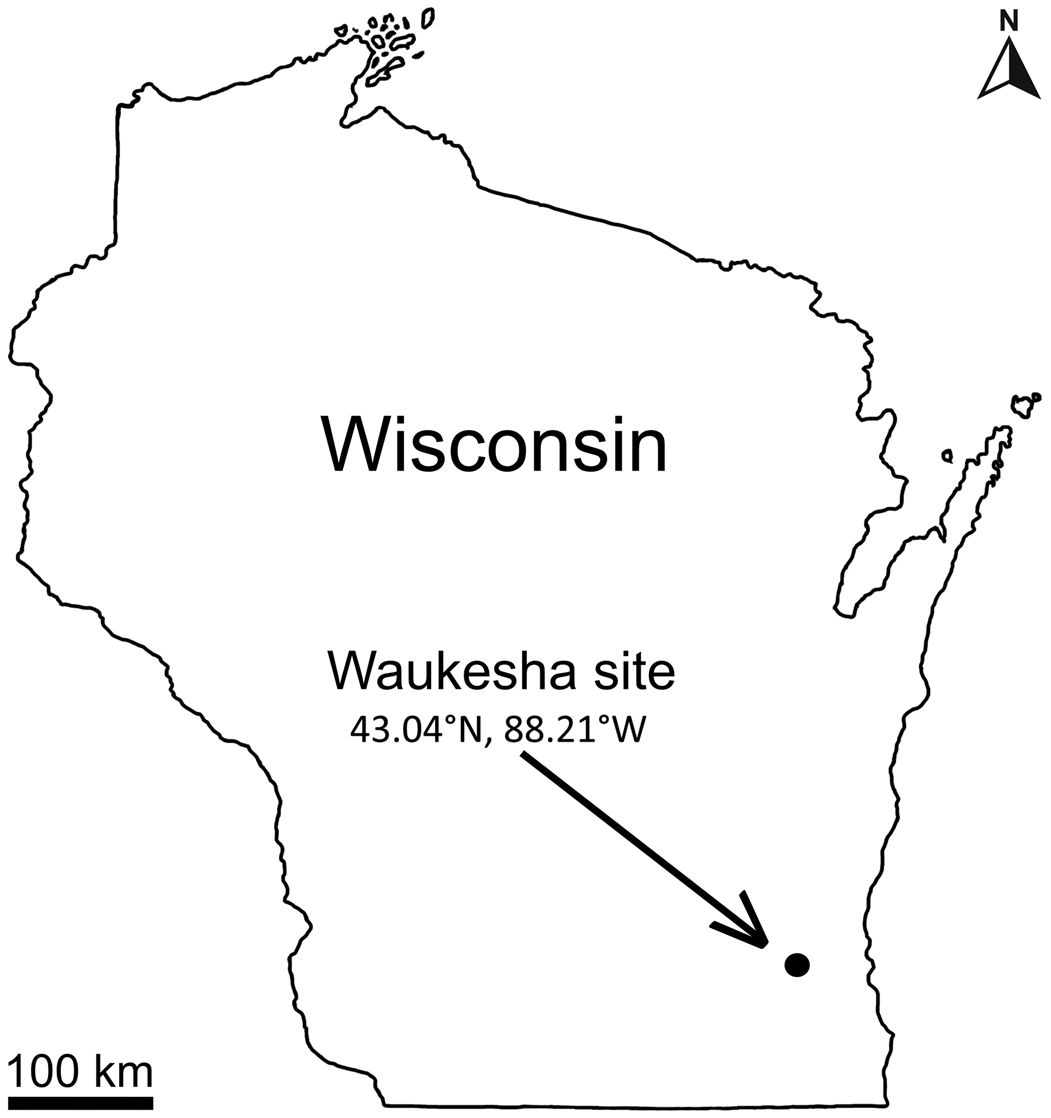
The Brandon Bridge Formation in southeastern Wisconsin lies below the Wenlockian Waukesha Formation and above the Llandoverian Manistique Formation (Fig. 1; Pulsipher et al., Reference Pulsipher, Anderson, Wright, Kluessendorf, Mikulic and Schiffbauer2022, fig. 1). The Waukesha Biota occurs in an interval (up to 1 m thick) of finely planar laminated carbonate mudstone beginning 2 m above the disconformity with the Manistique Formation. Most of the trilobites from this biota were preserved in the lower 12 cm of the interval (Wendruff et al., Reference Wendruff, Babcock, Kluessendorf and Mikulic2020a). The biota has been assigned to the Pterospathodus eopennatus Superzone (Telychian) (Kleffner et al., Reference Kleffner, Norby, Kluessendorf and Mikulic2018). The sediment in this interval was deposited in sediment traps under conditions interpreted to be peritidal (Wendruff et al., Reference Wendruff, Babcock, Kluessendorf and Mikulic2020a; Pulsipher et al., Reference Pulsipher, Anderson, Wright, Kluessendorf, Mikulic and Schiffbauer2022). The lithology of the interval differs from most other parts of the Brandon Bridge Formation in the generally darker color and relatively consistent presence of planar, rather than wavy, laminations in the former (Anderson et al., Reference Anderson, Schiffbauer, Jacquet, Lamsdell, Kluessendorf and Mikulic2021). Kluessendorf and Mikulic (Reference Kluessendorf and Mikulic1996b) and Wendruff et al. (Reference Wendruff, Babcock, Kluessendorf and Mikulic2020a) provided further details.
Map showing where the trilobites of the Waukesha Biota were collected.

Materials and methods
A Canon EOS Rebel T7i camera with an EFS 18-55 mm macro lens and polarizing filter and a Canon EOS Rebel T3i camera with an EFS 60 mm lens were used to photograph most of the fossils. Terminology relating to systematic placement, morphology, and orientation follows Whittington and Kelly (Reference Whittington, Kelly and Kaesler1997). In the description of the pygidial terminal piece, we counted any furrow that indicates segmentation, including those barely impressed (see discussions by Campbell, Reference Campbell1977).
Repository and institutional abbreviation
The fossils examined in this study are deposited in the University of Wisconsin Geology Museum (UWGM), Madison, Wisconsin.
Systematic paleontology
Class Trilobita Walch, Reference Walch1771
Order Phacopida Salter, Reference Salter1864
Suborder Phacopina Struve in Moore, Reference Struve and Moore1959
Superfamily Dalmanitoidea Vogdes, Reference Vogdes1890
Family Dalmanitidae Vogdes, Reference Vogdes1890
Subfamily Dalmanitinae Vogdes, Reference Vogdes1890
Remarks
The recognition and definition of subfamilies within Dalmanitidae has been long discussed. Several genera particularly challenge the validity of Dalmanitinae (see Carvalho and Fonseca, Reference Carvalho and da Fonseca2007; Holloway and Carvalho, Reference Holloway and Carvalho2009; Randolfe et al., Reference Randolfe, Rustán and Bignon2022). Because detailed analysis of the subfamily is beyond the scope of this study, we provisionally follow taxonomic proposals given by Campbell (Reference Campbell1977) and Holloway (Reference Holloway1981), together with additional taxonomic criteria drawn by Holloway and Carvalho (Reference Holloway and Carvalho2009), thus including Waukeshaaspis new genus as a member of the Dalmanitinae.
Genus Waukeshaaspis new genus
Type species
Waukeshaaspis eatonae n. gen. n. sp., by monotypy.
Diagnosis
As for the type species, by monotypy.
Occurrence
Quarry at Waukesha Lime and Stone Company, Waukesha, Wisconsin, 43.04°N, 88.21°W (Wendruff et al., Reference Wendruff, Babcock, Kluessendorf and Mikulic2020a, fig. 1A–C); Brandon Bridge Formation, Telychian.
Etymology
Named for Waukesha, Wisconsin, where the material was collected.
Remarks
Waukeshaaspis n. gen. can be differentiated from the majority of dalmanitids by the combination of the anterior branch of the facial suture not crossing the preglabellar furrow, the low visual surface, and the pygidium outline having a characteristic embayment, present in all pygidia studied with the posterior margin preserved. Bessazoon tenuimucronatum (Whittard, Reference Whittard1938) from the Telychian of England is another Silurian dalmanitid with an embayment in the posterior pygidial margin of large adult specimens. Bessazoon Curtis and Lane, Reference Curtis and Lane1998 shares with Waukeshaaspis n. gen. the apparent absence of conspicuous granulation, the low eyes, and the similar shape of the precranidial median process. It is noteworthy that Curtis and Lane (Reference Curtis and Lane1998), when defining Bessazoon, did not consider it to have a precranidial median process, which was later discussed by Chatterton and Ludvigsen (Reference Chatterton and Ludvigsen2004). Bessazoon is easily differentiated from Waukeshaaspis n. gen. by the course of the anterior branch of Bessazoon's facial suture, immersed in the preglabellar furrow, the shorter (sag.) anterior cephalic border, the shorter (sag.) preocular area, the connection of the anterior and posterior cephalic border furrows near the genal area, the almost straight anterior pygidial margin, and the posterior embayment of the pygidium being present only in the larger specimens, with shorter specimens (considered early holaspids) having a more triangular pygidium with a caudal spine, clearly different from that of Waukeshaaspis n. gen. With all of the specimens known of Waukeshaaspis n. gen., it is possible to affirm that even early holaspids have the embayment. In addition to this, the assignment of pygidia with posterior embayments to B. tenuimucronatum was questioned (Sandford and Holloway, Reference Sandford and Holloway2006). These pygidia, designated as type B by Curtis and Lane (Reference Curtis and Lane1998), are not found in association with any cephala. Those authors designated smaller pygidia as type A, which Sandford and Holloway (Reference Sandford and Holloway2006) considered a separate species. Resolving Bessazoon tenuimucronatum is outside the scope of the present work. Waukeshaaspis eatonae n. gen. n. sp. is comparable to B. tenuimucronatum in cephalic characters, but only to type B in pygidial characters as defined by Curtis and Lane (Reference Curtis and Lane1998). Kasachstania Maksimova, Reference Maksimova1972 has a similar pygidial outline, but can be differentiated from Waukeshaaspis n. gen. by the presence of a caudal spine and its pygidial pleural bands, which are slightly sinuous without the marked change in curvature seen in the middle course present in Waukeshaaspis n. gen. Additionally, there are several cephalic differences, including the course of the anterior branch of the facial suture and the shorter (exsag.) preocular and postocular areas. Preodontochile Degardin and Pillet, Reference Degardin and Pillet1984, known from the lower Silurian of Spain and Australia, is like Waukeshaaspis n. gen. in the course of the anterior branch of the facial suture, anterior to the preglabellar furrow, the long genal spines with a longitudinal furrow, and the low granular surface. Preodontochile can be differentiated by the absence of a precranidial median process, the extremely shorter (exsag.) eyes, the genal spines not reaching the height of the pygidium, and the more triangular pygidial outline, with a short caudal spine and a wider (tr.) axis. The number of pygidial segments is different in the species of Preodontochile. Preodontochile springfieldensis Sandford and Holloway, Reference Sandford and Holloway2006, from the lower Silurian of Australia, shares the same number of axial rings with W. eatonae n. gen. n. sp.
Waukeshaaspis eatonae new species
Figures 2, 3
- Reference Mikulic, Briggs and Kluessendorf1985a
Undescribed dalmanitid trilobite; Mikulic et al., pl. 1, fig. 6.
- Reference Meyer and Gunderson1986
Undescribed dalmanitid trilobite; Meyer and Gunderson, fig. 14.
- Reference Wendruff, Babcock, Kluessendorf and Mikulic2020a
Dalmanitid trilobites; Wendruff et al., figs. 3D–F, 9A–C, 10H, I, 11.
- Reference Gass and Braddy2023
Undescribed dalmanitid; Gass and Braddy, fig. 2h.
- Reference Fatka, Budil and Mikuláš2024
Undescribed dalmanitid; Fatka et al., p. 57.
Waukeshaaspis eatonae n. gen. n. sp., early Silurian (late Llandovery; Telychian) Brandon Bridge Formation; Waukesha Lime and Stone Company quarry, Waukesha, Wisconsin, USA (43.04°N, 88.21°W): (1) UWGM 7448, paratype, dorsal exoskeleton; (2) UWGM 7447, holotype, dorsal exoskeleton; (3) UWGM 7450, paratype, dorsal exoskeleton; (4) UWGM 7449, paratype, dorsal exoskeleton; (5) UWGM 7446, paratype, dorsal exoskeleton; (6) UWGM 2927, paratype, dorsolateral detail view of left eye; (7) UWGM 5048, paratype, dorsolateral detail view of right eye.

Waukeshaaspis eatonae n. gen. n. sp., early Silurian (late Llandovery; Telychian) Brandon Bridge Formation; Waukesha Lime and Stone Company quarry, Waukesha, Wisconsin, USA (43.04°N, 88.21°W): (1, 2) UWGM 7460 and 7461, paratypes, dorsal exoskeletons preserving gut tracts; (3, 4) UWGM 2576 and 5581, large clusters of mostly complete, microbially entombed dorsal exoskeletons; (5) UWGM 2868, microbially entombed partial cephalon; (6) UWGM 7462, paratype, partial dorsal exoskeleton (interior) showing cephalic doublure.

Holotype
Dorsal exoskeleton UWGM 7447 (Fig. 2.2); Waukesha Biota, Telychian, Brandon Bridge Formation, quarry at Waukesha Lime and Stone Company, Waukesha, Wisconsin (43.04°N, 88.21°W).
Paratypes
Dorsal exoskeletons (UWGM 5048 [Fig. 2.7], UWGM 7446 [Fig. 2.5; Gass and Braddy, Reference Gass and Braddy2023, fig. 2h], UWGM 7448 [Fig. 2.1], UWGM 7449 [ Fig. 2.4], UWGM 7450 [Fig. 2.3], partial dorsal exoskeletons (UWGM 2927 [Fig. 2.6], UWGM 7460 [Fig. 3.1], UWGM 7461 [Fig. 3.2], UWGM 7462 [Fig. 3.6]); Waukesha Biota, Telychian, Brandon Bridge Formation, quarry at Waukesha Lime and Stone Company, Waukesha, Wisconsin (43.04°N, 88.21°W).
Diagnosis
Dalmanitid with facial suture running anteriorly to, but not crossing, the preglabellar furrow. Cephalic border furrows not connecting in the genal area or extending into the genal spine more than the base. Short (sag.) anterior cephalic border. Lower visual surface, with no more than eight lenses per dorsoventral file. Long genal spines reaching the pygidial anterior margin. Pygidial pleural bands and furrows with maximum anterior convexity at the midline. Pygidium heart-shaped, with short (sag.) posterior embayment located at its midline, with 10 axial rings plus a terminal piece and 10 pleurae.
Occurrence
As for genus.
Description
Cephalon semicircular in dorsal view, with length/width index ~0.42–0.46. Cephalic anterior margin subcircular to slightly parabolic without indentations or crenulations. Anterolateral margin almost straight, with short (sag.) precranidial median process convex anteriorly. Deep epiborder furrow, continuing to genal spine, almost reaching distal tip of genal spine. Glabella (excluding occipital ring) approximately as long as wide. Axial furrow wide (tr.), deep, shallower anteriorly to S3, almost straight at level of occipital ring, then weakly divergent anteriorly to occipital furrow, slightly bending outward, giving maximum divergence in front of L3. Preglabellar furrow short (sag.; exsag.), shallow. Posterior border furrow not reaching lateral border furrow. Lateral border furrow shallow in cranidium, expanding toward base of genal spine, disappearing without extending into genal spine. Occipital ring moderately long (sag., exsag.), more extended than L1 laterally, slightly convex medially in lateral view. Occipital node absent. Occipital furrow only slightly impressed medially; occipital apodemes deep, short (tr.), in contact with axial furrows. S1 and S2 furrows transglabellar, shallow with narrow (tr.), deep apodemes without contact with axial furrows. S1 apodemes slightly curved backward medially. S2 apodemes practically transverse to the middle line. S3 furrows deep with distal portion strongly expanded exsagittally. L1, L2, and L3 lobes slightly convex dorsally. L1 and L2 subrectangular, of similar length (sag.), each corresponding to 10–13% of total glabellar length (sag.), excluding occipital ring. Frontal lobe subrhombic in outline, of width (tr.) comprising almost 36% of maximum cephalic width, convex dorsally, with two anteroposteriorly elongated and slightly depressed auxiliary impressions on either side of midline. Large (exsag.) palpebral lobes. Eyes situated with posterior edge opposite L1 and anterior edge opposite anterior part of L3. Palpebral furrow strongly curved in middle part, with anterior section slightly deeper than posterior section. Palpebral lobe elevated with respect to palpebral area, convex in transverse and exsagittal profile. Large (exsag.) eyes with steep, low visual surface. Shallow eye socle furrow. Preocular area elevated, convex dorsally. Visual surface outline semicircular in dorsal view, composed of 32 dorsoventral files, with maximum of eight lenses in some files. Anterior branch of facial suture running subparallel to and just laterally of axial furrow near lateral corner of frontal lobe of glabella, and anterior to preglabellar furrow on anterior border. Posterior branch of facial suture curving forward at level of S1, crossing genal field toward inner edge of lateral border reaching margin at level of L2. Posterior border narrow (exsag.), slightly shorter than lateral margin of occipital ring adjacent to axial furrow, tapering laterally until broadening markedly toward genal angle. Posterior border furrow deep, relatively broad (exsag.), markedly expanding toward base of genal spine, disappearing without extending into genal spine. Genal spines robust, long (exsag.), flattened and elliptical in cross section, reaching anterior margin of pygidium. Cephalic doublure, as observed from ventral view, with length (sag.) ~20% of total cranidium length (sag.), nearly flat to barely concave. Anterior cephalic doublure with more depressed internal area ~40% of total doublure length (sag.).
Thorax of 11 segments; axis moderately vaulted (tr.), increasing slightly in width and length until segment 7, then decreasing in width. Axial rings slightly vaulted, first one ~24% of maximum thorax width (tr.). Axial furrow deep, moderately narrow (tr.). Pleurae slightly oriented backward with respect to axis. Pleural furrows deep, wide (exsag.), lanceolate in outline, not reaching thoracic margin; anterior and posterior pleural bands narrower (exsag.) in median portion. Pleural tips curving backward distally to form sharp point.
Pygidium heart-shaped to widely subtriangular, length/width index ~0.52–0.56, with widely rounded anterolateral corners, evenly convex posterolateral margin, interrupted by medially located embayment in posterior margin. Axial furrows almost straight to barely convex laterally, narrow (tr.), moderately deep, diverging ~10° from sagittal line. Pygidial axis ~20% of maximum pygidial width, narrowing uniformly backward, with 10 well-defined axial rings plus terminal piece. Inter-ring furrows narrow (sag.), deepest laterally at apodemes, not in contact with axial furrows. Pleural field with 10 pleurae; pleural furrows narrow (exsag.), deep, gradually less impressed backward and more posteriorly directed. All pleural bands and furrows sinuous adaxially with marked maximum of anterior convexity midwidth, and laterally to it only slightly convex until almost reaching pygidial margin. Midwidth convexity reduced in posterior segments, with pleural bands straighter, posteriorly directed. Interpleural furrows well-impressed, incised, symmetrical in cross section, becoming deeper and wider (exsag.) near pygidial margin. Posterior pleural bands slightly wider (exsag.) than anterior pleural bands near margin, extending more laterally and almost contacting pleural margin. Pleural field dorsally convex in general, but slightly concave near margin. Posterior embayment short (sag.), narrow (tr.), with straight lateral margin and curved forward medially.
Etymology
Named after Carrie Eaton, Curator for the UWGM.
Other material studied
22 dorsal exoskeletons (UWGM 2722 [Mikulic et al., Reference Mikulic, Briggs and Kluessendorf1985a, pl. 1, fig. 6], 2896, 2903, 2929, 2932, 2936, 3434, 3460, 3464, 3495, 3559, 3834, 5046, 5048, 5052, 5073, 5076, 5085, 5105, 5295, 5319, 7133), six partial dorsal exoskeletons (UWGM 3608, 4026, 4374, 5322, 5326, 5329), 19 cephala (UWGM 2756, 2763, 2868, 2871, 2874, 2912, 2925, 2937, 3353, 3443, 3459, 3461, 3556, 3829, 3883, 5086, 5099, 5141, UWM 5306), two pygidia (UWGM 2915, 5077), seven slabs with multiple dorsal exoskeletons (UWGM 2340 [Wendruff et al., Reference Wendruff, Babcock, Kluessendorf and Mikulic2020a, fig. 3D, F], 2576, 2888, 2891, 2875, 3497, 5581), two slabs with parts from multiple individuals (UWGM 2933, 5289); Waukesha Biota, Telychian, Brandon Bridge Formation, quarry at Waukesha Lime and Stone Company, Waukesha, Wisconsin (43.04°N, 88.21°W).
Taphonomy
Waukeshaaspis eatonae n. gen. n. sp. is the most abundant and completely preserved trilobite in the Waukesha Biota, and it is one of the most common arthropods, surpassed only by leperditocopids. Many of the taxa, including W. eatonae n. gen. n. sp., preserve soft tissues including intestinal tracts (Fig. 3.1, 3.2). Fatka et al. (Reference Fatka, Budil and Mikuláš2024) recently considered this kind of preservation as infillings. Even though most of the fossils are flattened (least so, the trilobites), many are exceptionally preserved. Several factors, primarily taphonomic conditions, account for this abundance and exceptional preservation.
Evidence, e.g., common occurrences of alignment of the individuals on a surface, consistency of their up/down orientation, exceptional preservation, and paucity of trackways, indicates that the individuals preserved in the biota typically did not inhabit the site at which they were preserved, but were transported by currents as carcasses or molts from nearby areas to sediment traps, where they were typically microbially entombed (Mikulic et al., Reference Mikulic, Briggs and Kluessendorf1985a; Mikulic and Kluessendorf, Reference Mikulic and Kluessendorf1998; Wendruff et al., Reference Wendruff, Babcock, Kluessendorf and Mikulic2020a). This entombment aided in the preservation of soft tissues by inhibiting decay, predation, and scavenging most likely due to low oxygen conditions, and hypersalinity (compare Allison and Briggs, Reference Allison, Briggs, Allison and Briggs1991a, Reference Allison, Briggs and Donovanb; Gehling, Reference Gehling1999; Briggs, Reference Briggs2003; Wendruff et al., Reference Wendruff, Babcock, Kluessendorf and Mikulic2020a). Conditions were also conducive to the nonpreservation, absence or rarity of most organisms having biomineralized exoskeletons, the frequent decalcification of those that do, and the coating or replacement of some remains with calcium carbonate, calcium phosphate, or pyrite. Microbial entombment, the normal state of preservation in the trilobites at this locality, is generally indicated by an obscured appearance or ‘ghosting’ of the exoskeletal remains, whereas the degree of entombment is variable (Wendruff et al., Reference Wendruff, Babcock, Kluessendorf and Mikulic2020a; compare Fig. 2 with Fig. 3.3–3.5).
Another feature of the Waukesha Biota likely related to its preservation in sediment traps where the remains were protected from decay, predation, and scavenging, as outlined above, is the common preservation of articulated dorsal exoskeletons of trilobites, particularly Waukeshaaspis eatonae n. gen. n. sp. (Mikulic et al., Reference Mikulic, Briggs and Kluessendorf1985a; Wendruff et al., Reference Wendruff, Babcock, Kluessendorf and Mikulic2020a). Of particular interest is that W. eatonae n. gen. n. sp. clusters of up to 49 mostly-articulated individuals occur on some bedding planes (Fig. 3.3, 3.4). This is not the case with the trilobites preserved in the other parts of the Brandon Bridge strata at the Waukesha site, and other Brandon Bridge localities, where articulated trilobites are uncommon and preserved as molds, and clusters are rare (Mikulic et al, Reference Mikulic, Briggs and Kluessendorf1985a; Watkins et al., Reference Watkins, Kuglitsch and McGee1994). Sorted molt parts from multiple individuals (e.g., specimens are all cephala or all pygidia) of W. eatonae n. gen. n. sp., some sorted by size and/or orientation, have also been observed (Mikulic et al., Reference Mikulic, Briggs and Kluessendorf1985a; Kluessendorf, Reference Kluessendorf1990, fig. 2-13D), but not to the extent at which sorted, articulated dorsal exoskeletons of that taxon occur. Clustering of trilobites has also been attributed to molting or mating behaviors (Speyer and Brett, Reference Speyer and Brett1985; Karim and Westrop, Reference Karim and Westrop2002). Loosely folded specimens of W. eatonae n. gen. n. sp. are rare and enrolled specimens are absent. Wendruff et al. (Reference Wendruff, Babcock, Kluessendorf and Mikulic2020a) attributed this to either the individuals not succumbing to quickly changing conditions, or being incapable of enrollment; however, the similarity in the outlines of the precranidial median process and the embayment of the pygidium are consistent with the capacity for enrollment.
All known specimens of Waukeshaaspis eatonae n. gen. n. sp. are holaspids, and no known exoskeletons are estimated to be < 9 mm in maximum length. The next-smallest individual is 23 mm long, and most are much larger, with a mean length of ~60 mm (N = 178). This underrepresentation of larval individuals and small holaspid trilobites in this biota could be due to taphonomic bias.
The majority of specimens of Waukeshaaspis eatonae n. gen. n. sp. is housed in the UWGM. Numbering ~200 individuals, they far outnumber those of the other trilobite taxa from the Waukesha Biota in that museum, each taxon numbering < 10.
The other trilobite taxa preserved in the Waukesha Biota, all rare or uncommon, include Arctinurus Phleger, Reference Phleger1936, Distyrax Lane, Reference Lane1988, Leonaspis Richter and Richter, Reference Richter and Richter1917, Meroperix Lane, Reference Lane1972, Scotoharpes Lamont, Reference Lamont1948, Stenopareia Holm in Schmidt, Reference Schmidt1886, a calymenid, at least two cheirurids, an otarionid, a phacopid, an encrinurid, and a proetid (Mikulic et al., Reference Mikulic, Briggs and Kluessendorf1985a; Gass et al., Reference Gass, Edgecombe, Ramsköld, Mikulic and Watkins1992; Wendruff et al., Reference Wendruff, Babcock, Kluessendorf and Mikulic2020a). The Meroperix specimens appear to belong to a new species (Gass and Braddy, Reference Gass and Braddy2023, fig. 2j). Inadequate preservation and paucity of material of the other taxa preclude reliable specific determination.
The abundance of Waukeshaaspis eatonae n. gen. n. sp., in comparison to that of the other trilobites and most of the other organisms, with the exception of leperditicopids and conulariids, is notable and difficult to resolve. The size, shape, and lifestyle of the three organisms mentioned are different, as are the chemical compositions of their exoskeletons. Also puzzling is the rarity or absence of other heavily biomineralized organisms, e.g., brachiopods, mollusks, and echinoderms. Physiological intolerance at the habitation site, taphonomic bias, and other mechanisms were likely contributing factors.
Paleoecology and functional morphology
Campbell (Reference Campbell1977, p. 76) considered that enrollment in Silurian and Devonian dalmanitids, which is rarely preserved, would not be complete, because these trilobites lack coaptive structures that would allow a perfect closure. He postulated that incomplete enrollment most likely implies a need for openings, because the variety of morphologies made it “difficult to believe” that the margin would not be selected to have a perfect seal. These openings, including embayments, would allow water circulation, the exit of the antennae, and the expulsion of feces while the dalmanitid was enrolled (Campbell, Reference Campbell1977). The embayments more commonly are in the cephalon, laterally located to a precranidial median process, as in Huntoniatonia Jell and Adrain, Reference Jell and Adrain2002 or Synphoroides Delo, Reference Delo1940. Campbell (Reference Campbell1977) pointed to Coronura Hall and Clarke, Reference Hall and Clarke1888, with a pygidial embayment slightly arched dorsally that would form an open tunnel during enrollment allowing the previously mentioned functions. Holloway and Carvalho (Reference Holloway and Carvalho2010) considered a similar function for the pygidial embayment of Chacomurus Braniša and Vaněk, Reference Braniša and Vaněk1973, also slightly arched dorsally. The absence of enrolled specimens of Waukeshaaspis n. gen. or detailed specimens with ventral features preserved makes the proposal of a similar function provisory. The flatness of the material also makes it impossible to determine whether the embayment has a dorsal arch, although in some specimens, a slight arch was observed (Fig. 2.1). This could be resolved if additional material is uncovered, because some trilobite taxa known to be capable of enrollment, e.g., most dalmanitids, are rarely preserved in an enrolled state (e.g., Budil et al., Reference Budil, Thomas and Hoerbinger2008, fig. 3).
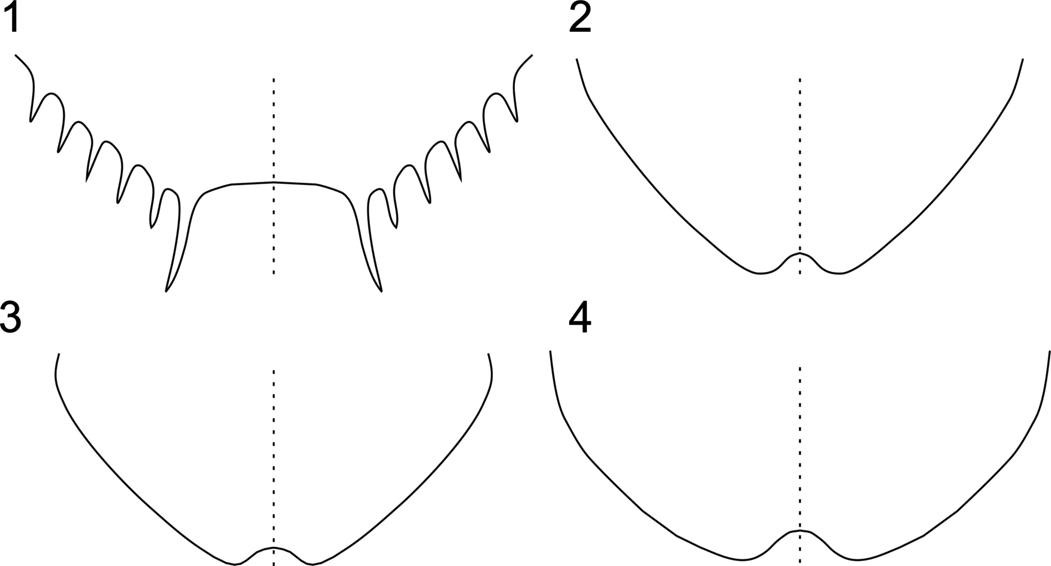
The presence of a pygidial embayment contrasts with caudal spines, present in almost all other dalmanitids, and the two structures could not coexist. The function of the caudal spine in trilobites, although not extensively discussed, has been suggested to have assisted in enrollment and burrowing (Whittington and Kelley, 1997) or having a function similar to those proposed for glabellar spines or genal spines as protection, stabilizing, hydrodynamic streamlining, or as a sensory apparatus (Kloc, Reference Kloc1992; Knell and Fortey, Reference Knell and Fortey2005; Esteve et al., Reference Esteve, Hughes and Zamora2011). The common presence of the caudal spine along the entire history of dalmanitids suggests that it could fulfill an important function, e.g., overturning the individual. In cases of its absence, either that function is no longer necessary or it was performed by a different structure. Coronura and Chacomurus have an embayment with two posteriorly directed marginal spines situated on each side of the embayment, probably with an analogous function to a caudal spine (Fig. 4.1). Both genera also have other marginal spines in the pygidium shorter than these two posteriorly directed spines. Marginal spines are not present in any of the other taxa with an embayment. If caudal spines and genal spines served similar functions, long genal spines could replace a short or absent caudal spine. Waukeshaaspis n. gen. bears long genal spines, remarkable for a Silurian dalmanitid. Other dalmanitids with long genal spines reaching or almost reaching the pygidium usually have short caudal spines, as seen in Odontochile hausmanni (Brongniart, Reference Brongniart, Brongniart and Desmarest1822) from the Pragian of Czech Republic, or do not have a caudal spine, e.g., Forillonaria dunbari (Delo, Reference Delo1940) from the Pragian of USA, and Needmorella simoni Holloway and Scott, Reference Holloway and Scott2023 from the Emsian-Eifelian of Australia. In the case of the other taxa with a pygidial embayment, the maximum size of the genal spines is unknown, making it impossible to estimate a relationship between the presence of embayment and the size of the genal spines. The absence of a caudal spine and presence of a long genal spine in W. eatonae n. gen. n. sp. could therefore be evidence for the functional substitution of one structure (caudal spine) with a different one (long genal spines) that performs a similar function, like those already proposed by other authors.
Schematic drawings of posterior margins of selected dalmanitids: (1) Chacomurus confragosus Braniša and Vaněk, Reference Braniša and Vaněk1973; (2) Schoharia quebecencis Lespérance, Reference Lespérance1975; (3) Bessazoon tenuimucronatum (Whittard, Reference Whittard1938); (4) Waukeshaaspis eatonae n. gen. n. sp.

Remarks
Pygidial embayments as a whole are a rare structure in dalmanitids (Fig. 4), present mostly in Devonian taxa considered to be of the subfamily Synphoriinae (Chacomurus [Fig. 4.1], Coronura, and Schoharia Lespérance, Reference Lespérance1975). Silurian synphoriines characteristically have a subtriangular pygidium without embayment or caudal spine (for example, Rickardsia Storey, Thomas, and Owens, Reference Storey, Thomas and Owens2016). In the Silurian, the only dalmanitid with an embayment is the aforementioned Bessazoon tenuimucronatum (Fig. 4.3), with the embayment being present only in large specimens, and specimens proposed as early holaspids bearing a caudal spine (Curtis and Lane, Reference Curtis and Lane1998). Although this character was included in the diagnosis of Bessazoon, no other species included in the genus have an embayment, having instead a caudal spine. The posterior pygidial margin of B. buttingtonense Curtis and Lane, Reference Curtis and Lane1998 from the early Silurian of Wales is without spines or any other modification. Additionally, not all species assigned to Coronura have a pygidial embayment. As such, the expression and possible variation of the embayment was always treated as a diagnostic character at the species level. Schoharia was erected as a genus that includes different species of synphoriines not considered necessarily closely related (Lespérance, Reference Lespérance1975), known only from pygidia, all with a posterior embayment. Each species has differences related to the grade of reentrance and outline. The embayment of Waukeshaaspis n. gen. (Fig. 4.4) is more like that of Schoharia quebecencis Lespérance, Reference Lespérance1975, from the Emsian of North America (Fig. 4.2), shorter (sag.) than the embayments of the previously mentioned taxa and with rounder anterolateral margins.
Conclusion
The most outstanding feature of Waukeshaaspis eatonae n. gen. n. sp. is the posterior embayment of its pygidium (a rare character in the family), rather than the much more common caudal spine. The observed lengthening of its genal spines might have served the same function that a caudal spine would have served, allowing the embayment to fulfill a different function, related to keeping an opening when enrolled. The abundance of the new taxon, combined with sorting at the preservation site are probably the primary factors accounting for the observed occurrence of significant clustering.
Acknowledgments
We thank C. Eaton and other UWGM personnel for providing support and making the collection available for study. We also thank the Consejo Nacional de Investigaciones Científicas y Técnicas (CONICET) and the Universidad Nacional de Córdoba for providing support and facilities used in this investigation. C. Brett, N. Hughes, and an anonymous reviewer are thanked for their helpful comments.
Declaration of competing interests
The authors declare none.